
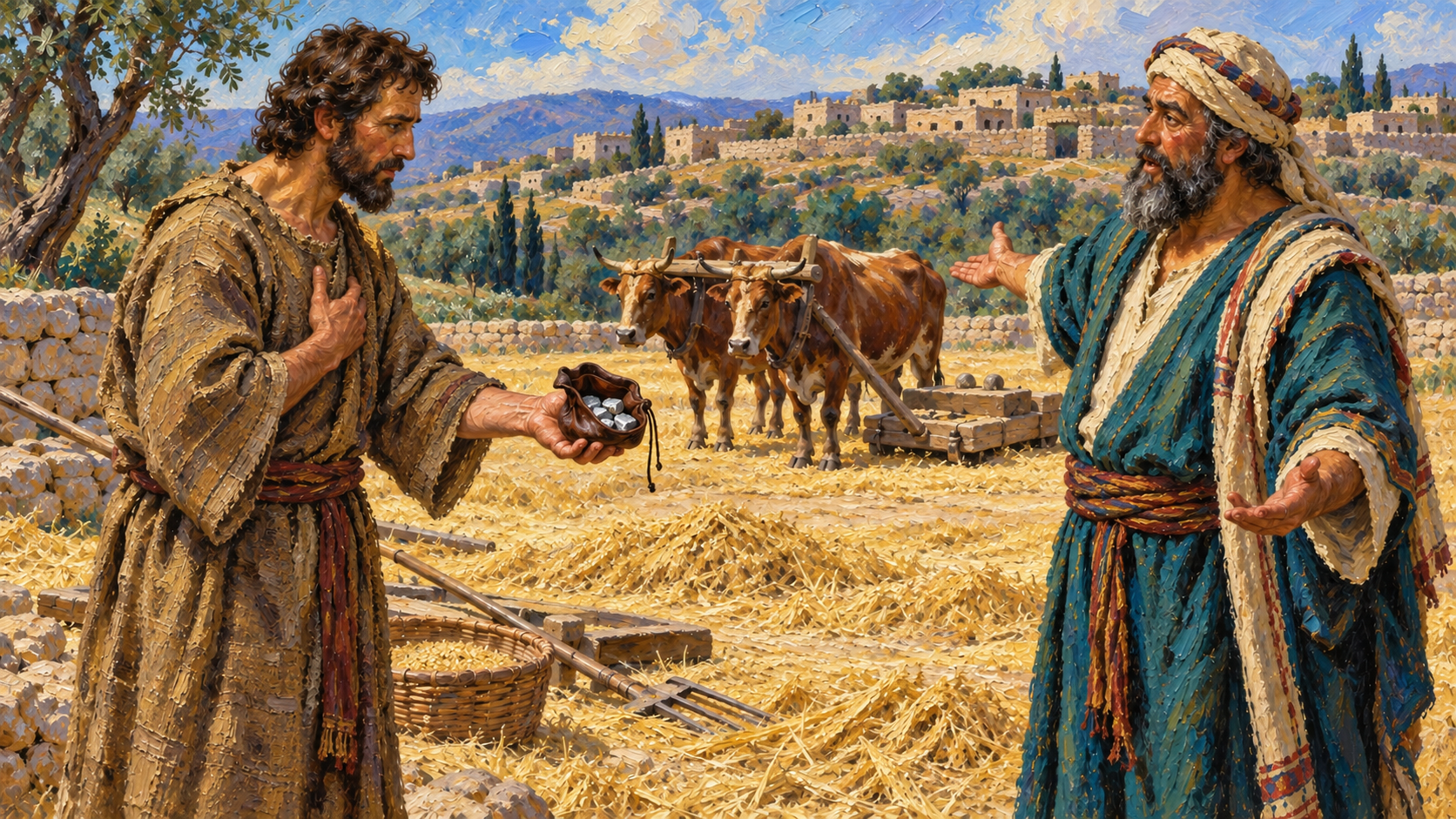
Why did David refuse to offer the Lord something that cost him nothing? That statement is memorable, but it only makes sense when we follow the whole account of his sin, the plague, and God’s mercy at Araunah’s threshing floor. This was not a lesson about impressive giving; it was a moment of repentance and obedient worship at a place God Himself chose.
David’s Census Brought Judgment on Israel
David ordered a census of Israel and Judah before the events at Araunah’s threshing floor. God had commanded censuses at other times, so counting people was not itself sinful. What made this one dangerous was the desire behind it. God had not commanded it, and even Joab recognized the danger in what the king wanted.
And Joab said to the king, “Now may the LORD your God add to the people a hundred times more than there are, and may the eyes of my lord the king see it. But why does my lord the king desire this thing?”
David had seen the Lord deliver him from lions and bears, and later from Goliath and Saul. God had also rescued him from the Philistines and rebellion within Israel. Yet he was tempted to find assurance in the number of people under his rule. Measuring the nation’s strength this way exposed his pride and desire for control.
1 Chronicles 21 says Satan stood up against Israel and moved David to number the people. I need to recognize that unseen pressure without using it to excuse David. Scripture still holds him responsible, and he later confessed that he had sinned greatly. He did not shift the blame to Joab or hide behind statistics and circumstances.
David’s command could have sounded like an ordinary management decision. In this account, he neither bowed publicly to an idol nor drew his sword against an innocent man. Yet God saw the misplaced confidence behind his order. That makes me consider how easily pride can pass for planning, or a desire for control can sound like responsible leadership. A decision can look merely administrative and still be sinful.
After the census, David’s heart condemned him. The prophet Gad brought him a choice of judgments: years of famine, defeat before enemies, or days of plague. David accepted that he deserved judgment and chose to fall into the Lord’s hand because he knew His mercies were great.
And David said to Gad, “I am in great distress. Please let us fall into the hand of the LORD, for His mercies are great; but do not let me fall into the hand of man.”
Seventy thousand men died in the plague. David’s appeal to mercy was no casual attempt to escape the consequences, and his position meant that his sin did not remain private. Scripture does not explain every aspect of the people’s shared responsibility here. It does plainly show how a leader’s choices can wound those entrusted to him.
David chose the Lord’s hand because of God’s character, not because he expected painless consequences. He acknowledged righteous judgment while appealing to mercy. I want to hold those together when I repent. Confessing that judgment is deserved does not mean treating God as cruel, and asking for His mercy does not require denying His holiness.
That should make me take authority seriously. A father’s choices affect his household, and a pastor’s conduct can injure a congregation. A ruler’s decisions reach an entire people. However sincere a confession may be, repentance does not ask us to minimize the damage.
Judgment Stopped at Araunah’s Threshing Floor
As the plague moved toward Jerusalem, the Lord relented from destruction. The Angel of the LORD stood by the threshing floor of Araunah the Jebusite.
And when the angel stretched out His hand over Jerusalem to destroy it, the LORD relented from the destruction, and said to the angel who was destroying the people, “It is enough; now restrain your hand.” And the angel of the LORD was by the threshing floor of Araunah the Jebusite.
The passage presents the Angel of the LORD in a distinctive and solemn way, not as an anonymous angel. In keeping with the larger Old Testament pattern, I understand this Angel of the LORD as a Christophany, an appearance of Christ before His incarnation.
The hand stretched over Jerusalem was restrained at God’s command, so we see both judgment and mercy in what happened. David saw it and pleaded for the people he called sheep, asking that the hand fall on him and his father’s house instead. The king who had been measuring his nation’s strength was now broken by what his own sin had cost.
The Lord stopped judgment at this threshing floor and then commanded worship there. His action and revealed will gave the place its significance in biblical history. The ground had no magical quality, and superstition about geography cannot explain why it mattered.
Gad came to David that same day with the Lord’s word. David was to build an altar on Araunah’s threshing floor.
And Gad came that day to David and said to him, “Go up, erect an altar to the LORD on the threshing floor of Araunah the Jebusite.”
God’s command gave David something definite to obey. Mercy did not release him from that responsibility, and he was not inventing a religious act to manipulate God. I need to read his purchase as part of this obedience. If I reduce it to advice about giving something expensive, I lose what David was responding to.
David Would Not Offer Another Man’s Sacrifice
2 Samuel calls the owner Araunah, while 1 Chronicles calls him Ornan. These are two names for the same Jebusite man. He saw David coming and bowed before him. Ornan and his sons had also seen the angel, so this was far more than an ordinary land sale.
Araunah offered the threshing floor, along with oxen for burnt offerings and wooden threshing tools for fuel. David refused to take those gifts and present them as his own sacrifice. The command to build the altar had been given to him. He would not make another man bear the loss while his own obedience cost him nothing.
I see no reason in the account to question Araunah’s sincerity. He was willing to provide everything needed and even asked that the LORD accept the king. David was addressing his own responsibility, not finding fault with Araunah’s generosity. Araunah could freely give his property, but David could not use the gift to avoid the personal cost of obeying God’s command to him.
2 Samuel 24:24 records David’s resolve to pay for the place rather than offer burnt offerings to the LORD his God that cost him nothing. If Araunah paid for everything, the outward act might still have looked religious, but it would have been hollow. David’s refusal makes me consider whether my worship involves my own surrender or merely relies on someone else’s. Obedience should mean more than what happens to be convenient.
David was not buying forgiveness. God had already restrained the angel and commanded the altar, so the payment could not be the price of that mercy. David paid because he would not disguise Araunah’s generosity as his own offering and cheapen his response to grace.
2 Samuel mentions fifty shekels of silver for the threshing floor and oxen, while 1 Chronicles records six hundred shekels of gold for the place. These can be understood as purchases of different scope. On that reading, Samuel describes the immediate altar site and materials, followed by the broader property in Chronicles. Both accounts record David actually paying.
David built the altar and brought burnt offerings and peace offerings. The burnt offering expressed consecration to God, while the peace offerings belonged to fellowship and thanksgiving. He was offering the worship God commanded where He had shown mercy, not trying to bribe Him.
And David built there an altar to the LORD, and offered burnt offerings and peace offerings. So the LORD heeded the prayers for the land, and the plague was withdrawn from Israel.
1 Chronicles adds that God answered David with fire from heaven on the altar. The place had been appointed by the Lord, and the fire showed that He received the worship offered there. David had not invented a private form of religion. The plague was then withdrawn.
The Threshing Floor Became the Temple Site
What happened there reached beyond David’s repentance. 2 Chronicles identifies this location on Mount Moriah as the place where Solomon began building the house of the LORD.
Now Solomon began to build the house of the LORD at Jerusalem on Mount Moriah, where the LORD had appeared to his father David, at the place that David had prepared on the threshing floor of Ornan the Jebusite.
Israel’s temple stood where God had halted judgment and received the sacrifice He commanded. I notice that mercy became part of the site’s history. The ground was chosen through God’s revelation, rather than for human convenience.
The location of Israel’s later worship carried the memory of that moment. David’s private failure brought public suffering, yet the Lord made the place where judgment stopped into a site prepared for national worship. I would not call the sin good because of what followed or forget the people who died. God established a future place of worship where He had exposed sin and commanded repentance, and where He had shown mercy.
A threshing floor was an ordinary work area where grain was separated from chaff. It was often a firm, open surface where wind could carry away the lighter chaff. That helps us understand the setting, but Scripture gives no secret meaning to each implement. We should not turn the tools on the floor into an allegory.
David’s heart was exposed there. God’s judgment revealed the seriousness of his pride, while His mercy stopped destruction and received obedient worship. This place for separating grain became a place of repentance and sacrifice, and later the site of Israel’s temple.
We do not have to rely on a private spiritual impression to connect David’s encounter with the temple. 2 Chronicles names the prepared place on Mount Moriah and links Solomon’s building directly to what happened there. Scripture keeps that connection within Israel’s actual history.
Christ’s Sacrifice Is Better Than David’s Altar
David had to build the altar because God commanded it for that moment. Yet the altar could not finally answer human sin. Old covenant offerings were actual acts of worship under God’s order, and they pointed forward to a better sacrifice.
By that will we have been sanctified through the offering of the body of Jesus Christ once for all.
Jesus is the eternal Son, fully God and fully man, born of a virgin and completely sinless. He physically bore the punishment for our sins in His innocent body on the cross through real torture, the shedding of His blood, and death. He was buried and rose bodily. The Father did not punish, curse, abandon, strike, bruise, or pour wrath on Jesus.
David purchased a place for sacrifice after his sin brought judgment on Israel. Jesus willingly gave Himself for the sins of the whole world. People may resist God’s genuine offer, but everyone who repents and believes is forgiven and born again. The believer is indwelt and sealed by the Holy Spirit and remains eternally secure.
Our costly worship does not buy salvation. Forgiveness is received through repentance and faith in the crucified and risen Christ. His offering was once for all, and Hebrews 10 says that after offering one sacrifice for sins forever, He sat down at God’s right hand.
I need to distinguish my costly obedience from Christ’s saving sacrifice. Treating what I give as payment would deny the sufficiency of what He has done. But grace does not excuse offering God only what is easy, since mercy calls us to a surrendered life. David’s payment did not make the Lord merciful. It showed that repentance had reached his possessions and choices.
David’s confession should teach me to repent without excuses. I should not hide pride and fear behind respectable language, or use it to disguise unbelief and a desire for control. When our sin harms someone else, we need to accept responsibility honestly and repair what we can. Repentance also means being willing to face the consequences instead of protecting appearances.
David’s refusal also asks us to take worship seriously. God does not measure devotion by the size of a payment; Jesus honored the widow’s two mites. What we need to consider is whether our surrender is real. Obedience sometimes costs time or money. It can also require the humility to confess and seek forgiveness, or the willingness to serve when no one notices. At other times, we may need to surrender a sin we have cherished.
Romans 12 keeps that cost in the right order. Paul calls believers to present their bodies as a living sacrifice “by the mercies of God.” Surrender responds to mercy; it does not purchase mercy.
I beseech you therefore, brethren, by the mercies of God, that you present your bodies a living sacrifice, holy, acceptable to God, which is your reasonable service.
Luke 14 likewise calls us to count the cost of discipleship honestly. Costly obedience does not earn salvation, but Jesus did not invite people into a convenient religious label that rejects His authority. He called them to follow Him.
David’s confession also gives us reason to rest in the Lord’s great mercy. The severity of this account does not leave us without hope. God stopped the plague and gave David a command he could obey, then received his offering. Later, He chose that place for the temple. The Lord who exposed David’s sin provided the only path forward, just as He now provides the only Savior sinners need.
David’s words rebuked his own heart. They should never become a way to manipulate other people into giving money. I need to ask whether my repentance reaches my choices and whether my worship comes from a surrendered life, rather than concern for religious appearances.
For related background, see the life of King David, David’s sin with Bathsheba, and David and the showbread. The study of the gospel follows the fulfillment in Christ.
My Final Thoughts
Araunah’s threshing floor brings David’s sin, God’s judgment, and the Lord’s mercy into one sobering scene. David would not turn another man’s generosity into his own sacrifice, because repentance had to reach his actual choices. The place later became the temple site, marking Israel’s worship with the memory of judgment restrained and sacrifice received. Yet David’s altar could not save sinners forever; only Jesus offered Himself once for all. I want this account to produce honest repentance and surrendered obedience in me while keeping my confidence entirely in the mercy God has provided through Christ.