
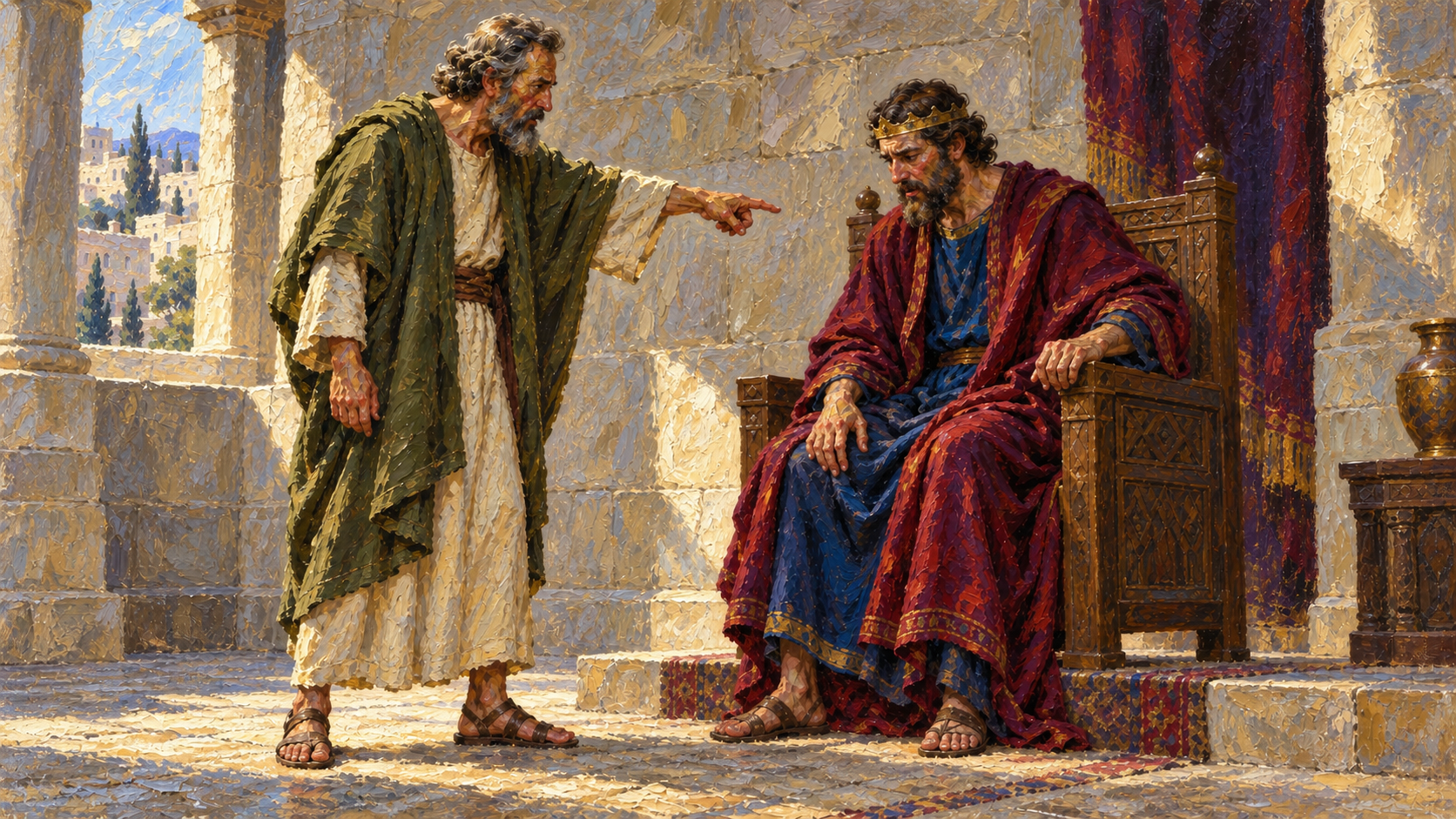
David used his royal power to take Bathsheba even though he knew she was Uriah’s wife. What concerns me as I follow this account is how he kept drawing other people into concealing that sin. Uriah and several soldiers died because of it. Nathan’s confrontation and David’s psalms help us understand the mercy he later received, while also making us face the painful damage that remained after God forgave him.
David Used Royal Power to Pursue Bathsheba
Before this account, 2 Samuel describes David’s victories alongside his devotion in worship and generosity toward others. God had taken him from tending sheep and established him on the throne. He had also promised that David’s royal house, his family line and kingdom, would continue and ultimately lead to the promised King. Those gifts gave David no exemption from God’s commands.
In 2 Samuel 11, we see David using that kingship to take another man’s wife. He then manipulated her loyal husband and finally arranged his death. Palace servants carried the messages, and Joab carried out the order to kill Uriah. Other soldiers also died while David tried to keep control of what people would discover.
David first tried to make Uriah appear to be the father of Bathsheba’s child. When that failed, he arranged Uriah’s death and afterward married her. Nathan eventually confronted him, and David confessed his sin. The Lord forgave him, but the damage continued through his household over the chapters that followed.
I don’t want to read this account as gossip about a famous man’s failure or let David’s later repentance excuse what he did. Scripture exposes the ugliness of concealed sin and God’s concern for those harmed by power. Through Nathan, we see why the truth had to be spoken. Through David’s confession, we see genuine forgiveness without any attempt to hide the damage sin left behind.
It happened in the spring of the year, at the time when kings go out to battle, that David sent Joab and his servants with him, and all Israel; and they destroyed the people of Ammon and besieged Rabbah. But David remained at Jerusalem. Then it happened one evening that David arose from his bed and walked on the roof of the king’s house. And from the roof he saw a woman bathing, and the woman was very beautiful to behold. So David sent and inquired about the woman. And someone said, “Is this not Bathsheba, the daughter of Eliam, the wife of Uriah the Hittite?” Then David sent messengers, and took her; and she came to him, and he lay with her, for she was cleansed from her impurity; and she returned to her house. And the woman conceived; so she sent and told David, and said, “I am with child.”
Spring commonly brought military campaigns because the winter rains had ended and travel was easier. David sent his commander Joab against the Ammonites at Rabbah, their capital. The royal servants and Israel’s army went with him while David stayed in Jerusalem. I notice the difference between the king’s comfort and the conditions his men faced on the battlefield. That contrast prepares us for what followed.
It is often said that David sinned simply by staying home because he was required to lead the army himself. But the verse does not say that. Kings could delegate command, and David had sent Joab before. His later actions are plainly condemned without our needing to invent an earlier offense.
David’s decision to stay home still helps us understand the setting, even though it was not necessarily sinful. His servants were facing battle at Rabbah while he enjoyed the security of the palace. From that position, he could exploit the very authority they were risking their lives to defend.
One evening David got out of bed and walked on the palace roof, where he saw a beautiful woman bathing. He may not have planned to see her, but he deliberately chose to inquire about her afterward.
Scripture does not tell us exactly where Bathsheba bathed in relation to the palace, whether she knew David was there, or that she intended him to see her. It records no attempt to attract him. I cannot call her a seductress without supplying a motive the passage never gives.
We need to distinguish an unexpected temptation from the choices David made next. Seeing the woman was different from sending servants to identify her and bring her to the palace. He could have stopped before using his authority to pursue her. Instead, he acted on his curiosity.
The woman was identified as Bathsheba, daughter of Eliam and wife of Uriah the Hittite. Scripture names her family and covenant marriage rather than presenting her only as the woman David desired. Later genealogical information may identify Eliam as Ahithophel’s son, though this account does not develop that connection.
2 Samuel 11 follows David’s commands and actions, but Bathsheba’s first recorded words are her brief message about the pregnancy. I need to respect what we are not told. Her silence gives us no basis for calling her a seductress, and it leaves us unable to reconstruct every detail of consent or resistance.
David was the king sending messengers to bring one of his subjects into his palace. We can recognize who held the power without forcing modern legal terms onto the account. Scripture presents David as the ruler who initiated the encounter, and Nathan later charged him with taking Uriah’s wife.
The servant had named both her father Eliam and her husband Uriah before David sent for her. Since he knew she was married, he could not later claim to have crossed that boundary in ignorance.
Uriah’s description as a Hittite points to ancestry outside Israel, yet his service and words show deep loyalty to Israel’s God and people. He honored the ark, the sacred chest associated with God’s covenant presence, and respected Joab as his commander. His care for the other soldiers fits his place among David’s mighty men, that honored group of proven warriors. David was violating a faithful covenant household within his own community.
David learned exactly why he needed to stop, yet used what he learned to continue. That makes me consider what I do when God’s command stands in the way of something I want. Treating a clear prohibition as information to work around allows sin to proceed instead of bringing it to an end.
The account keeps showing us what David chose to do. He sent for Bathsheba and took her into the palace before lying with her. The narrator also tells us she had been cleansed from her impurity and returned home afterward.
That cleansing most naturally refers to ceremonial washing associated with menstruation. Under Israel’s worship law, ceremonial impurity brought a temporary restriction; it did not make normal menstruation a moral sin. Here the detail helps establish when conception occurred and that David was the father. It gives us no evidence of Bathsheba arranging an invitation or performing a fertility ritual.
David committed adultery and misused the authority entrusted to him. The king responsible for administering justice had made his servants and access to the palace serve his own desire.
Concealment Recruited Deception and Murder
Bathsheba became pregnant and sent David a short message: “I am with child.” He could no longer pretend the encounter would remain private. Yet instead of confessing, he chose to conceal what he had done.
The pregnancy itself was not the sin, and the developing child bore no guilt for David’s conduct. Bathsheba was telling him what had happened, not manipulating him. The moral crisis lay in his actions and in what he chose to do once their consequences became visible.
Each later scheme protects his reputation at someone else’s expense, and the concealment steadily expands the circle of injury.
Then David sent to Joab, saying, “Send me Uriah the Hittite.” And Joab sent Uriah to David. When Uriah had come to him, David asked how Joab was doing, and how the people were doing, and how the war prospered. And David said to Uriah, “Go down to your house and wash your feet.” So Uriah departed from the king’s house, and a gift of food from the king followed him. But Uriah slept at the door of the king’s house with all the servants of his lord, and did not go down to his house. So when they told David, saying, “Uriah did not go down to his house,” David said to Uriah, “Did you not come from a journey? Why did you not go down to your house?” And Uriah said to David, “The ark and Israel and Judah are dwelling in tents, and my lord Joab and the servants of my lord are encamped in the open fields. Shall I then go to my house to eat and drink, and to lie with my wife? As you live, and as your soul lives, I will not do this thing.” Then David said to Uriah, “Wait here today also, and tomorrow I will let you depart.” So Uriah remained in Jerusalem that day and the next. Now when David called him, he ate and drank before him; and he made him drunk. And at evening he went out to lie on his bed with the servants of his lord, but he did not go down to his house.
David recalled Uriah from the battlefield and asked about Joab, the troops, and the progress of the war. Those questions gave the appearance of a king concerned about his men. His actual purpose was to send Uriah home so that the pregnancy would appear to be his.
Uriah slept at the palace entrance with the king’s servants instead of going home. He explained that the ark was with Israel’s forces and that Israel and Judah were dwelling in tents. While Joab and the soldiers remained in the open fields, he would not enjoy the comforts of home.
This Hittite soldier’s concern for his fellow soldiers makes David’s conduct harder to excuse. Uriah kept the loyalty the king had abandoned. I don’t want to treat his integrity merely as an obstacle that made David’s plan more difficult. It exposes the wrong David was doing.
When that attempt failed, David kept Uriah another day and made him drunk. He used hospitality to lower the man’s judgment through intoxication, hoping to accomplish what his direct suggestion had not.
Even then, Uriah did not go home. David had used alcohol to try to control the soldier’s conduct and get him to sleep with his wife, all to hide the king’s own sin. The man responsible for protecting Uriah was trying to compromise him instead. We can see how concealment led David into calculated deception.
We are not told whether Uriah suspected what David was planning. David knew exactly what he was doing, however, and was responsible for the whole scheme.
In the morning it happened that David wrote a letter to Joab and sent it by the hand of Uriah. And he wrote in the letter, saying, “Set Uriah in the forefront of the hottest battle, and retreat from him, that he may be struck down and die.” So it was, while Joab besieged the city, that he assigned Uriah to a place where he knew there were valiant men. Then the men of the city came out and fought with Joab. And some of the people of the servants of David fell; and Uriah the Hittite died also.
David wrote the order to Joab and sent it in Uriah’s own hand. This faithful soldier carried the instructions for his death: Joab was to put him where the fighting was hottest, then withdraw and leave him exposed.
Joab adapted those instructions to the conditions at Rabbah, placing men where the defenders could strike them. Uriah died there alongside other servants of David. The king’s attempt to conceal his sin cost those unnamed soldiers their lives too.
David did not hold the weapon that killed Uriah, but he ordered the murder. Joab’s part in carrying it out did not lessen David’s guilt. Putting the order in an official letter could not make Uriah’s death an ordinary casualty of war.
When the wife of Uriah heard that Uriah her husband was dead, she mourned for her husband. And when her mourning was over, David sent and brought her to his house, and she became his wife and bore him a son. But the thing that David had done displeased the LORD.
Bathsheba mourned when she heard that her husband was dead. After the mourning period, David brought her into his house as his wife, and she later gave birth to their son. To those watching, the relationship could now appear to be a respectable royal marriage.
The account of their marriage closes with God’s judgment on that respectable appearance: what David had done displeased the Lord. The ceremony and carefully managed timing had not concealed anything from Him. I need to remember that a protected reputation cannot hide the truth from God, however much power someone has.
The closing sentence includes the whole course of David’s sin. His coveting led to adultery and the misuse of his royal authority. Then he tried to conceal it through deception, using intoxication and conspiracy until he finally arranged a murder. These acts belonged to one continuing rebellion.
Nathan Named the Sin and Its Consequences
Then the LORD sent Nathan to David. And he came to him, and said to him: “There were two men in one city, one rich and the other poor. The rich man had exceedingly many flocks and herds. But the poor man had nothing, except one little ewe lamb which he had bought and nourished; and it grew up together with him and with his children. It ate of his own food and drank from his own cup and lay in his bosom; and it was like a daughter to him. And a traveler came to the rich man, who refused to take from his own flock and from his own herd to prepare one for the wayfaring man who had come to him; but he took the poor man’s lamb and prepared it for the man who had come to him.” So David’s anger was greatly aroused against the man, and he said to Nathan, “As the LORD lives, the man who has done this shall surely die! And he shall restore fourfold for the lamb, because he did this thing and because he had no pity.” Then Nathan said to David, “You are the man! Thus says the LORD God of Israel: ‘I anointed you king over Israel, and I delivered you from the hand of Saul.
The Lord sent Nathan to confront the sin David had tried to hide. Nathan described a rich man with many flocks who refused to use one of his own animals to feed a traveler. Instead, he took a poor man’s single beloved ewe lamb.
In Nathan’s parable, a powerful man took from someone vulnerable without showing pity. David immediately recognized the injustice when he thought someone else had committed it. He declared that the man deserved death and must repay fourfold for the lamb he had stolen.
The demand for fourfold repayment echoed the law about stolen sheep. But David also declared that the man deserved death. I notice how readily he condemned someone else’s cruelty while failing to face his own. His verdict described conduct painfully like the misuse of power he was concealing.
Then Nathan said to David, “You are the man! Thus says the LORD God of Israel: ‘I anointed you king over Israel, and I delivered you from the hand of Saul. I gave you your master’s house and your master’s wives into your keeping, and gave you the house of Israel and Judah. And if that had been too little, I also would have given you much more! Why have you despised the commandment of the LORD, to do evil in His sight? You have killed Uriah the Hittite with the sword; you have taken his wife to be your wife, and have killed him with the sword of the people of Ammon. Now therefore, the sword shall never depart from your house, because you have despised Me, and have taken the wife of Uriah the Hittite to be your wife.’ Thus says the LORD: ‘Behold, I will raise up adversity against you from your own house; and I will take your wives before your eyes and give them to your neighbor, and he shall lie with your wives in the sight of this sun. For you did it secretly, but I will do this thing before all Israel, before the sun.'”
Nathan looked directly at the king and said, “You are the man!” He did not blame palace life or David’s circumstances, and he did not transfer responsibility to Bathsheba or Joab. God reminded David that He had anointed him and delivered him, giving him his position along with abundant provision. David had responded to those gifts with ingratitude, despising the command of the One who gave them.
God charged David with taking Uriah’s wife and killing her husband by the sword of Ammon. Although others had carried out the killing, the Lord held the king who planned it responsible for murder.
The consequences Nathan announced answered David’s own conduct. The sword would remain in his household as evil arose within his family, and what he had done secretly would receive a public answer. God was governing the consequences in a household already shaped by David’s sin. That did not excuse the people who later committed their own offenses.
So David said to Nathan, “I have sinned against the LORD.” And Nathan said to David, “The LORD also has put away your sin; you shall not die. However, because by this deed you have given great occasion to the enemies of the LORD to blaspheme, the child also who is born to you shall surely die.” Then Nathan departed to his house. And the LORD struck the child that Uriah’s wife bore to David, and it became ill.
David answered, “I have sinned against the LORD.” He offered no defense based on the pressures of kingship or his desire for Bathsheba. Neither did he blame her, complain that Uriah had refused to go home, or use Joab’s part in the murder to shift responsibility. He acknowledged his own guilt.
Confession means agreeing with God’s verdict and accepting that the sin is ours. David’s words were brief, but Psalm 51 helps us see why they were more than an attempt to contain the damage to his reputation.
David’s repentance was genuine, even though the consequences of what he had done remained within his household.
Nathan immediately told David that the Lord had put away his sin and that he would not die. David deserved death, yet God granted him mercy. He had not earned forgiveness by somehow balancing the wrong he had done with enough good.
Nathan then announced that the child would die, and later chapters describe further violence and rebellion. So forgiveness did not remove every consequence from David’s life. Nor does it automatically restore lost trust or spare a person from discipline.
I would not look at those continuing consequences and conclude that God had failed to forgive David. The passage gives us both pardon and discipline. God removed his guilt without pretending the harm was gone.
David therefore pleaded with God for the child, and David fasted and went in and lay all night on the ground. So the elders of his house arose and went to him, to raise him up from the ground. But he would not, nor did he eat food with them. Then on the seventh day it came to pass that the child died. And the servants of David were afraid to tell him that the child was dead. For they said, “Indeed, while the child was alive, we spoke to him, and he would not heed our voice. How can we tell him that the child is dead? He may do some harm!” When David saw that his servants were whispering, David perceived that the child was dead. Therefore David said to his servants, “Is the child dead?” And they said, “He is dead.” So David arose from the ground, washed and anointed himself, and changed his clothes; and he went into the house of the LORD and worshiped. Then he went to his own house; and when he requested, they set food before him, and he ate. Then his servants said to him, “What is this that you have done? You fasted and wept for the child while he was alive, but when the child died, you arose and ate food.” And he said, “While the child was alive, I fasted and wept; for I said, ‘Who can tell whether the LORD will be gracious to me, that the child may live?’ But now he is dead; why should I fast? Can I bring him back again? I shall go to him, but he shall not return to me.”
For me, the child’s sickness and death are among the hardest parts of this account to read. Nathan explicitly announces the death within God’s judgment on David, yet Scripture never calls the infant personally guilty of David’s sin.
While the child was alive, David pleaded with God and fasted on the ground, hoping the Lord might yet be gracious. When the child died, he got up and washed, then changed his clothes and went to the house of the Lord to worship. Afterward he returned home and ate.
The servants did not understand why David had stopped fasting, but he explained that it could no longer bring the child back. His words, “I shall go to him, but he shall not return to me” describe the separation death brings in this life and his expectation of joining the dead. I would not use that sentence alone to settle every question about the intermediate state, the condition between death and resurrection.
Psalms 51 and 32 Show Repentance Without Excuse
Have mercy upon me, O God, According to Your lovingkindness; According to the multitude of Your tender mercies, Blot out my transgressions. Wash me thoroughly from my iniquity, And cleanse me from my sin. For I acknowledge my transgressions, And my sin is always before me. Against You, You only, have I sinned, And done this evil in Your sight– That You may be found just when You speak, And blameless when You judge. Behold, I was brought forth in iniquity, And in sin my mother conceived me. Behold, You desire truth in the inward parts, And in the hidden part You will make me to know wisdom.
David appealed to God’s lovingkindness and tender mercy, asking Him to blot out his transgressions and wash away his iniquity. He admitted the evil and asked to be cleansed. Neither his sorrow nor any restitution was offered as payment for forgiveness.
When David confessed that he had sinned against God alone, he was not denying what he had done to other people. Uriah had been murdered and Bathsheba harmed, with consequences for their families. Other soldiers had died under David’s order. He had corrupted Joab and betrayed Israel by misusing the throne. Every one of those wrongs was finally rebellion against God, whose judgment David now acknowledged as right.
David needed truth in his inward parts because being publicly exposed was not the whole problem. The corruption had been there in secret. He needed God to cleanse him within, not merely to repair what people could see.
Create in me a clean heart, O God, And renew a steadfast spirit within me. Do not cast me away from Your presence, And do not take Your Holy Spirit from me. Restore to me the joy of Your salvation, And uphold me by Your generous Spirit. Then I will teach transgressors Your ways, And sinners shall be converted to You. Deliver me from the guilt of bloodshed, O God, The God of my salvation, And my tongue shall sing aloud of Your righteousness. O Lord, open my lips, And my mouth shall show forth Your praise. For You do not desire sacrifice, or else I would give it; You do not delight in burnt offering. The sacrifices of God are a broken spirit, A broken and a contrite heart– These, O God, You will not despise.
David asked God for a clean heart and a renewed, steadfast spirit. He wanted the joy of salvation restored along with willing obedience that would sustain him. As a forgiven king, he promised to teach other transgressors and praise the God who delivered him from the guilt of bloodshed.
David’s plea about the Holy Spirit belongs to his position as Israel’s king under the Old Testament covenant. He had seen the Spirit’s special empowerment for kingship depart from Saul and pleaded that his own royal calling would not end that way. I need to keep that setting in view when reading his prayer. It does not overturn the New Testament promise that the Spirit indwells and seals every truly born-again believer, who is eternally secure.
A broken and contrite heart belongs to someone who has stopped defending his sin and come honestly before the God who alone can cleanse him. It is not a public performance of self-hatred.
Blessed is he whose transgression is forgiven, Whose sin is covered. Blessed is the man to whom the LORD does not impute iniquity, And in whose spirit there is no deceit. When I kept silent, my bones grew old Through my groaning all the day long. For day and night Your hand was heavy upon me; My vitality was turned into the drought of summer. Selah I acknowledged my sin to You, And my iniquity I have not hidden. I said, “I will confess my transgressions to the LORD,” And You forgave the iniquity of my sin. Selah
David described the relief of being forgiven and having his sin covered. His earlier attempt to cover it had depended on deceiving people. God’s covering was different: He removed David’s guilt through mercy. That difference helps me understand why concealment can never give us what forgiveness gives.
Keeping silent left David wasting inwardly under heavy conviction. When he acknowledged his sin instead of hiding it, God forgave him. His confession did not buy forgiveness, but brought an end to defending the lie so he could receive mercy.
Psalm 32 goes beyond the appearance of being restored. The forgiven person must become teachable and find gladness in the Lord. God’s grace produces the honesty of an upright heart.
The Sword in David’s House and Mercy Through Solomon
2 Samuel 13 records Amnon’s sexual violence against Tamar and David’s anger without adequate justice. Absalom later killed Amnon and fled. After returning to Jerusalem, he eventually rebelled against David and drove him out of the city. He then publicly took David’s concubines on the palace roof.
We can hear Nathan’s judgment in what happened to David’s family. Sexual evil and betrayal spread through the household, and the sword kept taking lives. Even the palace roof became a place of public humiliation. David’s actions did not force Amnon or Absalom to sin, and each remained responsible for his choices. Yet the king’s corruption and failures helped shape the household they devastated.
God’s forgiveness did not bring Uriah back or erase Bathsheba’s mourning. The other soldiers remained dead, and the destructive pattern in David’s family did not immediately end. I cannot appeal to grace as though those losses no longer count. We must not silence those who were harmed or insist that forgiveness makes every consequence disappear.
Then David comforted Bathsheba his wife, and went in to her and lay with her. So she bore a son, and he called his name Solomon. Now the LORD loved him, and He sent word by the hand of Nathan the prophet: So he called his name Jedidiah, because of the LORD.
David comforted Bathsheba his wife, and she gave birth to Solomon. The Lord loved him and sent word through Nathan to name him Jedidiah, “beloved of the LORD.” This was mercy after judgment, without any rewriting of David’s earlier crime.
Solomon would inherit the throne and build the temple. God’s covenant purpose continued through this family despite its grief, showing His grace. I cannot attribute that continuation to David’s merit when it rested on God’s faithfulness.
Matthew later referred to Bathsheba in the genealogy as “her who had been the wife of Uriah.” Even while tracing the royal line to Jesus, Scripture preserved Uriah’s place in the account. It did not make the Messiah’s human ancestry look better by hiding what had happened.
The Sinless Son of David and the Call to Bring Sin Into Light
David received covenant mercy when he confessed, and God used him to write inspired Psalms. But he could not cleanse himself or bring back those who had died. God’s promised royal line had to lead beyond David to a better King.
Jesus is fully God and fully man. Born of a virgin, He lived completely without sin. Wicked men physically tortured and punished Him before killing Him. He willingly bore that real punishment for our sins in His innocent body. He shed His blood and died, then was buried and rose bodily from the grave. The Father did not punish or curse Jesus. He did not abandon His Son or strike or bruise Him, nor did He pour wrath on Him.
Christ died for the whole world, and God’s offer of salvation is genuine even though people can resist and reject it. Whoever repents and believes is forgiven and justified before God. That person is born again and made new, with the Holy Spirit coming to dwell within him and seal him, so he is eternally secure. That security never excuses lawlessness or concealment such as David’s. A superficial profession also cannot establish that someone has been born again. New life brings sin into the light rather than defending it, and a believer learning to obey Christ can receive correction.
I should not need exposure or confrontation before I turn from sin. When the Holy Spirit uses Scripture to convict me, I need to agree with God rather than wait until the consequences become visible. That means stopping the conduct and telling the truth, seeking His mercy while accepting responsibility for what I have done.
Authority gives us a greater capacity to harm people and conceal what we have done. A spiritual office or workplace position must never become a way to gain improper access to someone. Within a family, leadership should not suppress another person’s voice. Neither money nor reputation gives us the right to manipulate an outcome.
God’s mercy toward David did not minimize the harm he caused. His care for those who were harmed and His mercy toward a repentant sinner do not compete with one another.
When we bring our guilt into the light, our only hope of cleansing is the sinless Son of David, whose blood cleanses every believer.
For related studies, see King David, Repentance, and Bathsheba.
My Final Thoughts
David’s conduct leaves me no room to call hidden sin harmless or use grace to avoid the truth. God forgave him, yet Uriah remained dead and the wounds in David’s household did not disappear. I need to confess without excuses and accept the accountability that truth requires. Any authority I hold should protect the people in my care, never be used against them. My hope rests in Jesus, the sinless Son of David who shed His blood and rose bodily to give eternal life to everyone who believes.