
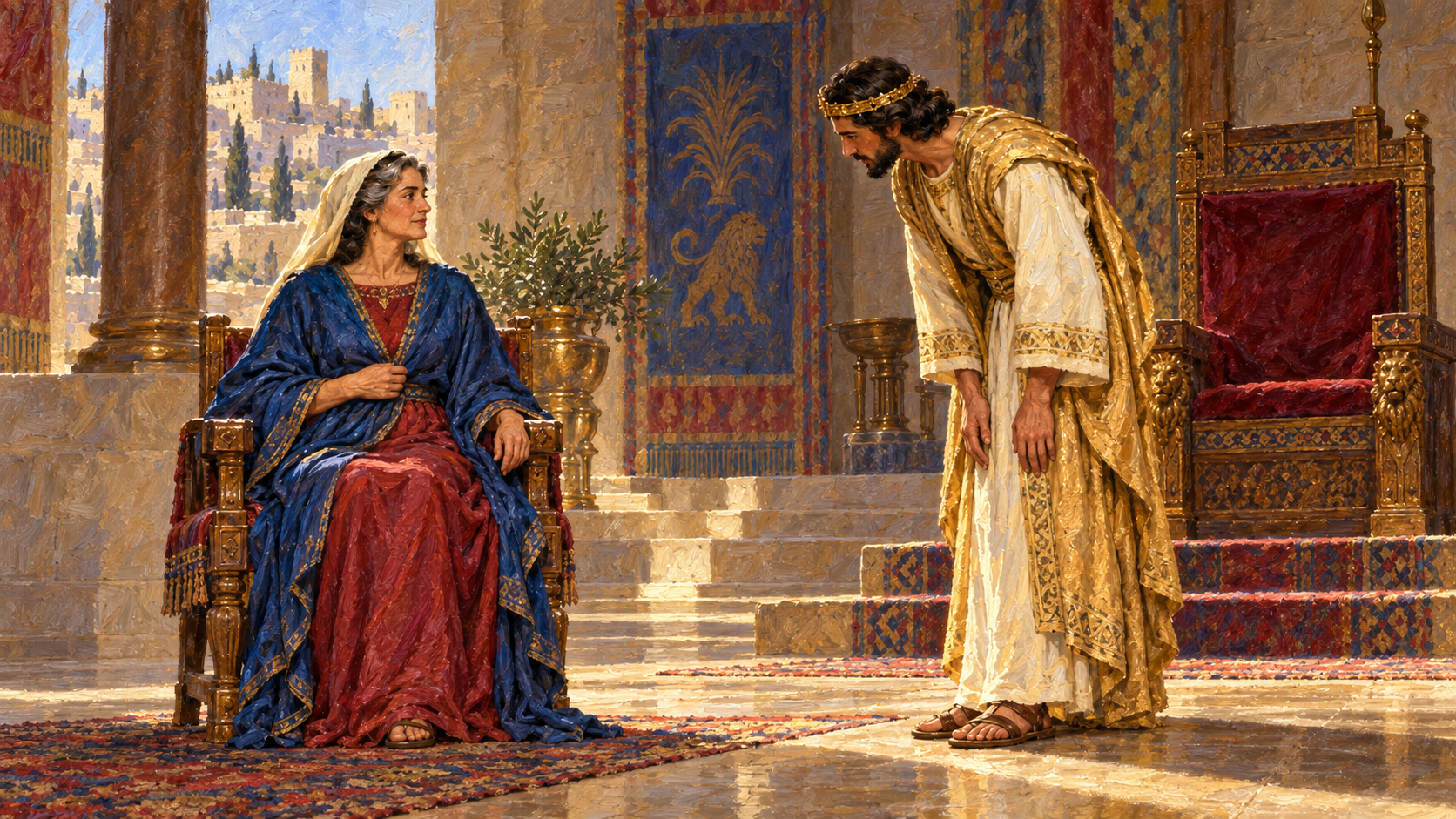
Bathsheba’s life is often reduced to David’s worst sin, but Scripture tells us more about her. She was Uriah’s wife and a mother who grieved. Later she spoke before the king during a succession crisis. She also has a place in the family line leading to Jesus Christ. I want to follow that fuller record without assigning blame the text does not give her or treating her later honor as though it erased what happened.
Bathsheba’s Identity and David’s Royal Initiative
2 Samuel first introduces Bathsheba through her family and marriage, then records her mourning and motherhood. When we reach 1 Kings, we hear her speak during a dangerous succession crisis. Those passages give us more to consider than David’s worst actions alone.
I do not want to make Bathsheba either the seductress of later imagination or a woman who never had a voice of her own. Scripture portrays neither. The account begins with David sending for her, but later we see her enter his chamber and speak before the court. Her appeal secured his public confirmation of Solomon. In time, she sat at her son’s right hand.
Uriah still belongs in our understanding of her life. Matthew deliberately remembers him in Jesus’ genealogy, even after Bathsheba’s later honor. We do not have to pretend the earlier wrong was harmless or that she and David had equal power. Solomon’s birth did not erase what happened.
In Bathsheba’s life, we see God carrying out His purposes through a history damaged by sin. His providence does not make Him the author of that sin or mean He approved it. Grace tells the truth about what happened while carrying His promise forward.
Bat-Sheva, the Hebrew form behind Bathsheba, can be rendered daughter of seven or daughter of an oath. 1 Chronicles uses the variant form Bat-Shua. These variations in a personal name are not unusual, and the narrative gives us no reason to search for a hidden spiritual code behind either form.
2 Samuel and 1 Kings call her Bathsheba. 1 Chronicles 3 calls her Bathshua, daughter of Ammiel. The surrounding details identify the same woman as David’s wife and mother of Solomon.
The Hebrew name Bathsheba joins daughter with a form related to seven or oath. Both explanations are common in English because the Hebrew words are related, but the account does not tell us which meaning her parents intended.
A meaningful name does not have to be a prophecy. I would not use daughter of an oath to prove a hidden covenant role for Bathsheba. Her place in God’s covenant purposes comes from the events Scripture records, rather than an uncertain word origin that supposedly determined her destiny.
Eliphelet the son of Ahasbai, the son of the Maachathite, Eliam the son of Ahithophel the Gilonite, and Uriah the Hittite: thirty-seven in all.
Bathsheba was the daughter of Eliam and wife of Uriah the Hittite. 2 Samuel 23 names an Eliam son of Ahithophel among David’s mighty men and includes Uriah in the same list.
1 Chronicles calls her father Ammiel. That name contains the same elements as Eliam in reverse order, which strongly supports the identification. If the Eliam among David’s mighty men was her father, Ahithophel was her grandfather. I want to keep the strength of that connection clear without pretending Scripture gives us one sentence explicitly joining the whole family.
David did not harm an unknown household on the edge of his kingdom. Uriah was one of his loyal warriors, and Eliam was another if the identification of Bathsheba’s father is correct. Ahithophel later served as a counselor and betrayed David during Absalom’s revolt. That possible family connection has led readers to wonder whether the earlier wrong contributed to his betrayal, but Scripture never tells us his motive.
Her family connections were significant, but they do not establish that she was noble or a palace insider. Scripture first gives her a name and identifies her as a daughter and covenant wife. I want to honor what it tells us about her without assigning a social rank it does not supply.
It happened in the spring of the year, at the time when kings go out to battle, that David sent Joab and his servants with him, and all Israel; and they destroyed the people of Ammon and besieged Rabbah. But David remained at Jerusalem. Then it happened one evening that David arose from his bed and walked on the roof of the king's house. And from the roof he saw a woman bathing, and the woman was very beautiful to behold. So David sent and inquired about the woman. And someone said, "Is this not Bathsheba, the daughter of Eliam, the wife of Uriah the Hittite?" Then David sent messengers, and took her; and she came to him, and he lay with her, for she was cleansed from her impurity; and she returned to her house. And the woman conceived; so she sent and told David, and said, "I am with child."
David stayed in Jerusalem while Joab and Israel besieged Rabbah. One evening he saw a beautiful woman bathing and chose to find out who she was. A servant identified her as Bathsheba, Eliam’s daughter and Uriah’s wife.
That answer should have stopped David. He knew she was married and knew whose household she belonged to, yet he sent messengers and took her. He lay with her and later received her message that she was pregnant.
David’s initiative runs through the account. As king, he commanded the palace servants and could gather information or summon a subject in a way Bathsheba could not. Her first recorded words are the necessary report, I am with child.
Scripture never says Bathsheba put herself where David would see her. It gives us no basis for saying she invited his inquiry, seduced him, or planned the encounter. If I blame her for bathing, I am turning the text’s silence into an accusation and taking attention away from the ruler whose actions it describes.
The focused study of David’s sin with Bathsheba examines how he tried to conceal it and manipulate Uriah. It follows his drunken scheme and the murder order, including the soldiers who died with Uriah. We need to keep that moral setting in view here while following what Scripture tells us about Bathsheba afterward.
2 Samuel does not tell us what Bathsheba thought or said during the encounter. We do not know whether she resisted or agreed, or what choices were available when the royal messengers arrived. I cannot fill those silences simply because I want a fuller explanation.
What we do know is that they did not have equal power. David was the king who ordered the inquiry and sent messengers to take her. Nathan later charged him with taking Uriah’s wife and killing Uriah. The LORD’s judgment fell directly on David for despising His command.
Those facts rule out the easy explanation of an ambitious seductress dealing with David as an equal. They also require care with a modern legal label that depends on details the narrator never supplies. I do not need to invent those details to take the wrong seriously. Leaving an unanswered question where Scripture leaves it is respect for the inspired record, not moral hesitation.
We should not blame Bathsheba for what Scripture does not assign to her, but neither should its silence make her disappear as a person. Later chapters let us hear her speak clearly and recall an oath. She recognized danger and worked with Nathan to address it. We then see her bow before David and speak directly to Solomon.
2 Samuel notes that Bathsheba was cleansed from her impurity. The most natural background is the ceremonial washing connected with menstruation in Leviticus 15.
That detail helps establish the timing of conception. Bathsheba’s cycle and purification placed it after David’s act, so the pregnancy could not plausibly be attributed to Uriah while he was away. Her message exposed a fact David could not control through royal secrecy.
The verse gives us a brief clarification of timing. It does not describe a fertility ritual or a signal to the palace, and it does not say she was trying to attract David. Those explanations supply motives the text never gives.
Her ceremonial cleansing did not make David’s conduct morally clean. Outward washing and faithfulness to God’s covenant are different things. Bathsheba could undergo purification while David violated marriage and justice and failed to love his neighbor.
Grief, Judgment, and the Birth of Solomon
When the wife of Uriah heard that Uriah her husband was dead, she mourned for her husband. And when her mourning was over, David sent and brought her to his house, and she became his wife and bore him a son. But the thing that David had done displeased the LORD.
When Bathsheba heard that Uriah had died, the account still called her his wife and recorded that she mourned him. I do not want to pass over that sentence. Her marriage cannot be erased, nor can we simply imagine that she regarded Uriah as an obstacle.
After her mourning ended, David sent for her and brought her into his house. She became his wife and bore the son. The sequence might have looked orderly to the public: a widow completed her mourning, married the king, and gave birth. But the passage ends by telling us that what David had done displeased the LORD. The outward sequence did not hide his crime from God.
God saw how that apparently legitimate outcome had been achieved. Marrying Bathsheba could not make the adultery right, and it could not sanctify the conspiracy or murder that preceded the marriage.
Bathsheba was now living in the household of the man who had arranged Uriah’s death. Scripture gives no account of her discovering what he had done or of her private response. We can acknowledge the pain of that situation without inventing a conversation for her.
Then the LORD sent Nathan to David. And he came to him, and said to him: "There were two men in one city, one rich and the other poor. The rich man had exceedingly many flocks and herds. But the poor man had nothing, except one little ewe lamb which he had bought and nourished; and it grew up together with him and with his children. It ate of his own food and drank from his own cup and lay in his bosom; and it was like a daughter to him. And a traveler came to the rich man, who refused to take from his own flock and from his own herd to prepare one for the wayfaring man who had come to him; but he took the poor man's lamb and prepared it for the man who had come to him." So David's anger was greatly aroused against the man, and he said to Nathan, "As the LORD lives, the man who has done this shall surely die! And he shall restore fourfold for the lamb, because he did this thing and because he had no pity." Then Nathan said to David, "You are the man! Thus says the LORD God of Israel: 'I anointed you king over Israel, and I delivered you from the hand of Saul. I gave you your master's house and your master's wives into your keeping, and gave you the house of Israel and Judah. And if that had been too little, I also would have given you much more! Why have you despised the commandment of the LORD, to do evil in His sight? You have killed Uriah the Hittite with the sword; you have taken his wife to be your wife, and have killed him with the sword of the people of Ammon.
Nathan told David of a rich man with many flocks who took a poor man’s single beloved lamb. David became angry and condemned the offender. Nathan answered, You are the man!
The parable makes the difference in power plain. A rich man who already had abundance took the poor man’s beloved lamb because he would not restrain his appetite. Even David’s own judgment recognized that the man had shown no pity.
God first reminded David of all He had given him, then exposed his ingratitude and contempt for the commandment. He charged David with both killing Uriah and taking his wife. I notice that David could not shift responsibility to the men who carried out the killing. Joab arranged the military action and Ammonite weapons struck Uriah, but God held David responsible for the death he ordered.
The cherished lamb in Nathan’s parable corresponds to Bathsheba. The comparison draws attention to Uriah’s bond with his household and to David’s taking. I would not stretch it into a claim that Bathsheba had no ability to act or speak for herself in the later chapters.
Nathan confronted David, not Bathsheba, as the one responsible for planning the crime. The king had used his power and concealed what he did. He then killed to protect his reputation.
So David said to Nathan, "I have sinned against the LORD." And Nathan said to David, "The LORD also has put away your sin; you shall not die. However, because by this deed you have given great occasion to the enemies of the LORD to blaspheme, the child also who is born to you shall surely die." Then Nathan departed to his house. And the LORD struck the child that Uriah's wife bore to David, and it became ill. David therefore pleaded with God for the child, and David fasted and went in and lay all night on the ground. So the elders of his house arose and went to him, to raise him up from the ground. But he would not, nor did he eat food with them. Then on the seventh day it came to pass that the child died. And the servants of David were afraid to tell him that the child was dead. For they said, "Indeed, while the child was alive, we spoke to him, and he would not heed our voice. How can we tell him that the child is dead? He may do some harm!" When David saw that his servants were whispering, David perceived that the child was dead. Therefore David said to his servants, "Is the child dead?" And they said, "He is dead." So David arose from the ground, washed and anointed himself, and changed his clothes; and he went into the house of the LORD and worshiped. Then he went to his own house; and when he requested, they set food before him, and he ate. Then his servants said to him, "What is this that you have done? You fasted and wept for the child while he was alive, but when the child died, you arose and ate food." And he said, "While the child was alive, I fasted and wept; for I said, 'Who can tell whether the LORD will be gracious to me, that the child may live?' But now he is dead; why should I fast? Can I bring him back again? I shall go to him, but he shall not return to me."
David confessed that he had sinned against the LORD. Nathan declared that the LORD had put away his sin and that he would not die. God had forgiven David, but the consequences Nathan announced still remained.
Nathan said the child would die because David’s deed had given the LORD’s enemies occasion to blaspheme. When the child became sick, David fasted and pleaded with God. The child nevertheless died on the seventh day.
I would not read the child’s death as evidence that the infant was personally guilty or served as an atoning sacrifice. Scripture describes a unique judgment announced by a prophet against David in Israel’s covenant history. It does not give us a rule for telling grieving parents that hidden sin caused their child’s death.
Bathsheba had lost Uriah, and now she lost her child too. The chapter follows David’s fasting and response without describing her own days of fear or grief. I need to remember that the attention given to David does not make her sorrow any less real.
Forgiveness does not promise to put life back where it was before the harm. God removed David’s guilt, but Bathsheba and the child still suffered. The consequences spread beyond David into his household and the nation.
Then David comforted Bathsheba his wife, and went in to her and lay with her. So she bore a son, and he called his name Solomon. Now the LORD loved him, and He sent word by the hand of Nathan the prophet: So he called his name Jedidiah, because of the LORD.
After the child’s death, David comforted Bathsheba his wife. She bore a son, and David called his name Solomon. The LORD loved him and sent word through Nathan to call him Jedidiah because of the LORD.
Jedidiah means beloved of the LORD. I hear more than reluctant acceptance in that name. God did not regard Solomon as a permanently tainted child. He entered the world loved by God and later received the throne God appointed for him.
That mercy does not make the earlier evil necessary. God could have fulfilled His promise to David without sin. His sovereignty appears in His ability to carry out His covenant purpose through a history that human wickedness could not derail.
Solomon went on to display great wisdom and build the temple, but his later conduct also needs to be judged by Scripture. He accumulated wealth and marriages, then fell into idolatry and received discipline. God’s love and choice did not make everything he did righteous or remove his responsibility to obey.
These six were born to him in Hebron. There he reigned seven years and six months, and in Jerusalem he reigned thirty-three years. And these were born to him in Jerusalem: Shimea, Shobab, Nathan, and Solomon–four by Bathshua the daughter of Ammiel.
1 Chronicles names Shimea, Shobab, Nathan, and Solomon as sons born to David in Jerusalem by Bathshua, Ammiel’s daughter. Bathsheba’s life as a mother therefore included more than the two births described in 2 Samuel 12.
Solomon became king and continued the royal succession Matthew records. Nathan did not reign over Israel, yet Luke traces Jesus’ legal human ancestry through a line named for him.
The genealogies have distinct structures and purposes. Christians have proposed several careful ways to relate Matthew and Luke. We do not have to solve every question about the two genealogies inside Bathsheba’s biography. Still, I do not think we should overlook the fact that two sons named in her household stand at significant points in the Gospel records.
We are given almost no account of what Shimea, Shobab, or Nathan did. Their names belong in the record, but I cannot add achievements or judgments about their character that Scripture does not provide.
Bathsheba Speaks During the Succession Crisis
Then Adonijah the son of Haggith exalted himself, saying, "I will be king"; and he prepared for himself chariots and horsemen, and fifty men to run before him. (And his father had not rebuked him at any time by saying, "Why have you done so?" He was also very good-looking. His mother had borne him after Absalom.) Then he conferred with Joab the son of Zeruiah and with Abiathar the priest, and they followed and helped Adonijah. But Zadok the priest, Benaiah the son of Jehoiada, Nathan the prophet, Shimei, Rei, and the mighty men who belonged to David were not with Adonijah. And Adonijah sacrificed sheep and oxen and fattened cattle by the stone of Zoheleth, which is by En Rogel; he also invited all his brothers, the king's sons, and all the men of Judah, the king's servants. But he did not invite Nathan the prophet, Benaiah, the mighty men, or Solomon his brother.
As David neared death, Adonijah exalted himself and announced that he would be king. He gathered chariots and horsemen to display royal power, with runners going before him. Joab and Abiathar supported him, as did royal sons and other influential men. He deliberately left Nathan, Benaiah, David’s mighty men, and Solomon out of his gathering.
This was more than a family disagreement about the next king. Adonijah was claiming the throne for himself while David still lived. The promised succession had not yet been publicly secured.
1 Kings points out that David had not rebuked Adonijah or asked why he was acting this way. Once again, David’s failure to discipline a son helped royal ambition go unchecked.
Bathsheba and Solomon faced a threat to their lives. A victorious claimant in an ancient succession struggle could eliminate rival heirs and their mothers. Nathan’s warning was therefore urgent: they needed to act to save her life and Solomon’s.
So Nathan spoke to Bathsheba the mother of Solomon, saying, "Have you not heard that Adonijah the son of Haggith has become king, and David our lord does not know it? Come, please, let me now give you advice, that you may save your own life and the life of your son Solomon. Go immediately to King David and say to him, 'Did you not, my lord, O king, swear to your maidservant, saying, "Assuredly your son Solomon shall reign after me, and he shall sit on my throne"? Why then has Adonijah become king?' Then, while you are still talking there with the king, I also will come in after you and confirm your words." So Bathsheba went into the chamber to the king. (Now the king was very old, and Abishag the Shunammite was serving the king.) And Bathsheba bowed and did homage to the king. Then the king said, "What is your wish?" Then she said to him, "My lord, you swore by the LORD your God to your maidservant, saying, 'Assuredly Solomon your son shall reign after me, and he shall sit on my throne.' So now, look! Adonijah has become king; and now, my lord the king, you do not know about it. He has sacrificed oxen and fattened cattle and sheep in abundance, and has invited all the sons of the king, Abiathar the priest, and Joab the commander of the army; but Solomon your servant he has not invited. And as for you, my lord, O king, the eyes of all Israel are on you, that you should tell them who will sit on the throne of my lord the king after him. Otherwise it will happen, when my lord the king rests with his fathers, that I and my son Solomon will be counted as offenders."
Nathan told Bathsheba what Adonijah had done and proposed that she speak to David. She entered the aged king’s chamber and bowed before him. David then asked what she wished to say.
Bathsheba reminded David of the oath he had sworn by the LORD that Solomon would reign. She then described Adonijah’s feast and identified the officials who supported him. All Israel, she explained, was looking to David to declare who would succeed him.
She ended by telling David plainly what his inaction would mean. If he died without acting, she and Solomon would be counted as offenders. Her appeal began with his oath and then explained the public confusion and rival coalition. The danger created by his silence was clear.
Nathan came in as they had arranged and confirmed the crisis with his own testimony. Their coordinated appeal moved David to act. He gave a public command instead of remaining passive.
I can appreciate Bathsheba’s courage and precision without crediting her with every part of the strategy. Nathan had proposed it. She carried out the appeal faithfully, and the chapter allows us to hear how clearly she spoke in a dangerous moment.
Then King David answered and said, "Call Bathsheba to me." So she came into the king's presence and stood before the king. And the king took an oath and said, "As the LORD lives, who has redeemed my life from every distress, just as I swore to you by the LORD God of Israel, saying, 'Assuredly Solomon your son shall be king after me, and he shall sit on my throne in my place,' so I certainly will do this day." Then Bathsheba bowed with her face to the earth, and paid homage to the king, and said, "Let my lord King David live forever!" And King David said, "Call to me Zadok the priest, Nathan the prophet, and Benaiah the son of Jehoiada." So they came before the king. The king also said to them, "Take with you the servants of your lord, and have Solomon my son ride on my own mule, and take him down to Gihon. There let Zadok the priest and Nathan the prophet anoint him king over Israel; and blow the horn, and say, 'Long live King Solomon!' Then you shall come up after him, and he shall come and sit on my throne, and he shall be king in my place. For I have appointed him to be ruler over Israel and Judah." Benaiah the son of Jehoiada answered the king and said, "Amen! May the LORD God of my lord the king say so too. As the LORD has been with my lord the king, even so may He be with Solomon, and make his throne greater than the throne of my lord King David." So Zadok the priest, Nathan the prophet, Benaiah the son of Jehoiada, the Cherethites, and the Pelethites went down and had Solomon ride on King David's mule, and took him to Gihon. Then Zadok the priest took a horn of oil from the tabernacle and anointed Solomon. And they blew the horn, and all the people said, "Long live King Solomon!" And all the people went up after him; and the people played the flutes and rejoiced with great joy, so that the earth seemed to split with their sound.
David called Bathsheba back and swore that Solomon would reign that day. She bowed with her face to the earth and answered, Let my lord King David live forever!
David then instructed Zadok, Nathan, and Benaiah to have Solomon ride the royal mule to Gihon for his anointing. The horn was to sound as he was proclaimed king. This made the succession public by David’s order, with priestly anointing and prophetic participation confirming it. The nation responded with celebration.
Bathsheba did not secretly place her son on the throne. Her appeal led the reigning king to declare and fulfill his succession oath before witnesses. That public sequence gives me reason to reject a description of her appeal as mere palace manipulation.
The people at Adonijah’s feast heard the rejoicing in the city, and his gathering broke up. His guests fled while he sought safety at the altar. Solomon initially showed him mercy on the condition that he proved worthy.
Honor, Adonijah’s Request, and the Limits of Tradition
Now Adonijah the son of Haggith came to Bathsheba the mother of Solomon. So she said, "Do you come peaceably?" And he said, "Peaceably." Moreover he said, "I have something to say to you." And she said, "Say it." Then he said, "You know that the kingdom was mine, and all Israel had set their expectations on me, that I should reign. However, the kingdom has been turned over, and has become my brother's; for it was his from the LORD. Now I ask one petition of you; do not deny me." And she said to him, "Say it." Then he said, "Please speak to King Solomon, for he will not refuse you, that he may give me Abishag the Shunammite as wife." So Bathsheba said, "Very well, I will speak for you to the king." Bathsheba therefore went to King Solomon, to speak to him for Adonijah. And the king rose up to meet her and bowed down to her, and sat down on his throne and had a throne set for the king's mother; so she sat at his right hand. Then she said, "I desire one small petition of you; do not refuse me." And the king said to her, "Ask it, my mother, for I will not refuse you."
When Bathsheba came to speak for Adonijah, Solomon rose and bowed to meet her. He returned to his own throne, then ordered a throne for the king’s mother at his right hand.
Solomon’s honor for his mother was visible to the whole court. Queen mother is a fitting description of her role, though the verse simply calls her the king’s mother. Her place beside him did not make her co-king or the source of Solomon’s authority.
Solomon honored his mother by bowing, in keeping with the commandment. Yet his later answer shows that he could hear her respectfully and still refuse the request. I see a useful distinction there: honoring someone does not require ignoring the truth.
There is a considerable change between David summoning Bathsheba and Solomon receiving her in a formal audience. Her public position had changed, but Scripture does not use that honor to erase Uriah or her grief. The complications within David’s household remained part of the account.
So she said, "Let Abishag the Shunammite be given to Adonijah your brother as wife." And King Solomon answered and said to his mother, "Now why do you ask Abishag the Shunammite for Adonijah? Ask for him the kingdom also–for he is my older brother–for him, and for Abiathar the priest, and for Joab the son of Zeruiah." Then King Solomon swore by the LORD, saying, "May God do so to me, and more also, if Adonijah has not spoken this word against his own life! Now therefore, as the LORD lives, who has confirmed me and set me on the throne of David my father, and who has established a house for me, as He promised, Adonijah shall be put to death today!" So King Solomon sent by the hand of Benaiah the son of Jehoiada; and he struck him down, and he died.
Adonijah asked Bathsheba to request Abishag the Shunammite as his wife. Bathsheba agreed to speak and presented the request to Solomon as a small petition.
Scripture does not say Bathsheba saw a hidden plot and knowingly carried it to Solomon. It does tell us that Solomon immediately connected the request with the kingdom. He also named Adonijah’s support from Abiathar and Joab.
Abishag had cared for the aged David, though 1 Kings says he had not known her sexually. In ancient royal politics, association with a former king’s woman could amount to a claim on his throne. Absalom’s public act with David’s concubines had already shown that connection.
Solomon ordered Benaiah to execute Adonijah. We need to understand that judgment within the dangerous struggle over succession, including Adonijah’s earlier attempt to seize the throne and the conditional mercy he had received. It gives no permission for private violence based on suspected motives.
Being honored did not make Bathsheba’s political judgment infallible. Scripture shows her bringing a request that the king refused. We can acknowledge that refusal without turning the encounter into a scene of humiliation.
The words of King Lemuel, the utterance which his mother taught him: What, my son? And what, son of my womb? And what, son of my vows? Do not give your strength to women, Nor your ways to that which destroys kings. It is not for kings, O Lemuel, It is not for kings to drink wine, Nor for princes intoxicating drink; Lest they drink and forget the law, And pervert the justice of all the afflicted. Give strong drink to him who is perishing, And wine to those who are bitter of heart. Let him drink and forget his poverty, And remember his misery no more. Open your mouth for the speechless, In the cause of all who are appointed to die. Open your mouth, judge righteously, And plead the cause of the poor and needy.
Proverbs 31 begins with teaching King Lemuel received from his mother. She warned him against giving his strength to women in ways that destroy kings, and against drinking that corrupts judgment. She also told him to speak for people who had no voice.
A longstanding tradition identifies Lemuel as Solomon and his mother as Bathsheba. I can see why the themes would seem fitting. A royal mother in David’s house had witnessed sexual sin and destructive uses of power, along with failures of justice.
But Scripture never identifies Lemuel as Solomon or names Bathsheba in this chapter. Lemuel does not appear elsewhere under that name. We may consider the traditional connection, but we cannot teach it as an established event in her life.
The mother’s identity does not determine the authority of this inspired instruction. A king must control his appetite so that his judgment remains clear. He is also responsible for defending the poor and speaking for those who cannot protect themselves.
Uriah’s Name and God’s Providence
The book of the genealogy of Jesus Christ, the Son of David, the Son of Abraham: Abraham begot Isaac, Isaac begot Jacob, and Jacob begot Judah and his brothers. Judah begot Perez and Zerah by Tamar, Perez begot Hezron, and Hezron begot Ram. Ram begot Amminadab, Amminadab begot Nahshon, and Nahshon begot Salmon. Salmon begot Boaz by Rahab, Boaz begot Obed by Ruth, Obed begot Jesse, and Jesse begot David the king. David the king begot Solomon by her who had been the wife of Uriah.
Matthew presents Jesus as the Son of David and the Son of Abraham. He names Tamar, Rahab, and Ruth, and later names Mary. Bathsheba appears through a different description: David the king begot Solomon by her who had been the wife of Uriah.
I notice that Matthew keeps Uriah’s name in the royal genealogy. He expressly identifies David as king, but also remembers the marriage that king violated. The Messiah’s legal line has not been polished into a record where powerful men decide how the people they harmed will be remembered.
That description does not leave Bathsheba out. It identifies her through her real former covenant relationship and tells the truth about the history into which Solomon was born. Uriah’s name receives attention, but her place is still there.
Jesus neither inherited David’s moral guilt nor repeated his conduct. The eternal Son entered a family line marked by betrayal and exile. Gentiles and widows belonged to it, as did kings who needed grace. Yet He was conceived by the Holy Spirit and born of a virgin, completely sinless.
The genealogy shows that God’s promise survived human failure. I do not read it as saying that those failures were needed to bring Christ into the world.
God appointed Solomon and preserved David’s royal line, eventually bringing Jesus through that history. David’s sin did not defeat God’s purpose. Neither could Adonijah’s ambition or the weakness within the royal house.
God’s sovereignty does not make Him the author of David’s adultery or abuse of power. Nor did He author the deceit and murder. David violated His command and came under judgment. God’s later mercy showed His rule over evil, without approving it.
Redemption does not change the past into something it never was. Uriah died, the child died, and Bathsheba grieved. Biblical hope allows us to hold those lasting facts alongside God’s restoration of purpose.
I think this guards us from the cruel idea that a later blessing proves an earlier violation was secretly a gift. God can bring fruit after evil while still hating the evil and holding offenders accountable.
Bathsheba’s later honor deserves to be celebrated for what Scripture actually says about it.
Care for the Harmed and the Greater Son of David
Bathsheba’s account makes me consider how authority is used in the church. A leader’s office or anointing does not put him above God’s commands. Neither does past faithfulness place him beyond confrontation. Spiritual gifts and public usefulness cannot excuse him from it either.
When Scripture does not tell us a harmed person’s motives, we must not supply our own suspicions. Clothing or location cannot prove an invitation, and neither can beauty. Silence does not establish equal power between the people involved. Continued contact and later survival do not establish it either.
A faithful response may start with making someone safe and giving a truthful report. Pastoral care can continue while the person receives competent counseling or medical help, and lawful accountability has its place. Forgiveness requires neither secrecy nor immediate trust. It does not automatically restore access or erase consequences.
We need the same care when speaking to grieving parents. 2 Samuel describes a specific judgment announced against David by a prophet. It does not give us authority to tell a family that hidden parental sin explains their child’s illness or death.
I want the church to remember everyone in this account. David needed confrontation and repentance, while Bathsheba lived with grief and later responsibility. Uriah and the unnamed soldiers must not disappear from our consideration, and the child was not a device for making a moral point. Truthful pastoral care does not use one person to simplify another’s pain.
David was Israel’s chosen king, yet he needed forgiveness. Solomon was loved and gifted, but later turned to idolatry. Jesus is the greater Son whose kingship has no corruption.
Jesus is the eternal Son, fully God and fully man. He was born of a virgin and is completely sinless. Rather than taking life to preserve His reputation, He gives Himself to save sinners. His rule will be perfectly righteous.
Wicked men physically tortured and punished Jesus, then killed Him. He willingly bore that real punishment for our sins in His innocent body. He shed His blood and died, was buried, and rose bodily. The Father did not punish, curse, abandon, strike, bruise, or pour wrath on Jesus.
Christ died for the whole world, and God’s offer is genuine even though people can resist and reject Him. Everyone who repents and believes is forgiven and justified. That person receives the new birth and becomes a new creation. The Holy Spirit indwells and seals every believer, who is eternally secure in Christ.
Eternal security does not excuse lawlessness, and a superficial profession does not prove salvation. Grace teaches us to tell the truth and repent, and to live in holiness. It also teaches us to protect vulnerable people and remain accountable under Christ.
Jesus will return bodily and reign from David’s throne. His literal thousand-year kingdom will display the justice every failed ruler lacked. The Messiah born within this line is also David’s Lord and Bathsheba’s only Savior.
My Final Thoughts
Bathsheba’s full record gives me no reason to reduce her to David’s sin or fill Scripture’s silences with accusations. We meet her as Uriah’s wife and see her grief and motherhood. Later we hear her courage when she speaks during the succession crisis. Her place of honor beside Solomon did not erase Uriah or make David’s evil necessary. God carried His promise forward to Jesus Christ without concealing the sin and grief along the way. That should make us careful with people harmed by power and with claims that go beyond what Scripture reveals. Our hope is in the greater Son of David, whose righteous rule and grace never require us to lie about the past.