
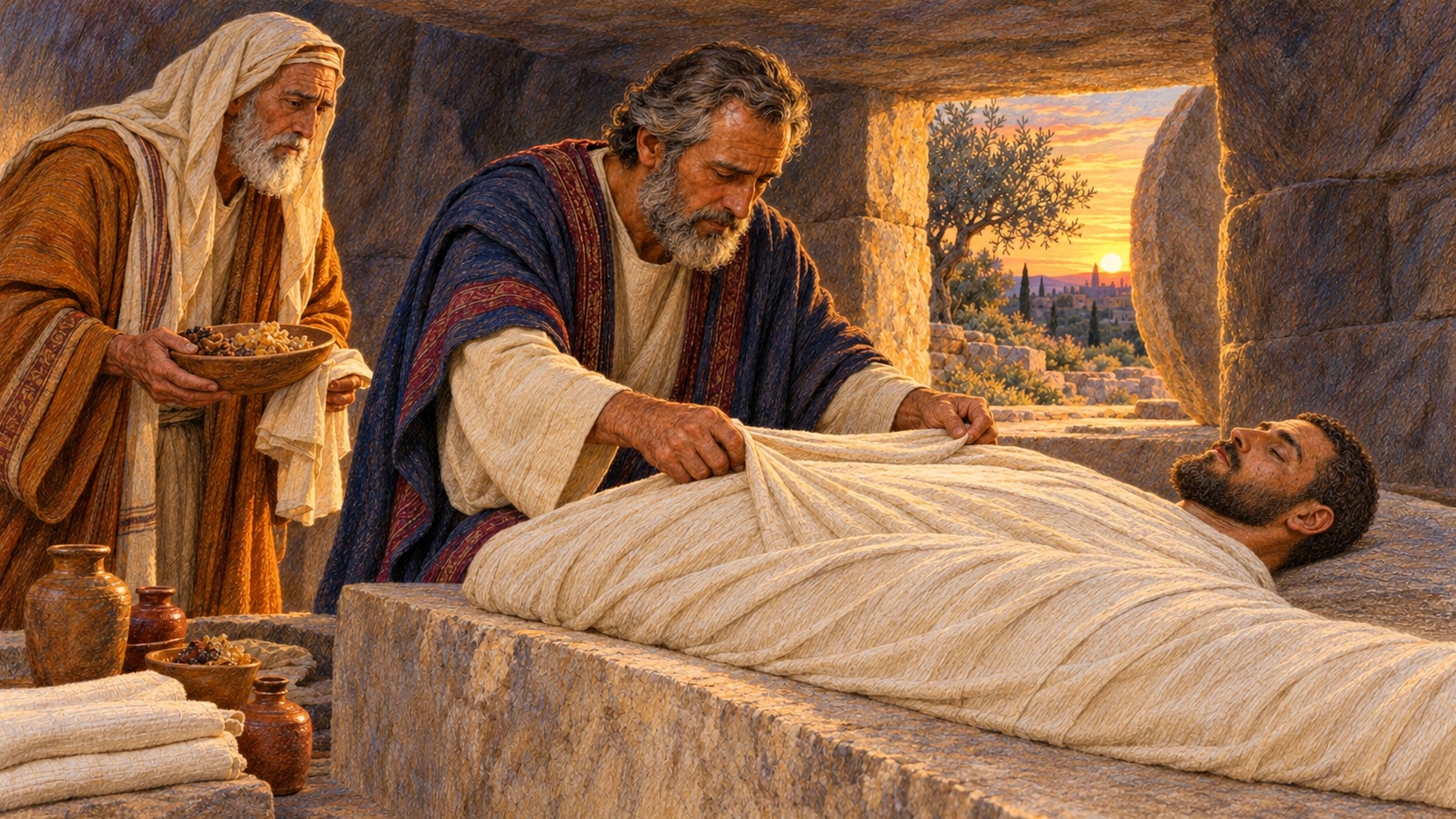
Joseph of Arimathea had followed Jesus secretly because he was afraid of the authorities who opposed Him. Yet after Jesus was crucified, Joseph went to the Roman governor and asked for His body so that he could bury Him. I find it interesting that the man who had kept his discipleship hidden was willing to identify himself with Jesus when the Lord had just been put to death.
What the Four Gospels Tell Us About Joseph
All four Gospels name Joseph, but they do not give us a biography of his life. We are not told about his childhood, his family, or what happened to him afterward. Each account introduces him through the part he played in the burial, and when we read them together, we learn why his decision involved more than simply providing a place for a body.
Matthew tells us that Joseph came from Arimathea and that he had become a disciple of Jesus, someone who followed Him as a learner. He also tells us that Joseph was wealthy:
Now when evening had come, there came a rich man from Arimathea, named Joseph, who himself had also become a disciple of Jesus.
Mark adds that Joseph held a respected position among the Jewish leaders. He belonged to the council, the governing body whose leaders had sought Jesus’ death. Mark introduces that position while telling us what Joseph did after the crucifixion:
Joseph of Arimathea, a prominent council member, who was himself waiting for the kingdom of God, coming and taking courage, went in to Pilate and asked for the body of Jesus.
Pilate was the Roman governor who had authorized Jesus’ execution. Joseph therefore had to ask the very man who had handed Jesus over to be crucified for permission to take His body. A prominent council member was now showing concern for the One that the council had rejected.
Luke describes Joseph as “a good and just man” in Luke 23:50. That description tells us something about his character that his wealth and position alone could never establish. Luke also agrees with Mark that he was waiting for the kingdom of God. Joseph expected the Lord to keep His promises, even though the events surrounding Jesus’ death did not look like the arrival of a victorious King.
Luke had described that kind of expectation earlier in his Gospel. When Jesus was brought to the temple as a baby, a man named Simeon was waiting for the Consolation of Israel, the comfort God had promised through the Messiah, His promised Savior and King. Simeon took the child in his arms and praised God because he had seen His salvation. Anna, an elderly prophetess who served God at the temple, also gave thanks and spoke about Jesus to those who were looking for redemption in Jerusalem. Their hope was that God would deliver His people, as He had promised.
I see Joseph’s waiting for the kingdom as belonging to that same expectation. Luke shows us people who were looking for God to act, and Joseph was one of those who had become a follower of Jesus. His resources would soon give him a way to serve the Lord, but using them would also make his allegiance visible.
The Secret Disciple Took Courage
John explains why Joseph had not openly identified himself with Jesus before this. His discipleship had been kept secret because he was afraid:
After this, Joseph of Arimathea, being a disciple of Jesus, but secretly, for fear of the Jews, asked Pilate that he might take away the body of Jesus; and Pilate gave him permission. So he came and took the body of Jesus.
When John refers here to fear of the Jews, he is describing the opposition Joseph faced from the hostile authorities. Joseph himself was Jewish, as were Jesus, His apostles, and the first believers. The passage does not place blame on every Jewish person. It tells us why this particular disciple was reluctant to let others see whom he followed.
John gives us some background for that fear elsewhere in his Gospel. In John 9, after Jesus healed a man who had been blind from birth, the man’s parents were questioned about what had happened. They acknowledged that he was their son and that he had been born blind, but they avoided saying who had healed him because they feared being put out of the synagogue, their community’s place of worship. John 12 also describes rulers who would not confess Jesus because they feared exclusion and loved the approval of people. These passages help us understand the pressure Joseph faced without telling us every consequence he personally expected.
His membership on the council did not mean that he had agreed with its action against Jesus. Luke specifically separates him from that decision:
He had not consented to their decision and deed. He was from Arimathea, a city of the Jews, who himself was also waiting for the kingdom of God.
We can say that Joseph did not consent to what the council decided and did. Luke does not tell us whether he objected during its proceedings, was absent, or had an opportunity to intervene. I do not want to turn that one sentence into a speech of protest that Scripture never records. His disagreement was real, but the public action the Gospels describe comes after Jesus had died.
There was also a limit to the time available for the burial. It was the Preparation Day, the day before the Sabbath, when the people would rest according to God’s command. As that day drew toward its close, Joseph went to Pilate:
Now when evening had come, because it was the Preparation Day, that is, the day before the Sabbath, Joseph of Arimathea, a prominent council member, who was himself waiting for the kingdom of God, coming and taking courage, went in to Pilate and asked for the body of Jesus.
Jesus had been crucified with a title identifying Him as the King of the Jews. The chief priests had sought His death, and the Roman governor had given Him over for execution. Joseph’s request associated him with that condemned man before the governor himself. I think we can see why Mark describes him as taking courage. He could no longer serve Jesus in this way while keeping his concern for Him entirely out of sight.
The Greek word Mark uses is τολμήσας (tolmēsas), a form of tolmaō, meaning to dare or to act boldly. The wording fits the action Mark describes. Joseph went in and made the request despite the opposition surrounding Jesus. We are not told that his fear had completely disappeared, and courage did not require him to know that everyone would approve.
His standing among the leaders may have made it easier for him to approach Pilate, but that same standing gave him something he could lose. He was exposing himself to the hostility of men whose respect he had previously enjoyed. The Gospels do not tell us what consequences followed for him, but his request made honoring Jesus more important than preserving the secrecy he had maintained.
Pilate did not immediately hand over the body. He was surprised to hear that Jesus had already died, and he called for the centurion, the Roman officer at the execution, to confirm what had happened:
Pilate marveled that He was already dead; and summoning the centurion, he asked him if He had been dead for some time. So when he found out from the centurion, he granted the body to Joseph.
Only after receiving that confirmation did Pilate release the body to Joseph. John adds that the soldiers had already seen that Jesus was dead, so they did not break His legs as they had done to the others crucified with Him. One soldier pierced His side with a spear, and John records the blood and water that came out.
These accounts describe the burial of a man who had truly died. Joseph was not taking Jesus away to recover from His wounds. The officer’s report and the soldiers’ actions belong to the sequence before the burial, and they help us understand what the later announcement of resurrection means. Jesus would rise from death itself.
An Honorable Burial in the Rich Man’s Tomb
Once permission was given, Joseph had work to do. Mark tells us that he bought fine linen and took Jesus down from the cross. Matthew identifies the tomb as Joseph’s own and describes the care he gave to the body:
When Joseph had taken the body, he wrapped it in a clean linen cloth, and laid it in his new tomb which he had hewn out of the rock; and he rolled a large stone against the door of the tomb, and departed.
Mark records the same burial while including Joseph’s purchase of the linen:
Then he bought fine linen, took Him down, and wrapped Him in the linen. And he laid Him in a tomb which had been hewn out of the rock, and rolled a stone against the door of the tomb.
The tomb was cut into rock, and it was new. Luke tells us that no one had ever been laid in it. Joseph made his own burial place available for Jesus and supplied clean linen to wrap His body. His wealth gave him the means to provide those things, but he also took part in the physical work. The accounts describe him handling the body, not merely authorizing someone to spend money on a funeral.
Under Israel’s Law, that work carried a consequence he would have understood. Numbers 19:11 says that anyone who touched a dead body became ceremonially unclean for seven days. The chapter then gives instructions for purification. Being unclean in that sense did not mean that showing care for the dead was morally wrong. It meant that contact with death brought a condition the Law required the person to address before returning to full participation in sanctuary worship.
Caring for Jesus’ body therefore meant accepting the need for purification as well as supplying the linen and the tomb. Joseph undertook the work himself, even though handling the body brought that requirement upon him.
Earlier that day, soldiers had stripped Jesus, mocked Him, struck Him, and crucified Him. Joseph could not reverse what they had done, but he could treat His body with honor. He wrapped Him in the linen, laid Him in the tomb, and rolled a large stone against its entrance. The care in those actions is a different response to the same Lord whom others had treated with contempt.
The women who had followed Jesus also saw where He was buried. Mark names Mary Magdalene and Mary the mother of Joses as witnesses to the place, and Luke says that the women observed both the tomb and how the body was laid. They returned and prepared spices, and then they rested on the Sabbath. The burial site was known to people who had been there, so the later visit to the tomb follows an identifiable burial rather than a disappearance no one could explain. The study on the resurrection grave clothes follows what the disciples found when they returned.
Joseph’s wealth and the tomb he provided also connect this burial with Isaiah 53:9. Isaiah describes the suffering Servant as having His grave associated with the wicked, yet being with the rich at His death. He also says that the Servant had done no violence and that there was no deceit in His mouth. I understand this to speak of Jesus, the innocent Savior who suffered for the sins of others.
Jesus was put to death between criminals, but afterward His body was laid in the new tomb belonging to a rich disciple. That is the connection I see between Isaiah’s words and the details Matthew records. Joseph’s provision was an act of care, and it was also part of the way God fulfilled what He had spoken about the Messiah.
The Gospels do not say that Joseph selected a tomb in order to stage a fulfillment of prophecy. He asked for the body and provided for its burial. Pilate made his decision after confirming the death, while the rulers who had opposed Jesus remained responsible for seeking His condemnation. God’s fulfillment of His Word did not make their evil choices innocent. The study on Isaiah’s prophecies of a Messiah follows the wider prophetic witness to the Messiah’s suffering and the salvation He would bring.
Joseph, Nicodemus, and the Gospel Witness
John tells us that another man joined Joseph in this work. Nicodemus came with a large quantity of spices for the burial:
And Nicodemus, who at first came to Jesus by night, also came, bringing a mixture of myrrh and aloes, about a hundred pounds.
Nicodemus was a Pharisee and a ruler among the Jewish people. In John 3, he had come to Jesus at night and acknowledged that His signs showed that God was with Him. Jesus then told him that he needed to be born again. Nicodemus initially asked how an old man could be born a second time, and Jesus explained that He was speaking about a birth brought about by the Spirit. Religious position and natural ancestry could not give Nicodemus that life.
He appears again in John 7, when the chief priests and Pharisees were angry that officers had returned without arresting Jesus. Nicodemus asked whether their Law judged a man before hearing him and finding out what he was doing. They answered him dismissively by asking whether he too was from Galilee. His question had challenged their handling of Jesus, even though John does not record a full confession of faith from him at that point.
Now he was helping to bury the One they had condemned. He brought myrrh and aloes, aromatic materials used in preparing the body, and John describes the amount as about a hundred pounds. The quantity tells us that he had come with a substantial provision. Joseph supplied the tomb and linen, and Nicodemus joined him with the spices. John then describes what they did together:
Then they took the body of Jesus, and bound it in strips of linen with the spices, as the custom of the Jews is to bury.
They bound the body in linen with the spices, following the Jewish custom of burial. John also explains that there was a garden at the place of crucifixion, and in that garden was the new tomb. Because the tomb was nearby, they could lay Jesus there on the Preparation Day before the approaching Sabbath. Its location met the immediate need as well as providing the particular burial the Gospels record.
I appreciate that John names both men. Joseph’s willingness to approach Pilate led to the release of the body, and Nicodemus helped him with the work that followed. Both had a place among the leaders, yet they were now using what they had to honor Jesus after His death.
The body they handled belonged to the eternal Son of God, who had taken human flesh. He remained fully God while becoming fully man, and the torture inflicted upon Him was real. Wicked men had beaten and crucified the sinless Savior, but He had willingly given Himself to be slain as the perfect sacrifice for our sins. He shed His innocent blood and completed that saving sacrifice through His bodily death before Joseph and Nicodemus buried Him.
Their burial work did not complete something lacking in His offering. It honored His body after His death. Nor do I understand the cross as the Father punishing or abandoning His Son. In John 10, Jesus speaks of His Father’s love and of His own willingness to lay down His life, and Hebrews 9 describes Him offering Himself without spot to God through the eternal Spirit. Father, Son, and Holy Spirit were united in the work of salvation. The study on the moment Jesus died examines His death in more detail.
The apostle Paul includes the burial when he reminds the believers in Corinth of the gospel he had preached to them:
For I delivered to you first of all that which I also received: that Christ died for our sins according to the Scriptures, and that He was buried, and that He rose again the third day according to the Scriptures.
The burial stands between Christ’s death for our sins and His bodily resurrection on the third day. Joseph’s service belongs within that sequence. The Lord he laid in the tomb was truly dead, and the Lord who rose was the same Jesus, alive again. Paul goes on to name witnesses who saw Him, and he explains that without His resurrection our faith would be futile and we would still be in our sins. The gospel cannot leave Jesus in the tomb.
Paul also includes the burial when he preaches in the synagogue at Antioch in Pisidia. After explaining how the rulers in Jerusalem rejected Jesus and asked Pilate to put Him to death, he recounts the burial in Acts 13:29. The reference to taking Him down from the tree describes taking His body down from the cross. Paul then announces in Acts 13:30 that God raised Him from the dead. The study on post-resurrection Jesus and His ascension considers the appearances and ministry of the risen Lord before He returned to Heaven.
The women who had seen the burial came back after the Sabbath and found the tomb empty. Peter also came, and John describes the linen cloths lying there after the body was gone. Joseph had helped provide the place and the burial that made those later observations possible. We are not told that he understood beforehand that Jesus would rise on the third day, so I would not assign him that expectation. He served the Lord in the task before him, and that service became part of testimony reaching far beyond the burial itself.
What Joseph’s Testimony Teaches Us
There are later traditions that connect Joseph with Britain and with sacred relics. Those claims do not come from the Gospel accounts, and I would not give them the authority of Scripture. We already have enough in the biblical record to understand why Joseph deserves our attention. The man who had followed Jesus secretly went to Pilate, received His body, and provided an honorable burial when doing so identified him with a condemned man.
I appreciate the honesty with which Scripture describes him. Matthew calls him a disciple, Luke calls him good and just, and John tells us that he was afraid. Those descriptions belong to the same man. His earlier fear should not cause us to discard what the Gospels say about his faith, but neither should his faith become our excuse for remaining silent whenever obedience is difficult.
He was not the only follower of Jesus who struggled under pressure. When Jesus was arrested, the disciples with Him fled. Later, Peter, one of His closest disciples, was questioned about his association with Him and denied three times that he knew Him. Peter then remembered the Lord’s warning and went out weeping. Those failures help me see Joseph’s fear in the company of real disciples whose courage was not as strong as their attachment to Jesus.
Yet Joseph eventually did something his earlier secrecy had prevented. He let another person see that he cared for Jesus and was willing to take responsibility for His body. I cannot use his hesitation as a reason to put off my own obedience indefinitely. The opportunity to care for the body existed at that moment, and Joseph acted while there was still time.
That makes me consider the things I may be trying to protect. A position or a good reputation can be useful in serving the Lord, but if keeping it becomes more important to me than honoring Him, it can also keep me from doing what is right. Joseph had influence, and he used it to make a request that exposed his allegiance. I want to bring my fear to the Lord and ask for the courage to obey, instead of waiting until obedience carries no possibility of loss.
His wealth also met a particular need. The body required burial, so he supplied linen and a tomb. That does not make a wealthy disciple more spiritual than a person who has little to give. It does make me ask whether the things God has entrusted to me are available for His service. Someone may be able to give time to a person who needs help, use a skill for another believer, or open a home to someone who needs hospitality. The value of that service is not measured simply by its price.
The Gospels record no sermon from Joseph. His recorded service involved obtaining permission and then doing the work of caring for the body. We should confess Christ in words, and we should also be willing to do what love for Him requires. A task may be quiet and practical while still demanding courage, especially when doing it lets others see that we belong to the Lord they reject.
None of that means Joseph earned salvation by providing the burial. He was serving the Savior who had died for the sins of the world. We also need to receive Christ by grace through faith, turning to Him in repentance rather than trusting our own goodness or courage. The new life He gives is His gift, and the works that follow are a response to that grace. Our hope rests in the crucified and risen Lord whom Joseph honored, not in our ability to equal Joseph’s service.
My Final Thoughts
When I compare the four Gospel accounts, I see how Joseph’s discipleship became visible through a decision that cost him the protection of secrecy. He approached Pilate, received Jesus’ body after His death had been confirmed, and gave Him an honorable burial in his own tomb. Nicodemus joined him, and the women saw where the body was laid. God used those actions in fulfilling His Word and in establishing the burial that belongs to the gospel’s announcement of Christ’s death and resurrection.
Joseph’s example gives me reason to stop treating fear as the final answer to a call to obey. I may not know everything the Lord will do through a particular act of service, but I can make what He has entrusted to me available to Him. The Savior Joseph buried did not remain in that tomb. He rose bodily from the dead, and my confidence rests in Him as I seek the courage to serve Him.