
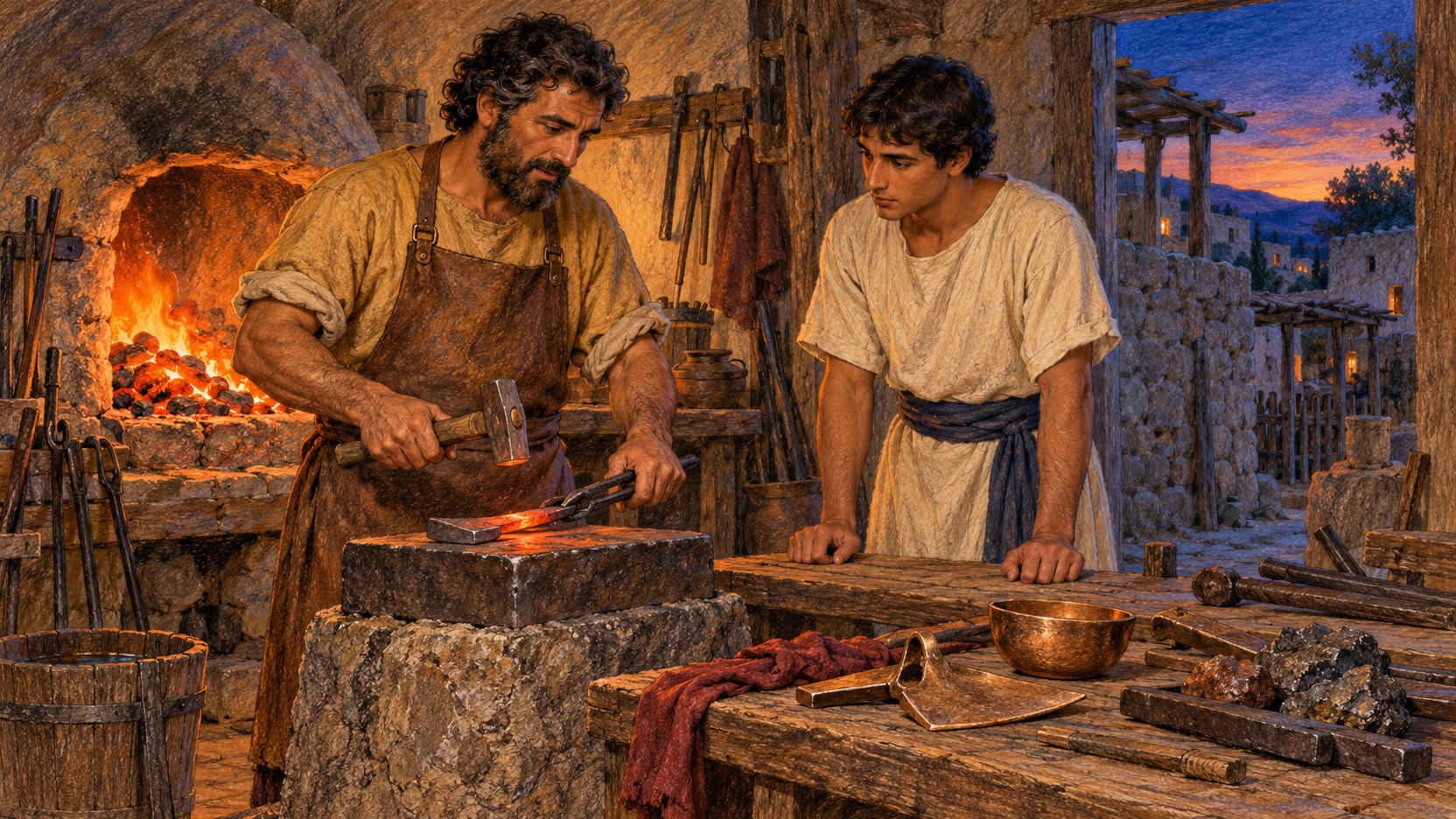
Genesis 4 places Tubal-Cain’s skill with bronze and iron beside his father Lamech’s boast about killing a man. The family could produce useful work, but its accomplishments had not kept violence out of the household. I find that to be a warning against assuming that a person’s ability tells us whether he is faithful to God.
Tubal-Cain in the Line of Cain
Tubal-Cain was a descendant of Cain, the first son of Adam and Eve. Adam and Eve were the first man and woman God created, and Genesis 4 follows what happened in their family after they had disobeyed Him and been sent out of the garden of Eden. Cain worked the ground, while his brother Abel kept sheep. When the brothers brought offerings to the Lord, He accepted Abel and his offering, but He did not accept Cain and his offering.
Cain became angry, and God warned him about the sin he needed to resist. Yet when Cain and Abel were together in the field, Cain killed his brother. God then confronted Cain and told him that the ground would no longer yield its strength to him when he worked it, and that he would become a fugitive and a wanderer. Cain was afraid that someone who found him would kill him, so God warned that anyone who killed Cain would face sevenfold vengeance and placed a mark on him for his protection. See Genesis 4:1–15.
Then Cain went out from the presence of the LORD and dwelt in the land of Nod on the east of Eden. And Cain knew his wife, and she conceived and bore Enoch. And he built a city, and called the name of the city after the name of his son, Enoch.
Cain’s departure did not mean that he lost the ability to build or that his descendants could no longer learn. He built a city and named it after his son Enoch. We are not told how large that settlement was, so I would not picture a modern city and assume Genesis is describing the same thing. It does tell us that the man who had murdered his brother could still undertake useful work. Building a city did not undo what he had done to Abel.
Genesis 4:18 follows Cain’s descendants through several generations until it reaches Lamech, Tubal-Cain’s father. Lamech took two wives, Adah and Zillah. He is the first man Scripture specifically records doing that. Earlier, Genesis 2 had described God bringing one woman to Adam and establishing marriage as the union of a man and his wife. The fact that Lamech’s household is recorded does not make every choice he made an example for us to follow.
Three of the sons in that household are remembered for work that other people could learn and continue. We are about to read of herding, music, and metalwork, but then we will hear Lamech speak about killing a man. I think we need to keep both parts of the account in view. The family’s accomplishments were real, and so was the violence its father boasted about.
Jabal, Jubal, and the Abilities of Early Humanity
Adah was the mother of Jabal and Jubal. Zillah was the mother of Tubal-Cain, making him their half-brother. Genesis identifies the work associated with each of them:
And Adah bore Jabal. He was the father of those who dwell in tents and have livestock. His brother’s name was Jubal. He was the father of all those who play the harp and flute.
And as for Zillah, she also bore Tubal-Cain, an instructor of every craftsman in bronze and iron. And the sister of Tubal-Cain was Naamah.
Calling Jabal the father of those who lived in tents and had livestock identifies him as a leading figure in that way of life. It cannot mean that nobody had cared for an animal before him, because the same chapter has already told us that Abel kept sheep. Jubal is similarly identified with people who played the harp and flute. These descriptions connect the brothers with practices that others carried on, and Tubal-Cain appears alongside them as someone who instructed craftsmen in working with metal.
His Hebrew name is written תּוּבַל קַיִן, commonly represented in English letters as Tubal Qayin. Genesis does not stop to explain what the name means. It also names his sister Naamah without telling us what she did or what became of her. I would keep proposed meanings and later accounts separate from the history we are actually given. Here, Scripture gives us their family relationships and Tubal-Cain’s craft.
The work associated with these brothers called for thought and skill. A person caring for livestock had to understand the animals’ needs. Someone making or playing an instrument had to learn how to produce the sound he wanted. Working metal also required a person to understand how the material responded to what he did with it. The account is brief, but it describes people who could observe, learn, and teach others.
All of this belongs to the generations before the Flood, the worldwide judgment God later brought upon the earth in Noah’s day. These early people already possessed the capacity for practical work and artistic expression. To understand where that capacity came from, we can go back to what Genesis says about the creation of humanity:
Then God said, “Let Us make man in Our image, according to Our likeness; let them have dominion…”
So God created man in His own image; in the image of God He created him; male and female He created them.
God made both the man and the woman in His image, and He gave them responsibility for the world He had made. Having dominion meant they were to exercise that responsibility under His authority. Genesis 2 then shows Adam receiving instructions from God, naming animals, and being given work to do in the garden. Human beings could understand what God said and respond to Him from the beginning.
Adam and Eve later ate from the tree God had forbidden them to eat from. That disobedience brought sin and its consequences into human life, but it did not erase the image of God or turn their descendants into people without understanding. After the Flood, God still grounds the value of human life in His image in Genesis 9:6. Cain’s descendants therefore retained human worth even when they used their abilities sinfully. The study on the image of God explains that worth and the responsibility that accompanies it.
I also find it interesting that Genesis names music alongside work that met everyday needs. The people described here did more than try to find enough food for another day. They could shape materials and make instruments, and they could pass those abilities on. I can appreciate that work without assuming that everyone who produced it was honoring the God who made him capable of doing it.
What Genesis Says About Tubal-Cain’s Metalwork
Tubal-Cain is often called the first blacksmith. I think it is more precise to call him the earliest metalworker named in Scripture. Genesis gives him a prominent place in the craft, but it does not expressly tell us that no one before him had ever shaped a piece of metal. We can affirm what the verse says without adding a claim it does not require.
The NKJV describes him as “an instructor of every craftsman in bronze and iron.” The Hebrew wording is commonly represented as lotesh kol choresh nechosheth uvarzel. The word lotesh is related to hammering or sharpening, as the Hebrew lexical entry explains. The translation comparison and NET note also show why other renderings speak of forging or shaping metal implements. In that use, forging means working metal into shape. Those renderings describe his metalworking, while the NKJV particularly brings out his place in instructing other craftsmen.
The term rendered “bronze” can refer to copper as well as bronze, which is a copper alloy. An alloy combines a metal with one or more other elements. That range helps explain why we may see either copper or bronze in a translation without losing the point that Tubal-Cain worked with metal. Iron is also named. The verse does not identify an exact alloy or describe his furnace, so I would not try to draw a complete workshop from those words.
His ability also depended on materials that he had not created. Job 28 describes people mining, cutting into rock, and bringing hidden resources to the surface. Among those resources it names these:
Iron is taken from the earth, And copper is smelted from ore.
Moses, the leader of Israel, also described these resources when he prepared the people to enter the land God had promised them. They had spent forty years in the wilderness, depending on the Lord’s provision. The land they were about to enter would provide food and water, and it would also provide materials they could work with:
“A land in which you will eat bread without scarcity, in which you will lack nothing; a land whose stones are iron and out of whose hills you can dig copper.”
Moses then warned them about what could happen after they had enough to eat, had built houses, and had become prosperous. They might begin to think their own strength had produced everything they possessed. He told them to remember that the Lord was the One who gave them the ability to obtain wealth. See Deuteronomy 8:10–18. A craftsman really does have to learn and work, but his effort does not make him independent of the God who gave him life and a world to work in.
I receive Genesis as a truthful account of how humanity began. God directly created Adam and Eve, and they could speak, work, and answer to Him for their choices. The people described in these early chapters already possessed the understanding they needed to learn and pass their knowledge to others. I do not accept evolutionary timelines that replace that beginning or explain human nature apart from our Creator. The study on the literal six days of creation develops that understanding of Genesis.
When we encounter terms such as Stone Age, Bronze Age, and Iron Age, we should understand what those labels describe. Archaeologists use them to group periods and material cultures according to characteristic tools and technologies, and the chronologies vary by region. They do not measure the worth of the people who used those tools. The British Museum’s description of the Iron Age is an example of the terminology used in museum catalogues. Knowing that someone worked with stone rather than iron does not tell us that he lacked intelligence or moral responsibility.
There is also a difference between finding evidence of a tool and having a complete record of everything a people knew. Some materials survive better than others, and some places have not been excavated. Stone and metal tools can also be used alongside each other. I would not treat a surviving collection as though it were an inventory of every ability human beings possessed everywhere at the time. Nor would I give an archaeological classification authority to overturn what I receive from Genesis.
Genesis 4 places Tubal-Cain’s metalworking before the Flood. It does not give modern archaeological dates, and it does not say that his world possessed every invention we have today. I do not need to add machines or processes the chapter never mentions in order to recognize how capable these people were. The testimony we have is that they developed useful crafts early in human history.
Skill Could Not Save the World Before the Flood
Once Genesis has named the work associated with Lamech’s sons, it records what their father said to Adah and Zillah:
Then Lamech said to his wives: “Adah and Zillah, hear my voice; Wives of Lamech, listen to my speech! For I have killed a man for wounding me, Even a young man for hurting me. If Cain shall be avenged sevenfold, Then Lamech seventy-sevenfold.”
Lamech said he had killed a man for wounding him, and then he brought Cain into the comparison. Earlier, Cain had been afraid that someone would kill him because he had murdered Abel. God had restrained that retaliation by warning of sevenfold vengeance. Lamech now spoke of seventy-sevenfold vengeance for himself. He was taking the language of protection given to Cain and making a far greater claim after killing someone who had hurt him.
I read that speech as a boast about revenge, not a confession of sorrow over taking a life. Its repeated lines give it a poetic form, but that form does not make what Lamech says good. His household could be associated with music and craftsmanship while its father spoke this way about violence. The study on Lamech from the line of Cain examines his words more fully.
We are not told what weapon Lamech used, or even whether he used one. Genesis does not say that Tubal-Cain supplied him with anything. I would not turn the placement of these verses into an accusation that the son armed his father. What the passage does show is that a household’s useful achievements had not removed the pride and violence we hear in Lamech’s speech.
The account later describes corruption spreading throughout the world. By Genesis 6, the Lord’s judgment concerns the people themselves and what they were doing:
Then the LORD saw that the wickedness of man was great in the earth, and that every intent of the thoughts of his heart was only evil continually.
So God looked upon the earth, and indeed it was corrupt; for all flesh had corrupted their way on the earth.
Genesis 6:11–13 also says that the earth was filled with violence. God told Noah that He would bring a Flood upon the earth. He instructed him to build an ark, a large wooden vessel in which his family and the animals God brought to him would be preserved. Noah found grace in God’s sight and did what He commanded. The coming judgment was not a problem that another invention could solve. The people needed to answer to God for the evil they were doing.
A better tool could make a task easier, but it could not make the murder of Abel right. A more accomplished musician could produce beautiful sound, but that sound could not turn Lamech’s boast into repentance. The skills themselves had value. Their value did not cancel the guilt of the people who sinned, and their development did not keep the world from becoming corrupt.
That is why I do not want to despise human ability or put my hope in it as the cure for sin. A community may become more productive while still treating people cruelly. A person may create something that helps thousands of others while refusing to turn from sin in his own life. I can acknowledge what his work has accomplished without treating that accomplishment as proof that he is right with God.
We face this responsibility whenever we put knowledge to use. Technology can help protect life or make a difficult job safer, but it can also help someone exploit people more efficiently. The ability to make something work does not answer whether we ought to use it for the purpose we have in mind. That question requires us to submit our purposes to God, not merely demonstrate that our invention succeeds.
When Craft and Music Serve God
Because these crafts appear in Cain’s family, someone might wonder whether Scripture is warning us against the crafts themselves. Later passages help answer that question. Exodus takes us to the people of Israel during their years in the wilderness. God commanded them to make the tabernacle, a tent sanctuary where He would dwell among them. He gave Moses the pattern for it and for its furnishings, and the people brought materials for the work. See Exodus 25:1–9.
God then named Bezalel, a man from the tribe of Judah, as a craftsman He had equipped for that work. He told Moses:
“And I have filled him with the Spirit of God, in wisdom, in understanding, in knowledge, and in all manner of workmanship, to design artistic works, to work in gold, in silver, in bronze…”
The Lord was giving a man skill to work with some of the very materials named in Genesis. Metalworking was being put to a purpose God had commanded. Exodus 31:5–11 goes on to describe work with wood and stones, and it also names Aholiab as someone appointed to work with Bezalel. Other skilled workers were to join them in making the sanctuary and its furnishings according to God’s instructions.
Exodus 35:34 adds that God gave Bezalel and Aholiab the ability to teach. I find that connection helpful because Tubal-Cain was also described in terms of instructing craftsmen. Passing a skill to another person is not something we should distrust simply because an early teacher of that skill belonged to Cain’s line. In the tabernacle work, God equipped people both to make things and to teach others how to take part.
Receiving ability from God did not mean the craftsmen could disregard His instructions or neglect the actual work. Exodus 36:1 says they were to do what He had commanded. They received the materials the people brought, and they put their knowledge to use. Their craftsmanship served God as they made what He had told them to make.
We can see the same principle with music. Jubal’s association with the harp and flute does not make those instruments unfit for worship. Psalm 150 begins by calling for praise of God because of His mighty acts and His greatness, and then it calls for instruments to be used in that praise:
Praise Him with the sound of the trumpet; Praise Him with the lute and harp! Praise Him with the timbrel and dance; Praise Him with stringed instruments and flutes!
The harp and flutes named here recall the instruments associated with Jubal, but the psalm tells us whom the music is to honor. I do not think an impressive performance is enough to make a song faithful worship. We also need to consider what it says about God and whether it directs our attention to Him. At the same time, someone’s misuse of music is no reason to reject the ability to make it.
This responsibility reaches into ordinary work too. A builder can use his skill to make a home safe for the family who will live in it. A mechanic can do an honest repair instead of hiding a fault that will put someone at risk. A farmer’s knowledge can help him care for the land, and a parent’s patience can help a child learn. Those activities do not have to take place in a church building to be done in obedience to the Lord.
The apostle Paul gives a practical example in Ephesians 4:28. He tells a person who has been stealing to stop, to work with his hands at what is good, and to use what he earns to help someone in need. The change reaches further than acquiring a useful skill. A man who once took from others is now working so that he can give. His labor serves a different purpose because he is responding to what Christ teaches.
That obedience cannot purchase forgiveness. Ephesians 2:8–10 says salvation is God’s gift, received by grace through faith, and then explains that believers are created in Christ for good works. Jesus willingly gave His life as the sinless sacrifice for our sins, completed that sacrifice through His shed blood and death, and rose bodily after His burial. Our hope is in Him, not in the quality of what we can produce. As we turn from sin and trust Him, our work becomes something to place under His authority rather than something to offer as proof that we do not need His mercy. See John 10:17–18; 1 Peter 1:18–21 and 1 Corinthians 15:3–4.
When I admire a person’s talent, I want to remain willing to examine what he is doing with it. That includes my own abilities. I can ask whether my work is useful and do it as well as I know how, but I also need to ask whether I am being honest, whether I am harming someone, and whether I am willing to change when Scripture corrects me. Success at a task does not remove my responsibility to the Lord.
My Final Thoughts
Tubal-Cain is the earliest metalworker named in Scripture, and Genesis presents his craft alongside the practical and artistic work of his family. Those abilities belonged to people God had made in His image. Yet the same household included Lamech, whose boast shows that useful accomplishments had not made him righteous. I cannot tell you every use Tubal-Cain made of his craft, because Genesis does not tell us. I can say that neither the craft nor the family connection removes a person’s responsibility for how he lives before God.
The later work of Bezalel and the music of Psalm 150 show that these abilities can be used in God’s service. I want to receive what He has given me with that purpose in mind. My work cannot earn the mercy I need from Christ, but because I belong to Him, the way I do that work should honor Him and serve the people it affects.