
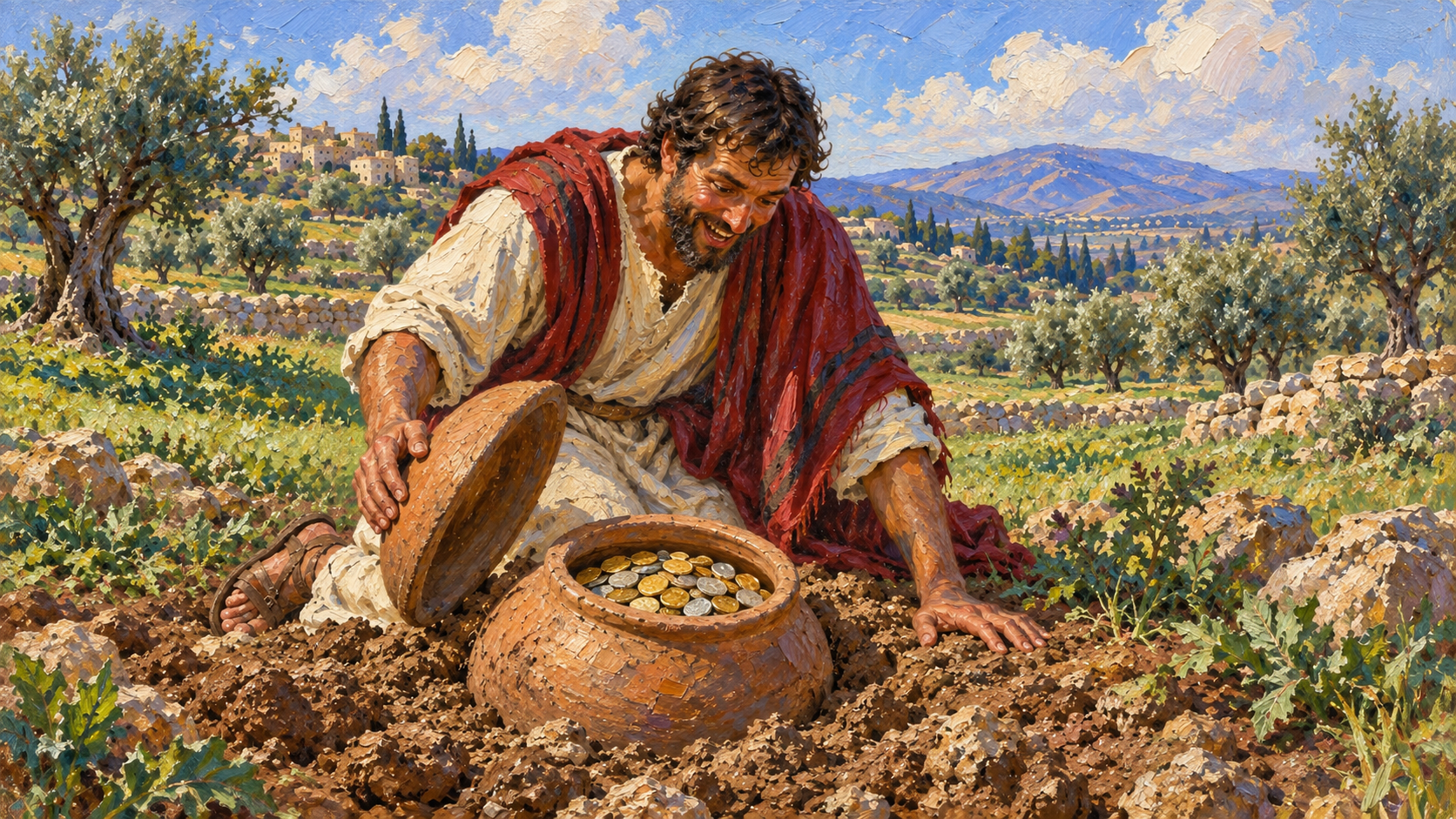
Jesus told the parable of the hidden treasure in a single verse. A man discovers something so valuable that he sells everything he owns to buy the field where it lies. He does this joyfully, because he understands what he has found. Jesus uses that response to teach us about the worth of His kingdom and the allegiance it deserves.
I want us to notice the man’s joy before turning his sale into a demand for some impressive sacrifice. Jesus is not putting a price on forgiveness. He is describing a discovery that changes how a person values everything else.
Read the Treasure in Matthew 13
All these things Jesus spoke to the multitude in parables; and without a parable He did not speak to them, that it might be fulfilled which was spoken by the prophet, saying: "I will open My mouth in parables; I will utter things kept secret from the foundation of the world." Then Jesus sent the multitude away and went into the house. And His disciples came to Him, saying, "Explain to us the parable of the tares of the field." He answered and said to them: "He who sows the good seed is the Son of Man. The field is the world, the good seeds are the sons of the kingdom, but the tares are the sons of the wicked one. The enemy who sowed them is the devil, the harvest is the end of the age, and the reapers are the angels. Therefore as the tares are gathered and burned in the fire, so it will be at the end of this age. The Son of Man will send out His angels, and they will gather out of His kingdom all things that offend, and those who practice lawlessness, and will cast them into the furnace of fire. There will be wailing and gnashing of teeth. Then the righteous will shine forth as the sun in the kingdom of their Father. He who has ears to hear, let him hear! "Again, the kingdom of heaven is like treasure hidden in a field, which a man found and hid; and for joy over it he goes and sells all that he has and buys that field. "Again, the kingdom of heaven is like a merchant seeking beautiful pearls, who, when he had found one pearl of great price, went and sold all that he had and bought it.
Matthew places this parable after Jesus has dismissed the multitude and entered a house. The disciples ask Him to explain the weeds, and He identifies the people and events represented in that parable. He then speaks about the treasure and the pearl. We are listening to Jesus teach His disciples about a kingdom whose full character and eventual triumph were not yet apparent to those around them.
The kingdom of heaven is God’s reign, including the people and realm under His rule. Matthew’s expression does not describe a different kingdom from the kingdom of God. In Matthew 19, quoted later in this study, Jesus uses both expressions while explaining the difficulty of a rich person entering it. The study on the Kingdom of Heaven and the Kingdom of God examines that relationship more fully.
Jesus the King had come, and His authority was already evident in His teaching, His miracles, and His call to repent. That did not mean the promised kingdom had reached its final public fullness. The explanation of the weeds looks ahead to judgment at the end of the age, when the Son of Man sends His angels and the righteous shine in their Father’s kingdom. The present call to believe and the future judgment both come from the same King.
Within that setting, Jesus asks us to consider a man who finds treasure hidden in a field. He hides it again, sells what he owns, and buys the field. We are not told who buried the treasure, whether the finder had been working there, or what the seller knew. The emphasis falls on the finder’s response: he recognizes the value of what lies in the ground and willingly parts with his possessions to obtain it.
The merchant in the next parable had been seeking beautiful pearls, whereas Jesus does not say that the man in the field had been searching for treasure. Both recognize extraordinary value and sell what they have to obtain it, although joy is expressly mentioned only in the treasure parable. I would not make the difference in their circumstances into a rule about conversion. Someone may hear the gospel unexpectedly, while another has asked questions for years. Neither a lengthy search nor a sudden discovery earns salvation; each person needs to respond to Christ.
Finding the treasure did not make it valuable. Its worth was already there, even while it remained hidden. In the same way, Christ does not become worthy when someone finally believes in Him. The person begins to recognize the King who already deserves his allegiance. Jesus’ teaching about the different responses to God’s word in the parable of the sower helps us understand why hearing the message does not always lead to receiving it.
Joy Reveals the Kingdom’s Surpassing Worth
The man is not reluctantly handing over his property because someone has threatened him. He sells it for joy over the treasure. We could look at everything he gives up and decide that he has ruined himself, but that would ignore what he has found. He judges his possessions in light of something worth far more. Paul describes a comparable change in his own estimate of what he had once prized.
Finally, my brethren, rejoice in the Lord. For me to write the same things to you is not tedious, but for you it is safe. Beware of dogs, beware of evil workers, beware of the mutilation! For we are the circumcision, who worship God in the Spirit, rejoice in Christ Jesus, and have no confidence in the flesh, though I also might have confidence in the flesh. If anyone else thinks he may have confidence in the flesh, I more so: circumcised the eighth day, of the stock of Israel, of the tribe of Benjamin, a Hebrew of the Hebrews; concerning the law, a Pharisee; concerning zeal, persecuting the church; concerning the righteousness which is in the law, blameless. But what things were gain to me, these I have counted loss for Christ. Yet indeed I also count all things loss for the excellence of the knowledge of Christ Jesus my Lord, for whom I have suffered the loss of all things, and count them as rubbish, that I may gain Christ and be found in Him, not having my own righteousness, which is from the law, but that which is through faith in Christ, the righteousness which is from God by faith; that I may know Him and the power of His resurrection, and the fellowship of His sufferings, being conformed to His death, if, by any means, I may attain to the resurrection from the dead.
Paul had once placed confidence in his ancestry, religious standing, and observance of the law. He had even treated persecution of the church as evidence of his zeal. Knowing Christ required him to admit that the record he prized could not make him righteous before God. He counted those former advantages as loss because righteousness comes through faith in Christ, and knowing Him surpassed the standing Paul had previously defended.
Paul also speaks about sharing Christ’s sufferings and being conformed to His death. His joy in Christ did not depend on avoiding hardship. Following the Lord can cost a person family approval, a position at work, or the reputation he spent years protecting. Confessing a lie may bring consequences that keeping it hidden would postpone. We should face those costs honestly without telling people that grief or fear proves they do not value Christ.
Jesus prepared His disciples for that kind of obedience while explaining what He Himself would suffer. Peter objected to His coming death, but Jesus reprimanded him for opposing God’s purpose and then addressed the disciples about following Him.
From that time Jesus began to show to His disciples that He must go to Jerusalem, and suffer many things from the elders and chief priests and scribes, and be killed, and be raised the third day. Then Peter took Him aside and began to rebuke Him, saying, "Far be it from You, Lord; this shall not happen to You!" But He turned and said to Peter, "Get behind Me, Satan! You are an offense to Me, for you are not mindful of the things of God, but the things of men." Then Jesus said to His disciples, "If anyone desires to come after Me, let him deny himself, and take up his cross, and follow Me. For whoever desires to save his life will lose it, but whoever loses his life for My sake will find it. For what profit is it to a man if he gains the whole world, and loses his own soul? Or what will a man give in exchange for his soul? For the Son of Man will come in the glory of His Father with His angels, and then He will reward each according to his works. Assuredly, I say to you, there are some standing here who shall not taste death till they see the Son of Man coming in His kingdom."
A cross was an instrument of execution. Taking it up meant accepting that allegiance to Jesus could cost even one’s life. I cannot reduce that command to putting up with an irritating inconvenience, or treat it as permission to be reckless with my safety. Jesus was warning His disciples that preserving their lives at the expense of loyalty to Him would not save what they were trying to protect. No amount of worldly success could compensate for losing their souls.
Christ’s claim on my life includes everything I would try to protect: my work, reputation, relationships, and private conduct. A believer may have to refuse dishonest income, endure a relative’s anger, or relinquish a cherished ambition because pursuing it requires disobedience. Those losses can hurt. The treasure finder’s joy helps explain why obedience is still reasonable: what Christ gives is worth more than the rival we are afraid to lose.
Jesus also taught that our estimate of treasure shapes ordinary decisions long before a crisis arrives. In the Sermon on the Mount, He connects possessions with the master we serve and with our anxiety about tomorrow.
"Do not lay up for yourselves treasures on earth, where moth and rust destroy and where thieves break in and steal; but lay up for yourselves treasures in heaven, where neither moth nor rust destroys and where thieves do not break in and steal. For where your treasure is, there your heart will be also. "The lamp of the body is the eye. If therefore your eye is good, your whole body will be full of light. But if your eye is bad, your whole body will be full of darkness. If therefore the light that is in you is darkness, how great is that darkness! "No one can serve two masters; for either he will hate the one and love the other, or else he will be loyal to the one and despise the other. You cannot serve God and mammon. "Therefore I say to you, do not worry about your life, what you will eat or what you will drink; nor about your body, what you will put on. Is not life more than food and the body more than clothing? Look at the birds of the air, for they neither sow nor reap nor gather into barns; yet your heavenly Father feeds them. Are you not of more value than they? Which of you by worrying can add one cubit to his stature? "So why do you worry about clothing? Consider the lilies of the field, how they grow: they neither toil nor spin; and yet I say to you that even Solomon in all his glory was not arrayed like one of these. Now if God so clothes the grass of the field, which today is, and tomorrow is thrown into the oven, will He not much more clothe you, O you of little faith? "Therefore do not worry, saying, 'What shall we eat?' or 'What shall we drink?' or 'What shall we wear?' For after all these things the Gentiles seek. For your heavenly Father knows that you need all these things. But seek first the kingdom of God and His righteousness, and all these things shall be added to you. Therefore do not worry about tomorrow, for tomorrow will worry about its own things. Sufficient for the day is its own trouble.
Mammon means wealth or possessions. Jesus does not forbid earning money, planning, or providing for a household; He forbids serving wealth as a master. If I lie to preserve my income or disregard someone else’s need because I cannot bear to part with money, my decisions reveal the authority I am giving it. Calling that behavior sensible does not make it faithful.
Jesus knows that food and clothing are real needs. He directs His disciples to their Father’s care so that those needs do not displace obedience to Him. Seeking the kingdom first is not a promise of luxury or immunity from suffering. Faithful believers have endured hunger, persecution, and death. We can take responsible steps to provide for tomorrow without assuming that our survival ultimately rests on how much we can accumulate.
Salvation Is Free, and Discipleship Is Costly
The man’s purchase illustrates his response to the treasure; it does not mean that we can purchase life in God’s kingdom. When Nicodemus came to Jesus, his considerable religious knowledge and standing had not supplied the new life he needed.
There was a man of the Pharisees named Nicodemus, a ruler of the Jews. This man came to Jesus by night and said to Him, "Rabbi, we know that You are a teacher come from God; for no one can do these signs that You do unless God is with him." Jesus answered and said to him, "Most assuredly, I say to you, unless one is born again, he cannot see the kingdom of God." Nicodemus said to Him, "How can a man be born when he is old? Can he enter a second time into his mother's womb and be born?" Jesus answered, "Most assuredly, I say to you, unless one is born of water and the Spirit, he cannot enter the kingdom of God. That which is born of the flesh is flesh, and that which is born of the Spirit is spirit. Do not marvel that I said to you, 'You must be born again.' The wind blows where it wishes, and you hear the sound of it, but cannot tell where it comes from and where it goes. So is everyone who is born of the Spirit." Nicodemus answered and said to Him, "How can these things be?" Jesus answered and said to him, "Are you the teacher of Israel, and do not know these things? Most assuredly, I say to you, We speak what We know and testify what We have seen, and you do not receive Our witness. If I have told you earthly things and you do not believe, how will you believe if I tell you heavenly things? No one has ascended to heaven but He who came down from heaven, that is, the Son of Man who is in heaven. And as Moses lifted up the serpent in the wilderness, even so must the Son of Man be lifted up, that whoever believes in Him should not perish but have eternal life. For God so loved the world that He gave His only begotten Son, that whoever believes in Him should not perish but have everlasting life. For God did not send His Son into the world to condemn the world, but that the world through Him might be saved. "He who believes in Him is not condemned; but he who does not believe is condemned already, because he has not believed in the name of the only begotten Son of God. And this is the condemnation, that the light has come into the world, and men loved darkness rather than light, because their deeds were evil. For everyone practicing evil hates the light and does not come to the light, lest his deeds should be exposed. But he who does the truth comes to the light, that his deeds may be clearly seen, that they have been done in God."
Nicodemus recognized Jesus as a teacher sent from God, yet Jesus told him he must be born again. Neither his ancestry nor his position as a teacher of Israel could produce life from the Spirit. Jesus then directed him to the Son of Man being lifted up, so that whoever believes in Him should have eternal life. The answer to Nicodemus’s need was God’s saving provision, received by faith.
Jesus is the eternal Son, fully God, who became fully man through the virgin birth and lived without sin. Wicked men inflicted real bodily suffering on Him and killed Him, but He willingly gave Himself, shedding His blood for the sins of the whole world. The Father did not punish, curse, abandon, strike, bruise, or pour wrath on Jesus. His saving work through His blood and death was completed before His burial and bodily resurrection. Eternal life comes from this Savior, rather than from the value of whatever we surrender.
God genuinely offers salvation to every person. People can resist that grace, as Jesus’ explanation about those who love darkness makes clear. Whoever repents and believes is forgiven and justified, meaning declared righteous before God. God gives that person new birth, and the Holy Spirit indwells and seals the believer, who is eternally secure. A Christian label or outward religious act cannot produce that life. Simon’s conduct in Samaria gives us a pointed example of someone trying to acquire a spiritual privilege with money.
But there was a certain man called Simon, who previously practiced sorcery in the city and astonished the people of Samaria, claiming that he was someone great, to whom they all gave heed, from the least to the greatest, saying, "This man is the great power of God." And they heeded him because he had astonished them with his sorceries for a long time. But when they believed Philip as he preached the things concerning the kingdom of God and the name of Jesus Christ, both men and women were baptized. Then Simon himself also believed; and when he was baptized he continued with Philip, and was amazed, seeing the miracles and signs which were done. Now when the apostles who were at Jerusalem heard that Samaria had received the word of God, they sent Peter and John to them, who, when they had come down, prayed for them that they might receive the Holy Spirit. For as yet He had fallen upon none of them. They had only been baptized in the name of the Lord Jesus. Then they laid hands on them, and they received the Holy Spirit. And when Simon saw that through the laying on of the apostles' hands the Holy Spirit was given, he offered them money, saying, "Give me this power also, that anyone on whom I lay hands may receive the Holy Spirit." But Peter said to him, "Your money perish with you, because you thought that the gift of God could be purchased with money! You have neither part nor portion in this matter, for your heart is not right in the sight of God. Repent therefore of this your wickedness, and pray God if perhaps the thought of your heart may be forgiven you. For I see that you are poisoned by bitterness and bound by iniquity." Then Simon answered and said, "Pray to the Lord for me, that none of the things which you have spoken may come upon me."
Simon had believed Philip’s preaching and been baptized, but his request exposed a heart Peter described as bound by iniquity. He wanted the ability to confer the Holy Spirit on others and offered the apostles money for it. Peter did not negotiate a price or praise Simon’s willingness to give. He called the request wicked and commanded him to repent. We are told how Simon answered, but not whether he subsequently repented.
The delay between the Samaritans’ baptism and their reception of the Spirit is expressly recorded here. It involved Peter and John coming from Jerusalem as the gospel reached Samaria. I would not turn that particular sequence into a requirement that every Christian must obtain a second spiritual experience through an apostle’s hands. Romans 8:9 identifies those who belong to Christ as people who have His Spirit, and Ephesians 1:13 describes believers being sealed with the Spirit after hearing and believing the gospel. This exceptional sequence in Samaria does not make the Spirit a privilege that a minister can sell.
Isaiah’s invitation makes the generosity of God’s provision especially clear. People who have nothing to pay are called to receive what they need, while the wicked are summoned to forsake their ways and return to the Lord.
"Ho! Everyone who thirsts, Come to the waters; And you who have no money, Come, buy and eat. Yes, come, buy wine and milk Without money and without price. Why do you spend money for what is not bread, And your wages for what does not satisfy? Listen carefully to Me, and eat what is good, And let your soul delight itself in abundance. Incline your ear, and come to Me. Hear, and your soul shall live; And I will make an everlasting covenant with you– The sure mercies of David. Indeed I have given him as a witness to the people, A leader and commander for the people. Surely you shall call a nation you do not know, And nations who do not know you shall run to you, Because of the LORD your God, And the Holy One of Israel; For He has glorified you." Seek the LORD while He may be found, Call upon Him while He is near. Let the wicked forsake his way, And the unrighteous man his thoughts; Let him return to the LORD, And He will have mercy on him; And to our God, For He will abundantly pardon. "For My thoughts are not your thoughts, Nor are your ways My ways," says the LORD. "For as the heavens are higher than the earth, So are My ways higher than your ways, And My thoughts than your thoughts. "For as the rain comes down, and the snow from heaven, And do not return there, But water the earth, And make it bring forth and bud, That it may give seed to the sower And bread to the eater, So shall My word be that goes forth from My mouth; It shall not return to Me void, But it shall accomplish what I please, And it shall prosper in the thing for which I sent it. "For you shall go out with joy, And be led out with peace; The mountains and the hills Shall break forth into singing before you, And all the trees of the field shall clap their hands. Instead of the thorn shall come up the cypress tree, And instead of the brier shall come up the myrtle tree; And it shall be to the LORD for a name, For an everlasting sign that shall not be cut off."
The invitation to buy without money deliberately rules out the idea that the poor must first acquire purchasing power. God offers abundant pardon because He is merciful. He also calls people to listen, seek Him, and turn from wickedness. Repentance is a real response to that mercy, without becoming a payment that obligates Him to forgive. Paul explains how God’s freely given salvation produces a changed life in Ephesians 2.
And you He made alive, who were dead in trespasses and sins, in which you once walked according to the course of this world, according to the prince of the power of the air, the spirit who now works in the sons of disobedience, among whom also we all once conducted ourselves in the lusts of our flesh, fulfilling the desires of the flesh and of the mind, and were by nature children of wrath, just as the others. But God, who is rich in mercy, because of His great love with which He loved us, even when we were dead in trespasses, made us alive together with Christ (by grace you have been saved), and raised us up together, and made us sit together in the heavenly places in Christ Jesus, that in the ages to come He might show the exceeding riches of His grace in His kindness toward us in Christ Jesus. For by grace you have been saved through faith, and that not of yourselves; it is the gift of God, not of works, lest anyone should boast. For we are His workmanship, created in Christ Jesus for good works, which God prepared beforehand that we should walk in them.
Paul explains the order: God saves people by grace through faith and creates them in Christ Jesus for good works. The people who were dead in sins could not rescue themselves. God gave them life, and that life is to become evident in their conduct. Obedience does not earn salvation or keep us saved. It grows from the new life God has given, so claiming His grace while insisting on the right to continue in sin is a serious contradiction. The study of salvation considers these distinctions in greater detail.
When I read about selling everything, I therefore cannot make generosity, suffering, or moral improvement into the price of forgiveness. Nor can I present Christ as a Savior whose authority we are free to disregard. He saves us without payment and calls us to follow Him with an honest understanding of what that may require. Luke records His warning to the multitudes about the cost of becoming His disciples.
Now great multitudes went with Him. And He turned and said to them, "If anyone comes to Me and does not hate his father and mother, wife and children, brothers and sisters, yes, and his own life also, he cannot be My disciple. And whoever does not bear his cross and come after Me cannot be My disciple. For which of you, intending to build a tower, does not sit down first and count the cost, whether he has enough to finish it– lest, after he has laid the foundation, and is not able to finish, all who see it begin to mock him, saying, 'This man began to build and was not able to finish'? Or what king, going to make war against another king, does not sit down first and consider whether he is able with ten thousand to meet him who comes against him with twenty thousand? Or else, while the other is still a great way off, he sends a delegation and asks conditions of peace. So likewise, whoever of you does not forsake all that he has cannot be My disciple. "Salt is good; but if the salt has lost its flavor, how shall it be seasoned? It is neither fit for the land nor for the dunghill, but men throw it out. He who has ears to hear, let him hear!"
His language about hating family cannot cancel His commands to honor parents, love a spouse, and care for children. It expresses the priority of allegiance to Him: even the closest relationship cannot authorize disobedience to God. A relative may demand that a believer deny Christ or participate in wrongdoing. Loving that relative does not require complying.
The builder must consider whether he can finish, and the king whether he can face the approaching army. Jesus applies those illustrations to people who would follow Him while withholding their possessions or lives from His authority. Enthusiasm does not prepare someone for costly obedience if he assumes Christ will never ask him to relinquish anything he wants. We should tell people the truth about that cost without suggesting that the size of their sacrifice will purchase eternal life.
Rival Treasure Exposes the Heart
Jesus brought this issue directly before a young man who asked Him how to obtain eternal life. The man’s response differs sharply from the joy of the treasure finder.
Now behold, one came and said to Him, "Good Teacher, what good thing shall I do that I may have eternal life?" So He said to him, "Why do you call Me good? No one is good but One, that is, God. But if you want to enter into life, keep the commandments." He said to Him, "Which ones?" Jesus said, "'You shall not murder,' 'You shall not commit adultery,' 'You shall not steal,' 'You shall not bear false witness,' 'Honor your father and your mother,' and, 'You shall love your neighbor as yourself.'" The young man said to Him, "All these things I have kept from my youth. What do I still lack?" Jesus said to him, "If you want to be perfect, go, sell what you have and give to the poor, and you will have treasure in heaven; and come, follow Me." But when the young man heard that saying, he went away sorrowful, for he had great possessions. Then Jesus said to His disciples, "Assuredly, I say to you that it is hard for a rich man to enter the kingdom of heaven. And again I say to you, it is easier for a camel to go through the eye of a needle than for a rich man to enter the kingdom of God." When His disciples heard it, they were greatly astonished, saying, "Who then can be saved?" But Jesus looked at them and said to them, "With men this is impossible, but with God all things are possible." Then Peter answered and said to Him, "See, we have left all and followed You. Therefore what shall we have?" So Jesus said to them, "Assuredly I say to you, that in the regeneration, when the Son of Man sits on the throne of His glory, you who have followed Me will also sit on twelve thrones, judging the twelve tribes of Israel. And everyone who has left houses or brothers or sisters or father or mother or wife or children or lands, for My name's sake, shall receive a hundredfold, and inherit eternal life. But many who are first will be last, and the last first.
The young man claimed to have kept the commandments Jesus named, yet Jesus’ instruction to sell his possessions, give to the poor, and follow Him exposed what the man would not surrender. He went away sorrowful because he had great possessions. Jesus did not offer him a cheaper donation plan. The man needed to recognize that the wealth he wanted to retain could not give him the life he was asking about.
The disciples were astonished by Jesus’ warning about the rich and asked who could be saved. His answer directs them to God, with whom the humanly impossible is possible. Poverty does not automatically save anyone, and wealth does not make God’s saving power ineffective. But wealth can encourage a person to trust his own resources and refuse the One who alone can save him.
Jesus also answered Peter’s question about those who had left things to follow Him. His promise reaches ahead to the renewal when the Son of Man sits on His glorious throne, including the apostles’ role in relation to the twelve tribes of Israel. Faithful service is not forgotten, and His kingdom has a future fulfillment. We should not turn His promise into a guarantee that every sacrifice will produce a larger bank balance now.
Owning property lawfully is not sinful. Scripture commends honest work, provision for a household, generosity, and hospitality. The command against stealing itself recognizes that something can rightfully belong to another person. What I own must be managed under Christ’s authority, but giving away everything is not the universal measure of faithfulness.
A parent who pays for food, housing, or needed medical care is fulfilling a responsibility God has given. It would be reckless to neglect those needs so that a public donation could make the parent appear unusually devoted. On the other hand, I can use the language of responsibility to rationalize greed, postponing generosity indefinitely while always enlarging what I consider necessary. Scripture should govern both decisions, and candid counsel can help expose an excuse I have learned to defend.
The same examination belongs in how we acquire money. An employer who withholds honest wages to protect his profits is choosing his own advantage over the worker’s rightful claim. A person who maintains his position through deception cannot call the resulting income God’s blessing on his work. Following Christ may require giving up that income or changing the practices that produce it. The cost comes from correcting wrongdoing, rather than from trying to impress God with a loss.
Other rivals can be less visible than possessions. A relationship may require compromising the truth, public approval may depend on concealing our faith, or resentment may become something we refuse to release because we want another person to suffer. I need to ask what act of obedience I am avoiding and why. Keeping an ordinary possession or enjoying an ordinary pleasure does not by itself answer that question; the issue is whether I will disobey Christ to preserve it.
Wisdom Is Treasure, and Every Treasure Is Found in Christ
To recognize when I am rationalizing disobedience, I need more than my own judgment. Proverbs calls us to seek wisdom from God as diligently as we would search for hidden treasure.
My son, if you receive my words, And treasure my commands within you, So that you incline your ear to wisdom, And apply your heart to understanding; Yes, if you cry out for discernment, And lift up your voice for understanding, If you seek her as silver, And search for her as for hidden treasures; Then you will understand the fear of the LORD, And find the knowledge of God. For the LORD gives wisdom; From His mouth come knowledge and understanding; He stores up sound wisdom for the upright; He is a shield to those who walk uprightly; He guards the paths of justice, And preserves the way of His saints. Then you will understand righteousness and justice, Equity and every good path. When wisdom enters your heart, And knowledge is pleasant to your soul, Discretion will preserve you; Understanding will keep you, To deliver you from the way of evil, From the man who speaks perverse things,
The son is told to receive instruction, listen carefully, cry out for discernment, and search diligently. He is not promised wisdom while refusing to pay attention. Yet the Lord remains the giver; study does not put Him in our debt. The result is practical discernment about righteousness, justice, and the paths that lead into evil. Biblical wisdom should change how a person deals with others, rather than merely give him more impressive things to say.
I should therefore take time to understand a passage, ask for God’s help, and obey what He has made clear. Collecting information while defending dishonesty or impurity is a misuse of knowledge. In Colossians 2, Paul warns believers who could be persuaded that spiritual fullness required something beyond Christ.
For I want you to know what a great conflict I have for you and those in Laodicea, and for as many as have not seen my face in the flesh, that their hearts may be encouraged, being knit together in love, and attaining to all riches of the full assurance of understanding, to the knowledge of the mystery of God, both of the Father and of Christ, in whom are hidden all the treasures of wisdom and knowledge. Now this I say lest anyone should deceive you with persuasive words. For though I am absent in the flesh, yet I am with you in spirit, rejoicing to see your good order and the steadfastness of your faith in Christ. As you therefore have received Christ Jesus the Lord, so walk in Him, rooted and built up in Him and established in the faith, as you have been taught, abounding in it with thanksgiving. Beware lest anyone cheat you through philosophy and empty deceit, according to the tradition of men, according to the basic principles of the world, and not according to Christ. For in Him dwells all the fullness of the Godhead bodily; and you are complete in Him, who is the head of all principality and power.
Paul wanted these believers encouraged and firmly established in the Christ they had received. He warned them about persuasive speech and teaching built on human tradition rather than on Christ. All the treasures of wisdom and knowledge are in Him, and the fullness of the Godhead dwells in Him bodily. The King is fully God; no spiritual teacher can supply a deficiency in Him.
This is not a command to stop asking questions or studying carefully. It is a reason to test the claim that ordinary believers lack some hidden key available only through a particular teacher. Secret codes, unfamiliar vocabulary, and a confident presentation can give an appearance of depth while moving people away from what Scripture actually says. Genuine understanding leads us to remain rooted in Christ and walk in Him with gratitude.
Interpret the Parable Without Making It Say Too Much
That same care should govern our interpretation of the treasure. Some dispensational interpreters, who emphasize the distinction between Israel and the church, identify the finder as Christ, the field as the world, and the treasure as Israel. They rightly want to protect salvation by grace and affirm Israel’s future. The explanation also draws on Jesus’ identification of the field as the world in the weeds parable. My difficulty is that Jesus supplied those identities for that parable without giving them again for this one.
A field can have an assigned meaning in one comparison without carrying it into every other comparison. Here Jesus emphasizes the treasure’s value, the man’s joy, and his willingness to sell what he owns. The neighboring pearl likewise involves recognizing extraordinary value and acting on it. I understand these scenes to portray the kingdom’s worth and the response it deserves. Neither requires us to deny grace or transfer Israel’s promises to the church.
I understand the kingdom’s future fulfillment from a pretribulation and premillennial perspective: Christ will gather His church before the Tribulation and afterward return bodily to judge and establish His literal thousand-year reign. The gathering described in 1 Thessalonians 4:13–18 and the return and reign described in Revelation 19–20 belong to that wider prophetic teaching.
We also need to be careful with the man’s hiding of the treasure. Jesus does not tell us enough about its ownership or the seller’s knowledge to resolve every ethical question. I should not invent a generous owner to remove the difficulty, or confidently accuse the finder on the basis of facts Jesus does not provide. We can understand the comparison without reconstructing an entire dispute over ownership.
Parables can draw a focused comparison from morally complicated conduct. Jesus elsewhere describes an unjust manager and uses the unexpected arrival of a thief to teach watchfulness. The comparison does not command us to practice dishonesty or theft. Here, the finder’s response to value is in view; hiding another person’s property is not presented as an instruction for obtaining spiritual benefits.
God’s direct commands still govern what we do. We must tell the truth about ownership, return what we have wrongfully taken, and meet our honest obligations. A ministry leader cannot use the words about selling everything to demand unrestricted access to someone’s assets or imply that God’s favor depends on a donation. Nor may a person abandon dependents or evade debts while calling it surrender to Christ. The King’s authority requires us to fulfill those responsibilities faithfully.
For someone protecting dishonest income, obedience may mean refusing the next transaction and correcting the falsehoods that sustain it. Someone else may need to return property or seek help in ending a sinful relationship. When a decision is unclear, we can ask believers who know Scripture and will speak honestly, rather than looking only for someone who approves what we already intend to do. We do not need to invent a dramatic sacrifice; we need to act faithfully where Christ’s commands address our actual conduct.
My Final Thoughts
The man sold his possessions because he recognized what he had found. I want us to keep that reason in view when obedience becomes costly. Christ does not ask us to purchase His forgiveness, and our losses do not add anything to His finished saving work. He freely gives life to those who repent and believe, and He has the right to direct the lives He saves. When something competes with His authority, we can acknowledge the cost of relinquishing it without pretending that keeping it would be worth more than following Him.