
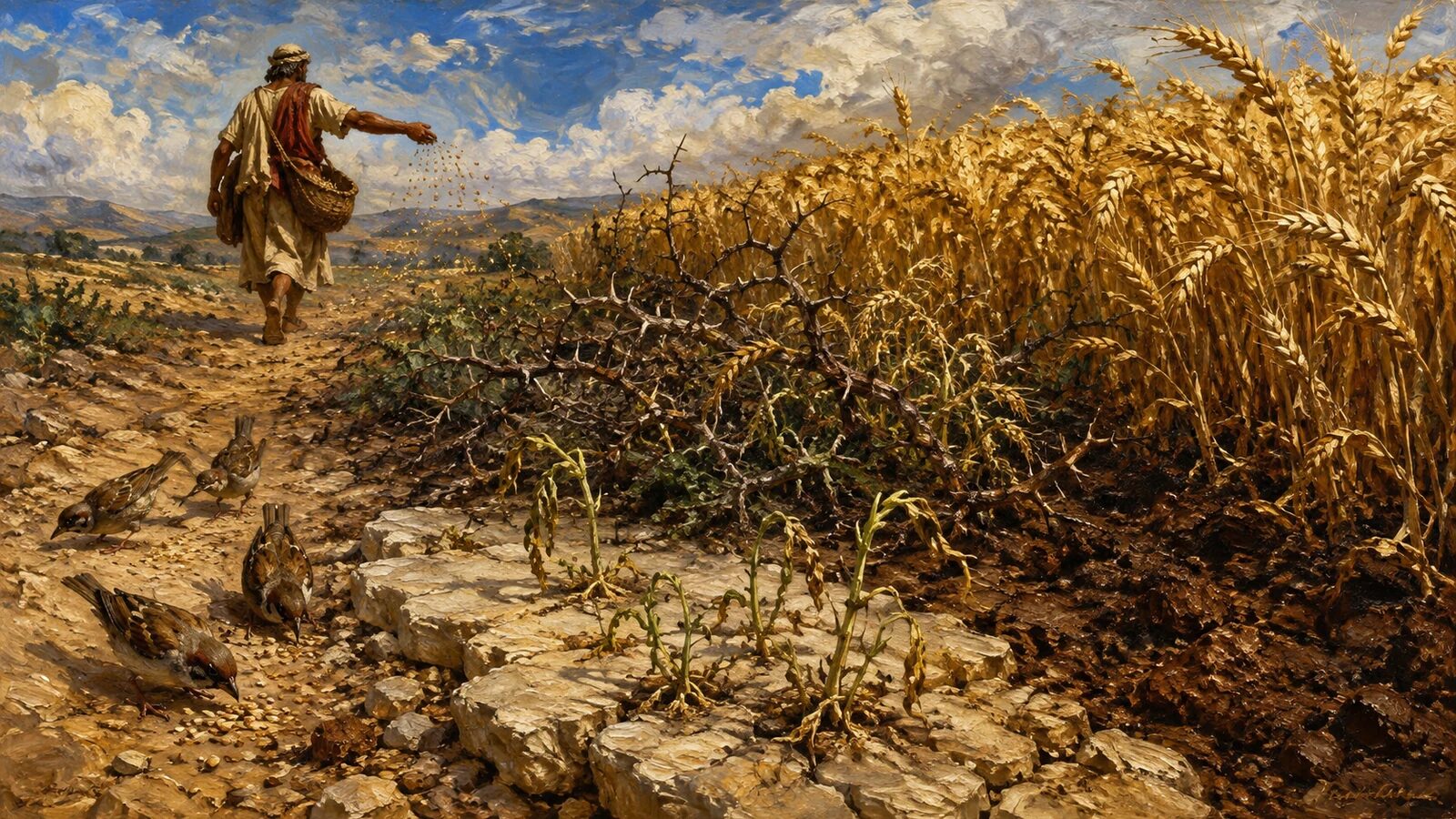
Jesus describes people who hear the same Word and respond very differently. That makes me consider how I am hearing it, because He places the problem in the hearer’s heart rather than in the seed. I need to let His explanation examine my own response before using it to explain someone else’s.
Jesus describes four kinds of hearers. One continues to harden his heart, while another responds with immediate emotion and falls away when following Christ becomes costly. A third allows anxiety and the pursuit of money and pleasure to crowd out the Word until no fruit matures. The final hearer receives it with understanding and holds it fast, bearing fruit patiently over time.
The Parable of the Sower uses seed and soil to explain what happens when people hear God’s Word. The condition of each heart affects how the Word is received, and the harvest reveals whether that reception was genuine. Matthew 13 records both the parable and Jesus’ explanation. Mark and Luke confirm its meaning while supplying details that help us understand Matthew.
Jesus’ audience knew the sight of a farmer scattering seed by hand. Some landed on a packed path through or beside the field, while other seed fell on thin soil with rock underneath. Thorn roots lay in another part of the ground, ready to grow alongside the seed. Prepared soil produced a crop. Jesus used those visible differences to explain what happens within the people who hear.
I should not assume that hearing the Word means I have received it. Jesus describes outright resistance as well as responses that fail under pressure or become choked by competing desires. Yet this warning also encourages those who share Scripture. Jesus told His servants to expect different responses, so they must not change the message in search of better results. Neither should they blame themselves for every rejection or stop sowing because some hearers remain fruitless.
Why Jesus Used Parables
Matthew places this parable after a period of growing opposition. In the preceding chapter, Jesus healed and taught while some Pharisees attributed His work by the Holy Spirit to Beelzebub. The scribes and Pharisees demanded another sign despite the evidence already given. That same day, Jesus left the house and taught a large crowd from a boat while they stood on the shore. They were all near enough to hear Him, but they were not receiving Him in the same way.
When the disciples asked why He spoke in parables, Jesus quoted Isaiah 6. Isaiah had been sent to a nation that repeatedly resisted God and would go on hearing without receiving. Jesus applied that pattern to His own listeners. They could see and hear, but refusal had made their hearts dull. The parables revealed kingdom truth to receptive disciples while hardened hearers left the teaching unexplored. Those who wanted to understand came closer and asked Him, while others let the same words pass without responding.
Therefore I speak to them in parables, because seeing they do not see, and hearing they do not hear, nor do they understand.
I don’t understand Jesus to be refusing salvation to a sincere seeker who is willing to receive the truth. He was confronting moral and spiritual resistance. Matthew says the people had closed their own eyes, so this was a refusal for which they were responsible, not an inability imposed on innocent hearers. Their response to the parable exposed that difference. Would they come to Jesus for understanding as the disciples did, or let His words pass without responding?
Jesus explained that someone who receives truth will be given more, while someone who refuses it will lose even what he seemed to possess. Our response to truth shapes the heart. Receiving it prepares us to understand more, and refusing it increases our hardness. His words describe that responsibility rather than arbitrary cruelty.
For whoever has, to him more will be given, and he will have abundance; but whoever does not have, even what he has will be taken away from him.
The Seed Is the Word
Luke states the meaning plainly: “The seed is the word of God.” Matthew calls it the word of the kingdom, and Mark calls it the word. All three direct us to what God has spoken as the source of life. I find encouragement in that distinction when thinking about the sower. He may be weak or tired, and his ordinary work may pass unnoticed, but the seed itself is never weak.
Now the parable is this: The seed is the word of God.
A person’s charisma cannot replace God’s Word, and pressure cannot produce spiritual life. Branding or entertainment may gain attention, but neither gives life. Emotional manipulation cannot do it either. God does use people to speak His Word, whether a pastor preaching publicly or a parent or friend in an ordinary conversation. Evangelists take it to those who have not heard. The power remains in God’s Word, so faithful ministry keeps teaching Scripture clearly with the gospel of Jesus Christ at its center.
The word of the kingdom centers on Jesus, the eternal Son who is fully God and fully man. He calls sinners to repent and believe Him. Wicked men physically tortured and punished His innocent body, shed His blood, and killed Him on the cross. He willingly bore that punishment for our sins and rose bodily from the dead. The Father did not punish or curse His beloved Son. He did not abandon, strike, or bruise Jesus, nor pour wrath upon Him. Christ died for the whole world, and His genuine offer can be received or resisted. Everyone who repents and believes is forgiven and born again. The Holy Spirit lives in each believer and seals them, and their salvation is eternally secure. Good works follow salvation as its fruit; they never produce it.
Even the wayside hearer truly encounters the Word. Jesus says it was sown in that person’s heart, though it was later rejected. The message had reached the hearer. The difficulty lay in the heart’s response and the enemy’s work while the Word remained on the surface.
The Hardened and Shallow Hearers
The wayside is a path packed hard by people’s feet. Seed lands on it without sinking in, and birds eat it. Jesus used that picture for someone who hears the word of the kingdom without understanding it. The wicked one then snatches away what was sown in the heart.
When anyone hears the word of the kingdom, and does not understand it, then the wicked one comes and snatches away what was sown in his heart.
Mark names the enemy as Satan and says he comes immediately to take the Word from their hearts. That makes me take gospel preaching seriously as a spiritual conflict. We are doing more than exchanging opinions. A real enemy opposes the Word and every call to repentance because he hates the faith that receives God’s truth. He works to prevent the message from settling into the heart.
When they hear, Satan comes immediately and takes away the word that was sown in their hearts.
Satan’s opposition does not remove the hearer’s responsibility. Scripture repeatedly warns us not to harden our hearts, and refusing truth makes that resistance stronger. Pride reinforces it, while cherished sin gives us a reason to remain closed. John explains that people love darkness because their deeds are evil and they do not want the light to expose them.
If you are praying for someone whose heart is hard, keep speaking the truth and praying with earnest love. You cannot soften that heart by argument alone, but God can break the hard ground. I also need to guard my own heart against sin instead of becoming cruel or cynical toward the person who resists. Jesus did not tell sowers to avoid the hard paths. He prepared them for resistance and for the enemy’s quick response.
On stony ground, the thin soil allows a quick sprout but the rock underneath prevents deep roots. The early growth looks impressive until the sun’s heat scorches the plant and it withers. Jesus compared this to someone who receives the Word with joy but has no root.
But he who received the seed on stony places, this is he who hears the word and immediately receives it with joy; yet he has no root in himself, but endures only for a while.
In Matthew 13:21, the Greek word translated “stumbles” is skandalizō. It can describe being offended or tripped, or being caused to fall away. Here the pressure reveals the hearer’s lack of root rather than creating it.
I need to distinguish a joyful response from the new birth without treating joy itself as suspect. The gospel is good news, and joy can accompany genuine faith. It simply does not prove conversion on its own. Some people welcome the relief and belonging they find around a church, enjoying its music and community or the prospect of a fresh start. But their response collapses when the Word confronts their sin or following Christ becomes costly.
Jesus said the tribulation or persecution arose because of the Word. The message itself brought the pressure. Someone may be comfortable with a version of Christianity that leaves his life and relationships unchallenged and never calls him to repent. It costs him no conflict with the world. When the real Word speaks with authority, however, the shallow hearer takes offense.
A quick response must not become the end of discipleship. People need the whole counsel of Scripture and a growing life of prayer. Fellowship encourages them, and correction exposes assumptions they need to reconsider. Ordinary obedience develops the habits of faith. If I judge ministry only by how quickly people respond, I can overlook the lack of root that pressure will later expose.
The Crowded Heart
The thorny soil may look promising longer than the stony ground. The seed starts growing, but thorns grow alongside it and choke the Word until the hearer becomes unfruitful. The problem is a crowded heart rather than immediate rejection.
Now he who received seed among the thorns is he who hears the word, and the cares of this world and the deceitfulness of riches choke the word, and he becomes unfruitful.
Jesus described cares as one of those thorns. Anxiety and burdens can occupy the mind until little room remains for the Word. Riches offer a deceptive promise of safety, which can lead people to seek their identity in money or expect lasting freedom and satisfaction from it. Luke also names the pleasures of life. Comfort can become a ruling desire, and amusement can make spiritual dullness seem harmless. These things often grow quietly rather than looking dangerous from the start.
Now the ones that fell among thorns are those who, when they have heard, go out and are choked with cares, riches, and pleasures of life, and bring no fruit to maturity.
Luke directs attention to the fruit that never matures. Leaves can make a plant look active without producing a harvest. In much the same way, a person can keep using religious language while rival loves and fears choke the Word. Busyness may even look respectable and responsible to others while the heart becomes barren before God.
I would not judge a thorny hearer to be born again simply because some growth is visible. Jesus points to the absence of mature fruit, and a profession without enduring fruit provides no sound basis for assurance. Genuine believers need this warning too. Tolerated cares and desires can damage our fellowship with God and hinder obedience, leaving us far less useful. The warning addresses false confidence and carelessness without teaching that someone truly born again can lose salvation.
I need to ask what receives my time and what keeps being squeezed out. If Scripture confronts something I want to protect, that deserves an honest response. An anxiety may be ruling my choices, or a desired purchase may be directing my schedule more than God’s Word. Ambition can do the same, along with an entertainment habit or the pursuit of comfort. Disliking those thorns will not remove them. We need to identify them in repentance and respond with deliberate obedience.
The Good Soil and Lasting Fruit
The good soil receives the seed so that it takes root and produces fruit. Matthew records harvests of a hundredfold, sixty, and thirty. Jesus was not setting up a comparison between believers. He was showing that genuinely receiving the Word produces real fruit.
But he who received seed on the good ground is he who hears the word and understands it, who indeed bears fruit and produces: some a hundredfold, some sixty, some thirty.
Luke says the good hearer receives the Word with a noble and good heart, keeps it, and bears fruit with patience. That patience helps me understand why quiet growth should not be overlooked. This hearer continues to hold the Word when feelings change or life becomes heavy. Costly obedience and a longer wait for fruit do not make him let it go.
But the ones that fell on the good ground are those who, having heard the word with a noble and good heart, keep it and bear fruit with patience.
A noble and good heart does not mean someone is naturally sinless or deserves salvation. Luke describes an honest willingness to receive God’s Word, not goodness that earns life. That person yields when Scripture corrects him and confesses the sin it exposes. He trusts God’s character when the Word brings comfort and obeys when God gives a command. His life moves toward Christ under Scripture’s authority.
Fruit gives evidence of life; it does not cause salvation. We are saved by grace through faith in Jesus Christ, without producing enough good works to buy forgiveness. Yet God’s gift of new life produces fruit. A born-again person is not designed to remain fruitless.
The differences between these hearers are not morally neutral. Some harden themselves or remain shallow, while others let their hearts become crowded. Those who receive truth are given more light, and those who resist grow increasingly dull. John explains that people love darkness rather than light because their deeds are evil.
And this is the condemnation, that the light has come into the world, and men loved darkness rather than light, because their deeds were evil.
Hebrews warns us directly: “Today, if you will hear His voice, Do not harden your hearts” (Hebrews 3:7-8). People are responsible for responding to God’s voice. They are not machines forced to reject Him. He calls them to repent and believe instead of hardening themselves further against what He says.
God can change the soil by breaking hard ground or deepening what is shallow. He can expose the thorns that have crowded out His Word. I should not turn these descriptions into permanent labels that leave people beyond hope. The patterns are real, but we must keep praying and speaking the truth as we plead with sinners to come to Christ.
Everyone truly born again is eternally secure in Christ’s finished work and resurrection life, sealed by the Holy Spirit. That does not make Jesus’ warning unnecessary for believers. We can tolerate thorns until we grow dull toward Scripture and lose our fruitfulness. Our spiritual clarity and obedience can suffer too. The answer is to repent and listen again, bringing our lives under God’s Word, rather than fearing that Christ will abandon His sheep.
Sowing the Word Without Quitting
Jesus prepared His disciples for these different responses before sending them out with the message of the kingdom. That encourages everyone who teaches Scripture, including parents raising children under the Word and pastors preaching publicly. Counselors and evangelists encounter these same responses, as does a believer sharing the gospel with a friend.
When people respond differently, I must not assume the Word has failed or that every rejection is my fault. Replacing it with something more exciting will not produce life. Neither will forcing a response through pressure, fear, or flattery, or relying on entertainment. Jesus directs us to keep sowing the Word faithfully and clearly while praying for God to work in every hearer.
I planted, Apollos watered, but God gave the increase.
Paul planted and Apollos later watered. Their work mattered, but neither could manufacture life. God gave the increase through His Word and Spirit. He convicts and draws as He genuinely calls hearers, and they remain responsible to receive or resist the truth. I can take responsibility for speaking clearly and courageously without trying to force the outcome. Faithful sowing is active work carried on in patient love, even when visible results are slow.
Parents can keep that same confidence as they teach their children Scripture and pray with them regularly. Correct them when necessary while keeping the gospel clear. Temporary excitement is not proof of settled faith, and resistance is no reason to give up. God’s Word is not weak. Keep speaking it with humility and tenderness while remaining firm about its truth.
My Final Thoughts
I need to examine my own hearing instead of using the parable to become suspicious of everyone else. Admiring it from a distance is not the same as letting it take root. Genuine reception produces fruit with patience, while shallow and crowded responses warn against false confidence. When we share the gospel, we need to keep that message pure and speak it faithfully. God gives the increase, and we can trust Him as we continue sowing.