
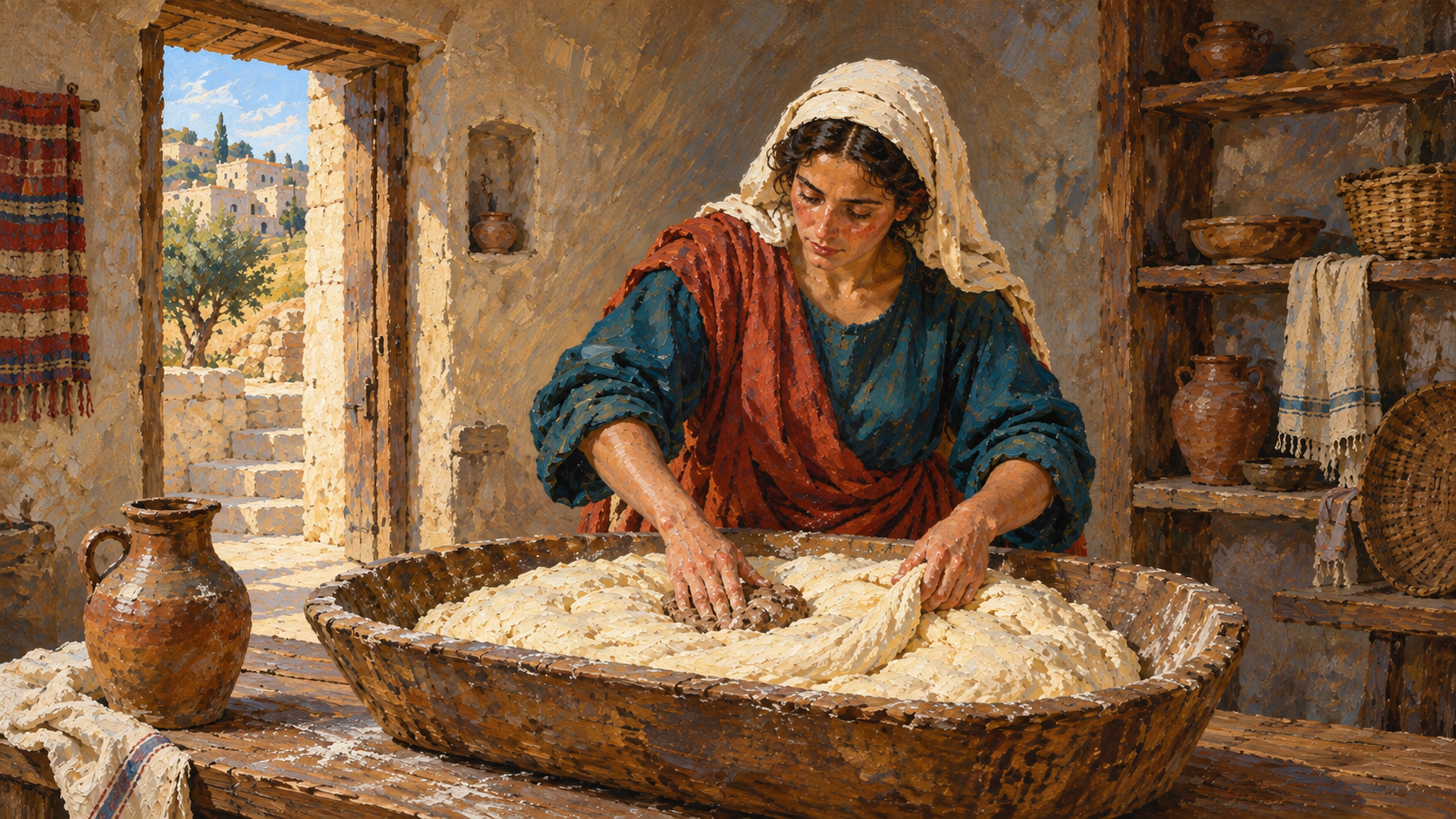
The Parable of the Leaven is only one sentence in Matthew and two verses in Luke. So what does the leaven mean here: the quiet spread of God’s kingdom, or corruption as it does in some other passages? I believe the answer becomes clear when we keep Jesus’ comparison inside its Gospel setting and let the rest of the Bible show us how symbols work.
Reading the Parable in Matthew and Luke
Matthew 13:33 says the kingdom of heaven is like leaven a woman took and hid in three measures of meal until all was leavened. Luke 13:20-21 uses “kingdom of God” and gives the same action.
The two expressions do not describe competing kingdoms. Matthew characteristically writes “kingdom of heaven,” while Luke usually writes “kingdom of God.” The parallel wording here shows that both expressions describe the same royal rule rather than two separate programs.
Neither Gospel supplies a direct explanation like the ones Jesus gives for the Sower and the Weeds. We must infer the main point from the comparison itself and its placement among the other parables. The normal function of leaven and the Bible’s broader kingdom teaching also guide us. Details that Scripture does not explain should be held with humility.
On the same day Jesus went out of the house and sat by the sea. And great multitudes were gathered together to Him, so that He got into a boat and sat; and the whole multitude stood on the shore. Then He spoke many things to them in parables, saying: “Behold, a sower went out to sow. And as he sowed, some seed fell by the wayside; and the birds came and devoured them. Some fell on stony places, where they did not have much earth; and they immediately sprang up because they had no depth of earth. But when the sun was up they were scorched, and because they had no root they withered away. And some fell among thorns, and the thorns sprang up and choked them. But others fell on good ground and yielded a crop: some a hundredfold, some sixty, some thirty. He who has ears to hear, let him hear!” And the disciples came and said to Him, “Why do You speak to them in parables?” He answered and said to them, “Because it has been given to you to know the mysteries of the kingdom of heaven, but to them it has not been given. For whoever has, to him more will be given, and he will have abundance; but whoever does not have, even what he has will be taken away from him. Therefore I speak to them in parables, because seeing they do not see, and hearing they do not hear, nor do they understand. And in them the prophecy of Isaiah is fulfilled, which says: ‘Hearing you will hear and shall not understand, And seeing you will see and not perceive; For the hearts of this people have grown dull. Their ears are hard of hearing, And their eyes they have closed, Lest they should see with their eyes and hear with their ears, Lest they should understand with their hearts and turn, So that I should heal them.’ But blessed are your eyes for they see, and your ears for they hear; for assuredly, I say to you that many prophets and righteous men desired to see what you see, and did not see it, and to hear what you hear, and did not hear it. “Therefore hear the parable of the sower: When anyone hears the word of the kingdom, and does not understand it, then the wicked one comes and snatches away what was sown in his heart. This is he who received seed by the wayside. But he who received the seed on stony places, this is he who hears the word and immediately receives it with joy; yet he has no root in himself, but endures only for a while. For when tribulation or persecution arises because of the word, immediately he stumbles. Now he who received seed among the thorns is he who hears the word, and the cares of this world and the deceitfulness of riches choke the word, and he becomes unfruitful. But he who received seed on the good ground is he who hears the word and understands it, who indeed bears fruit and produces: some a hundredfold, some sixty, some thirty.” Another parable He put forth to them, saying: “The kingdom of heaven is like a man who sowed good seed in his field; but while men slept, his enemy came and sowed tares among the wheat and went his way. But when the grain had sprouted and produced a crop, then the tares also appeared. So the servants of the owner came and said to him, ‘Sir, did you not sow good seed in your field? How then does it have tares?’ He said to them, ‘An enemy has done this.’ The servants said to him, ‘Do you want us then to go and gather them up?’ But he said, ‘No, lest while you gather up the tares you also uproot the wheat with them. Let both grow together until the harvest, and at the time of harvest I will say to the reapers, “First gather together the tares and bind them in bundles to burn them, but gather the wheat into my barn.”‘” Another parable He put forth to them, saying: “The kingdom of heaven is like a mustard seed, which a man took and sowed in his field, which indeed is the least of all the seeds; but when it is grown it is greater than the herbs and becomes a tree, so that the birds of the air come and nest in its branches.” Another parable He spoke to them: “The kingdom of heaven is like leaven, which a woman took and hid in three measures of meal till it was all leavened.” All these things Jesus spoke to the multitude in parables; and without a parable He did not speak to them, that it might be fulfilled which was spoken by the prophet, saying: “I will open My mouth in parables; I will utter things kept secret from the foundation of the world.”
Matthew places the Leaven after the Sower and the Weeds. It also follows the Mustard Seed. The kingdom word meets different hearts in the first parable, while the enemy plants counterfeits in the world in the second. A small mustard seed then grows into a conspicuous plant before Jesus describes leaven working through a batch of flour.
This setting combines growth with opposition and mixture. The Word bears fruit even while the devil works. The sons of the kingdom remain in the world alongside the sons of the wicked one until harvest. Through it all, God’s kingdom reaches the outcome He determined.
The parables reveal truths kept hidden while also exposing dull hearing. They are not simple moral tales that every listener automatically understands. “He who has ears to hear” calls for receptive faith.
Then Jesus sent the multitude away and went into the house. And His disciples came to Him, saying, “Explain to us the parable of the tares of the field.” He answered and said to them: “He who sows the good seed is the Son of Man. The field is the world, the good seeds are the sons of the kingdom, but the tares are the sons of the wicked one. The enemy who sowed them is the devil, the harvest is the end of the age, and the reapers are the angels. Therefore as the tares are gathered and burned in the fire, so it will be at the end of this age. The Son of Man will send out His angels, and they will gather out of His kingdom all things that offend, and those who practice lawlessness, and will cast them into the furnace of fire. There will be wailing and gnashing of teeth. Then the righteous will shine forth as the sun in the kingdom of their Father. He who has ears to hear, let him hear! “Again, the kingdom of heaven is like treasure hidden in a field, which a man found and hid; and for joy over it he goes and sells all that he has and buys that field. “Again, the kingdom of heaven is like a merchant seeking beautiful pearls, who, when he had found one pearl of great price, went and sold all that he had and bought it. “Again, the kingdom of heaven is like a dragnet that was cast into the sea and gathered some of every kind, which, when it was full, they drew to shore; and they sat down and gathered the good into vessels, but threw the bad away. So it will be at the end of the age. The angels will come forth, separate the wicked from among the just, and cast them into the furnace of fire. There will be wailing and gnashing of teeth.” Jesus said to them, “Have you understood all these things?” They said to Him, “Yes, Lord.” Then He said to them, “Therefore every scribe instructed concerning the kingdom of heaven is like a householder who brings out of his treasure things new and old.”
Now He was teaching in one of the synagogues on the Sabbath. And behold, there was a woman who had a spirit of infirmity eighteen years, and was bent over and could in no way raise herself up. But when Jesus saw her, He called her to Him and said to her, “Woman, you are loosed from your infirmity.” And He laid His hands on her, and immediately she was made straight, and glorified God. But the ruler of the synagogue answered with indignation, because Jesus had healed on the Sabbath; and he said to the crowd, “There are six days on which men ought to work; therefore come and be healed on them, and not on the Sabbath day.” The Lord then answered him and said, “Hypocrite! Does not each one of you on the Sabbath loose his ox or donkey from the stall, and lead it away to water it? So ought not this woman, being a daughter of Abraham, whom Satan has bound–think of it–for eighteen years, be loosed from this bond on the Sabbath?” And when He said these things, all His adversaries were put to shame; and all the multitude rejoiced for all the glorious things that were done by Him. Then He said, “What is the kingdom of God like? And to what shall I compare it? It is like a mustard seed, which a man took and put in his garden; and it grew and became a large tree, and the birds of the air nested in its branches.” And again He said, “To what shall I liken the kingdom of God? It is like leaven, which a woman took and hid in three measures of meal till it was all leavened.” And He went through the cities and villages, teaching, and journeying toward Jerusalem. Then one said to Him, “Lord, are there few who are saved?” And He said to them, “Strive to enter through the narrow gate, for many, I say to you, will seek to enter and will not be able. When once the Master of the house has risen up and shut the door, and you begin to stand outside and knock at the door, saying, ‘Lord, Lord, open for us,’ and He will answer and say to you, ‘I do not know you, where you are from,’ then you will begin to say, ‘We ate and drank in Your presence, and You taught in our streets.’ But He will say, ‘I tell you I do not know you, where you are from. Depart from Me, all you workers of iniquity.’ There will be weeping and gnashing of teeth, when you see Abraham and Isaac and Jacob and all the prophets in the kingdom of God, and yourselves thrust out. They will come from the east and the west, from the north and the south, and sit down in the kingdom of God. And indeed there are last who will be first, and there are first who will be last.”
Jesus heals a woman who had been bent over for eighteen years. The synagogue ruler objects because the healing occurred on the Sabbath. Jesus exposes his hypocrisy and identifies the sufferer as a daughter of Abraham whom Satan had bound. He says plainly that she ought to be loosed.
Luke calls her condition a “spirit of infirmity,” and Jesus describes Satan’s bondage in this particular case. The passage does not teach that every disability or illness results from a demon. Luke records the spiritual oppression because it helps readers see the kingdom confrontation taking place: Christ’s authority releases a suffering woman whom Satan had held for eighteen years.
His opponents are put to shame while the crowd rejoices. Jesus then immediately asks what the kingdom of God is like and gives the Mustard Seed and Leaven together. The King showed His authority by freeing one overlooked sufferer even while religious leaders resisted Him.
Luke’s placement leads me toward a hopeful primary comparison. The ministry of Jesus may look small and contested in the scene, but it carries God’s liberating authority and will not fail to reach its appointed end.
What Leaven and Three Measures Meant
Ancient leaven was commonly a piece of fermented dough retained from an earlier batch. Mixed into fresh flour and water, microorganisms within it produced fermentation that changed the new dough. It functioned like sourdough starter rather than a packet of modern commercial yeast.
A small portion could affect a much larger mass, but the process was not immediately visible from outside. Time allowed the influence to spread. That ordinary kitchen experience supplies the image Jesus used.
We should not make the parable depend on the false scientific claim that fermentation can never be interrupted. The temperature and moisture of dough affect the process. Salt and other conditions do as well. The certainty of the kingdom comes from the King rather than from treating bread chemistry as irresistible magic.
The Greek word saton represents a dry measure related to the Hebrew seah. Three seahs equal roughly one ephah. Although ancient measures varied by place and modern reconstruction, the total was clearly a large quantity of flour capable of feeding many people.
Modern weight estimates vary because volume does not translate into one fixed flour weight. The type of flour and the way it is packed make a difference, as does its moisture. Estimates also depend on the size assigned to the ancient unit. A confident claim of exactly fifty pounds therefore says more than the evidence allows. “A very large batch” communicates the point without pretending the ancient volume has one certain modern weight.
The quantity makes the contrast vivid. The leaven begins as a comparatively small hidden portion, yet its effect extends through an amount far larger than an ordinary loaf.
When the LORD appears visibly to Abraham, two angels accompany Him; Genesis 19 identifies the two who continue to Sodom as angels. The visible LORD is a preincarnate appearance of the eternal Son, a Christophany. Abraham tells Sarah to prepare three measures of fine meal for the visitors. The same large hospitality quantity may have sounded familiar to Jesus’ hearers.
Then the LORD appeared to him by the terebinth trees of Mamre, as he was sitting in the tent door in the heat of the day. So he lifted his eyes and looked, and behold, three men were standing by him; and when he saw them, he ran from the tent door to meet them, and bowed himself to the ground, and said, “My Lord, if I have now found favor in Your sight, do not pass on by Your servant. Please let a little water be brought, and wash your feet, and rest yourselves under the tree. And I will bring a morsel of bread, that you may refresh your hearts. After that you may pass by, inasmuch as you have come to your servant.” They said, “Do as you have said.” So Abraham hurried into the tent to Sarah and said, “Quickly, make ready three measures of fine meal; knead it and make cakes.” And Abraham ran to the herd, took a tender and good calf, gave it to a young man, and he hastened to prepare it. So he took butter and milk and the calf which he had prepared, and set it before them; and he stood by them under the tree as they ate.
The verbal echo can enrich the picture of abundant bread preparation, but Jesus does not cite Genesis 18 or declare the meal sacred. A possible background is different from an inspired interpretation.
Gideon prepared an ephah of flour in Judges 6, which is equivalent to three seahs. The NKJV, however, does not use the phrase “three measures” there. 1 Samuel 1:24 in the Masoretic Hebrew speaks of three bulls and one ephah of flour. It does not say that Hannah brought three measures of flour. Similar quantities may provide background, but they do not create a hidden code for interpreting Jesus’ parable.
Why Context Must Control the Symbol
A lion can picture Christ as the Lion of Judah, but it can also picture the devil prowling for prey. Water sometimes pictures cleansing or life. In other passages, it may represent chaos or judgment. Sometimes it is simply water for drinking. An object does not carry a fixed doctrinal definition into every passage.
Leaven works the same way. Its ability to spread makes it useful for warning about hypocrisy and sin. Scripture can also use that action to warn about false teaching. Yet the same permeating action can illustrate the kingdom’s hidden reach when the immediate comparison points in a positive direction.
I believe responsible interpretation begins by asking what the speaker actually compares and which action receives emphasis. We then consider how the saying relates to the surrounding material. Any explanation Scripture gives for the image elsewhere must also be considered. A symbol dictionary detached from context creates contradictions the text never intended.
At Passover, Israel removed leaven and ate unleavened bread. The removal first reflected the historical urgency of their departure from Egypt. It then became part of the memorial feast. Paul later applies this Passover imagery to church discipline and sincere Christian living.
‘So this day shall be to you a memorial; and you shall keep it as a feast to the LORD throughout your generations. You shall keep it as a feast by an everlasting ordinance. Seven days you shall eat unleavened bread. On the first day you shall remove leaven from your houses. For whoever eats leavened bread from the first day until the seventh day, that person shall be cut off from Israel. On the first day there shall be a holy convocation, and on the seventh day there shall be a holy convocation for you. No manner of work shall be done on them; but that which everyone must eat–that only may be prepared by you. So you shall observe the Feast of Unleavened Bread, for on this same day I will have brought your armies out of the land of Egypt. Therefore you shall observe this day throughout your generations as an everlasting ordinance. In the first month, on the fourteenth day of the month at evening, you shall eat unleavened bread, until the twenty-first day of the month at evening. For seven days no leaven shall be found in your houses, since whoever eats what is leavened, that same person shall be cut off from the congregation of Israel, whether he is a stranger or a native of the land. You shall eat nothing leavened; in all your dwellings you shall eat unleavened bread.'”
In the meantime, when an innumerable multitude of people had gathered together, so that they trampled one another, He began to say to His disciples first of all, “Beware of the leaven of the Pharisees, which is hypocrisy. For there is nothing covered that will not be revealed, nor hidden that will not be known. Therefore whatever you have spoken in the dark will be heard in the light, and what you have spoken in the ear in inner rooms will be proclaimed on the housetops.
Jesus identifies the leaven of the Pharisees as hypocrisy. Hidden pretense spreads, but it will finally be exposed. Elsewhere He warns about the teaching shared by the Pharisees and Sadducees. He also speaks of the leaven of Herod.
These passages establish a strong negative association, which is why the corruption interpretation of Matthew 13 deserves a fair hearing. They do not settle the parable before its own context is read.
Leviticus generally forbids leaven in grain offerings burned upon the altar. That restriction is specific rather than universal. A thanksgiving peace offering included leavened bread. The Feast of Weeks likewise required two wave loaves baked with leaven.
‘When anyone offers a grain offering to the LORD, his offering shall be of fine flour. And he shall pour oil on it, and put frankincense on it. He shall bring it to Aaron’s sons, the priests, one of whom shall take from it his handful of fine flour and oil with all the frankincense. And the priest shall burn it as a memorial on the altar, an offering made by fire, a sweet aroma to the LORD. The rest of the grain offering shall be Aaron’s and his sons’. It is most holy of the offerings to the LORD made by fire. ‘And if you bring as an offering a grain offering baked in the oven, it shall be unleavened cakes of fine flour mixed with oil, or unleavened wafers anointed with oil. But if your offering is a grain offering baked in a pan, it shall be of fine flour, unleavened, mixed with oil. You shall break it in pieces and pour oil on it; it is a grain offering. ‘If your offering is a grain offering baked in a covered pan, it shall be made of fine flour with oil. You shall bring the grain offering that is made of these things to the LORD. And when it is presented to the priest, he shall bring it to the altar. Then the priest shall take from the grain offering a memorial portion, and burn it on the altar. It is an offering made by fire, a sweet aroma to the LORD. And what is left of the grain offering shall be Aaron’s and his sons’. It is most holy of the offerings to the LORD made by fire. ‘No grain offering which you bring to the LORD shall be made with leaven, for you shall burn no leaven nor any honey in any offering to the LORD made by fire. As for the offering of the firstfruits, you shall offer them to the LORD, but they shall not be burned on the altar for a sweet aroma. And every offering of your grain offering you shall season with salt; you shall not allow the salt of the covenant of your God to be lacking from your grain offering. With all your offerings you shall offer salt.
‘This is the law of the sacrifice of peace offerings which he shall offer to the LORD: If he offers it for a thanksgiving, then he shall offer, with the sacrifice of thanksgiving, unleavened cakes mixed with oil, unleavened wafers anointed with oil, or cakes of blended flour mixed with oil. Besides the cakes, as his offering he shall offer leavened bread with the sacrifice of thanksgiving of his peace offering. And from it he shall offer one cake from each offering as a heave offering to the LORD. It shall belong to the priest who sprinkles the blood of the peace offering.
‘And you shall count for yourselves from the day after the Sabbath, from the day that you brought the sheaf of the wave offering: seven Sabbaths shall be completed. Count fifty days to the day after the seventh Sabbath; then you shall offer a new grain offering to the LORD. You shall bring from your dwellings two wave loaves of two-tenths of an ephah. They shall be of fine flour; they shall be baked with leaven. They are the firstfruits to the LORD. And you shall offer with the bread seven lambs of the first year, without blemish, one young bull, and two rams. They shall be as a burnt offering to the LORD, with their grain offering and their drink offerings, an offering made by fire for a sweet aroma to the LORD. Then you shall sacrifice one kid of the goats as a sin offering, and two male lambs of the first year as a sacrifice of a peace offering. The priest shall wave them with the bread of the firstfruits as a wave offering before the LORD, with the two lambs. They shall be holy to the LORD for the priest. And you shall proclaim on the same day that it is a holy convocation to you. You shall do no customary work on it. It shall be a statute forever in all your dwellings throughout your generations.
These commands do not make leaven a symbol of righteousness. They do show that Scripture can include actual leaven in accepted worship contexts and that the ingredient is not intrinsically sinful. For that reason, the meaning in this parable must arise from Jesus’ comparison rather than from a rule that leaven always equals evil.
The positive reading takes the way leaven spreads unseen through the dough as the main point. This fits the neighboring Mustard Seed, which moves from a small beginning to a large result. It also fits Luke’s placement of the parable after a kingdom deliverance. Jesus says the kingdom is like the leavening process continuing until completion.
The negative reading begins with the way leaven commonly symbolizes corruption. Its advocates also point to the enemy’s work in Matthew 13 and the mixture within the field. Later visible Christianity certainly contains false teaching. Some interpreters also regard the Mustard Seed’s tree-like growth as abnormal and identify the birds with evil.
After comparing these passages, I believe the positive reading best fits the parable while preserving the warnings supplied by the surrounding discourse. The kingdom’s influence works quietly and extends far beyond its small beginning. Even so, contact with visible Christian influence does not make every person regenerate. The Weeds and Sower prevent that conclusion.
The opposing reading raises a valid pastoral concern about corruption. Its weakness is making the comparison depend on a negative symbolic rule even though Jesus directly likens the kingdom to the leaven’s completed action.
Hidden Influence and a Certain Outcome
Matthew and Luke use a verb meaning to hide or conceal within. The woman works the leaven into the flour so that the active portion is no longer visible as a separate lump.
Hidden does not imply deception here. The ordinary baker places starter inside dough because interior contact is how it works. Jesus emphasizes an effect that may begin beyond public notice.
The kingdom arrived in the humble ministry of Jesus rather than with the immediate political spectacle many expected. He taught the truth and healed the sick while exercising authority over demons. He also called disciples who would become His witnesses. After He died and rose, He sent them into the world. God’s rule was active even when rulers and religious elites judged it weak.
The woman need not symbolize the church or Israel. Nothing in the parable identifies her with wisdom. The text also gives no reason to make her represent false religion or a corrupt institution. She is simply the person carrying out the familiar household action required by the comparison.
The endpoint is the complete permeation of the measured meal, so the parable moves toward an appointed result rather than endless uncertainty. What begins hidden eventually becomes effective throughout the whole batch.
This does not require the postmillennial conversion of every person or institution before Jesus returns. Matthew 13 says the weeds remain until harvest and that the net gathers both good and bad. Scripture predicts apostasy and persecution before the bodily return of Christ. The Antichrist and the Tribulation also come before that return.
“All” belongs first to the flour in the story. The corresponding kingdom truth is that God’s work is thorough and certain within the sphere He appoints. Jesus is not promising universal salvation or the moral perfection of the present world.
Both Matthew and Luke place the Mustard Seed immediately before the Leaven. The first moves from a tiny seed to a large garden plant with branches. The second moves from hidden starter to a fully affected batch.
The pair gives us two perspectives on the same surprising development. The mustard plant makes the growth visible, while the leaven works inside the dough. People cannot control the kingdom’s growth, and for a time they may not even notice it. The result greatly exceeds the first impression.
The pairing does not demand that every detail match. The man and woman are ordinary actors in different household scenes. The birds and flour should not be forced into one parallel symbolic chart.
The Weeds immediately precedes this pair in Matthew. Jesus explains that the field represents the world. The good seed are the sons of the kingdom, while the tares are the sons of the wicked one. He identifies the devil as the enemy and the end of the age as the harvest.
The kingdom’s real advance therefore takes place while counterfeit religion and hostile influence remain active. Visible reach is not the same as universal new birth. Church history contains faithful witness alongside shallow professions of faith. It also records cultural borrowing and compromise. Periods of persecution and seasons of reform both belong to that history.
Christ will make the final separation, which means our confidence in His kingdom can remain biblical rather than naive. The King will succeed, but we do not need to pretend that the enemy is inactive in the meantime.
The Kingdom Now and at Christ’s Return
Jesus was the King present among them during His earthly ministry. Disease, demons, and even nature obeyed Him, and He demonstrated authority over sin and death. The gospel announces His death and resurrection while calling people to repent and believe. Those who receive Him become a people who submit to His lordship.
Every believer has been transferred into the kingdom of the Son and lives under His saving rule. Churches bear witness to Christ and teach His commands. They baptize disciples and remember His sacrifice. In these ways, they display kingdom life imperfectly in the present age.
This present reality is genuine without exhausting the kingdom promises. Jesus is seated at the Father’s right hand and rules; the earth has not yet entered the literal thousand-year reign promised after His return.
Jesus will gather His church before the seven-year Tribulation. After that period, He will return bodily in glory and defeat the Antichrist. He will deliver Israel and reign for a literal thousand years. The promised government of Messiah will then become public and worldwide.
The Leaven should not be used to dissolve that future reign into gradual social improvement. The prophets describe a real throne and nations living under the returning King. Their promises concern Israel and include judgment followed by peace. They also anticipate a restored creation.
The same King is at work in both stages. His hidden working now does not cancel the open reign He has promised. Instead, the small beginning teaches us patience while God’s appointed sequence unfolds.
Now when He was asked by the Pharisees when the kingdom of God would come, He answered them and said, “The kingdom of God does not come with observation; nor will they say, ‘See here!’ or ‘See there!’ For indeed, the kingdom of God is within you.” Then He said to the disciples, “The days will come when you will desire to see one of the days of the Son of Man, and you will not see it. And they will say to you, ‘Look here!’ or ‘Look there!’ Do not go after them or follow them. For as the lightning that flashes out of one part under heaven shines to the other part under heaven, so also the Son of Man will be in His day. But first He must suffer many things and be rejected by this generation. And as it was in the days of Noah, so it will be also in the days of the Son of Man: They ate, they drank, they married wives, they were given in marriage, until the day that Noah entered the ark, and the flood came and destroyed them all. Likewise as it was also in the days of Lot: They ate, they drank, they bought, they sold, they planted, they built; but on the day that Lot went out of Sodom it rained fire and brimstone from heaven and destroyed them all. Even so will it be in the day when the Son of Man is revealed. “In that day, he who is on the housetop, and his goods are in the house, let him not come down to take them away. And likewise the one who is in the field, let him not turn back. Remember Lot’s wife. Whoever seeks to save his life will lose it, and whoever loses his life will preserve it. I tell you, in that night there will be two men in one bed: the one will be taken and the other will be left. Two women will be grinding together: the one will be taken and the other left. Two men will be in the field: the one will be taken and the other left.” And they answered and said to Him, “Where, Lord?” So He said to them, “Wherever the body is, there the eagles will be gathered together.”
Jesus answered Pharisees who asked when the kingdom would come. The NKJV reads, “the kingdom of God is within you,” while the Greek expression can also mean “in your midst” or “among you.” I believe the audience helps settle the issue here because Jesus was not telling hostile Pharisees that God’s saving rule filled their hearts. The King and His authority stood among them, yet they failed to recognize Him.
The following instruction to disciples speaks of the future day when the Son of Man is revealed with sudden, visible judgment. The passage combines present royal presence with future public manifestation.
The church consists of born-again Jews and Gentiles united to Christ during this age. The kingdom is God’s royal rule and the realm of the King across His redemptive plan. The two realities overlap without becoming synonyms.
The church proclaims the kingdom and lives under the King, but it does not replace Israel. Neither does it conquer the nations politically before Christ returns. The church does not fulfill every promise concerning Israel’s land and throne.
Visible Christendom, the wider world of people and institutions that identify as Christian, includes those who have not been born again. The parable’s permeation should not be used to declare every cultural artifact bearing a Christian label part of Christ’s saving body.
Living Under the Kingdom’s Influence
A believer is genuinely changed from within through new birth and the indwelling Holy Spirit. Scripture commands us to renew the mind and put off sinful conduct. We are to walk in the Spirit so that our lives bear His fruit.
I think those truths resemble leaven’s interior effect and give us a fitting application. Even so, they are not the main interpretation because the parable explicitly compares leaven with the kingdom rather than with individual sanctification.
Spiritual growth may be gradual, but it is not automatic fermentation. Believers actively trust and obey God. When they sin, they repent and pray while continuing to learn Scripture. They serve others in dependence on the Spirit. Grace trains the will rather than bypassing it.
Jesus’ positive kingdom comparison does not cancel His warnings. Hypocrisy can spread through a community, as can tolerated sexual sin. Legalistic teaching and other forms of false doctrine can do the same.
It is actually reported that there is sexual immorality among you, and such sexual immorality as is not even named among the Gentiles–that a man has his father’s wife! And you are puffed up, and have not rather mourned, that he who has done this deed might be taken away from among you. For I indeed, as absent in body but present in spirit, have already judged (as though I were present) him who has so done this deed. In the name of our Lord Jesus Christ, when you are gathered together, along with my spirit, with the power of our Lord Jesus Christ, deliver such a one to Satan for the destruction of the flesh, that his spirit may be saved in the day of the Lord Jesus. Your glorying is not good. Do you not know that a little leaven leavens the whole lump? Therefore purge out the old leaven, that you may be a new lump, since you truly are unleavened. For indeed Christ, our Passover, was sacrificed for us. Therefore let us keep the feast, not with old leaven, nor with the leaven of malice and wickedness, but with the unleavened bread of sincerity and truth.
Stand fast therefore in the liberty by which Christ has made us free, and do not be entangled again with a yoke of bondage. Indeed I, Paul, say to you that if you become circumcised, Christ will profit you nothing. And I testify again to every man who becomes circumcised that he is a debtor to keep the whole law. You have become estranged from Christ, you who attempt to be justified by law; you have fallen from grace. For we through the Spirit eagerly wait for the hope of righteousness by faith. For in Christ Jesus neither circumcision nor uncircumcision avails anything, but faith working through love. You ran well. Who hindered you from obeying the truth? This persuasion does not come from Him who calls you. A little leaven leavens the whole lump. I have confidence in you, in the Lord, that you will have no other mind; but he who troubles you shall bear his judgment, whoever he is. And I, brethren, if I still preach circumcision, why do I still suffer persecution? Then the offense of the cross has ceased. I could wish that those who trouble you would even cut themselves off!
Paul uses “a little leaven leavens the whole lump” in two negative settings. Corinth must address open immorality. “Deliver such a one to Satan” means removing the unrepentant man from the church’s protected fellowship and returning him to the outside world where Satan operates. The severe action seeks repentance rather than revenge; Paul later urges restoration and comfort when discipline has produced sorrow.
Galatia must reject teaching that makes circumcision and law-keeping conditions of justification. “Fallen from grace” describes abandoning grace as the basis of justification and attempting to be declared righteous by law. Paul is warning what that false path means, not teaching that a person truly born again can become unborn. Christ alone justifies, and adding law as a saving requirement abandons the very principle one claims to supplement.
Church discipline and doctrinal vigilance are therefore compatible with confidence in kingdom advance. The King does not ask His people to call corruption growth.
The disciples could not manufacture the kingdom, but they were commanded to bear witness. They preached Christ and taught Scripture wherever they went. As people believed, the disciples formed churches and taught them how to care for those in need. They kept going through persecution because they trusted God to produce the growth.
The Parable of the Leaven encourages me to remain faithful when results are quiet. God may use a conversation or a faithful sermon in work whose full extent is not immediately visible. He can also work through a translated Bible, patient discipleship within a family, or an unnoticed act of obedience that serves His larger purpose.
The message remains the gospel of Jesus Christ. Jesus is the eternal Son, fully God and fully man, virgin-born and completely sinless. Wicked men physically tortured, punished, and killed Jesus. He willingly bore that real punishment for our sins in His innocent body, shed His blood, died, was buried, and rose bodily. The Father did not punish, curse, abandon, strike, bruise, or pour wrath on Jesus.
Christ died for the whole world, although people can resist God’s genuine offer. Everyone who repents and believes is forgiven and justified, born again and made new, indwelt and sealed by the Holy Spirit, and eternally secure. Security does not excuse lawlessness, and a superficial profession is not proof of new birth. The new life Christ gives bears obedient fruit under the King.
For more of the surrounding kingdom teaching, read the studies on the Mustard Seed, the Weeds and Tares, and the Kingdom of Heaven and the Kingdom of God.
My Final Thoughts
After working through both Gospel settings, I believe Jesus is showing us that God’s kingdom can begin quietly and still reach every part of the work He has appointed. That confidence should never make us careless, because Jesus and Paul also warn that corrupting leaven spreads. When faithful work seems small, we can remain patient instead of trying to manufacture growth. We should also watch what enters our lives and churches. The outcome belongs to the risen Christ, and every promise of His future reign will stand.