
What does Scripture actually tell us about Gabriel? We know his name, but the wings and trumpets we associate with him often come from art or tradition. The title “archangel” often comes from tradition too, so it needs to be checked against the text. I want to follow the passages that name Gabriel and understand how his messages direct us toward God’s plan in Jesus Christ.
What Scripture Tells Us About Gabriel
Gabriel is named in four verses within the sixty-six books of the biblical canon. The canon is the recognized collection of inspired books, so we are counting what Scripture says rather than including later traditions. In Daniel 8:16, a human voice commands Gabriel to help Daniel understand a vision. Daniel 9:21 identifies him as the Gabriel Daniel had seen before and connects his arrival with Daniel’s prayer. Gabriel identifies himself to Zacharias in Luke 1:19, and Luke 1:26 tells us God sent him to Mary in Nazareth.
Those references give us four major assignments, not an extensive biography. Gabriel explained the vision in Daniel 8. In Daniel 9, he helped Daniel understand God’s prophetic program for Israel and Jerusalem, reaching forward to Messiah and events God had already determined. Luke 1 records his announcements concerning John the Baptist and Jesus.
Other passages describe angels without naming Gabriel. Similar work is not enough for me to conclude that Gabriel was the angel involved. Scripture does not identify him as Daniel’s visitor in chapter 10 or as the angel who appeared to Joseph in dreams. Nor does it name Gabriel at the shepherds’ encounter or the empty tomb. The angels who released apostles from prison and delivered Revelation to John are not identified as Gabriel either. Where Scripture leaves a servant unnamed, we should do the same.
The Hebrew name Gavri’el includes a form related to gever, which can refer to a man or strong man, together with El, God. Those who study the name suggest meanings such as ‘man of God,’ ‘strong man of God,’ or ‘God is my strength.’ The familiar rendering ‘God is my strength’ expresses a fitting thought. Still, Scripture never pauses to translate Gabriel’s name for us.
Rather than build doctrine on an uncertain word history, I want to pay attention to what Gabriel actually does. He never boasts about his own power. He receives commands and delivers the word entrusted to him, explaining only what he is authorized to explain. He stands in God’s presence as His servant.
I see the same attention to God in Gabriel’s ministry that his name expresses. Whatever strength he has is created and dependent on God. No angel has an independent source of authority.
Luke plainly calls Gabriel an angel. Angels are ministering spirits, created through the eternal Son and sent to serve according to God’s will. Gabriel is therefore neither divine nor part of the Trinity, and he is not a mediator between God and humanity.
God, who at various times and in various ways spoke in time past to the fathers by the prophets, has in these last days spoken to us by His Son, whom He has appointed heir of all things, through whom also He made the worlds; who being the brightness of His glory and the express image of His person, and upholding all things by the word of His power, when He had by Himself purged our sins, sat down at the right hand of the Majesty on high, having become so much better than the angels, as He has by inheritance obtained a more excellent name than they. For to which of the angels did He ever say: “You are My Son, Today I have begotten You”? And again: “I will be to Him a Father, And He shall be to Me a Son”? But when He again brings the firstborn into the world, He says: “Let all the angels of God worship Him.” And of the angels He says: “Who makes His angels spirits And His ministers a flame of fire.” But to the Son He says: “Your throne, O God, is forever and ever; A scepter of righteousness is the scepter of Your kingdom. You have loved righteousness and hated lawlessness; Therefore God, Your God, has anointed You With the oil of gladness more than Your companions.” And: “You, LORD, in the beginning laid the foundation of the earth, And the heavens are the work of Your hands. They will perish, but You remain; And they will all grow old like a garment; Like a cloak You will fold them up, And they will be changed. But You are the same, And Your years will not fail.” But to which of the angels has He ever said: “Sit at My right hand, Till I make Your enemies Your footstool”? Are they not all ministering spirits sent forth to minister for those who will inherit salvation?
Paul places the Son above every angel in Hebrews. They worship Him and serve at His command, and God sends them to minister to those who will inherit salvation. The Son has the throne and eternal divine identity that no created messenger can share.
I also need to distinguish Gabriel from the unique Angel of the LORD in the Old Testament. That Messenger speaks as God and bears His divine name. He receives worship and acts with divine authority, which is why I understand Him to be Christ appearing before the incarnation. Gabriel is a created angel whom God sends. Confusing the two would erase the distinction between the Lord and His servant.
He is the image of the invisible God, the firstborn over all creation. For by Him all things were created that are in heaven and that are on earth, visible and invisible, whether thrones or dominions or principalities or powers. All things were created through Him and for Him. And He is before all things, and in Him all things consist. And He is the head of the body, the church, who is the beginning, the firstborn from the dead, that in all things He may have the preeminence. For it pleased the Father that in Him all the fullness should dwell, and by Him to reconcile all things to Himself, by Him, whether things on earth or things in heaven, having made peace through the blood of His cross.
Daniel first saw someone with the appearance of a man, and a voice called Gabriel to explain the vision. Daniel 9 uses the description “the man Gabriel.” This tells us what Daniel saw during the vision; it does not mean Gabriel became a human being.
Scripture refers to Gabriel with masculine grammar and the pronoun “he.” Jesus teaches that angels do not marry. Gabriel is a personal created spirit who can appear in a recognizable form. He is not a human male with an earthly family. Daniel’s description tells us how Gabriel appeared to him, without classifying angelic bodies for us.
The NKJV describes Gabriel as “being caused to fly swiftly” in Daniel 9:21. The underlying Hebrew phrase is difficult and has also been connected with weariness. Even if we retain the traditional rendering about flight, Daniel does not mention wings. Scripture describes wings on cherubim and seraphim in their own passages, but I cannot transfer those features to every angel.
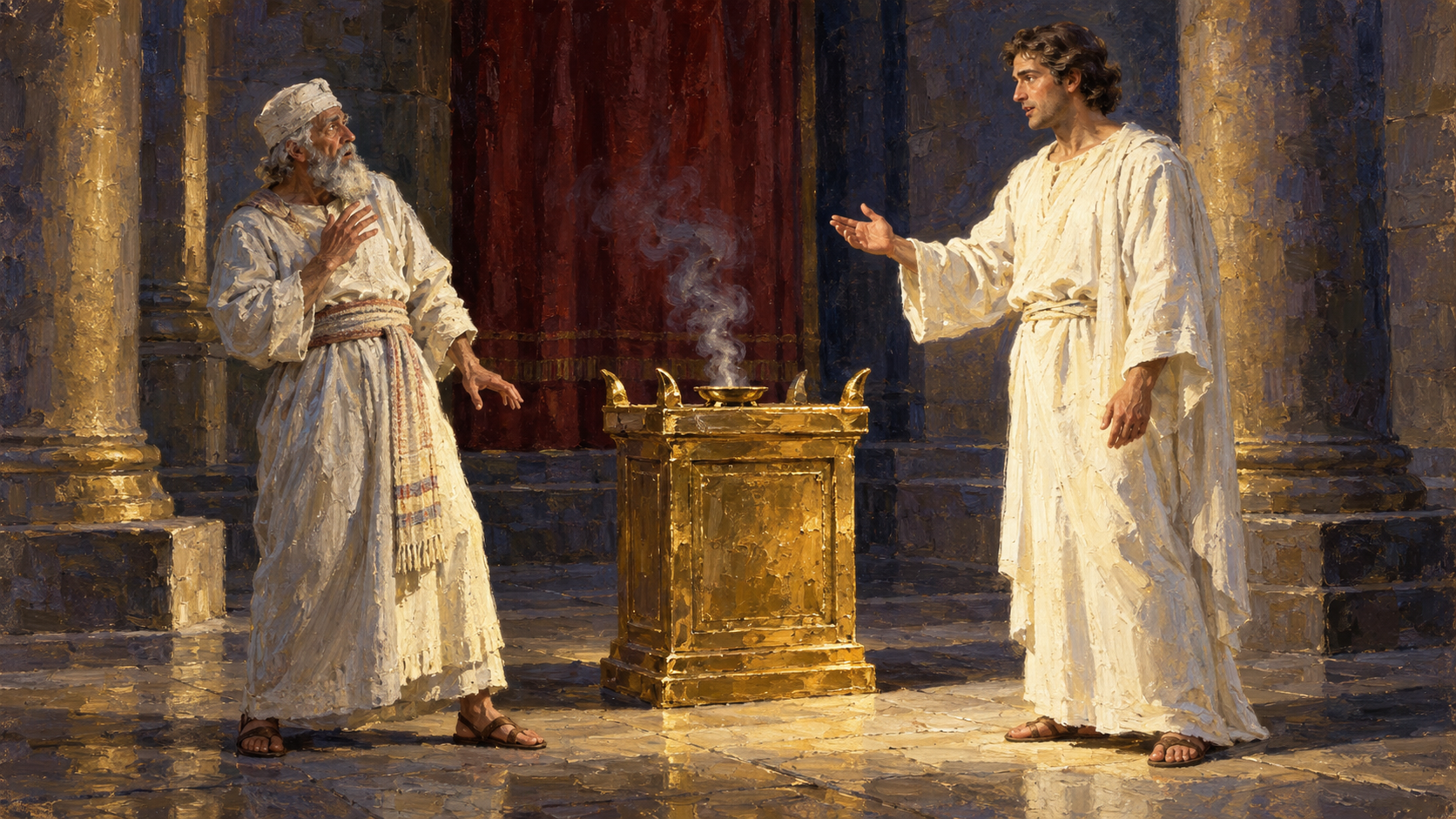
The featured artwork illustrates Gabriel’s appearance to Zacharias. We should receive it as an illustration, without treating it as a portrait based on a biblical description of Gabriel’s anatomy.
Gabriel Explains Daniel’s Vision
Daniel received this vision in the third year of Belshazzar’s reign, while he was a Jewish exile serving in the Babylonian world. The empires pictured had not yet completed their rise and fall. He first saw a ram, followed by a male goat with a great horn. Four horns took its place when it was broken, and then a little horn grew in power. Imagination alone would not tell Daniel what those images meant. As he sought understanding, someone with a man’s appearance stood before him, and a voice commanded Gabriel to explain the vision. God did not leave Daniel to guess.
Then it happened, when I, Daniel, had seen the vision and was seeking the meaning, that suddenly there stood before me one having the appearance of a man. And I heard a man’s voice between the banks of the Ulai, who called, and said, “Gabriel, make this man understand the vision.” So he came near where I stood, and when he came I was afraid and fell on my face; but he said to me, “Understand, son of man, that the vision refers to the time of the end.” Now, as he was speaking with me, I was in a deep sleep with my face to the ground; but he touched me, and stood me upright. And he said, “Look, I am making known to you what shall happen in the latter time of the indignation; for at the appointed time the end shall be. The ram which you saw, having the two horns–they are the kings of Media and Persia. And the male goat is the kingdom of Greece. The large horn that is between its eyes is the first king. As for the broken horn and the four that stood up in its place, four kingdoms shall arise out of that nation, but not with its power. “And in the latter time of their kingdom, When the transgressors have reached their fullness, A king shall arise, Having fierce features, Who understands sinister schemes. His power shall be mighty, but not by his own power; He shall destroy fearfully, And shall prosper and thrive; He shall destroy the mighty, and also the holy people. “Through his cunning He shall cause deceit to prosper under his rule; And he shall exalt himself in his heart. He shall destroy many in their prosperity. He shall even rise against the Prince of princes; But he shall be broken without human means. “And the vision of the evenings and mornings Which was told is true; Therefore seal up the vision, For it refers to many days in the future.” And I, Daniel, fainted and was sick for days; afterward I arose and went about the king’s business. I was astonished by the vision, but no one understood it.
Daniel fell on his face in fear when Gabriel approached. The angel called him to understand the vision and told him it concerned the time of the end. Daniel then fell into a deep sleep with his face to the ground, until Gabriel touched him and stood him upright.
Daniel’s reaction does not tell me to seek frightening or overpowering sensations as proof of truth. A trance or a feeling of being overwhelmed cannot establish that God sent a message. We must examine what God revealed and later fulfilled. Daniel’s weakness shows the distance between frail humanity and a heavenly messenger, but Gabriel’s assignment was to explain God’s revelation.
Gabriel identified the main symbols rather than leaving Daniel to supply his own interpretation. The ram’s two horns were the kings of Media and Persia, and the goat represented Greece. Its large first horn was the first king. Alexander the Great fits the rapid conquest and the breaking of that great horn. After he died, his empire divided among successor kingdoms instead of remaining under a single ruler with equal power. Those Greek-influenced realms, called Hellenistic kingdoms by historians, fit the four horns that replaced the first.
God named the empires and their succession before those events unfolded. That specificity is central to biblical prophecy. Gabriel was conveying an interpretation God had authorized, not predicting history from insights of his own.
Daniel 8 also helps us understand how one prophecy can include events near the prophet’s time and others much farther ahead. Developments under Greek rule established the language and pattern, while the vision reached toward an appointed end. I want to keep the explicit historical identifications in view before extending that pattern.
The little horn arose from the divided Greek realm and attacked the glorious land. He assaulted the sanctuary and stopped the regular sacrifice. Antiochus IV Epiphanes clearly fulfilled this in the nearer historical setting when he persecuted the Jews and desecrated the temple in the second century BC.
Some features also point forward to the final Antichrist, who will exalt himself against God and persecute the faithful. During the future Tribulation, he will desecrate a temple setting too. That future pattern must not erase the historical ruler. The earlier oppressor serves as a picture of the final one.
Gabriel said the fierce king would be broken without human means. Evil may prosper for an appointed time, but it cannot escape the limit God sets. Daniel was told to seal the vision because it concerned many days in the future. I notice that he returned to the king’s business even after the vision had left him sick and astonished. Knowing prophecy did not release him from his ordinary responsibilities.
Gabriel Comes During Daniel’s Prayer
Daniel 9 begins with Daniel reading Scripture and responding in prayer. Jeremiah’s prophecy of seventy years helped him understand Jerusalem’s desolation as God’s judgment. He confessed his own sin along with Israel’s and pleaded for mercy, without blaming God for what had happened.
Gabriel returned while Daniel was still praying, around the time of the evening offering. The temple service was not functioning in Jerusalem, yet its appointed time still shaped Daniel’s worship. Gabriel told him the command had gone out when his supplications began.
Now while I was speaking, praying, and confessing my sin and the sin of my people Israel, and presenting my supplication before the LORD my God for the holy mountain of my God, yes, while I was speaking in prayer, the man Gabriel, whom I had seen in the vision at the beginning, being caused to fly swiftly, reached me about the time of the evening offering. And he informed me, and talked with me, and said, “O Daniel, I have now come forth to give you skill to understand. At the beginning of your supplications the command went out, and I have come to tell you, for you are greatly beloved; therefore consider the matter, and understand the vision: “Seventy weeks are determined For your people and for your holy city, To finish the transgression, To make an end of sins, To make reconciliation for iniquity, To bring in everlasting righteousness, To seal up vision and prophecy, And to anoint the Most Holy. “Know therefore and understand, That from the going forth of the command To restore and build Jerusalem Until Messiah the Prince, There shall be seven weeks and sixty-two weeks; The street shall be built again, and the wall, Even in troublesome times. “And after the sixty-two weeks Messiah shall be cut off, but not for Himself; And the people of the prince who is to come Shall destroy the city and the sanctuary. The end of it shall be with a flood, And till the end of the war desolations are determined. Then he shall confirm a covenant with many for one week; But in the middle of the week He shall bring an end to sacrifice and offering. And on the wing of abominations shall be one who makes desolate, Even until the consummation, which is determined, Is poured out on the desolate.”
Gabriel came to give Daniel skill to understand. He called him greatly beloved and also told him to consider the matter carefully. I need to hear both parts of that message. Being loved by God does not excuse careless attention to His Word; His people still need to study it and interpret it with care.
God had heard Daniel before Gabriel arrived. The answer began with God’s command, not with an angel persuading Him to listen. Gabriel’s arrival shows that God can answer prayer through created servants while remaining the only proper object of our prayers.
Daniel never prayed to Gabriel or asked him to come back. He neither commanded the angel nor tried to establish ongoing contact with him. His confession and request went to the Lord. He received Gabriel’s message without turning that encounter into a devotional practice centered on the messenger.
We should follow Daniel’s example. We pray to the Father through the Son in dependence on the Holy Spirit, receiving Scripture as our sufficient authority. God may use angels in His providence without telling us what they are doing. I do not need to know their names or see them to trust that He has heard my prayer.
The word translated ‘weeks’ describes groups of seven. Gabriel set out seventy sevens for Daniel’s people, Israel, and his holy city, Jerusalem. I understand these as years, giving a total of 490 years. The prophecy concerns God’s covenant purposes for that people and city, not a vague timetable for humanity in general.
The first sixty-nine sevens lead to Messiah the Prince, who is then cut off but not for Himself. Jerusalem and its sanctuary are destroyed afterward. The people connected with the coming prince fulfilled that part in AD 70. A final seven-year period remains for the future Tribulation, when a covenant will be confirmed and then broken. Sacrifice will cease, and an abomination will bring desolation. The desolator will finally face the judgment God has already determined.
This reading keeps Daniel’s people and city in the roles Gabriel names, with Messiah and the sanctuary retaining their place in the prophecy. It accounts for Jerusalem’s destruction after the sixty-nine sevens while the last seven still awaits fulfillment. I hear Gabriel placing Christ and God’s covenant purposes at the center of history, rather than drawing attention to angelic rank. He delivered the schedule; God determined it. Such detailed prophecy should deepen our confidence in God’s rule and our faith in Messiah, without feeding pride in setting dates.
Gabriel Announces John and Jesus
Centuries later, Gabriel appeared in the Jerusalem temple. Zacharias was an elderly priest serving with his division. A sacred lot assigned him to enter the temple and burn incense while the people prayed outside. That is why he was alone at the altar and the waiting crowd could not see what happened. When an angel appeared on the altar’s right side, Zacharias was afraid.
There was in the days of Herod, the king of Judea, a certain priest named Zacharias, of the division of Abijah. His wife was of the daughters of Aaron, and her name was Elizabeth. And they were both righteous before God, walking in all the commandments and ordinances of the Lord blameless. But they had no child, because Elizabeth was barren, and they were both well advanced in years. So it was, that while he was serving as priest before God in the order of his division, according to the custom of the priesthood, his lot fell to burn incense when he went into the temple of the Lord. And the whole multitude of the people was praying outside at the hour of incense. Then an angel of the Lord appeared to him, standing on the right side of the altar of incense. And when Zacharias saw him, he was troubled, and fear fell upon him. But the angel said to him, “Do not be afraid, Zacharias, for your prayer is heard; and your wife Elizabeth will bear you a son, and you shall call his name John. And you will have joy and gladness, and many will rejoice at his birth. For he will be great in the sight of the Lord, and shall drink neither wine nor strong drink. He will also be filled with the Holy Spirit, even from his mother’s womb. And he will turn many of the children of Israel to the Lord their God. He will also go before Him in the spirit and power of Elijah, ‘to turn the hearts of the fathers to the children,’ and the disobedient to the wisdom of the just, to make ready a people prepared for the Lord.” And Zacharias said to the angel, “How shall I know this? For I am an old man, and my wife is well advanced in years.” And the angel answered and said to him, “I am Gabriel, who stands in the presence of God, and was sent to speak to you and bring you these glad tidings. But behold, you will be mute and not able to speak until the day these things take place, because you did not believe my words which will be fulfilled in their own time.” And the people waited for Zacharias, and marveled that he lingered so long in the temple. But when he came out, he could not speak to them; and they perceived that he had seen a vision in the temple, for he beckoned to them and remained speechless. So it was, as soon as the days of his service were completed, that he departed to his own house. Now after those days his wife Elizabeth conceived; and she hid herself five months, saying, “Thus the Lord has dealt with me, in the days when He looked on me, to take away my reproach among people.”
Gabriel announced that Elizabeth would have a son named John. His birth would bring joy, and he would be great in the Lord’s sight. Filled with the Holy Spirit from the womb, John would turn many Israelites to the Lord. He would go before Him in the spirit and power of Elijah.
Notice the words “go before Him.” John was to prepare people for the Lord, and the One who came was Jesus. I see Gabriel connecting the prophetic forerunner with the coming of the LORD Himself in the Person of the Son.
Gabriel identified himself as one who stood in God’s presence and had been sent to speak. That was a position of privilege and service, without making him God’s equal. He brought glad tidings because God had acted.
Zacharias asked how he could know the promise would come true, pointing to his own age and Elizabeth’s. The angel was already before him as a sign, yet his question expressed unbelief. Gabriel told him he would be unable to speak until the promise was fulfilled because he had not believed the words.
God assigned this sign and judgment to Gabriel. The angel was not acting on his own to defend his reputation. His words would be fulfilled at the appointed time because God had sent them. Zacharias’ silence made the encounter evident publicly and continued until John was named.
Mary asked a question too, but she wanted to understand how she would conceive when she did not know a man. Gabriel explained how the miracle would happen. I would not treat those two questions as though they were the same: one sought understanding in faith, while the other demanded proof in unbelief.
Zacharias later spoke and praised God, so his discipline was not the end of the account. When the promise was fulfilled, his silence gave way to prophecy. His song directed hope toward the Lord’s redemption and the coming Dayspring.
In the sixth month of Elizabeth’s pregnancy, God sent Gabriel to Nazareth in Galilee. Mary was a virgin betrothed to Joseph, who belonged to David’s house. That betrothal was a binding marriage commitment, although they had not yet come together sexually or begun ordinary married life. In those humble circumstances, we encounter the royal covenant promise God had made to David.
Now in the sixth month the angel Gabriel was sent by God to a city of Galilee named Nazareth, to a virgin betrothed to a man whose name was Joseph, of the house of David. The virgin’s name was Mary. And having come in, the angel said to her, “Rejoice, highly favored one, the Lord is with you; blessed are you among women!” But when she saw him, she was troubled at his saying, and considered what manner of greeting this was. Then the angel said to her, “Do not be afraid, Mary, for you have found favor with God. And behold, you will conceive in your womb and bring forth a Son, and shall call His name JESUS. He will be great, and will be called the Son of the Highest; and the Lord God will give Him the throne of His father David. And He will reign over the house of Jacob forever, and of His kingdom there will be no end.” Then Mary said to the angel, “How can this be, since I do not know a man?” And the angel answered and said to her, “The Holy Spirit will come upon you, and the power of the Highest will overshadow you; therefore, also, that Holy One who is to be born will be called the Son of God. Now indeed, Elizabeth your relative has also conceived a son in her old age; and this is now the sixth month for her who was called barren. For with God nothing will be impossible.” Then Mary said, “Behold the maidservant of the Lord! Let it be to me according to your word.” And the angel departed from her.
Gabriel greeted Mary as highly favored and told her the Lord was with her. She was troubled by his greeting and considered what it meant, so he told her not to fear. She would conceive a Son and name Him Jesus. Gabriel then explained who this Son was: He would receive David’s throne, and His kingdom would never end.
Mary answered as the Lord’s maidservant, submitting to His word. Her faith rested in God’s promise. She did not worship Gabriel or seek an ongoing relationship with him, and she did not treat him as the source of grace.
The Greek verb translated “highly favored” describes someone who has received favor or grace. Its root also appears in Ephesians 1:6, where grace is bestowed on believers in the Beloved. Understanding that wording helps us see Mary as the recipient of grace. It does not describe her as its source or dispenser.
Mary is blessed among women because God chose her for a unique calling. We should honor her as Scripture does, as a faithful virgin mother. Gabriel’s greeting does not teach that she was immaculately conceived or lived without sin, and it says nothing about her body being assumed into heaven. It does not make her the universal mother of believers or give her a place beside Christ as a mediator.
Mary called God her Savior in her own song. She models receptive faith for us: she heard His word and asked an honest question, then yielded to His will and magnified the Lord. I want to honor that faith without directing prayer or worship to the servant. That would distort proper honor, because saving power belongs to God alone.
When Mary asked how she could conceive without knowing a man, Gabriel said the Holy Spirit would come upon her and the power of the Highest would overshadow her. The holy One born would be called the Son of God.
This was a miraculous conception without a human father. It was not a sexual union between God and Mary. Through the Spirit’s supernatural work, the divine Person of the Son took a real human nature in Mary’s womb. Jesus is one Person, fully God and fully man. He was born of a virgin and is completely sinless.
Now the birth of Jesus Christ was as follows: After His mother Mary was betrothed to Joseph, before they came together, she was found with child of the Holy Spirit. Then Joseph her husband, being a just man, and not wanting to make her a public example, was minded to put her away secretly. But while he thought about these things, behold, an angel of the Lord appeared to him in a dream, saying, “Joseph, son of David, do not be afraid to take to you Mary your wife, for that which is conceived in her is of the Holy Spirit. And she will bring forth a Son, and you shall call His name JESUS, for He will save His people from their sins.” So all this was done that it might be fulfilled which was spoken by the Lord through the prophet, saying: “Behold, the virgin shall be with child, and bear a Son, and they shall call His name Immanuel,” which is translated, “God with us.” Then Joseph, being aroused from sleep, did as the angel of the Lord commanded him and took to him his wife, and did not know her till she had brought forth her firstborn Son. And he called His name JESUS.
Matthew describes the same event from Joseph’s side, identifying it as the fulfillment of Isaiah’s virgin sign. An unnamed angel appeared to Joseph in a dream. The fact that Gabriel spoke to Mary does not give us a reason to attach his name to that angel.
Gabriel instructed Mary to use the name Jesus, which means that the LORD saves. He said the Son would be great and would be called the Son of the Highest. God would give Him David’s throne to reign over Jacob’s house forever, with no end to His kingdom. These promises go far beyond the life of an ordinary king.
Jesus is the eternal Son who created Gabriel. In taking a true human nature, He became the promised Son of David without ceasing to be the eternal divine Son. He will return bodily to fulfill the promises made to Israel and reign in the literal kingdom Scripture describes.
I am following Gabriel’s message when my attention comes to rest on Christ. Fascination with angels reverses that message if it pushes Jesus aside. Gabriel can announce God’s work, but Jesus alone saves and reigns.
What Scripture Does Not Say About Gabriel
Scripture calls Michael “the archangel” and describes him as one of the chief princes. It gives neither title to Gabriel. His access to God’s presence and the work entrusted to him show that he has an honored position, but I cannot supply a title Scripture does not give him.
Likewise also these dreamers defile the flesh, reject authority, and speak evil of dignitaries. Yet Michael the archangel, in contending with the devil, when he disputed about the body of Moses, dared not bring against him a reviling accusation, but said, “The Lord rebuke you!” But these speak evil of whatever they do not know; and whatever they know naturally, like brute beasts, in these things they corrupt themselves.
Later Jewish and Christian traditions, as well as Islam, develop much larger angelic hierarchies and regularly call Gabriel an archangel. They may explain the familiar language in art and culture. They cannot, however, add that title to the biblical text.
Gabriel and Michael are the two faithful angels named in the Protestant canon, but only Michael is explicitly called the archangel. Anything claimed beyond that needs to be identified as tradition or inference, rather than presented as biblical fact.
The Bible never uses the phrase ‘Gabriel’s trumpet.’ In 1 Thessalonians, the Lord descends with a shout, accompanied by an archangel’s voice and the trumpet of God. The passage does not name the archangel or say who sounds the trumpet. It certainly does not give the instrument to Gabriel.
But I do not want you to be ignorant, brethren, concerning those who have fallen asleep, lest you sorrow as others who have no hope. For if we believe that Jesus died and rose again, even so God will bring with Him those who sleep in Jesus. For this we say to you by the word of the Lord, that we who are alive and remain until the coming of the Lord will by no means precede those who are asleep. For the Lord Himself will descend from heaven with a shout, with the voice of an archangel, and with the trumpet of God. And the dead in Christ will rise first. Then we who are alive and remain shall be caught up together with them in the clouds to meet the Lord in the air. And thus we shall always be with the Lord. Therefore comfort one another with these words.
Some readers connect the voice with Michael because he is the only named archangel. Yet the passage leaves that voice unnamed, and it provides even less support for identifying Gabriel.
The comfort offered here concerns the bodily resurrection of believers who have died and the gathering of living believers to Christ. I do not want a familiar image of an angel to draw our attention away from the returning Lord.
Gabriel stands in God’s presence, but Scripture never tells believers to pray to him or ask for his protection. It does not direct us to invoke his name in spiritual warfare or give us grounds to treat him as a mediator. Jesus Christ alone is the Mediator between God and men.
When John fell before an angel in Revelation, the angel refused his worship. He identified himself as a fellow servant and told John to worship God. That response leaves no room for devotion to the messenger in God’s place.
Then he said to me, “These words are faithful and true.” And the Lord God of the holy prophets sent His angel to show His servants the things which must shortly take place. “Behold, I am coming quickly! Blessed is he who keeps the words of the prophecy of this book.” Now I, John, saw and heard these things. And when I heard and saw, I fell down to worship before the feet of the angel who showed me these things. Then he said to me, “See that you do not do that. For I am your fellow servant, and of your brethren the prophets, and of those who keep the words of this book. Worship God.”
A faithful angel will never accept the devotion that belongs to the Lord. If an apparition encourages worship of angels or prayer to them, it contradicts Scripture. So does a message that adds to the gospel or demands submission to a new spiritual authority. However powerful the experience feels, it cannot make falsehood true.
The LORD has established His throne in heaven, And His kingdom rules over all. Bless the LORD, you His angels, Who excel in strength, who do His word, Heeding the voice of His word. Bless the LORD, all you His hosts, You ministers of His, who do His pleasure. Bless the LORD, all His works, In all places of His dominion. Bless the LORD, O my soul!
Scripture does not promise that Christians will meet Gabriel. God is free to send angels as He purposes, and Hebrews says some people have entertained them unknowingly. That possibility gives us no authorization to seek an encounter.
Let brotherly love continue. Do not forget to entertain strangers, for by so doing some have unwittingly entertained angels. Remember the prisoners as if chained with them–those who are mistreated–since you yourselves are in the body also. Marriage is honorable among all, and the bed undefiled; but fornicators and adulterers God will judge. Let your conduct be without covetousness; be content with such things as you have. For He Himself has said, “I will never leave you nor forsake you.” So we may boldly say: “The LORD is my helper; I will not fear. What can man do to me?”
I believe God remains free to act supernaturally. That does not mean I should accept every dramatic spiritual claim, because each one must be tested by Scripture. An impressive figure or bright light cannot authenticate a message that contradicts God’s Word. Nor does one accurate detail make everything else in a message true. A vivid dream or a strong sense of peace must answer to Scripture too.
Every believer has the indwelling Holy Spirit, who illuminates the written Word. We do not need Gabriel to reveal secret doctrine or predict private dates, nor an angel to uncover a hidden Bible or give us access to God. Seeking contact with named spirits can expose us to deception.
If we do have an unusual experience, we should refuse any demand for worship and compare every claim with Scripture. We should seek mature counsel and keep Christ central. God never needs falsehood or doctrinal novelty to accomplish His will.
Gabriel’s Announcement Leads to the Gospel
Gabriel announced Jesus’ conception and kingdom, but Luke continued the account through the cross and the empty tomb. The promised Son came to save His people from their sins. We cannot separate the hope of His kingdom from that saving work.
Jesus is the eternal Son, fully God and fully man. He was born of a virgin and lived a completely sinless life. Wicked men physically tortured and punished Him before killing Him. Jesus willingly bore that real punishment for our sins in His innocent body. He shed His blood and died before being buried, and then He rose bodily from the grave. The Father did not punish or curse His Son. He did not abandon Jesus or strike and bruise Him, nor did He pour wrath upon Him.
Christ died for the whole world, and God’s offer of salvation is genuine even though people can resist and reject it. Everyone who repents and believes in Jesus is forgiven and justified. That person is born again and made new. The Holy Spirit indwells and seals the believer, who is eternally secure in Christ. Eternal security is not permission for lawlessness, and a superficial profession does not prove that someone has truly been born again.
Gabriel cannot forgive sin or give everlasting life. His honor lies in announcing the Son who can.
For related study, see A Complete Bible Study on Michael the Archangel and A Complete Bible Study on Mary the Mother of Jesus. The timing Gabriel gave Daniel is examined more fully in A Bible Study on the 70 Weeks of Daniel.
My Final Thoughts
The passages that name Gabriel show me a faithful servant whose honor lies in doing exactly what God sent him to do. He explained prophecy to Daniel and announced the births of John and Jesus, without asking for worship or drawing people into devotion to himself. Scripture gives us no basis for calling him an archangel or placing a trumpet in his hand, and it does not direct us to seek an encounter with him. His greatest messages point to Jesus, the eternal Son who came to save sinners and will reign on David’s throne. I want to hear that message without allowing fascination with Gabriel to overshadow it. His service brings us back to God’s Word and the worship of God alone, calling us above all to trust the Christ he announced.