
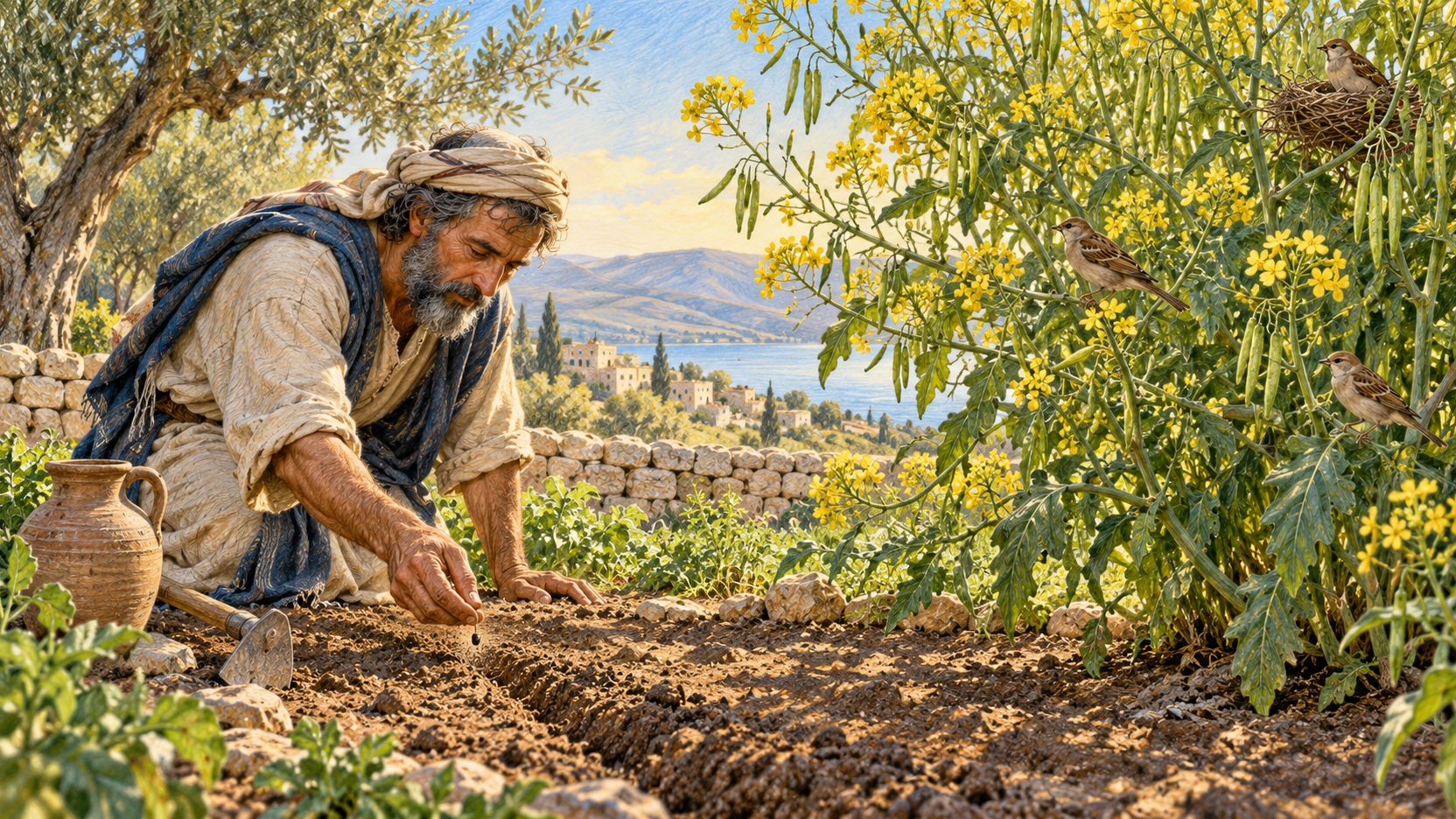
Jesus used a mustard seed both to describe the kingdom and to teach His disciples about faith. Those sayings are related, but they do not make exactly the same comparison. In the kingdom parable, a tiny seed grows into a substantial plant.
The Parable in Its Gospel Settings
He answered and said to them, “Because it has been given to you to know the mysteries of the kingdom of heaven, but to them it has not been given. For whoever has, to him more will be given, and he will have abundance; but whoever does not have, even what he has will be taken away from him. Therefore I speak to them in parables, because seeing they do not see, and hearing they do not hear, nor do they understand. And in them the prophecy of Isaiah is fulfilled, which says: ‘Hearing you will hear and shall not understand, And seeing you will see and not perceive; For the hearts of this people have grown dull. Their ears are hard of hearing, And their eyes they have closed, Lest they should see with their eyes and hear with their ears, Lest they should understand with their hearts and turn, So that I should heal them.'”
Jesus taught from a boat while the crowd stood on the shore, beginning with a sower whose seed fell on different kinds of ground (Matthew 13:1-23). He explained the soils as different responses to the word of the kingdom. Some heard without understanding. Others welcomed the word joyfully but fell away under trouble or persecution, while worldly cares and the deceitfulness of riches choked it in another hearer. The good ground represented someone who heard, understood, and bore fruit. The same word was sown, but the hearers responded differently, as the study of the Parable of the Sower explains more fully.
When the disciples asked why He taught in parables, Jesus explained that He was making the kingdom’s mysteries known to them. These were truths previously hidden, which they were now privileged to receive. Others heard Him without accepting what He taught. Isaiah’s words described their refusal: they had closed their eyes and would not turn to be healed. A parable could disclose truth to someone willing to listen while leaving a resistant hearer without understanding. I therefore need to follow the comparison Jesus actually gives, rather than assume that every object in it conceals a separate doctrine.
The Weeds comes between the Sower and the Mustard Seed in Matthew’s account, so we should hear the growth Jesus promises alongside His warning about an enemy’s work (Matthew 13:24-30).
Another parable He put forth to them, saying: “The kingdom of heaven is like a mustard seed, which a man took and sowed in his field, which indeed is the least of all the seeds; but when it is grown it is greater than the herbs and becomes a tree, so that the birds of the air come and nest in its branches.” Another parable He spoke to them: “The kingdom of heaven is like leaven, which a woman took and hid in three measures of meal till it was all leavened.”
The man sows a mustard seed in his field. From that minute beginning comes a plant larger than the garden herbs, with branches in which birds can lodge. Jesus asks His hearers to hold the beginning and the result together. What looks easily dismissed when sown becomes conspicuous when grown.
That growth takes place amid opposition. In the Weeds, an enemy sows a harmful imitation among the good crop. Jesus explains that sons of the kingdom and sons of the wicked one remain in the world until the harvest, when He will separate them. The related study of the Weeds follows His explanation. Neither the enemy’s work nor the presence of people who falsely claim allegiance to Christ can prevent the kingdom from reaching God’s appointed outcome.
The Leaven follows the Mustard Seed and also moves from an inconspicuous beginning to an extensive result. Leaven makes dough rise as it works through the flour. Both comparisons speak to people who had seen very different responses to Jesus. Israel’s religious leaders opposed Him, and His followers had little of the visible strength people ordinarily associated with a kingdom. He was assuring them of an outcome they could not yet see.
Mark likewise places the Mustard Seed among sayings about hearing and growth. Notice the lamp that must give light, the warning to attend to what is heard, and the farmer whose crop develops beyond his understanding (Mark 4:21-29).
And He said, “The kingdom of God is as if a man should scatter seed on the ground, and should sleep by night and rise by day, and the seed should sprout and grow, he himself does not know how. For the earth yields crops by itself: first the blade, then the head, after that the full grain in the head. But when the grain ripens, immediately he puts in the sickle, because the harvest has come.” Then He said, “To what shall we liken the kingdom of God? Or with what parable shall we picture it? It is like a mustard seed which, when it is sown on the ground, is smaller than all the seeds on earth; but when it is sown, it grows up and becomes greater than all herbs, and shoots out large branches, so that the birds of the air may nest under its shade.”
A lamp belongs where its light can be seen, and Jesus urges His hearers to pay attention to the teaching He is making known. He then describes a farmer going through the ordinary rhythm of sleeping at night and rising by day while his seed sprouts and grows. The farmer does not understand how the crop develops, but he recognizes ripe grain and harvests it. His inability to explain or produce the growth does not keep him from doing the work that belongs to him.
When I teach Scripture or proclaim the gospel, I am responsible to prepare and labor faithfully. I cannot give someone spiritual life by choosing an impressive technique or manipulating a response. The farmer sows and harvests, but he does not supply the life that makes his seed grow. God’s servants likewise have work to do without imagining they can manufacture the result only He can bring about.
The mustard seed then gives Mark’s hearers another reason to look beyond what they see at first. Its large branches bear little resemblance to the tiny seed that was sown. Luke records the same comparison after Jesus has shown what His authority means for one suffering woman.
Then He said, “What is the kingdom of God like? And to what shall I compare it? It is like a mustard seed, which a man took and put in his garden; and it grew and became a large tree, and the birds of the air nested in its branches.” And again He said, “To what shall I liken the kingdom of God? It is like leaven, which a woman took and hid in three measures of meal till it was all leavened.”
For eighteen years, the woman had been bent over and unable to straighten herself. Jesus called her, laid His hands on her, and released her from that infirmity. She immediately stood straight and glorified God, but the synagogue ruler objected to the healing because it was the Sabbath. Jesus exposed his hypocrisy by pointing to the care people gave their animals that very day. They would untie an ox or donkey to lead it to water, yet the ruler objected when this daughter of Abraham was freed from Satan’s bondage. His adversaries were ashamed, while the people rejoiced over what Jesus had done (Luke 13:10-17).
The people who heard the mustard seed parable had just seen what the King’s authority meant for this woman. Her healing did not remove every oppressive power from the world that afternoon, but Jesus had released her from bondage. His opponents could protest, yet they could neither reverse her healing nor defeat His purpose.
Luke pairs the mustard seed with leaven, as Matthew does, directing our attention beyond an unremarkable beginning to the result that follows. Each Gospel setting helps us understand that promise. Matthew places it amid mixed responses, opposition, and the certainty of final judgment. Mark shows a sower working faithfully without the power to make his seed grow, while Luke shows Christ freeing a woman despite religious hostility. Jesus assures His hearers of the kingdom’s growth amid those difficulties, without promising that everything they encounter will become steadily more comfortable.
From a Small Seed to the Kingdom’s Appointed Extent
In all three accounts, the comparison begins with ordinary planting. A man sows a small seed in his field or garden, and a branching plant eventually grows large enough for birds to lodge in it. Jesus compares the kingdom with that whole development from small to large. Dividing the picture into a code, with each feature independently representing Christ, Scripture, the church, or personal faith, can distract us from the comparison He makes.
Matthew calls mustard the least of the seeds, and Mark describes it as smaller than all the seeds on earth when sown. Smaller seeds do exist; Kew’s account of orchid seeds describes some as dustlike. I understand Jesus’ words within the field or garden He asks His hearers to picture. He is comparing the familiar smallness of a cultivated mustard seed with the substantial plant it becomes. His teaching concerns that agricultural comparison, rather than a classification of every seed species in the world.
Ordinary speech can make such a comparison truthfully. We speak of sunrise without claiming that the sun travels around the earth, because the words describe what someone sees. Here, too, the setting tells us how to understand the expression: Jesus has asked His hearers to consider a man sowing a seed. We need neither an invented ancient seed catalog nor a denial of smaller seeds to follow His point.
Matthew and Luke call the mature plant a tree, while Mark draws attention to its large branches. Mustards vary with species and growing conditions, but can become tall, substantial plants. Jesus describes a plant that has grown enough to shelter birds, without specifying its height or identifying its species. We do not have to imagine a cedar-sized specimen for the contrast with its tiny seed to be striking.
Jesus’ kingdom was never powerless. Its King is the eternal Son, yet He came in humility and was rejected by Israel’s leaders. His early followers had no army, palace, or royal prestige to establish their importance. Someone judging His kingdom by its public beginning could badly underestimate what God intended to accomplish.
After Jesus rose and ascended, His witnesses carried the gospel from Jerusalem through Judea and Samaria to the nations. Congregations formed across the Roman world, and people of many languages have received the message in the centuries since. That widening witness helps us appreciate how much can follow a small beginning. Still, Christ’s promise gives us firmer ground for confidence than statistics about the size of Christian institutions.
A larger organization is not necessarily a more faithful one. The Sower has already warned about shallow responses and competing loves, and the Weeds describes counterfeit allegiance that continues until judgment. We cannot count every institution using Christian language as genuine kingdom growth. Its teaching and conduct must be tested against the King’s Word.
Mark’s account of the growing seed also helps us understand our part in the work. We sow and water by teaching Scripture and caring for disciples, but cannot make another person spiritually alive. Paul later distinguished the servants who planted and watered from God, who gave the increase (1 Corinthians 3:6–7). If little seems to be happening, I still have reason to teach and care faithfully. If the work flourishes, I have no reason to claim credit for the life God has given.
Matthew says “kingdom of heaven,” while Mark and Luke say “kingdom of God” in these parallel accounts. Both expressions describe the same divine reign. Matthew’s wording fits a reverent Jewish way of referring to God’s authority, rather than identifying an unrelated kingdom. The study on the kingdom of heaven and the kingdom of God considers those expressions in greater detail.
The word kingdom can refer to a king’s authority, the people who belong to him, or the realm where he openly rules. Jesus announced that the kingdom had drawn near as He stood among the people, their promised King. When He forgave sins, expelled demons, and healed the sick, they saw His authority at work. He also commanded nature and raised the dead. People who repent and believe belong to Him now and are called to obey Him. Paul describes that belonging as a transfer into the kingdom of God’s beloved Son (Colossians 1:13).
That present belonging does not fulfill every promise about His reign. The church bears witness to Christ now, while Israel still has a promised future restoration. Social improvement, church expansion, or political influence cannot establish the millennial kingdom. Jesus will return bodily after the appointed Tribulation, defeat His enemies, deliver Israel, judge the nations, and reign on earth for a literal thousand years.
Those future events are explained more fully in Daniel, the Olivet Discourse, the apostolic letters, and Revelation. Although the Mustard Seed does not give us that entire timetable, it assures us that the kingdom will reach far beyond its small public beginning. Final judgment and the eternal state follow Christ’s millennial reign, and His redeemed people will dwell with Him forever. His kingdom will endure beyond every passing institution and will be far more than a vague spiritual influence.
The Birds and the Old Testament Tree Background
The birds introduce a further question. Jesus says that they lodge in the branches, but does not explain whom they represent or identify them as God’s promises. Their presence certainly shows that the plant has grown large enough to shelter them. We should begin with that clear part of the comparison before considering whether the birds carry a further meaning.
Readers commonly approach that question in two ways. In the Sower, birds devour the seed, and Jesus identifies the one who snatches away the word as the wicked one. Their appearance so close to the Mustard Seed makes a negative association possible. The prophets, however, also pictured birds and beasts sheltering beneath trees that represented rulers and kingdoms. In that setting, the creatures could picture peoples or nations under a ruler’s authority. Ezekiel’s promise about a tender shoot that God Himself plants gives us an example.
Thus says the Lord GOD: “I will take also one of the highest branches of the high cedar and set it out. I will crop off from the topmost of its young twigs a tender one, and will plant it on a high and prominent mountain. On the mountain height of Israel I will plant it; and it will bring forth boughs, and bear fruit, and be a majestic cedar. Under it will dwell birds of every sort; in the shadow of its branches they will dwell. And all the trees of the field shall know that I, the LORD, have brought down the high tree and exalted the low tree, dried up the green tree and made the dry tree flourish; I, the LORD, have spoken and have done it.”
Earlier in Ezekiel 17, God condemned Judah’s ruler for breaking his oath to Babylon and turning to Egypt for help. That faithlessness would bring judgment, yet the chapter ends with God promising to plant a tender twig on Israel’s mountain and make it a fruitful, majestic cedar. Birds of every sort would shelter in its branches. Judah’s rulers had failed, but the LORD could still bring down the high tree and raise the low one.
I understand this as a promise of restoration through David’s line, fulfilled in the Messiah. Failed human rulers would not prevent God from establishing His King. We can recognize the resemblance to Jesus’ small beginning and extensive reign without insisting that Ezekiel’s cedar and the mustard plant correspond in every detail.
Ezekiel used the tree image differently when he warned Pharaoh by recalling Assyria’s former greatness (Ezekiel 31:1-9).
Indeed Assyria was a cedar in Lebanon, With fine branches that shaded the forest, And of high stature; And its top was among the thick boughs. The waters made it grow; Underground waters gave it height, With their rivers running around the place where it was planted, And sent out rivulets to all the trees of the field. ‘Therefore its height was exalted above all the trees of the field; Its boughs were multiplied, And its branches became long because of the abundance of water, As it sent them out. All the birds of the heavens made their nests in its boughs; Under its branches all the beasts of the field brought forth their young; And in its shadow all great nations made their home.
Assyria’s influence had spread like the branches of a magnificent cedar. Birds nested in it, beasts sheltered beneath it, and great nations made their home in its shadow. The verses that follow describe judgment on the tree’s pride. Its impressive extent had never made it independent of God or immune to being brought down.
Daniel records a similar tree in Nebuchadnezzar’s dream.
“These were the visions of my head while on my bed: I was looking, and behold, A tree in the midst of the earth, And its height was great. The tree grew and became strong; Its height reached to the heavens, And it could be seen to the ends of all the earth. Its leaves were lovely, Its fruit abundant, And in it was food for all. The beasts of the field found shade under it, The birds of the heavens dwelt in its branches, And all flesh was fed from it.”
The tree supplied food and shelter until a heavenly watcher ordered it cut down. Daniel explained that it represented Nebuchadnezzar and his far-reaching dominion. The creatures finding food and shade pictured the peoples dependent on his rule. Although the king had enjoyed great authority, God would humble him and teach him that the Most High rules over human kingdoms and gives authority as He wills (Daniel 4:13-17).
Those warnings should make us cautious about treating a religious organization’s size as proof of God’s approval. A great empire could shelter many people and still face judgment for arrogance. Likewise, a ministry’s large audience, generous budget, imposing buildings, or political access cannot establish its faithfulness. I have to examine what it teaches and how it acts in light of Christ’s Word. His kingdom is righteous because its King is righteous, and work done in His name must answer to Him.
These prophetic passages give me good reason to consider nations or peoples as a possible meaning for the birds in the Mustard Seed. On that reading, they find blessing and shelter within the kingdom’s extensive reach and remain dependent on its King. The resemblance supports the interpretation, though Jesus does not expressly identify the birds as He did in the Sower.
Others emphasize the Sower’s birds and the counterfeit sons in the Weeds. They understand the large plant as Christendom, meaning the visible world of Christian institutions, which grows into a shelter for corrupt powers. The surrounding parables give them grounds to take corruption seriously. Even so, Jesus describes the mustard plant’s growth without identifying the plant itself as corrupt. I can acknowledge the possibility of that reading while recognizing what the passage leaves unexplained.
The Leaven raises a similar question because leaven elsewhere pictures corruption. Some therefore understand it here as false doctrine spreading through Christendom. In this parable, however, Jesus describes a woman hiding leaven in flour until it works through the whole amount. I understand the connection with the Mustard Seed to be the movement from an inconspicuous beginning to an extensive result. The same image need not carry the same meaning in every passage; its use in this comparison must guide our reading.
That reading does not deny the mixed conditions described elsewhere in Matthew 13. False teaching and counterfeit professions of faith remain during this age, and Christ will separate the wicked from those who belong to Him at judgment. God’s kingdom purpose will nevertheless reach its appointed completion.
Mustard-Seed Faith, the Gospel, and the Coming Kingdom
Jesus also used the mustard seed when correcting His disciples’ unbelief. In that setting, the comparison addresses their dependence on God rather than the kingdom’s development.
And Jesus rebuked the demon, and it came out of him; and the child was cured from that very hour. Then the disciples came to Jesus privately and said, “Why could we not cast it out?” So Jesus said to them, “Because of your unbelief; for assuredly, I say to you, if you have faith as a mustard seed, you will say to this mountain, ‘Move from here to there,’ and it will move; and nothing will be impossible for you. However, this kind does not go out except by prayer and fasting.”
After the Transfiguration, a father brought Jesus an urgent plea for his severely afflicted son. The child repeatedly fell into fire or water, and the disciples had been unable to deliver him. Jesus rebuked the demon and healed the child (Matthew 17:14-18). Later, when the disciples privately asked why they had failed, Jesus identified their unbelief and spoke of prayer and fasting. Their earlier commission had not given them power they could exercise independently of God. They still needed to depend on Him.
Faith as a mustard seed is not a spiritual substance we accumulate until we can force a result. Even small, genuine faith relies on God, whose power is sufficient where ours is not. The command to “Move this mountain” uses forceful, proverbial language for overcoming an obstacle beyond human ability. It gives us reason to trust God’s power without granting permission to demand anything we please apart from His will.
Nor does this correction give us permission to blame every suffering believer for weak faith. Faithful people have endured torture and death. We can pray for deliverance while continuing to trust and obey when God’s answer differs from what we requested. The problem Jesus identified in these disciples must not be made the explanation for every person’s illness or hardship.
Luke records the mustard-seed saying in another setting, after commands about how disciples must treat one another.
“Take heed to yourselves. If your brother sins against you, rebuke him; and if he repents, forgive him. And if he sins against you seven times in a day, and seven times in a day returns to you, saying, ‘I repent,’ you shall forgive him.” And the apostles said to the Lord, “Increase our faith.” So the Lord said, “If you have faith as a mustard seed, you can say to this mulberry tree, ‘Be pulled up by the roots and be planted in the sea,’ and it would obey you.”
Jesus warned His disciples against causing little ones to stumble, then commanded them to rebuke a sinning brother and forgive him when he repented (Luke 17:1-4). If he sinned and returned in repentance seven times in one day, they were to forgive him seven times. The apostles asked for more faith in response to those demanding commands. Jesus’ answer about a mustard seed and an uprooted mulberry tree directed them toward God’s ability, rather than leaving them to measure obedience against their own resources.
The servant illustration that follows explains the humility such obedience requires. Even after working in the field, the servant attends to his master’s meal before his own. Doing what he was commanded does not put the master in his debt. In the same way, repeatedly forgiving a repentant brother does not give me a claim over Christ, however difficult that obedience may be. I need His grace to do what He commands, and cannot treat doing my duty as a reason He owes me the outcome I want (Luke 17:7-10).
Matthew 17 thus places mustard-seed faith in a struggle the disciples could not resolve, while Luke 17 connects it with forgiveness and humble service. In both, disciples need to rely on the Lord whose power exceeds their own. That is a different comparison from the kingdom parable’s growth from a small beginning, though both direct our confidence toward the same King. Neither gives us a way to control Him.
That dependence on the King also belongs to the work He gave His apostles after His resurrection. His instructions bring us back to the relationship between the kingdom’s present witness and its future fulfillment.
Therefore, when they had come together, they asked Him, saying, “Lord, will You at this time restore the kingdom to Israel?” And He said to them, “It is not for you to know times or seasons which the Father has put in His own authority. But you shall receive power when the Holy Spirit has come upon you; and you shall be witnesses to Me in Jerusalem, and in all Judea and Samaria, and to the end of the earth.”
The apostles asked whether He would restore the kingdom to Israel then. Jesus did not deny its future restoration. He placed the timing under the Father’s authority and directed them to their assignment: the Holy Spirit would empower them to bear witness from Jerusalem through Judea and Samaria to the end of the earth.
Acts records the widening testimony Jesus described. His death and bodily resurrection remained central as His witnesses carried the message to new places. We share that responsibility when we proclaim reconciliation with God, establish faithful local churches, and teach disciples to obey Christ. The Holy Spirit empowers those who bear witness to Him. Such work helps us see how the mustard seed’s small beginning can lead to a far greater reach, without turning the church’s present mission into a political substitute for Christ’s future kingdom.
Paul described the fruit of that gospel among the Colossians.
We give thanks to the God and Father of our Lord Jesus Christ, praying always for you, since we heard of your faith in Christ Jesus and of your love for all the saints; because of the hope which is laid up for you in heaven, of which you heard before in the word of the truth of the gospel, which has come to you, as it has also in all the world, and is bringing forth fruit, as it is also among you since the day you heard and knew the grace of God in truth; as you also learned from Epaphras, our dear fellow servant, who is a faithful minister of Christ on your behalf, who also declared to us your love in the Spirit.
Paul thanked God for the Colossians’ faith in Christ and their love for the saints. Both grew from the hope they had heard in the true gospel, which was also bearing fruit beyond their congregation. As the message spread, its truth remained the same. The Colossians had come to know God’s grace through that message, and its effect could be seen in their lives.
That is growth worth seeking: people coming to know Christ and learning to love those who belong to Him. Reaching a larger audience cannot compensate for losing the gospel that brings life. The witnesses of the rejected Messiah carried His message to people they had never met, and that same gospel remains God’s power to save everyone who believes.
The King they proclaimed is the eternal Son, fully God and fully man, born of a virgin and entirely sinless. He came in humility to save the lost and willingly gave Himself to be slain as the perfect sacrifice for our sins. Wicked men tortured and killed Him, but His atonement rests on His perfection and His voluntary sacrifice. Through His shed blood and death, His saving sacrifice was complete before His burial and bodily resurrection. The Father did not punish, curse, abandon, strike, bruise, or pour wrath on Jesus. Father, Son, and Holy Spirit are the three distinct, coequal, coeternal Persons of the one God and acted in unity in our salvation.
Christ died for the whole world, and God genuinely offers salvation to every person. People can resist His grace and reject Him; everyone who repents and believes receives forgiveness and is justified, declared righteous before God. That person is born again and made new, indwelt and sealed by the Holy Spirit, and eternally secure in Christ.
Growing up within Christian culture, improving our conduct, or joining a successful institution cannot bring us into God’s kingdom. Salvation comes by grace through faith in the King. Obedience gives evidence of new birth, but neither earns salvation nor keeps us born again. A superficial profession of faith does not establish that someone has new life. Genuine believers are not sinless and still need correction and forgiveness, but their security in Christ never excuses lawlessness.
The risen King will fulfill the promises His servants proclaim. Revelation announces His victory over the kingdoms that oppose Him.
Then the seventh angel sounded: And there were loud voices in heaven, saying, “The kingdoms of this world have become the kingdoms of our Lord and of His Christ, and He shall reign forever and ever!” And the twenty-four elders who sat before God on their thrones fell on their faces and worshiped God, saying: “We give You thanks, O Lord God Almighty, The One who is and who was and who is to come, Because You have taken Your great power and reigned. The nations were angry, and Your wrath has come, And the time of the dead, that they should be judged, And that You should reward Your servants the prophets and the saints, And those who fear Your name, small and great, And should destroy those who destroy the earth.”
Heaven worships as the Lord and His Christ take the rule rebellious nations have claimed. God judges evil and rewards His servants. His intervention and the King’s victory bring about what human progress could never establish. The King whose work many dismissed in His earthly ministry will openly reign, and the world will no longer be able to dismiss Him.
Christ will vindicate faithful witnesses whose work appeared small and expose counterfeit allegiance. Looking forward to that judgment should make us careful about truth and holiness now, while His promise sustains us in work whose results we cannot control.
My Final Thoughts
The mustard seed directs me to trust Christ’s promise rather than judge His kingdom by its small public beginning. Opposition and counterfeit profession cannot prevent the King from fulfilling His purpose. Until He returns, I am responsible to speak His Word faithfully, care for people, and depend on God for the life I cannot produce. That dependence should keep me from pride when the work grows and from despair when it still looks small. Mustard-seed faith gives me no control over the Lord who shed His blood and rose for us; it gives me reason to trust Him and keep serving.