
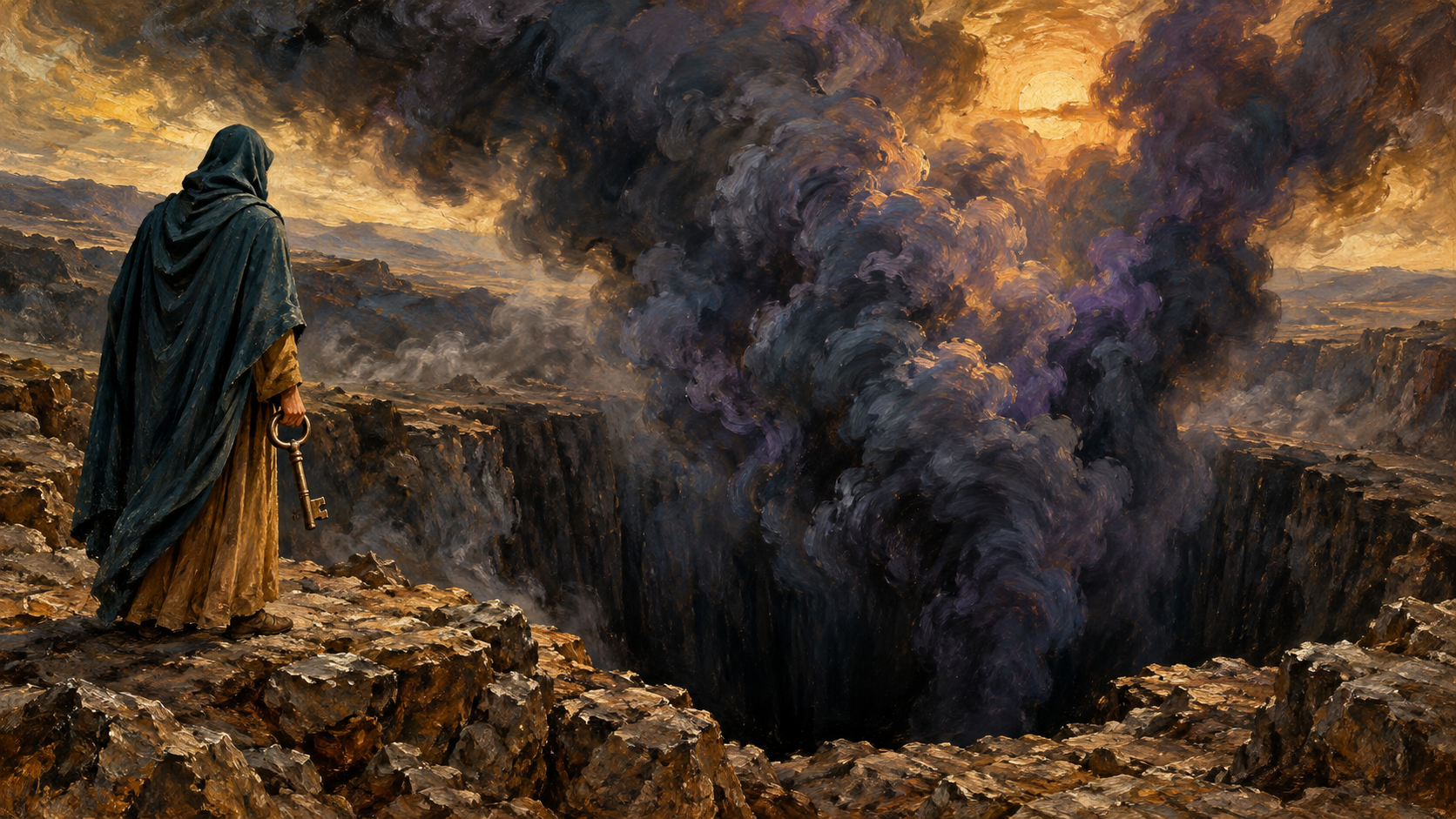
What is the abyss that demons fear and Revelation calls the bottomless pit? Scripture gives us enough detail to distinguish this prison from Hades and the Lake of Fire, but it does not give us a map or answer every question about the beings connected with it. I want to follow the wording and sequence God gave us, because this subject becomes confusing as soon as speculation takes over.
The Abyss and the Terms Scripture Keeps Distinct
The Greek noun abyssos describes an abyss or immeasurable depth. In the received New Testament text, the Greek basis normally followed in these studies, it occurs nine times: once each in Luke and Romans and seven times in Revelation. We can therefore look at every use without guessing from one passage alone. I still need to follow each writer’s argument to understand what the word means there.
Revelation traditionally calls it the bottomless pit, which may suggest a hole stretching downward forever. But Revelation 9 uses two related nouns that help us understand the expression. Abyssos names the depth, while phrear refers to a shaft or well. Together, phrear tes abyssou means the shaft of the abyss, distinguishing the entrance from the place of confinement beyond it.
I do not think the word bottomless tells us the mathematical shape of the earth or this prison. It communicates depth beyond human measuring. Revelation presents a real confinement and a real opening without inviting us to turn its language into a diagram of the planet.
The Old Testament word deep needs to be read in its Hebrew context as well. The Masoretic Text uses tehom, especially for watery depths. That is the setting at the beginning of Genesis, where darkness covers the deep and the Spirit of God hovers over the waters.
In the beginning God created the heavens and the earth. The earth was without form, and void; and darkness was on the face of the deep. And the Spirit of God was hovering over the face of the waters. Then God said, “Let there be light”; and there was light. And God saw the light, that it was good; and God divided the light from the darkness. God called the light Day, and the darkness He called Night. So the evening and the morning were the first day.
The deep here belongs to the unformed creation. Genesis neither calls it a prison nor describes demons emerging from it. Elsewhere tehom can describe seas or springs and can refer to depths more generally. The Greek Septuagint sometimes used abyssos to translate it, but that shared Greek word does not overrule the Masoretic Text. I cannot make every watery deep the prison described in Revelation simply because the translation uses the same noun.
We also need to distinguish the Bible’s other terms for death and judgment. If we call all of them hell, we lose what each passage is saying. Sheol and Hades concern the realm of the dead before final judgment, whereas Gehenna warns of final destruction. The Lake of Fire is the second death after bodily resurrection and judgment. The abyss serves a different purpose as temporary confinement for spiritual powers, and the end-time powers that emerge from it do so only under God’s authority.
Luke 16 describes Hades and a great gulf in the account of the rich man and Lazarus, but it does not use abyssos. I have no basis for simply renaming that gulf the bottomless pit. Jude and 2 Peter likewise describe angels held in chained darkness without using abyssos. We can compare the related ideas while still respecting the different words Scripture uses.
Before looking at who enters or leaves the abyss, we need to notice who holds authority over death and judgment. Jesus tells John that He holds the keys of Hades and Death. His death and bodily resurrection establish His victory, and no hostile power decides the final destiny of human beings.
And when I saw Him, I fell at His feet as dead. But He laid His right hand on me, saying to me, “Do not be afraid; I am the First and the Last. I am He who lives, and was dead, and behold, I am alive forevermore. Amen. And I have the keys of Hades and of Death. Write the things which you have seen, and the things which are, and the things which will take place after this. The mystery of the seven stars which you saw in My right hand, and the seven golden lampstands: The seven stars are the angels of the seven churches, and the seven lampstands which you saw are the seven churches.
In Revelation 9, a fallen star receives the key to the abyss; in Revelation 20, an angel descends carrying a key. Neither acts in competition with Christ. A key given or carried represents permission to act under His authority. The star is a personal agent, but John does not name him as Satan. Some understand him to be a holy messenger and others a fallen angel. What I can say firmly is that he receives limited authority for an appointed judgment.
Legion, Romans, and the Authority of Christ
The first New Testament use of abyssos appears in the account of Jesus meeting a tormented man in the country of the Gadarenes. Before the surrounding people understood what was happening, the demons already knew who Jesus was. They also knew He could send them into the confinement they dreaded.
Then they sailed to the country of the Gadarenes, which is opposite Galilee. And when He stepped out on the land, there met Him a certain man from the city who had demons for a long time. And he wore no clothes, nor did he live in a house but in the tombs. When he saw Jesus, he cried out, fell down before Him, and with a loud voice said, “What have I to do with You, Jesus, Son of the Most High God? I beg You, do not torment me!” For He had commanded the unclean spirit to come out of the man. For it had often seized him, and he was kept under guard, bound with chains and shackles; and he broke the bonds and was driven by the demon into the wilderness. Jesus asked him, saying, “What is your name?” And he said, “Legion,” because many demons had entered him. And they begged Him that He would not command them to go out into the abyss. Now a herd of many swine was feeding there on the mountain. So they begged Him that He would permit them to enter them. And He permitted them. Then the demons went out of the man and entered the swine, and the herd ran violently down the steep place into the lake and drowned.
The demons begged Jesus not to send them into the abyss. Their pleading helps me see who had authority over this dreaded prison for evil spirits. They had no independent right to enter it or avoid it. Jesus allowed them to enter the swine, but the lake into which the herd rushed was an ordinary body of water in that region. It was neither the abyss nor the Lake of Fire.
Jesus freed the man by His decisive command. That is where this passage directs my attention. His encounter with the demons does not invite us to interview them or seek secret names, much less build a hierarchy from what hostile spirits say. We should be looking to the One they feared rather than becoming fascinated with them.
Romans 10 uses the same noun in a different argument. Paul draws from Deuteronomy 30, where Moses says God’s word is not impossibly far away in heaven or beyond the sea. Paul applies Moses’ point about the nearness of God’s word to the gospel.
But the righteousness of faith speaks in this way, “Do not say in your heart, ‘Who will ascend into heaven?'” (that is, to bring Christ down from above) or, “‘Who will descend into the abyss?'” (that is, to bring Christ up from the dead). But what does it say? “The word is near you, in your mouth and in your heart” (that is, the word of faith which we preach): that if you confess with your mouth the Lord Jesus and believe in your heart that God has raised Him from the dead, you will be saved. For with the heart one believes unto righteousness, and with the mouth confession is made unto salvation.
God has already sent His Son and raised Him from the dead. No one needs to climb into heaven to bring Christ down or descend into an unreachable depth to bring Him up. The word of faith is near enough for us to hear it and respond in belief and confession. Paul uses the abyss as the depth beyond our reach in contrast with heaven, while explicitly speaking of Christ being raised from the dead. He is not saying Jesus was imprisoned with the beings of Revelation 9.
If I turn Paul’s words into a search for hidden geography, I have missed the help he is giving the reader. He brings us directly to Jesus Christ and His bodily resurrection. We receive salvation by faith; we do not have to accomplish an impossible journey into heaven or the depths.
The Fifth Trumpet and the Destroyer
Revelation places the opening of the abyss in a definite prophetic sequence. The seven seals lead to seven trumpet judgments, and the shaft opens at the fifth trumpet. I understand this to occur during the literal seven-year Tribulation. That timing keeps me from treating it as a picture that repeats whenever a war, disease, or frightening headline appears.
Then the fifth angel sounded: And I saw a star fallen from heaven to the earth. To him was given the key to the bottomless pit. And he opened the bottomless pit, and smoke arose out of the pit like the smoke of a great furnace. So the sun and the air were darkened because of the smoke of the pit. Then out of the smoke locusts came upon the earth. And to them was given power, as the scorpions of the earth have power. They were commanded not to harm the grass of the earth, or any green thing, or any tree, but only those men who do not have the seal of God on their foreheads. And they were not given authority to kill them, but to torment them for five months. Their torment was like the torment of a scorpion when it strikes a man. In those days men will seek death and will not find it; they will desire to die, and death will flee from them. The shape of the locusts was like horses prepared for battle. On their heads were crowns of something like gold, and their faces were like the faces of men. They had hair like women’s hair, and their teeth were like lions’ teeth. And they had breastplates like breastplates of iron, and the sound of their wings was like the sound of chariots with many horses running into battle. They had tails like scorpions, and there were stings in their tails. Their power was to hurt men five months. And they had as king over them the angel of the bottomless pit, whose name in Hebrew is Abaddon, but in Greek he has the name Apollyon. One woe is past. Behold, still two more woes are coming after these things.
The key is given before the shaft opens. Smoke then darkens the air, and locust-like beings emerge with power compared to that of scorpions. They may torment only people without God’s seal on their foreheads, and only for five months. They are forbidden to kill. Even in this terrifying scene, God’s command determines whom they may harm and how long their activity lasts.
The seal is not a charm that a frightened person can copy. Revelation identifies God’s servants within its prophetic sequence and repeatedly distinguishes those who worship the beast from those who belong to the Lamb. The warning should turn readers toward Christ, not toward a ritual that imitates the seal.
The fifth trumpet is the first woe, with two more still to come. We need to keep that sequence in view before calling an insect swarm or a military machine its fulfillment. A pandemic or addictive technology does not become the fulfillment simply because it dominates the news either.
John describes beings like horses prepared for battle, with crowns that look golden. Their faces resemble human faces, and their hair looks like women’s hair, while their teeth are like those of lions. They have breastplates like iron and wings that sound like thundering chariots. Their tails inflict torment like scorpion stings. Ordinary locusts do not fit that description, but John never calls these beings demons. We can speak of their supernatural or demonic character without pretending the vivid description gives us a complete classification.
Their king is called the angel of the abyss. Revelation gives his name in Hebrew as Abaddon and in Greek as Apollyon, both conveying destruction. Understanding the two names helps us recognize one ruler described in two languages, rather than two beings drawn from later folklore.
The Hebrew word abaddon elsewhere can mean destruction or the realm of destruction, but Revelation uses it personally for this angelic ruler. John does not identify him as Satan, even though Satan will later be confined in the same abyss. I also cannot identify him with the Passover destroyer merely because both are connected with destruction. Exodus 12 never calls that destroyer Abaddon or Apollyon, so the similar language does not establish a shared identity.
We must also keep this ruler distinct from the Angel of the LORD, whom the relevant Old Testament passages present as a pre-incarnate appearance of Christ. An angel ruling forces from the abyss under judgment is not the eternal Son. Confusing them would let folklore alter what we teach about Christ.
Chained Angels and the Beast From the Abyss
Jude and 2 Peter tell us about angels already held under darkness. Their secure confinement resembles what we have read about the abyss, but we need to look at the apostles’ actual words before identifying the prisons as the same place.
But I want to remind you, though you once knew this, that the Lord, having saved the people out of the land of Egypt, afterward destroyed those who did not believe. And the angels who did not keep their proper domain, but left their own abode, He has reserved in everlasting chains under darkness for the judgment of the great day; as Sodom and Gomorrah, and the cities around them in a similar manner to these, having given themselves over to sexual immorality and gone after strange flesh, are set forth as an example, suffering the vengeance of eternal fire.
Jude says these angels left their proper domain and are kept in everlasting chains under darkness for the judgment of the great day. I understand those chains to hold them securely until that appointed judgment. Jude names the coming judgment as the purpose of their confinement, so he is not saying this particular arrangement will be their final state forever.
For if God did not spare the angels who sinned, but cast them down to hell and delivered them into chains of darkness, to be reserved for judgment; and did not spare the ancient world, but saved Noah, one of eight people, a preacher of righteousness, bringing in the flood on the world of the ungodly; and turning the cities of Sodom and Gomorrah into ashes, condemned them to destruction, making them an example to those who afterward would live ungodly; and delivered righteous Lot, who was oppressed by the filthy conduct of the wicked (for that righteous man, dwelling among them, tormented his righteous soul from day to day by seeing and hearing their lawless deeds)– then the Lord knows how to deliver the godly out of temptations and to reserve the unjust under punishment for the day of judgment,
In 2 Peter, cast them down to hell translates a verb related to Tartarus, not the noun abyssos. We can compare Peter’s words with Jude’s without claiming an exact location neither names. Some fallen angels are already confined, while the active demons in the Gospels fear being confined. Both passages assure us that God knows how to hold rebels for judgment, and Peter also says He knows how to deliver the godly from temptation.
Revelation also describes the beast rising from the abyss. He makes war against the two witnesses and kills them, but only after they have finished their appointed testimony.
And I will give power to my two witnesses, and they will prophesy one thousand two hundred and sixty days, clothed in sackcloth.” These are the two olive trees and the two lampstands standing before the God of the earth. And if anyone wants to harm them, fire proceeds from their mouth and devours their enemies. And if anyone wants to harm them, he must be killed in this manner. These have power to shut heaven, so that no rain falls in the days of their prophecy; and they have power over waters to turn them to blood, and to strike the earth with all plagues, as often as they desire. When they finish their testimony, the beast that ascends out of the bottomless pit will make war against them, overcome them, and kill them.
The witnesses’ deaths do not mean the beast has escaped God’s limits. He cannot stop them before their work is complete, and even his apparent victory afterward is overturned when God raises them. I need to read his attack within that whole sequence. Coming from the abyss gives him no authority beyond the limits God has set in the prophecy.
But the angel said to me, “Why did you marvel? I will tell you the mystery of the woman and of the beast that carries her, which has the seven heads and the ten horns. The beast that you saw was, and is not, and will ascend out of the bottomless pit and go to perdition. And those who dwell on the earth will marvel, whose names are not written in the Book of Life from the foundation of the world, when they see the beast that was, and is not, and yet is. “Here is the mind which has wisdom: The seven heads are seven mountains on which the woman sits. There are also seven kings. Five have fallen, one is, and the other has not yet come. And when he comes, he must continue a short time. The beast that was, and is not, is himself also the eighth, and is of the seven, and is going to perdition. “The ten horns which you saw are ten kings who have received no kingdom as yet, but they receive authority for one hour as kings with the beast. These are of one mind, and they will give their power and authority to the beast. These will make war with the Lamb, and the Lamb will overcome them, for He is Lord of lords and King of kings; and those who are with Him are called, chosen, and faithful.”
Revelation 17 tells us where the beast comes from and where he is going: he ascends from the abyss and goes to perdition. His emergence and destruction belong to the same prophecy. He and the allied kings fight the Lamb, but they cannot defeat Him because He is Lord of lords and King of kings. I can read about evil rising without forgetting that the prophecy already leads to Christ’s public victory.
Satan’s Temporary Prison and the Final Judgment
Revelation 20 gives the clearest proof that the abyss and the Lake of Fire are not the same place. An angel descends with a key and chain, binds Satan, shuts him in the abyss, and seals it. Satan is later released before being cast somewhere else.
Then I saw an angel coming down from heaven, having the key to the bottomless pit and a great chain in his hand. He laid hold of the dragon, that serpent of old, who is the Devil and Satan, and bound him for a thousand years; and he cast him into the bottomless pit, and shut him up, and set a seal on him, so that he should deceive the nations no more till the thousand years were finished. But after these things he must be released for a little while. And I saw thrones, and they sat on them, and judgment was committed to them. Then I saw the souls of those who had been beheaded for their witness to Jesus and for the word of God, who had not worshiped the beast or his image, and had not received his mark on their foreheads or on their hands. And they lived and reigned with Christ for a thousand years. But the rest of the dead did not live again until the thousand years were finished. This is the first resurrection. Blessed and holy is he who has part in the first resurrection. Over such the second death has no power, but they shall be priests of God and of Christ, and shall reign with Him a thousand years. Now when the thousand years have expired, Satan will be released from his prison and will go out to deceive the nations which are in the four corners of the earth, Gog and Magog, to gather them together to battle, whose number is as the sand of the sea. They went up on the breadth of the earth and surrounded the camp of the saints and the beloved city. And fire came down from God out of heaven and devoured them. The devil, who deceived them, was cast into the lake of fire and brimstone where the beast and the false prophet are. And they will be tormented day and night forever and ever.
Satan is confined so that he can no longer deceive the nations until the thousand years are complete. I read that time literally, with Christ reigning while Satan is actually prevented from carrying out this international deception. His brief release at the end exposes rebellion still present among mortals born during the kingdom. Their revolt is then brought to final judgment.
After the revolt, the devil is cast into the Lake of Fire, where the beast and false prophet already are. Revelation 20:10 says these three are tormented day and night forever. Following that order helps me distinguish Satan’s temporary imprisonment in the abyss from his final state in the Lake of Fire.
The Great White Throne follows the millennium and Satan’s defeat, when the unbelieving dead are raised and the books are opened before God.
Then I saw a great white throne and Him who sat on it, from whose face the earth and the heaven fled away. And there was found no place for them. And I saw the dead, small and great, standing before God, and books were opened. And another book was opened, which is the Book of Life. And the dead were judged according to their works, by the things which were written in the books. The sea gave up the dead who were in it, and Death and Hades delivered up the dead who were in them. And they were judged, each one according to his works. Then Death and Hades were cast into the lake of fire. This is the second death. And anyone not found written in the Book of Life was cast into the lake of fire.
Death and Hades give up the dead and are then cast into the Lake of Fire, so even here the named realms are not interchangeable. I understand the Lake of Fire to be the second death for human beings: the final, irreversible destruction of body and soul. Human souls are not inherently immortal. Those absent from the Book of Life face final judgment, which rules out universalism, but this does not mean every human being suffers endless conscious torment.
I also believe every person begins written in the Book of Life. Those who finally reject the Messiah are blotted out, while believers remain because Christ’s blood has blotted out their sins. The other books record deeds and sins. None of this changes the distinction between final human judgment and the abyss’s temporary purpose.
What Scripture Reveals and What It Leaves Hidden
The visions show a shaft opening with smoke rising and beings emerging, followed later by an angel descending with a key and chain. They describe a real prison and real future events, but they do not tell us its latitude or depth or give physical coordinates. No passage locates it in a particular volcano or ocean trench. Nor does Scripture identify it as a cave or black hole, the earth’s core, or a hidden dimensional portal.
Using bottomless to argue for a flat earth asks the word to give us a diagram of the planet. Apocalyptic imagery can describe something real without providing a modern geological map. The abyss will open in the future under God’s restraint and for His judgment. I can affirm that without claiming details He has not revealed.
We can also understand the upward and downward movements without treating them as directions for an explorer. Smoke and hostile powers rise only after the shaft opens. The beast ascends on his way to destruction, while an angel descends from heaven to bind Satan. Those movements show authority over the imprisoned powers and their humiliation, not coordinates we could reach.
This restraint also protects readers from fraud. A drilling project or seismic recording cannot supply what the inspired text withholds. Neither can a satellite image or a supposed secret government report. Every dramatic claim must be tested by both its evidence and Scripture.
Several popular identifications therefore go beyond Scripture. The abyss is not the great gulf in Luke 16 or another name for the Lake of Fire. Nor can we identify every Old Testament watery deep with it. Scripture does not say Jesus was imprisoned there between His death and resurrection. It does not identify Abaddon as Satan or the Passover destroyer, a holy guardian angel, or the Angel of the LORD. John leaves the star who receives the key unnamed and gives no complete biological or angelic classification of the locust-like beings.
Jude’s chains and Peter’s darkness may describe a comparable prison, but neither apostle calls it the abyss. What we can say is that the abyss is feared confinement under God’s authority. It opens by permission, and every judgment from it remains limited. The beast comes out of it on his way to destruction, and Satan will be held there during Christ’s thousand-year reign. We have enough to understand its purpose without a map, a complete list of its inhabitants, or the identity of every agent connected with the key.
Because demons and Satan are creatures under authority, I do not need occult knowledge to face spiritual conflict. Secret names will not equip us for obedience, nor will protective rituals or amulets. We must never try to communicate with imprisoned spirits. We resist the devil by submitting to God and holding firmly to Scripture, with prayer and holy living as we remain in fellowship with the church. Fearful fascination with these beings takes us away from that obedience.
Some evil spirits are active now, while other angels are specifically confined. Satan will be bound at the future time God has appointed. Ordinary temptation does not prove that the abyss has opened, and we should not claim that every demon is currently held there.
Romans 10 brings us back to Jesus and the gospel. He is the eternal Son who became fully man without ceasing to be fully God. He was born of a virgin and remained completely sinless. Wicked men physically tortured and punished Him before killing Him, yet He willingly bore that real punishment in His innocent body for our sins. He shed His blood and died, was buried, and rose bodily. The Father did not punish or curse His Son. He did not abandon Jesus or strike or bruise Him, and He did not pour wrath upon Him.
Christ died for the whole world, though people can resist and reject God’s genuine offer. Everyone who repents and believes is forgiven and justified. God gives that believer new birth and makes the person new. The Holy Spirit comes to live within the believer and seals that person as eternally secure. Security never excuses lawlessness, and a superficial profession does not prove new birth. The life Christ gives calls believers away from occult curiosity and into holy obedience.
My Final Thoughts
I understand the abyss to be a real, temporary prison completely under Christ’s authority. It is distinct from Hades and the Hebrew deep, and it is not the final Lake of Fire. Scripture gives us no map or secret identity chart, but it does show that evil powers emerge only within God’s limits and that the events of Revelation lead to the Lamb’s victory. I do not want interest in the prison to draw my attention away from the One who holds every key. Jesus died and rose bodily, and He will reign, judge evil, and make all things new. Knowing that calls us to trust Him and obey His Word soberly.