
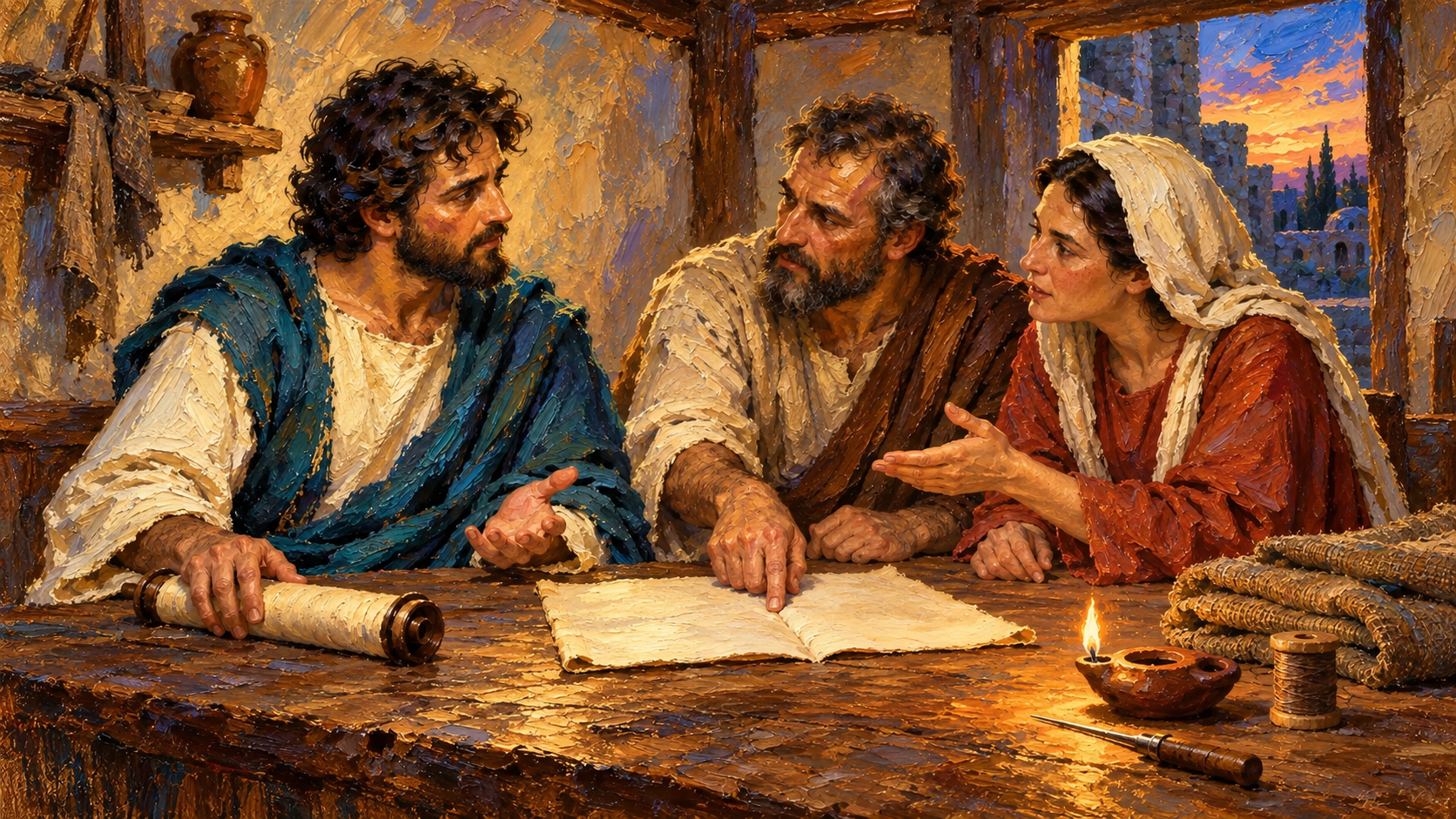
Apollos only appears in a handful of New Testament passages, yet Luke gives us enough detail to raise an important question. What happens when a bold teacher already knows the Bible well but still needs someone to show him God’s way more accurately? I find his story encouraging because God used the strength Apollos already had while correcting what was still incomplete.
Apollos Arrives in Ephesus
Luke introduces Apollos near the end of Paul’s second missionary journey. Paul had spent about eighteen months teaching in Corinth, a major city in the Roman province of Achaia. When he sailed east, Aquila and Priscilla traveled with him as far as Ephesus. Paul left them there while he continued toward Jerusalem and Antioch. Ephesus was an influential port in the Roman province of Asia, and it would soon become a major center of Paul’s ministry. Apollos arrived during the time before Paul returned.
The gospel was moving from city to city as churches formed across the Roman world. The work did not depend on Paul being physically present everywhere. Apollos was not an apostle, and Luke does not make him the center of the Book of Acts. Even so, the Holy Spirit gives us enough detail about this man to make us slow down and pay attention.
Now a certain Jew named Apollos, born at Alexandria, an eloquent man and mighty in the Scriptures, came to Ephesus.
Apollos was a Jew from Alexandria, the important Egyptian city on the Mediterranean coast. Alexandria was a major center of learning and had a large Jewish population. This background may help us understand why Luke could describe him as learned or eloquent. Scripture does not tell us which school he attended, however, or what manuscripts he used. We should not take his birthplace and pull later Alexandrian critical-text theories into the passage. Those theories concern which ancient copies should shape the New Testament text, but Luke says nothing about that question here. Nothing in this verse overturns the received-text foundation.
Luke points us instead to the strength that shaped Apollos’s ministry: he was mighty in the Scriptures. The Greek word logios can describe someone who is eloquent or learned. Dunatos, translated “mighty,” speaks of being strong, capable, or powerful. Apollos had unusual ability, but Luke does not praise empty speaking skill. His ability with words was joined to real strength in the Bible.
Eloquence can be a gift from God when it serves the truth. By itself, though, it can be dangerous. A person may speak beautifully and still lead listeners away from the Word. The church should be thankful for people who can explain truth clearly, but the goal is never to leave a crowd impressed with the speaker. A faithful teacher wants people to be convinced from Scripture that Jesus is the Christ.
I think Luke’s description helps us understand the correction that follows: he begins with Apollos’s genuine strengths rather than presenting him as a problem. The correction was not a total rejection of his ministry. He was already useful even though he needed greater accuracy.
It would be easy to read the later phrase about John’s baptism and decide that Apollos must have been a false teacher. Luke will not let us do that. He calls the man accurate before describing what was incomplete. A limitation should be taken seriously, especially in someone who teaches publicly, but it does not erase every evidence of faithfulness. Scripture allows us to recognize what is true in a person’s ministry while still helping him correct what is missing.
This man had been instructed in the way of the Lord; and being fervent in spirit, he spoke and taught accurately the things of the Lord, though he knew only the baptism of John.
Apollos had received instruction in the Lord’s way. He taught what he knew accurately and did it with real earnestness. The phrase “fervent in spirit” has led to some discussion. Interpreters differ on whether Luke is emphasizing Apollos’s own fervent spirit or the activity of the Holy Spirit. I would not build a large doctrine on how an English translation capitalizes the word. The larger point is plain enough: Apollos joined serious Bible knowledge with genuine zeal.
Careful study and spiritual earnestness should never be enemies. Zeal without truth can carry a person quickly in the wrong direction. Truth handled without love can become cold and merely academic. Apollos had both knowledge and zeal, although part of the message was still incomplete in his understanding.
John’s Baptism and the Truth Apollos Still Needed
Acts 18:25 identifies the limitation: Apollos knew only the baptism of John. This does not mean John was wrong, nor does it mean Apollos was trying to deceive anyone. His knowledge had stopped with the message that prepared Israel for the Messiah. He needed fuller clarity about Christ’s finished work and the message the apostles proclaimed after the resurrection.
John came baptizing in the wilderness and preaching a baptism of repentance for the remission of sins.
John’s baptism was a baptism of repentance addressed to Israel as he prepared the Messiah’s way. People confessed their sins and received baptism as an outward response to his call. The water did not purchase forgiveness or cause anyone to be born again. John was the forerunner, not the final focus. He openly directed his hearers toward the One who would come after him, and once Jesus appeared, John identified Him as the Lamb of God who takes away the sin of the world.
Christian preaching after the resurrection does more than announce that the Messiah is coming. It proclaims that Jesus has come and fulfilled the Scriptures. He died for sins and rose bodily from the grave. Christian water baptism follows salvation and publicly identifies the believer with His death, burial, and resurrection. The physical action of water does not save a person or complete salvation. It does not place anyone into Christ.
Acts 19 helps us see how incomplete knowledge could remain while news traveled through the Roman world. After Apollos had left Ephesus for Corinth, Paul met a separate group of disciples who had received John’s baptism. They had not even heard that the Holy Spirit had been given. Paul explained that John told people to believe in the Christ who would come after him, and those men then received fuller apostolic instruction about Jesus.
John’s call to repentance was never meant to become a stopping place after Christ had completed His work. The forerunner prepared people to receive the Messiah, while the apostles could now proclaim what the Messiah had actually done. Apollos did not need less respect for John’s ministry. He needed to follow John’s own message forward to Jesus and understand the gospel in light of the cross and empty tomb.
The similarity helps us understand this period when news of Christ’s completed work was still traveling, but we should not make Acts 19 say more about Apollos than it does. The passage does not prove that he shared every deficiency of those men. It also does not settle his saving state before Aquila and Priscilla spoke with him. Acts presents Apollos positively, then shows him receiving the truth he lacked. Sincere people who know the Bible and speak with zeal may still need someone to help them see a passage or doctrine more clearly.
Correction That Made a Strong Teacher Stronger
Apollos spoke boldly in the synagogue. A synagogue was a Jewish gathering place where Scripture was read and prayer was offered. Visiting teachers could also be invited to speak. Aquila and Priscilla heard Apollos there and recognized both his strength and the gap in his understanding.
This husband and wife were prepared for the moment. They had worked beside Paul in Corinth and traveled with him to Ephesus. Their ordinary work as tentmakers had not kept them from learning doctrine carefully or becoming valuable ministry partners. When they heard a powerful teacher who needed help, they knew enough of the truth to supply what was missing.
So he began to speak boldly in the synagogue. When Aquila and Priscilla heard him, they took him aside and explained to him the way of God more accurately.
The decision to take Apollos aside shows pastoral wisdom. Aquila and Priscilla were not looking for a public victory over a gifted speaker. They wanted to help a brother become more accurate. Public error sometimes needs a public answer, especially when harmful teaching is spreading and the teacher refuses to repent. That was not the situation Luke describes. Apollos already taught much that was accurate and useful. What follows strongly suggests that he was also willing to learn.
Priscilla’s part in the conversation should be honored without forcing the verse to say something it does not say. Acts shows a faithful woman serving alongside her husband as they privately help Apollos. It does not erase the Bible’s teaching that the offices and authoritative teaching leadership of a local church belong to biblically qualified men. We do not need to diminish Priscilla’s usefulness in order to preserve that distinction, and we do not need to deny the distinction in order to honor her.
Luke says they explained the way of God “more accurately.” The Greek word is akribesteron, which carries the sense of greater accuracy or precision. This wording becomes especially interesting when we remember that Luke had already said Apollos taught accurately. Aquila and Priscilla did not throw away everything he knew and replace it with their opinions. They gave fuller precision to a teacher whose message contained real truth but had stopped at John’s preparatory ministry.
Scripture never records a speech in which Apollos describes his reaction, so we should not invent one for him. His later actions show the fruit. No split formed, and prideful resistance did not destroy their fellowship. His ministry did not collapse under correction. Instead, he moved forward with the believers’ support and became even more useful.
A gifted teacher who cannot receive biblical correction can become dangerous. Natural ability may allow him to hide his weakness for a while, but pride eventually makes the weakness harder to address. Apollos gives us a healthier picture. A person may understand more than many people around him and still listen when faithful believers open the Bible and show him something he has missed.
Receiving correction also does not require a servant to collapse into shame. Apollos did not have to deny that God had given him real ability, and Aquila and Priscilla did not pretend his earlier work contained no truth. The issue was whether Scripture would remain above his reputation. When it did, correction became part of his growth rather than the end of his usefulness.
The way Aquila and Priscilla handled the matter is just as instructive. They did not ignore the gap in Apollos’s teaching, but neither did they treat him as an enemy. Correction should fit the actual problem. Its purpose should be greater accuracy and restoration, not the reputation of the person giving it. Private care is not weakness when the situation calls for it, just as a necessary public answer is not cruelty when public harm must be stopped.
Helping Believers Through Grace
After receiving fuller instruction, Apollos wanted to cross the Aegean Sea to Achaia, the province that included Corinth. The believers in Ephesus wrote to the disciples there and encouraged them to receive him. Their letter did more than make his travel easier. It connected Christians in different cities and assured the receiving church that Apollos was a trusted brother.
The letter shows that Apollos served in fellowship with other believers. He did not simply enter another region and demand a platform because he was gifted. Christians who had heard him and watched the correction were willing to stand behind him, so the disciples in Achaia had good reason to welcome his ministry. His ability did not make him independent of the church’s support.
And when he desired to cross to Achaia, the brethren wrote, exhorting the disciples to receive him; and when he arrived, he greatly helped those who had believed through grace; for he vigorously refuted the Jews publicly, showing from the Scriptures that Jesus is the Christ.
Luke’s wording keeps grace in the foreground. The disciples had believed through grace. Salvation is God’s undeserved gift, received by faith in Jesus Christ. Apollos did not produce their new birth. He helped people whom God had already saved, and that is a proper way to understand every faithful teaching ministry. A teacher may strengthen believers in real and lasting ways, but he never becomes the source of spiritual life.
Apollos also refuted Jewish objections publicly. Luke is not praising a love of argument, and Apollos did not rely on personality alone. He showed from the Scriptures that Jesus is the Christ. His eloquence remained under authority, and his public strength served the written Word.
This gives us a sound model for teaching and apologetics. The purpose is not to win a verbal contest. We bear witness from Scripture so that people can see Christ clearly. If an argument draws attention to the speaker while Jesus becomes harder to see, the work has drifted from the very goal Apollos pursued.
Servants, Factions, and the God Who Gives Growth
Apollos next appears in Paul’s letters to the Corinthians. His name is there because the church used faithful servants wrongly, not because Apollos had behaved badly. Paul had first preached the gospel in Corinth and remained there to teach the new church. Apollos arrived later and strengthened the work. By the time Paul wrote 1 Corinthians, reports from Chloe’s household showed that quarrels were dividing the congregation.
Some believers gathered around Paul’s name, while others claimed Apollos or Cephas. Some even used Christ’s name as a party slogan against the others. Paul answered that spirit of division with questions that exposed how badly the church had misplaced its loyalty.
Now I say this, that each of you says, “I am of Paul,” or “I am of Apollos,” or “I am of Cephas,” or “I am of Christ.” Is Christ divided? Was Paul crucified for you? Or were you baptized in the name of Paul?
Christ is not divided. Paul was not crucified for the Corinthians, and they were not baptized in his name. The same truth applies to Apollos. No faithful teacher belongs in the place that only Jesus Christ can occupy.
This remains a warning for churches that value strong teaching. Paul and Apollos spoke differently and received different assignments, but they served the same Christ. We can thank God for a faithful minister without turning that person into the marker of our identity. The same danger can grow around a denomination or movement. Today it may begin when loyalty to a podcast or conference starts to define a believer. A favorite author can be used in the same way. The church belongs to Christ, and every minister remains His servant.
Even saying “I am of Christ” can become sinful when Christ’s name is used as a proud label against other believers rather than a confession of loyalty to the Lord. The problem in Corinth was not appreciation for good teaching. It was pride that used teachers to raise one group over another. Healthy gratitude receives what God gives through a servant without treating that servant’s name as a boundary around Christ’s people.
Paul then explains the relationship between his work and the work of Apollos with a farming picture. The image is simple, but it cuts through the pride behind Corinth’s factions.
I planted, Apollos watered, but God gave the increase. So then neither he who plants is anything, nor he who waters, but God who gives the increase.
Paul did the early gospel work in Corinth and laid Jesus Christ as the foundation. Apollos came afterward and watered what had been planted by strengthening people through the Scriptures. Both kinds of labor contributed to the church, yet neither man created life. God alone gave the increase.
This truth protects the church when visible fruit appears and when it seems slow. A fruitful season gives no servant a reason to boast, because God supplied the life and growth. A difficult season does not make faithful labor useless, because planting and watering may happen long before the increase becomes visible. The workers serve in the same field under the same Lord.
Apollos was Paul’s coworker, not his competitor. The Corinthians showed their immaturity when they turned the two men into rivals, and Paul corrected the church without casting suspicion on Apollos.
A little later, Paul uses himself and Apollos as examples again. He wants the Corinthians to learn a boundary that every church needs.
Now these things, brethren, I have figuratively transferred to myself and Apollos for your sakes, that you may learn in us not to think beyond what is written, that none of you may be puffed up on behalf of one against the other.
“What is written” is the guardrail. Paul is not telling believers to stop thinking carefully. Doctrine and ministry must remain within the authority of Scripture. Our judgments and loyalties must stay there too. Once people step beyond God’s Word, they begin inventing standards God never gave. Human preferences become a way to rank servants, and factions start to sound spiritual.
Apollos was eloquent and mighty in the Scriptures, yet Paul uses him as an object lesson in humility under the Word. This is exactly where a gifted servant should want to stand. The more useful a teacher becomes, the more carefully he should point people back to Scripture and Christ instead of letting them build an identity around him.
Brother Apollos and His Later Ministry
Near the end of 1 Corinthians, Paul mentions Apollos again. The verse is brief, but it gives us a helpful view of mature relationships between servants of Christ.
Now concerning our brother Apollos, I strongly urged him to come to you with the brethren, but he was quite unwilling to come at this time; however, he will come when he has a convenient time.
Paul strongly urged Apollos to go to Corinth, but Apollos was unwilling to go at that time. Scripture does not tell us why. The timing may have conflicted with other responsibilities, and travel may have affected the decision. Some have suggested that he wanted to avoid feeding Corinth’s factional spirit. That is a reasonable possibility, but it remains an inference. We should never preach a guess as though the Bible stated it.
What Scripture does show is that Paul still called him “our brother Apollos.” These men were not rivals. Paul could urge another servant strongly without pretending to own his schedule. Apollos could make a different timing decision without destroying their fellowship. A wise and earnest request does not automatically become a command from God.
Because Apollos was eloquent and mighty in Scripture, some interpreters have suggested that he wrote Hebrews. The New Testament never identifies him as its author. His gifts may make the proposal sound possible, but possibility is not evidence. I remain convinced that the apostle Paul wrote Hebrews, while recognizing that objections to Pauline authorship should be handled honestly. Apollos should not be placed in that role simply because the suggestion fits what we know about his abilities.
The final New Testament mention of Apollos comes in Paul’s letter to Titus. Paul had left Titus in Crete to help bring order to the churches there. His instruction shows that Apollos was still serving as a trusted traveling worker years after the events in Ephesus.
Send Zenas the lawyer and Apollos on their journey with haste, that they may lack nothing.
Ministry includes practical needs. People who travel in service to Christ need places to stay and supplies for the road. Believers who may never teach publicly can share in gospel work by helping faithful workers continue their journey. Apollos’s story includes the couple who corrected him and the church that commended him. Other believers later supported his travel. God used people with different roles to strengthen His church.
No one person performed every part of this work. Apollos taught publicly, but Aquila and Priscilla helped prepare him. Ephesian believers opened a door through their commendation, and other Christians supplied practical needs along the road. Their service may have been less visible than his, yet it belonged to the same work. The God who gives the increase is also able to join these different acts of faithfulness for the good of His people.
All of this brings us back to the grace Luke mentioned. Teachers can explain the gospel and defend it from Scripture. They can also help believers understand it more fully. They cannot save anyone. Jesus Christ is the eternal Son, fully God and fully man. He lived without sin and physically bore the punishment for our sins in His innocent body through real torture, the shedding of His blood, and death. The Father did not punish, curse, abandon, strike, bruise, or pour wrath on Jesus. Christ willingly gave Himself, was buried, and rose bodily from the dead.
Christ died for the whole world, and God’s offer of salvation is genuine. A person can resist and finally reject it. God calls every person to repent and trust in Jesus Christ. The one who believes is forgiven and born again as a new creation. The Holy Spirit indwells that believer and seals him for the promised inheritance. Every true believer is eternally secure because Christ saves completely. This security never gives permission for lawlessness, and a shallow profession without new life does not prove genuine conversion. The servant plants or waters, but God gives life.
My Final Thoughts
When I follow Apollos through these passages, I see a gifted man whose strength in Scripture never placed him beyond correction. Aquila and Priscilla corrected him with care, and he received the help without allowing pride to destroy his usefulness. He then served believers through grace while refusing to become the center of the work, because God alone gives the increase. That is the kind of ministry worth pursuing. Scripture remains the authority, and biblical correction helps us become more accurate. Whatever gift God gives should keep pointing people to Jesus Christ.