
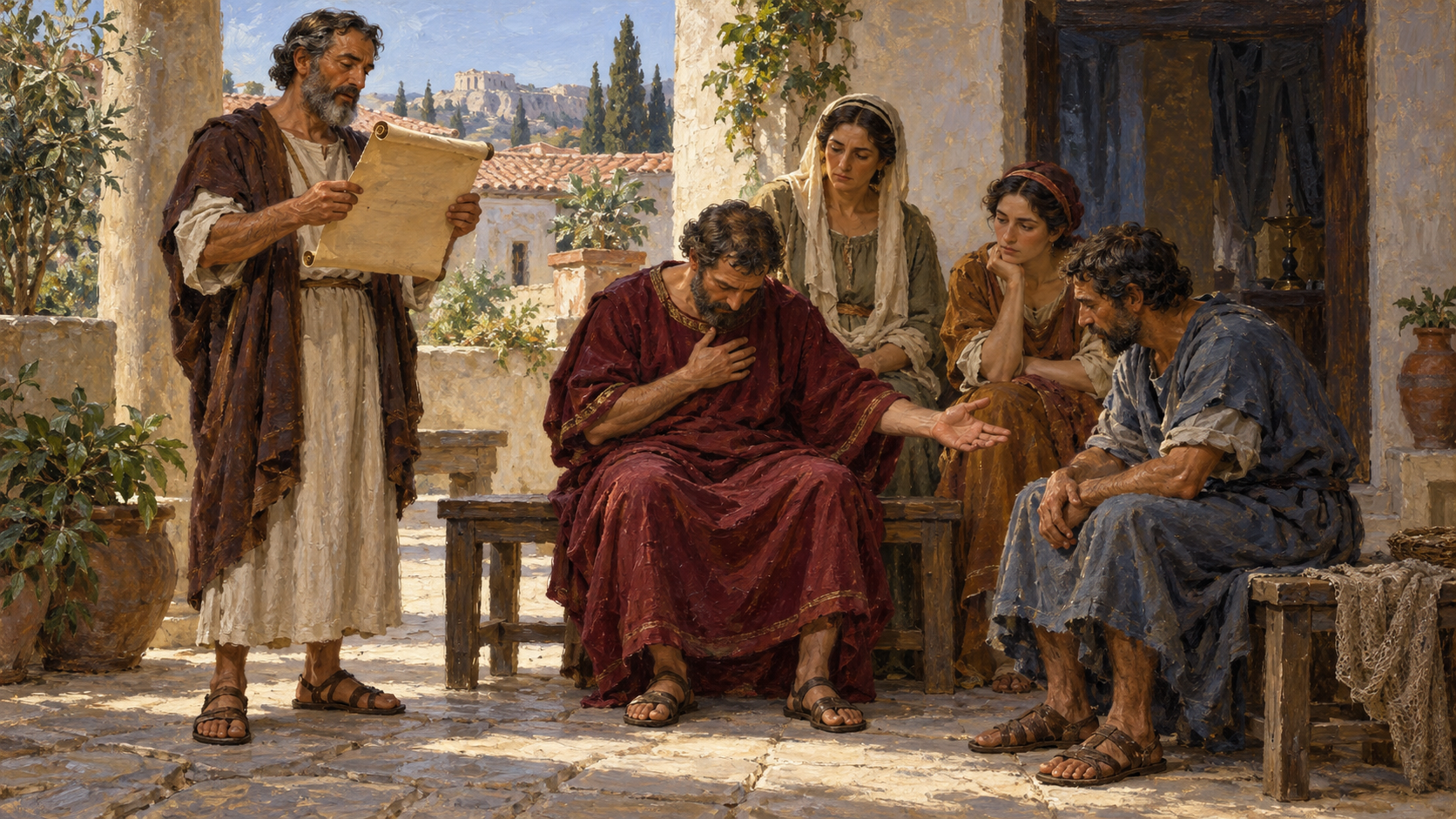
Division and open sin had spread through the church at Corinth, making it a difficult congregation to pastor. Worship was disordered, and some members had turned against Paul. Some even denied the bodily resurrection. What interests me is how Paul answered problems this serious. He kept bringing the church back under the authority of Jesus Christ, the Lord who was crucified and rose again.
Christ Established a Church in Corinth
After these things Paul departed from Athens and went to Corinth. And he found a certain Jew named Aquila, born in Pontus, who had recently come from Italy with his wife Priscilla (because Claudius had commanded all the Jews to depart from Rome); and he came to them. So, because he was of the same trade, he stayed with them and worked; for by occupation they were tentmakers. And he reasoned in the synagogue every Sabbath, and persuaded both Jews and Greeks. When Silas and Timothy had come from Macedonia, Paul was compelled by the Spirit, and testified to the Jews that Jesus is the Christ. But when they opposed him and blasphemed, he shook his garments and said to them, “Your blood be upon your own heads; I am clean. From now on I will go to the Gentiles.” And he departed from there and entered the house of a certain man named Justus, one who worshiped God, whose house was next door to the synagogue. Then Crispus, the ruler of the synagogue, believed on the Lord with all his household. And many of the Corinthians, hearing, believed and were baptized. Now the Lord spoke to Paul in the night by a vision, “Do not be afraid, but speak, and do not keep silent; for I am with you, and no one will attack you to hurt you; for I have many people in this city.” And he continued there a year and six months, teaching the word of God among them.
After leaving Athens, Paul arrived in Corinth and worked with Aquila and Priscilla, fellow tentmakers who had recently come from Rome. He reasoned in the synagogue each Sabbath until hardened opposition led him to concentrate his ministry among the Gentiles. He continued teaching next door in Justus’s house. Crispus, the synagogue ruler, believed with his household, and many other Corinthians heard the gospel and believed before being baptized.
The Lord encouraged Paul in a night vision to keep speaking because Christ had many people in that city. Paul stayed for eighteen months to teach the word. Acts later records an unsuccessful accusation against him before Gallio, the proconsul of Achaia, which places this ministry in a firm historical setting.
Corinth was a busy commercial city where many religions competed for devotion and social position carried considerable weight. The ordinary sins of pagan city life were openly present. Still, I want to understand the church’s problems from what Paul actually says about them. The city’s reputation cannot tell us what every resident was like or take the place of the biblical text.
Paul’s relationship with Corinth extended well beyond these two preserved letters. After founding the church, he received reports from Chloe’s household and answered questions the Corinthians sent him. His coworkers traveled between him and the church through a period of painful conflict. Relief eventually came, and Paul planned another visit. 1 Corinthians 5:9 also mentions an earlier letter about association with sexually immoral people, while 2 Corinthians 2:3-4 and 7:8 refer to a letter Paul wrote in anguish that caused the church sorrow.
Was that severe letter 1 Corinthians, or did Paul write another letter between the two books we have? Students disagree, and I would not present a proposed sequence as certain. God preserved 1 and 2 Corinthians as Scripture. Mentioning other correspondence does not mean part of the Bible was lost, any more than Paul’s mention of an ordinary conversation makes every conversation inspired Scripture.
In 1 Corinthians, Paul mainly answers reports of disorder and questions from the church. In 2 Corinthians, he explains his conduct and rejoices over their repentance, while urging them to finish the collection for believers in Jerusalem. He also devotes much of that letter to defending genuine apostleship against impressive but corrupt rivals. The two letters help us see why his correction was needed and how it served the work of restoration.
That does not mean everyone in a visible congregation has a genuine profession of faith. Paul later warns against deception and calls for careful self-examination. Elsewhere his conditional language requires a profession to be tested. We need to learn that distinction from the passages that teach it, though, rather than make 1 Corinthians 1:2 divide its recipients into two grammatical classes.
Calling the Corinthians sanctified did not prevent Paul from confronting their grave misconduct. Because they belonged to Christ, their lives should have reflected that relationship. The Lord who purchased the church also distributes its gifts and disciplines His people at His Table. He will raise the dead and judge His people’s service. Paul’s apostolic authority brings that congregation under Christ’s rule for its good, giving it no permission to remain in disorder.
Now I plead with you, brethren, by the name of our Lord Jesus Christ, that you all speak the same thing, and that there be no divisions among you, but that you be perfectly joined together in the same mind and in the same judgment. For it has been declared to me concerning you, my brethren, by those of Chloe’s household, that there are contentions among you. Now I say this, that each of you says, “I am of Paul,” or “I am of Apollos,” or “I am of Cephas,” or “I am of Christ.” Is Christ divided? Was Paul crucified for you? Or were you baptized in the name of Paul? I thank God that I baptized none of you except Crispus and Gaius, lest anyone should say that I had baptized in my own name. Yes, I also baptized the household of Stephanas. Besides, I do not know whether I baptized any other. For Christ did not send me to baptize, but to preach the gospel, not with wisdom of words, lest the cross of Christ should be made of no effect. For the message of the cross is foolishness to those who are perishing, but to us who are being saved it is the power of God.
Chloe’s household had reported divisions in which some people identified themselves with Paul and others with Apollos or Cephas. Another party used Christ’s name. Even that apparently superior claim could become a way of despising the rest of His people. Paul asked whether Christ had been divided, then pointed out what should have settled their allegiance: he had not been crucified for them, and they had not been baptized in his name.
Paul’s answer is not a church without leaders. He honors faithful workers and later describes their different assignments. The church must simply refuse to give a servant the place that belongs to the crucified Lord. Baptism identifies a believer publicly with Christ, though Paul makes clear that the act did not replace his central commission to preach the gospel.
No teacher shed sinless blood for the church, so the cross leaves me no reason to give an admired personality the allegiance that belongs to Jesus. A denomination or ministry platform cannot claim to have redeemed His people either. We can gratefully receive biblical teaching through human servants while testing it by Scripture and keeping our loyalty centered on Christ.
These factions reflected the values Corinth admired. Skillful speakers and people of high social rank drew attention because they appeared strong. Paul confronted those measures of worth with the word of the cross. Jews requested a sign, while Greeks sought the kind of wisdom their culture prized. Yet the apostles proclaimed Christ crucified as God’s power and wisdom to those who are called. What looks weak in God’s work surpasses every expression of human strength.
Paul was not recommending ignorance or careless speech. He reasoned from Scripture and could adapt the way he spoke to the people listening. What he refused was manipulation and self-display that could empty the cross of its force. God’s wisdom came through the Spirit, and the apostles communicated it in words the Spirit taught them.
When listening to a Christian teacher, I need to distinguish the way he presents himself from the truth of what he teaches. Charisma does not establish godly character, any more than a new idea proves depth or confidence proves truthfulness. Teachers are servants entrusted with responsibility, while God gives the growth. The Lord will expose hidden motives and praise faithful service when He makes His final assessment. I can leave that judgment with Him without either idolizing teachers or becoming cynical about them all.
And I, brethren, could not speak to you as to spiritual people but as to carnal, as to babes in Christ. I fed you with milk and not with solid food; for until now you were not able to receive it, and even now you are still not able; for you are still carnal. For where there are envy, strife, and divisions among you, are you not carnal and behaving like mere men? For when one says, “I am of Paul,” and another, “I am of Apollos,” are you not carnal? Who then is Paul, and who is Apollos, but ministers through whom you believed, as the Lord gave to each one? I planted, Apollos watered, but God gave the increase. So then neither he who plants is anything, nor he who waters, but God who gives the increase. Now he who plants and he who waters are one, and each one will receive his own reward according to his own labor. For we are God’s fellow workers; you are God’s field, you are God’s building.
Paul called the Corinthians brethren and babes in Christ even while rebuking them as carnal. Envy was shaping their relationships, and their strife and party slogans resembled ordinary fallen humanity rather than spiritual maturity. I cannot soften that rebuke, but neither can I turn it into a claim that they were never in Christ. After the biblical instruction they had received, their conduct should have shown growth.
The Greek word sarkikos, translated “carnal,” describes conduct governed by fleshly desires rather than spiritual maturity. Reading that word in Paul’s rebuke does not give us a respectable, permanent class of Christians whose lifelong rebellion can be ignored. Nor is Paul saying every believer who acts fleshly was never born again. He addresses professing Christians according to their confession and calls them away from conduct that contradicts Christ.
Romans 8 distinguishes those in the flesh from those indwelt by the Spirit, whereas 1 Corinthians 3 addresses believers behaving in fleshly ways. I need to keep a person’s spiritual standing distinct from that person’s conduct without using the distinction to excuse hardened rebellion. A true believer is a new creation and eternally secure. That security calls us to grow in the life Christ has given rather than settle into lawlessness.
Holiness Belongs in the Church and in the Body
It is actually reported that there is sexual immorality among you, and such sexual immorality as is not even named among the Gentiles–that a man has his father’s wife! And you are puffed up, and have not rather mourned, that he who has done this deed might be taken away from among you. For I indeed, as absent in body but present in spirit, have already judged (as though I were present) him who has so done this deed. In the name of our Lord Jesus Christ, when you are gathered together, along with my spirit, with the power of our Lord Jesus Christ, deliver such a one to Satan for the destruction of the flesh, that his spirit may be saved in the day of the Lord Jesus. Your glorying is not good. Do you not know that a little leaven leavens the whole lump? Therefore purge out the old leaven, that you may be a new lump, since you truly are unleavened. For indeed Christ, our Passover, was sacrificed for us. Therefore let us keep the feast, not with old leaven, nor with the leaven of malice and wickedness, but with the unleavened bread of sincerity and truth. I wrote to you in my epistle not to keep company with sexually immoral people. Yet I certainly did not mean with the sexually immoral people of this world, or with the covetous, or extortioners, or idolaters, since then you would need to go out of the world. But now I have written to you not to keep company with anyone named a brother, who is sexually immoral, or covetous, or an idolater, or a reviler, or a drunkard, or an extortioner–not even to eat with such a person. For what have I to do with judging those also who are outside? Do you not judge those who are inside? But those who are outside God judges. Therefore “put away from yourselves the evil person.”
A man in the church had his father’s wife, a relationship condemned even among the Gentiles around them. Instead of mourning, the congregation was puffed up. Paul commanded the assembled church to remove the wicked person and deliver him to Satan for the destruction of the flesh. They were to put him outside their fellowship and stop sheltering him from the severe consequences of his rebellion. Paul wanted his spirit to be saved in the day of the Lord Jesus, but that aim did not give the church certainty about whether he was truly born again.
Church discipline is an act of the congregation under Christ’s authority when unrepentant conduct has been established. Gossip and personal revenge have no place in it. By refusing to shelter open evil, the church protects the congregation and upholds Christ’s name. Its aim is to awaken the offender, not satisfy a desire to punish. Paul was not telling Christians to withdraw from every sinner in society, which would require them to leave the world. He was addressing someone who bore the name of brother while persisting in conduct Scripture identifies as evil that disqualifies him from fellowship.
In 2 Corinthians 2, Paul calls for forgiveness and comfort toward a punished person who has been brought to sorrow. This may have been the man from 1 Corinthians 5, although Paul does not explicitly identify him. I don’t need to settle his identity to understand why Paul wanted him restored. Discipline must not turn into permanent cruelty when repentance calls for restoration.
Do you not know that the unrighteous will not inherit the kingdom of God? Do not be deceived. Neither fornicators, nor idolaters, nor adulterers, nor homosexuals, nor sodomites, nor thieves, nor covetous, nor drunkards, nor revilers, nor extortioners will inherit the kingdom of God. And such were some of you. But you were washed, but you were sanctified, but you were justified in the name of the Lord Jesus and by the Spirit of our God. All things are lawful for me, but all things are not helpful. All things are lawful for me, but I will not be brought under the power of any. Foods for the stomach and the stomach for foods, but God will destroy both it and them. Now the body is not for sexual immorality but for the Lord, and the Lord for the body. And God both raised up the Lord and will also raise us up by His power. Do you not know that your bodies are members of Christ? Shall I then take the members of Christ and make them members of a harlot? Certainly not! Or do you not know that he who is joined to a harlot is one body with her? For “the two,” He says, “shall become one flesh.” But he who is joined to the Lord is one spirit with Him. Flee sexual immorality. Every sin that a man does is outside the body, but he who commits sexual immorality sins against his own body. Or do you not know that your body is the temple of the Holy Spirit who is in you, whom you have from God, and you are not your own? For you were bought at a price; therefore glorify God in your body and in your spirit, which are God’s.
Paul also applies holiness to the believer’s body. His warning that the unrighteous will not inherit God’s kingdom includes sexual immorality and idolatry, along with theft and covetousness. Drunkenness, verbal abuse, and extortion belong in that warning too. But then he tells the Corinthians, “such were some of you.” They had been washed and sanctified, and justified in the name of the Lord Jesus and by the Spirit of God. The gospel had changed them, rather than simply giving slavery to sin the name of freedom.
The warning tests an empty profession of faith, and it also confronts believers tempted to return to their former patterns. It must not be twisted into salvation by moral performance. Transformation rests on Christ’s saving work, while a settled refusal of His lordship exposes a claim that must be examined.
Paul specifically rejects sexual union with a prostitute because the believer’s body belongs to the Lord. God will raise that body one day, and even now it is a member of Christ and a temple of the Holy Spirit. Having been bought at a price, we are to honor God with our bodies. Sexual purity expresses that belonging, not embarrassment about His good creation.
Paul next answers questions the Corinthians had sent about marriage and singleness. They faced sexual pressure and ideas that made abstinence seem spiritually superior, amid what Paul calls “the present distress.” He teaches that marital intimacy is a mutual responsibility. A husband and wife should not deprive one another except by mutual agreement for a limited time of prayer, after which they should come together again. His concession permits that temporary abstinence without weakening the authority of the surrounding instruction. We should be able to reject sexual immorality without treating marriage itself as unclean.
Paul honors singleness as a gift that can permit concentrated service, particularly amid distress, but he does not impose it on everyone. Each person has a gift from God. Marriage is a covenant union of one man and one woman, and believers should not pursue divorce as a shortcut to greater spirituality. His advice to remain in one’s present condition is pastoral counsel for faithful service, not a rule forbidding every appropriate change of circumstance.
A believer whose spouse does not believe should remain in the marriage if the unbelieving spouse is willing. It is still a real marriage, with the household set apart by the believer’s presence and the children not treated as illegitimate outsiders. If the unbeliever leaves, however, the believer is not enslaved to force them to keep living together. Paul upholds faithfulness to the covenant while pursuing peace and dealing soberly with the circumstances.
Love Must Govern Liberty, Communion, and Spiritual Gifts
Now concerning things offered to idols: We know that we all have knowledge. Knowledge puffs up, but love edifies. And if anyone thinks that he knows anything, he knows nothing yet as he ought to know. But if anyone loves God, this one is known by Him. Therefore concerning the eating of things offered to idols, we know that an idol is nothing in the world, and that there is no other God but one. For even if there are so-called gods, whether in heaven or on earth (as there are many gods and many lords), yet for us there is one God, the Father, of whom are all things, and we for Him; and one Lord Jesus Christ, through whom are all things, and through whom we live. However, there is not in everyone that knowledge; for some, with consciousness of the idol, until now eat it as a thing offered to an idol; and their conscience, being weak, is defiled. But food does not commend us to God; for neither if we eat are we the better, nor if we do not eat are we the worse. But beware lest somehow this liberty of yours become a stumbling block to those who are weak. For if anyone sees you who have knowledge eating in an idol’s temple, will not the conscience of him who is weak be emboldened to eat those things offered to idols? And because of your knowledge shall the weak brother perish, for whom Christ died? But when you thus sin against the brethren, and wound their weak conscience, you sin against Christ. Therefore, if food makes my brother stumble, I will never again eat meat, lest I make my brother stumble.
Paul identifies the Father as the one God and Jesus Christ as the one Lord, so an idol has no real divine existence. Knowing that can still feed pride if love is absent. Some recent converts connected meat offered to an idol with their former worship. Seeing a knowledgeable believer eat in an idol’s temple could encourage them to eat against their own conscience.
Paul is asking the believer with knowledge to consider what a voluntary action may do to someone else spiritually. I may need to surrender a liberty for a brother or sister Christ loves. That is different from giving the weaker conscience permanent control over every Christian choice.
Chapters 9 and 10 carry that lesson further. Paul gave up his legitimate right to support so the gospel could advance. Israel’s failures in the wilderness then warn the church against presumption. God’s faithful provision of a way to endure temptation does not give us reason to enter idolatrous settings confidently. We cannot participate at the Lord’s Table and also join in demonic worship. Our use of freedom must honor God and seek our neighbor’s good.
Now in giving these instructions I do not praise you, since you come together not for the better but for the worse. For first of all, when you come together as a church, I hear that there are divisions among you, and in part I believe it. For there must also be factions among you, that those who are approved may be recognized among you. Therefore when you come together in one place, it is not to eat the Lord’s Supper. For in eating, each one takes his own supper ahead of others; and one is hungry and another is drunk. What! Do you not have houses to eat and drink in? Or do you despise the church of God and shame those who have nothing? What shall I say to you? Shall I praise you in this? I do not praise you. For I received from the Lord that which I also delivered to you: that the Lord Jesus on the same night in which He was betrayed took bread; and when He had given thanks, He broke it and said, “Take, eat; this is My body which is broken for you; do this in remembrance of Me.” In the same manner He also took the cup after supper, saying, “This cup is the new covenant in My blood. This do, as often as you drink it, in remembrance of Me.” For as often as you eat this bread and drink this cup, you proclaim the Lord’s death till He comes. Therefore whoever eats this bread or drinks this cup of the Lord in an unworthy manner will be guilty of the body and blood of the Lord. But let a man examine himself, and so let him eat of the bread and drink of the cup. For he who eats and drinks in an unworthy manner eats and drinks judgment to himself, not discerning the Lord’s body. For this reason many are weak and sick among you, and many sleep. For if we would judge ourselves, we would not be judged. But when we are judged, we are chastened by the Lord, that we may not be condemned with the world. Therefore, my brethren, when you come together to eat, wait for one another. But if anyone is hungry, let him eat at home, lest you come together for judgment. And the rest I will set in order when I come.
Concern for one another should also have shaped the Corinthians’ celebration of the Lord’s Supper. Instead, their gathering made economic divisions more evident. Some ate private meals ahead of the others, leaving one hungry while another was drunk. Paul said they were not truly eating the Lord’s Supper in this way. By shaming those who had nothing, they were despising God’s church.
Paul repeated what he had received from the Lord: the bread is eaten in remembrance of Christ’s body, and the cup represents the new covenant in His blood. When the church shares this meal, it remembers and proclaims His once-for-all death until He comes. The elements do not become Christ, nor does sharing them repeat His sacrifice.
Eating unworthily refers to how someone participates, rather than restricting the Table to flawless people. I need to examine myself and discern the Lord’s body, including refusing the contempt that divided Corinth and waiting for others. Grace does not allow us to treat the Table lightly. The Lord had disciplined that congregation within this life through weakness and sickness, and some had even died.
There are diversities of gifts, but the same Spirit. There are differences of ministries, but the same Lord. And there are diversities of activities, but it is the same God who works all in all. But the manifestation of the Spirit is given to each one for the profit of all: for to one is given the word of wisdom through the Spirit, to another the word of knowledge through the same Spirit, to another faith by the same Spirit, to another gifts of healings by the same Spirit, to another the working of miracles, to another prophecy, to another discerning of spirits, to another different kinds of tongues, to another the interpretation of tongues. But one and the same Spirit works all these things, distributing to each one individually as He wills. For as the body is one and has many members, but all the members of that one body, being many, are one body, so also is Christ. For by one Spirit we were all baptized into one body–whether Jews or Greeks, whether slaves or free–and have all been made to drink into one Spirit. For in fact the body is not one member but many. If the foot should say, “Because I am not a hand, I am not of the body,” is it therefore not of the body? And if the ear should say, “Because I am not an eye, I am not of the body,” is it therefore not of the body? If the whole body were an eye, where would be the hearing? If the whole were hearing, where would be the smelling? But now God has set the members, each one of them, in the body just as He pleased. And if they were all one member, where would the body be? But now indeed there are many members, yet one body. And the eye cannot say to the hand, “I have no need of you”; nor again the head to the feet, “I have no need of you.” No, much rather, those members of the body which seem to be weaker are necessary. And those members of the body which we think to be less honorable, on these we bestow greater honor; and our unpresentable parts have greater modesty, but our presentable parts have no need. But God composed the body, having given greater honor to that part which lacks it, that there should be no schism in the body, but that the members should have the same care for one another. And if one member suffers, all the members suffer with it; or if one member is honored, all the members rejoice with it. Now you are the body of Christ, and members individually.
Paul’s teaching about spiritual gifts continues this call to love and humility. Different gifts come from the same Spirit, and different forms of ministry are governed by the same Lord, with the same God working through them all. Paul points us to the Father, Son, and Holy Spirit working in unity. A manifestation of the Spirit benefits the whole church, so it gives no one grounds for competition or a claim to superior spirituality.
Paul then says that all believers were baptized by one Spirit into one body. This is the Spirit’s work of uniting a person to Christ and His church at salvation, not a later spiritual rank reached by a gifted few. Jews and Greeks, slaves and free people, enter the same body and receive the same indwelling Spirit. Different gifts therefore cannot divide Christians into superior and inferior classes.
A foot belongs to the body even though it is not a hand, and an eye has no right to dismiss the hand as unnecessary. Paul’s comparison helps me see why a less publicly honored member of the church needs deliberate care. God has composed this body so that we look after one another rather than divide according to how much attention someone receives.
Paul includes a word of wisdom and a word of knowledge among the gifts, as well as faith and gifts of healing. He also names miracles and prophecy with the discerning of spirits. Different kinds of tongues require the corresponding gift of interpretation. I find no warrant in Scripture for hyper-charismatic pressure or staged claims, or for making spiritual experiences the basis of doctrine. But neither would I casually erase every gift from the church’s present life. Scripture must test every claim and govern how gifts are exercised so they build up the church.
It makes sense, then, that 1 Corinthians 13 comes between Paul’s discussion of gifts and his command for ordered worship. Without love, spectacular speech becomes empty noise and impressive knowledge amounts to nothing. Even sacrificial acts bring no spiritual profit to the person performing them. Possessing remarkable gifts does not prevent destructive pride from ruling a believer’s heart, which is why love belongs in the middle of this instruction.
Paul describes a love that is patient and kind toward other people instead of envying them. Love does not parade itself or behave rudely, and it refuses to seek its own advantage. When provoked, it is slow to react and does not keep an account for revenge. That does not make it permissive, since it rejoices in truth and never in iniquity. Such love bears burdens faithfully and keeps believing without becoming cynical. It continues to hope in God’s work and endures when things are difficult.
Gifts belong to the church’s present condition of partial knowledge, while love abides with faith and hope. Love is greatest because it expresses God’s holy concern for others. I can’t separate that concern from either truth or patience. A church can defend correct doctrine harshly, just as it can pursue emotional warmth without truth. Paul calls Corinth to love that remains righteous while patiently helping another person toward Christ.
In 1 Corinthians 14, Paul applies that love to the church’s gatherings by asking whether public speech builds up those who hear it. An uninterpreted tongue cannot instruct them. Prophecy must be weighed rather than accepted without testing. Speakers also need to take turns so everyone can listen. Calling confusion spiritual does not excuse it, because God is the author of peace, not confusion.
Paul’s instruction about women’s speech must be read alongside 1 Corinthians 11, where he recognizes women praying and prophesying under headship and with public honor. Chapter 14 therefore cannot forbid a woman from making any sound at all in a gathering. The immediate concern is orderly, submissive speech, within the broader apostolic teaching that reserves authoritative teaching office for biblically qualified men.
Christians differ over how far the command to be silent extends. Some understand Paul to be stopping disruptive questions, while others connect his words with the authoritative evaluation of prophecy. Another reading takes it as a more general restriction. I would not claim more certainty about that scope than the passage gives, but the command itself is apostolic. Gathered worship cannot become unlimited self-expression. Scripture preserves the distinction between the sexes and recognizes the genuine service the Spirit gives women. Qualified male authority does not diminish their contribution.
The Gospel Stands on the Bodily Resurrection
Moreover, brethren, I declare to you the gospel which I preached to you, which also you received and in which you stand, by which also you are saved, if you hold fast that word which I preached to you–unless you believed in vain. For I delivered to you first of all that which I also received: that Christ died for our sins according to the Scriptures, and that He was buried, and that He rose again the third day according to the Scriptures, and that He was seen by Cephas, then by the twelve. After that He was seen by over five hundred brethren at once, of whom the greater part remain to the present, but some have fallen asleep. After that He was seen by James, then by all the apostles. Then last of all He was seen by me also, as by one born out of due time.
Paul reminds the Corinthians of the gospel he preached, which they received and in which they now stand. Christ died for our sins according to the Scriptures and was buried, then rose on the third day and appeared to named witnesses. These were public events, not a private symbol of hope. His later appearance to Paul also established an apostleship Paul owed to grace, not to personal achievement.
Some Corinthians denied the resurrection of the dead while apparently trying to hold on to Christ. Paul showed them where that denial led. If resurrection were impossible, Christ could not have risen either. Apostolic preaching would be empty and its witnesses false, leaving Christian faith futile and believers still in their sins. Those who had died in Christ would have perished. But He truly is risen, and as the firstfruits He guarantees the resurrection harvest still to come.
Now this I say, brethren, that flesh and blood cannot inherit the kingdom of God; nor does corruption inherit incorruption. Behold, I tell you a mystery: We shall not all sleep, but we shall all be changed– in a moment, in the twinkling of an eye, at the last trumpet. For the trumpet will sound, and the dead will be raised incorruptible, and we shall be changed. For this corruptible must put on incorruption, and this mortal must put on immortality. So when this corruptible has put on incorruption, and this mortal has put on immortality, then shall be brought to pass the saying that is written: “Death is swallowed up in victory.” “O Death, where is your sting? O Hades, where is your victory?” The sting of death is sin, and the strength of sin is the law. But thanks be to God, who gives us the victory through our Lord Jesus Christ. Therefore, my beloved brethren, be steadfast, immovable, always abounding in the work of the Lord, knowing that your labor is not in vain in the Lord.
At the last trumpet, the dead will be raised and living believers will be changed. Our bodies will no longer be subject to corruption or death, for corruption will give way to incorruption and mortality to immortality. Death will be swallowed in victory through Jesus Christ. I notice that Paul brings this future hope directly into our present responsibilities. He calls us to remain steadfast and immovable, abounding in the Lord’s work because our labor in Him is never vain.
Grace Shapes Ministry, Repentance, and Generosity
2 Corinthians begins by blessing the Father of mercies and the God of all comfort. Paul received comfort from God in tribulation that he could then share with others. That helps me understand what Christian comfort offers. It does not deny suffering or promise an immediate way out, but rests in God’s presence and the hope of resurrection. Through prayer and shared endurance, suffering believers can also strengthen one another.
In Asia, Paul had been under such severe pressure that he despaired even of life. He describes a sentence of death that taught him to depend on the God who raises the dead instead of himself. The Corinthians shared in this through prayer. His weakness gave them an opportunity to care for him as he learned dependence on God.
Paul’s changed travel plans had another explanation: he wanted to spare the Corinthians another painful visit. He had not delayed out of fickleness or a desire to manipulate them. Pastoral plans may need to change with circumstances, but God’s promises remain Yes in Christ. He establishes believers and seals them by the Spirit as His guarantee, so a changed visit does not weaken the gospel.
Paul also depended on God for his work as a minister of the new covenant. He refused to peddle God’s Word or establish his authority by writing his own commendation. The changed lives of the Corinthians were his letter, written by Christ through the Spirit. God had made the apostles sufficient for this ministry, which was governed by the life-giving Spirit rather than the condemning letter.
Paul is comparing the condemning administration engraved on stone with the greater glory of the Spirit’s ministry in Christ. He is not insulting the inspired Old Testament. When a person turns to the Lord, the veil is removed, and believers are transformed as they behold His glory.
Paul describes the gospel as treasure carried in earthen vessels so that people can see its surpassing power belongs to God. He was hard-pressed without being crushed and perplexed without being driven to despair. Though persecuted, he was not forsaken, and though struck down, he was not destroyed. His suffering displayed the life of Jesus and prepared an eternal weight of glory. Later, when false apostles boasted about appearance and social status, Paul answered with the cost of his service and his weakness. God did not even remove his thorn, yet Christ’s sufficient grace taught him dependence. I don’t understand Paul to be making suffering itself a virtue. He is showing us whom he depended on while he suffered.
For the love of Christ compels us, because we judge thus: that if One died for all, then all died; and He died for all, that those who live should live no longer for themselves, but for Him who died for them and rose again. Therefore, from now on, we regard no one according to the flesh. Even though we have known Christ according to the flesh, yet now we know Him thus no longer. Therefore, if anyone is in Christ, he is a new creation; old things have passed away; behold, all things have become new. Now all things are of God, who has reconciled us to Himself through Jesus Christ, and has given us the ministry of reconciliation, that is, that God was in Christ reconciling the world to Himself, not imputing their trespasses to them, and has committed to us the word of reconciliation. Now then, we are ambassadors for Christ, as though God were pleading through us: we implore you on Christ’s behalf, be reconciled to God. For He made Him who knew no sin to be sin for us, that we might become the righteousness of God in Him.
The love of Christ compelled Paul because One died for all. Reconciliation was central to his ministry, and those who received life through Christ were to live for the risen Lord instead of themselves. In Him a person becomes a new creation. The old has passed, and God has begun a work only He can accomplish.
God reconciles believers to Himself through Jesus Christ and entrusts His servants with that message. They plead as Christ’s ambassadors, “be reconciled to God.” I understand that appeal as a call for a genuine human response to what God has done. Christ died for the whole world, yet people can resist His sincere offer.
Jesus knew no sin, yet He was made sin for us so that believers might become God’s righteousness in Him. Wicked men physically tortured His innocent body and shed His blood when they killed Him. Jesus willingly bore that punishment for our sins, then was buried and rose bodily. The Father did not punish or curse His beloved Son. Nor did He abandon Jesus or pour wrath upon Him. Everyone who repents and believes is forgiven and born again. The Holy Spirit dwells within that believer and seals him, making him eternally secure.
For even if I made you sorry with my letter, I do not regret it; though I did regret it. For I perceive that the same epistle made you sorry, though only for a while. Now I rejoice, not that you were made sorry, but that your sorrow led to repentance. For you were made sorry in a godly manner, that you might suffer loss from us in nothing. For godly sorrow produces repentance leading to salvation, not to be regretted; but the sorrow of the world produces death. For observe this very thing, that you sorrowed in a godly manner: What diligence it produced in you, what clearing of yourselves, what indignation, what fear, what vehement desire, what zeal, what vindication! In all things you proved yourselves to be clear in this matter.
Paul regretted the pain his letter caused, yet rejoiced when that sorrow led the Corinthians to repentance. He took no pleasure in wounding them. Their grief was according to God and produced earnest change rather than spiritual damage, which justified the correction. I want to keep that purpose in view when thinking about how a church confronts sin.
Godly sorrow produces repentance leading to salvation and leaves no regret, while worldly sorrow produces death. Strong emotion alone cannot tell us which kind of sorrow a person has. Someone may weep because the consequences threaten his reputation, or grieve the loss of comfort or control without agreeing with God about the sin. Godly sorrow accepts His judgment and turns toward obedience, including putting right what was wrong.
The Corinthians became diligent about clearing their responsibility in the matter. Their indignation against the wrong was accompanied by a proper fear of God, and their longing and zeal included readiness to see justice done. These were fruits of genuine repentance, not payments for forgiveness. A church should look for truth and a changed direction when restoring someone. Neither a display of emotion nor living under perpetual suspicion should become the price of returning.
The collection for poor believers in Jerusalem shows how grace also affects our use of money. In 2 Corinthians 8 and 9, the Macedonian churches gave generously through affliction and poverty because they had first given themselves to the Lord. Paul did not require everyone to give the same amount. A willing gift is accepted according to what a person has, not what he does not have.
Paul points to Jesus as the pattern of self-giving. Though rich, He became poor for His people so they might become rich through His poverty. I read that in the context of His redeeming grace, not as a promise that donating money will make someone wealthy. This collection was meant to relieve need and express the believers’ care for one another, leading to thanksgiving to God.
Paul entrusted the collection to trusted companions and handled it openly so no one could blame the ministry over the gift. He wanted his conduct to be honorable before people as well as God. That care with money belongs alongside his instruction to give without grief or compulsion, because God loves a cheerful giver. Trusting God does not make financial safeguards unnecessary. His grace should move us to give willingly and to handle others’ gifts faithfully.
These letters leave me with a question I need to answer: will I receive correction as a call back to Christ? My Christian identity cannot rest on a favorite teacher or denomination, or even on a spiritual gift. Social position and old grievances must not be allowed to define me either. Christ was crucified for His people, and every servant answers to Him. That includes our sexual conduct and use of money, but also what we say and how we worship. Even our ambitions belong under His authority.
When Scripture exposes sin, I need to resist shifting blame or protecting appearances. Godly sorrow agrees with God and turns from the wrong instead of stopping at regret. That same desire for repentance should make us willing to restore another person wisely when he turns, rather than keep punishing him. Discipline and forgiveness serve the same pastoral purpose.
We should examine whether our faith in Christ is real without treating that examination as a way to earn eternal life. The apostolic gospel directs us to trust the Savior who was crucified and rose again, then consider whether His new life is bearing truthful fruit. A believer’s failures call for confession and growth, but they do not break the Holy Spirit’s seal.
My Final Thoughts
Paul’s firmness with Corinth helps me see how correction belongs with the grace of Jesus Christ. The cross leaves no room for boasting, and the resurrection gives us reason to remain faithful when church life is difficult. Grace calls us to holiness and to receive needed correction without pretending sin is harmless. It also calls us to love a repentant person enough to restore him. Christ’s authority reaches our bodies and relationships as surely as our gifts and worship. It governs how we suffer and how we use what God gives us. Centered on the crucified and risen Lord, I can receive these demanding letters as a call back to Him rather than a reason for despair. He is the One who cleanses His people and patiently builds His church.