
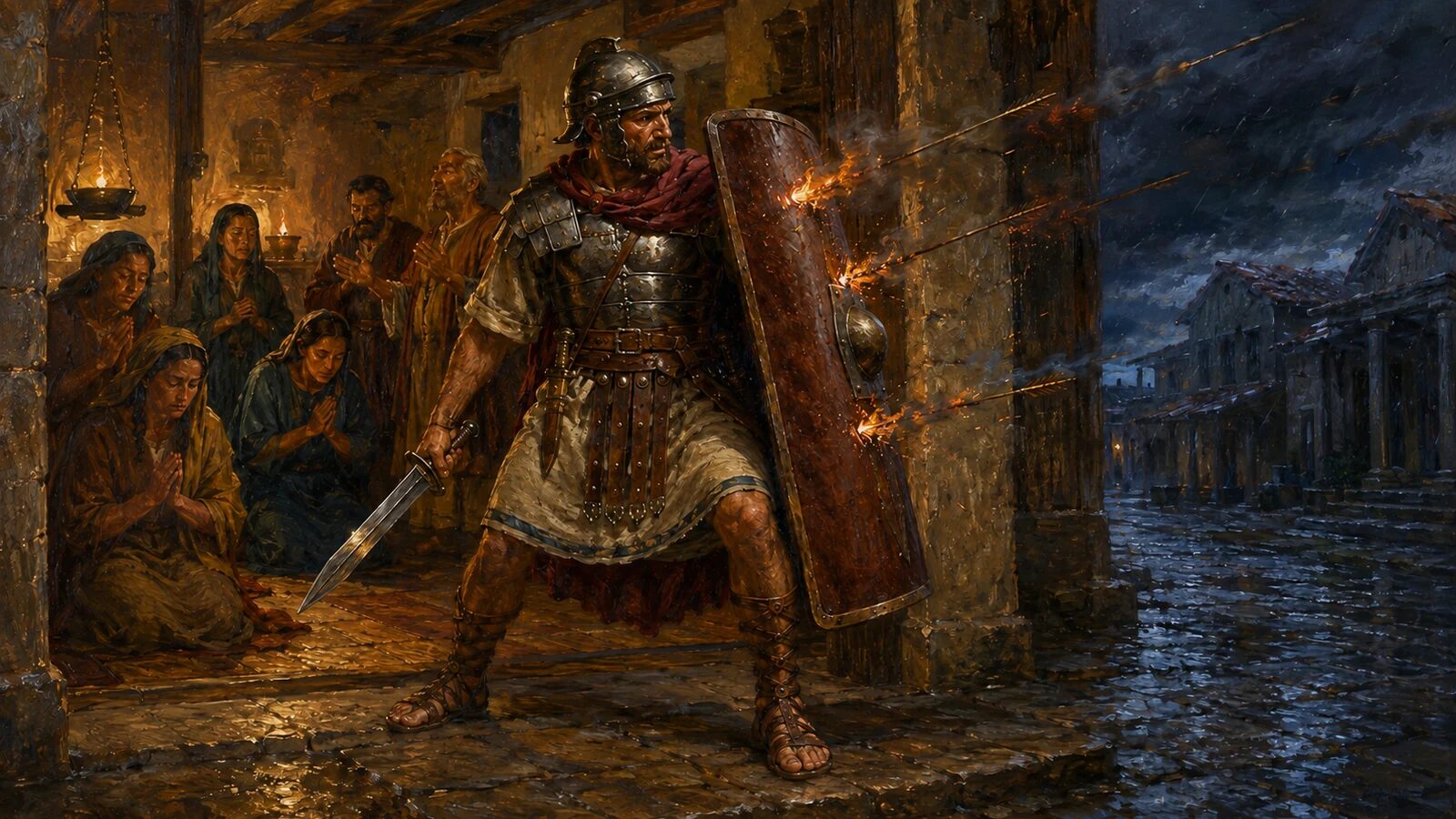
Paul’s teaching on the armor of God is familiar, but I find that familiarity can keep us from hearing what he is actually asking of us. Ephesians 6:10-18 is neither a ritual nor an invitation to become preoccupied with darkness. Paul calls believers to receive strength from the Lord and remain standing in what God has supplied.
The pressure is real, yet Paul does not point us to personality, volume, or spiritual showmanship. He brings us back to Christ. His truth, righteousness, gospel peace, faith, salvation, Scripture, and prayer are all part of the provision He gives. As we work through the passage, I want to keep that simple center in view.
The Context in Ephesians
Ephesians does not begin with spiritual warfare techniques. It begins with what God has done in Christ. In Him, believers are chosen and redeemed through His blood, which is also the ground of their forgiveness. After they believe, the Holy Spirit seals them. God gives them new life, brings them near through Christ’s blood, and joins them into one body. He then calls them to walk worthy of that calling. The armor passage stands on these truths.
The armor of God is not self-improvement dressed in religious language. It describes the life of a redeemed person who stands in the blessings and responsibilities already given in Christ. The believer does not put on armor to become accepted by God. He puts it on because he is already accepted in the Beloved and must now stand in a hostile world.
Paul writes to a church rather than to isolated spiritual athletes. His letter has already called believers to unity and holiness. It has addressed the way they speak and forgive. Paul also applies the gospel to marriage and family life, then to work and the filling of the Spirit. Spiritual warfare therefore reaches into ordinary obedience. Someone who wants to stand against the devil while refusing the truth has missed Paul’s argument. The same is true of anyone who resists forgiveness or purity and neglects prayer and fellowship.
The word finally connects the armor to everything before it. The battle is present when Christians preserve unity instead of feeding resentment and put away lies rather than letting corrupt speech control them. It reaches into the home as believers love sacrificially and raise children without provoking them. It is also present when they work honestly before the Lord. Spiritual warfare is not an escape from ordinary discipleship. It is one reason ordinary obedience faces opposition.
Paul’s first command sets the tone for everything that follows. The battle is real, but the believer’s personality is not the source of strength. Neither grit nor spiritual showmanship can sustain him. His strength is found in the Lord and the power of His might.
I have often needed the reminder that dependence is not weakness in this battle. God does not throw His people into conflict and demand that they impress Him. He gives His own strength and equips them with His armor, then calls them to keep trusting Him.
Finally, my brethren, be strong in the Lord and in the power of His might.
The idea is received strength. Paul is not telling frightened Christians to pretend they are strong. He is telling believers to draw strength from the Lord who is strong. Earlier in the same letter, Paul prayed that believers would be strengthened with might through God’s Spirit in the inner man. Ephesians 6 is therefore an answer shaped by Ephesians 3.
that He would grant you, according to the riches of His glory, to be strengthened with might through His Spirit in the inner man.
The Greek command translated “be strong” carries the sense of being strengthened. Paul directs believers to strength received in the Lord, not strength manufactured by self-effort.
Not Flesh and Blood
Paul then explains why the armor is needed. Believers do not wrestle against flesh and blood. This does not mean that people cannot sin against you or that human choices have no importance. Paul knew that people could persecute and deceive. He had also experienced betrayal and physical harm. His point is that the deepest conflict is spiritual, so a believer cannot win it with fleshly weapons.
For we do not wrestle against flesh and blood, but against principalities, against powers, against the rulers of the darkness of this age.
When Christians forget this, they begin treating people as the ultimate enemy. Bitterness and slander can then seem justified. Some answer injury with manipulation or retaliation. Others collapse into panic and despair. Paul pulls the curtain back far enough to sober us. Spiritual hosts of wickedness are real, and the devil has schemes. Even so, believers must never fear them as though they were equal with Christ. Paul tells the church to stand.
The terms principalities, powers, rulers, and spiritual hosts confirm organized spiritual opposition, but Paul does not give believers a chart of demonic ranks to name or command. His attention stays on God’s provision. Nor does the spiritual source of temptation remove human responsibility. An abuser, deceiver, thief, or violent person remains accountable for chosen acts, and victims may seek safety and lawful justice. “Not flesh and blood” forbids hatred and fleshly retaliation; it does not forbid truth, boundaries, church discipline, or civil reporting.
Spiritual warfare language must also be used carefully around illness, trauma, disability, and mental-health symptoms. Scripture recognizes demonic activity, but it does not authorize Christians to label every panic attack, intrusive thought, seizure, depression, or unusual behavior as a demon. Prayer and biblical care can accompany qualified medical or mental-health treatment. Reckless diagnoses can frighten suffering people and delay needed care.
The word behind “wiles,” or schemes, points to crafty methods and planned strategy. The pressure is often quiet. It may come through distorted truth, persistent accusation, temptation, suspicion, or plain weariness.
The repeated word in this passage is stand. Paul tells believers to stand and withstand, then repeats the command. The goal is not to chase the devil or imagine a hidden demon behind every inconvenience. Christians are to hold the ground God has given them. When pressure comes, they remain obedient as they trust the truth and continue in prayer.
Paul commands believers to put on and take up the whole armor of God because every part is necessary. Someone may emphasize truth while ignoring righteousness. Another person may speak often about faith even though his prayer life remains weak. Others want assurance while refusing to confess known sin. Paul gives a complete picture because spiritual readiness cannot be reduced to one dimension.
Therefore take up the whole armor of God, that you may be able to withstand in the evil day, and having done all, to stand.
The “evil day” may describe a season when spiritual pressure becomes concentrated. Temptation may grow sharper or discouragement unusually heavy. Confusion can settle over the mind during persecution or grief, and conflict may intensify the strain. Paul is not asking believers to identify one date on a calendar. He wants them to be ready before the pressure comes. We should not wait until the blow lands to begin learning how to stand.
The word translated “whole armor” refers to complete equipment. Paul is not inviting believers to choose a favorite piece while neglecting the rest.
The phrase “armor of God” reaches back into the Old Testament more deeply than a comparison with an ordinary soldier. In Isaiah 59, the LORD sees that truth and justice have failed and that no human intercessor can bring deliverance. He puts on righteousness as a breastplate and salvation as a helmet and acts Himself. Paul is therefore not inventing a clever costume or telling Christians to admire their own equipment. The armor first belongs to God, and believers stand only through the character and salvation He supplies.
For He put on righteousness as a breastplate, And a helmet of salvation on His head.
Truth and Righteousness
Paul begins with the belt of truth. A soldier’s belt gathered and secured what needed to be held together. In the same way, truth stabilizes a believer’s life. Without it, everything begins to hang loose. The enemy does not need one enormous lie if small compromises can slowly weaken a person. Half-truths and distorted Scripture can accomplish the same purpose.
Stand therefore, having girded your waist with truth, having put on the breastplate of righteousness.
Truth is more than a collection of correct opinions. It includes what God has revealed and calls the believer to live truthfully. Jesus Himself is the truth. God’s Word is also truth, and the Holy Spirit is the Spirit of truth. A believer cannot stand while making peace with lies or secret deceit. False doctrine will also weaken him, as will spiritual impressions that contradict Scripture.
The breastplate of righteousness protects the inner life. It guards the conscience and brings our desires and motives under God. Righteousness also supports moral courage and clarity. Believers possess a righteousness that comes through Christ and is received by faith rather than earned by performance. When accusation comes, the answer is not, “I have been good enough.” Christ Himself is the believer’s righteousness.
For He made Him who knew no sin to be sin for us, that we might become the righteousness of God in Him.
At the same time, righteousness must appear in a clean walk. Obedience does not purchase salvation, but known sin dulls the conscience, weakens prayer, harms other people, and makes accusations easier to believe. This does not mean one failure transfers ownership or a legal right over a born-again believer to a demon. The believer belongs to Christ and is sealed by the Spirit. The breastplate points to righteousness grounded in Christ and received through faith, as well as practical righteousness lived through the Spirit.
Gospel Peace and the Shield of Faith
Paul next speaks of feet fitted with the preparation of the gospel of peace. A soldier without stable footing is vulnerable. The gospel gives believers a place to stand because it announces peace with God through Jesus Christ.
and having shod your feet with the preparation of the gospel of peace.
Peace begins with reconciliation to God. Romans 5:1 says that we have peace with God through our Lord Jesus Christ because we have been justified by faith, meaning declared righteous. Our relationship with God has truly changed. Paul is describing more than the feeling of a calm week.
Jesus is the eternal Son, fully God and fully man, who lived completely without sin. Wicked men physically tortured and punished Him, shed His innocent blood, and killed Him on the cross. He willingly bore that real punishment for our sins in His innocent body, died, was buried, and rose bodily. The Father did not punish or curse His beloved Son. He did not abandon, strike, or bruise Jesus, nor did He pour wrath upon Him.
Christ died for the whole world, and God’s offer of salvation is genuine. People may resist and reject Him, but everyone who repents and believes is forgiven and born again. The Holy Spirit lives in and seals each of these believers, and they are eternally secure. That settled peace with God gives the believer firm ground when circumstances and emotions remain unsettled.
Therefore, having been justified by faith, we have peace with God through our Lord Jesus Christ.
The Greek term translated preparation can carry the idea of readiness or preparedness. Some interpreters emphasize the stable footing supplied by the gospel, while others emphasize readiness to carry it. The wider biblical connections support both without forcing them to compete.
Isaiah 52 pictures a messenger arriving at Zion with good news of peace, salvation, and the announcement, “Your God reigns!” A person settled in gospel peace can stand firmly and step toward hard conversations without panic. He is not selling religion. He is bearing witness that God saves through Christ.
The shield of faith comes next. Faith is not vague optimism. It relies on God’s character and promises because His saving work is finished. The enemy’s fiery darts may arrive as accusation or temptation. Fear and despair can strike just as suddenly, while suspicion can smolder under continuing pressure. These darts are fiery because they are meant to ignite something destructive within the believer.
above all, taking the shield of faith with which you will be able to quench all the fiery darts of the wicked one.
Faith quenches the dart by refusing to give it authority over what God has said. It does not pretend that fear or other painful feelings are unreal. Instead, the believer can say, “God is true. Christ has died and risen. My feelings may be loud, but they are not Lord.” That kind of faith needs regular nourishment from Scripture. A shield neglected in ordinary days is harder to lift in the evil day.
The shield also reminds us that believers were not designed to stand alone. Paul writes to the church, and the New Testament repeatedly calls Christians to encourage one another. At times they must offer correction, but they should always remain faithful in prayer and patiently bear with each other. Isolation makes accusations sound louder and temptation harder to resist. Fellowship does not replace personal faith. God often strengthens that faith through the steady trust of other believers.
Salvation and the Word of God
The helmet protects the head, and many spiritual battles press hardest on the mind. Paul therefore tells believers to take the helmet of salvation. God’s saving work settles their identity in Christ and gives them assurance. Because Christ keeps them, they also have a living hope. The enemy accuses and whispers that God has abandoned them. He tries to make every stumble feel like the end of grace. The helmet answers his lies with what Christ has actually done.
And take the helmet of salvation, and the sword of the Spirit, which is the word of God.
A true believer does not fight for acceptance. He fights from the acceptance he already has in Christ. Romans 8:1 says that there is now no condemnation for those who are in Christ Jesus. This does not make sin safe. It allows a believer to repent without falling into despair. When he fails, he confesses his sin and returns to the Lord. Then he continues walking because Christ’s sacrifice is sufficient.
The helmet of salvation is not pride. It is settled confidence that Christ saves and keeps those who are truly born again.
Paul then gives the sword of the Spirit, which is the Word of God. It is the one piece of armor that plainly cuts. The Greek noun here should not be used to create a rigid contrast between written Scripture and a supposedly superior private utterance. In context, the Spirit supplies God’s communicated truth, and He never contradicts the Scripture He inspired. The Word answers temptation, exposes error, and brings truth into the moment of pressure.
For the word of God is living and powerful, and sharper than any two-edged sword.
Matthew 4 places Jesus in the wilderness after His baptism, fasting forty days as Israel once spent forty years in the wilderness. Each answer comes from Deuteronomy and expresses the faithful obedience Israel repeatedly failed to give. The devil also quotes Scripture, but he twists Psalm 91 into a demand that Jesus manufacture a spectacle. Jesus does not answer with a louder slogan. He reads Scripture as a unified word and refuses to test the Father. If the sinless Son answered temptation with correctly understood written Scripture, believers should not imagine that they can stand while neglecting context.
But He answered and said, “It is written, ‘Man shall not live by bread alone, but by every word that proceeds from the mouth of God.’ “
Paul’s statement in Hebrews 4:12 belongs to a warning against hardening the heart in unbelief. God’s Word exposes the thoughts and intentions of people who stand naked before Him; it is not merely an aggressive phrase Christians direct at other people. This is why vague spirituality is dangerous. A believer who does not know what God has said is left arguing with impressions and changing moods. The sword of the Spirit is not decorative. We must learn the Word in context, submit to its searching judgment, and bring its truth to bear when lies come.
Prayer and Watchfulness
Paul does not list prayer as another piece of armor, but he attaches it to the whole passage as the ongoing practice that keeps the armor in use. Prayer keeps the believer dependent and the mind watchful. It also turns concern for other believers into prayer on their behalf instead of suspicion or gossip.
praying always with all prayer and supplication in the Spirit, being watchful to this end with all perseverance and supplication for all the saints.
Praying in the Spirit does not mean surrendering to empty emotion or receiving private revelation that outranks Scripture. It means depending on the Holy Spirit as the truth He inspired shapes our prayers. We approach God through the access Christ has secured. The Spirit is a divine Person who helps believers in their weakness, and He never leads prayer away from the Word of God.
Paul speaks of every kind of prayer and calls for perseverance on behalf of all the saints. Spiritual warfare is not merely private. The enemy takes advantage of isolated believers and divided churches. He also works through suspicion within families and the weariness that leads servants to stop praying for each other. Persevering prayer pushes back against isolation and keeps love awake.
Sometimes the most faithful act of spiritual warfare is stubborn and ordinary prayer when nothing feels dramatic. We confess our sin and ask God for help. Scripture shapes what we pray and leads us to intercede for other believers. Even in trouble, we can ask the Lord for boldness and thank Him for remaining faithful. Then we keep praying. The believer who continues turning to God is not passive. He is standing.
My Final Thoughts
After working through Ephesians 6, I do not see the armor of God as a way to perform strength. It is the Lord’s provision for people who already belong to Christ and must stand while lies, temptation, accusation, and discouragement press against them. The answer is not panic or spiritual theater. We stand by returning to the truth and remembering the gospel. We let Scripture correct us, and we keep praying for one another as we walk in the righteousness Christ has given. Victory will often look very ordinary: remaining faithful when the enemy wanted us to leave the ground God gave us.