
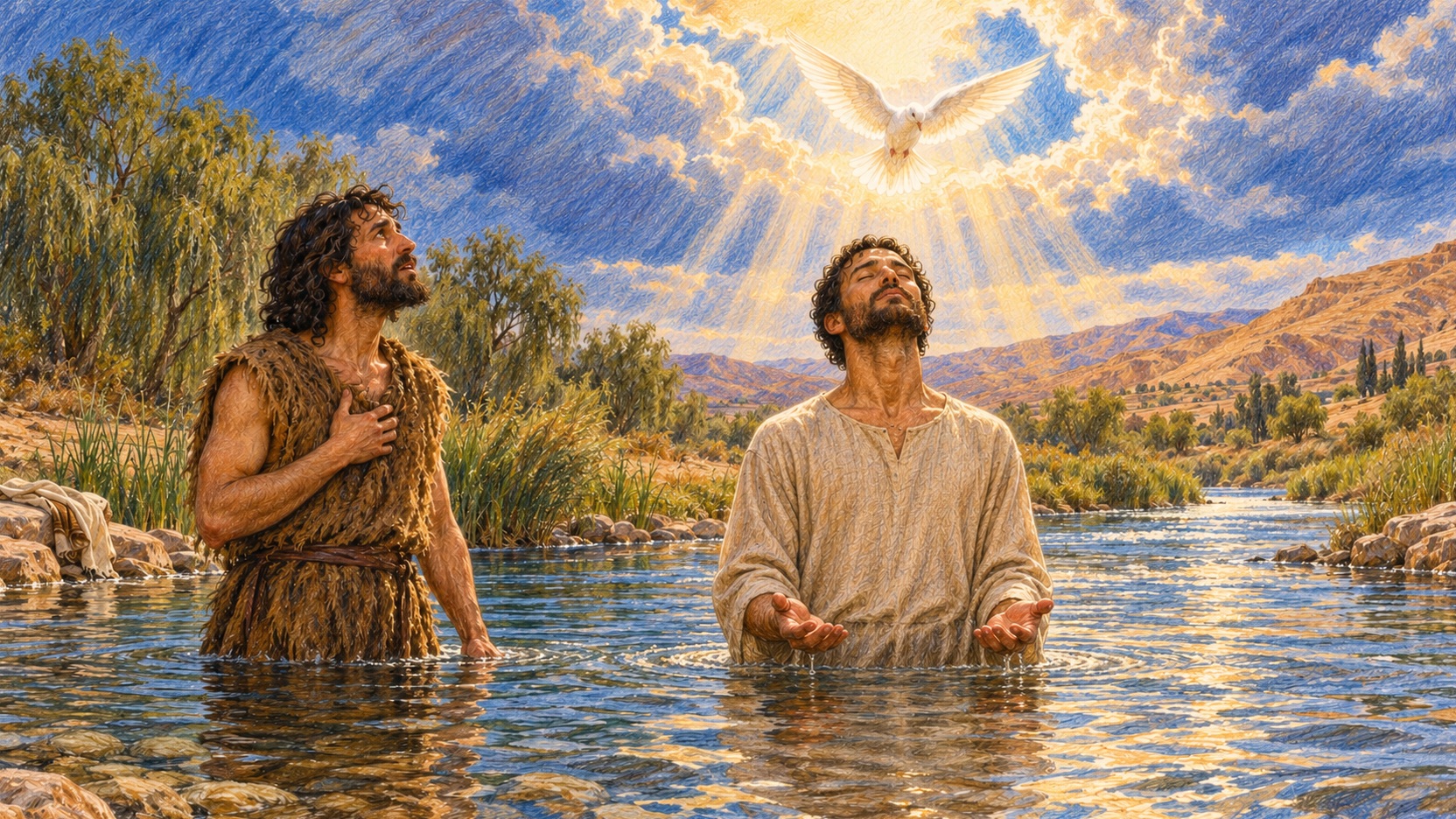
Before John the Baptist saw the Holy Spirit descend like a dove upon Jesus, God had told him what that sign would mean. John had been sent to baptize people in water, and the Man upon whom the Spirit descended and remained would be the One who baptizes with the Holy Spirit. I find that to be a useful place to begin, because John explains why he was able to recognize Jesus as the Son of God.
Jesus Comes to the Jordan
John the Baptist was preaching in the wilderness of Judea, calling the people of Israel to repent. People came to him at the Jordan River, confessed their sins, and were baptized. His message called them to turn from their disobedience to God, and he warned them that claiming a religious heritage would not excuse a life that refused to change. See Matthew 3:1-12.
People wondered whether John himself might be the Christ, the promised Messiah. John told them that Someone mightier than he was coming, and that he was not even worthy to loosen that Man’s sandal strap. John could baptize them in water, but the One coming after him would baptize with the Holy Spirit. His preaching was preparing people to receive Someone else. See Luke 3:15-16.
Then Jesus came from Galilee to be baptized by John. Since John’s baptism was associated with repentance, we can understand why John objected when Jesus asked to receive it.
Then Jesus came from Galilee to John at the Jordan to be baptized by him.
And John tried to prevent Him, saying, “I need to be baptized by You, and are You coming to me?”
But Jesus answered and said to him, “Permit it to be so now, for thus it is fitting for us to fulfill all righteousness.” Then he allowed Him.
John recognized that he needed what Jesus could give him. The people coming to the river had sins to confess, and John knew that he himself needed Jesus. Yet Jesus was the One asking John to baptize Him. His request did not mean that He had committed sins that needed forgiving. He came to the water as the sinless Son of God.
Jesus explained that they were to fulfill all righteousness, and John accepted His instruction. I understand Jesus’ baptism as His obedience to the work the Father had appointed and His willingness to stand among the Israelites responding to John’s message. He was taking His place in that work without sharing their guilt. Nothing in His answer suggests that the water would make a sinful man righteous or that He needed to become God’s Son.
What happened as Jesus came up from the water confirmed His identity. The heavens opened, the Spirit descended upon Him, and a voice spoke from heaven. To show you what I mean, let’s compare the Gospel accounts and then read John’s explanation of the sign he saw. The wider ministry of John the Baptist helps explain his role in preparing Israel, but his own testimony about this particular event gives us the reason for the descent.
What All Four Gospels Say
Matthew describes Jesus coming up from the water and seeing the Spirit of God descend upon Him:
When He had been baptized, Jesus came up immediately from the water; and behold, the heavens were opened to Him, and He saw the Spirit of God descending like a dove and alighting upon Him.
Mark records the same order. Jesus had been baptized, and the Spirit descended as He came up from the water:
And immediately, coming up from the water, He saw the heavens parting and the Spirit descending upon Him like a dove.
Those accounts place the descent at an identifiable moment in Jesus’ life. Luke adds what Jesus was doing when heaven opened. He was praying, and Luke also describes how the Spirit appeared and what the voice from heaven said:
When all the people were baptized, it came to pass that Jesus also was baptized; and while He prayed, the heaven was opened.
And the Holy Spirit descended in bodily form like a dove upon Him, and a voice came from heaven which said, “You are My beloved Son; in You I am well pleased.”
Luke calls the descent a bodily appearance like a dove. That gives us reason to understand it as something visible, rather than a description of a feeling Jesus or John experienced. There was also something to hear. The voice addressed Jesus as the beloved Son in whom the Father was well pleased.
The Gospel of John approaches the event through the testimony of John the Baptist. The Gospel writer is John the apostle, a different man from John the Baptist, whose testimony he records here. The Baptist describes what he saw and adds that the Spirit remained upon Jesus:
And John bore witness, saying, “I saw the Spirit descending from heaven like a dove, and He remained upon Him.”
So we have Jesus seeing the descent in Matthew and Mark, Luke describing its visible form, and the Baptist testifying that he saw the Spirit descend and remain. The accounts do not tell us how many other people saw it or heard the voice. I would not want to supply a crowd’s reaction that the writers never recorded. What they do give us is enough to establish that this happened and that John was able to bear witness to it.
That still leaves a question. How did John know what the appearance meant? His answer takes us back to an instruction God had given him before he witnessed it.
The Sign Given to John
John had received more than a command to baptize with water. God had also told him how to recognize the One who would baptize with the Holy Spirit. Pay attention to both parts of the sign: the Spirit would descend upon Him, and the Spirit would remain upon Him.
I did not know Him, but He who sent me to baptize with water said to me, “Upon whom you see the Spirit descending, and remaining on Him, this is He who baptizes with the Holy Spirit.”
And I have seen and testified that this is the Son of God.
John says that he did not know Him, and then he explains what God had told him to look for. Matthew has already shown us that John recognized his own need for Jesus when Jesus came to be baptized. I understand John’s explanation here to concern the sign that established Jesus’ identity as the One who baptizes with the Holy Spirit. Whatever John understood beforehand, God had given him a particular way to recognize and testify about Him.
The sign happened as God had said it would. John saw the Spirit descend and remain upon Jesus, so his testimony rested on God’s instruction and what he had actually witnessed. He was not choosing a meaning for an unusual sight after it occurred. In John 1:31, John explains that revealing Jesus to Israel was the purpose for which he had come baptizing with water. His work was leading people to the Son of God.
I also notice that John repeats the detail about the Spirit remaining. Scripture gives earlier accounts in which the Spirit empowered someone for a particular responsibility, and that empowerment could be withdrawn. For example, 1 Samuel 16 describes the prophet Samuel anointing David with oil as the king God had chosen. The Spirit came upon David, while the following verse says that the Spirit departed from Saul, the king God had rejected. The passage concerns God’s dealings with those men in Israel’s kingship.
John’s testimony about Jesus does not describe a passing empowerment that would later be taken away. I understand the Spirit remaining upon Him as an abiding anointing for the mission the Father had given Him. By anointing here, I mean God’s appointment and the Spirit’s empowering for that work. There is no oil being poured over Jesus in this account; the Spirit Himself descends upon Him.
The prophet Isaiah had described the promised Messiah long before Jesus came to the Jordan. In Isaiah 11, he speaks of a ruler coming from the family of Jesse, who was King David’s father. That ruler would judge righteously, and Isaiah tells us that the Spirit of the LORD would rest upon Him:
The Spirit of the LORD shall rest upon Him, The Spirit of wisdom and understanding, The Spirit of counsel and might, The Spirit of knowledge and of the fear of the LORD.
Isaiah later describes God’s chosen Servant, in whom God delights. The Servant’s work would reach the Gentiles, meaning the nations beyond Israel, and again God speaks of putting His Spirit upon Him:
Behold! My Servant whom I uphold, My Elect One in whom My soul delights! I have put My Spirit upon Him; He will bring forth justice to the Gentiles.
These promises help explain what we see at the Jordan. The Spirit comes upon Jesus, and the Father declares His pleasure in Him. Isaiah had not predicted a dove-like appearance, so I would not claim that every detail of the baptism is stated in those prophecies. I do understand the baptism as a public commissioning that identifies Jesus with the promised work. Matthew 12:15-21 also applies Isaiah’s words about the Servant to Jesus as He heals the people who follow Him.
John’s sign points beyond the beginning of that ministry, because the Man receiving the Spirit would Himself give the Spirit. John could baptize people in water, but he could not give them God’s indwelling presence. Later, as Jesus prepared His disciples for His departure, He promised that the Father would send the Holy Spirit in His name. He also said that He would send the Spirit to them. See John 14:16-17, 26 and John 16:7.
I came to that conclusion about the sign by comparing John’s explanation with what Jesus later promised. God was identifying the Son whose work would bring salvation and whose people would receive the Spirit. The appearance at the river served that purpose, so the purpose ought to govern how we understand the appearance.
Like a Dove, Not a Dove
In Matthew 3:16, the Greek word translated “like” is ὡσεί, commonly written hosei in English letters. It is a word of comparison that can mean “as,” “like,” or “as it were.” Matthew is telling us how the Spirit descended without identifying Him as a created bird. The comparison describes what was seen; it does not change who the Holy Spirit is.
Luke’s description of bodily form keeps us from treating the event as nothing more than poetic language about peace. There was a real, visible manifestation. At the same time, Luke has not supplied dimensions or a detailed description of every movement. I am content to affirm the dove-like appearance he records without trying to fill in what he leaves unsaid.
We can understand why the Spirit must not be reduced to that appearance by looking at how Jesus describes Him. Before His death, Jesus told His disciples that the Holy Spirit would teach them and bring His words to their remembrance. He would also guide them into truth and convict the world concerning sin, righteousness, and judgment. A bird or an impersonal force cannot account for the One Jesus describes. See John 14:26 and John 16:8-14.
The Spirit also speaks and acts with His own will. In Acts 13:1-4, while the leaders of the church at Antioch were ministering to the Lord and fasting, the Holy Spirit directed them to set apart Barnabas and Saul for work He had called them to do. Barnabas and Saul, who is also called Paul, were being sent to preach, and the account identifies the Spirit as the One sending them. In 1 Corinthians 12:11, Paul explains that the Spirit distributes gifts among believers as He wills. Those actions tell us about a divine Person, not a religious mood.
His relationship with believers continues beyond a moment of visible activity. Jesus promised that the Spirit would dwell in His people, and Ephesians 1:13-14 says that those who believed the gospel were sealed with Him. That seal identifies them as belonging to God, and the Spirit is the guarantee of their promised inheritance. The study on the Person of the Holy Spirit develops these passages further. His appearance at the Jordan belongs within that larger testimony about who He is.
Other appearances of doves in Scripture have their own explanations. After the flood, Noah sent a dove from the ark, the vessel in which God had preserved his family and the animals. He wanted to learn whether the waters had receded enough for the bird to find a resting place. Israel’s laws also permitted certain birds as offerings, while Song of Solomon compares a beloved person’s eyes to doves. Those accounts concern conditions after a flood, worship under God’s law, and the language of love. See Genesis 8:8-12, Leviticus 1:14-17, and Song of Solomon 1:15.
I do not think those different uses allow us to assign one meaning to every dove in the Bible. We can examine doves in the Bible in their settings, but John has already told us why God gave this sign at Jesus’ baptism. The descent and the remaining identified the Son. Making the passage depend on a hidden meaning borrowed from another dove would leave John’s own explanation behind.
Father, Son, and Spirit in the Work of Redemption
The sign identifies Jesus, and the Father’s voice tells us how He regards Him. Matthew records the declaration that accompanied the Spirit’s descent:
And suddenly a voice came from heaven, saying, “This is My beloved Son, in whom I am well pleased.”
Jesus has been baptized, the Spirit is descending upon Him, and the Father is speaking from heaven. We are reading about Persons relating to one another. The Father speaks about His Son, and His Son receives the Spirit’s anointing as He enters His public ministry.
This is part of the biblical testimony from which I understand the Trinity. By that word, I mean that the one God eternally exists as Father, Son, and Holy Spirit. They are distinct Persons, and each is fully God. They share the same divine nature and are co-equal and co-eternal. I am not describing three separate gods or three parts that must be assembled to make God.
That is why I reject modalism, which treats Father, Son, and Spirit as different roles or manifestations of a single divine Person. The difficulty with that view goes beyond their different locations at the baptism. The Father loves and sends the Son, the Son obeys the Father, and the Spirit comes upon the Son. Those relationships are real. Treating them as one Person using different names does not explain what the accounts tell us. The study on the Trinity follows the wider evidence for this understanding.
We also have to consider who Jesus was before He entered the water. The Father’s declaration did not turn an ordinary man into the Son of God. John begins his Gospel by identifying the Word as God and saying that all things were made through Him. Then John 1:14 explains that the Word became flesh, identifying Jesus as the eternal Word who had become human. The baptism therefore revealed who He already was.
Luke’s account of Jesus’ conception agrees with that identity. The angel Gabriel told Mary, who was a virgin, that the Holy Spirit would come upon her and that the holy Child to be born would be called the Son of God. Jesus did not first become holy at His baptism. The teaching sometimes called adoptionism, in which a merely human Jesus becomes God’s Son by being adopted at the baptism, cannot be reconciled with those accounts. See Luke 1:26-35.
For the same reason, the Spirit’s descent did not repair something morally deficient in Jesus or imply that His life had been without the Spirit until then. The holy Son was being identified and anointed for His public work. We can see how that anointing relates to the ministry that followed by reading Peter’s later explanation.
Peter was one of Jesus’ apostles and a witness to His ministry. In Acts 10, he went to the home of Cornelius, a Roman officer who had sent for him after receiving an angel’s instruction. Peter told the people gathered there about Jesus, beginning with the ministry that followed John’s preaching:
That word you know, which was proclaimed throughout all Judea, and began from Galilee after the baptism which John preached:
how God anointed Jesus of Nazareth with the Holy Spirit and with power, who went about doing good and healing all who were oppressed by the devil, for God was with Him.
Peter connected the Spirit’s anointing with what Jesus went on to do. Jesus helped people and healed those oppressed by the devil, and God was with Him. The Son, fully God and truly man, carried out the Father’s mission in the power of the Spirit. His teaching and works belonged to the ministry for which He had been sent.
Peter then continued through Jesus’ death and resurrection. He told his hearers that Jesus had been killed, that God had raised Him on the third day, and that the apostles had eaten and drunk with Him after He rose. Peter’s testimony led to the promise that whoever believes in Jesus receives forgiveness of sins through His name. The anointing at the beginning of Jesus’ ministry belongs to the same work of salvation Peter was now proclaiming. See Acts 10:39-43.
I understand the Father’s pleasure in His Son as continuing through that obedience, including His death on the cross. Jesus voluntarily gave Himself as the perfect sacrifice for our sins. Wicked people inflicted His bodily suffering and put Him to death; the Father did not punish Him or abandon Him. Jesus had told His disciples that even when they scattered and left Him, the Father would be with Him. See John 16:32 and Acts 2:22-24.
His atoning sacrifice was complete when He had shed His innocent blood and died, before His burial and bodily resurrection. He did not need to undergo further punishment after death to finish paying for sin. His resurrection vindicated Him as Lord and Christ, and the living Savior gives forgiveness to those who repent and trust Him. The Father, Son, and Spirit were united in that work of redemption, the work by which sinners are brought back to God through Christ.
John the Baptist had called Jesus the Lamb of God who takes away the sin of the world. That description points us to His sacrifice. The One John recognized at the river would give Himself for sinners and give the Holy Spirit to His people. I would miss the purpose of John’s witness if I admired the appearance of the dove while refusing to trust the Savior it identified.
The same witness also affects how I speak about the Holy Spirit. He is the divine Person who teaches and indwells believers, so I should not speak as though He were merely an atmosphere we create in a meeting. His visible descent helped John recognize the Son, and His continuing work directs God’s people to Christ. Honoring Him includes receiving what He has revealed rather than confining Him to the appearance through which John saw Him.
My Final Thoughts
John saw the Holy Spirit descend like a dove and remain upon Jesus. God had told him beforehand that this sign would identify the One who baptizes with the Holy Spirit, and John testified that Jesus was the Son of God. The Gospels give us a visible event with a stated purpose. I do not need to invent details about the appearance to understand why John bore witness to it.
The Father declared His pleasure in the Son He already loved, and the Spirit came upon Jesus as He began the ministry that led to His saving death and bodily resurrection. The baptism revealed their relationship and their united work; it did not make Jesus divine or make the Spirit a created bird. That leaves me looking where John’s testimony directs me, to the Son who gave Himself for our sins and who gives His Spirit to those who belong to Him. I want my response to be faith in that Savior and worship of the God who has made Him known.