
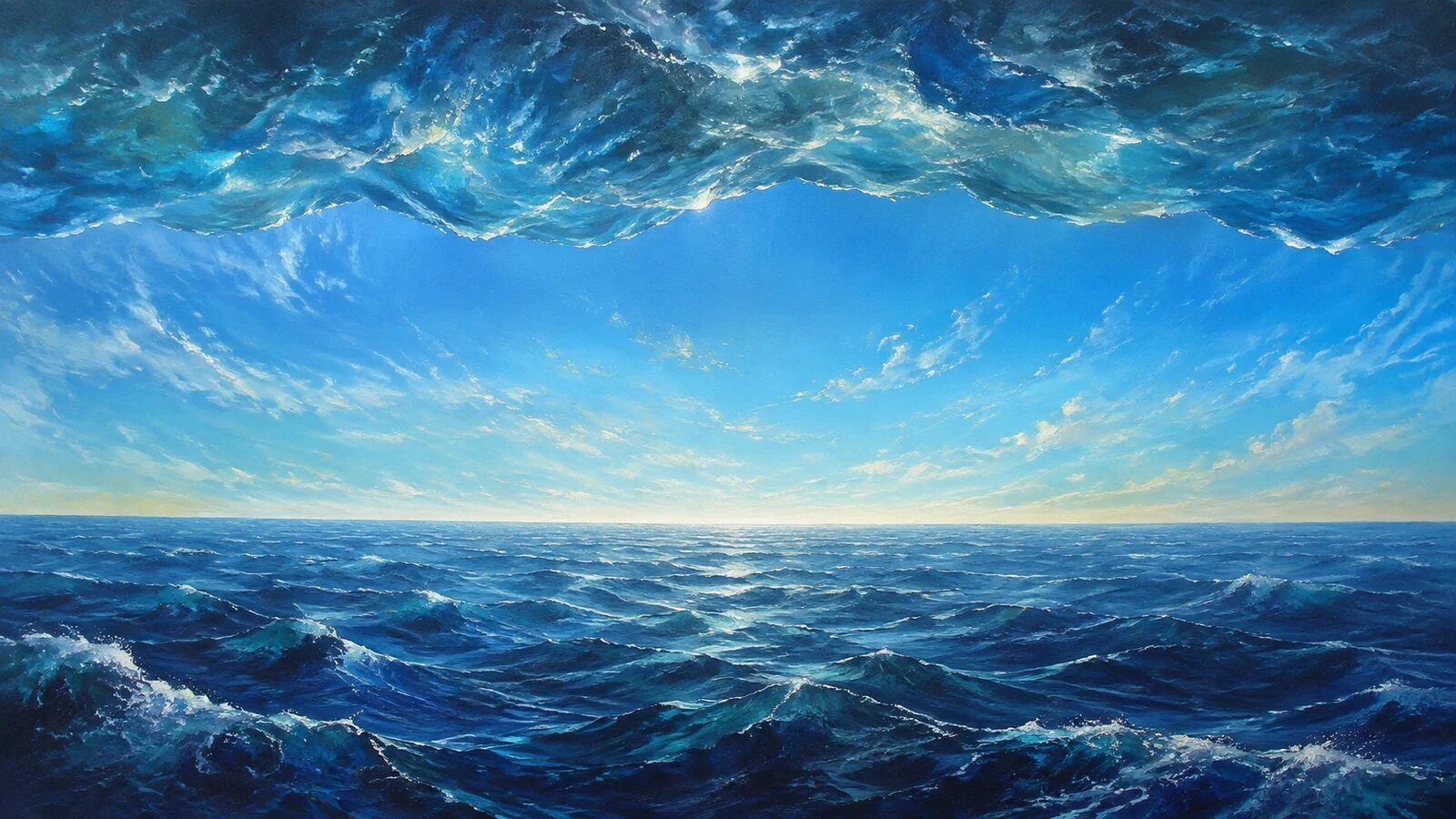
Genesis tells us that God made the firmament to divide waters from waters and named it Heaven. That is a definite claim about creation, even though the passage does not answer every question about its physical structure. I want to understand what God says before deciding which explanation fits. Ezekiel and John later describe crystal-like imagery near God’s throne, which raises a further question about how their visions relate to the firmament God made.
What Genesis Means by the Firmament
The firmament belongs to the second day of creation. God had already made light and divided it from darkness. He then commanded a separation between waters, and what He commanded came into being:
Then God said, “Let there be a firmament in the midst of the waters, and let it divide the waters from the waters.” Thus God made the firmament, and divided the waters which were under the firmament from the waters which were above the firmament; and it was so. And God called the firmament Heaven. So the evening and the morning were the second day.
God made the firmament to separate the waters and named it Heaven. As elsewhere in Genesis 1, His naming shows His authority over what He made. Moses describes something the Lord actually brought into existence and gave a purpose. Reading the firmament as an undefined symbol for order would lose that claim.
The Hebrew word raqia, translated “firmament,” is related to a verb that describes spreading or extending something. That verb can also describe beating material thin, as when metal is hammered out. That connection helps explain the sense of something spread out, but it does not automatically tell us what the firmament is made of. To understand raqia, we need to read the noun in its own context.
“Expanse” conveys that basic sense. The older English “firmament” may suggest a hard dome, but Genesis does not supply a complete description of its structure. It does not describe edges resting on mountains or lesser gods holding up a roof. Those details should not be smuggled into the account and then treated as though they were claims Moses made.
I accept the firmament as a real part of creation that divides the waters. Calling it merely poetic would dismiss what Genesis says God made. At the same time, I cannot identify every physical property from this passage. If I supply additional details, I need to distinguish my explanation from the statements God actually gave us.
Heaven, Heavens, and the Waters Above
Since God called the firmament Heaven, we need to consider how Scripture uses that name. The Hebrew shamayim can refer to the sky where birds fly, the region of the heavenly lights, or the highest heaven as God’s dwelling place. We also use “heaven” in more than one way in English. In each passage, the context helps us understand which sense is intended; the same word does not always refer to exactly the same region.
During the rest of the creation week, God continued preparing the world and filling it with life. On day three He gathered the waters under the heavens so that dry land appeared. On day four He appointed the heavenly lights, and on day five He commanded birds to fly across the face of the firmament. These places and purposes came from His command. He did not have to wrest control from a rival power to make a world His creatures could inhabit.
Genesis tells us why God appointed the lights: they give light to the earth, distinguish day from night, and mark signs and seasons. I want those stated purposes to guide my reading. If I approach the passage expecting the categories and detail of a modern science textbook, I may overlook what Moses actually explains or demand answers to questions he is not addressing.
The waters below the firmament connect naturally with the seas God gathered on day three. The waters above are harder to locate. Some readers identify them entirely with clouds, which certainly carry rain. Yet the language in Genesis and the Psalms is broad enough that I do not regard that identification as settled:
Praise Him, you heavens of heavens, And you waters above the heavens!
The psalm calls on both the highest heavens and the waters above the heavens to praise God. Scripture therefore speaks of these waters beyond Genesis and treats them as part of God’s real creation. The psalm does not explain their location or composition. I can accept its testimony without pretending that I can answer those further questions.
Peter also refers to water when explaining creation and judgment. In 2 Peter 3:5, he says that by God’s word “the heavens were of old, and the earth standing out of water and in the water.” He is answering scoffers who dismiss future judgment because they assume the world has continued unchanged. By pointing to the Flood, Peter confronts them with a judgment that has already happened. Their assurance that nothing will change depends on disregarding what God has already done.
Peter is not filling in the missing physical details of the firmament. He is confronting the assumption that the world can be understood apart from its Creator’s word. God formed it and judged it, and He will judge it again. The world had a beginning, and it still depends on Him for its continued existence.
God’s Boundaries and Creation’s Witness
Job 38 brings us back to the Creator’s authority over the waters. Job had endured terrible losses and wanted God to explain how He governed the world. When the LORD answered from the whirlwind, He asked where Job had been when the earth’s foundations were laid. He did not account for each loss in turn. Instead, His questions showed Job how little he knew about the creation whose Maker he was questioning.
When God described the sea, He spoke of shutting it in with doors and setting the limits of its advance:
When I fixed My limit for it, And set bars and doors; When I said, “This far you may come, but no farther, And here your proud waves must stop!”
God was not explaining the firmament’s structure to Job, but He was asserting His authority over the waters. Job could see the waves, but he had not set their limits and could not instruct the One who had. The sea belonged to its Maker, as did everything else in creation. None of it could challenge His right to rule.
I need to remember that when I resent a limit simply because I would rather decide for myself. Genesis places these boundaries before sin and death entered the world, as part of God’s good provision for life. I have no reason to assume that a limit He establishes is hostile to the creatures He made.
The heavens also testify to the wisdom and power of their Maker:
The heavens declare the glory of God; And the firmament shows His handiwork.
The firmament displays God’s workmanship without itself being God. To worship the sky would give a created thing the honor that belongs to its Maker. Romans 1 explains that God’s invisible attributes can be understood through what He has made, even though sinners suppress that knowledge. Their resistance does not silence the witness of His creation.
Psalm 19 then turns from the heavens to the perfection of God’s law. Creation’s witness is real, but we also need His written Word. It gives the further revelation that identifies the Savior and explains how sinners receive forgiveness. If I become absorbed in explaining the sky while disregarding the God it declares, I have missed the purpose of its witness.
Ezekiel, Revelation, and the Throne of God
Ezekiel uses the word firmament in his account of a vision among the Judean exiles by the River Chebar. This priest was far from Jerusalem and the temple when the heavens opened and God revealed His glory. The exile had not put the people beyond His reach. Babylon had conquered Judah, but it had not conquered the God of Israel.
Ezekiel repeatedly describes what he saw with expressions such as “like” and “the likeness of.” He reports a genuine vision through comparisons his readers can understand:
The likeness of the firmament above the heads of the living creatures was like the color of an awesome crystal, stretched out over their heads.
He describes the expanse over the living creatures’ heads and then a throne above it:
And above the firmament over their heads was the likeness of a throne, in appearance like a sapphire stone.
The description takes us upward from the creatures to the expanse and then to the throne. Ezekiel then reports the appearance of the LORD’s glory, before which he fell on his face and heard the One speaking to him. His reverent response helps us understand what the vision revealed: the God of Israel was holy, exalted, and distinct from all He had made.
John describes another throne scene in Revelation 4. After Christ’s messages to the seven churches, John saw an open door in heaven and was called to come up. He was immediately in the Spirit and saw a throne with One seated on it. Around that throne were other thrones and living creatures, while before it lay a sea of glass:
Before the throne there was a sea of glass, like crystal.
Revelation is apocalyptic prophecy, which communicates through visions and symbols and draws on earlier Scripture. That form does not make it any less true. The living creatures around the throne continually declare God’s holiness. In this setting, I understand the crystal-like sea as conveying the majesty and purity of His presence, with a suggestion of holy separation before Him.
Ezekiel places the expanse above the creatures and the throne above that expanse. John places the sea before the throne and does not call it the firmament. Genesis records God making the firmament to divide waters. All three passages exalt the Creator, but I cannot take a detail from one and insert it into another as though they jointly supplied a complete physical diagram of the universe.
Isaiah 66:1 similarly calls heaven God’s throne and earth His footstool. The language declares His authority over creation without confining Him inside it. He is not dependent on the world to supply a place where He can rule.
Reading the Firmament Without Error
We can distort Genesis by deciding in advance that it must be primitive error, then reading a reconstruction of ancient beliefs into the account. Genesis itself does not describe sky and sea gods fighting for control. The one God commands, and creation takes its appointed place. A criticism needs to address the claims the passage makes.
Christians can also give their proposed explanations too much authority. We are free to discuss clouds, the atmosphere, outer space, and the physics of creation. But if I accuse someone of rejecting God’s word simply because he questions my model, I have put my own explanation on the same level as Scripture. An explanation can be useful while remaining open to correction from the passages it is supposed to explain.
The visions require the same honesty. Ezekiel and John reveal God’s glory; they should not become a pretext for sensational claims about features of the universe they do not describe. We can receive their testimony with reverence while acknowledging the questions it leaves unanswered.
I live beneath a sky I did not make and on an earth I did not bring into existence. I can study them and propose explanations, but I cannot treat my limited understanding as authority over their Maker. Genesis gives me reason to affirm His supernatural work through His spoken command and to distinguish that work from my attempts to explain it.
The heavens bear witness to their Maker, but they cannot reconcile a sinner to Him. Looking at the sky cannot bring forgiveness. For that, we need the Savior revealed in His written Word: Jesus Christ, the eternal Son through whom all things were made. The Lord of creation became truly human, lived without sin, and gave His life to save us.
Jesus willingly gave Himself to be slain as the perfect sacrifice. Wicked men inflicted real bodily torture and death on Him, yet the saving worth of His sacrifice rests on His perfection and the blood and life He offered for the whole world. His sacrifice was complete through His shed blood and death, before He was buried and rose bodily. The Father and Son were united in redeeming us; the Father did not punish, curse, abandon, strike, bruise, or pour wrath on Jesus.
God’s offer of salvation is genuine, although people can resist and reject Him. Everyone who repents and believes in Jesus is forgiven and justified, meaning declared righteous before God. The Holy Spirit gives that person new life, dwells within him, and seals him for redemption. Every genuine believer is eternally secure. That security does not permit lawlessness, nor does calling ourselves Christians establish that we have received new life. The Creator who made the heavens is the Redeemer to whom all creation will finally answer.
For related teaching, see A Complete Bible Study on the Literal Six Days of Creation, A Bible Study on How to Prove the Existence of God, and A Complete Bible Study on Giants in the Bible.
My Final Thoughts
God made the firmament to divide the waters and named it Heaven. The Psalms call His creation to praise Him, and the throne visions show His glory. I want to receive those passages with confidence in what He has said and humility about what remains unexplained. Studying His handiwork should do more than equip me to argue about its structure. It should lead me to honor its Maker and trust the Son who entered His own creation to redeem us.