
Timothy was already a disciple with a good reputation when we meet him in Acts. How did he become the coworker Paul trusted with suffering churches and the defense of sound doctrine? To understand that growth, we need to begin before his public assignments, with Scripture in the home and faithfulness among people who knew him. His life shows us a servant learning courage under pressure and continuing to obey through the grace of Christ.
Scripture and Character Came Before Public Ministry
What interests me is that Timothy’s early credibility survived the hard roads and difficult churches that followed. He learned to care for people without loosening his hold on truth. God’s Word had begun working through his home and local church, and that same faithfulness helps explain why Paul could later trust him with churches under strain.
Scripture first calls Timothy a disciple and says believers in two cities spoke well of him. We are not given a dramatic conversion scene, an impressive title, or a speech. Instead, we meet someone who had learned Scripture at home and lived a credible Christian life among people who knew him. That quiet beginning helps explain the man he became.
Paul later trusted Timothy with substantial responsibilities. He traveled with Paul and strengthened persecuted believers, then represented him in troubled congregations when Paul could not be there. Timothy also reported back on their condition. Several inspired letters name him beside Paul in their openings, showing that the churches knew him as a close coworker without making him the author of every argument. At Ephesus he guarded sound doctrine and helped maintain orderly leadership, and eventually he received Paul’s last preserved charge. His usefulness throughout that work rested on Christ and the apostolic gospel. Tested character and sound teaching had to be expressed through sincere care for people.
Timothy’s youth did not disqualify him because his life and doctrine were exemplary. But neither his gift nor his relationship with Paul removed the need for discipline and public accountability. Paul never became another mediator for him. We also meet a man who knew tears and illness, so physical weakness cannot be treated as proof of spiritual failure. God strengthened him for demanding assignments without giving him permission to retreat from truth.
We can follow that development without assigning Timothy an exact age or filling in what Scripture leaves unsaid about his father. Later ideas about monarchical bishops and accounts of his martyrdom need to be distinguished from the biblical record. What Scripture does reveal is enough to show how truth received in childhood matured into courageous service, helping preserve the gospel for generations Timothy would never meet.
Timothy’s mother was a Jewish believer, and his father was Greek. Paul later named his mother Eunice and grandmother Lois, remembering the genuine faith that had lived in both women before it lived in Timothy. He described their faith as sincere rather than a religious performance. Timothy had seen that sincerity close enough to recognize the difference.
when I call to remembrance the genuine faith that is in you, which dwelt first in your grandmother Lois and your mother Eunice, and I am persuaded is in you also.
In 2 Timothy 3, Paul says Timothy had known the Holy Scriptures from childhood. The word translated “childhood” can refer to very early life. Eunice and Lois had placed God’s written revelation before him while his mind and habits were forming. They were teaching him more than general morality. The New Testament writings were still being given during Timothy’s lifetime, so the Scriptures he first learned were the Old Testament. Paul says those writings can make a person wise for salvation through faith in Christ Jesus. Paul presents them as pointing the reader to the Messiah, not as a failed route to salvation by keeping the law.
I notice that Paul connects those Scriptures with faith in Christ, not with inheriting salvation from a faithful family. Timothy’s grandmother could teach him truth, but she could not believe for him. His mother could model faith without passing the new birth to him through their bloodline. Family loyalty and information alone could not save him. The faith that lived in these women became Timothy’s own genuine response to God’s Word.
Beyond telling us his father was Greek, the Bible does not describe the man’s spiritual condition. We cannot say he was hostile or indifferent, dead or absent. He may have believed later, but Scripture gives no evidence that he did. I would rather stay with what we are told: two faithful women taught a child the Scriptures, and that foundation later strengthened work far beyond their home.
Lois and Eunice help me see why honoring biblical male leadership does not diminish women’s ministry. The office of elder and authoritative teaching leadership belong to biblically qualified men, yet women remain indispensable in God’s work. Through discipleship and prayer, a woman can strengthen the church. Teaching children can lay a foundation for generations, while hospitality and wise counsel serve people in other ways. Her witness and faithful service may shape servants whose influence reaches well beyond her household.
Paul returned to the region of Derbe and Lystra near the beginning of his second missionary journey. This was not new territory to him. During the earlier journey, a crowd in Lystra had stoned Paul and dragged him outside the city, supposing he was dead. He nevertheless rose, later returned to strengthen the disciples, and warned them that believers enter the kingdom through many tribulations. Timothy’s home region had therefore seen both gospel fruit and the violent cost of preaching Christ before Timothy joined the traveling work.
Then he came to Derbe and Lystra. And behold, a certain disciple was there, named Timothy, the son of a certain Jewish woman who believed, but his father was Greek. He was well spoken of by the brethren who were at Lystra and Iconium.
Timothy was a disciple with a good report before Paul invited him to come along. I don’t want to pass over that order. Believers from two separate communities, Lystra and Iconium, could speak about his conduct. Paul was not sending him somewhere unfamiliar to manufacture a reputation among people who did not know him.
A good report means more than popularity. Charisma and family connections can attract praise, as can money or public confidence. The New Testament looks for sound doctrine lived out in purity. Humble service over time shows whether a person’s endurance is genuine, and Timothy’s later life confirms that his reputation had that substance behind it.
A church needs to observe ordinary faithfulness before giving someone wider influence. Refusing service or correction shows that a person is unprepared for greater responsibility. Repeatedly breaking commitments or refusing to govern his appetites likewise shows he is unprepared. His speech among the church must be truthful. However skillfully he communicates, that ability cannot replace character. Taking time to see these things protects the servant as well as the church.
Young believers need not despise years of service that few people notice. God uses local responsibilities to expose motives and form habits. Leaders should allow gifted people that time of testing, especially since 1 Timothy warns against laying hands on anyone hastily. An urgent need for workers does not make a rushed appointment wise.
Acts 16:3 says Paul circumcised Timothy because the Jews in those places knew his father was Greek. When I read that statement by itself, the act can sound as though Paul added a Jewish ritual to the gospel. That impression disappears when we remember what had happened immediately before Paul met Timothy.
Acts 15 records the Jerusalem Council, where the church addressed whether Gentile converts had to be circumcised and keep the law of Moses in order to be saved. The apostles and elders rejected that demand and affirmed salvation through the grace of the Lord Jesus Christ. Paul and Timothy then traveled while delivering that very decision to the churches. Timothy’s circumcision cannot reasonably mean the opposite of the message he was carrying.
Paul had refused to circumcise Titus, a Greek believer, when false brothers tried to compel it. In that setting, giving in would have suggested that Christ’s finished work was insufficient. Refusal was necessary to preserve gospel truth.
Timothy’s situation was different. With a Jewish mother and Greek father, his uncircumcised condition was already known in the synagogue communities Paul hoped to enter. Paul regularly began his work in a city by reasoning with Jews from Scripture. Circumcision could not justify Timothy or add anything to his salvation and new birth. Here it removed an avoidable cultural objection, allowing people to hear about Christ without first dismissing the messenger.
That difference helps me think about Christian liberty. I must refuse a practice when someone makes it necessary for salvation, but I may willingly accept the same lawful practice if it serves love and opens a way to speak. The gospel determines which response is right. We can give up comfort and preference to avoid unnecessary offense without surrendering truth to gain a hearing.
For Timothy, that willingness cost something. His first recorded step in serving with Paul brought pain instead of public applause as he accommodated people he hoped to reach. He continued to serve with that same willingness.
A Coworker Proven on Difficult Assignments
A good report at home prepared Timothy for wider work. Paul then sent him into churches where persecution and division made service difficult, and where false teaching had to be confronted. He would learn through costly responsibility, not just by watching from safety.
The missionary record lets us follow those widening responsibilities. Timothy helped deliver the Jerusalem decrees before traveling through Phrygia and Galatia. When the Lord directed the team westward, he crossed into Macedonia and served amid opposition in Thessalonica and Berea. Later his work took him to Corinth and Ephesus. The team sent trusted workers wherever churches needed strengthening, and the disciple respected locally at Lystra became someone Paul could send across provinces to face serious pressure and false teaching.
We see the cost of one assignment at Thessalonica. Hostile opponents had forced Paul and his companions to leave soon after people believed there, but Paul remained concerned for those new Christians. From Athens he chose to be left alone and sent Timothy back to establish and encourage their faith. Timothy was returning to the city that had driven the missionaries out. The believers he would help were still suffering affliction, so this was no comfortable visit to a settled church.
and sent Timothy, our brother and minister of God, and our fellow laborer in the gospel of Christ, to establish you and encourage you concerning your faith, that no one should be shaken by these afflictions; for you yourselves know that we are appointed to this.
Timothy came back with good news about their faith and love. To bring that report, he had spent time with the believers, teaching and encouraging them while carefully observing how they were doing. He served the church rather than using Paul’s absence to gather a following for himself, and Paul received accurate news from someone he could trust.
Paul later sent him to Corinth to remind the church of Paul’s ways in Christ. The affectionate way Paul speaks of Timothy can make it easy to miss how demanding that assignment was. Corinth was divided into factions and impressed by worldly wisdom. It tolerated serious sexual sin and questioned apostolic authority. Timothy was not chosen because the congregation was easy to serve or because his personality could win it over. His life and teaching could faithfully represent the apostolic pattern Paul taught in every church.
In 1 Corinthians 16, Paul told the church to receive Timothy without fear and not despise him, because he did the Lord’s work as Paul did. That instruction may tell us more about Corinth’s difficult atmosphere than a defect in Timothy. I can recognize the pressure he faced without treating apprehension as failure. A faithful messenger obeys by submitting to God even when he feels it.
I find Paul’s clearest personal commendation of Timothy in Philippians, where he explains why he trusted him so deeply. He hoped to send Timothy to learn how the believers were doing and bring back encouraging news. His reason was their shared concern for the church, not some rare skill in administration.
For I have no one like-minded, who will sincerely care for your state. For all seek their own, not the things which are of Christ Jesus. But you know his proven character, that as a son with his father he served with me in the gospel.
Timothy’s sincere concern did not prevent him from correcting people or defending doctrine through conflict. He wanted the things of Christ Jesus rather than his own advancement. That allowed him to tell a church what it needed to hear while still caring for its people. They were not obstacles in his way, numbers to report, or simply an audience.
The Philippians knew his proven character. The Greek idea behind “proven” is character shown to be genuine through testing, and Timothy’s service gives us concrete examples. He had traveled extensively and faced opposition, returning to difficult places instead of choosing only comfortable assignments. He had also handled sensitive messages faithfully. People no longer had only a claim about his character; they had watched it hold up under responsibility.
Competence is necessary, but that makes me consider a worker’s motives and character too. A gifted teacher who seeks his own interests is dangerous, and an organizer who treats people as machinery does not imitate Christ. Even a courageous voice can wound people while calling the damage faithfulness if sincere care is missing. Timothy defended truth with tested loyalty and concern for the people he served.
Paul called Timothy his beloved and faithful son in the Lord. Elsewhere he called him his true son in the faith and again a beloved son. He was describing a spiritual relationship formed through gospel instruction, not biological fatherhood. As they served together, genuine affection allowed room for correction as well as trust.
Paul’s spiritual fatherhood did not put him between Timothy and God. The Man Christ Jesus is the one Mediator between God and men. A healthy mentor points a believer toward obedience to Christ and the written Word rather than demanding control or creating dependence on himself. Affection never authorizes manipulation or places a leader beyond testing.
Paul was also building on work God had already done. Timothy knew Scripture from childhood and had personally believed. When Paul returned to Lystra, he found a disciple with a good local report, then trained him through shared ministry and gave him greater responsibility. Mentorship should develop truth and character already taking root, not replace them with attachment to the leader’s personality.
The son-father comparison in Philippians describes their shared gospel service. Timothy watched Paul preach and suffer, reason from Scripture and support himself through manual work. He saw how the apostle prayed and corrected troubled churches while continuing through hardship. Later he carried that same doctrine and pattern into places where Paul could not be present.
Paul remembered Timothy’s tears and longed to see the man he freely called beloved. Yet he also commanded him to wage the good warfare and flee youthful lusts. Timothy had to endure hardship while guarding the truth and fulfilling his ministry. I see affection and accountability working together here. Love gave Paul’s exhortation a personal purpose without making the truth vague.
Guarding and Ordering the Church at Ephesus
Those assignments help explain why Paul could later leave Timothy at Ephesus. The church needed a trusted servant to confront error and help restore order under apostolic truth, not simply an encouraging visitor.
When 1 Timothy opens, that assignment is already underway. Paul had urged Timothy to stay at Ephesus while he went to Macedonia. The church had received years of apostolic labor and had recognized elders, but it was still vulnerable to error. Certain people were teaching a different doctrine and attending to fables and endless genealogies. Their speculation stirred disputes instead of building people up in godliness through faith.
As I urged you when I went into Macedonia—remain in Ephesus that you may charge some that they teach no other doctrine, nor give heed to fables and endless genealogies, which cause disputes rather than godly edification which is in faith.
Paul charged Timothy to stop teaching that contradicted the apostolic truth entrusted to him. He was not being asked to keep an endless discussion going as though every spiritual option were equally valid. Sound doctrine already received was the standard. A speaker’s popularity or confidence could not replace it, nor could novelty or mystical appeal.
Paul also made the aim of that command clear: love flowing from a pure heart, a good conscience, and sincere faith. I cannot separate doctrine from love when error harms the people Timothy was sent to serve. False teaching distorts worship and conscience, and its effects can reach family life and church leadership. Generosity and Christian hope suffer too. Correcting it protects people and allows the love God’s truth produces to grow.
Paul had worked in Ephesus for years and warned its elders that savage wolves would arise, even from among themselves, speaking perverse things. Timothy’s assignment continued that vigilance. The church’s importance and past success could not protect it from later corruption.
I do not believe 1 Timothy describes Timothy as Ephesus’s first monarchical bishop. He served as Paul’s trusted apostolic delegate, charging teachers who spread error and instructing the congregation. He also oversaw orderly appointments under Paul’s direction. Those were substantial responsibilities, but they do not give us reason to read later church structures back into words Scripture does not use.
Near the center of 1 Timothy, Paul explains that he is writing so Timothy will know how people should conduct themselves in God’s house if Paul is delayed. By “house” he means the church of the living God, not a religious building. Thinking of the church as a family helps me follow the letter’s directions. Public prayer and modest conduct belong to that life together, as do male teaching leadership and qualifications for church officers. The household must care for widows and follow Paul’s directions in treating elders. Paul’s instructions reach family duties, honest work, and the use of money too. Such order serves the church’s calling as the pillar and ground of the truth. It supports and displays what God has entrusted to it; it does not invent the truth.
An overseer must be above reproach and faithful in marriage. Sober judgment and proven self-control must be evident in his life, together with hospitality and gentleness toward people. He must be able to teach, and the way he manages his household should show that his character has been tested. Deacons likewise must be examined and found trustworthy. Timothy could not lower those standards because workers were needed. Giving a man an office recognizes qualified service; it cannot create the character he lacks.
In 1 Timothy 2, Paul grounds authoritative teaching and governing leadership in creation, so we cannot reduce his instructions to a temporary emergency at Ephesus. That does not make women spiritually inferior. Lois and Eunice had already given Timothy powerful examples of faithful instruction. Men and women receive the same salvation and spiritual life, and the Holy Spirit gives gifts to both. Both pray and bear Christian witness, with many forms of service open to women. The office of elder and authoritative teaching leadership in the local church still belong to qualified men.
Timothy had to be impartial in dealing with leaders. Charges against an elder required proper witnesses, while elders who persisted in sin were to be rebuked before everyone so others would fear. A useful or well-liked leader could not be exempt, even if Timothy regarded him as a friend. Justice requires evidence for an accusation and refuses to protect sin once it is established.
Some false teachers treated godliness as a way to make money, so Paul addressed wealth directly. He condemned the love of money without calling possessions inherently sinful. Wealthy believers were to trust the living God instead of uncertain riches and use what they had for good. Generous giving would store up a good foundation. Timothy himself needed to flee greed and pursue righteousness and godliness, expressing his faith through love toward others. Patience and gentleness were to mark that life as well.
Paul’s instruction about Timothy’s youth asks more of him than the familiar advice not to let anyone underestimate him. He was responsible for a church threatened by error, where some older hearers might dismiss him because he was relatively young. He could not control their first reaction or compel respect for his title. What he could do was live as a credible example of the doctrine he taught.
Let no one despise your youth, but be an example to the believers in word, in conduct, in love, in spirit, in faith, in purity.
We are not told how old Timothy was then. The term for youth could cover a broad range, and years had passed since Acts 16. Calling him a teenager would claim more than Scripture gives us. He was young enough compared with older hearers for Paul to address the issue, yet mature and tested enough for serious authority.
Timothy was to answer contempt through his speech and conduct rather than aggressive self-assertion. People should be able to see love and genuine spiritual life in him. His faith and moral purity could strengthen his teaching, just as their absence would contradict it. Paul made that purity concrete by telling him to treat older women as mothers and younger women as sisters, with all purity.
Paul then directed him to the public reading of Scripture, with exhortation and doctrine. The congregation needed to hear words more authoritative than its minister’s. Exhortation brought those words to bear on life, while doctrine explained their truth. Timothy was to give himself wholly to that work so people could see his progress.
Timothy also had to watch his own life and doctrine, continuing in both. I cannot teach truth faithfully while excusing hypocrisy in my conduct, but sincerity alone will not make up for neglecting doctrine either. Perseverance in both would save Timothy and his hearers by keeping the saving message clear and showing the fruit of a genuine servant. Paul was not saying he could earn justification through that work.
Gift and Courage Under Pressure
That responsibility did not make Timothy self-sufficient. God’s gift to him was real, but it needed cultivation. He depended on the Holy Spirit for the courage and disciplined judgment his work required.
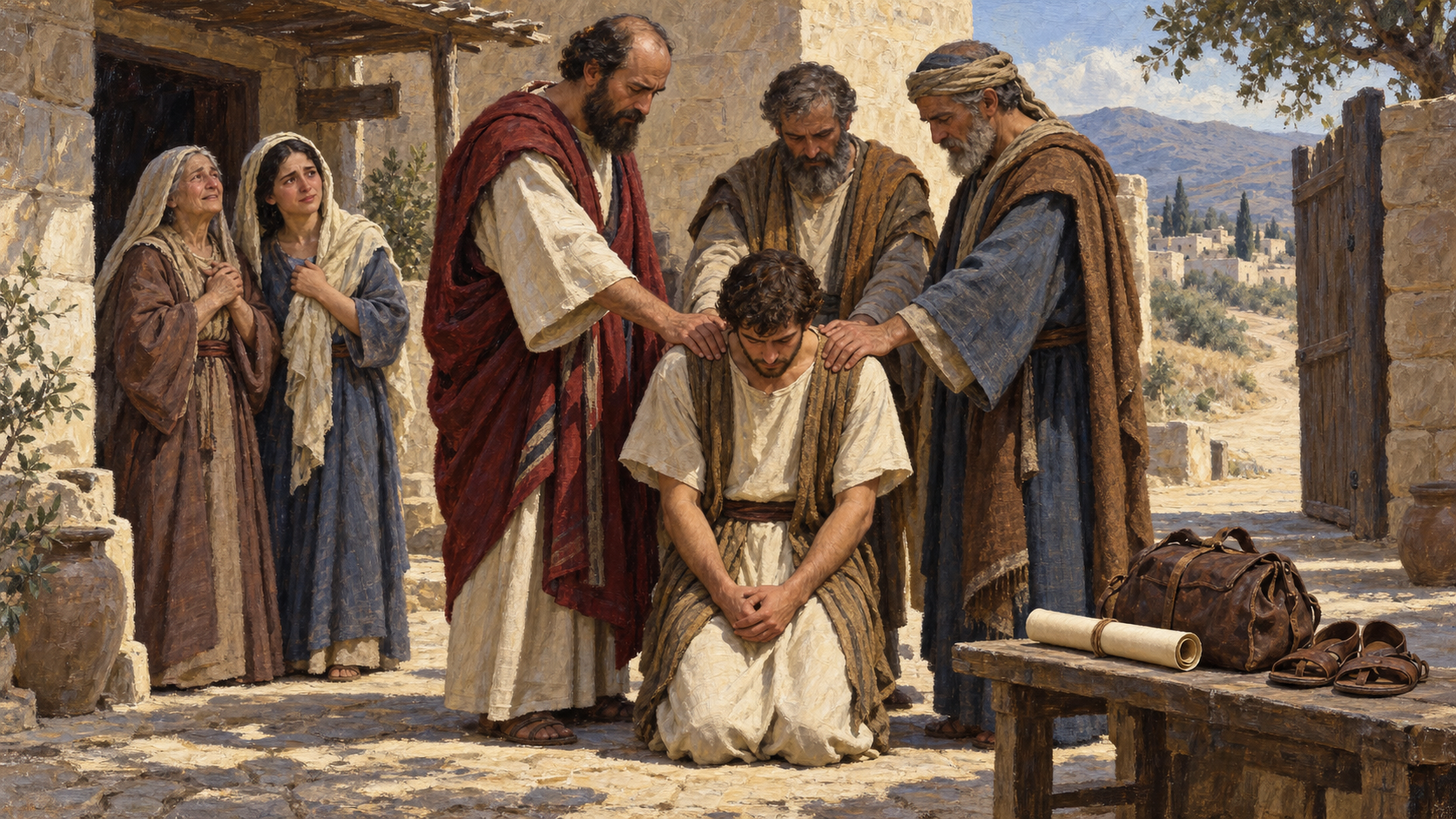
Paul told Timothy not to neglect the gift given him by prophecy with the laying on of the elders’ hands. In 2 Timothy, he spoke of stirring up the gift of God received through the laying on of Paul’s hands. These may be two descriptions of the same public commissioning. God gave the gift and confirmed it prophetically, while Paul and the elders participated by laying their hands on Timothy.
The laying on of hands publicly identified Timothy with recognized service and expressed the church’s part in commissioning him. It was not a magical act that created spiritual life. The gift remained God’s to give, and human hands could neither guarantee future faithfulness nor establish an untouchable succession.
Prophecy did not remove the need for character and doctrine either. Timothy already had a good report, and apostolic truth continued to govern his service. A claimed prediction cannot set aside the qualifications for elders or excuse immorality. Nor can it make someone a new source of revelation.
Timothy could neglect the gift God had given him, so Paul called him to meditate on his responsibilities and give himself wholly to the work. He needed to fan the gift into flame. That helps me understand why dependence on God includes effort. Grace directs that effort toward obedience without allowing me to imagine my own strength can replace the Holy Spirit.
The Holy Spirit still gives gifts according to His will. We need to test every spiritual claim, since Scripture authorizes neither hyper-charismatic disorder nor cessationist dismissal. A genuine gift agrees with the written Word and serves people. Its use should exalt Christ, with love governing how it helps the church, rather than draw attention to the person using it. No gift puts its recipient beyond correction.
Paul wrote 2 Timothy as a prisoner expecting to die soon. He remembered Timothy’s tears and longed to see him. I hear the call to courage differently with that personal setting in mind. Being associated with Paul now carried shame and danger in the world’s eyes. Paul urged Timothy not to be ashamed of the Lord’s testimony or His prisoner, but to share in suffering for the gospel through God’s power.
Therefore I remind you to stir up the gift of God which is in you through the laying on of my hands. For God has not given us a spirit of fear, but of power and of love and of a sound mind.
This verse addresses Timothy’s testimony under ministry pressure and suffering; it does not give us a diagnosis of his personality. Cowardly retreat did not come from God, who supplied the power he needed to endure. God’s love kept the good of others in view, and sound judgment kept his response governed by truth.
Paul also addressed Timothy’s physical weakness, telling him to use a little wine for his stomach and frequent infirmities. I notice that even an apostolic coworker was not guaranteed immediate healing. His frequent sickness did not prove a lack of faith. We should also keep Paul’s direction within its limits. A small medicinal use for one man is neither a command for every Christian to drink alcohol nor permission for drunkenness.
Scripture does not hide his tears or bodily weakness, and neither disqualified him nor erased his gift. Pressure did not mean God had abandoned him. Yet he still had to stir up the gift and hold fast to the pattern he had received. His frailty did not excuse neglect; he was to continue until the work was complete.
Churches need to support servants carrying heavy responsibilities with ordinary human frailty. Faithfulness does not make someone physically invulnerable or emotionally cold. Those serving should also resist using sensitivity to avoid their duties. God’s power meets weakness so that obedient service can continue.
Guarding Scripture and Entrusting It to Others
Personal courage served a larger responsibility. Timothy had received a body of apostolic truth that had to be protected from distortion and passed on without becoming a private tradition centered on himself.
Paul repeatedly pictured apostolic truth as a valuable deposit placed in Timothy’s care. He had to protect what had been entrusted to him. This was the public pattern of sound words the churches had heard, not a mystical secret or traditions reserved for insiders. That truth taught them about Christ and salvation and governed godliness and church life. It also included the resurrection, future judgment, and Christian hope.
Protecting that truth meant teaching it as well as preserving it. Timothy would not be guarding it faithfully by keeping it from the church. He needed to reject profane chatter and confront contradictions while living in a way that agreed with his teaching. Mixing the gospel with fashionable speculation could never improve it.
Hold fast the pattern of sound words which you have heard from me, in faith and love which are in Christ Jesus. That good thing which was committed to you, keep by the Holy Spirit who dwells in us.
The Holy Spirit lives in believers and enables faithful obedience to the truth He inspired. His help does not make the written pattern optional. A claim of spiritual leading that contradicts apostolic Scripture fails the test Timothy was commanded to apply, however deep a revelation it claims to be.
Paul showed what such drift looked like by naming Hymenaeus and Philetus. They claimed the resurrection had already happened and overthrew the faith of some. Other people had turned to empty talk or pursued money. I cannot regard false doctrine as harmless variety when it can misdirect hope and excuse sin. Households can be disturbed, and people’s confidence in God’s promises can be destroyed.
Even with that danger, Timothy did not need to panic as though God’s foundation might collapse. It stands firm with the seal that the Lord knows those who are His and that everyone naming Christ must leave iniquity. God’s preservation gives us security in Christ while calling us to separate from sin. It never permits carelessness.
Paul knew the gospel would continue beyond his imprisonment and approaching death. Timothy needed strength from the grace found in Christ Jesus as he prepared others to carry it forward.
And the things that you have heard from me among many witnesses, commit these to faithful men who will be able to teach others also.
What Timothy had heard was public teaching given among many witnesses. He could be held accountable to it, and he was to entrust those same things to others without adding revelations that changed them. Paul was providing for responsible teaching across generations, not a secret tradition held by an elite chain. The passage creates neither new apostles nor an infallible human succession.
The men receiving that responsibility needed both faithfulness and the ability to teach. Skill without faithfulness can spread error efficiently, but a faithful man unable to explain the truth cannot fulfill a teaching assignment. The qualifications for elders in 1 Timothy require the same combination of tested character and doctrinal competence.
Paul expected the truth to outlive him. Timothy would succeed by preparing trustworthy men to teach others, not by keeping every learner dependent on him. That makes me look beyond the influence of one personality when considering a church’s future. A faithful church invests in people who may never become widely known so the teaching can continue beyond its present ministry.
In 2 Timothy 3, Paul warns of dangerous seasons in the last days. Self-love and greed will rule people, while pride produces disobedience and brutality. Some of those people will still maintain a form of godliness while denying its transforming power. False teachers will enter households and resist the truth. Timothy’s answer was to continue in what he had learned and firmly believed, remembering the truth and the trustworthy people who taught him. He did not need novelty or a technique designed to match the age.
The Scriptures Timothy knew as a child could make him wise for salvation through faith in Christ Jesus. We should not treat the Old Testament as an obsolete pre-Christian failure. Rightly understood, it reveals God’s character and exposes our sin, while announcing His promises and directing sinners to the Messiah.
All Scripture is given by inspiration of God, and is profitable for doctrine, for reproof, for correction, for instruction in righteousness, that the man of God may be complete, thoroughly equipped for every good work.
Calling Scripture God-breathed tells us where it came from. These were not ordinary human words that later became inspiring. God breathed out His inerrant Word through chosen authors while preserving their own vocabulary and real circumstances.
Scripture teaches us what is true through doctrine and exposes what is wrong through reproof. It corrects what has gone crooked and trains us to walk rightly through instruction in righteousness. All Scripture is profitable in these ways, equipping the man of God for every good work. That is why we can depend on it as sufficient for the church’s faith and obedience.
Scripture’s sufficiency still leaves a place for faithful teachers, language study, and careful attention to history. We need wise application too. The point is that every helper serves beneath the inspired text. Timothy could value Paul’s mentorship because the apostle’s teaching agreed with revelation. Neither tradition nor personal experience can judge God’s Word, and the same limit applies to psychological fashions, political movements, and scholarly theories.
Earlier in the letter, Paul tells Timothy to rightly divide the word of truth. The verb orthotomeo pictures cutting straight or handling a path correctly. That helps me understand the command as a call to accuracy, not permission to cut away parts of the Bible I do not want. A teacher needs to consider context and grammar together with history, keeping the whole counsel of Scripture in view. In 2 Timothy, receiving all Scripture as God-breathed belongs with handling each passage accurately in its own setting.
Paul’s Final Charge and the Gospel Timothy Guarded
The responsibility to guard and transmit truth becomes especially urgent in Paul’s final charge. Paul writes as a prisoner nearing death, while Timothy must continue preaching under the judgment and promised appearing of Christ.
Paul gave his final charge before God and the Lord Jesus Christ, who will judge the living and the dead at His appearing and kingdom. Timothy might have to say things his listeners did not welcome. Paul wanted him to weigh that reaction against Christ’s coming evaluation. Timothy answered first to the Judge, so the congregation’s mood could not determine what he preached.
Preach the word! Be ready in season and out of season. Convince, rebuke, exhort, with all longsuffering and teaching.
“In season and out of season” means being ready with the Word when the moment is unfavorable as well as when it is favorable. It does not authorize rude intrusion. Paul joined convincing and rebuking with exhortation, patience, and teaching because he wanted repentance and faithfulness. Preaching was not a way to vent the preacher’s frustration.
Paul warned that people would seek teachers to satisfy itching ears, gathering voices that affirmed their desires and led them from truth to fables. Timothy could not answer that appetite by making his preaching more flattering. He needed to remain watchful and endure affliction while doing the work of an evangelist. Fulfilling his ministry meant continuing that work even when people wanted something else.
Paul described himself as already being poured out, having fought the good fight, finished the race, and kept the faith. The crown of righteousness awaited him, but not him alone. It is for everyone who loves Christ’s appearing. That hope gave Timothy’s charge an eternal purpose alongside Paul’s personal affection. The work could continue because the righteous Judge remained faithful.
We also hear Paul’s loneliness in the final chapter. Demas had forsaken him, others were away on assignments, and only Luke remained. No one stood with him at his first defense, but the Lord stood with him and strengthened him so the message could be fully preached. Timothy could not expect uninterrupted human support. The deepest security in the work Paul was calling him to was Christ’s presence.
I want to know what happened to Timothy after that charge, but Hebrews gives us only one later-looking detail. Near its close, Paul writes, “Know that our brother Timothy has been set free, with whom I shall see you if he comes shortly.” Timothy had experienced some form of confinement and release. We are not told where he was held, why, or for how long, so further details would be conjecture.
Timothy was known well enough for the readers of Hebrews to care about his release and possible visit. That fits the network we see throughout Paul’s letters. As the author of Hebrews, Paul called him “our brother,” emphasizing their shared life and service rather than rank.
Later traditions call Timothy a bishop of Ephesus and recount his martyrdom in connection with opposition to idolatry. Those reports may interest me historically, but they are not inspired testimony on which to build doctrine. We need to identify them as tradition instead of blending them into what Scripture tells us about his life.
Scripture gives enough to show Timothy’s faithfulness without answering every question about him. An embellished account of his death would not make that life more significant. He began as a disciple and became a trusted coworker whom Paul called both brother and spiritual son. He served as messenger and teacher, guarding truth and going where churches needed him.
To understand his work, we have to understand the message he guarded. In 1 Timothy, Paul declares that Christ Jesus came into the world to save sinners. He presents himself as the chief example of mercy, showing Christ’s longsuffering toward those who would later believe.
There is one God and one Mediator between God and men, the Man Christ Jesus, who gave Himself a ransom for all. God desires everyone to be saved and come to know the truth. Since Christ died for the whole world, that offer is genuine to every person, though people may resist and reject it. No church leader can stand as an additional mediator.
Jesus is the eternal Son, fully God and fully man. He physically bore the punishment for our sins in His innocent body on the cross, enduring real torture and shedding His blood. He died and rose bodily, and we receive salvation by grace through faith in Him. Circumcision and family heritage cannot provide it. Neither can religious office or good works, and loyalty to a human teacher can never replace faith in Christ.
Paul told Timothy to remember Jesus Christ, of the seed of David, raised from the dead according to the gospel. He was not speaking about Jesus’ influence continuing after His death. The crucified Christ rose bodily from the grave. That fact sustained Paul in chains and gave Timothy reason to endure.
Everyone truly born again is a new creation. The Holy Spirit lives in that person and seals him, and his eternal life is secure. Yet grace never permits lawlessness. The Lord knows those who are His and commands everyone naming Christ to leave iniquity. The warnings expose false professions of faith and call believers to live faithfully; they do not make Christ an unreliable Savior.
Christ will appear and establish His kingdom, judging the living and the dead. Every human being who finally rejects Him will be raised and judged at the Great White Throne. That judgment ends in the irreversible destruction of body and soul in the Lake of Fire, the second death named in Scripture. I see why Timothy’s evangelistic work carried such eternal seriousness. The coming Judge is also the one Mediator who gave Himself for all.
We cannot turn Timothy’s life into a formula for producing an apostolic coworker. We can learn why Scripture and ordinary faithfulness should come before visibility. A church needs to see how someone lives among people who know him before extending his influence. Training can deepen what grace is producing while leaving the learner personally responsible to Christ.
That means refusing hurried appointments even when an empty position feels urgent. Biblical qualifications protect teaching offices. The same commitment requires a church to examine accusations justly and correct established, persistent sin without partiality. Friendship and usefulness cannot change God’s standard.
Timothy helps me keep accuracy and affection together. He had to tell some people to stop teaching error, but the aim was love. His convincing and rebuking still required patient instruction. I would misunderstand his courage if I treated harshness as proof of it, just as I would misunderstand his love if I made the teaching vague.
His circumcision shows how Christian liberty can remove a barrier to ministry out of love. He accepted that painful accommodation after the church had rejected circumcision as a condition of salvation. Making room for a hearer must never cost us justification by grace or clarity about a gospel essential.
Lois and Eunice give families reason to value quiet work at home. Parents and grandparents cannot create saving faith, but they can teach truth and model a sincere walk with God. They can answer a child’s questions honestly and pray for that child. Work that seems hidden now may one day support ministry reaching further than the teacher lives to see.
Those with gifts need to cultivate them through Scripture and continued practice instead of turning them into a display of self. That includes accepting correction. Growth in doctrine must go with vigilance over our conduct. The Holy Spirit supplies power and love while forming disciplined judgment, leading a servant into faithful work rather than careless self-confidence.
Timothy’s responsibility to train others belongs to every generation. We should entrust public apostolic truth to faithful men able to teach it and prepare our churches to remain sound after a beloved leader is gone. I want the gospel to stay clear for people we may never meet, rather than make the future depend on one personality’s influence.
For related studies, see The Life of the Apostle Paul, The Role and Qualifications of a Pastor, Bishop, and Elder, and Being a Biblical Wife and Mother.
My Final Thoughts
Timothy’s usefulness depended little on public attention. God first formed him through sincere faith at home and ordinary credibility among his local churches. That makes me value the years of receiving Scripture and living it where people can see whether our conduct agrees with what we confess. Difficult assignments proved that he could defend truth without losing his concern for people. He knew tears and physical weakness, and the pressure he faced was real, yet grace in Christ kept calling him forward. His life encourages us to receive God’s Word deeply and prepare faithful people to carry the gospel after us, trusting that quiet faithfulness can serve work beyond what we see.