
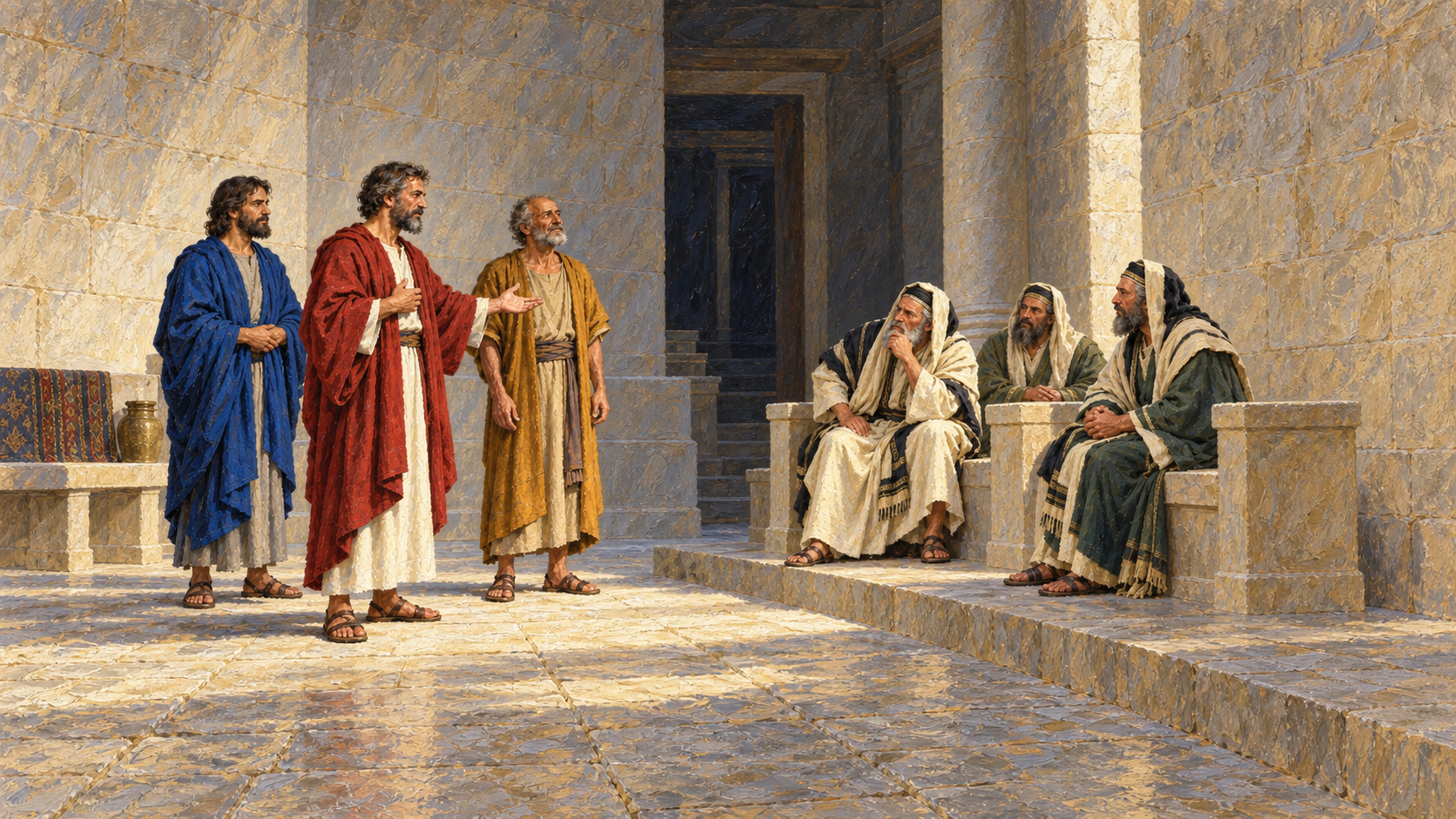
The New Testament uses apologia, the source of our English word apologetics, in settings that reach beyond formal debate. As we look at each occurrence, I want to pay particular attention to the instruction in 1 Peter about giving a Christian defense. He connects truthful speech with hope in Christ and a life submitted to Him, so we need to consider more than the argument itself.
What Apologia Means in the New Testament
The Greek noun apologia means a defense, reply, or reasoned answer. Someone might give that answer during an examination or in response to an accusation. It can also be a reply to a person asking for reasons. Although the word often appears in legal and public settings, its meaning is not limited to them. In each case, someone is answering a real challenge.
The noun is feminine in Greek and belongs to a word family that includes the verb for making a defense. Recognizing those related forms helps us follow the word through Scripture, but its parts alone cannot tell us what a passage teaches. We need the sentence and setting to understand it honestly and accurately. Nor should we assume that every use describes the whole modern field of apologetics.
The Textus Receptus, the received Greek New Testament base I use for language study, contains the noun eight times. It appears in Acts 22:1 and Acts 25:16; 1 Corinthians 9:3 and 2 Corinthians 7:11; Philippians 1:7 and Philippians 1:17; 2 Timothy 4:16; and 1 Peter 3:15. The NKJV usually translates it as “defense,” though “clearing” and “answer” appear where the context calls for them.
When I compare those uses, I see why we need more than one picture of a Christian defense. Acts and 2 Timothy describe courtrooms or hearings. In Corinthians, an apostle answers an examination of his ministry, while repentance clears people who have responded to correction. Philippians concerns defending and confirming the gospel. Peter commands ordinary believers to be ready when their hope raises questions amid hostility. Apologia reaches beyond intellectual debate and private testimony to the responsibility of giving a truthful answer under pressure.
The challenge determines what kind of answer is needed. A person facing a legal charge needs to answer that charge, while questions about an apostle’s conduct or rights call for an honest explanation of his stewardship. Repentance may clear people by showing that they no longer defend their sin. When Christian hope is challenged, the reasons we give should lead back to Christ. These answers take different forms, but every one must be truthful.
Peter Places the Defense Inside a Faithful Life
Finally, all of you be of one mind, having compassion for one another; love as brothers, be tenderhearted, be courteous; not returning evil for evil or reviling for reviling, but on the contrary blessing, knowing that you were called to this, that you may inherit a blessing. For "He who would love life And see good days, Let him refrain his tongue from evil, And his lips from speaking deceit. Let him turn away from evil and do good; Let him seek peace and pursue it. For the eyes of the LORD are on the righteous, And His ears are open to their prayers; But the face of the LORD is against those who do evil." And who is he who will harm you if you become followers of what is good? But even if you should suffer for righteousness' sake, you are blessed. "And do not be afraid of their threats, nor be troubled." But sanctify the Lord God in your hearts, and always be ready to give a defense to everyone who asks you a reason for the hope that is in you, with meekness and fear; having a good conscience, that when they defame you as evildoers, those who revile your good conduct in Christ may be ashamed. For it is better, if it is the will of God, to suffer for doing good than for doing evil.
Peter wrote to scattered believers in the Roman provinces of Asia Minor who lived as outsiders because they belonged to Christ. They might face slander and social hostility without ever entering a courtroom. Someone included in “everyone who asks” could be a neighbor or relative as readily as a magistrate. The question arose when people saw Christians endure suffering without giving up their hope, rather than through clever advertising.
I need to remember that pressure when I read Peter’s command. He was preparing believers whose faithfulness might cost them something, not speakers who could choose a friendly audience and control the clock. They had to answer steadily even when a question came with ridicule or a threat. Being ready began with deciding to honor the Lord even if the person listening was hostile or suspicious.
Before discussing a defense, Peter called believers to unity and compassion. They were to love one another as family and treat each other tenderly and answer people courteously. When reviled, they were to bless their opponents instead of retaliating, continuing to do good without letting threats rule them. I cannot separate that conduct from the answer Peter tells me to give. A sharp argument will not repair a cruel or dishonest life, and apologetics without holiness contradicts the passage it claims to obey.
Peter first tells us to “sanctify the Lord God” in the heart. The Textus Receptus and NKJV preserve that wording, rather than the Alexandrian critical-text wording found in many modern translations. To sanctify the Lord God is to set Him apart as holy within us and submit to His supreme authority. Honoring Him above the crowd breaks the power of our fear of human opposition. Peter puts worship before technique, so preparation that only makes me proud has missed where he begins.
Peter asks us to explain “the hope that is in you.” That hope rests on Jesus’ bodily resurrection. Because He lives, believers know that their sins are forgiven and their salvation is eternally secure. His promised return and coming kingdom are certain as well. This confidence comes from the risen Lord and the future He has promised, not from having an optimistic personality.
Questions about creation or morality may present a genuine obstacle that a careful answer can help remove. Questions about manuscripts and history deserve the same care, while philosophical reasoning can uncover a false assumption. But I don’t want to answer all of those questions and leave out Christ. Peter and John showed us why He must remain central when rulers asked how a man had been healed and in whose name they had acted.
Now as they spoke to the people, the priests, the captain of the temple, and the Sadducees came upon them, being greatly disturbed that they taught the people and preached in Jesus the resurrection from the dead. And they laid hands on them, and put them in custody until the next day, for it was already evening. However, many of those who heard the word believed; and the number of the men came to be about five thousand. And it came to pass, on the next day, that their rulers, elders, and scribes, as well as Annas the high priest, Caiaphas, John, and Alexander, and as many as were of the family of the high priest, were gathered together at Jerusalem. And when they had set them in the midst, they asked, "By what power or by what name have you done this?" Then Peter, filled with the Holy Spirit, said to them, "Rulers of the people and elders of Israel: If we this day are judged for a good deed done to a helpless man, by what means he has been made well, let it be known to you all, and to all the people of Israel, that by the name of Jesus Christ of Nazareth, whom you crucified, whom God raised from the dead, by Him this man stands here before you whole. This is the 'stone which was rejected by you builders, which has become the chief cornerstone.' Nor is there salvation in any other, for there is no other name under heaven given among men by which we must be saved." Now when they saw the boldness of Peter and John, and perceived that they were uneducated and untrained men, they marveled. And they realized that they had been with Jesus. And seeing the man who had been healed standing with them, they could say nothing against it. But when they had commanded them to go aside out of the council, they conferred among themselves, saying, "What shall we do to these men? For, indeed, that a notable miracle has been done through them is evident to all who dwell in Jerusalem, and we cannot deny it. But so that it spreads no further among the people, let us severely threaten them, that from now on they speak to no man in this name." So they called them and commanded them not to speak at all nor teach in the name of Jesus. But Peter and John answered and said to them, "Whether it is right in the sight of God to listen to you more than to God, you judge. For we cannot but speak the things which we have seen and heard." So when they had further threatened them, they let them go, finding no way of punishing them, because of the people, since they all glorified God for what had been done. For the man was over forty years old on whom this miracle of healing had been performed.
The apostles answered with concrete facts about Jesus’ crucifixion and resurrection, then plainly declared that salvation is found in no other name. The Holy Spirit and their time with Jesus gave them boldness, but their words were still easy to understand. We need deliberate preparation to “always be ready” in that way. Knowing the gospel and reading Scripture in context help us understand the central doctrines of our faith so we can explain sound reasons in ordinary language.
No believer needs to master every field, and sometimes the most faithful answer is, “I do not know; I will study that.” Honest limits are stronger than invented evidence or false certainty. Peter commands readiness, not the pretense of knowing everything.
I would begin preparation with what I actually confess as a Christian. Can I explain who Jesus is and why He died? Do I understand what His bodily resurrection means and why I trust His promises? I should be able to open the passage that supports my answer, rather than repeat something I heard. Specialized study can be valuable, but it cannot replace a clear grasp of the gospel. A believer with a simple grasp of the gospel who explains Christ may give a better defense than an impressive speaker who never gets to Him.
Peter’s instruction about meekness and fear governs how we answer. Meekness lets us resist error without contempt or a need to dominate because it is strength under control, not surrender of the truth. And the fear Peter describes cannot mean terror of our questioners, since he has just told believers not to fear human threats. We speak with reverence before God, whose judgment carries more weight than applause from either side.
A good conscience means that our conduct supports what we say. We can walk honestly before God and confess our sin when we fail without pretending to be sinless. James explains why hearing the Word must lead to doing what it says.
So then, my beloved brethren, let every man be swift to hear, slow to speak, slow to wrath; for the wrath of man does not produce the righteousness of God. Therefore lay aside all filthiness and overflow of wickedness, and receive with meekness the implanted word, which is able to save your souls. But be doers of the word, and not hearers only, deceiving yourselves. For if anyone is a hearer of the word and not a doer, he is like a man observing his natural face in a mirror; for he observes himself, goes away, and immediately forgets what kind of man he was. But he who looks into the perfect law of liberty and continues in it, and is not a forgetful hearer but a doer of the work, this one will be blessed in what he does. If anyone among you thinks he is religious, and does not bridle his tongue but deceives his own heart, this one's religion is useless. Pure and undefiled religion before God and the Father is this: to visit orphans and widows in their trouble, and to keep oneself unspotted from the world.
When a Christian has actually sinned, a defense must not become evasion. The truthful response may begin with confession, and restitution may be necessary where someone has suffered loss. The believer receives correction and returns to obedience instead of hiding behind a protected reputation.
A church can defend the gospel while admitting wrongdoing by a member or leader. Protecting someone’s reputation by concealing the truth would contradict the message we are defending.
Paul Shows the Range of a Biblical Defense
Paul’s use of apologia helps us see why one modern method cannot cover everything the word means. When he addressed the Jerusalem crowd, he answered the accusation by explaining his personal history and why his allegiance had changed.
"Brethren and fathers, hear my defense before you now." And when they heard that he spoke to them in the Hebrew language, they kept all the more silent. Then he said: "I am indeed a Jew, born in Tarsus of Cilicia, but brought up in this city at the feet of Gamaliel, taught according to the strictness of our fathers' law, and was zealous toward God as you all are today. I persecuted this Way to the death, binding and delivering into prisons both men and women, as also the high priest bears me witness, and all the council of the elders, from whom I also received letters to the brethren, and went to Damascus to bring in chains even those who were there to Jerusalem to be punished. "Now it happened, as I journeyed and came near Damascus at about noon, suddenly a great light from heaven shone around me. And I fell to the ground and heard a voice saying to me, 'Saul, Saul, why are you persecuting Me?' So I answered, 'Who are You, Lord?' And He said to me, 'I am Jesus of Nazareth, whom you are persecuting.' "And those who were with me indeed saw the light and were afraid, but they did not hear the voice of Him who spoke to me. So I said, 'What shall I do, Lord?' And the Lord said to me, 'Arise and go into Damascus, and there you will be told all things which are appointed for you to do.' And since I could not see for the glory of that light, being led by the hand of those who were with me, I came into Damascus. "Then a certain Ananias, a devout man according to the law, having a good testimony with all the Jews who dwelt there, came to me; and he stood and said to me, 'Brother Saul, receive your sight.' And at that same hour I looked up at him. Then he said, 'The God of our fathers has chosen you that you should know His will, and see the Just One, and hear the voice of His mouth. For you will be His witness to all men of what you have seen and heard. And now why are you waiting? Arise and be baptized, and wash away your sins, calling on the name of the Lord.' "Now it happened, when I returned to Jerusalem and was praying in the temple, that I was in a trance and saw Him saying to me, 'Make haste and get out of Jerusalem quickly, for they will not receive your testimony concerning Me.' So I said, 'Lord, they know that in every synagogue I imprisoned and beat those who believe on You. And when the blood of Your martyr Stephen was shed, I also was standing by consenting to his death, and guarding the clothes of those who were killing him.' Then He said to me, 'Depart, for I will send you far from here to the Gentiles.'"
Paul began with his Jewish background and former zeal, openly acknowledging that he had persecuted Christians. He then gave specific facts about meeting the risen Jesus and receiving his commission. The testimony was personal, but Jesus’ actions remained central. Paul’s changed life supported the message rather than creating the gospel.
I notice that Paul did not soften his former violence into a harmless search for truth. Nor did he make himself the hero of what happened. Knowing his past helps us see how great the change was, and meeting the risen Jesus explains that change. Our testimony should be just as honest about God’s work. An experience cannot bear more weight than who Christ is and what He has done.
Acts 22:16 must be read with the words “calling on the name of the Lord.” Paul had already met and submitted to the risen Jesus before Ananias arrived. Water baptism followed faith as obedient public identification with Christ. It did not produce Paul’s new birth or add cleansing power to Christ’s blood. The Lord saves, and baptism confesses the believer’s union with Him.
At Caesarea, apologia had a direct legal meaning. Festus explained the Roman rule that an accused person should meet the accusers and have an opportunity to answer the charge.
And after some days King Agrippa and Bernice came to Caesarea to greet Festus. When they had been there many days, Festus laid Paul's case before the king, saying: "There is a certain man left a prisoner by Felix, about whom the chief priests and the elders of the Jews informed me, when I was in Jerusalem, asking for a judgment against him. To them I answered, 'It is not the custom of the Romans to deliver any man to destruction before the accused meets the accusers face to face, and has opportunity to answer for himself concerning the charge against him.' Therefore when they had come together, without any delay, the next day I sat on the judgment seat and commanded the man to be brought in. When the accusers stood up, they brought no accusation against him of such things as I supposed, but had some questions against him about their own religion and about a certain Jesus, who had died, whom Paul affirmed to be alive. And because I was uncertain of such questions, I asked whether he was willing to go to Jerusalem and there be judged concerning these matters. But when Paul appealed to be reserved for the decision of Augustus, I commanded him to be kept till I could send him to Caesar." Then Agrippa said to Festus, "I also would like to hear the man myself." "Tomorrow," he said, "you shall hear him." So the next day, when Agrippa and Bernice had come with great pomp, and had entered the auditorium with the commanders and the prominent men of the city, at Festus' command Paul was brought in. And Festus said: "King Agrippa and all the men who are here present with us, you see this man about whom the whole assembly of the Jews petitioned me, both at Jerusalem and here, crying out that he was not fit to live any longer. But when I found that he had committed nothing deserving of death, and that he himself had appealed to Augustus, I decided to send him. I have nothing certain to write to my lord concerning him. Therefore I have brought him out before you, and especially before you, King Agrippa, so that after the examination has taken place I may have something to write. For it seems to me unreasonable to send a prisoner and not to specify the charges against him."
Paul’s appeals and hearings show that using lawful rights is compatible with trusting God. Passivity is not the same thing as faith. Even when officials do not understand the theology, the controversy keeps turning toward “a certain Jesus, who had died, whom Paul affirmed to be alive.” The resurrection remains at the heart of the case.
Paul also used the word when defending his apostolic ministry and right to material support in Corinth.
Am I not an apostle? Am I not free? Have I not seen Jesus Christ our Lord? Are you not my work in the Lord? If I am not an apostle to others, yet doubtless I am to you. For you are the seal of my apostleship in the Lord. My defense to those who examine me is this: Do we have no right to eat and drink? Do we have no right to take along a believing wife, as do also the other apostles, the brothers of the Lord, and Cephas? Or is it only Barnabas and I who have no right to refrain from working? Who ever goes to war at his own expense? Who plants a vineyard and does not eat of its fruit? Or who tends a flock and does not drink of the milk of the flock? Do I say these things as a mere man? Or does not the law say the same also? For it is written in the law of Moses, "You shall not muzzle an ox while it treads out the grain." Is it oxen God is concerned about? Or does He say it altogether for our sakes? For our sakes, no doubt, this is written, that he who plows should plow in hope, and he who threshes in hope should be partaker of his hope. If we have sown spiritual things for you, is it a great thing if we reap your material things? If others are partakers of this right over you, are we not even more? Nevertheless we have not used this right, but endure all things lest we hinder the gospel of Christ. Do you not know that those who minister the holy things eat of the things of the temple, and those who serve at the altar partake of the offerings of the altar? Even so the Lord has commanded that those who preach the gospel should live from the gospel. But I have used none of these things, nor have I written these things that it should be done so to me; for it would be better for me to die than that anyone should make my boasting void. For if I preach the gospel, I have nothing to boast of, for necessity is laid upon me; yes, woe is me if I do not preach the gospel! For if I do this willingly, I have a reward; but if against my will, I have been entrusted with a stewardship. What is my reward then? That when I preach the gospel, I may present the gospel of Christ without charge, that I may not abuse my authority in the gospel.
Paul explained that he had a right to material support, then explained why he had freely chosen not to use it when doing so might hinder the gospel. He was accounting for his conduct and the mission Christ had entrusted to him. In 2 Corinthians, the noun appears as “clearing” when the church responded to correction with earnest repentance.
For even if I made you sorry with my letter, I do not regret it; though I did regret it. For I perceive that the same epistle made you sorry, though only for a while. Now I rejoice, not that you were made sorry, but that your sorrow led to repentance. For you were made sorry in a godly manner, that you might suffer loss from us in nothing. For godly sorrow produces repentance leading to salvation, not to be regretted; but the sorrow of the world produces death. For observe this very thing, that you sorrowed in a godly manner: What diligence it produced in you, what clearing of yourselves, what indignation, what fear, what vehement desire, what zeal, what vindication! In all things you proved yourselves to be clear in this matter. Therefore, although I wrote to you, I did not do it for the sake of him who had done the wrong, nor for the sake of him who suffered wrong, but that our care for you in the sight of God might appear to you.
The Corinthians’ godly sorrow had changed their attitude toward sin. Their clearing came from that response, not from an impressive argument designed to protect appearances. Together, these passages show why defending truth includes answering questions about conduct. Faithful stewardship sometimes needs to be explained, while actual sin calls for genuine repentance.
If someone loudly accuses me of wrongdoing when I have acted faithfully, I should explain what I have done rather than confess guilt that isn’t there. But if the charge is true, a technical defense cannot take the place of repentance. Paul could state his lawful right without shame, while the Corinthians needed to show that they had received correction. The facts must determine our answer, even when another response might do more to preserve our image.
In Philippians, Paul connected his defense with the work of confirming and spreading the gospel.
I thank my God upon every remembrance of you, always in every prayer of mine making request for you all with joy, for your fellowship in the gospel from the first day until now, being confident of this very thing, that He who has begun a good work in you will complete it until the day of Jesus Christ; just as it is right for me to think this of you all, because I have you in my heart, inasmuch as both in my chains and in the defense and confirmation of the gospel, you all are partakers with me of grace. For God is my witness, how greatly I long for you all with the affection of Jesus Christ. And this I pray, that your love may abound still more and more in knowledge and all discernment, that you may approve the things that are excellent, that you may be sincere and without offense till the day of Christ, being filled with the fruits of righteousness which are by Jesus Christ, to the glory and praise of God. But I want you to know, brethren, that the things which happened to me have actually turned out for the furtherance of the gospel, so that it has become evident to the whole palace guard, and to all the rest, that my chains are in Christ; and most of the brethren in the Lord, having become confident by my chains, are much more bold to speak the word without fear. Some indeed preach Christ even from envy and strife, and some also from goodwill: The former preach Christ from selfish ambition, not sincerely, supposing to add affliction to my chains; but the latter out of love, knowing that I am appointed for the defense of the gospel. What then? Only that in every way, whether in pretense or in truth, Christ is preached; and in this I rejoice, yes, and will rejoice. For I know that this will turn out for my deliverance through your prayer and the supply of the Spirit of Jesus Christ, according to my earnest expectation and hope that in nothing I shall be ashamed, but with all boldness, as always, so now also Christ will be magnified in my body, whether by life or by death. For to me, to live is Christ, and to die is gain. But if I live on in the flesh, this will mean fruit from my labor; yet what I shall choose I cannot tell. For I am hard-pressed between the two, having a desire to depart and be with Christ, which is far better. Nevertheless to remain in the flesh is more needful for you. And being confident of this, I know that I shall remain and continue with you all for your progress and joy of faith, that your rejoicing for me may be more abundant in Jesus Christ by my coming to you again. Only let your conduct be worthy of the gospel of Christ, so that whether I come and see you or am absent, I may hear of your affairs, that you stand fast in one spirit, with one mind striving together for the faith of the gospel, and not in any way terrified by your adversaries, which is to them a proof of perdition, but to you of salvation, and that from God. For to you it has been granted on behalf of Christ, not only to believe in Him, but also to suffer for His sake, having the same conflict which you saw in me and now hear is in me.
Paul’s imprisonment had helped advance the gospel, and the Philippian church shared in that work through its fellowship with him. Defending the gospel and confirming it belonged together. The received text places “I am appointed for the defense of the gospel” in verse 17; other textual traditions order the nearby phrases differently, which is why discussions may cite a different verse number. The NKJV follows the received base used for this study.
Paul wanted more than a chance to be heard. He wanted Christ to be sincerely proclaimed and magnified whether he lived or died. The church was also to stand together without being intimidated and live in a way worthy of the gospel it defended.
Near the end of his life, Paul described a defense at which every human supporter had abandoned him.
Be diligent to come to me quickly; for Demas has forsaken me, having loved this present world, and has departed for Thessalonica–Crescens for Galatia, Titus for Dalmatia. Only Luke is with me. Get Mark and bring him with you, for he is useful to me for ministry. And Tychicus I have sent to Ephesus. Bring the cloak that I left with Carpus at Troas when you come–and the books, especially the parchments. Alexander the coppersmith did me much harm. May the Lord repay him according to his works. You also must beware of him, for he has greatly resisted our words. At my first defense no one stood with me, but all forsook me. May it not be charged against them. But the Lord stood with me and strengthened me, so that the message might be preached fully through me, and that all the Gentiles might hear. Also I was delivered out of the mouth of the lion. And the Lord will deliver me from every evil work and preserve me for His heavenly kingdom. To Him be glory forever and ever. Amen!
Paul did not pretend that being left alone was easy, but he did not respond with bitterness. He asked that the abandonment not be charged against those who had left him. The Lord stood with him and gave him strength to preach the message fully so that the nations could hear. Even in a personal legal defense, Paul had a purpose beyond obtaining an acquittal.
Defending the Gospel Means Reaching Christ and His Resurrection
Jude does not use the noun apologia, so Jude 3 is not a ninth occurrence. His command to contend earnestly for the faith is still related evidence because destructive teachers must sometimes be opposed for the sake of the church.
Jude, a bondservant of Jesus Christ, and brother of James, To those who are called, sanctified by God the Father, and preserved in Jesus Christ: Mercy, peace, and love be multiplied to you. Beloved, while I was very diligent to write to you concerning our common salvation, I found it necessary to write to you exhorting you to contend earnestly for the faith which was once for all delivered to the saints. For certain men have crept in unnoticed, who long ago were marked out for this condemnation, ungodly men, who turn the grace of our God into lewdness and deny the only Lord God and our Lord Jesus Christ. But I want to remind you, though you once knew this, that the Lord, having saved the people out of the land of Egypt, afterward destroyed those who did not believe. And the angels who did not keep their proper domain, but left their own abode, He has reserved in everlasting chains under darkness for the judgment of the great day; as Sodom and Gomorrah, and the cities around them in a similar manner to these, having given themselves over to sexual immorality and gone after strange flesh, are set forth as an example, suffering the vengeance of eternal fire. Likewise also these dreamers defile the flesh, reject authority, and speak evil of dignitaries. Yet Michael the archangel, in contending with the devil, when he disputed about the body of Moses, dared not bring against him a reviling accusation, but said, "The Lord rebuke you!" But these speak evil of whatever they do not know; and whatever they know naturally, like brute beasts, in these things they corrupt themselves. Woe to them! For they have gone in the way of Cain, have run greedily in the error of Balaam for profit, and perished in the rebellion of Korah. These are spots in your love feasts, while they feast with you without fear, serving only themselves. They are clouds without water, carried about by the winds; late autumn trees without fruit, twice dead, pulled up by the roots; raging waves of the sea, foaming up their own shame; wandering stars for whom is reserved the blackness of darkness forever. Now Enoch, the seventh from Adam, prophesied about these men also, saying, "Behold, the Lord comes with ten thousands of His saints, to execute judgment on all, to convict all who are ungodly among them of all their ungodly deeds which they have committed in an ungodly way, and of all the harsh things which ungodly sinners have spoken against Him." These are grumblers, complainers, walking according to their own lusts; and they mouth great swelling words, flattering people to gain advantage. But you, beloved, remember the words which were spoken before by the apostles of our Lord Jesus Christ: how they told you that there would be mockers in the last time who would walk according to their own ungodly lusts. These are sensual persons, who cause divisions, not having the Spirit. But you, beloved, building yourselves up on your most holy faith, praying in the Holy Spirit, keep yourselves in the love of God, looking for the mercy of our Lord Jesus Christ unto eternal life. And on some have compassion, making a distinction; but others save with fear, pulling them out of the fire, hating even the garment defiled by the flesh. Now to Him who is able to keep you from stumbling, And to present you faultless Before the presence of His glory with exceeding joy, To God our Savior, Who alone is wise, Be glory and majesty, Dominion and power, Both now and forever. Amen.
Jude exposed false doctrine and the immorality it produced because people needed protection and care. He also told believers to build themselves up in the faith and pray in the Holy Spirit. Some people in danger needed patient compassion, while others needed urgent rescue. In helping them, the defender must remain holy and remember that God is the One able to keep His people.
I cannot read Jude as permission to enjoy conflict for its own sake. False teaching harms households and turns grace into permission for sin, so remaining silent can abandon people who need protection. Yet opposing an arrogant teacher does not excuse arrogance in me. The purpose is to preserve the faith that was delivered to us and help people escape error, not build a reputation for winning fights.
I also see in Scripture that careful reasoning and structured dispute have a proper place. It is inaccurate to say that apologetics should never include debate.
Now while Paul waited for them at Athens, his spirit was provoked within him when he saw that the city was given over to idols. Therefore he reasoned in the synagogue with the Jews and with the Gentile worshipers, and in the marketplace daily with those who happened to be there. Then certain Epicurean and Stoic philosophers encountered him. And some said, "What does this babbler want to say?" Others said, "He seems to be a proclaimer of foreign gods," because he preached to them Jesus and the resurrection. And they took him and brought him to the Areopagus, saying, "May we know what this new doctrine is of which you speak? For you are bringing some strange things to our ears. Therefore we want to know what these things mean." For all the Athenians and the foreigners who were there spent their time in nothing else but either to tell or to hear some new thing. Then Paul stood in the midst of the Areopagus and said, "Men of Athens, I perceive that in all things you are very religious; for as I was passing through and considering the objects of your worship, I even found an altar with this inscription: TO THE UNKNOWN GOD. Therefore, the One whom you worship without knowing, Him I proclaim to you: God, who made the world and everything in it, since He is Lord of heaven and earth, does not dwell in temples made with hands. Nor is He worshiped with men's hands, as though He needed anything, since He gives to all life, breath, and all things. And He has made from one blood every nation of men to dwell on all the face of the earth, and has determined their preappointed times and the boundaries of their dwellings, so that they should seek the Lord, in the hope that they might grope for Him and find Him, though He is not far from each one of us; for in Him we live and move and have our being, as also some of your own poets have said, 'For we are also His offspring.' Therefore, since we are the offspring of God, we ought not to think that the Divine Nature is like gold or silver or stone, something shaped by art and man's devising. Truly, these times of ignorance God overlooked, but now commands all men everywhere to repent, because He has appointed a day on which He will judge the world in righteousness by the Man whom He has ordained. He has given assurance of this to all by raising Him from the dead." And when they heard of the resurrection of the dead, some mocked, while others said, "We will hear you again on this matter." So Paul departed from among them. However, some men joined him and believed, among them Dionysius the Areopagite, a woman named Damaris, and others with them.
Paul began with the Athenians’ religious setting so they could understand what he was addressing. He did not affirm their pagan worship as another road to God. Having made that connection, he corrected their understanding: the true God made the world and does not depend on human temples. He commands every person to repent because He has appointed a day of judgment, and Jesus’ resurrection gives assurance of it.
Some listeners mocked Paul, others wanted to hear him again, and some believed. He could make the claim clear, but he could not control their response. That helps me distinguish useful reasoning from an argument driven by pride. Scripture allows debate, but it does not allow us to manipulate or mock people, and it forbids quarrels that help no one. Reasoning should serve both the truth and the person listening.
Paul treated the bodily resurrection as both central evidence and the basis of our hope. He named witnesses who could be questioned about an event in history. A vague claim that faith makes people feel better could never replace that testimony.
Moreover, brethren, I declare to you the gospel which I preached to you, which also you received and in which you stand, by which also you are saved, if you hold fast that word which I preached to you–unless you believed in vain. For I delivered to you first of all that which I also received: that Christ died for our sins according to the Scriptures, and that He was buried, and that He rose again the third day according to the Scriptures, and that He was seen by Cephas, then by the twelve. After that He was seen by over five hundred brethren at once, of whom the greater part remain to the present, but some have fallen asleep. After that He was seen by James, then by all the apostles. Then last of all He was seen by me also, as by one born out of due time. For I am the least of the apostles, who am not worthy to be called an apostle, because I persecuted the church of God. But by the grace of God I am what I am, and His grace toward me was not in vain; but I labored more abundantly than they all, yet not I, but the grace of God which was with me. Therefore, whether it was I or they, so we preach and so you believed. Now if Christ is preached that He has been raised from the dead, how do some among you say that there is no resurrection of the dead? But if there is no resurrection of the dead, then Christ is not risen. And if Christ is not risen, then our preaching is empty and your faith is also empty. Yes, and we are found false witnesses of God, because we have testified of God that He raised up Christ, whom He did not raise up–if in fact the dead do not rise. For if the dead do not rise, then Christ is not risen. And if Christ is not risen, your faith is futile; you are still in your sins! Then also those who have fallen asleep in Christ have perished. If in this life only we have hope in Christ, we are of all men the most pitiable. But now Christ is risen from the dead, and has become the firstfruits of those who have fallen asleep. For since by man came death, by Man also came the resurrection of the dead. For as in Adam all die, even so in Christ all shall be made alive. But each one in his own order: Christ the firstfruits, afterward those who are Christ's at His coming. Then comes the end, when He delivers the kingdom to God the Father, when He puts an end to all rule and all authority and power. For He must reign till He has put all enemies under His feet. The last enemy that will be destroyed is death. For "He has put all things under His feet." But when He says "all things are put under Him," it is evident that He who put all things under Him is excepted. Now when all things are made subject to Him, then the Son Himself will also be subject to Him who put all things under Him, that God may be all in all.
The gospel Paul received and passed on says that Christ died for our sins according to the Scriptures, was buried, and rose on the third day. If He had not risen, the apostles would be false witnesses and their preaching would be empty. Faith in that message would be useless. But because Christ rose, death will not have the last word: those who belong to Him will be raised at His coming.
Paul’s warning about holding fast does not mean that a genuinely born-again believer repeatedly loses and regains salvation. If the Corinthians abandon the bodily resurrection, they expose that the message they claim to believe has been emptied of its defining truth. A shallow profession or an altered gospel is not saving faith in the apostolic Christ.
I cannot treat the resurrection as an optional piece of evidence alongside other equally important ideas. The crucified Jesus lives, and His claims did not end at His burial. His resurrection explains the hope Peter expected outsiders to notice. We have forgiveness through a living Savior and await the defeat of death and our own bodily resurrection, not merely some vague survival of the soul. Without that event, neither our defense nor our hope could stand.
Personal testimony can help people see the gospel’s effect, but its truth rests on more than an experience. People in other religions also report powerful experiences, so a Christian testimony must point to who Jesus is and the saving blood He shed. His bodily resurrection and written promises give testimony its meaning. I must not embellish my past or invent a supernatural incident to make my answer more compelling. Misrepresenting a quotation or repeating unchecked statistics and historical claims would be just as wrong.
Answer the Person Without Becoming Quarrelsome
When we answer, we need to remember that a person is listening. Paul begins his instruction about speaking with outsiders by calling believers to prayer.
Continue earnestly in prayer, being vigilant in it with thanksgiving; meanwhile praying also for us, that God would open to us a door for the word, to speak the mystery of Christ, for which I am also in chains, that I may make it manifest, as I ought to speak. Walk in wisdom toward those who are outside, redeeming the time. Let your speech always be with grace, seasoned with salt, that you may know how you ought to answer each one.
Paul calls Christians to walk wisely and use each opportunity carefully. Speech can be gracious without being evasive, just as salt gives it fitting force. We need to distinguish what Scripture clearly teaches from a reasonable inference and admit when we need to study a question further.
I need to hear the person’s concern before deciding how to answer. A question about suffering may be a philosophical objection, or the same words may come from someone who is deeply wounded. If I rush into a memorized speech, I may answer a question no one asked. Slowing down to understand the concern is part of giving a useful defense.
Listening also helps us avoid treating every question as an attack. Someone sincere may struggle to find the right words, and a wounded believer may need compassion before analysis. Someone else may use a question to make an accusation that needs a direct answer. We should address the actual obstacle without changing Scripture to suit the listener. That is part of knowing how to answer “each one.”
We can listen carefully and still give firm, direct correction. Paul condemned useless battles over words while commanding believers to handle the truth accurately and correct error with humility.
Remind them of these things, charging them before the Lord not to strive about words to no profit, to the ruin of the hearers. Be diligent to present yourself approved to God, a worker who does not need to be ashamed, rightly dividing the word of truth. But shun profane and idle babblings, for they will increase to more ungodliness. And their message will spread like cancer. Hymenaeus and Philetus are of this sort, who have strayed concerning the truth, saying that the resurrection is already past; and they overthrow the faith of some. Nevertheless the solid foundation of God stands, having this seal: "The Lord knows those who are His," and, "Let everyone who names the name of Christ depart from iniquity." But in a great house there are not only vessels of gold and silver, but also of wood and clay, some for honor and some for dishonor. Therefore if anyone cleanses himself from the latter, he will be a vessel for honor, sanctified and useful for the Master, prepared for every good work. Flee also youthful lusts; but pursue righteousness, faith, love, peace with those who call on the Lord out of a pure heart. But avoid foolish and ignorant disputes, knowing that they generate strife. And a servant of the Lord must not quarrel but be gentle to all, able to teach, patient, in humility correcting those who are in opposition, if God perhaps will grant them repentance, so that they may know the truth, and that they may come to their senses and escape the snare of the devil, having been taken captive by him to do his will.
The Lord’s servant must be patient and able to teach because the purpose is to help a person recover from error. We hope God will grant repentance; we are not seeking a public humiliation. Some conversations become foolish disputes that we should refuse. I need wisdom to recognize when an answer might help and when another round would only add to the strife.
Every believer should be ready to explain Christian hope, but elders carry an additional responsibility because of their office.
For this reason I left you in Crete, that you should set in order the things that are lacking, and appoint elders in every city as I commanded you– if a man is blameless, the husband of one wife, having faithful children not accused of dissipation or insubordination. For a bishop must be blameless, as a steward of God, not self-willed, not quick-tempered, not given to wine, not violent, not greedy for money, but hospitable, a lover of what is good, sober-minded, just, holy, self-controlled, holding fast the faithful word as he has been taught, that he may be able, by sound doctrine, both to exhort and convict those who contradict. For there are many insubordinate, both idle talkers and deceivers, especially those of the circumcision, whose mouths must be stopped, who subvert whole households, teaching things which they ought not, for the sake of dishonest gain. One of them, a prophet of their own, said, "Cretans are always liars, evil beasts, lazy gluttons." This testimony is true. Therefore rebuke them sharply, that they may be sound in the faith, not giving heed to Jewish fables and commandments of men who turn from the truth. To the pure all things are pure, but to those who are defiled and unbelieving nothing is pure; but even their mind and conscience are defiled. They profess to know God, but in works they deny Him, being abominable, disobedient, and disqualified for every good work.
Biblically qualified men who hold firmly to the faithful Word are entrusted with the church’s authoritative teaching leadership. They must be able to encourage others through sound doctrine and answer those who contradict it. That responsibility does not silence other believers. Every Christian may bear personal witness and answer sincere questions while contending faithfully for truth. Women also teach in biblically appropriate settings.
Titus does not allow doctrine to be detached from character. An argumentative or dishonest teacher contradicts the defense he gives. Greed, violence, and lack of self-control undermine the truth that teacher claims to represent.
I do not see careful preparation and dependence on God as opposites. The Holy Spirit inspired Scripture, and He gives believers the strength they need to bear faithful witness.
Finally, my brethren, be strong in the Lord and in the power of His might. Put on the whole armor of God, that you may be able to stand against the wiles of the devil. For we do not wrestle against flesh and blood, but against principalities, against powers, against the rulers of the darkness of this age, against spiritual hosts of wickedness in the heavenly places. Therefore take up the whole armor of God, that you may be able to withstand in the evil day, and having done all, to stand. Stand therefore, having girded your waist with truth, having put on the breastplate of righteousness, and having shod your feet with the preparation of the gospel of peace; above all, taking the shield of faith with which you will be able to quench all the fiery darts of the wicked one. And take the helmet of salvation, and the sword of the Spirit, which is the word of God; praying always with all prayer and supplication in the Spirit, being watchful to this end with all perseverance and supplication for all the saints– and for me, that utterance may be given to me, that I may open my mouth boldly to make known the mystery of the gospel, for which I am an ambassador in chains; that in it I may speak boldly, as I ought to speak.
Paul began his description of the armor with truth and a life shaped by righteousness. Believers are then pictured ready with the gospel of peace. They hold firmly to faith and the assurance of salvation, using the Word as the Spirit’s sword. Prayerful watchfulness sustains their bold speech. Depending on God belongs with disciplined preparation, not in place of it.
The Spirit who inspired Scripture also empowers our witness, but depending on Him cannot excuse a careless claim or misquotation. As we study a passage in context, we should pray for clarity and check historical or scientific claims before repeating them. If someone offers a valid correction, I should receive it gratefully. Correcting my answer strengthens the defense instead of threatening who I am.
Paul knew the gospel he intended to preach, yet he still asked for prayer that he would be given words and boldness. I need both study and prayer. Prayer cannot be an emergency substitute for study, and study cannot replace prayer. Truth deserves careful preparation, but only God can open doors and steady a fearful heart. We depend on Him to use the answer for the listener’s good.
The Defense Begins With the Biblical Gospel
For to this you were called, because Christ also suffered for us, leaving us an example, that you should follow His steps: "Who committed no sin, Nor was deceit found in His mouth"; who, when He was reviled, did not revile in return; when He suffered, He did not threaten, but committed Himself to Him who judges righteously; who Himself bore our sins in His own body on the tree, that we, having died to sins, might live for righteousness–by whose stripes you were healed. For you were like sheep going astray, but have now returned to the Shepherd and Overseer of your souls.
Jesus is the eternal Son, fully God, who also became fully man through the virgin birth and never sinned. He alone is Savior and Mediator. Wicked men subjected Him to real physical torture, and He willingly bore that punishment for our sins in His innocent body. He shed His blood until He died, voluntarily laying down His life. After He was buried, God raised Him bodily from the grave.
The Father did not punish or curse Jesus, nor did He abandon Him. He did not strike or bruise the Son or pour wrath on Him. Christ died for the whole world, although people may resist God’s genuine offer. Everyone who repents and believes is forgiven and born again as a new creation. The Holy Spirit comes to live within that believer and seals the new life He has given.
Every true believer is eternally secure, and that security never gives permission for lawlessness. A shallow profession without evidence of new life does not prove genuine salvation. This gospel gives us the hope we are called to explain. We begin by honoring the Lord as holy in our hearts, then prepare carefully to answer another person with courage and reverence.
For further study, see How to Study the Bible, The Gospel, and The Risen Jesus and His Ascension.
My Final Thoughts
Following the uses of apologia has brought me back to the kind of person giving the answer. I need to know why my hope rests in the crucified and risen Christ and prepare carefully to explain it to the person before me. I also need to speak with meekness and courage, remembering that I answer to God and must welcome honest examination of my own conduct. Having the sharpest argument in the room cannot take the place of that. When we honor Christ in what we say and how we live, we give the faithful explanation of hope under pressure that Peter describes.