
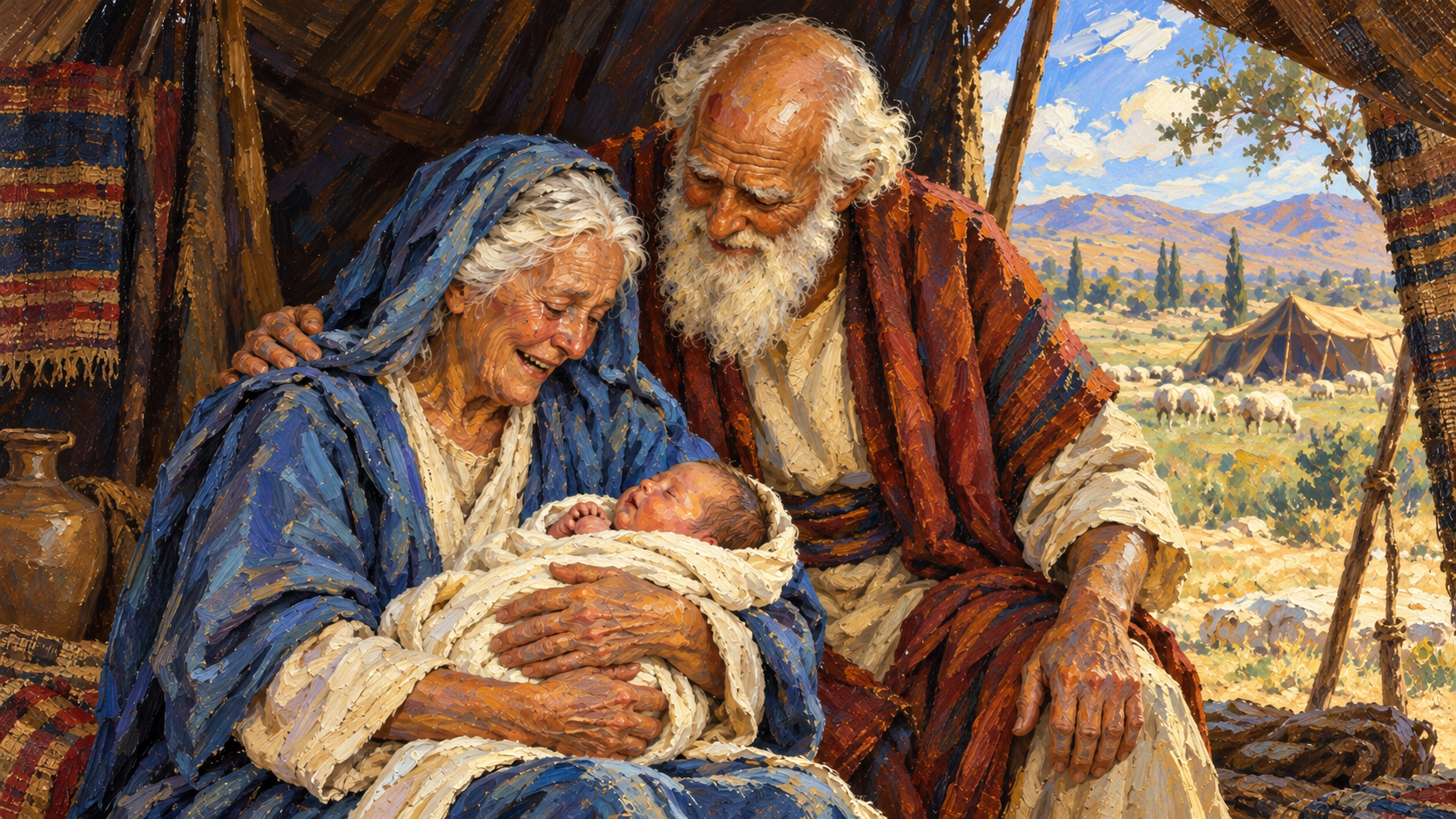
Why did God change Abram’s name to Abraham and Sarai’s name to Sarah? I want to let Genesis answer that before reading a secret message into one Hebrew letter. The promise God had already made shows what the new names meant and why their story leads through Isaac to Christ.
Abram Believed God Before His Name Changed
Abram’s story did not begin in Genesis 17. God had already called him to leave his country and family setting for a land that the Lord would show him. Abram went forward without being able to see how the whole promise would unfold.
Now the LORD had said to Abram: “Get out of your country, From your family And from your father’s house, To a land that I will show you. I will make you a great nation; I will bless you And make your name great; And you shall be a blessing.”
“I will bless those who bless you, And I will curse him who curses you; And in you all the families of the earth shall be blessed.”
These verses place several promises near the beginning of Abram’s journey. God speaks of land and a great nation. He will bless Abram and make him a blessing, and all the families of the earth will be blessed through him. The Lord was not merely improving one man’s private life. He was setting apart Abram so that His redemptive plan would reach far beyond Abram’s household.
That earlier setting helps us read the name change correctly. Genesis 17 did not turn an unbelieving man into a believer. Abram had already responded to the Lord by faith, and the new name would publicly identify him with the covenant promises God had already spoken. His life is not a motivational story about inventing a better identity for himself. God chose Abram and led him forward. Even when Abram needed correction, the Lord remained faithful to His own word.
Genesis 15 brings the difficulty Abram faced into the open. He had received the promise, but he still did not have the son through whom it would continue. The Lord took him outside and told him to look toward the heavens. Abram could not count the stars, and God used that vast sight to teach him about descendants he could not yet hold.
Then He brought him outside and said, “Look now toward heaven, and count the stars if you are able to number them.” And He said to him, “So shall your descendants be.”
And he believed in the LORD, and He accounted it to him for righteousness.
Genesis 15:6 becomes central to Paul’s explanation of justification by faith. Justification means that God declares a person righteous before Him. Abram was not accepted because he had already produced the promised heir or built the promised nation. He believed the Lord, and the Lord accounted that faith to him for righteousness. This happened before circumcision was given in Genesis 17, so the covenant story is rooted in God’s grace and received by faith.
I think that order keeps us from treating Abraham’s new name as a reward for flawless performance. Abram had real faith, but he also showed weakness and impatience. The strength of the story does not come from a man who never struggled; it comes from God remaining faithful to what He had promised. When the Lord later called him Abraham, that name announced the certainty of God’s word before the fulfillment could be seen.
The Covenant Setting of Abraham’s New Name
Abram was ninety-nine years old when Genesis 17 opened. The Lord appeared as Almighty God and told him to walk before Him and be blameless. The chapter holds several parts of the covenant together. God confirms His promise and gives circumcision as its sign. He also calls Abraham to obedience and identifies the family line through which the covenant will continue. The new names belong inside that whole setting.
When Abram was ninety-nine years old, the LORD appeared to Abram and said to him, “I am Almighty God; walk before Me and be blameless. And I will make My covenant between Me and you, and will multiply you exceedingly.”
Then Abram fell on his face, and God talked with him, saying: “As for Me, behold, My covenant is with you, and you shall be a father of many nations.”
The repeated emphasis falls on what God will do. The Lord says that He will make His covenant and multiply Abram. He calls it “My covenant.” Abram must walk before God, and the males in his household must receive the covenant sign. Their obedience responds to God’s word; it does not create the promise. The promise begins with the Lord and depends on His faithfulness.
The timing makes this even clearer. At ninety-nine, Abram was not at the natural beginning of fatherhood, and Sarah had passed the ordinary years of childbearing. God waited until human ability could not explain what was coming. Then He named Abram according to a future only divine power could bring about.
“No longer shall your name be called Abram, but your name shall be Abraham; for I have made you a father of many nations.”
Scripture itself gives the controlling explanation. Abram is commonly understood to mean “exalted father,” while Abraham is connected with being the father of a multitude or many nations. Abram already carried a name of dignity. The covenant promise enlarged its reach. He would become more than an honored father within a private household, for nations and kings would come from him.
I am struck by the way God says, “I have made you.” Isaac had not yet been conceived, and the promised nations had not appeared in history. Yet the Lord spoke of that future with the certainty of His own decree. God’s promise was firm before Abraham’s eyes had evidence that it could happen.
This does not make the name Abraham a spell that brought the promise into existence. Biblical faith is not word magic, and repeating a desired identity cannot force God to act. The power rested in the God who spoke. The name trained Abraham, Sarah, and the people around them to reckon with God’s promise as the defining reality while they waited for Him to fulfill it.
Sarah and the Promised Son
God did not rename Abram alone. Before announcing that the covenant son would come through Sarai, He gave her the name Sarah. She was not a background figure who happened to be attached to Abraham’s story. God deliberately named her in connection with His blessing and the birth of a son. Nations and kings would come through her.
Then God said to Abraham, “As for Sarai your wife, you shall not call her name Sarai, but Sarah shall be her name. And I will bless her and also give you a son by her; then I will bless her, and she shall be a mother of nations; kings of peoples shall be from her.”
A common explanation says that Sarai means “my princess” while Sarah means “princess.” That may describe a movement from a personal designation toward a wider royal role, but I would handle the exact linguistic distinction carefully. Genesis makes Sarah’s covenant role unmistakable even where questions about the precise shades of the names remain. God would bless her, give Abraham a son by her, and make her the mother of nations from whom kings would come.
This keeps us from treating Sarah as a mere vessel for a promise that really belonged only to Abraham. The covenant line would not continue through Hagar. Ishmael would receive a real blessing, but Sarah’s son would carry the covenant. God was deliberate about the mother as well as the father, choosing to bring Isaac through both Abraham and Sarah.
The new name also prepared the reader for the laughter and wonder surrounding Isaac’s birth. Abraham asked whether a child could be born to a hundred-year-old man and whether Sarah could bear a son at ninety. He pleaded that Ishmael might live before God. The Lord answered with both kindness and precision: Ishmael would be blessed, but Isaac would be the covenant son.
Then God said: “No, Sarah your wife shall bear you a son, and you shall call his name Isaac; I will establish My covenant with him for an everlasting covenant, and with his descendants after him.”
“But My covenant I will establish with Isaac, whom Sarah shall bear to you at this set time next year.”
Ishmael was not discarded or treated as worthless. God said that He had heard Abraham and would bless Ishmael. He would make him fruitful, multiply him greatly, and make him a great nation. Genesis 17 still draws a clear distinction between blessing and the covenant line. Isaac was the son through whom this covenant promise would move forward.
Genesis 21 later records Isaac’s birth as fulfillment rather than coincidence. The Lord visited Sarah as He had said and did for her as He had spoken. Abraham became the father of the promised multitude because God gave life where human strength had failed. Sarah became the mother through whom the promised son arrived because the Lord kept His word at the appointed time.
What the Hebrew Spelling Can and Cannot Prove
The spelling changes in these names naturally catch a careful reader’s attention. Abram is אַבְרָם (Avram), while Abraham is אַבְרָהָם (Avraham). Genesis 17:5 gives the meaning that must control our interpretation: God had made him a father of many nations.
Sarai is שָׂרַי (Sarai), while Sarah is שָׂרָה (Sarah). Both names are related to royal or princely language. Genesis 17:16 then explains Sarah’s place in the covenant by connecting her with the promised son and the nations and kings who would come through her.
The added sound is often connected with the Hebrew letter called he or hei. That same letter appears in the divine name commonly represented in English as YHWH, and it can appear in words associated with breathing or an expression such as “behold.” Those observations may explain why some readers see a beautiful devotional connection between the names and God’s own identity.
We should not make the observation carry more weight than the passage gives it. The letter does not automatically mean “breath” every time it appears, much less carry a whole doctrine of the Spirit or divine revelation. Nor can we claim as a lexical fact that God placed a portion of His name inside Abraham and Sarah. Someone may offer that idea cautiously as a devotional reflection, but it cannot replace the explanation God states openly in Genesis 17.
The clearer reading is already rich. God used their new names to state His covenant promise. The spelling and sound changes were memorable, but the promise was explicit. Abraham’s name spoke of fatherhood over many nations, while Sarah’s name stood beside the promise that she would bear Isaac and become connected with nations and kings. This was not a hidden code that depended on mystical meaning in one letter.
The Promise Reaches the Nations Through Christ
The new names reach beyond one family’s remarkable history. Paul uses Abraham’s story to explain faith in the God who brings life where death seems to have won. Abraham was called the father of many nations before the covenant son was born because God’s promise was more certain than the visible conditions.
(as it is written, “I have made you a father of many nations”) in the presence of Him whom he believed, God, who gives life to the dead and calls those things which do not exist as though they did;
He did not waver at the promise of God through unbelief, but was strengthened in faith, giving glory to God, and being fully convinced that what He had promised He was also able to perform.
Romans 4 also returns us to the order established in Genesis 15. Abraham was justified by faith before he received circumcision. The sign confirmed the covenant; it did not earn him a righteous standing before God. His faith looked away from the weakness of human ability and rested in the Lord who was able to perform what He had promised.
Galatians 3 carries the promise of blessing for all families of the earth to its redemptive center. The name Abraham, father of many nations, finds its fullest meaning in the promised Seed.
Now to Abraham and his Seed were the promises made. He does not say, “And to seeds,” as of many, but as of one, “And to your Seed,” who is Christ.
The blessing of the nations was not fulfilled by Abraham’s biological descendants alone. It reaches Jews and Gentiles who believe through Jesus Christ, who came through Abraham’s line according to the flesh. He shed His blood for sinners, died, and rose bodily. The way of salvation is opened through Christ, the promised Seed, rather than through physical descent or human effort.
I do not think we should treat the renaming as a small decorative detail. The promise moves through Isaac into the nation of Israel. From there it continues through David’s royal line until it reaches the Messiah. Long before all of that history unfolded, the names Abraham and Sarah bore witness to God’s faithfulness.
The passage also teaches us how faith waits, but we need to apply it without taking promises that belonged uniquely to Abraham and Sarah. God did not establish a rule that every believer must receive a private new name to discover a purpose. This was a particular covenant moment in redemptive history.
Still, Abraham and Sarah had to live under names that sounded larger than anything they could see. Every time Abraham heard his name, he heard of nations while he was still waiting for Isaac. Sarah carried a name tied to motherhood and royalty when her age made the promised birth naturally impossible. Their circumstances did not define what God was able to do.
Their faith was not passive. Genesis 17 called Abraham to walk before God, and circumcision was given as a covenant sign for his household. Trusting God meant obeying the word he had received while the fulfillment was still ahead. In this sense, their identity was received before it was expressed in history. They had to read their circumstances under the authority of God’s promise rather than measure His promise by what their circumstances seemed to allow.
The years between Genesis 12, Genesis 17, and Isaac’s birth exposed human weakness, but delay never exposed weakness in God. He fulfilled His word at the time He had appointed. The timing made it plain that Isaac’s birth was not an ordinary human achievement.
For a fuller look at how these promises unfold, the related studies on the life of Abraham, the Abrahamic covenant, and the gospel follow those lines further.
My Final Thoughts
After following the promise from Genesis into the New Testament, this is where I land: God changed their names to mark publicly what He had pledged to do through them. Abraham would become the father of many nations, while Sarah would bear Isaac and become the mother from whom nations and kings would come. Their names were covenant witnesses, not mystical formulas. We should not claim their unique promise for ourselves, but we can trust that waiting never weakens God’s word. Real faith keeps obeying Him while it waits for what He has spoken.