
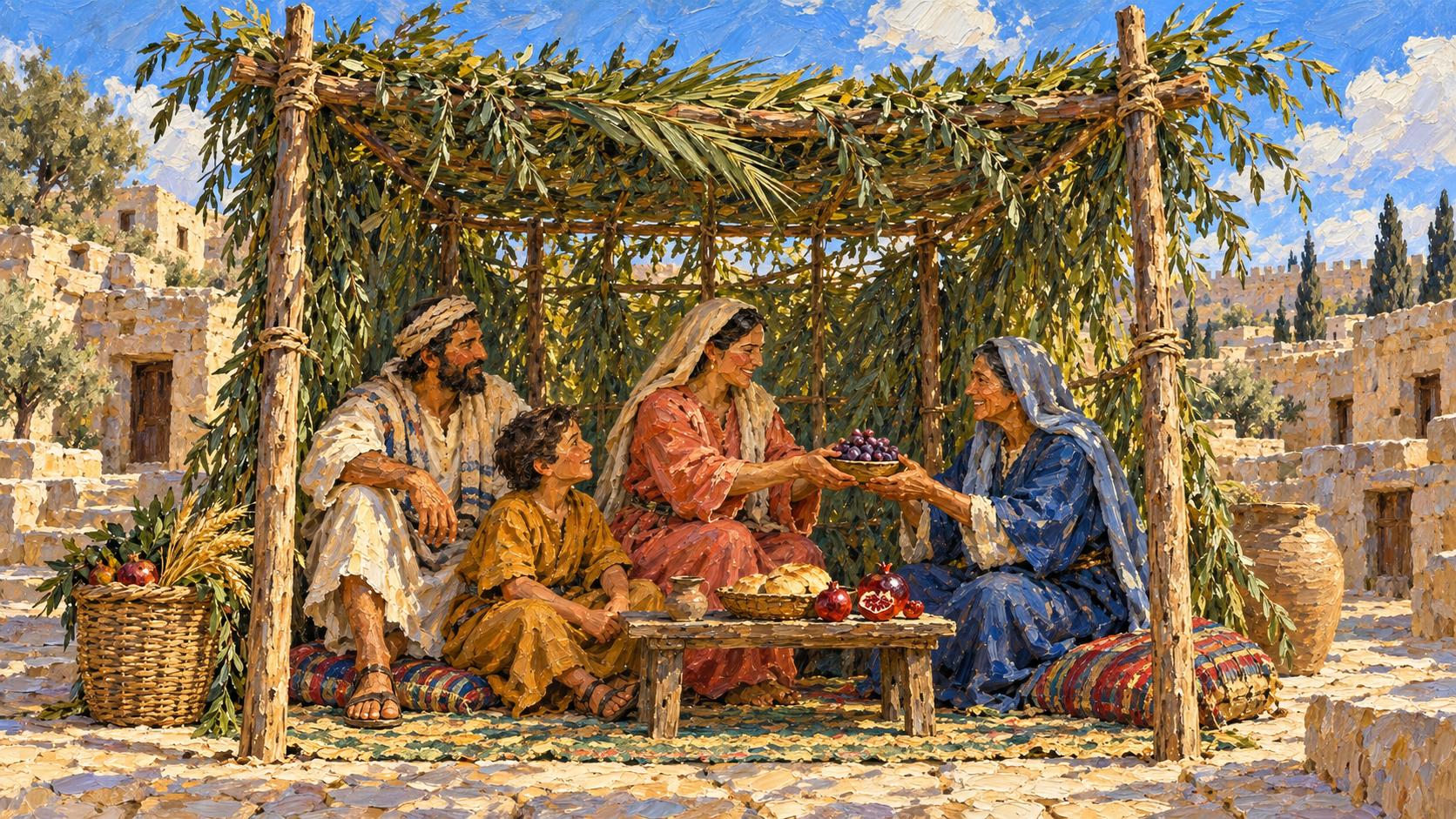
Israel lived in temporary shelters during the Feast of Tabernacles to remember the LORD’s care in the wilderness, while also celebrating the harvest He had provided. The same feast later forms the setting for Jesus’ offer of living water and appears in Zechariah’s prophecy of the coming King. I want to follow those connections carefully, beginning with what God commanded Israel and keeping His promises to that nation in view as we consider what the feast teaches us.
The LORD’s Feast of Booths and Ingathering
Then the LORD spoke to Moses, saying, "Speak to the children of Israel, saying: 'The fifteenth day of this seventh month shall be the Feast of Tabernacles for seven days to the LORD. On the first day there shall be a holy convocation. You shall do no customary work on it. For seven days you shall offer an offering made by fire to the LORD. On the eighth day you shall have a holy convocation, and you shall offer an offering made by fire to the LORD. It is a sacred assembly, and you shall do no customary work on it. 'These are the feasts of the LORD which you shall proclaim to be holy convocations, to offer an offering made by fire to the LORD, a burnt offering and a grain offering, a sacrifice and drink offerings, everything on its day– besides the Sabbaths of the LORD, besides your gifts, besides all your vows, and besides all your freewill offerings which you give to the LORD. 'Also on the fifteenth day of the seventh month, when you have gathered in the fruit of the land, you shall keep the feast of the LORD for seven days; on the first day there shall be a sabbath-rest, and on the eighth day a sabbath-rest. And you shall take for yourselves on the first day the fruit of beautiful trees, branches of palm trees, the boughs of leafy trees, and willows of the brook; and you shall rejoice before the LORD your God for seven days. You shall keep it as a feast to the LORD for seven days in the year. It shall be a statute forever in your generations. You shall celebrate it in the seventh month. You shall dwell in booths for seven days. All who are native Israelites shall dwell in booths, that your generations may know that I made the children of Israel dwell in booths when I brought them out of the land of Egypt: I am the LORD your God.'" So Moses declared to the children of Israel the feasts of the LORD.
The feast began on the fifteenth day of Israel’s seventh month, known by the later Jewish name Tishri. Trumpet blowing marked the first day of that month, and the Day of Atonement came on the tenth. Five days later, after gathering the produce of the land, Israel began seven days of rejoicing before the LORD. The study on the Feasts of the LORD places these appointments within the wider calendar.
Sukkot is the Hebrew plural of sukkah, a booth or temporary shelter. The name Tabernacles refers to those shelters, rather than the Mosaic Tabernacle, Israel’s portable sanctuary. God’s dwelling with His people is a larger biblical theme that connects with the feast, but a family’s booth and the sanctuary were different things.
God required a holy assembly and rest from customary work on the first day. The people lived in booths for seven days, followed by another sacred assembly and rest on the eighth. That last assembly belonged to the same festival season but was distinct from the seven booth days. Later Jewish usage calls it Shemini Atzeret, the assembly of the eighth. Numbers gives it its own smaller schedule of offerings; Scripture does not command an eighth day of booth dwelling.
Some Christians see completion or a new beginning in the eighth day. I can consider that possibility without treating the calendar as a code that identifies a future event. God explicitly commanded a sacred assembly and offerings. He did not explain every meaning later interpreters have attached to the number eight, and those suggestions should not displace the instruction He actually gave.
Native Israelites were to leave their permanent dwellings and spend seven days in booths so their descendants would remember the LORD’s care after the exodus. A settled family with a house and a gathered harvest could look back on ancestors who had lived without those advantages in the wilderness. Their present stability had not made them independent of the God who sustained their forefathers.
God also commanded them to take fruit from beautiful trees, palm branches, leafy boughs, and willows from the brook, and rejoice before Him. These were gifts of His creation used in worship under His direction. Later Jewish practice identified particular species and prescribed how to use them. We should distinguish those developed customs from the wording in Leviticus, which does not turn the plants into charms or give each one a hidden prophetic meaning.
"Three times you shall keep a feast to Me in the year: You shall keep the Feast of Unleavened Bread (you shall eat unleavened bread seven days, as I commanded you, at the time appointed in the month of Abib, for in it you came out of Egypt; none shall appear before Me empty); and the Feast of Harvest, the firstfruits of your labors which you have sown in the field; and the Feast of Ingathering at the end of the year, when you have gathered in the fruit of your labors from the field. "Three times in the year all your males shall appear before the Lord GOD.
Exodus calls the feast Ingathering because the produce had been gathered from the fields. It was the third annual pilgrimage season, after Unleavened Bread and the Feast of Harvest, also called Weeks. Israel’s men were to appear before the Lord, bringing gifts instead of arriving empty-handed. The study on the Feast of Unleavened Bread examines the earlier appointment.
Tabernacles therefore joined remembrance of the wilderness to gratitude for life in the land. The LORD had given the fields, the rain, and the strength to work. Crediting Baal with the harvest, or boasting as though their own labor explained everything, would deny the One they had come to worship. This was also a national gathering under God’s covenant, rather than a collection of private family celebrations.
Joy, Sacrifice, Scripture, and Restored Worship
"You shall observe the Feast of Tabernacles seven days, when you have gathered from your threshing floor and from your winepress. And you shall rejoice in your feast, you and your son and your daughter, your male servant and your female servant and the Levite, the stranger and the fatherless and the widow, who are within your gates. Seven days you shall keep a sacred feast to the LORD your God in the place which the LORD chooses, because the LORD your God will bless you in all your produce and in all the work of your hands, so that you surely rejoice. "Three times a year all your males shall appear before the LORD your God in the place which He chooses: at the Feast of Unleavened Bread, at the Feast of Weeks, and at the Feast of Tabernacles; and they shall not appear before the LORD empty-handed. Every man shall give as he is able, according to the blessing of the LORD your God which He has given you.
God named the people who were to share the feast: sons and daughters, servants, Levites, strangers, the fatherless, and widows. The owner of a productive field was not to reserve the celebration for people whose circumstances matched his own. Servants were included in the rejoicing, while those without secure land or family support were welcomed into the community’s abundance.
The Levite did not have the ordinary tribal inheritance of farmland. Widows and fatherless children had lost important family provision, and strangers could not simply assume the security of a settled Israelite household. God included them by name. I need to notice that before reducing gratitude to a private feeling about what I possess. Israel’s thanksgiving involved making room for other people, not enjoying God’s gifts while ignoring those who lacked them.
Each man gave according to the blessing he had received. His gift expressed gratitude; it was not a payment to secure a more profitable harvest next year. The celebration also required substantial sacrifices, with the offerings for each day specified in Numbers.
'On the fifteenth day of the seventh month you shall have a holy convocation. You shall do no customary work, and you shall keep a feast to the LORD seven days. You shall present a burnt offering, an offering made by fire as a sweet aroma to the LORD: thirteen young bulls, two rams, and fourteen lambs in their first year. They shall be without blemish. Their grain offering shall be of fine flour mixed with oil: three-tenths of an ephah for each of the thirteen bulls, two-tenths for each of the two rams, and one-tenth for each of the fourteen lambs; also one kid of the goats as a sin offering, besides the regular burnt offering, its grain offering, and its drink offering. 'On the second day present twelve young bulls, two rams, fourteen lambs in their first year without blemish, and their grain offering and their drink offerings for the bulls, for the rams, and for the lambs, by their number, according to the ordinance; also one kid of the goats as a sin offering, besides the regular burnt offering with its grain offering, and their drink offerings. 'On the third day present eleven bulls, two rams, fourteen lambs in their first year without blemish, and their grain offering and their drink offerings for the bulls, for the rams, and for the lambs, by their number, according to the ordinance; also one goat as a sin offering, besides the regular burnt offering, its grain offering, and its drink offering. 'On the fourth day present ten bulls, two rams, and fourteen lambs in their first year, without blemish, and their grain offering and their drink offerings for the bulls, for the rams, and for the lambs, by their number, according to the ordinance; also one kid of the goats as a sin offering, besides the regular burnt offering, its grain offering, and its drink offering. 'On the fifth day present nine bulls, two rams, and fourteen lambs in their first year without blemish, and their grain offering and their drink offerings for the bulls, for the rams, and for the lambs, by their number, according to the ordinance; also one goat as a sin offering, besides the regular burnt offering, its grain offering, and its drink offering. 'On the sixth day present eight bulls, two rams, and fourteen lambs in their first year without blemish, and their grain offering and their drink offerings for the bulls, for the rams, and for the lambs, by their number, according to the ordinance; also one goat as a sin offering, besides the regular burnt offering, its grain offering, and its drink offering. 'On the seventh day present seven bulls, two rams, and fourteen lambs in their first year without blemish, and their grain offering and their drink offerings for the bulls, for the rams, and for the lambs, by their number, according to the ordinance; also one goat as a sin offering, besides the regular burnt offering, its grain offering, and its drink offering. 'On the eighth day you shall have a sacred assembly. You shall do no customary work. You shall present a burnt offering, an offering made by fire as a sweet aroma to the LORD: one bull, one ram, seven lambs in their first year without blemish, and their grain offering and their drink offerings for the bull, for the ram, and for the lambs, by their number, according to the ordinance; also one goat as a sin offering, besides the regular burnt offering, its grain offering, and its drink offering. 'These you shall present to the LORD at your appointed feasts (besides your vowed offerings and your freewill offerings) as your burnt offerings and your grain offerings, as your drink offerings and your peace offerings.'" So Moses told the children of Israel everything, just as the LORD commanded Moses.
The first day required thirteen bulls, two rams, and fourteen lambs without blemish. The number of bulls decreased by one each day, ending with seven on the seventh day, for seventy in all. Grain and drink offerings accompanied the animals, and a goat was offered for sin each day in addition to the regular burnt offering. On the eighth day the distinct schedule required one bull, one ram, seven lambs, and a goat for sin.
Later interpreters connected the seventy bulls with the nations. That is an interpretation of the number, rather than an explanation Numbers itself gives. The chapter is clear about the cost and order of Israel’s worship: the regular daily offerings continued, and vowed or freewill gifts did not replace what God required. A plentiful harvest did not remove their need to deal with sin, and joy did not authorize them to devise their own service.
The feast was also a time for the whole people to hear God’s law. Every seventh year, during the year of release, the gathering included a public reading addressed to adults, children, and the stranger within their gates.
So Moses wrote this law and delivered it to the priests, the sons of Levi, who bore the ark of the covenant of the LORD, and to all the elders of Israel. And Moses commanded them, saying: "At the end of every seven years, at the appointed time in the year of release, at the Feast of Tabernacles, when all Israel comes to appear before the LORD your God in the place which He chooses, you shall read this law before all Israel in their hearing. Gather the people together, men and women and little ones, and the stranger who is within your gates, that they may hear and that they may learn to fear the LORD your God and carefully observe all the words of this law, and that their children, who have not known it, may hear and learn to fear the LORD your God as long as you live in the land which you cross the Jordan to possess."
Moses wanted the people to hear, learn to fear the LORD, and carefully obey His words. Children who had not known these things needed to be taught; descent from Israel would not automatically give them knowledge of God. Hearing Scripture kept the celebration directed toward the One who had delivered and provided for them. A harvest festival without that instruction could become mere sentiment or take on the religion of Israel’s neighbors.
Later, the seventh-month feast provided the setting for Solomon’s dedication of the temple. Israel brought the ark into the house built for the LORD, and His glory interrupted the priests’ service.
Now Solomon assembled the elders of Israel and all the heads of the tribes, the chief fathers of the children of Israel, to King Solomon in Jerusalem, that they might bring up the ark of the covenant of the LORD from the City of David, which is Zion. Therefore all the men of Israel assembled with King Solomon at the feast in the month of Ethanim, which is the seventh month. So all the elders of Israel came, and the priests took up the ark. Then they brought up the ark of the LORD, the tabernacle of meeting, and all the holy furnishings that were in the tabernacle. The priests and the Levites brought them up. Also King Solomon, and all the congregation of Israel who were assembled with him, were with him before the ark, sacrificing sheep and oxen that could not be counted or numbered for multitude. Then the priests brought in the ark of the covenant of the LORD to its place, into the inner sanctuary of the temple, to the Most Holy Place, under the wings of the cherubim. For the cherubim spread their two wings over the place of the ark, and the cherubim overshadowed the ark and its poles. The poles extended so that the ends of the poles could be seen from the holy place, in front of the inner sanctuary; but they could not be seen from outside. And they are there to this day. Nothing was in the ark except the two tablets of stone which Moses put there at Horeb, when the LORD made a covenant with the children of Israel, when they came out of the land of Egypt. And it came to pass, when the priests came out of the holy place, that the cloud filled the house of the LORD, so that the priests could not continue ministering because of the cloud; for the glory of the LORD filled the house of the LORD. Then Solomon spoke: "The LORD said He would dwell in the dark cloud. I have surely built You an exalted house, And a place for You to dwell in forever."
The priests placed the ark in the Most Holy Place, and the cloud filled the temple so that they could not continue ministering. Solomon had built an exalted house, but the LORD’s presence gave it a significance no finished building could supply for itself. In his dedication prayer, Solomon also acknowledged that even heaven could not contain God. The temple was a real dwelling for His name and glory, without confining His being to its walls.
That temple was later destroyed when Babylon conquered Jerusalem and carried Judah into exile. A remnant returned under Persian rule, rebuilt the temple, and eventually restored the city’s wall. In Nehemiah 8, the renewed community gathered to hear Scripture, and the heads of households, priests, and Levites came to Ezra to understand it more fully. They found the command to dwell in booths and acted on it.
Now on the second day the heads of the fathers' houses of all the people, with the priests and Levites, were gathered to Ezra the scribe, in order to understand the words of the Law. And they found written in the Law, which the LORD had commanded by Moses, that the children of Israel should dwell in booths during the feast of the seventh month, and that they should announce and proclaim in all their cities and in Jerusalem, saying, "Go out to the mountain, and bring olive branches, branches of oil trees, myrtle branches, palm branches, and branches of leafy trees, to make booths, as it is written." Then the people went out and brought them and made themselves booths, each one on the roof of his house, or in their courtyards or the courts of the house of God, and in the open square of the Water Gate and in the open square of the Gate of Ephraim. So the whole assembly of those who had returned from the captivity made booths and sat under the booths; for since the days of Joshua the son of Nun until that day the children of Israel had not done so. And there was very great gladness. Also day by day, from the first day until the last day, he read from the Book of the Law of God. And they kept the feast seven days; and on the eighth day there was a sacred assembly, according to the prescribed manner.
The people gathered branches and built booths on rooftops, in courtyards, in the temple courts, and in public squares. The command became something they did together, while the Book of the Law was read each day. Nehemiah describes very great gladness and says Israel had not done so since Joshua’s time. I understand that to describe the renewed keeping of the booth command in this manner, rather than deny every celebration of the feast in the intervening centuries. The earlier temple dedication already places worship in this festival season.
They kept the seven days and the prescribed sacred assembly on the eighth. Their joy came with renewed attention to God’s instruction, rather than with permission to ignore it. Israel’s national life also remained central to this gathering after exile. The study on the twelve tribes of Israel follows that identity through Scripture.
The Word Tabernacled Among Us
The LORD’s glory filled Israel’s sanctuary. John describes the eternal Son Himself coming to live among us, using dwelling language to explain His incarnation.
In the beginning was the Word, and the Word was with God, and the Word was God. He was in the beginning with God. All things were made through Him, and without Him nothing was made that was made. In Him was life, and the life was the light of men. And the light shines in the darkness, and the darkness did not comprehend it. There was a man sent from God, whose name was John. This man came for a witness, to bear witness of the Light, that all through him might believe. He was not that Light, but was sent to bear witness of that Light. That was the true Light which gives light to every man coming into the world. He was in the world, and the world was made through Him, and the world did not know Him. He came to His own, and His own did not receive Him. But as many as received Him, to them He gave the right to become children of God, to those who believe in His name: who were born, not of blood, nor of the will of the flesh, nor of the will of man, but of God. And the Word became flesh and dwelt among us, and we beheld His glory, the glory as of the only begotten of the Father, full of grace and truth. John bore witness of Him and cried out, saying, "This was He of whom I said, 'He who comes after me is preferred before me, for He was before me.'" And of His fullness we have all received, and grace for grace. For the law was given through Moses, but grace and truth came through Jesus Christ. No one has seen God at any time. The only begotten Son, who is in the bosom of the Father, He has declared Him.
John begins his Gospel with the eternal Word, who was with God and was God, and through whom everything was made. The Word then became flesh and “dwelt” among us. The Greek verb eskēnōsen can be expressed as “tabernacled” or “pitched His tent.” The Son truly became man, and His glory was made known among the people He came to save.
I see a clear connection with God’s dwelling among His people, without needing to turn every part of an Israelite booth into a prediction about Jesus. John is declaring the incarnation, God the Son taking true humanity. That declaration neither makes Israel disappear nor says that every promise associated with Tabernacles has already been fulfilled.
Later in the Gospel, Jesus goes to Jerusalem for the feast itself. By then, Jewish practice included customs beyond the commands we have read in Moses. The Mishnah describes water brought from Siloam and poured at the altar and large lamps in the temple courtyard. These accounts of temple practice help explain the festival background; they do not make those ceremonies Mosaic commands or tell us the exact moment at which Jesus spoke.
Jesus’ brothers urged Him to go to Judea and display His works publicly. John says they did not believe in Him. Jesus refused to let their demand determine His timing, remaining in Galilee before going to the feast privately. In the middle of the feast He taught openly in the temple, where some praised Him and others accused Him of deceiving the people. Fear of the authorities restrained open discussion, while the leaders sought an opportunity to seize Him.
After these things Jesus walked in Galilee; for He did not want to walk in Judea, because the Jews sought to kill Him. Now the Jews' Feast of Tabernacles was at hand. His brothers therefore said to Him, "Depart from here and go into Judea, that Your disciples also may see the works that You are doing. For no one does anything in secret while he himself seeks to be known openly. If You do these things, show Yourself to the world." For even His brothers did not believe in Him. Then Jesus said to them, "My time has not yet come, but your time is always ready. The world cannot hate you, but it hates Me because I testify of it that its works are evil. You go up to this feast. I am not yet going up to this feast, for My time has not yet fully come." When He had said these things to them, He remained in Galilee. But when His brothers had gone up, then He also went up to the feast, not openly, but as it were in secret. Then the Jews sought Him at the feast, and said, "Where is He?" And there was much complaining among the people concerning Him. Some said, "He is good"; others said, "No, on the contrary, He deceives the people." However, no one spoke openly of Him for fear of the Jews. Now about the middle of the feast Jesus went up into the temple and taught. And the Jews marveled, saying, "How does this Man know letters, having never studied?" Jesus answered them and said, "My doctrine is not Mine, but His who sent Me. If anyone wills to do His will, he shall know concerning the doctrine, whether it is from God or whether I speak on My own authority. He who speaks from himself seeks his own glory; but He who seeks the glory of the One who sent Him is true, and no unrighteousness is in Him. Did not Moses give you the law, yet none of you keeps the law? Why do you seek to kill Me?" The people answered and said, "You have a demon. Who is seeking to kill You?" Jesus answered and said to them, "I did one work, and you all marvel. Moses therefore gave you circumcision (not that it is from Moses, but from the fathers), and you circumcise a man on the Sabbath. If a man receives circumcision on the Sabbath, so that the law of Moses should not be broken, are you angry with Me because I made a man completely well on the Sabbath? Do not judge according to appearance, but judge with righteous judgment." Now some of them from Jerusalem said, "Is this not He whom they seek to kill? But look! He speaks boldly, and they say nothing to Him. Do the rulers know indeed that this is truly the Christ? However, we know where this Man is from; but when the Christ comes, no one knows where He is from." Then Jesus cried out, as He taught in the temple, saying, "You both know Me, and you know where I am from; and I have not come of Myself, but He who sent Me is true, whom you do not know. But I know Him, for I am from Him, and He sent Me." Therefore they sought to take Him; but no one laid a hand on Him, because His hour had not yet come. And many of the people believed in Him, and said, "When the Christ comes, will He do more signs than these which this Man has done?" The Pharisees heard the crowd murmuring these things concerning Him, and the Pharisees and the chief priests sent officers to take Him. Then Jesus said to them, "I shall be with you a little while longer, and then I go to Him who sent Me. You will seek Me and not find Me, and where I am you cannot come." Then the Jews said among themselves, "Where does He intend to go that we shall not find Him? Does He intend to go to the Dispersion among the Greeks and teach the Greeks? What is this thing that He said, 'You will seek Me and not find Me, and where I am you cannot come'?" On the last day, that great day of the feast, Jesus stood and cried out, saying, "If anyone thirsts, let him come to Me and drink. He who believes in Me, as the Scripture has said, out of his heart will flow rivers of living water." But this He spoke concerning the Spirit, whom those believing in Him would receive; for the Holy Spirit was not yet given, because Jesus was not yet glorified.
In the temple, Jesus told His hearers that His teaching came from the One who sent Him. Their claim to honor Moses did not agree with their desire to kill Him. They accepted circumcision on the Sabbath so that the law would be kept, yet resented His making a man completely well. Jesus called them to righteous judgment because their accusation could not be justified by a sincere reading of the law. Some believed in Him, but the opposition continued.
On the last day, the great day of the feast, He stood and called the thirsty to come to Him and drink. Water naturally belonged to the festival’s concerns: the people remembered wilderness provision and depended on rain for the land. The water-pouring custom adds historical background, but John does not say Jesus cried out at the precise instant a priest poured it. His invitation remains clear without that reconstructed scene.
Jesus directed people to Himself and promised rivers of living water from within the believer. John explains that He meant the Holy Spirit, whom those believing in Him would receive after His glorification. The water was not a ritual object they needed to obtain. They were to believe in the Son, who would give them the Spirit.
John 8:12 also records Jesus calling Himself the light of the world near this feast setting. In the received New Testament text used here, the account of the woman caught in adultery stands between the festival debate and that declaration. The lamp-lighting custom may illuminate the background, but John does not name the ceremony in that verse. The eternal Word is the giver of light and life, rather than one more religious light competing for attention.
The Church Receives Christ Without Replacing Israel
Believers now receive eternal life and the indwelling Holy Spirit through Christ. God’s presence among His people is therefore a present blessing, and Israel’s feast can teach us grateful dependence on Him. Its command to include servants, widows, and strangers makes me ask who gets left out when I celebrate what God has provided. A household with room at its table can share more than words of thanks.
Receiving those blessings does not make the church Israel’s replacement. Zechariah still describes Jerusalem, the nations, and their King, with an annual feast in a future earthly reign. Jesus has come in the flesh, and the Spirit indwells believers, but He has not yet returned bodily to reign from Jerusalem over the nations. Calling the present church age the complete fulfillment of Tabernacles would leave that promised future unexplained.
The apostles did not command Gentile Christians to travel to Jerusalem, live in booths, or offer the sacrifices in Numbers 29. Neither salvation nor Christian growth depends on keeping this feast. A believer may voluntarily build a booth or remember the occasion to learn and give thanks, provided he acknowledges that this does not reproduce the full Mosaic service with Israel’s temple and priesthood.
I have no reason to mock that voluntary remembrance, and the person observing it has no right to call another Christian disobedient for declining to join him. Using Hebrew words or following a calendar does not raise our standing before God. We should receive the instruction Scripture gives through the feast without imposing an additional requirement on another believer’s conscience or promoting it as a higher form of Christianity. Only Christ can justify a sinner.
The Returning King and the Nations
Zechariah 14 places the future observance of Tabernacles after the LORD comes to deliver Jerusalem and reign over the nations. The chapter begins with the attack from which He rescues His people.
Behold, the day of the LORD is coming, And your spoil will be divided in your midst. For I will gather all the nations to battle against Jerusalem; The city shall be taken, The houses rifled, And the women ravished. Half of the city shall go into captivity, But the remnant of the people shall not be cut off from the city. Then the LORD will go forth And fight against those nations, As He fights in the day of battle. And in that day His feet will stand on the Mount of Olives, Which faces Jerusalem on the east. And the Mount of Olives shall be split in two, From east to west, Making a very large valley; Half of the mountain shall move toward the north And half of it toward the south. Then you shall flee through My mountain valley, For the mountain valley shall reach to Azal. Yes, you shall flee As you fled from the earthquake In the days of Uzziah king of Judah. Thus the LORD my God will come, And all the saints with You. It shall come to pass in that day That there will be no light; The lights will diminish. It shall be one day Which is known to the LORD– Neither day nor night. But at evening time it shall happen That it will be light. And in that day it shall be That living waters shall flow from Jerusalem, Half of them toward the eastern sea And half of them toward the western sea; In both summer and winter it shall occur. And the LORD shall be King over all the earth. In that day it shall be– "The LORD is one," And His name one. All the land shall be turned into a plain from Geba to Rimmon south of Jerusalem. Jerusalem shall be raised up and inhabited in her place from Benjamin's Gate to the place of the First Gate and the Corner Gate, and from the Tower of Hananel to the king's winepresses. The people shall dwell in it; And no longer shall there be utter destruction, But Jerusalem shall be safely inhabited. And this shall be the plague with which the LORD will strike all the people who fought against Jerusalem: Their flesh shall dissolve while they stand on their feet, Their eyes shall dissolve in their sockets, And their tongues shall dissolve in their mouths. It shall come to pass in that day That a great panic from the LORD will be among them. Everyone will seize the hand of his neighbor, And raise his hand against his neighbor's hand; Judah also will fight at Jerusalem. And the wealth of all the surrounding nations Shall be gathered together: Gold, silver, and apparel in great abundance. Such also shall be the plague On the horse and the mule, On the camel and the donkey, And on all the cattle that will be in those camps. So shall this plague be. And it shall come to pass that everyone who is left of all the nations which came against Jerusalem shall go up from year to year to worship the King, the LORD of hosts, and to keep the Feast of Tabernacles. And it shall be that whichever of the families of the earth do not come up to Jerusalem to worship the King, the LORD of hosts, on them there will be no rain. If the family of Egypt will not come up and enter in, they shall have no rain; they shall receive the plague with which the LORD strikes the nations who do not come up to keep the Feast of Tabernacles. This shall be the punishment of Egypt and the punishment of all the nations that do not come up to keep the Feast of Tabernacles. In that day "HOLINESS TO THE LORD" shall be engraved on the bells of the horses. The pots in the LORD's house shall be like the bowls before the altar. Yes, every pot in Jerusalem and Judah shall be holiness to the LORD of hosts. Everyone who sacrifices shall come and take them and cook in them. In that day there shall no longer be a Canaanite in the house of the LORD of hosts.
Zechariah begins with Jerusalem being attacked and its people suffering terribly. The LORD then goes out to fight the nations, His feet stand on the Mount of Olives, and the mountain splits to provide a valley. Living waters flow from Jerusalem, and the LORD becomes King over all the earth. These geographical and public events do not describe the present church age. I understand them as promises of Christ’s bodily return, Israel’s restoration, and His reign over the nations.
Revelation 20 supplies the duration of that earthly kingdom: a literal thousand years. During that reign, survivors from the nations that attacked Jerusalem will go there annually to worship the King, the LORD of hosts, and keep Tabernacles. The feast that gathered Israel after harvest will be honored internationally before Israel’s Messiah. The nations will acknowledge the King who supplies their needs, while Jerusalem retains its place in the promise.
The prophecy also describes what happens when a family of the earth refuses to come: there will be no rain. Egypt is named specifically and will not escape the appointed punishment. Its agriculture relied heavily on the Nile rather than local rainfall, but that circumstance could not make it independent of the King’s command. Zechariah expressly includes Egypt under the plague for refusing to keep the feast.
Holiness will extend through ordinary life in Jerusalem and Judah. The horses’ bells will bear the words “HOLINESS TO THE LORD,” and cooking pots will be holy for the LORD’s service like the bowls before the altar. Zechariah does not confine reverence to a ceremonial corner of public life. Yet the nations remain mortal peoples who can refuse worship and require discipline. That condition distinguishes this earthly reign from the final new creation, where death and rebellion will be gone.
God’s Final Dwelling and Our Present Tent
Revelation 21 follows the thousand-year reign, Satan’s final release and rebellion, and the Great White Throne judgment. The dwelling John describes belongs to the new creation that follows those events.
Now I saw a new heaven and a new earth, for the first heaven and the first earth had passed away. Also there was no more sea. Then I, John, saw the holy city, New Jerusalem, coming down out of heaven from God, prepared as a bride adorned for her husband. And I heard a loud voice from heaven saying, "Behold, the tabernacle of God is with men, and He will dwell with them, and they shall be His people. God Himself will be with them and be their God. And God will wipe away every tear from their eyes; there shall be no more death, nor sorrow, nor crying. There shall be no more pain, for the former things have passed away." Then He who sat on the throne said, "Behold, I make all things new." And He said to me, "Write, for these words are true and faithful." And He said to me, "It is done! I am the Alpha and the Omega, the Beginning and the End. I will give of the fountain of the water of life freely to him who thirsts. He who overcomes shall inherit all things, and I will be his God and he shall be My son. But the cowardly, unbelieving, abominable, murderers, sexually immoral, sorcerers, idolaters, and all liars shall have their part in the lake which burns with fire and brimstone, which is the second death."
John sees a new heaven and earth and the New Jerusalem coming down from God. God dwells with His redeemed people, wipes away every tear, and removes death, sorrow, and pain. His dwelling with humanity reaches its permanent fulfillment after the final judgment.
These conditions differ from Zechariah’s description of nations that can disobey and lose their rain. Revelation does not command annual Tabernacles observance in eternity. It promises life in the new creation after evil has been irreversibly excluded. Keeping the order of Revelation 20–21 lets us receive both promises without treating the kingdom’s discipline of mortal nations as though it were the final state.
We still live in bodies that weaken and die while we wait for God to fulfill His promises. Paul calls this mortal body a tent and explains why we can face its loss with hope, looking forward to the bodily life God has prepared.
For we know that if our earthly house, this tent, is destroyed, we have a building from God, a house not made with hands, eternal in the heavens. For in this we groan, earnestly desiring to be clothed with our habitation which is from heaven, if indeed, having been clothed, we shall not be found naked. For we who are in this tent groan, being burdened, not because we want to be unclothed, but further clothed, that mortality may be swallowed up by life. Now He who has prepared us for this very thing is God, who also has given us the Spirit as a guarantee. So we are always confident, knowing that while we are at home in the body we are absent from the Lord. For we walk by faith, not by sight. We are confident, yes, well pleased rather to be absent from the body and to be present with the Lord. Therefore we make it our aim, whether present or absent, to be well pleasing to Him. For we must all appear before the judgment seat of Christ, that each one may receive the things done in the body, according to what he has done, whether good or bad.
Our earthly tent is the mortal body. Paul longs for mortality to be swallowed up by life, rather than for permanent existence without a body. Believers who die are with the Lord while awaiting bodily resurrection; God’s promise reaches beyond preserving a soul apart from the body. He will raise and transform His people for embodied life with Christ.
The Holy Spirit is God’s guarantee of that future. We walk by faith while we wait, and we aim to please Christ because we will answer to Him for what we have done in the body. Eternal security does not release us from that accountability. Our hope rests in the Savior who gave Himself for us, rather than in performing a festival correctly.
Jesus Christ is the eternal Son, fully God and fully man, born of a virgin and without sin. Wicked men tortured Him and inflicted real bodily punishment before killing Him on the cross. He willingly bore that suffering for our sins and shed His blood for the whole world. His saving work through His blood and death was complete before His burial and bodily resurrection. The Father did not punish, curse, abandon, strike, bruise, or pour wrath on Jesus. The saving work was the united purpose of the Father and the willing Son.
God offers salvation genuinely to everyone, though a person may resist His grace. Those who repent and believe in Christ are forgiven and justified, meaning declared righteous before God. They receive new birth, and the Holy Spirit indwells and seals them, making salvation eternally secure. Their conduct should give evidence of that new life; it does not earn salvation or keep them saved. A Christian profession alone does not establish that someone has been born again, and assurance never permits lawlessness.
Keeping a feast cannot provide that standing with God. We come to Christ and drink by faith, receiving the Spirit He promised, while still awaiting resurrection and the King’s public reign. A permanent house and money saved are benefits to receive gratefully, but neither can guarantee our security. Remembering God’s provision should make us generous toward people who lack those advantages, rather than complacent about our own.
My Final Thoughts
Tabernacles taught Israel to remember the LORD’s wilderness care, rejoice in His harvest provision, and share that joy with people whose lives were less secure. Jesus stood at the feast and offered the Spirit’s living water to those who believed in Him. We receive that gift now without replacing Israel or turning its calendar into a requirement for the church. The returning King will keep His promises to Jerusalem and the nations, and God’s final dwelling with His redeemed people will be free of death and sorrow. I want us to live with grateful dependence on Him as we wait for those promises to be fulfilled in their proper time.