
Why did the Jewish remnant rebuild the temple after the exile? Ezra, Haggai, and Zechariah help us understand what that house meant to the people who returned, and the account continues into the days of Jesus. I want to understand its place in God’s larger plan because it shows His faithfulness to Israel and points us toward Christ.
God Brought a Remnant Home
To understand why the second temple was built, we need to remember why Judah lost the first one. Solomon’s temple had been the house for the LORD’s name, where Israel brought its sacrifices and celebrated its feasts. The priests served there under the covenant God had given, but the building could not protect people who kept rebelling against Him. Judah ignored the prophets and practiced idolatry, trusting religious symbols while refusing the God they represented. Babylon finally destroyed Jerusalem and burned the temple in 586 BC (2 Kings 25:8–9).
Jerusalem’s destruction did not mean that Babylon’s gods had defeated the LORD or that His promises had failed. Long before the city fell, Jeremiah announced both the coming judgment and the limit God had set on the exile. After seventy years, God would visit the captives and cause them to return (Jeremiah 29:10). Daniel read that prophecy while he was still in Babylon and appealed to God’s mercy for Jerusalem and the sanctuary as he confessed Israel’s sin (Daniel 9:1–19). I notice that the promise of a return did not lead Daniel to excuse what Israel had done. He sought mercy from the God whose word he trusted.
God showed His holiness by keeping His covenant warnings when He sent His people into exile. When He brought them home, He showed that He also keeps His promises of mercy. His discipline did not mean He had abandoned David’s line. He also preserved the priestly order and His written Word, and His purpose to bless the nations through the promised Messiah remained in place. That is why I see more than human resilience in the second temple. Its rebuilding testifies to God’s faithfulness to His covenant.
We should learn from Judah’s exile without treating every hardship as an exact parallel. Judah lived under specific national covenants and had received explicit prophetic warnings. I cannot use that history to identify one particular sin behind every national disaster. What we can see clearly is that outward religion never deceives God. He judges rebellion righteously, yet His mercy is greater than the ruin people bring upon themselves.
In the first year of Cyrus king of Persia, the LORD stirred him to issue a decree allowing Jewish exiles to return to Jerusalem and rebuild the house of God (Ezra 1:1–4). Ezra directly connects that decree with the LORD’s word through Jeremiah. Cyrus acknowledged that the God of heaven had given him kingdoms and charged him to build a house in Jerusalem. I can see God’s rule over this powerful king without assuming something Ezra does not tell us: that Cyrus himself became a believer.
Cyrus also returned the temple vessels Nebuchadnezzar had taken, restoring objects that had been used in the worship God appointed. I notice the continuity here. The returned community was not founding a new religion. They were coming back to the God of Abraham, Isaac, and Jacob and to the worship He had revealed through Moses.
Zerubbabel was a descendant of David who led the first return with Jeshua the high priest (Ezra 2:2). Judah still lived under Persian rule, so Zerubbabel did not take David’s throne as an independent king. Yet his place in that family helps me see that God had not forgotten His promise to bring the Messiah through David’s house. Jeshua’s place alongside him also shows what the people needed. A repaired city would not be enough without restored worship and instruction.
Only a remnant returned, while many Jewish families remained scattered across the Persian Empire. The group that went home looked small beside the former kingdom, but its size does not tell us the value of God’s work. He had preserved these people and brought them back to the land. Now they had the privilege of rebuilding what His judgment had destroyed.
The Altar, the Foundation, and a Mixed Response
When the returned exiles reached Jerusalem, they rebuilt the altar of the God of Israel before they laid the temple foundation. Jeshua, his fellow priests, and Zerubbabel built it so they could offer burnt offerings according to the Law of Moses (Ezra 3:1–3). The building was still missing, but worship according to God’s command was already being restored.
The fact that they built the altar first catches my attention. Israel could not approach a holy God with worship of its own invention, and national recovery by itself could not meet that need. The altar stood at the center of the sacrificial system, where the burnt offering declared both the seriousness of sin and God’s provision of a substitute. Keeping the appointed feasts and regular sacrifices was part of the priests’ return to obedience. Coming back to the land also meant coming back to the covenant God had given them.
Ezra says they built the altar despite their fear of the surrounding peoples. Jerusalem was still damaged and nearby opposition was real, yet they obeyed God before they had visible security. Their fear did not excuse them from worship, and they did not wait for it to disappear before beginning.
Christians do not rebuild an altar or repeat animal sacrifices, because Jesus Christ offered Himself once for all and His blood alone gives lasting forgiveness. Still, I need to hear the remnant’s example if I am tempted to postpone worship until life feels settled. We can gather with other believers and pray while circumstances remain unresolved. God deserves our obedience before those circumstances improve.
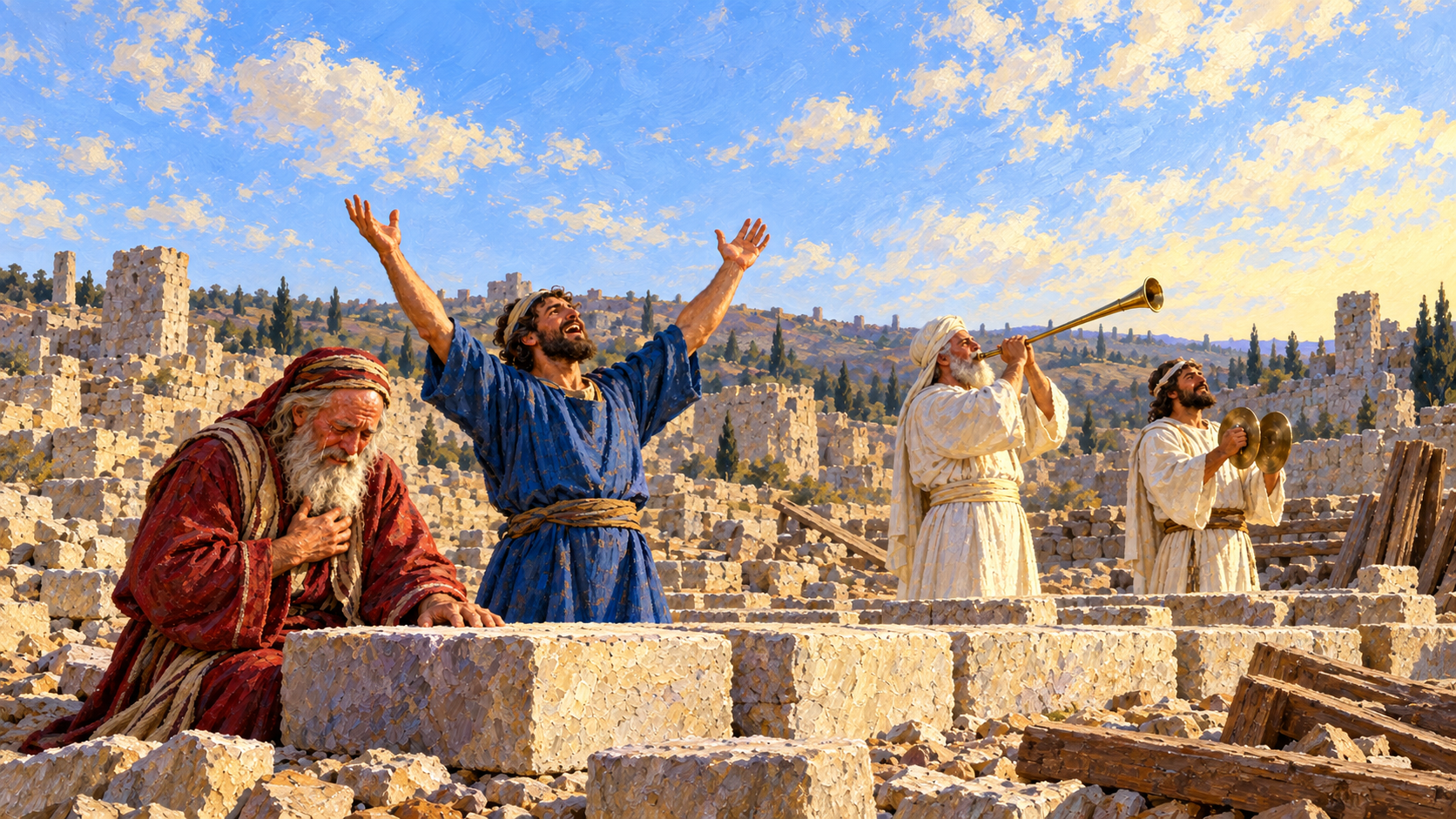
When the builders later laid the foundation, the priests sounded trumpets and the Levites praised the LORD. The people sang that He is good and that His mercy endures forever toward Israel (Ezra 3:10–11). After years of judgment, this was a real beginning.
Older priests, Levites, and family leaders remembered the first temple and wept loudly when they saw the new foundation. Others shouted for joy, and Ezra says the weeping and shouting could not be distinguished at a distance (Ezra 3:12–13). I would not dismiss the grief as faithlessness or the joy as shallowness. The older people knew what Judah had lost, while those rejoicing recognized God’s mercy in the new beginning. Both grief and joy belonged to that moment in the community’s life.
That response helps me understand how someone can thank God for a new beginning and still mourn an earlier loss. What He is rebuilding does not make the consequences of sin unimportant, or erase the grief caused by disaster or death. Biblical hope allows us to face what was broken without surrendering to despair. We can acknowledge the loss and still trust the God who keeps His word.
The new temple did not immediately resemble Solomon’s gold-covered house, but a comparison with the past could not determine its value. God had chosen to restore His worship among a chastened remnant. His presence gave them reason to continue even while the work lacked the outward splendor people expected.
Opposition, Delay, and the Word of the Prophets
Ezra 4 records opposition that first came as an offer to help. The adversaries claimed to seek the God of Israel, but Zerubbabel, Jeshua, and the family leaders refused their participation. The Persian decree had assigned the work to the returned Jewish community. Their refusal guarded that covenant responsibility and kept God’s worship from being joined to rival loyalties. I understand it as faithfulness to that responsibility, not ethnic pride.
After that refusal, the opponents discouraged the people and troubled the work, even hiring counselors to frustrate it. Ezra then includes later accusations from the reigns of Ahasuerus and Artaxerxes. We need to notice how the chapter is arranged: it follows the continuing pattern of opposition. Those later letters do not prove that the temple project stopped under every king named. The account of the temple work itself resumes with Darius in Ezra 5.
The building did stop for years, and Haggai shows that opposition was not the only problem. The returned people were living in paneled houses while God’s house remained in ruins (Haggai 1:4). They had been discouraged by their opponents, but concern for protecting themselves had also changed their priorities. The LORD told them to consider their ways.
Haggai addressed Judah’s particular covenant setting and the temple God had commanded them to rebuild. I would not turn his message into a promise that everyone who gives to a church building project will become prosperous. But I do need to let it challenge my priorities. Hardship must not become a cover for neglecting what God has told us to do. He deserves first place in the lives of those who belong to Him.
God sent Haggai and Zechariah to speak His Word to the discouraged remnant. Haggai’s instruction was practical: they were to go to the mountains for wood and use it to build the house. The LORD would take pleasure in it and be glorified (Haggai 1:8). The people obeyed, and God strengthened them for the work with His promise, “I am with you” (Haggai 1:13).
Some people still remembered the first temple and felt how small the present work looked. The LORD told Zerubbabel and Jeshua to be strong, and He called the people to work because His Spirit remained among them (Haggai 2:3–5). Their confidence had to rest in the presence of the God who kept His covenant. Their resources were not the basis for that confidence, and public approval could not sustain it. Looking back longingly at the past could not produce it either.
Zechariah’s visions placed that same hope within a wider prophetic view. In Zechariah 3, Jeshua stood before the Angel of the LORD in filthy garments and received cleansing by grace. The vision pointed beyond the high priest to God’s promised Branch, the righteous King who was coming. In Zechariah 4, Zerubbabel heard, “Not by might nor by power, but by My Spirit” (Zechariah 4:6). Those words addressed the temple project, but they also challenge any pride I might take in human strength. God supplies what His servants lack, and His work succeeds through that provision.
Zechariah said the hands that laid the foundation would also finish the house (Zechariah 4:9). The people were not to despise the day of small things, and God saw the plumb line in Zerubbabel’s hand. That detail draws my attention to the ordinary labor involved. God was carrying out His declared purpose through faithful leaders and a small community returning to obedience.
The Completed House and Its Greater Glory
When rebuilding resumed, the Persian governor Tattenai asked who had authorized it. The elders identified themselves as servants of the God of heaven and earth. They explained that their fathers had built the former house and that Judah’s sin had brought judgment (Ezra 5:11–12). I notice that their confidence in God did not keep them from admitting why the exile happened. They acknowledged that it was deserved while testifying that the living God had moved Cyrus to authorize their return.
Darius searched the royal archives, and officials found Cyrus’s decree. The king confirmed the project and ordered officials not to interfere. He also directed that support be supplied from royal revenue (Ezra 6:6–12). God used Persian administration to protect the work He had promised. The people built as Haggai and Zechariah prophesied, and the house was completed in the sixth year of Darius (Ezra 6:14–15).
The dedication was joyful, though modest compared with Solomon’s. Ezra records the sacrifices and the arrangement of the priests and Levites according to the Book of Moses. The returned exiles then kept the Passover, remembering how God had redeemed Israel from Egypt. Their rebuilt house continued the worship of that same redeeming God. It looked back to His saving acts and forward to the greater redemption He would provide through the Messiah.
Finishing the temple did not finish the restoration of Jerusalem. The city still needed walls and the people needed instruction, while later events would show the need for further reform. I can appreciate a completed task without expecting it to solve every challenge that follows. We receive each stage of obedience as God’s gift and continue walking in His Word.
Haggai promised that the latter glory of the house would be greater than the former and that God would give peace there (Haggai 2:6–9). Since Solomon’s temple had displayed greater visible wealth, I do not understand Haggai to be promising merely that the second building would contain more gold. His prophecy reaches into a larger picture of God shaking the nations and bringing future glory.
Jesus Christ entered the temple complex that developed during this second-temple period. Herod had greatly enlarged and renovated it, but it remained the temple rebuilt after the exile. Jesus was brought there as an infant and later taught in its courts. He also cleansed it when commercial corruption profaned a place intended for prayer (Luke 2:22–32; Matthew 21:12–13). The eternal Son had come among His people. His presence gave that house a glory no architecture could provide.
Even with Christ’s presence in the temple before us, I would not reduce Haggai’s prophecy to one simple statement of fulfillment. Scripture also directs our hope toward God’s future reign and His final dwelling with the redeemed. Christ brings the peace and glory the temple anticipated, but that does not erase the future parts of the prophetic promise or cancel God’s continuing purposes for Israel.
The temple itself never saved anyone. Its sacrifices and priesthood taught Israel about sin and God’s mercy. They also taught the need for mediation, for someone to stand between sinful people and a holy God. Its holy spaces prepared the way for the One who would accomplish what animal sacrifices never could. The Messiah to whom that worship pointed is the greatest glory associated with the second temple.
Jesus Christ Is the True Temple and Final Sacrifice
When Jesus said, “Destroy this temple, and in three days I will raise it up,” His hearers thought only of the building. John explains that He was speaking about the temple of His body (John 2:19–21). That explanation helps me see why Jesus Himself is the true meeting place between God and man. God the Son took real human flesh and lived among us.
Christ’s death and bodily resurrection fulfill what the sacrificial system pointed toward. Hebrews explains that the blood of bulls and goats could not finally remove sin, but Christ entered once for all by His own blood and obtained eternal redemption (Hebrews 9:11–14). He is both the sinless High Priest and the perfect sacrifice. I cannot add to that finished work through another sacrifice or a temple rite, and no religious effort can improve what He has accomplished.
At the cross, Jesus physically bore the punishment for our sins in His innocent body. He endured torture and shed His blood, then died and was buried. On the third day He rose bodily. He died for the whole world, so His offer of salvation is genuine even though people may resist it. Everyone who repents and trusts Him receives forgiveness and is made alive by grace. The Holy Spirit indwells and seals each true believer, who remains secure in Christ.
When Jesus died, the temple veil tore, declaring that access to God now rests on His sacrifice. I do not see permission to treat holiness lightly in that event. The torn veil shows the costly grace by which sinners can draw near. We cannot secure access by manipulating a sacred space or building up spiritual merit. We come to God through the risen Son with reverence and faith.
The Church, Israel, and the Final Dwelling of God
The New Testament calls believers a spiritual house and a dwelling place for God in the Spirit (Ephesians 2:19–22; 1 Peter 2:4–5). The Holy Spirit lives within each true believer and among the gathered church. That helps me understand why Christians can meet in a home or a hall as well as a church building. No structure can contain God. We gather around the risen Christ and His Word, depending on the Spirit’s presence as we pray and observe the ordinances.
Calling the church God’s dwelling place does not mean it has replaced Israel or made His promises to Israel meaningless. The second temple belonged to Israel’s historical covenant life, and we need to read the prophets’ future promises carefully too. I understand Scripture to teach that Jesus will return bodily and gather His church before the Tribulation. He will deliver Israel and reign for a literal thousand years. Describing the church as a spiritual house does not cancel God’s faithfulness to what He has spoken.
Revelation carries our hope beyond those earlier temples. God’s tabernacle will be with humanity, and the Lord God Almighty and the Lamb are the temple of the New Jerusalem (Revelation 21:3, 22). Exile and the curse will be gone, with no veil or sacrifice for sin remaining. The God whose presence strengthened the returned remnant will dwell openly with His redeemed people forever.
For a fuller look at the earlier house, The First Temple explains David’s preparation, Solomon’s temple, its worship, its destruction, and its fulfillment in Christ. Ezra traces the ministry of return and reform among the restored community, with special attention to worship and Scripture.
Zechariah examines the prophet’s visions, the coming Branch, Israel’s hope, and the coming King. The High Priest explains priestly mediation and the final high-priestly work of Jesus Christ.
My Final Thoughts
The second temple helps me see God’s faithfulness in the lives of people rebuilding after judgment. He kept His promise to bring a remnant home and restore Israel’s appointed worship, moving rulers and sending prophets while leaders and ordinary laborers continued through opposition. Later, the Messiah Himself entered that house’s courts. Its sacrifices could point to the blood He would shed, but only His sacrifice could secure redemption once for all. We can trust this same God and obey the Word He has given us even when our circumstances look weak. His promises have not failed, and through His risen Son we can come to the Father with confidence.