
Solomon built a magnificent temple, but I want to understand more than what the building looked like. Why did God allow him to build it, and what was He teaching Israel through it? The temple also points us to Jesus Christ. To understand that connection, we need to go back to David’s desire to build and the greater promise God gave him.
David Prepared What Solomon Would Build
After the LORD gave David rest from his surrounding enemies, David noticed the difference between his own cedar house and the tent where the ark of God remained. He wanted to build a permanent house for the LORD (2 Samuel 7:1–2). That desire expressed reverence, yet God’s answer went far beyond the building David had in mind. The LORD did not need anyone to provide Him with a home. He promised instead to establish David’s house, an enduring royal dynasty from which the promised King would come.
God told David that his son would build a house for His name and that He would establish that son’s kingdom (2 Samuel 7:12–13). In 1 Chronicles, we learn why David would not be the builder: he was a man of war who had shed blood. The task would go to Solomon, whose name is associated with peace (1 Chronicles 22:8–10). I do not read that as God rejecting David. He had used David to establish the kingdom and defeat its enemies, and David had gathered resources and received the covenant promise. The father and son had different work to do in God’s plan.
David responded in faith by preparing materials and organizing servants for the work. He gave generously from his own treasure and invited Israel to contribute willingly. In 1 Chronicles 29, the people rejoiced over their free giving. Before a building began to take shape, they were acknowledging that everything they had came from God and still belonged to Him.
David’s willingness to prepare a temple he would not build encourages me. Faithful stewardship can mean serving in work that someone else will finish. God may give one generation the preparation and another the building, so I cannot measure faithfulness by how much of the final result I control. I can serve Him with what He has entrusted to me.
Solomon received both the kingdom David had established and the work his father had prepared. He also received wisdom from God. When the LORD invited him to ask for what he wanted, Solomon asked for an understanding heart so he could judge God’s people. God gave him that wisdom along with riches and honor (1 Kings 3:5–13). Building the temple required wise leadership, but Solomon repeatedly called it a house for the name of the LORD his God. The work was meant to honor Him, not display the king’s brilliance.
To obtain cedar and cypress from Lebanon, Solomon worked with Hiram, king of Tyre. Hiram supplied timber and skilled workers in exchange for Solomon’s grain and oil. Scripture records peace between the kings and describes the enormous workforce preparing stone and wood as well as the metalwork and furnishings (1 Kings 5). This costly public undertaking needed careful organization.
A House for the Name of the LORD
For all the temple’s grandeur, Solomon knew that no building could contain the Creator. He said so plainly at its dedication:
But will God indeed dwell on the earth? Behold, heaven and the heaven of heavens cannot contain You. How much less this temple which I have built!
God’s presence was not confined to Jerusalem by the temple walls. He chose that place for His name so that Israel could approach Him through the covenant provision He had revealed. That helps me appreciate the place without giving the building power over God. He is present everywhere, yet He gave Israel a definite place and a way to draw near. We should not mistake that gift for a limit on Him, or conclude that places and gathering together in person have no meaning.
The account in 1 Kings 6 describes the temple’s dimensions and rooms along with its materials and carvings, including the inner sanctuary. The work took seven years, and the stones were prepared at the quarry so that no hammer, chisel, or iron tool was heard at the building site (1 Kings 6:7). I can appreciate the care and reverence in that detail without trying to find a secret message in it. Scripture records how they worked but does not assign a symbolic meaning to the silence.
Inside were cedar and gold, with carvings of cherubim, palm trees, and open flowers. The ark stood beneath the great cherubim in the Most Holy Place. These features formed a holy setting around the place where the LORD caused His name to dwell. As in the tabernacle, that holiness became more pronounced as a person moved from the courts to the holy place and finally to the Most Holy Place. God had given sinful people access to Him, but guarded access taught them that they could not approach Him casually.
The altars and lampstands served the worship God had commanded, while the tables and basins belonged with the priestly ministry in the sacrificial system He gave through Moses. These were far more than decorations. They taught that sin brings death and that people need cleansing before God. Forgiveness depended on His provision, and sinners needed a mediator, someone to act on their behalf before Him. At the temple, Israel offered sacrifices and prayed as the priests instructed the people and the nation gathered for covenant worship.
The excellent workmanship honored God, but the gold could not be the temple’s greatest glory. Later prophets rebuked people who honored the building while remaining far from the LORD in their hearts. That makes me look beyond how impressive the temple must have been. The question was whether Israel would obey the God whose name it bore.
The Ark, Solomon’s Prayer, and God’s Glory
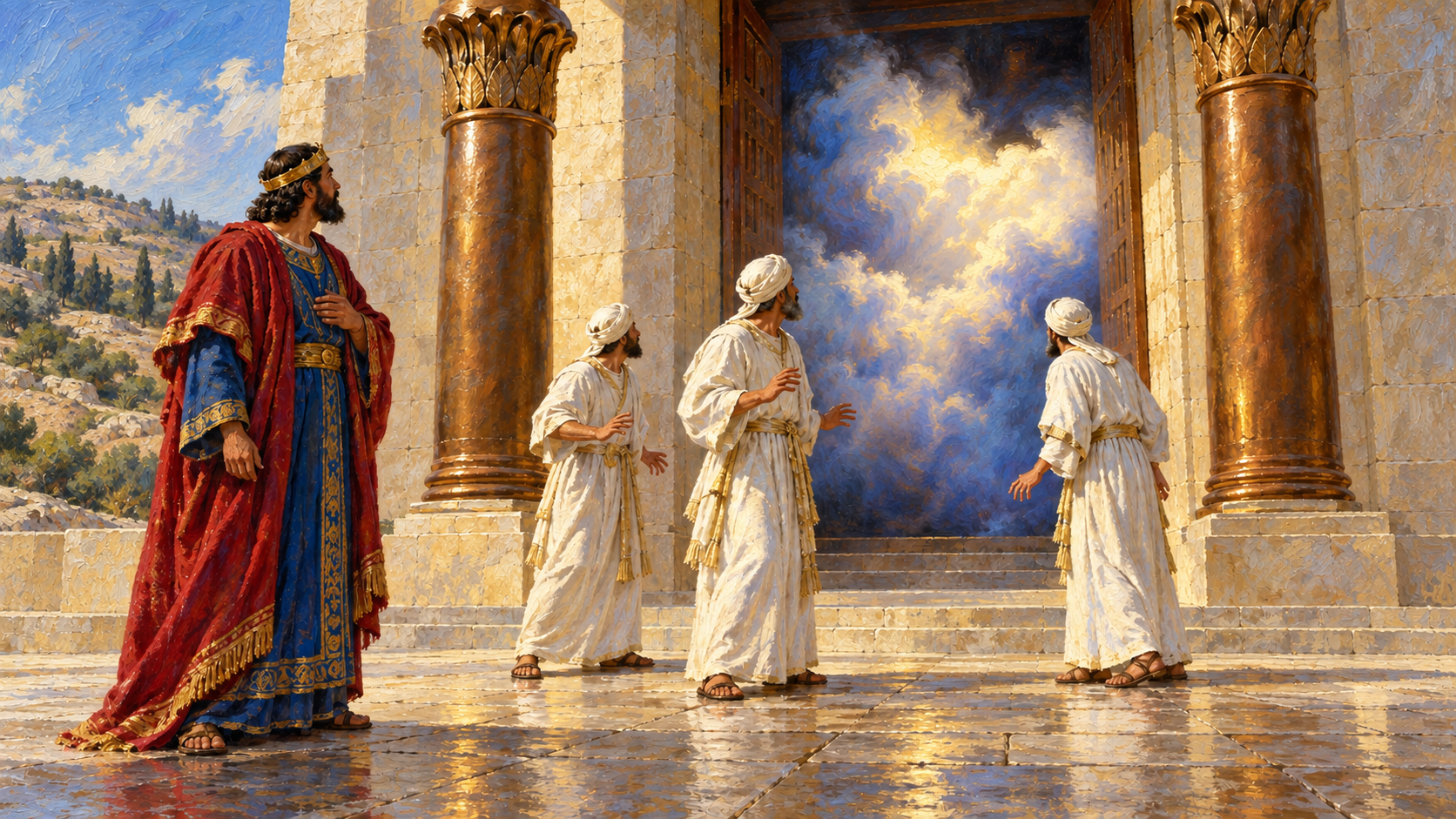
When construction was complete, Solomon gathered Israel to bring the ark of the covenant into the Most Holy Place. The ark held the tablets of the covenant, which continued to testify that Israel belonged to the LORD by His Word. After the priests came out, the house filled with a cloud so overwhelming that they could not continue their ministry:
for the glory of the LORD filled the house of the LORD
The cloud recalls the glory that filled the wilderness tabernacle (Exodus 40:34–35). God was accepting the place He had chosen and making His holy presence known among His covenant people. That glory was real and overwhelming. We do not need a later technical label for every appearance of the cloud to understand what Israel was seeing: their God was living and present, not a lifeless idol fashioned by human hands.
In his dedication prayer, Solomon praised God for keeping His covenant with David while acknowledging again that heaven could not contain Him. He asked the LORD to hear prayers directed toward the temple and to administer justice and grant forgiveness. He asked for restoration after defeat in battle and rain after drought. He also prayed that God would deliver His people from famine or plague and show mercy to a foreigner who came to fear the LORD (1 Kings 8:22–53).
I notice that Solomon made room in this prayer for people from other nations. The temple belonged to Israel’s covenant life, yet he asked God to hear the foreigner so that others could come to know His great name. The LORD’s name was never Israel’s private possession. Their worship was meant to bear witness to the living God before the world.
Solomon blessed the people after he prayed, and the king and nation offered sacrifices and celebrated. There was good reason for joy because God had provided a place where they could approach Him. There was also reason for reverence. He remained the holy King who hears and judges His people, even as He forgives them and calls them to walk before Him.
The temple was the house for the LORD’s name, where He promised to receive Israel’s covenant worship without limiting Himself to that place. The people prayed there to the God who had redeemed them from Egypt and gathered for their national feasts. The priests served as mediators there, and sacrifices dealt ceremonially with sin. All of this made the temple central to Israel’s life with God.
The guarded access through the veil and priesthood taught Israel that they could not approach God on their own terms. The washings and sacrifices at the altar confronted them with the separation sin had caused. Yet I also see mercy in those provisions. God Himself had made a way for unclean people to come near Him.
Covenant Warning, Defilement, and Destruction
In 1 Kings 9, God told Solomon that obedience would bring blessing, but turning away from Him would lead to Israel being removed from the land and the house being cast out of His sight. The temple stood under that covenant warning from the beginning. It could never protect a rebellious nation like a charm. Bearing God’s name made Israel more accountable to Him.
That warning should make me consider what I rely on before God. A church building cannot take the place of repentance and faith, and neither can family tradition. A ministry title or theological vocabulary cannot do that for me either. Even remembering a past revival cannot replace living justly and showing mercy as we obey Him today. God desires truth within us, not merely the religious symbols we associate with Him.
During the centuries that Solomon’s temple stood, Israel and Judah repeatedly turned to idols. The prophets confronted people who practiced injustice and worshiped false gods while treating the temple as their guarantee of safety. Jeremiah stood at its gate and called them to change their ways, because the building would not shield them from the consequences of covenant rebellion (Jeremiah 7).
When Babylon destroyed Jerusalem and burned the house of the LORD, the loss was devastating (2 Kings 25:8–9). But Babylon’s gods had not defeated the LORD. He had warned Israel and was judging their idolatry while preserving His promises. The exile shows me that His faithfulness and glory never depended on the temple walls remaining standing.
Returning from exile and building a second temple did not erase the grief over the first temple’s destruction. Haggai encouraged the discouraged remnant with God’s presence and spoke of a latter glory (Haggai 2:6–9). We rightly recognize Jesus Christ as the supreme revelation of God’s glory and peace, but I would not use that truth to set aside His continuing promises to Israel. The nation’s judgment did not cancel any covenant God had made.
Christ, the Spiritual House, and Future Glory
John writes that the Word became flesh and dwelt among us, and that we beheld His glory (John 1:14). The Greek word translated dwelt carries the idea of tabernacling, which helps us see the connection with God dwelling among His people. In Jesus, God the Son took on real human flesh and made His glory known among humanity. The temple had pointed toward God’s dwelling with His people; now the eternal Son had come to save them.
Jesus also spoke about the temple of His own body:
Destroy this temple, and in three days I will raise it up.
John explains that Jesus meant His own body when He spoke of the temple (John 2:19–21). His death and bodily resurrection established the access to God that the temple sacrifices had anticipated. Jesus is far greater than any sacred building. He is the risen Lord who serves as our sinless Mediator and has given Himself as the final sacrifice.
At Jesus’ death, the torn temple veil visibly declared that access to God now rested on Christ’s sacrifice rather than the old-covenant barrier. Holiness had not become unimportant. The torn veil showed what it cost for sinners to draw near, because the Son had given Himself for us. That gives me confidence to approach God without losing reverence for His holiness.
Hebrews explains why another animal sacrifice could never give us that lasting access: the blood of bulls and goats could not take sin away once for all. Christ entered once for all by His own blood and obtained eternal redemption. Through Him we have boldness to enter the Holiest, by the living way opened through His flesh rather than a merely human priesthood or another sacrifice (Hebrews 9–10).
Jesus bore the punishment for our sins in His innocent body on the cross. He was physically tortured and shed His blood. He died, and on the third day He rose bodily. The temple’s sacrifices anticipated God’s perfect provision in Him instead of competing with His work. His resurrection shows that the true temple could not remain destroyed. He lives forever to represent His people before the Father, so every sinner who trusts Him is freely welcomed into God’s presence.
The New Testament also calls God’s gathered people a temple and a spiritual house. Paul says believers are being built together as a dwelling place of God in the Spirit (Ephesians 2:19–22). Peter calls them living stones who are being built into a spiritual house and holy priesthood (1 Peter 2:4–5). This does not mean the church has replaced Israel. It describes the new-covenant people Christ has formed from believing Jews and Gentiles.
The Holy Spirit lives within each believer and among the church as a whole. With that in mind, I can understand why Paul told the Corinthians that God’s temple is holy and that they are that temple (1 Corinthians 3:16–17). Sexual sin and false teaching cannot be treated as minor concerns in a church where He dwells. Nor can a congregation tolerate division or the exploitation of people without denying His holiness. Injustice conflicts with the character of the God who lives among us.
Because we approach God through Christ, we do not need a sacred building to meet with Him. A home or rented room can be a place for Christians to gather, as can a building set aside for church use. None of these structures contains God. The risen Christ remains the center of the church’s life as we gather under His Word for prayer and the ordinances. We come together to love one another and depend on the Spirit’s presence.
Christ has fulfilled what the temple taught about access and sacrifice, and He has formed the church as a spiritual house. I do not understand either truth to cancel what Scripture says about the future. I believe Scripture teaches that Jesus will return bodily and gather His church before the Tribulation. He will deliver Israel and reign for a literal thousand years. His promises to Israel still mean what He said, because He remains faithful.
Ezekiel’s temple vision and Daniel’s prophecy still require careful reading, as do Jesus’ words about coming desolation and Revelation’s final vision. I cannot claim to settle every detail with certainty Scripture has not given. What we can say clearly is that no future rite will compete with the once-for-all blood of Christ. In the final new creation, there will be no need for a temple because the Lord God Almighty and the Lamb are its temple (Revelation 21:22).
The first temple helps me look toward the future God has promised. Its glory and sacrifices direct our attention to the Lord, and its prayers teach us to turn to the God who hears His people. Even its guarded access shows that He alone provides the way to come near. One day He will dwell with His redeemed people without any curse or veil, and sin and death will be gone.
Related Studies
The Second Temple follows the return from exile and the rebuilding of the house of God in Jerusalem.
The Ark of the Covenant examines the ark, the mercy seat, and God’s covenant presence among Israel.
The Role of the High Priest explains priestly mediation and its fulfillment in Jesus Christ.
The Deity of Jesus examines Scripture’s witness that Jesus Christ is fully God.
My Final Thoughts
Solomon’s temple helps me see God’s mercy without losing sight of His holiness. Heaven cannot contain Him, yet He gave Israel a real place to approach Him through the sacrifices and priesthood He provided. Those provisions point us to Jesus Christ, whose shed blood and bodily resurrection opened the living way to the Father. His Spirit is now building believers together, and His promises to Israel remain secure. We can draw near with confidence through Christ while worshiping with reverence, trusting the Lord to complete everything He has declared.