
Sodom and Gomorrah are so familiar that we can forget to slow down and read what actually happened. These were real cities where ordinary life continued while corruption grew severe and the cries of harmed people rose before God. I want to follow the whole account because it shows both the certainty of the LORD’s judgment and the mercy by which He brings people out.
Lot’s Road Into Sodom and the Violence He Found There
Genesis 13 explains how Lot came to live there. Abram and Lot owned more flocks and herds than the land could support together, and their herdsmen began to quarrel. To end the dispute, Abram gave Lot the first choice of land. Lot chose the well-watered Jordan plain, whose abundance promised good grazing, but Genesis immediately adds that Sodom’s people were exceedingly wicked and sinful against the LORD.
Those advantages did not remove the danger of Sodom’s wickedness. Lot first pitched his tent toward the city, then made his home inside it. By Genesis 19 he was sitting at the gate, where public business and legal affairs commonly took place. His seat may suggest an official role, although Genesis does not establish one. What is clear is that his household had become part of the city’s life, including through his daughters’ proposed marriages.
The apostle Peter later calls Lot righteous and describes how Sodom’s lawless deeds tormented him. Lot did not join the mob in Genesis 19, but being troubled by wickedness did not make his choices wise. He remained in a setting that endangered his household, and when the time came to leave, he hesitated. The Life of Lot examines those decisions and their consequences more fully.
We should not take Lot’s failures as a command to avoid every place where unbelievers live. Abraham dealt with pagan neighbors and rulers, and Christians are sent to love and work among people who need the gospel. The question I need to face is whether an advantage is making me excuse something God condemns. Comfort and income cannot be my only measures of a job, friendship, business arrangement, or neighborhood, because people who depend on me will also be affected by what I learn to tolerate.
The LORD Appears, Hears the Outcry, and Receives Intercession
Before describing the attack at Lot’s door, Genesis 18 shows us what God had revealed to Abraham. The LORD appeared at Mamre, where Abraham welcomed three men with water and food. One continued speaking as the LORD; the other two later arrived at Sodom, where Genesis 19 identifies them as angels.
I understand this visible appearance of the LORD as a Christophany, an appearance of the eternal Son before He became man. He did not begin to exist at Bethlehem. John 1 describes the eternal Word becoming flesh and making the unseen Father known, and I read Genesis 18 in light of that revelation. Abraham was receiving the LORD Himself, not a created messenger claiming to be God. Christophanies in the Old Testament examines the wider evidence.
The Son is fully God and remains distinct from the Father. Later, Genesis 19:24 describes the LORD raining fire from the LORD out of heaven. I understand that wording as a personal distinction within the one God, consistent with the fuller biblical revelation of Father, Son, and Holy Spirit. These three Persons are coequal and eternal; the Son is neither a lesser deity nor a second god.
Before speaking about Sodom, the LORD confirmed that Sarah would bear Isaac, the promised son. The One who would judge the cities was also keeping His covenant with Abraham and Sarah. As the visitors looked toward Sodom, the LORD explained why Abraham should hear what He intended to do:
And the LORD said, “Shall I hide from Abraham what I am doing, since Abraham shall surely become a great and mighty nation, and all the nations of the earth shall be blessed in him? For I have known him, in order that he may command his children and his household after him, that they keep the way of the LORD, to do righteousness and justice, that the LORD may bring to Abraham what He has spoken to him.”
Abraham was to teach his children and household to keep the LORD’s way through righteousness and justice. What God revealed therefore carried a responsibility: Abraham needed to pass on what he learned about the LORD’s character and conduct. The LORD then told him why judgment was approaching the cities:
And the LORD said, “Because the outcry against Sodom and Gomorrah is great, and because their sin is very grave, I will go down now and see whether they have done altogether according to the outcry against it that has come to Me; and if not, I will know.”
The Hebrew za’aqah describes an outcry of distress. Sodom’s corruption had harmed people, and their cries had reached the LORD. The description kaved me’od, “very grave,” conveys the severity of the wickedness that had accumulated there.
God was not coming down to discover something He could not know in heaven. Scripture teaches that nothing is hidden from Him. By describing an investigation, Genesis shows us the justice of His response in terms we can understand: He would make the truth of the charge evident rather than judge on rumor, prejudice, or impulse.
The two angels turned toward Sodom while Abraham remained before the LORD. Abraham did not plead that the city was innocent. He asked whether the righteous would be destroyed with the wicked:
And Abraham came near and said, “Would You also destroy the righteous with the wicked? Suppose there were fifty righteous within the city; would You also destroy the place and not spare it for the fifty righteous that were in it? Far be it from You to do such a thing as this, to slay the righteous with the wicked, so that the righteous should be as the wicked; far be it from You! Shall not the Judge of all the earth do right?”
Abraham called himself dust and ashes as he continued asking the LORD to spare the city. Beginning with fifty righteous people, he asked about forty-five, forty, thirty, twenty, and finally ten. The LORD agreed to spare it for each number Abraham named, revealing a willingness to show mercy that rules out any idea of impatience with a mostly innocent community.
Abraham appealed to the Judge’s character because he trusted Him to do right. He was not correcting an unfair God or making a reluctant God merciful. Although his prayer supplied no information the LORD lacked, God chose to receive his requests and involve him in seeking mercy. Genesis 19:29 later connects Lot’s rescue with God remembering Abraham.
Genesis does not tell us why Abraham stopped at ten, or whether he knew how many righteous people lived in the city. It does show him bringing specific requests before the LORD and receiving patient answers. That encourages me to pray for actual people and places while leaving the answer with the Judge whose character Abraham trusted.
Mercy Brings Lot Out Before Judgment Falls
The two angels reached Sodom that evening and found Lot at the gate. They initially said they would spend the night in the open square, but he strongly urged them to stay in his house. His insistence suggests he knew the danger they would face outside. Like Abraham, Lot welcomed the visitors, yet his guests would face violence in the city where he had chosen to live. Hebrews 13 reminds believers that some have welcomed angels without knowing it.
Before the guests lay down, men from every part of Sodom surrounded Lot’s house. Genesis describes both old and young taking part, showing how widely the corruption had spread. We need not make additional claims about every individual resident to recognize the severity of what the chapter records:
Now before they lay down, the men of the city, the men of Sodom, both old and young, all the people from every quarter, surrounded the house. And they called to Lot and said to him, “Where are the men who came to you tonight? Bring them out to us that we may know them carnally.”
The verb translated know can describe ordinary knowledge, but the context makes the sexual intent unmistakable. The NKJV says “know them carnally.” These men wanted Lot to surrender his male guests to gang rape. Their demand involved sexual domination and degradation, so reducing the incident to poor hospitality would evade what they actually intended to do.
Lot went outside and shut the door behind him before pleading with the men not to act wickedly. He then offered his two virgin daughters in the visitors’ place. I find that proposal horrifying. His duty to protect guests could never justify handing his own children over to sexual violence, and Genesis gives his offer no approval by recording it. Under pressure, he condemned one evil while proposing another.
The mob responded by calling Lot an outsider who had made himself their judge. They threatened to treat him worse than his guests and pressed toward the door. The angels pulled him inside and struck the attackers with blindness, yet the men still wore themselves out trying to find the entrance. Even supernatural restraint did not turn them from their intended crime.
I have to keep Peter’s description of Lot as righteous beside this dreadful offer. A right standing before God does not make a person’s conduct blameless, and grace cannot turn Lot’s failure as a father into virtue. Neither fear of the crowd nor an obligation to his guests excused what he proposed. We can acknowledge his standing before God while plainly condemning his conduct.
After protecting Lot, the angels told him why they had come. The outcry against Sodom had become so great that the LORD had sent them to destroy it, and Lot needed to bring his family out. He warned the men who were to marry his daughters, but they treated his words as a joke. Genesis does not explain every reason for their response; it does tell us that they did not believe him. At dawn, the angels urged Lot himself to leave:
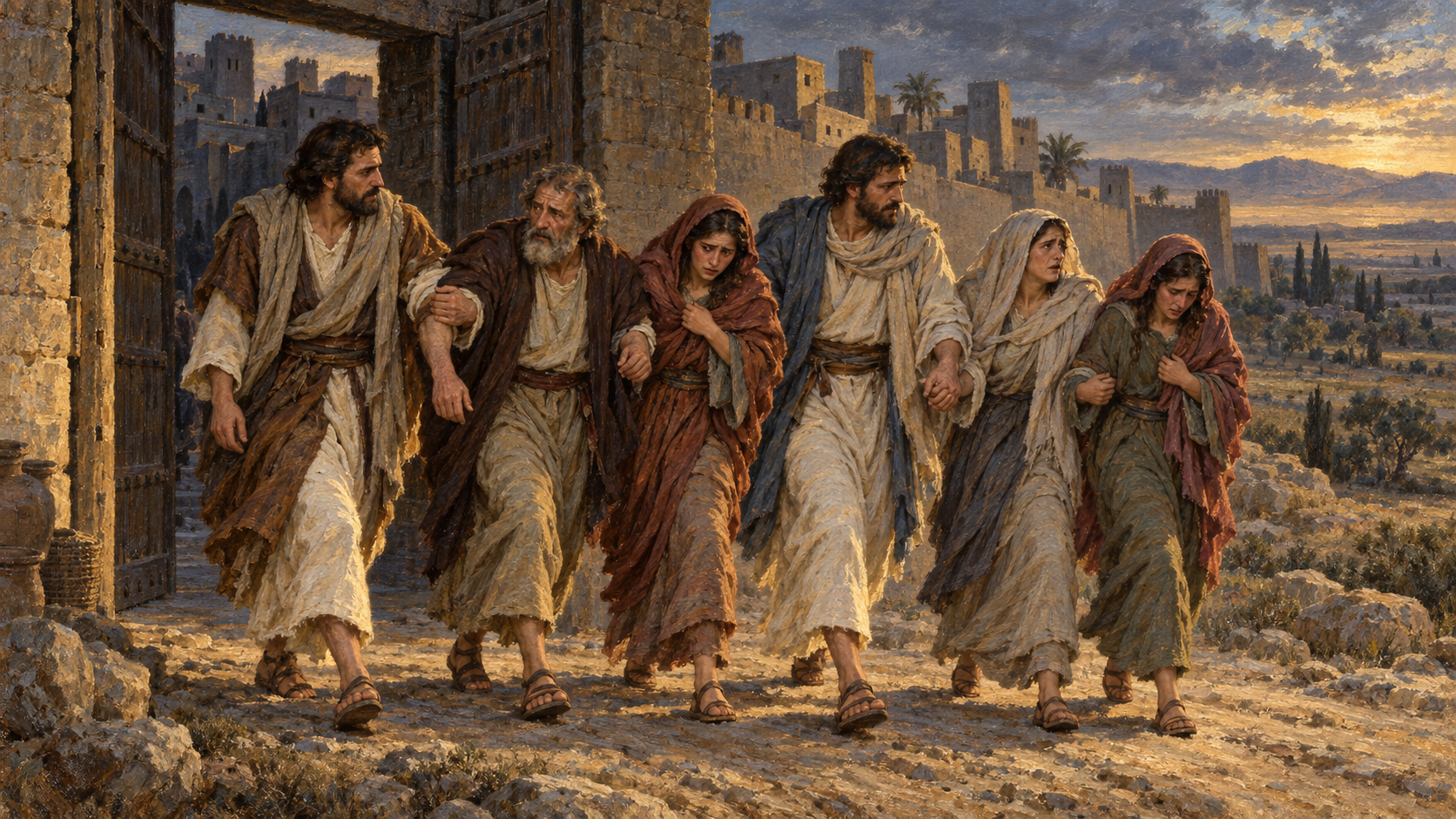
When the morning dawned, the angels urged Lot to hurry, saying, “Arise, take your wife and your two daughters who are here, lest you be consumed in the punishment of the city.” And while he lingered, the men took hold of his hand, his wife’s hand, and the hands of his two daughters, the LORD being merciful to him, and they brought him out and set him outside the city.
The passage tells us why Lot escaped: the LORD was merciful to him. Genesis says, “Lot lingered.” He had heard the warning and seen what happened to the attackers, yet the angels still had to take his family’s hands and lead them out. I cannot credit their escape to unusually prompt obedience. The LORD’s mercy brought them out of a danger that remained every bit as real as He had said.
Once outside, the family was commanded to flee without looking back or stopping anywhere in the plain. Lot feared that he could not reach the mountains, so he asked to enter the nearby small city of Zoar instead. His request was granted, and Zoar was spared for his sake. The sun had risen when he reached that refuge, before the fire fell:
Then the LORD rained brimstone and fire on Sodom and Gomorrah, from the LORD out of the heavens. So He overthrew those cities, all the plain, all the inhabitants of the cities, and what grew on the ground. But his wife looked back behind him, and she became a pillar of salt.
Genesis attributes the overthrow directly to the LORD. He destroyed the cities, their inhabitants, and even what grew in the surrounding plain. This was God’s judgment on the wickedness He had exposed, rather than a random event to which people later attached a religious explanation. The description of the LORD acting from the LORD in heaven also fits the personal distinction discussed in chapter 18.
Lot’s wife disobeyed the command by looking back and became a pillar of salt. Genesis records her action without giving a full account of her thoughts. When Jesus later said, “Remember Lot’s wife,” He warned against turning back to preserve the old life when the Son of Man is revealed. Her relationship to Lot and her escape from the city did not remove her responsibility to respond to the LORD for herself. In the same way, a Christian family, church attendance, and baptism cannot give someone the new birth.
I understand Jesus’ warning as a call to examine our allegiance, rather than a teaching that a genuinely born-again person loses eternal life through one failure. God’s judgment of each member of Lot’s household was exact. Living in a wicked city could not make Him lose track of someone who belonged to Him, and being near a righteous man could not take the place of personal faith.
When Abraham rose early, he looked toward the cities and saw smoke rising like smoke from a furnace. The cities had been overthrown, but God had brought Lot out. Genesis connects that rescue with God remembering Abraham, meaning that He acted faithfully toward His servant and the intercession He had received. The LORD had not forgotten Abraham and then recovered the information.
Lot’s escape did not leave his household safely settled and free of consequences. Afraid to remain in Zoar, he took his daughters into the mountains, where they lived in a cave. The older daughter told the younger that their father was old and that no men were available to continue their family line. On successive nights they made him drunk and had intercourse with him. Their sons became the ancestors of Moab and Ammon.
The daughters planned the incest and used intoxication to violate their father. Lot’s drunkenness and earlier failures should not be excused, but neither should they be confused with knowingly consenting to what his daughters did. Genesis says he did not know when either daughter lay down or arose. The chapter gives us no detailed psychological explanation of their plan and does not say Sodom alone caused it. Whatever influence the city had on them, their responsibility for the assault remained their own.
Getting away from Sodom had not automatically removed the household’s sinful desires or undone learned habits. A change of location cannot provide the inward transformation that comes through God. Nor did the circumstances of Moab and Ammon’s birth place every descendant beyond His mercy. Those peoples later often opposed Israel, yet Ruth, a Moabitess who trusted the LORD, entered David’s family line and the Messiah’s ancestry. Family history cannot prevent a repentant person from receiving grace.
Scripture’s Full Indictment of Sodom
The violence at Lot’s door was not the only sin for which Scripture condemns Sodom. When Ezekiel rebuked Jerusalem, he compared its conduct with the earlier city’s sins:
Look, this was the iniquity of your sister Sodom: She and her daughter had pride, fullness of food, and abundance of idleness; neither did she strengthen the hand of the poor and needy. And they were haughty and committed abomination before Me; therefore I took them away as I saw fit.
Ezekiel names pride and abundant food, along with idleness and refusal to help the poor and needy. He then speaks of haughtiness and abomination before God. Prosperity had not led Sodom to gratitude or generosity; people in need remained without help while others lived at ease. That rebuke adds to the indictment rather than replacing the sexual violence recorded in Genesis. The men at Lot’s door used threats and force to defend their wicked demand.
Other prophets also used Sodom’s name to confront rebellion among God’s people. Isaiah called Judah’s leaders rulers of Sodom while condemning bloodshed and the religious observances of people who refused to do right and seek justice (Isaiah 1:10-17). Jeremiah compared adulterous prophets who encouraged evildoers with Sodom and Gomorrah (Jeremiah 23:14). I need to receive those rebukes alongside Genesis, rather than select whichever passage best supports the argument I want to make.
At Lot’s door, the attempted assault involved both coercive violence and male-on-male sexual desire. Scripture’s condemnation of homosexual acts, however, does not rest on this violent incident alone. Romans 1:26-27 addresses same-sex desire and acts among women and men without making coercion the defining issue. God places sexual intimacy within the marriage covenant of one man and one woman. Homosexual acts violate that design, as do adultery, fornication, pornography that cultivates lust, and sexual violence.
That conviction gives Christians no right to mock, threaten, abuse, or dehumanize someone who experiences same-sex attraction or practices sexual sin. Each person bears God’s image and is someone Christ invites to receive salvation. We also need to distinguish unwanted temptation from choosing to entertain or act on it. The church should help people pursue holiness through the truth and the Spirit’s power, rather than treat a particular temptation as proof that someone is beyond grace. A Biblical Examination of Homosexuality considers the relevant passages more fully.
These passages show how Sodom’s sins reinforced one another. Pride and ease without mercy encouraged people to treat others as available for their use. Sexual corruption rejected God’s order, and violence enforced what the men desired. The outcry against the city brings us back to the people harmed by its conduct. I cannot honestly condemn sexual wrongdoing while defending greed or cruelty in my own life, any more than concern for justice gives me permission to reject God’s sexual commands.
Jesus, Peter, and Jude Keep the Warning Alive
Sodom’s destruction continued to serve as a warning in the New Testament. Jesus used the ordinary routines of its final days to explain how suddenly the Son of Man would be revealed:
Likewise as it was also in the days of Lot: They ate, they drank, they bought, they sold, they planted, they built; but on the day that Lot went out of Sodom it rained fire and brimstone from heaven and destroyed them all. Even so will it be in the day when the Son of Man is revealed.
The activities Jesus names were ordinary parts of life. His warning was not that people should stop planting crops or building homes, but that they could keep doing those things while remaining unready for judgment. He told those He addressed not to turn back for possessions and called them to remember Lot’s wife. Readiness for His bodily return means responding to Him in repentant faith and living in obedience, rather than assuming a normal day proves judgment is far away. We prepare by responding to His warning, not by setting dates.
In Matthew 11:20-24, Jesus also said judgment would be more tolerable for Sodom than for towns that had rejected greater revelation. Those who hear the gospel of the crucified and risen Messiah are responsible for how they respond. Sodom’s notorious wickedness cannot make outwardly respectable unbelief harmless. Peter’s use of the same account further shows that God knows how to distinguish the righteous from the wicked:
and turning the cities of Sodom and Gomorrah into ashes, condemned them to destruction, making them an example to those who afterward would live ungodly; and delivered righteous Lot, who was oppressed by the filthy conduct of the wicked (for that righteous man, dwelling among them, tormented his righteous soul from day to day by seeing and hearing their lawless deeds)— then the Lord knows how to deliver the godly out of temptations and to reserve the unjust under punishment for the day of judgment,
Peter calls Lot righteous three times. I cannot use Lot’s failures to deny that inspired description, although nothing in it makes his harmful decisions wise. The Lord knew whom He was rescuing and whom He was reserving for judgment. That assurance is not a promise that every faithful believer will escape earthly suffering or death; it is confidence that God never confuses the godly with those who reject Him. Jude then brings the sexual rebellion and its judgment together:
as Sodom and Gomorrah, and the cities around them in a similar manner to these, having given themselves over to sexual immorality and gone after strange flesh, are set forth as an example, suffering the vengeance of eternal fire.
Immediately before this, Jude describes angels who left their proper domain. In that context, I understand his reference to “strange flesh” as including an attempted crossing of the boundaries between human and angelic beings, as well as God’s sexual boundaries. Genesis identifies the visitors as angels, although the mob demanded them as male guests. We should not turn that interpretation into a claim that the attackers knew who the visitors really were. Recognizing that the visitors were angels also does not erase the male-on-male nature of the demand.
Jude’s warning reaches beyond the destruction of the cities themselves. Peter says they were reduced to ashes, and Jude presents their punishment by eternal fire as an example. Sodom and Gomorrah are not still burning, but their overthrow has never been reversed. I therefore understand the fire’s eternal character in terms of its result: it points to the final and irreversible destruction awaiting those who reject the Lord, rather than an endless process of conscious human torment.
That reading of Sodom needs to be kept within Scripture’s fuller teaching about final judgment. Unbelievers will be raised bodily and judged at the Great White Throne, where the books expose their deeds. I understand that every person’s name is initially written in the Book of Life. Those who finally reject the Messiah are blotted out, while believers remain because Christ’s blood blots out their sins.
Revelation calls the Lake of Fire the second death and says those absent from the Book of Life are cast into it. Jesus also says God can destroy both soul and body in Gehenna, the place of final judgment (Matthew 10:28). Since human souls are not naturally immortal, I understand final human punishment as the complete and irreversible destruction of the whole person. It does not end in universal salvation or leave the person alive forever in conscious torment.
This final destruction must be distinguished from soul sleep, the belief that the dead are unconscious before resurrection. Scripture presents conscious existence while the body awaits raising. The final sentence comes afterward, when the whole person has been raised and judged, and it will never be canceled by a later restoration of everyone. Believers look forward to immortal life because Christ saves them from the second death.
Revelation 20:10 gives a specific sentence for the devil, the beast, and the false prophet: torment day and night forever. Those three are expressly named, so I cannot simply apply their sentence to every human being. The human sentence is described as death, perishing, destruction, and consumption. Such destruction is a severe judgment because it ends the person’s created life irreversibly, with no further opportunity for repentance.
Christ Provides the Greater Rescue and Teaches Us How to Live
The severity of that judgment brings us to the need for a greater rescue than escape from a doomed city. Lot was brought out before the fire fell, yet the damage of compromise followed him. Christ saves from guilt and final judgment while beginning the inward work that a change of location cannot accomplish. Condemning Sodom more loudly than someone else cannot obtain that salvation for me. I need mercy as a sinner too.
Jesus is the eternal Son, fully God, who became fully man through the virgin birth and lived without sin. He willingly gave Himself to be slain as the perfect sacrifice. Wicked men tortured and crucified Him, and through His shed blood and death He completed His saving sacrifice before His burial and bodily resurrection. The Father did not punish or abandon Him; Father, Son, and Holy Spirit acted in unity to provide our salvation. Jesus alone is Savior and Mediator, the One through whom we come to God.
Because He died for the whole world, the invitation to receive salvation is genuine for every person. It reaches the sexually immoral and violent, the proud and greedy, and those whose outward respectability conceals their unbelief. People can resist His grace, but I have no right to decide that someone before me is beyond His invitation. We must name sin honestly while calling people to receive the life God offers. Paul reminded Corinthian believers that God’s cleansing had reached them in the midst of such sins:
And such were some of you. But you were washed, but you were sanctified, but you were justified in the name of the Lord Jesus and by the Spirit of our God.
Before those words, Paul had condemned sexual immorality, including adultery and homosexual practice. His list also named idolatry, theft, greed, drunkenness, reviling, and extortion. “Such were some of you” acknowledges their former conduct while announcing that God had cleansed them. They had received salvation by grace through repentant faith, without first making themselves respectable enough to earn it.
At new birth the believer is washed and justified, meaning declared righteous in Christ. The Holy Spirit regenerates him, giving him genuine new life, and comes to live in him, sealing him for redemption. Christ’s sacrifice needs no completion, and the eternal life He gives remains secure. Obedience neither earns nor keeps that life. It grows from the Spirit’s work as the believer learns Scripture, prays, receives correction, and shares fellowship with other believers. When he sins, he must confess and return to the light, trusting Christ as his Advocate rather than using security as permission for lawlessness.
Lot helps us see why security and a warning against compromise belong together. God kept a righteous man whose failures still brought terrible earthly consequences. We should take that warning seriously when an attachment keeps us near sin. If access to something feeds it, remove that access. End the secret arrangement that helps it continue, and seek help from someone who will tell you the truth rather than excuse it.
Abraham’s intercession shows how to pray for people facing judgment without pretending they are innocent. We can ask God to bring them to conversion and restrain the evil they might do. We can also seek protection for victims and justice from those responsible to uphold it, with concern for our neighbors rather than contempt. Since God heard Sodom’s outcry, we should listen carefully when people report harm and address their claims truthfully. Protecting the vulnerable must take priority over preserving an institution’s reputation.
That responsibility begins at home for those entrusted with children. Lot’s offer of his daughters shows how dreadful a failure of protection can become under pressure. No duty to guests, employers, neighbors, or a ministry could justify sacrificing people in our care. Children need adults whose own conduct teaches sexual faithfulness, truthfulness, generosity, and trust in God’s justice.
Ezekiel’s rebuke also requires us to examine what we do with prosperity. Full tables and a life of ease did not make Sodom righteous, and our comfort cannot establish that God approves our conduct. Wealth can support generosity, but abundance becomes an occasion for sin when we ignore people in need. We cannot excuse dishonest business, pride, pornography, adultery, greed, or cruelty by pointing to someone whose wrongdoing attracts more public condemnation.
Jesus’ description of ordinary life brings that examination into the way I work and plan. Daily responsibilities can be carried out faithfully, yet they cannot take the place of readiness to meet Him. I need to live attentively without treating every failure as though it erased eternal life. Christ bought His people with His blood, His Spirit dwells in them, and they await bodily resurrection. Those assurances give us reason to obey Him now.
My Final Thoughts
I share Abraham’s confidence that the Judge of all the earth will do right. He heard the outcry against Sodom, judged its entrenched rebellion, and mercifully brought Lot out even while he lingered. I cannot receive that mercy as permission to remain comfortable with sin. Christ offers the greater refuge through His finished sacrifice, and His invitation is still before us. Let us receive His mercy and pray for those who continue to resist Him, while protecting the people in our care and leaving what God tells us to abandon.