
The Bible calls Lot righteous, yet Genesis records some terrible choices he made. That leaves me with a question: how do those truths fit together? His life also makes us consider what it means to live near a corrupt culture. As we follow what happened to him, we can see why his failures do not erase God’s mercy and why his rescue does not make compromise safe.
Lot Traveled With Abraham but Chose by Sight
Lot first appears in Genesis as the son of Haran, Abram’s brother. After Haran died in Ur, Lot traveled with Terah and then with Abram toward Canaan. Scripture does not explain every detail of the family arrangement, but we find Lot beside Abram as God began to unfold His covenant promises. He benefited from traveling with a man who trusted God. Abram built altars and called upon the Lord’s name, so Lot had that example before him.
Genesis never says Lot had no faith. In fact, 2 Peter later calls him righteous and says the lawless conduct around him distressed him. Still, I notice that Genesis does not show the same steady pattern of worship and dependence in Lot that it shows in Abraham. We should not read more into that difference than Scripture gives us. But being near a faithful person is not the same as personally walking by faith, and Lot’s life makes us consider that distinction.
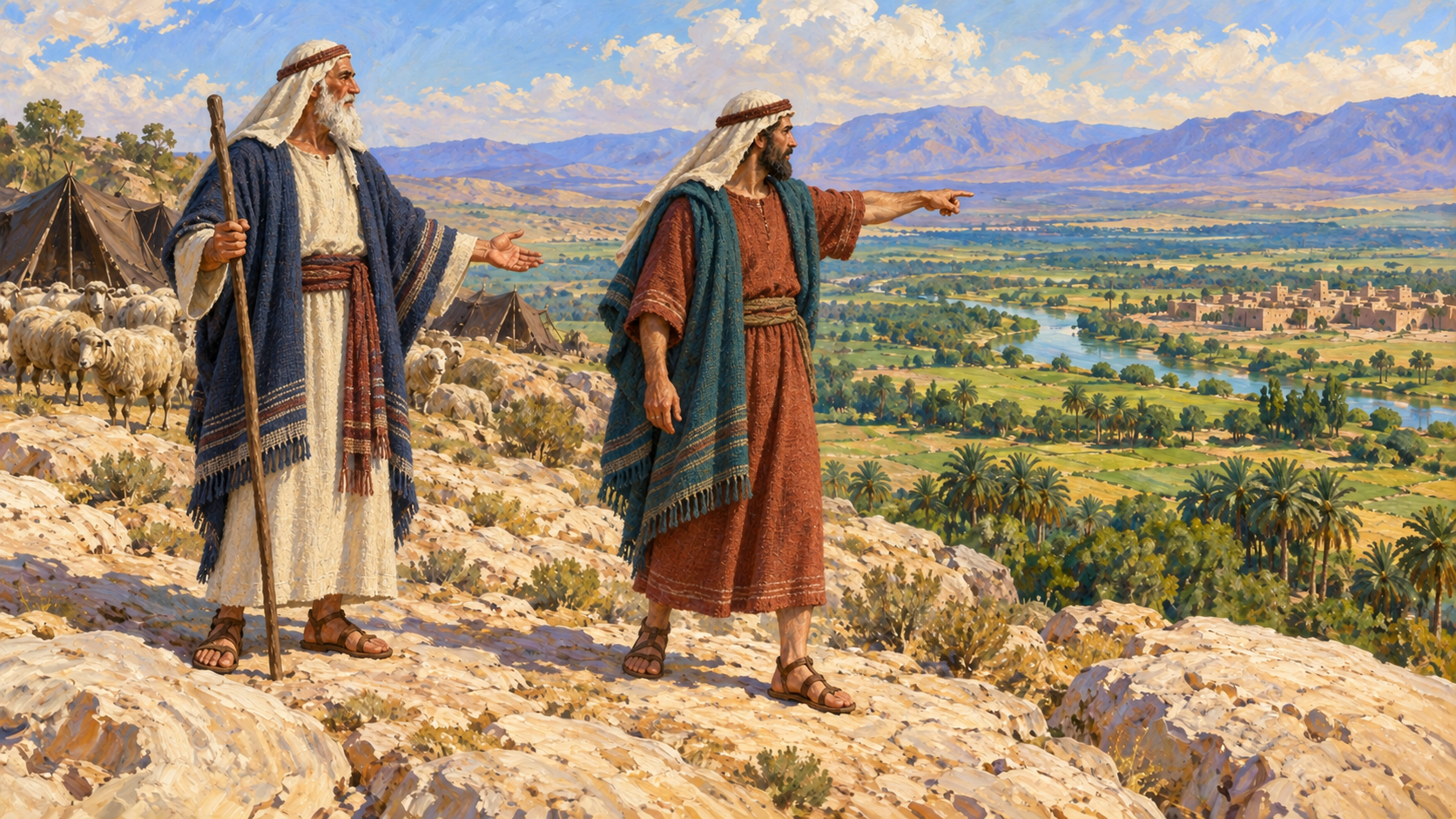
Both men became wealthy, with large households that included livestock and servants. The land could not support them together, and their herdsmen began to quarrel. Abraham generously allowed Lot to choose where to settle first, even though God had promised the land through him. He sought peace instead of grasping for an advantage because he trusted the Lord to provide what He had promised.
Lot lifted his eyes and saw the well-watered plain of the Jordan. Before God destroyed Sodom and Gomorrah, the land looked rich and fertile, like the garden of the Lord. I can understand why that appealed to a prosperous herdsman. Yet Genesis immediately tells us something Lot needed to weigh alongside the quality of the land: the men of Sodom were exceedingly wicked and sinful against the Lord.
Lot chose the plain and moved east, living among its cities and pitching his tent toward Sodom. We are not told every stage of that move or everything that passed through his mind. What we are given is a view of the attractive land alongside the spiritual danger. The material advantage was easy to see, but God had plainly named the city’s moral condition too.
By Genesis 14, Lot was living in Sodom. His choice makes me ask what I am weighing when an opportunity looks promising. A home or career can offer advantages while placing a household near influences that gradually weaken faithfulness. Friendships and business opportunities can put us under similar pressure. That does not mean believers must leave every hard place, since God may send His people into difficult settings for His purposes. But when we make decisions, visible prosperity can never take the place of what God has told us is right.
Captivity, Rescue, and Abraham’s Intercession
When invading kings defeated the region, Lot’s home in Sodom put him in danger along with the city. The kings captured its goods and people, including Lot and his possessions. Genesis does not say this was punishment for one particular sin he had committed. It does show that his decision to live there meant he shared the city’s danger.
When Abraham heard that his nephew had been taken, he pursued the kings with his trained servants. God gave him success, and he recovered Lot along with the other people and goods. I notice that Lot’s rescue came through another man’s courage and faith. Even in that dangerous place, God’s mercy reached him through Abraham.
Genesis does not tell us how Lot responded to his rescue or record that he repented or permanently left Sodom. The next time he appears, he is there again. I cannot explain his motives from details we have not been given, but I do not want to pass over his presence there again. His rescue did not become a recorded turning point. Grace should lead a believer toward obedience, yet Scripture shows honestly that a redeemed person can fail to respond wisely to a serious warning.
Before Sodom’s final destruction, Genesis 18 records Abraham speaking with the Lord about the city. He appealed to God’s justice by asking whether the Judge of all the earth would destroy the righteous with the wicked. The Lord patiently answered him. We should understand that Sodom’s judgment was no impulsive act: the outcry against it had become great, and its sin was very grave.
Abraham’s conversation with the Lord helps me understand Lot’s rescue. God knew exactly where Lot was and the anguish Sodom’s conduct caused him. He sent help before judgment fell. The Lord heard Abraham’s plea and knew the difference between the righteous and the wicked. His patience did not excuse Sodom’s violence or make the warning less urgent. He remained holy, and His judgment rested on perfect knowledge.
Abraham’s response also makes me consider how I respond when evil seems to be everywhere. He did not simply give up or watch with self-righteous fascination. He cared about Lot and trusted God’s righteousness, so his faith moved him to pray and plead for him. That is a better response for us as believers too.
The Angels in Sodom and Lot’s Terrible Failure
Genesis 19 begins with two angels arriving at Sodom in the evening while Lot sat at the city gate. Gates were public places where civic business and judgment took place. The verse does not name Lot’s office, so I would not give him a title the passage does not supply. But he was no longer a visitor camping outside the city. He had a recognized place in Sodom’s life.
Lot urged the visitors to stay in his home and invited them to wash their feet. Once they had come inside, he prepared a meal for them. His hospitality stood in sharp contrast to the men who later surrounded the house. They demanded that he bring his guests out so they could abuse them. Their violent conduct exposed the city’s grievous rebellion and confirmed the justice of the coming judgment.
What Lot did next cannot be defended. He offered his daughters to the crowd rather than surrendering the visitors. Scripture records the proposal without approving it. Protecting a guest never gives a father the right to sacrifice his daughters. Lot’s failure warns us that a person can be genuinely troubled by evil and still make morally distorted decisions after living too close to it.
The angels pulled Lot inside and struck the men with blindness. His handling of the crisis had been terribly wrong, yet God still rescued him. I see God’s sovereign mercy here, reaching Lot in a city whose wickedness had brought it to the point of judgment.
God Led Lot Out While He Lingered
The angels told Lot that Sodom would be destroyed and instructed him to gather his family. When he warned the men who had married his daughters, they thought he was joking. Scripture does not explain exactly why. We are left with the tragedy of men refusing a warning while judgment was near.
Morning came, and Lot still lingered. The angels took hold of him, his wife, and his two daughters and led them outside because the Lord was merciful to him. I do not want to miss the reason Genesis gives for that rescue. Lot had not moved quickly or faced the danger with moral strength. God remembered Abraham and brought Lot out of the overthrow because He was merciful.
God’s command was to escape for their lives without looking back or remaining in the plain. There was no room for delay, yet Lot asked to flee to the small city of Zoar, and God granted his request. The Lord’s patience with Lot should not make me slower to obey. When He gives a warning, His people need to listen.
Lot’s wife looked back and became a pillar of salt. Jesus later said, “Remember Lot’s wife,” when He warned against clinging to the life God calls a person to leave behind. Genesis does not reveal everything in her heart, and I would be careful about supplying it. What it does tell us is sobering enough: she disobeyed during the judgment.
Lot eventually left Zoar because he was afraid to remain there and went to live in a cave with his two daughters. What Genesis records next is grievous. His daughters made him drunk and lay with him. The passage does not reduce their conduct to a simple explanation, nor does it excuse Lot’s drunkenness. It tells us the truth about sin and its consequences even when that truth is painful to read.
The sons born from that event became the fathers of Moab and Ammon. Later Scripture records conflict between those nations and Israel, though their ancestry never put them beyond God’s providence or mercy. I read this as a warning about how far the consequences of sin can reach, not a reason to hold a people group in contempt. The effects can continue long after the moment in which someone chooses to sin.
We are not given the details of Lot’s final years or all his hidden motives, but we have enough to consider. A man delivered from Sodom ended in fear and isolation, with terrible disorder in his household. God’s mercy saved him without making his choices harmless.
Righteous Lot and the Warning Against Compromise
2 Peter 2 calls Lot righteous three times. Peter says that the lawless conduct he saw and heard each day oppressed and tormented him. This is God’s inspired assessment, so we must receive it. Lot belonged to the Lord and was truly distressed by Sodom’s evil.
Peter’s use of righteous does not approve everything Genesis records. The same Bible that establishes Lot’s standing before God preserves his failures without hiding them. I need to take both seriously. A true believer can make destructive choices that cost him opportunities for a wise witness, and painful earthly consequences may remain. Grace does not remove accountability, and eternal security never gives us permission for lawlessness.
Peter’s larger point is that God knows how to deliver the godly out of temptations and reserve the unjust for punishment. Lot’s rescue shows that God can save His own from a corrupt world. That gives me reason to be grateful, but it should also keep me watchful. Rescue by God’s mercy is no reason for complacency.
Lot’s life does not mean every hardship proves a believer chose badly. Faithful people suffer in this fallen world too. The warning in Lot’s life concerns how we make our choices: faith and obedience to God should guide us rather than visible comfort alone. Before accepting an opportunity, I should ask whether it makes compromise easier and what pressure it might place on my household. That calls for wisdom in how we handle money and entertainment as well as our relationships. Our work and ambitions in public life need the same care.
Living wisely will not always mean withdrawing. Christians are called to live as light in the world without making peace with its rebellion. What troubles me about Lot is that he was grieved by Sodom’s evil while his life remained entangled with it. Private distress was not enough. Grief over sin should lead us to prayer and truthful witness. It should also move us to obey God and set whatever practical boundaries faithfulness requires.
Lot warned his sons-in-law, and they refused to believe him. That rejection does not tell us that every Christian whose relatives reject the Gospel has been unfaithful. Only God knows each heart, and even a faithful witness may be refused. What I can take personally is the need for my words about Christ to be joined to a life that seeks His holiness. I should speak with humility while remembering how urgently people need to hear.
Jesus used the days of Lot to warn that ordinary life can continue right up to sudden judgment. People were eating and drinking, buying and selling. They kept planting and building until the day Lot left Sodom. Those activities were not sinful in themselves. The danger was going on with life as though God’s call and coming judgment could be ignored. Since the Gospel announces both rescue and judgment, we need to trust Christ now.
Lot’s deliverance can comfort believers who have made serious mistakes, because God does not abandon His own when they most need correction. Forgiveness does not erase every earthly result, though. Our choices can damage relationships and the trust others place in us. They can form habits and close opportunities for witness. If I need to repent, I need to face those consequences honestly while resting in God’s faithful mercy and following Him in practical obedience.
The Greater Rescue in Jesus Christ
God’s mercy led Lot out of danger, and every believer has received an even greater rescue through Jesus Christ. The Son of God became man and lived without sin. He bore our punishment in His innocent body and shed His physical blood. Through His death and bodily resurrection, everyone who trusts Him can be delivered from sin’s guilt and power and receive eternal life.
Salvation is not earned by avoiding a corrupt city or repairing a ruined past. It is received by faith in Christ. The person who is truly born again is made new and indwelt by the Holy Spirit. The Spirit seals that believer, who is eternally secure because the Savior’s work is finished. This assurance calls us toward gratitude and obedience rather than indifference to sin.
Lot’s rescue reassures me that the Lord knows how to save His people even when their own choices have brought them into danger. Our hope rests finally in Christ’s finished work. Because He has rescued us, we should be quick to receive correction and walk in the light. Our hearts belong with His kingdom, which cannot be destroyed.
For more on the events surrounding Lot’s life, see Abraham and Sodom and Gomorrah. The study on Eternal Security explains why salvation in Christ remains secure without excusing sin, while Salvation traces forgiveness and eternal life through Christ’s finished work.
My Final Thoughts
I cannot read about Lot’s life honestly by choosing between his righteousness and his failures. He belonged to God and was grieved by Sodom’s wickedness, yet choices shaped by appearance brought danger into his life and painful disorder into his household. The Lord rescued him because He was merciful, not because Lot handled the crisis well. That gives hope to believers who need correction and makes me take compromise seriously. God’s grace does not give us permission to settle near sin. It teaches us to trust His wisdom and walk in the light of the greater rescue we have received in Jesus Christ.