
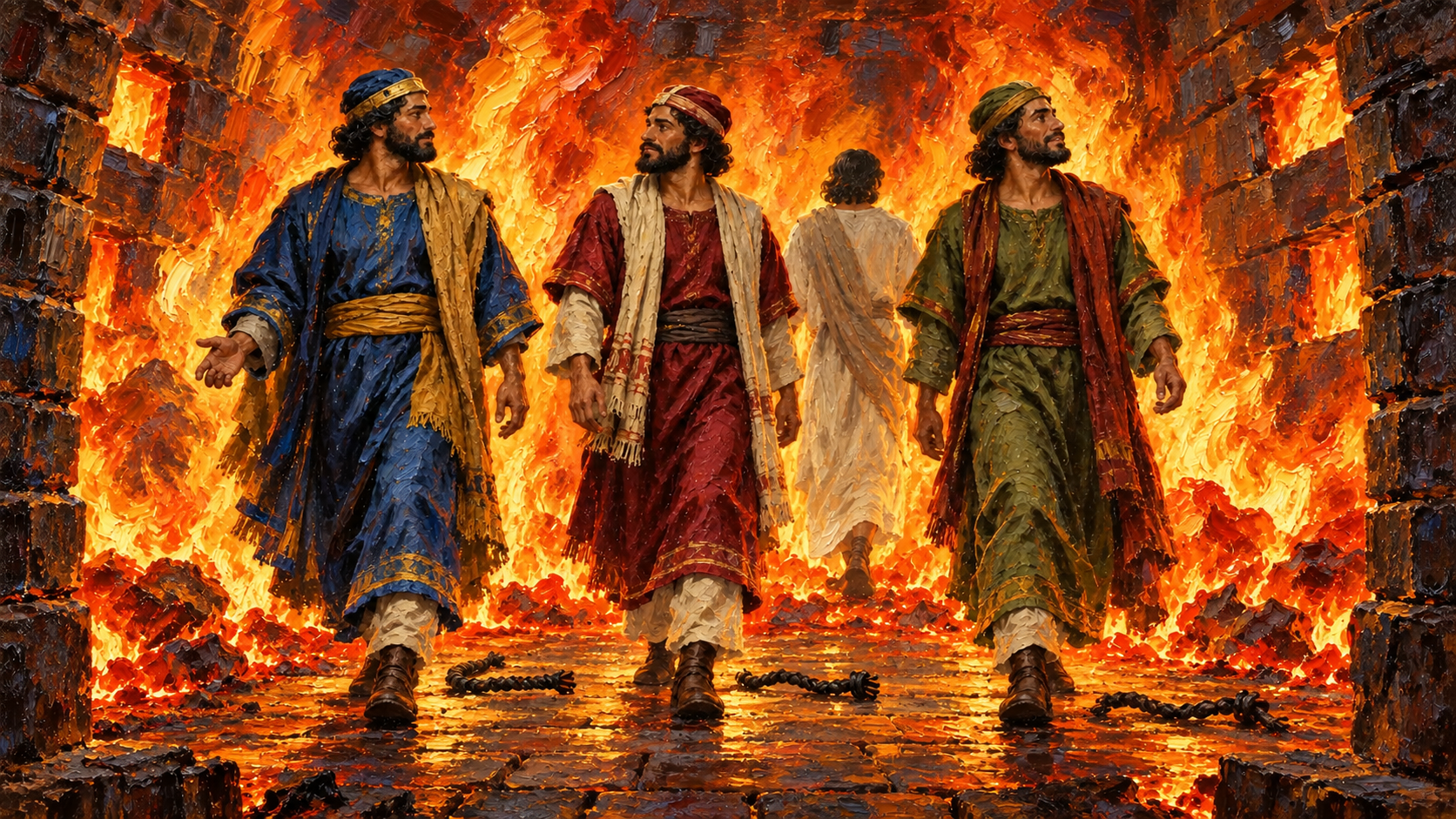
When I read Daniel 3, I have to remember that these men answered the king before they knew whether they would survive the furnace. They believed God could deliver them, but they would not worship Nebuchadnezzar’s image even if He didn’t. To understand that answer, we need to begin with their life in Babylon.
Babylon Tried to Reshape Their Allegiance
God had warned Judah repeatedly before using Babylon to discipline His people through conquest and exile, but His use of that empire didn’t excuse its brutality or arrogance. Babylon’s rulers were still responsible for their wickedness, even though God used their actions to carry out His judgment.
Daniel and his friends were taken during an early stage of Babylon’s domination, before Jerusalem and the temple were finally destroyed. They were young men from families of standing in Judah, selected for training that would prepare them to serve the government that had conquered their homeland.
Then the king instructed Ashpenaz, the master of his eunuchs, to bring some of the children of Israel and some of the king’s descendants and some of the nobles, young men in whom there was no blemish, but good-looking, gifted in all wisdom, possessing knowledge and quick to understand, who had ability to serve in the king’s palace, and whom they might teach the language and literature of the Chaldeans.
Nebuchadnezzar provided food from his table and three years of training because he intended to use their abilities in his service. That could lead to opportunities in Babylon, but I don’t want to describe the arrangement as though these young men had simply accepted an attractive offer. They had been uprooted from their homeland, and the king now controlled their education and work.
They could learn the language and serve competently without betraying God, but the king’s influence extended beyond their work. His officials even replaced their Hebrew names with names associated with Babylon’s religious world.
To them the chief of the eunuchs gave names: he gave Daniel the name Belteshazzar; to Hananiah, Shadrach; to Mishael, Meshach; and to Azariah, Abed-Nego.
Their Hebrew names spoke of the God of Israel: Hananiah refers to His grace, Mishael asks who is like God, and Azariah refers to the Lord’s help. Although we usually know them by their Babylonian names, their refusal in Daniel 3 shows that they had not given their worship to Babylon’s gods.
By Daniel 3, they held government positions in Babylon, but serving Nebuchadnezzar had not given him authority to decide whom they would worship. His demand would force them to explain that distinction to the king himself.
The Image Made Worship a Public Test
Nebuchadnezzar erected a gold image on the plain of Dura. In Daniel 2, he had learned that he was the head of gold in his dream and that another kingdom would follow his. I think his new image may reflect a proud desire to display his kingdom’s grandeur, although Daniel 3 doesn’t expressly tell us his motive.
The king summoned his officials to the dedication of an image sixty cubits high and six wide, about ninety feet by nine if we use eighteen inches for a cubit. We aren’t told whether a pedestal was included in that height or whether the image was solid gold or overlaid with it, so I would leave those construction details open.
When the music began, everyone was to fall down and worship the image, and anyone who refused would be thrown into a burning furnace. A man who remained standing would be conspicuous among those bowing around him. With that threat hanging over the ceremony, the officials were being required to demonstrate their loyalty to the king through an act of worship.
Daniel is not mentioned in this chapter, and we aren’t told where he was during the ceremony. The rest of the book establishes his faithfulness to God, so I don’t think we should invent an explanation.
I don’t think we can treat this as a harmless royal occasion that the men simply didn’t want to attend. Nebuchadnezzar was demanding worship, and God had already forbidden them to give it to another god or an image.
“You shall have no other gods before Me. You shall not make for yourself a carved image—any likeness of anything that is in heaven above, or that is in the earth beneath, or that is in the water under the earth; you shall not bow down to them nor serve them.”
In this Aramaic chapter, pelach, translated “serve,” describes service given to a deity, which helps explain why the men refused. Their government positions did not oblige them to serve Nebuchadnezzar’s gods. I can see how someone might rationalize bowing because everyone else was doing it, but the king’s approval could not make that act acceptable to God.
“But If Not” Is Faith Without a Bargain
When certain Chaldeans accused the men of disregarding the king and refusing to worship his image, Nebuchadnezzar summoned them in anger. He offered them another chance to bow, but the death threat remained, and he challenged the ability of their God to rescue them from him.
But if you do not worship, you shall be cast immediately into the midst of a burning fiery furnace. And who is the god who will deliver you from my hands?
Nebuchadnezzar had already learned through Daniel’s interpretation of his dream that his kingdom would not last forever. Yet he now spoke as though no one could thwart his plans, and I think his question reveals his disdain for the very God whose power he had witnessed.
Shadrach, Meshach, and Abed-Nego answered and said to the king, “O Nebuchadnezzar, we have no need to answer you in this matter. If that is the case, our God whom we serve is able to deliver us from the burning fiery furnace, and He will deliver us from your hand, O king. But if not, let it be known to you, O king, that we do not serve your gods, nor will we worship the gold image which you have set up.”
When the men said “but if not,” I don’t understand them to be questioning God’s ability to rescue them. They were acknowledging that He could deliver them without claiming He had promised to do so, and they would not worship the king’s gods even if their refusal cost them their lives.
I find their answer difficult to put into practice because I want to know that things will turn out well before I risk losing something. These men were facing death without any assurance that they would be spared, yet they refused to make their worship depend on receiving the deliverance they hoped for.
Even if Nebuchadnezzar had stopped short of throwing them into the furnace, the accusation could have harmed their standing in Babylon. They held government positions, and others could accept the claim that they disregarded the king. Protecting their place would require them to do something God had forbidden, and they were unwilling to pay that price.
Incensed by their refusal, Nebuchadnezzar ordered the furnace heated seven times more than usual and had his soldiers bind the men and throw them in with their clothes on. The heat killed the soldiers carrying out his order, so his determination to punish the prisoners had cost his own men their lives.
The Fourth Man and the Complete Deliverance
Nebuchadnezzar sprang up in astonishment and asked his counselors whether they had thrown in three bound men. When they confirmed that they had, he described four men walking around in the fire, unbound and unscathed.
“Look!” he answered, “I see four men loose, walking in the midst of the fire; and they are not hurt, and the form of the fourth is like the Son of God.”
Although the NKJV records his description as “like the Son of God,” Nebuchadnezzar was a pagan describing what he saw, so I wouldn’t assume those words mean he understood the Trinity. He later said in Daniel 3:28 that God had sent His Angel to deliver the men.
I believe the fourth Man was Christ appearing before He took on human flesh, an appearance known as a Christophany. My understanding comes from reading this alongside other Old Testament appearances in which the Messenger speaks and acts as God. The burning bush and appearances of the Angel of the LORD give fuller descriptions than we have here, so I would explain this as my conclusion rather than say Daniel 3 explicitly identifies Him as Christ.
Some readers understand Him as a created angel, but I don’t think the word angel, meaning messenger, settles the question on its own. Scripture uses messenger language in accounts of divine appearances too, and the study on Christophanies in the Old Testament examines the wider pattern on which my conclusion rests.
When the king called them out, the officials gathered to examine them.
And the satraps, administrators, governors, and the king’s counselors gathered together, and they saw these men on whose bodies the fire had no power; the hair of their head was not singed nor were their garments affected, and the smell of fire was not on them.
I am struck by the contrast with the soldiers who died from the heat, because the men inside came out without singed hair or even the smell of fire on them. The officials could examine them for themselves and see how completely God had preserved them. We aren’t told how their bonds were removed, but they had gone in bound and were now walking freely.
Nebuchadnezzar spoke, saying, “Blessed be the God of Shadrach, Meshach, and Abed-Nego, who sent His Angel and delivered His servants who trusted in Him, and they have frustrated the king’s word, and yielded their bodies, that they should not serve nor worship any god except their own God!”
When Nebuchadnezzar said they had “yielded their bodies,” he was acknowledging that they had been willing to suffer rather than worship another god. They could not keep their belief private while using their bodies to do what God forbade, including kneeling before his image.
I don’t take this confession as proof that Nebuchadnezzar had fully repented of his arrogance, since Daniel 4 records a further humbling that he still needed. Here he acknowledged their deliverance and promoted them. The study on Nebuchadnezzar follows his later humbling in more detail.
Faithfulness Is Prepared Before the Crisis
Daniel 1 shows that these men had already faced pressure over what the king provided during their training, so their obedience had begun long before they were brought to the furnace. I need to take that seriously when I admire their courage, because I shouldn’t assume I will become faithful under a death threat if I am willing to disobey God whenever doing right becomes inconvenient.
We need to know God through His Word and depend on Him in the decisions we are making now. That doesn’t mean we can make ourselves fearless, but it gives us a reason to examine the compromises we are already excusing rather than imagine what we might do in a more dramatic situation.
We may never face a gold image, but speaking the truth could hurt our prospects at work, especially if keeping someone’s approval depends on agreeing with something Scripture condemns. I need to recognize when gratitude for an opportunity is becoming an excuse to overlook what is wrong.
But Peter and the other apostles answered and said: “We ought to obey God rather than men.”
Before I say I must refuse a human command, I need to identify what it requires me to do against God. Disliking a policy is not enough to make it idolatry, and I need discernment to distinguish a sinful demand from something I simply oppose.
Where lawful appeals are available, we should make them truthfully and respectfully, but if the demand still requires sin, we must refuse and face the consequences. These men were resolute without insulting Nebuchadnezzar, and I don’t need to become abusive or violent to prove that I mean what I say.
We should also be careful about making this entire account a lesson in personal resolve. These men needed God to save them from the furnace, and all of us need Christ to save us from our sins. Jesus is the eternal Son, fully God and fully man, and He lived without sin. He willingly gave Himself to be slain as the perfect sacrifice for our sins. Wicked people tortured and crucified Him, and His shed blood and death completed His saving sacrifice before His burial and bodily resurrection.
Father and Son acted in unity; the Father did not punish, curse, abandon, strike, bruise, or pour wrath on Jesus. Christ died for the sins of the whole world, which means God’s offer of salvation is genuine for every person. A person can resist His grace and reject the Savior, but everyone who repents and believes in Jesus is forgiven and born again.
Their courage didn’t atone for their sins, and our determination cannot accomplish what Christ’s shed blood does in delivering sinners from judgment. I want this account to direct people to repent and trust Him, rather than become another appeal to believe in ourselves.
When someone is genuinely born again, he becomes a new creation in whom the Holy Spirit lives, and the Spirit seals him so that he is eternally secure in Christ. That assurance gives us no permission to continue in lawlessness. If we call ourselves Christians, there should be evidence of new life in how we live. Obedience does not earn salvation or keep us saved, but belonging to Christ gives us reason to obey Him even when doing so threatens our comfort or position.
who through faith subdued kingdoms, worked righteousness, obtained promises, stopped the mouths of lions, quenched the violence of fire.
Paul wrote Hebrews and included deliverance from fire among the works of faith, but he went on to describe believers who were tortured and killed. I would be doing those believers a terrible injustice if I treated their suffering as proof that they didn’t trust God enough. We can ask for deliverance without treating a fellow believer’s affliction as evidence of weak faith. The study on Daniel in the lions’ den considers the same dependence on God when a later king outlawed Daniel’s prayers.
My Final Thoughts
I am grateful that God delivered these men, but knowing the ending shouldn’t make me overlook what they were prepared to lose. Their answer makes me examine the compromises I might excuse to protect a comfortable life. I can ask God for deliverance without making my obedience depend on receiving the answer I want.