
Jesus and the apostles explain how earlier people, events, sacrifices, and institutions point to Christ. Those connections give us good reason to read the Old Testament with Him in view. I also need to distinguish an inspired explanation from a resemblance I happen to notice. The Bible’s unity does not authorize me to assign a hidden message to every color, number, or object.
Reading Shadows Without Inventing Them
Scripture was written through many men over many centuries, but its unity comes from the God who inspired it and unfolded His saving purpose in history. The earlier events were real. Israel left Egypt, a lamb died at Passover, people were bitten by serpents, and Jonah entered the great fish. The tabernacle was an actual sanctuary where Israel worshiped according to God’s instructions. Later fulfillment depends on those realities rather than making them disappear.
The Greek skia means a shadow, a truthful outline of something greater. Typos can mean a mark, pattern, example, or type, according to context. A type is a correspondence God designed between an earlier reality and a later fulfillment. Antitypon describes a corresponding figure in 1 Peter 3:21. These words help us recognize the relationship, but they do not tell us to search for any similarity our imagination can supply.
We should distinguish several kinds of connection. Prophecy predicts in words given by God. An analogy points out a resemblance. Allegory uses one thing to represent another, as Paul does with Hagar and Sarah in Galatians 4. His inspired explanation establishes that allegory’s authority; it does not authorize me to invent another meaning for every account. A Christophany is different again: it is an actual appearance of the eternal Son before He took on human flesh.
Some categories overlap. Passover was a historical deliverance and covenant memorial that also pointed to Christ. Jesus identifies Jonah’s time in the fish as a sign of His burial and resurrection. I understand Melchizedek, however, as more than a human type. I believe he was the eternal Son appearing as Priest-King before the incarnation. I will return to the grounds for that conclusion below.
Before making a connection, I need to understand what the earlier passage says. Its grammar, literary setting, history, and covenant responsibilities establish what happened and what God was teaching. Then I look for the explanation later Scripture provides. Jesus may identify a sign, an apostle may name a type, or Hebrews may explain the purpose of a sanctuary or sacrifice. That inspired interpretation carries authority a suggestive parallel does not possess.
The differences can be as important as the similarities. Adam and Christ acted as representative heads, but Adam disobeyed and Christ obeyed. Jonah’s time in the fish corresponds to Christ’s burial and resurrection; Jonah’s resentment does not describe Jesus. The lifted bronze serpent points to God’s remedy for dying people without implying that Christ became morally corrupt. Plain teaching about Him must govern the comparison.
The fulfillment also exceeds the earlier pattern. A sinful man cannot equal the sinless Son, a dying priest cannot provide an endless priesthood, and animal blood cannot do what Christ’s willing bodily offering does. A type helps explain doctrine established by Scripture. An invented parallel cannot establish a new doctrine.
Later revelation can disclose more than the people in the original event understood without changing the historical meaning. An Israelite household did not need to comprehend every aspect of Christ’s future work to obey at Passover. When Paul identifies Christ as our Passover, he gives the later explanation from the same Spirit who inspired Exodus. I want to receive that fuller understanding without turning tent pegs, journey stages, or ordinary family details into messages Scripture never assigns them.
Hebrews and the Once-for-All Substance
Hebrews provides the fullest explanation of the old covenant shadows, and I believe Paul wrote it. I recognize the questions raised by his absence from the opening, the elevated style, and the wording of Hebrews 2:3. His scriptural training and the letter’s agreement with his teaching support the attribution, as do the reference to Timothy, the closing word of grace, and its early reception. A secretary or translator could help explain aspects of the literary process, but we are not given every detail. Who Wrote the Book of Hebrews? examines those grounds more fully.
The law was not a failed attempt to save people before God devised something better. He gave it to govern Israel, reveal His holiness, expose sin, and prepare His people to understand what Christ would accomplish. The sacrifices taught Israel about shed blood, cleansing, consecration, fellowship, and mediation. Consecration means being set apart to God; mediation concerns approaching Him through the representative He appointed. The priesthood and sanctuary gave those teachings a concrete form.
The offerings had distinct purposes and rituals. The burnt offering was wholly given on the altar, while a grain offering did not center on animal blood. Peace offerings included a fellowship meal. Sin and trespass offerings addressed guilt and defilement in their appointed ways, and the Day of Atonement had a particular sequence. Several sacrifices displayed substitution, but forcing every offering into precisely the same pattern would erase part of what God taught through them.
The tabernacle’s ordered approach also taught reverence. Courts led toward the Holy Place and Most Holy Place, with the veil guarding access to the mercy seat. Priests served through appointed washings and offerings. The lampstand, bread, and incense altar stood within that sanctuary order. God dwelt among His people, but sinners could not treat access to Him casually.
The system’s limits were equally visible. Levitical priests needed offerings for their own sins and eventually died. The high priest entered the Most Holy Place with blood, but the Day of Atonement returned the next year. Repeated animal sacrifices could not finally cleanse the conscience. Israel needed a sinless Priest who lives forever and a sufficient offering that would not have to be repeated. Paul states the limitation directly:
For the law, having a shadow of the good things to come, and not the very image of the things, can never with these same sacrifices, which they offer continually year by year, make those who approach perfect.
Jesus is both that Priest and that offering. Wicked men physically tortured the sinless Son and inflicted the punishment He willingly bore in His innocent body for our sins. He shed His blood and died, completing His saving work. He was buried and rose bodily from the dead. The Father did not punish, curse, abandon, strike, bruise, or pour wrath on Jesus. The Trinity’s unity was never broken, and Christ’s suffering was real bodily violence rather than a figure of speech.
By that will we have been sanctified through the offering of the body of Jesus Christ once for all.
Once for all means His offering cannot be repeated, supplemented, or improved. Communion remembers His body and blood and proclaims His death without offering Him again. Any future kingdom offering must stand under that same finality and cannot add atoning value to His blood.
When Jesus died, the temple veil tore from top to bottom. Hebrews 10:19-20 connects our entry into the Holiest with His blood and the new and living way associated with His flesh. We may approach through the sufficient Mediator without treating God’s holiness as less serious. Our confidence rests on what Christ accomplished.
Hebrews also contrasts priests standing day after day with Christ sitting down after one sacrifice. Their service continued because it never reached final completion. His seated position declares the offering finished, and His resurrection means death cannot interrupt His priesthood. I do not need self-punishment, religious achievement, or another emotional crisis to make that offering sufficient. Obedience belongs in the life of someone redeemed; it cannot purchase redemption.
Adam, Passover, and the Lifted Serpent
Romans 5 explicitly identifies Adam as a type. Paul explains that sin entered through one man and death spread to all because all sinned, then directs us to the greater work of the One who would come.
Nevertheless death reigned from Adam to Moses, even over those who had not sinned according to the likeness of the transgression of Adam, who is a type of Him who was to come.
Paul is comparing representative actions, not presenting Adam as a moral likeness of Jesus. Adam disobeyed in a garden and brought condemnation and death. Christ obeyed through suffering and provides the righteous basis for justification and life. Where Adam took what God forbade, Christ gave Himself. The free gift is greater than the offense, and Paul’s repeated contrasts prevent us from reducing the fulfillment to a matching act.
Romans 5 does not teach that every person is automatically saved, or that Christ’s atonement is sincerely offered only to a hidden group. He died for the whole world, and God’s saving appeal is genuine. People may resist and reject Him. The gift is received through faith. We need both the correspondence between Adam and Christ and the apostle’s explanation of how greatly Christ exceeds Adam.
Passover supplies another explicit connection. Exodus 12 records God’s command to take an unblemished lamb, kill it, and apply its blood where He directed. The firstborn were not spared through superior character. A life was given in place of a life, and safety rested on God’s promise attached to the provision He appointed. The blood was not magic, and the household’s confidence was to be in the LORD who spoke. Paul identifies the fulfillment while correcting the Corinthian congregation:
Therefore purge out the old leaven, that you may be a new lump, since you truly are unleavened. For indeed Christ, our Passover, was sacrificed for us.
John calls Him the Lamb of God who takes away the sin of the world, and Peter describes His precious blood as that of a lamb without blemish or spot. The saving fulfillment is the sinless Son shedding His blood for us. Repeating the Exodus meal cannot accomplish that work.
The setting in 1 Corinthians 5 explains the response. Because Christ has been sacrificed, the congregation must stop protecting tolerated wickedness. Moral cleansing does not create redemption, but sincerity and truth belong in a redeemed community. Israel ate prepared to leave slavery, so deliverance led into a changed life. We can recognize that connection without making each sandal, staff, herb, or doorway measurement represent a separate Christian virtue.
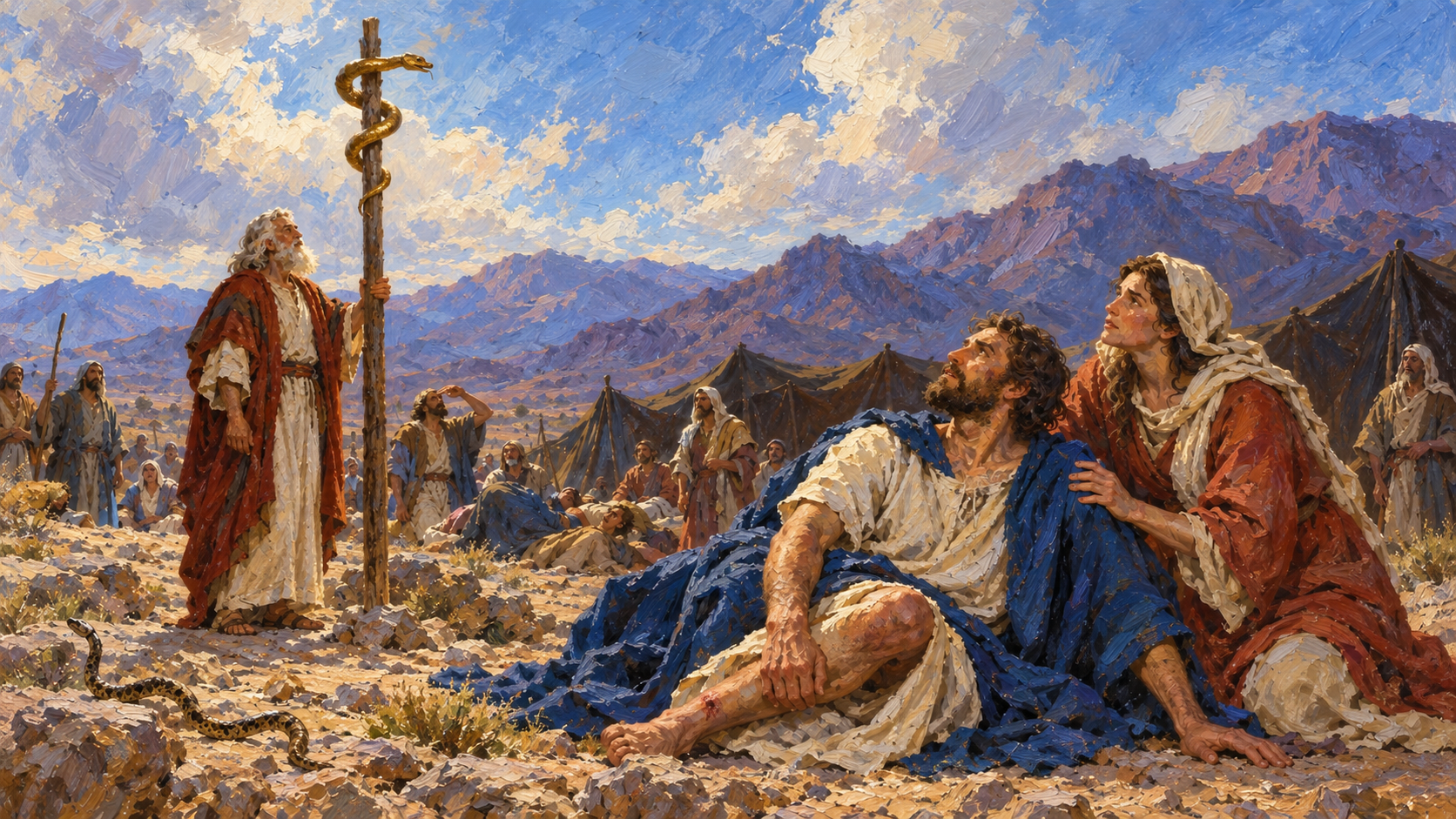
Numbers 21 begins with Israel speaking against God and Moses. Fiery serpents brought judgment, and the dying people could not remove the venom. They confessed, Moses interceded, and God directed him to raise a bronze serpent. Whoever looked according to God’s promise lived. Jesus explains the connection Himself:
And as Moses lifted up the serpent in the wilderness, even so must the Son of Man be lifted up, that whoever believes in Him should not perish but have eternal life.
The lifted serpent points to the lifted Savior, and the look corresponds to believing in Him. Faith contributes nothing to the remedy and does not pay for it. It receives the salvation God provides. The type joins a dying people, an object associated with the instrument of death, and God’s appointed means of life.
It does not mean Jesus became sinful or that the Father cursed Him. Christ remained the spotless Son while wicked people inflicted real bodily punishment that He willingly bore for our sins. The illustration must remain governed by His holiness and the Father’s unbroken love. The study on The Bronze Serpent follows Numbers 21 and John 3 more closely.
The later history of the bronze object reinforces the need to distinguish a sign from the Lord who gives it. Hezekiah destroyed it in 2 Kings 18:4 after Israel made it an object of idolatry. Something God originally appointed could still be misused when people placed their trust in the object itself.
Isaac, Jonah, Manna, and the Rock
Genesis 22 records a test of Abraham’s faith in God’s promise concerning Isaac. Hebrews 11 explains that he reasoned God could raise his son from the dead. Abraham’s confidence had a specific basis: God had said the covenant line would continue through Isaac. He received his son back in a figurative sense when God prevented the sacrifice and supplied a ram.
The father and beloved son, the wood, the prospect of death, and the provision God made prepare us to consider a greater fulfillment. The differences still govern the comparison. Isaac was a sinner in need of redemption and did not die. A ram died in his place. Jesus is the sinless eternal Son who willingly laid down His life and rose bodily.
Abraham said, “God will provide for Himself the lamb,” and we first hear those words in relation to the provision on Moriah. In the wider Bible, God’s provision prepares us for the Lamb of God. We do not need to make the servants, rope, or every step of the journey carry a secret doctrine. Abraham reasoned from what God had promised, and our interpretation should follow that discipline.
With Jonah, Jesus names the sign directly. Religious leaders demanded a sign, and He pointed to the prophet’s time in the great fish:
For as Jonah was three days and three nights in the belly of the great fish, so will the Son of Man be three days and three nights in the heart of the earth.
The correspondence concerns time in the depths followed by a return. It does not extend to Jonah’s reluctance, disobedience, or anger. God rescued that prophet in mercy, while Jesus willingly obeyed the Father through death and conquered it. A reader who ignores the contrast would misrepresent the Savior.
John 6 presents another contrast through manna. Israel received actual bread from heaven that sustained life for a time, but the people who ate it still died. Jesus is the true bread from heaven who gives life to the world. Whoever believes receives eternal life, a gift far greater than another day’s physical sustenance.
First Corinthians 10 identifies Christ as the spiritual Rock from which Israel drank. Paul places His sustaining presence within Israel’s history and uses those events to warn the church. The people passed through the sea and received supernatural provision, yet many hardened themselves in unbelief. Outward privilege did not guarantee a faithful heart. The apostle’s warning gives us the application; we do not need to assign hidden meanings to the rock’s shape, each measure of manna, or every campsite.
Baptism, Firstfruits, and God’s Rest
The sea and Flood passages require care because their baptismal language is sometimes used to teach that water produces the new birth. In 1 Corinthians 10, Israel was baptized into Moses in the cloud and sea, identified with him in the exodus. Yet most later fell in the wilderness. Shared outward experience did not establish that each person trusted God.
First Peter 3 recalls Noah’s family being carried through the Flood in the ark. The water judged the old world, while eight people were preserved. Peter then identifies a corresponding figure and gives a qualification within the sentence:
There is also an antitype which now saves us—baptism (not the removal of the filth of the flesh, but the answer of a good conscience toward God), through the resurrection of Jesus Christ,
I do not read Peter as teaching that water removes sin. He excludes mere bodily washing and directs the good conscience toward God through Christ’s resurrection. Water baptism follows salvation and pictures identification with Christ’s death, burial, and resurrection; it does not cause the new birth. Isolating “baptism now saves” while ignoring the qualification makes the outward element accomplish what the explanation assigns to Christ.
The family’s passage through judgment marked a real break with the old world. Baptism corresponds to that deliverance, while the saving reality depends on the risen Lord. We should keep the figure under the gospel of grace received through faith, rather than use it to overturn that gospel.
Israel’s calendar also taught through repeated observances. Passover recalled deliverance, Unleavened Bread accompanied separation from the old life, and Firstfruits presented the beginning of harvest. Sabbaths and sabbatical patterns required a pause in ordinary labor and taught dependence on God’s provision. Later Scripture identifies particular fulfillments, including Christ as our Passover and the risen Lord as firstfruits:
But now Christ is risen from the dead, and has become the firstfruits of those who have fallen asleep.
His bodily resurrection begins and guarantees the harvest to come. We can trust that promise without turning every feast detail into a complete prophetic calendar. The certainty of our interpretation should follow the certainty of the inspired explanation.
The rest associated with Sabbath is developed through several stages in Hebrews 4. God rested after creation; Israel then faced the wilderness test of faith, and Joshua brought the people into the land. Yet David later spoke of another “Today,” showing that entry into Canaan had not exhausted God’s promise. A rest remained open to God’s people.
That argument includes the believer’s rest from trying to save himself, but it must not be reduced entirely to justification. It also looks toward the completed enjoyment of God’s promise. The hearers must believe instead of hardening themselves as the wilderness generation did. The command to be diligent rules out spiritual passivity. We persevere in obedient faith because God’s provision is sufficient, not because our efforts purchase it.
Colossians 2 also forbids judging believers over food, drink, festivals, new moons, and sabbaths. Those shadows have their substance in Christ. Observing them cannot justify us, finish His work, or make our salvation secure. I can study them gratefully without accepting a human demand that places my conscience under them.
Christophanies, Strong Patterns, and Necessary Restraint
Genesis 14 introduces Melchizedek as king of Salem and priest of God Most High. He blessed Abraham and received a tenth. Hebrews explains his titles as king of righteousness and king of peace. Psalm 110 records the oath that Messiah is a priest forever according to Melchizedek’s order, and Hebrews 7 connects that priesthood with endless life and its superiority to Levi’s.
Many Christians understand him as a human type of Christ. I believe he is a Christophany, an actual appearance of the eternal Son as Priest-King before the incarnation. Hebrews describes him without father, mother, genealogy, beginning of days, or end of life, remaining a priest continually. In my understanding, that description exceeds an ordinary man whose family record was simply left out. The study on Melchizedek examines that conclusion and Christ’s unchangeable priesthood more fully.
A temporary appearance is different from the incarnation, when the eternal Word truly became man through the virgin birth. Jesus remains fully God and fully man. His existence did not begin in Mary’s womb, and He could appear before taking human nature permanently. Genesis 14 does not require us to place the incarnation centuries before Christ’s birth.
The distinctive Angel of the LORD also needs to be evaluated by His words and actions. Angel means messenger; the title alone does not establish that He is created. In Genesis and Exodus, this Messenger speaks as the LORD while remaining personally distinct from the One sending Him. Judges and Zechariah show divine marks as well, including reverence that ordinary created angels refuse. I understand those divine appearances as Christ before the incarnation.
That does not identify every mysterious visitor or unnamed angel as Jesus. The particular passage must provide the grounds. An actual appearance of Christ is more than a literary illustration, while an unusual messenger is not automatically divine.
Joseph’s life provides a different kind of connection. His brothers rejected and sold him, false accusation brought him to prison, and God later exalted him to preserve many lives. He refused revenge without pretending his brothers’ wickedness was good. God’s purpose worked through their wrongdoing without excusing them.
Jesus was rejected and falsely accused before wicked men tortured and crucified Him. God raised Him bodily and exalted Him, while His accusers remained responsible. Joseph preserved physical lives through famine; Christ gives eternal life through His sufficient saving work. I see a strong redemptive pattern here, but no New Testament verse directly names Joseph a type of Christ.
I would therefore state that connection with less certainty than Paul’s explicit identification of Adam. Joseph’s coat, pit, purchase price, prison companions, Egyptian name, and wife do not each require a separate prediction about Jesus. The same care is needed with comparisons involving Noah’s ark, Ruth and Boaz, David and Goliath, or individual pieces of sanctuary furniture. A useful analogy should remain open to examination.
Restraint does not leave us with an Old Testament that says nothing about Christ. Jesus and the apostles show how actual sacrifices, signs, people, and deliverances belong to God’s purpose. We can receive those fulfillments while refusing imaginative allegory. What I call a clear biblical connection should be supported in Scripture; what I offer as a suggestion should be identified honestly as one.
These passages also give me reason to trust Scripture’s unity. Adam, Passover, the lifted serpent, the true bread, and firstfruits lead beyond themselves to Christ. The priesthood and sanctuary explain the need for holy access, a sufficient offering, and a Priest who lives forever. The purpose of explaining them is to make His work clearer, not make a teacher appear unusually perceptive.
The shadows cannot save, and knowledge of them cannot replace faith. Christ died for the whole world, and His invitation is genuine. A person can resist and reject Him, while everyone who truly repents and believes in Him receives eternal life and is born again. The Holy Spirit comes to live within and seals that believer, who is eternally secure. That assurance rests on Christ’s finished offering and endless priesthood. It gives no permission for lawlessness; grateful obedience grows from the life He has given.
My Final Thoughts
I appreciate seeing God’s purpose unfold through history in connections He explains Himself. The shadows teach us more when we understand what happened, follow the later inspired explanation, and preserve the differences between the earlier figure and Christ. We should not return to a ceremony or personal achievement as though it could finish His work. Jesus is the substance toward which the shadows point, and His bodily offering was once for all. Careful study should deepen our confidence in Him and our worship of the One who fulfills what they could only outline.