
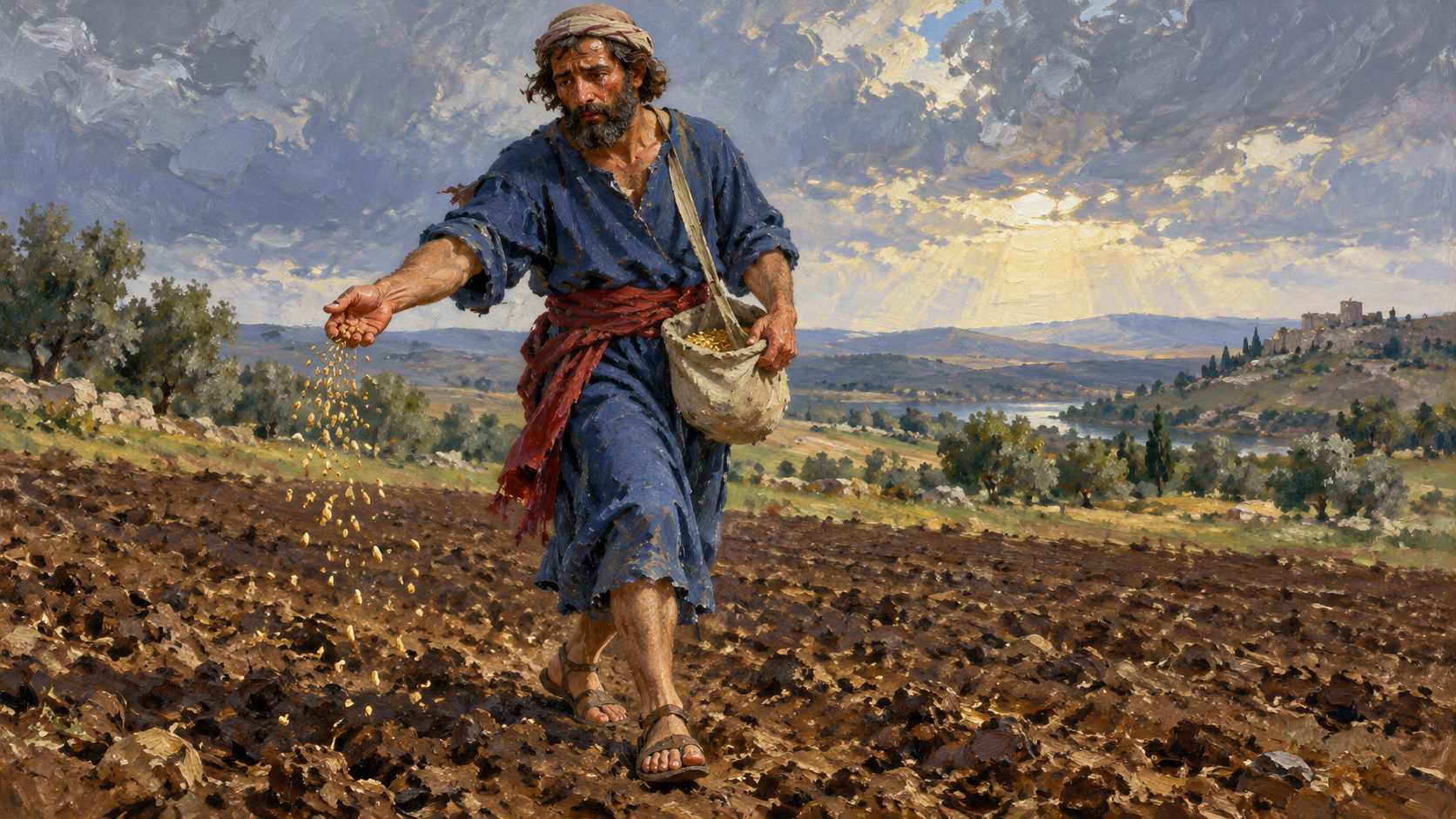
When someone says, “You reap what you sow,” I need to know what he means before agreeing. Scripture teaches that our choices have consequences, but it does not give us a formula for controlling every result. A generous gift cannot force God to make us wealthy, and another person’s hardship does not prove that he planted some particular sin. We need to read the passages carefully enough to understand both our responsibility and the harvest God actually promises.
One Picture With Several Biblical Uses
A farmer works before he can see the crop. He can prepare the ground, plant, and tend what grows, but he cannot order the weather or make a seed live. Biblical writers draw on different parts of that process. Sometimes the seed is the Word being preached; elsewhere sowing describes giving, a person’s conduct, or even the burial of a body that will be raised. We will misunderstand those passages if we assign every seed the same meaning.
Paul used the image to correct the Corinthians’ habit of dividing into groups around admired teachers. He asked them to reconsider who those men actually were.
Who then is Paul, and who is Apollos, but ministers through whom you believed, as the Lord gave to each one?
Paul planted and Apollos watered, but God gave the increase. Both men had real work to do, yet neither could regenerate a heart, meaning give someone new birth. Their abilities did not entitle them to the honor the Corinthians were giving them. I should recognize faithful ministry without treating a minister as the source of spiritual life or measuring his faithfulness solely by the size of the response.
Jesus’ teaching in Mark 4 likewise describes seed growing while the sower sleeps and rises, without his knowing how the growth occurs. The crop develops toward harvest, but the farmer does not supply its life. That is a reason to depend on God while working, not an excuse to leave the field untended.
A different parable, the Parable of the Sower, concentrates on how the seed is received. Jesus identifies the seed as God’s Word and the soils as those who hear it. Some resist, some receive it briefly without taking root, and others allow competing cares and pleasures to choke it. The good soil bears fruit with patience. The passage calls us to consider how the Word is received; it does not promise every witness an identical response. The study on The Parable of the Sower examines those responses more fully.
Parents, pastors, teachers, and believers speaking with a friend can all share that Word. We should explain Scripture clearly, keep the gospel centered on Christ, and answer honest questions. Entertainment, fear, flattery, or manufactured emotion cannot accomplish the new birth. Pressuring someone into a profession of faith may produce words we want to hear without producing the life only God gives. First Peter 1:23 describes new birth through the incorruptible seed of God’s living and abiding Word. The messenger must be faithful to that Word rather than trust his personality to supply its power.
Galatians 6 and the Direction of a Life
Galatians applies sowing and reaping to conduct within a letter defending salvation by grace. Paul had opposed teachers who pressed circumcision and Mosaic-law observance on Gentile believers. He explained justification, being declared righteous before God, through faith rather than works of law. His instructions about the harvest must agree with the gospel he has already defended.
Brethren, if a man is overtaken in any trespass, you who are spiritual restore such a one in a spirit of gentleness, considering yourself lest you also be tempted. Bear one another's burdens, and so fulfill the law of Christ. For if anyone thinks himself to be something, when he is nothing, he deceives himself. But let each one examine his own work, and then he will have rejoicing in himself alone, and not in another. For each one shall bear his own load. Let him who is taught the word share in all good things with him who teaches. Do not be deceived, God is not mocked; for whatever a man sows, that he will also reap. For he who sows to his flesh will of the flesh reap corruption, but he who sows to the Spirit will of the Spirit reap everlasting life. And let us not grow weary while doing good, for in due season we shall reap if we do not lose heart. Therefore, as we have opportunity, let us do good to all, especially to those who are of the household of faith.
Paul begins with brethren restoring someone overtaken in sin. Spiritual maturity calls for gentleness and self-examination, because the person helping is also vulnerable to temptation. Sowing to the Spirit includes how we handle a fellow believer’s failure. Proud distance and public humiliation cannot be excused as zeal for holiness when Paul calls us to help restore the person.
His commands about burdens and personal loads belong together. We are to help carry burdens that weigh another person down, while recognizing that each of us answers to God for our own conduct. Helping does not remove responsibility, and responsibility does not justify abandoning someone in need.
Paul then tells those taught the Word to share good things with their teachers. Material support is part of the setting when he warns that God is not mocked. A person cannot claim devotion to spiritual things while continually arranging life around selfish desire. Paul closes with patient goodness toward everyone, especially fellow believers, and places the harvest “in due season.” We do not get to choose an earlier date because we have grown tired.
To sow to the flesh is to feed fallen desire as though it had the right to direct us. Galatians 5 names sexual immorality, idolatry, hatred, jealousy, selfish ambition, envy, drunkenness, and related conduct. Sowing to the Spirit means yielding our conduct to the Holy Spirit who dwells within believers. He produces love, joy, peace, patience, kindness, goodness, faithfulness, gentleness, and self-control. His work becomes visible in how we treat people and respond to temptation.
When Paul speaks of reaping everlasting life, he is not turning eternal life into wages for enough good choices. Earlier in Galatians he explains that we receive the Spirit by faith and become sons through Christ, not through earning our standing. The Spirit gives believers new life now, and they will enjoy the everlasting life God promises in the resurrection. Obedience grows from His saving work; it does not purchase life.
A genuinely born-again believer is a new creation, indwelt and sealed by the Holy Spirit and eternally secure. Yet that believer can yield to sinful desires and suffer real corruption in habits, relationships, health, or Christian witness. God’s fatherly discipline calls His child back to obedience. Security does not erase the harm or give us permission to continue causing it.
A settled, unrepentant pattern of serving the flesh can expose a superficial profession of faith. It does not demonstrate that regeneration is repeatedly gained and lost. We need to take Paul’s warning seriously while remembering that the grace which keeps Christ’s people also teaches them to reject ungodliness.
Consequences Without Karma or Mechanical Blame
Proverbs often describes the consequences that follow a course of conduct.
He who sows iniquity will reap sorrow, And the rod of his anger will fail. He who has a generous eye will be blessed, For he gives of his bread to the poor.
Wrongdoing brings sorrow, and abusive power will fail. Generosity toward the poor, by contrast, is commended and blessed. The proverb gives us good reason to reject iniquity and share our bread; it does not tell us the date or form of every consequence.
Other proverbs connect diligence with provision and idleness with poverty. Those principles deserve our attention, but the same book recognizes poverty caused by oppression and injustice. An honest worker can be underpaid, robbed, or prevented from working. Naboth lost his vineyard because powerful people arranged false testimony and murder. Job’s affliction did not come from a refusal to work, and Jesus’ material poverty did not reveal a moral failure. The study on The Book of Proverbs considers how its wisdom should be read.
We can often trace particular harm to particular conduct. Deceit undermines trust, bitterness encourages continued anger, and addiction narrows freedom. Exploitation injures the people subjected to it and brings the exploiter under judgment. Those connections do not allow us to reason backward from every hardship to an accusation of secret sin. Job’s friends made that mistake, John 9 rejects the assumption that a man’s blindness must come from a particular sin of his or his parents, and Psalm 73 describes wicked people prospering while the righteous suffer.
Nor does a delayed result make our choices harmless. A lie can go undiscovered while corrupting a relationship. Faithfulness can remain unnoticed for years. I can recognize how conduct forms habits and affects others without pretending to know when God will bring every hidden thing to account.
I would not call biblical sowing and reaping karma. Scripture teaches one earthly life followed by resurrection and judgment before the personal Creator who both judges and forgives. His dealings with us include grace and mercy, so present circumstances cannot serve as a complete judgment on someone’s character.
Hosea addressed Israel’s covenant unfaithfulness, including idolatry and trust in military strength. The people had sown the wind and would reap the whirlwind. Hosea 10 calls them to break up fallow ground, sow righteousness, and seek the LORD, with mercy in view. The appeal includes repentance and God’s personal response to His people.
Psalm 126 uses the farming image in a different setting, remembering a restoration God had given and asking Him to restore His people again.
When the LORD brought back the captivity of Zion, We were like those who dream. Then our mouth was filled with laughter, And our tongue with singing. Then they said among the nations, "The LORD has done great things for them." The LORD has done great things for us, And we are glad. Bring back our captivity, O LORD, As the streams in the South. Those who sow in tears Shall reap in joy. He who continually goes forth weeping, Bearing seed for sowing, Shall doubtless come again with rejoicing, Bringing his sheaves with him.
The opening joy came from something the LORD had done so wonderfully that even the nations recognized it. The prayer then asks for renewed restoration like streams filling the dry channels of the south. Within that prayer, the sowing worshiper continues to carry seed while weeping and looks ahead to returning with sheaves.
We can understand why sowing might be painful when resources are scarce: seed committed to the ground cannot be eaten now. That helps us picture costly hope, although the psalm does not specify every cause of the sower’s tears. It does not use Hosea’s phrase about sowing righteousness, and we should not force the two passages into one meaning. Here grief and hopeful action continue together.
Neither should we promise that every project will succeed or that every earthly sorrow will be reversed before death. Faithful servants sometimes die without seeing the fruit of their work. Christian hope reaches beyond one season to God’s final restoration and bodily resurrection into His promised kingdom.
Stewardship, Generosity, and Work Under Uncertainty
Jesus’ parable of the talents in Matthew 25 concerns servants awaiting their master’s return. A talent was a large sum of money, not an ability in the modern sense of the word. The master entrusted different amounts to his servants and returned after a long time to settle accounts. The first two received the same commendation despite their different totals. The third hid the money and defended his refusal by accusing the master.
Jesus calls us to be faithful with what He entrusts to us as we await His return. Money is the property entrusted in the parable, while the responsibility also applies to how we use opportunities, time, knowledge, and service. It is not a direct command about sowing gospel seed or a guarantee that every Christian undertaking will double. The returning Lord examines faithfulness.
Paul addresses giving more directly when arranging relief for needy believers in Jerusalem.
But this I say: He who sows sparingly will also reap sparingly, and he who sows bountifully will also reap bountifully. So let each one give as he purposes in his heart, not grudgingly or of necessity; for God loves a cheerful giver. And God is able to make all grace abound toward you, that you, always having all sufficiency in all things, may have an abundance for every good work.
In 2 Corinthians 8–9, Paul emphasizes willingness, fairness, and trustworthy handling of the collection. He wanted it prepared beforehand so the gift would express generosity rather than be extracted at the last moment. Here giving is the seed. Each person decides what to give without grudging pressure or compulsion.
God supplies what the giver needs for further good work, and the following verses describe a harvest of righteousness, generosity, needs met, and thanksgiving to God. Prosperity teaching reverses the purpose when it makes a gift into a deposit that obligates God to enrich the donor. We give because He has given to us, trusting Him to equip us for further generosity. His grace cannot be reduced to an investment contract.
Those with little can give willingly according to what they have, and those with much are not generous merely because their total looks impressive. Neither can a dramatic offering excuse neglected dependents or a refusal to pay a legitimate debt. Planning helps us honor those duties and give thoughtfully. Paul’s concern for trusted people to handle the collection also shows that compassion never removes the need for financial integrity.
That concern for responsible conduct also shapes Paul’s instructions about work.
For even when we were with you, we commanded you this: If anyone will not work, neither shall he eat. For we hear that there are some who walk among you in a disorderly manner, not working at all, but are busybodies. Now those who are such we command and exhort through our Lord Jesus Christ that they work in quietness and eat their own bread.
Notice “will not work.” Paul is addressing people refusing responsibility and becoming disorderly busybodies. The warning is not a charge against someone unable to work through disability, age, or illness, or against a willing worker who cannot find employment or is blocked by injustice. Children and people caring for others should not be dismissed as idle because they are not earning wages.
Proverbs uses the ant, a neglected field, and a missed harvest to expose excuses and habitual delay. Diligence normally helps us prepare for need, provide for others, and carry out our responsibilities well. Laziness can create preventable need. We should face that honestly without promising that diligence will make everyone wealthy.
An honest worker may still lose a job or strength through sickness. The church should distinguish unwilling idleness from genuine need and help vulnerable people rather than accuse them. Work also does not establish human worth or excuse neglect of family, worship, or rest. I want to work honestly and well, remain willing to learn, and accept help when strength or opportunity fails.
Ecclesiastes addresses the uncertainty we face even when we are willing to work.
He who observes the wind will not sow, And he who regards the clouds will not reap. As you do not know what is the way of the wind, Or how the bones grow in the womb of her who is with child, So you do not know the works of God who makes everything. In the morning sow your seed, And in the evening do not withhold your hand; For you do not know which will prosper, Either this or that, Or whether both alike will be good.
Waiting until every condition is perfect can become another reason never to begin. The farmer cannot remove every risk, and we cannot know in advance which lawful effort will prosper. Wise counsel and needed training can help without making God’s work predictable. The passage encourages us to keep working in dependence on Him. It may be prudent to pursue more than one lawful opportunity when we do not know which will succeed, while refusing the anxiety that scatters our attention everywhere.
Plans and records can help us carry out our responsibilities. Budgets, calendars, project reviews, and ministry counts provide useful information until we use numbers to define human worth or excuse compromise. They cannot replace prayerful judgment.
Parenting and Relationships Without Control
Parents are responsible for the instruction and example they give a child. Proverbs commends careful training, but we need to consider what it promises before blaming a parent for an adult child’s rejection of that teaching.
Train up a child in the way he should go, And when he is old he will not depart from it.
Parents shape a household through teaching and example. Children see what we value, how we respond to wrongdoing, whether we pray, and whether we admit our own failures. Affection and patient discipline help make that instruction understandable in daily life. What we repeatedly practice can undermine or reinforce what we say.
I read Proverbs 22:6 as a principle of wisdom about the direction given to a child, not an unconditional covenant guaranteeing every adult child’s conversion. Children remain responsible to God, and parents cannot regenerate their hearts. A wandering adult child does not prove that every effort to teach him was false. We should take our responsibilities seriously without assuming we can control another person’s faith.
Ephesians 6 tells fathers not to provoke their children to wrath. Discipline must teach and protect, with no place for humiliation or injury. Rage and domination do not become righteous because a parent calls them spiritual formation. We need to instruct patiently rather than demand visible results as proof of our success.
Adult relationships also bear the effects of repeated conduct. Truthfulness and kindness help build trust; gossip and manipulation teach someone to fear what we will do next. Ephesians 4 calls us to useful, truthful speech, tenderness, and forgiveness because God in Christ has forgiven us. We owe that conduct to the Lord even when someone responds badly.
Jesus loved perfectly and was hated without cause. Faithful people can experience rejection, abuse, and betrayal despite treating others well. Advice promising that goodness will always bring a matching response unfairly blames the injured person. Matthew 7’s teaching about fruit identifies false prophets through their character; it does not promise that every relationship will repay our efforts. Luke 6:38 belongs to teaching about love for enemies, mercy, forgiveness, and generosity, not a cash formula for multiplying donations.
Love seeks another person’s good and may require a difficult conversation, a boundary, or church discipline for serious sin. Forgiveness does not require pretending that broken trust has already been repaired. Where we have harmed someone, we should confess without excuses and make restitution where needed. We have no right to pressure the injured person into trusting us immediately.
Grace, Resurrection, and the Final Harvest
I would begin with the responsibility already before me rather than demand a preview of the harvest. A parent can teach Scripture to a child, a worker can finish a neglected duty, and a believer can speak the gospel clearly to a friend. We can give within wise limits or tell the truth in a difficult conversation. Faithfulness may require repeating those actions for years without the response we hoped to see.
Continuing faithfully does not require denying grief or refusing help. Galatians recognizes weariness, Psalm 126 includes tears, and believers are commanded to share burdens. Proper rest can help us continue doing good.
We also need to stop feeding what is wrong. Cherished resentment, sexual fantasy, gossip, envy, intoxication, and selfish ambition will not produce the Spirit’s fruit. Confession needs to name the actual conduct and lead to change. If I want help recognizing how grasping desire directs those choices, the study on Covetousness examines it more closely.
Our obedience still cannot erase guilt or create new birth. Every sinner has sown to the flesh and needs forgiveness. If receiving the consequences we deserve were our only prospect, humanity would have no hope.
Jesus Christ is the eternal Son, fully God and fully man, born of a virgin and completely sinless. Wicked men physically tortured and punished Him before killing Him. He willingly bore that real punishment for our sins in His innocent body, shed His blood, and died. His saving work was complete before He rose bodily from the dead. The Father did not punish, curse, abandon, strike, bruise, or pour wrath on Jesus.
Christ died for the whole world and genuinely offers salvation, though people can resist and reject Him. Everyone who repents and believes receives forgiveness through His blood and is born again. The Spirit indwells and seals that believer, who is eternally secure. Grace removes guilt and gives new life without canceling every earthly repercussion. Forgiven theft still requires restitution, and trust broken through a forgiven lie may take years to rebuild.
Paul uses the seed image again in 1 Corinthians 15 while answering people who denied the resurrection of the dead. He begins with Christ’s death, burial, bodily resurrection, and the witnesses to it, then insists that His people will also rise. The body sown in corruption, dishonor, and weakness will be raised in incorruption, glory, and power. God gives the resurrection body as He pleases. That final hope rests on Christ’s resurrection rather than the visible success of our work.
Some evil brings quick ruin; other evil remains profitable for years. One servant sees much fruit, while another dies after long labor with little visible response. Final judgment means the present appearance of success cannot decide whether a course of life was righteous.
Unbelievers will be raised bodily and judged at the Great White Throne. The books record deeds and sins, while the Book of Life identifies those who remain written in it. Every person begins written there, but those who finally reject the Messiah are blotted out. Believers remain, with their sins blotted out through Christ’s blood.
The Lake of Fire is the second death, the final and irreversible destruction of unbelieving humanity in body and soul. Human souls are not inherently immortal. Revelation 20:10 specifically states endless torment for the devil, the beast, and the false prophet; it does not establish endless conscious torment for humanity. We must take God’s judgment seriously while recognizing His genuine offer of life through His Son.
My Final Thoughts
I am responsible for what I sow, but I cannot command the harvest or explain every hardship by pointing to someone’s choices. These passages call me to share truth, practice generosity, resist sin, and continue doing good while trusting God with the result. Christ supplies the forgiveness our efforts could never earn, and His resurrection gives us hope beyond what we see now. We can face the responsibility before us without making immediate success the condition of our obedience.