
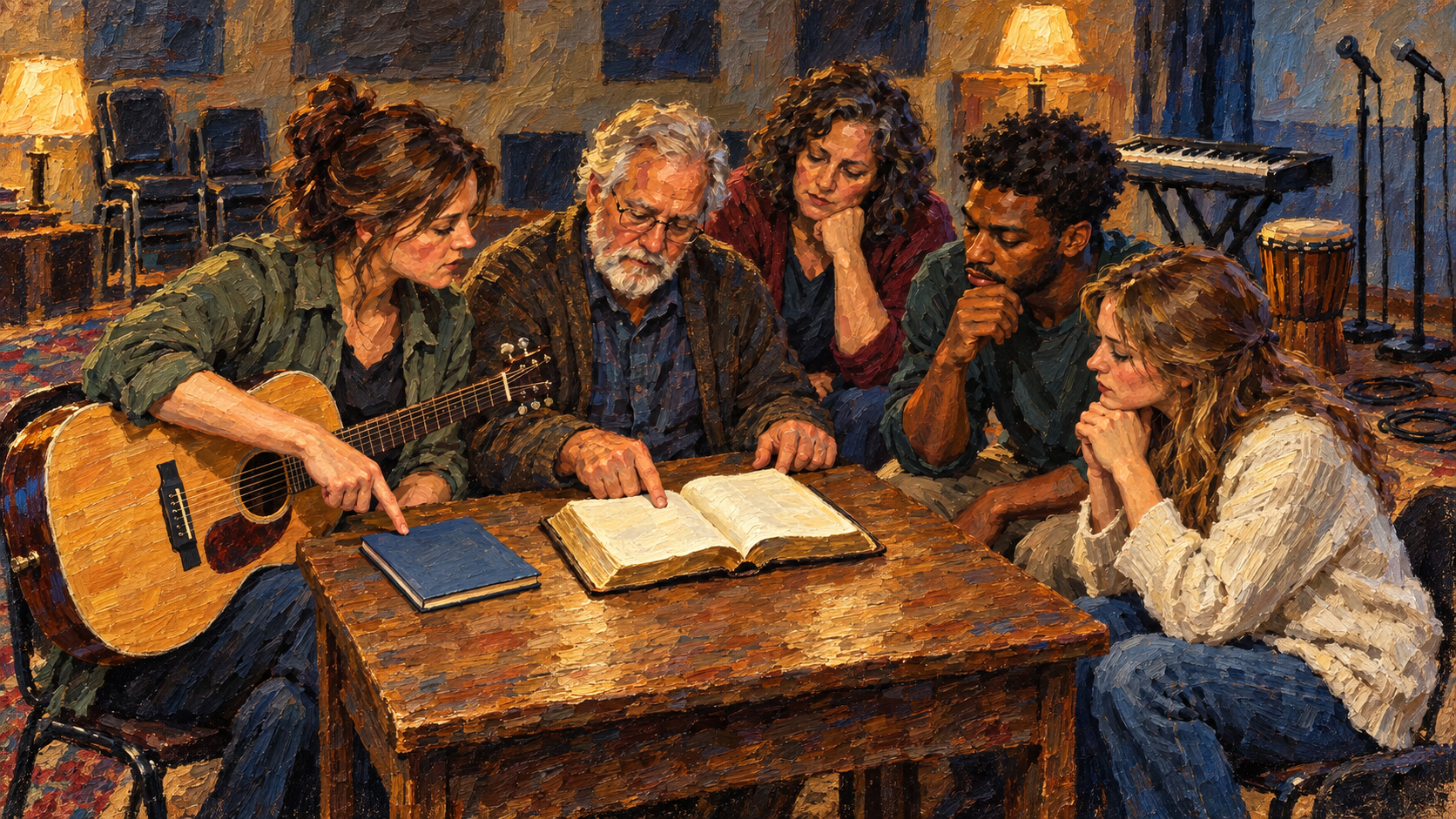
I ought to know what I am saying when I sing to God. A familiar song can come so easily that I scarcely think about its lyrics, especially when I enjoy the music. But those words make claims about God, about us, and about what He has promised. Before calling a song biblical praise, we need to examine those claims. A moving arrangement can help us express the truth, but it cannot make an inaccurate lyric true.
Praise Begins with God
The book of Psalms does not reach its final call to praise by ignoring suffering. We have already heard God’s people confess sin, grieve over evil, and cry out in fear. Some of their prayers are anguished. After letting us hear all of that, Psalm 150 calls everything with breath to praise the Lord.
Praise the LORD! Praise God in His sanctuary; Praise Him in His mighty firmament! Praise Him for His mighty acts; Praise Him according to His excellent greatness! Praise Him with the sound of the trumpet; Praise Him with the lute and harp! Praise Him with the timbrel and dance; Praise Him with stringed instruments and flutes! Praise Him with loud cymbals; Praise Him with clashing cymbals! Let everything that has breath praise the LORD. Praise the LORD!
The psalm begins with God’s sanctuary and His mighty firmament, calling for praise among His people and throughout His creation. I can praise Him outdoors or while working at home, but that does not make gathering with the church unnecessary. Under the new covenant, believers also come together to thank Him and confess the truth as a body.
The psalm directs our attention to God’s mighty acts and excellent greatness. He made the world and rules it righteously, and His works reveal His power and faithfulness to His people. Those are reasons to praise Him even when our own circumstances are painful. I do not have to pretend a loss has stopped hurting before I can acknowledge the goodness of God.
The Hebrew verb halal, used repeatedly here, means to praise. God’s people are openly declaring greatness He already possesses. Singers and musicians should use their abilities to help people honor Him. If we leave the gathering impressed with the performers but have scarcely considered the Lord they sang about, we ought to question where our attention has gone.
For Christians, praise for God’s saving work centers on Jesus Christ, His death for our sins, and His bodily resurrection. A church can sing a great deal about its own hopes and feelings while saying very little about what the Savior actually did. Our songs need to speak truthfully about His character and grace, take sin and judgment seriously, and give us reason to trust Him and live holy lives. Not every song has to explain every doctrine, but the songs we keep singing should teach us to know the Lord rather than simply describe how we want to feel.
Psalm 150 gives us no reason to despise musical beauty or instruments. It names everything from the trumpet and harp to clashing cymbals, with dancing among its expressions of praise. These are not instructions to assemble the entire list every time the church meets. They do, however, make it difficult to argue that instruments or vigorous rejoicing are inherently worldly.
We still need to consider how our expression of praise affects the gathered church. In 1 Corinthians 14, Paul directs believers to use their gifts so that others can understand and be built up. His closing instruction applies to the gathering as a whole.
Let all things be done decently and in order.
Order does not require everyone to look solemn, and joy does not excuse ignoring the people around us. If the volume prevents people from understanding the words or participating, turning it up further is not a spiritual accomplishment. The Old Testament includes dancing at times of celebration, but it does not command every church gathering to include it. Nor should we insist that someone who moves while singing must be irreverent. We need reverence and self-control, and we should care about how our actions help or hinder others in worship.
God Saves, Then His People Sing
After the Lord brought Israel through the sea, Moses and the people sang about what He had done. They had been trapped, unable to deliver themselves from Pharaoh’s army, and God had rescued them. Their song followed His deliverance.
Then Moses and the children of Israel sang this song to the LORD, and spoke, saying: “I will sing to the LORD, For He has triumphed gloriously! The horse and its rider He has thrown into the sea! The LORD is my strength and song, And He has become my salvation; He is my God, and I will praise Him; My father’s God, and I will exalt Him.”
Israel did not obtain that rescue by singing enthusiastically enough. I need to remember that when I come to praise God, because it is easy to start treating a worship experience as something that earns His approval. Neither my voice nor my emotional intensity can purchase His favor. Believers give thanks because He has acted mercifully to redeem us, and we approach Him through Jesus Christ.
Paul makes that dependence on Christ explicit when he describes praise as an offering to God in Hebrews.
Therefore by Him let us continually offer the sacrifice of praise to God, that is, the fruit of our lips, giving thanks to His name.
The words “by Him” tell us how we come. Jesus is the eternal Son, fully God and fully man, who lived without sin. Wicked men tortured Him and put Him to death, but He willingly gave Himself to be slain as the sinless, perfect sacrifice for our sins. He shed His blood to redeem us and completed that saving work through His death before His burial and bodily resurrection. The Father did not punish, curse, abandon, strike, bruise, or pour wrath on Jesus. Father and Son acted in unity to redeem us.
Christ died for the sins of the whole world, so God’s offer of salvation is genuine for every person. A person can resist His grace and reject Him, but everyone who repents and trusts in Jesus receives forgiveness and new birth. The Holy Spirit lives within that believer and seals him, and his salvation is eternally secure in Christ. That is why acceptance before God cannot depend on whether a song moved me or I managed to sing it well.
Calling ourselves Christians and joining the singing are not, by themselves, proof that we have been born again. Regeneration means that God has given a person new life, and we should see evidence of that life in his conduct. His obedience does not earn salvation or keep him saved, nor does being born again mean that he never sins. The assurance we have in Christ gives us reason to thank Him, without giving us permission to disregard His commands.
The sacrifice of praise in Hebrews is offered through Christ in joy as well as sorrow. At times, though, giving thanks is costly because grief makes the words difficult to say. A believer can acknowledge that pain and still thank the Lord for what is true about Him. I think we should be careful not to pressure someone into pretending to be cheerful in order to prove that he trusts God.
Continual praise does not mean singing every waking moment. Gratitude should become part of our speech and ordinary conduct, including at home and at work, where no one is leading the music. The study on thanksgiving in the Bible considers how believers can keep giving thanks, including during trouble.
Singing Teaches the Church
When believers sing together, they address one another as well as the Lord. The words we share can remind a discouraged person of God’s faithfulness or confront an attitude we have been excusing. Paul connects that shared singing with learning and living by the word of Christ.
Let the word of Christ dwell in you richly in all wisdom, teaching and admonishing one another in psalms and hymns and spiritual songs, singing with grace in your hearts to the Lord.
Paul expects singing to teach us the truth and to admonish us, meaning to warn or correct us. A song can help us remember what God says long after a spoken explanation has faded from memory. Yet a familiar lyric can also become our explanation of a doctrine we have never examined in Scripture. We may accept its claims without question simply because we have sung them so often.
Repetition itself is not the problem. Repeating a biblical truth can help us dwell on it, but repeating a vague promise does not make the promise biblical. I want to be able to explain what I am singing and why I believe it. A short chorus can do that well; a lengthy song can still say very little.
Paul uses the Greek expressions psalmois, hymnois, and odais pneumatikais for psalms, hymns, and spiritual songs here and in Ephesians 5:19. These terms have overlapping uses, rather than dividing music into three modern styles. A hymn is a song of praise, and the word for song is broader. Calling something a hymn does not establish that its theology is sound, just as calling it a chorus does not establish that its theology is shallow.
In Ephesians, singing belongs to the Spirit-filled life: believers address one another, make melody to the Lord, and give thanks to the Father in Jesus’ name. The Holy Spirit is a divine Person who directs us to Christ and works in agreement with the Word He inspired. His work gives us reason to sing with understanding and gratitude. We should not confuse being filled with the Spirit with being carried along by an atmosphere we find exciting.
Paul’s instruction involves the whole church, so leaders need to choose songs the congregation can actually sing. A soloist may handle a demanding vocal range and an intricate melody beautifully, but that does not make the same arrangement suitable for the whole congregation. Leaders should consider whether ordinary singers can follow the tune, keep their place in the rhythm, and understand the words. Musical skill serves the gathering when it helps those people participate.
I would not insist that every arrangement be plain or that every unfamiliar song be discarded. The congregation can learn new music, but if the musicians consistently take over while the people watch, the church is losing something Paul told it to do together. The leader should want to hear the people singing, and the accompaniment should leave room for their voices and the meaning of the words.
That includes making room for people whose taste differs from mine. An older believer and a younger believer worship the same Lord, as do the trained singer and the person who struggles to carry a tune. If a song is faithful and helps the church sing, I can receive it gratefully even when I would not have chosen its style. My preference does not deserve to govern everyone else’s opportunity to praise God.
Worship Must Join Spirit and Truth
Jesus’ conversation with the Samaritan woman takes the question of worship deeper than musical choices. She raised the dispute between worship on Mount Gerizim and worship in Jerusalem. Jesus did not treat both traditions as equally true; He said that salvation is of the Jews. As the Messiah, He announced that worship of the Father would no longer depend on either location.
But the hour is coming, and now is, when the true worshipers will worship the Father in spirit and truth; for the Father is seeking such to worship Him. God is Spirit, and those who worship Him must worship in spirit and truth.
Worship “in spirit” reaches beyond an outward ceremony to the person who is approaching God. Completing the expected actions is not enough if my heart is disengaged. Jesus was not giving instructions for producing an atmosphere or telling us to trust every inward impression. The Father seeks people who truly worship Him, wherever they are.
To worship “in truth” is to approach the God revealed in Scripture and made known through Jesus Christ. We cannot invent a version of God we find more agreeable. I cannot dismiss His holiness because a song about unconditional approval makes me feel accepted. Nor should I imagine that He is less merciful than Scripture says because I find it difficult to believe He would forgive me. We need His Word to correct our thinking in both directions.
That does not require us to sing without feeling. God’s mercy should stir gratitude, and recognizing our sin should bring repentance. The Psalms also give us words for grief and fear. We can bring those feelings honestly before the Lord while allowing what He has said to govern what we believe about Him.
Isaiah warned people who could say the expected words of worship while keeping their hearts far from God.
Therefore the Lord said: “Inasmuch as these people draw near with their mouths And honor Me with their lips, But have removed their hearts far from Me, And their fear toward Me is taught by the commandment of men.”
Jesus later repeated that warning. I can sing a true lyric and still refuse the correction it brings. Tears during a song do not settle whether I will forgive someone, admit a sin, or stop defending conduct Scripture condemns. Music can affect us deeply, and there is nothing wrong with that. The danger is treating the experience as proof that all is well with God while avoiding what He has told us to do.
When a song brings God’s mercy or holiness to mind, I need to respond to Him, rather than merely enjoy the way the song expresses them. The study on the Lord’s Prayer follows a similar order: Jesus teaches us to honor the Father and His name while bringing our actual needs before Him.
Test Songs as Part of Whole-Life Worship
Discernment does not require finding fault with every song. Paul told the Thessalonians not to quench the Spirit or despise prophecies, and also required them to examine what they received. They were neither to reject everything nor accept every claim uncritically.
Test all things; hold fast what is good.
The same instruction helps us assess the songs we sing. Read the lyrics without the music for a moment. What are they saying about God, about Jesus, and about our relationship with Him? If a line makes a promise, we should be able to find grounds for that promise in Scripture. Familiar Christian words do not guarantee that the songwriter is using them with their biblical meaning.
We also need to read the whole song. One accurate line about the cross cannot correct repeated claims that make repentance unnecessary or treat God as someone obliged to fulfill our wishes. On the other hand, a song does not become self-centered merely because it uses the word “I.” The Psalms speak personally about fear, gratitude, and dependence on God. We need to examine what the singer is saying, rather than object to a pronoun.
Once the lyrics have been examined, church leaders still need to consider where a song comes from. A biblically sound song can come from a ministry that also teaches serious error. That connection does not automatically answer every question about using it, but it deserves more thought than whether the tune is popular. Repeatedly drawing from one ministry may introduce its language and influence, and people may take the church’s use of its songs as a recommendation of its teaching.
Using one song carefully is different from building the church’s music around a source that directs people toward dangerous teachers. Leaders need to consider whether their choices will confuse less mature believers or draw them into following that ministry. The study on false teachers examines the doctrinal danger more fully. Here, we need to weigh the actual teaching and the effect on people, without condemning every song by association or ignoring an influence because we enjoy the music.
I also need to be honest when my objection is a preference. If I dislike a song’s tempo, its instrumentation, or an unfamiliar arrangement, I ought to say so. Practical preferences can help leaders decide what suits a particular congregation, but they do not carry the authority of a biblical command. A doctrinal objection needs to identify what the song teaches and explain where it conflicts with Scripture. Neither the song’s age nor the generation that enjoys it can do that work for us.
We should be willing to keep a faithful song and just as willing to leave one aside when its teaching is false or it consistently hinders the church’s participation. This calls for honesty from people on either side of a musical disagreement. I cannot defend a favorite song merely because it feels meaningful, and I should not condemn someone else’s favorite merely because its style is unfamiliar to me.
These questions apply to private listening too. The music we listen to while commuting, exercising, or working at home can keep words in our minds for hours. Music is a gift when it helps us remember Scripture, pray, and give thanks, including while grieving. Whatever we listen to, we should not use it to replace time in the Word, fellowship with believers, or obedience we have been putting off.
Paul’s appeal in Romans 12 helps keep singing in its proper place within the rest of our worship.
I beseech you therefore, brethren, by the mercies of God, that you present your bodies a living sacrifice, holy, acceptable to God, which is your reasonable service.
He calls believers to present their bodies to God because of His mercies. If I sing passionately on Sunday and then cheat someone at work on Monday, my singing does not excuse the dishonesty. The Lord has a claim on the way I work and speak, my sexual conduct, and the way I treat people who depend on me. Praise should help me remember His mercy and obey Him in those responsibilities.
And do not be conformed to this world, but be transformed by the renewing of your mind, that you may prove what is that good and acceptable and perfect will of God.
Having our minds renewed includes learning to judge differently from a culture preoccupied with celebrity and image. A performer’s popularity cannot tell us whether his lyrics are true, and an exhilarating experience does not establish that the church has been helped. Scripture teaches us to consider God’s honor and other people’s good, even when that requires changing something we personally enjoy.
My Final Thoughts
I want our singing to give us words we can mean before God and remember when the music has stopped. That requires truthful lyrics, but it also requires a willingness to believe and obey what we sing. We can value skill, enjoy a range of musical styles, and express real feeling while keeping those things under the authority of Scripture. If a song helps the church thank the Father through Christ and carries His truth into our ordinary lives, we have good reason to sing it together.