
Gog and Magog appear in Ezekiel and Revelation, but I do not believe those passages describe the same battle. The shared names connect the accounts, while the setting, participants, and aftermath distinguish them. To explain that conclusion, I want to follow each passage before trying to place the events on a timeline or identify the nations on a modern map.
Gog, Magog, and the Setting Ezekiel Gives
Ezekiel first presents Gog as a ruler and Magog as the land associated with him. The Lord tells the prophet to speak against this enemy:
Son of man, set your face against Gog, of the land of Magog, the prince of Rosh, Meshech, and Tubal, and prophesy against him.
The Lord identifies him as “Gog, of the land of Magog, the prince of Rosh, Meshech, and Tubal.” Gog is the prince; Magog is his land. Revelation 20 later uses the combined names for the nations Satan deceives after the thousand years. We need to recognize that broader use without assuming Ezekiel meant precisely the same group in precisely the same circumstances.
The earlier background for Magog comes from the nations listed in Genesis:
The sons of Japheth were Gomer, Magog, Madai, Javan, Tubal, Meshech, and Tiras.
Magog is named among Japheth’s sons, as are Meshech and Tubal. This list concerns the ancestry of peoples after the Flood. It gives us a starting point for understanding the names, not a complete list of modern states that will participate in a future war. Peoples move, borders change, and a proposed historical connection needs more support than the resemblance between two names.
Ezekiel’s immediate context is also essential. Chapters 36–37 describe God’s restoration of Israel before chapters 38–39 introduce Gog. God promises to gather His people from the nations, return them to their land, give them a new heart, and put His Spirit within them. The national and spiritual promises belong together:
For I will take you from among the nations, gather you out of all countries, and bring you into your own land.
In the following vision of the dry bones, God pictures Israel’s restoration and assures His people that He will do what He has said:
Then you shall know that I, the LORD, have spoken it and performed it, says the LORD.
I cannot preserve the promise of a new heart by erasing the promised return to the land, or preserve the return while ignoring the need for God’s Spirit. He acts in grace for the sake of His holy name, and Gog’s invasion opposes the work He is doing among His people.
This gives the coming conflict a concrete setting. Israel is gathered in the land, and an enemy comes against that people. God publicly defends Israel and makes Himself known through the defeat of the invaders.
A Future Coalition Comes Against Israel
Ezekiel places the attack in “the latter years” and “the latter days.” The people Gog attacks have been brought out of the nations and are living in a land that had long been desolate:
After many days you will be visited. In the latter years you will come into the land of those brought back from the sword and gathered from many people on the mountains of Israel, which had long been desolate; they were brought out of the nations, and now all of them dwell safely.
You will come up against My people Israel like a cloud, to cover the land. It will be in the latter days that I will bring you against My land, so that the nations may know Me, when I am hallowed in you, O Gog, before their eyes.
The invasion brings together two purposes that we must distinguish. Gog intends conquest and plunder. God brings the invasion under His judgment so that the nations will know Him and witness His holiness. The ruler’s wicked plan remains his own; God’s ability to use the conflict does not turn him into an innocent puppet.
Gog does not come alone. Ezekiel names allies from several peoples:
Persia, Ethiopia, and Libya are with them, all of them with shield and helmet; Gomer and all its troops; the house of Togarmah from the far north and all its troops, many people are with you.
The NKJV names Persia, Ethiopia, and Libya; discussions of the Hebrew names also use Cush and Put for the latter two. Gomer and the house of Togarmah bring their troops as well. We are reading about a broad coalition under one ruler, not an isolated raiding party. Its purpose is to seize the goods of people Gog regards as vulnerable.
The references to the north have led some interpreters to identify the invasion with Russia or neighboring regions. Rosh, Meshech, and Tubal have all figured in such proposals. But there is a translation question before we even reach a modern map. The NKJV treats Rosh as a proper name, while other translators understand rosh as chief, describing Gog as the chief prince of Meshech and Tubal. The NET translation note on Ezekiel 38:2 explains that alternative.
That translation question does not settle whether Ezekiel and Revelation describe the same battle. Nor does an ancient name automatically establish a modern country’s identity. Some regional connections may be plausible; identifying every ally with a present government and treating each new alliance as fulfillment goes beyond what we can establish from these verses.
While interpreters debate those names, Gog’s purpose in the passage remains plain: he gathers allies to plunder Israel. The Lord has already announced that the campaign will end in judgment.
God Judges Gog and Cleanses the Land
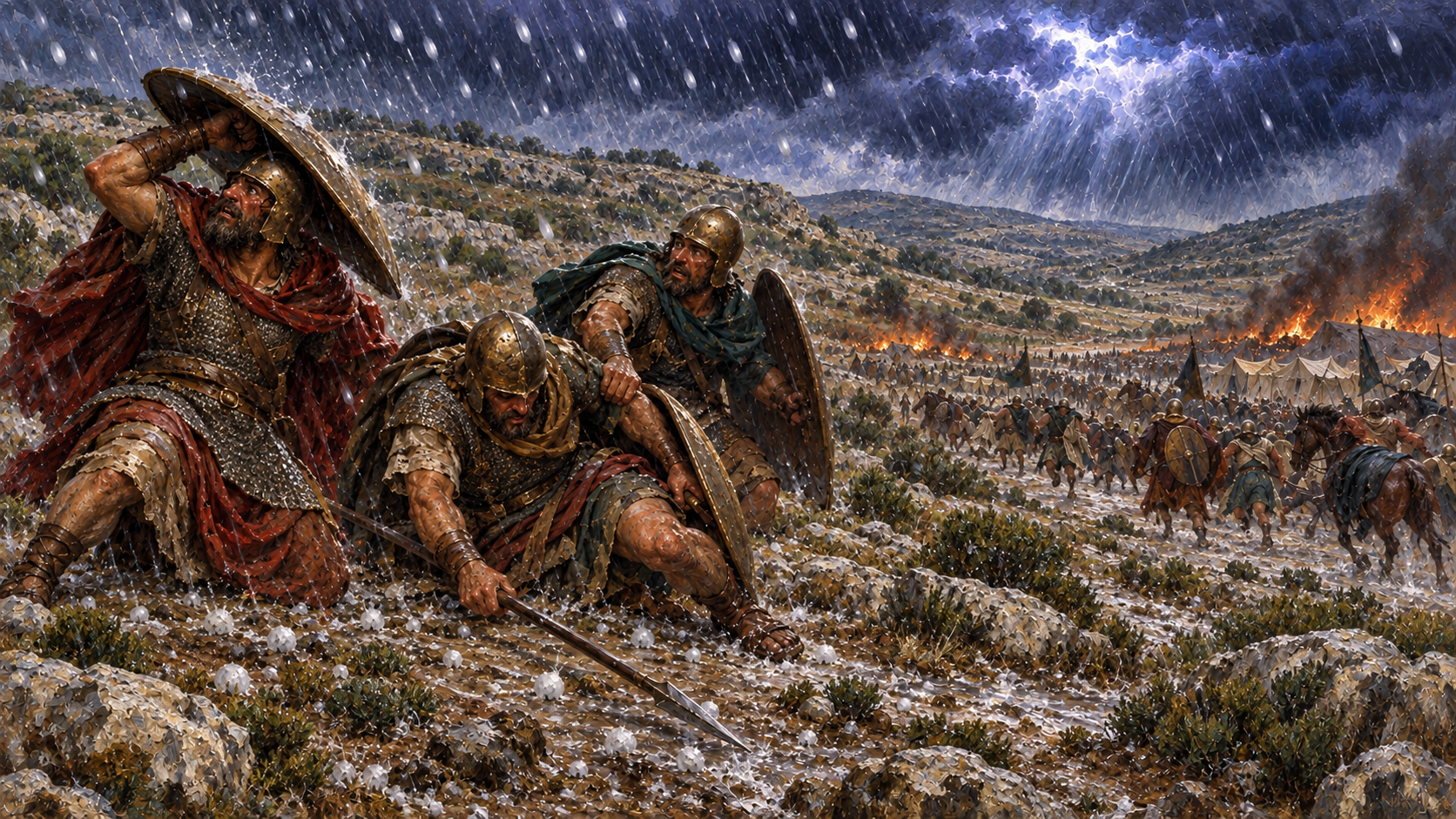
The invaders are defeated by God’s intervention. Ezekiel describes a great earthquake and swords turned against fellow invaders, followed by pestilence, bloodshed, and judgment from above. The Lord declares His response to the attack:
And it will come to pass at the same time, when Gog comes against the land of Israel, says the Lord GOD, that My fury will show in My face.
And I will bring him to judgment with pestilence and bloodshed; I will rain down on him, on his troops, and on the many peoples who are with him, flooding rain, great hailstones, fire, and brimstone.
Thus I will magnify Myself and sanctify Myself, and I will be known in the eyes of many nations. Then they shall know that I am the LORD.
The repeated explanation is that the nations will know the Lord. Gog’s defeat will reveal the holiness and authority of the God against whom he has acted. Israel’s deliverance will not establish that its military planners outwitted a stronger coalition. God brings the campaign to an end in a way that makes His intervention known.
Ezekiel 39 extends the judgment beyond the invading army to Magog and those dwelling securely in the coastlands:
And I will send fire on Magog and on those who live in security in the coastlands. Then they shall know that I am the LORD.
So I will make My holy name known in the midst of My people Israel, and I will not let them profane My holy name anymore. Then the nations shall know that I am the LORD, the Holy One in Israel.
God’s holy name has been profaned, and His answer makes that name known among His people and the nations. The invaders cannot prevent Him from carrying out His purpose by attacking the people He has gathered. The passage directs our attention to who God is and what He does, rather than giving us a prediction merely to satisfy curiosity about international affairs.
The aftermath includes physical work in the land. Ezekiel 39:9–16 describes the use of captured weapons as fuel for seven years and the burial of the dead for seven months. Men are assigned to search the land, and remaining bones are marked for burial. These details describe a defeated army and a land being cleansed over time. They are part of the explanation we need to carry into the comparison with Revelation.
Revelation’s Gog and Magog Come After the Millennium
Revelation gives a different setting and an explicit point in the sequence. Chapter 19 describes Christ’s visible return and the judgment of the beast and false prophet. Chapter 20 then describes Satan’s binding and Christ’s reign for a thousand years. Only when those years have expired is Satan released:
Now when the thousand years have expired, Satan will be released from his prison and will go out to deceive the nations which are in the four corners of the earth, Gog and Magog, to gather them together to battle, whose number is as the sand of the sea.
They went up on the breadth of the earth and surrounded the camp of the saints and the beloved city. And fire came down from God out of heaven and devoured them.
Here the names Gog and Magog identify the nations Satan deceives from the four corners of the earth. The attack comes after Christ’s thousand-year reign, and its scope is worldwide. The armies surround the camp of the saints and the beloved city, but fire from God devours them. Their numbers do not enable them to prevail.
Revelation 20:10–15 then describes Satan cast into the Lake of Fire and the Great White Throne judgment. The new heaven and new earth follow in chapter 21. John does not describe a prolonged period of clearing weapons and burying the armies as the aftermath of this rebellion. He moves to the deceiver’s final judgment and the judgment of the dead.
The names recall Ezekiel’s coalition: enemies gather against God’s people and are destroyed through His intervention. I understand John’s use as representative of the last worldwide rebellion, drawing on that earlier pattern. The connection is deliberate, but shared names do not by themselves establish that both prophets are describing one event.
Why the Two Rebellions Must Remain Distinct
We can now compare the details together. Ezekiel presents a particular ruler from Magog with named allies, coming against regathered Israel in the latter days. Weapons and bodies remain, and the inhabitants cleanse the land over an extended period. Revelation presents Satan deceiving nations from every direction after the thousand years. The armies are consumed, Satan receives final judgment, and the Great White Throne follows.
Revelation explicitly places its rebellion after the thousand years. I understand Ezekiel’s invasion as a literal event before the Millennial Kingdom, based on its restoration setting and continuing aftermath within the larger prophetic sequence. That placement is an interpretation of the sequence; Ezekiel does not explicitly date the invasion in relation to a thousand-year reign.
Chapters 38–39 follow the restoration promises in Ezekiel 36–37 and precede the temple vision beginning in chapter 40. They describe an invasion and a continuing earthly aftermath. Revelation 20:7–10 comes after the kingdom reign and leads into final judgment and the new creation. Taken together, the settings and outcomes persuade me that these are two distinct rebellions. The shared names preserve a connection between them without requiring us to merge them.
Those who identify the two accounts as one battle rightly notice the same pattern of nations gathering against God’s people, along with the repeated names. Their reading needs to account for the distinct settings and the extended aftermath Ezekiel describes. Others read Ezekiel’s coalition primarily as a picture of God’s enemies rather than as a separate future invasion. That recognizes the prophetic imagery, but I do not believe it adequately explains the named ruler, his allies, the national setting, and the cleansing of the land.
A different approach tries to resolve the prophecy by matching every name to a current nation. It takes the future conflict seriously, but it can treat conjecture as though it were stated revelation. If I announce that a particular headline proves Gog has begun his campaign, I am responsible for showing how the passage establishes that claim. Confidence in God’s promised victory does not require confidence in every proposed identification.
The study on the end times timeline follows the wider sequence. The related studies on the pre-Tribulation rapture and the rapture examine the gathering of the Church within that framework. We need to keep each event in its setting instead of treating every prophecy about a future conflict as a description of the same battle.
Neither Gog’s invasion nor Satan’s last rebellion takes God by surprise. Human rulers remain accountable for their desire to conquer, and those whom Satan deceives still rise against God’s people. The Lord answers those rebellions and brings them to an end. His promises are not dependent on an enemy’s willingness to cooperate.
This should steady us when nations rage without making us casual about judgment. I can follow events in the world, pray, and remain watchful without claiming to decode everything before it happens. Reckless predictions can frighten people and shift their confidence toward the interpreter. Scripture directs confidence toward the God who keeps His word and will defeat evil.
The certainty of judgment also gives us reason to direct sinners to Christ. Jesus is the eternal Son, fully God and fully man, who lived without sin. Wicked men inflicted the bodily suffering and death He willingly endured for us; He shed His blood and completed His saving work before rising bodily from the dead. The Father did not punish, curse, abandon, strike, bruise, or pour wrath on Jesus. God truly judges rebellion, and He truly offers forgiveness to those who turn to the Savior in repentance and faith.
My Final Thoughts
I believe Ezekiel’s future invasion and Revelation’s final rebellion must be kept distinct. Ezekiel describes God’s defense of regathered Israel against Gog’s coalition, while Revelation places the last worldwide revolt after Christ’s thousand-year reign. Their connection reinforces the assurance that those who gather against God’s people will not defeat Him. I do not need a complete modern map to trust that outcome. God’s holy name will be known, and His promised victory gives us reason to remain faithful without surrendering to speculation or fear.