
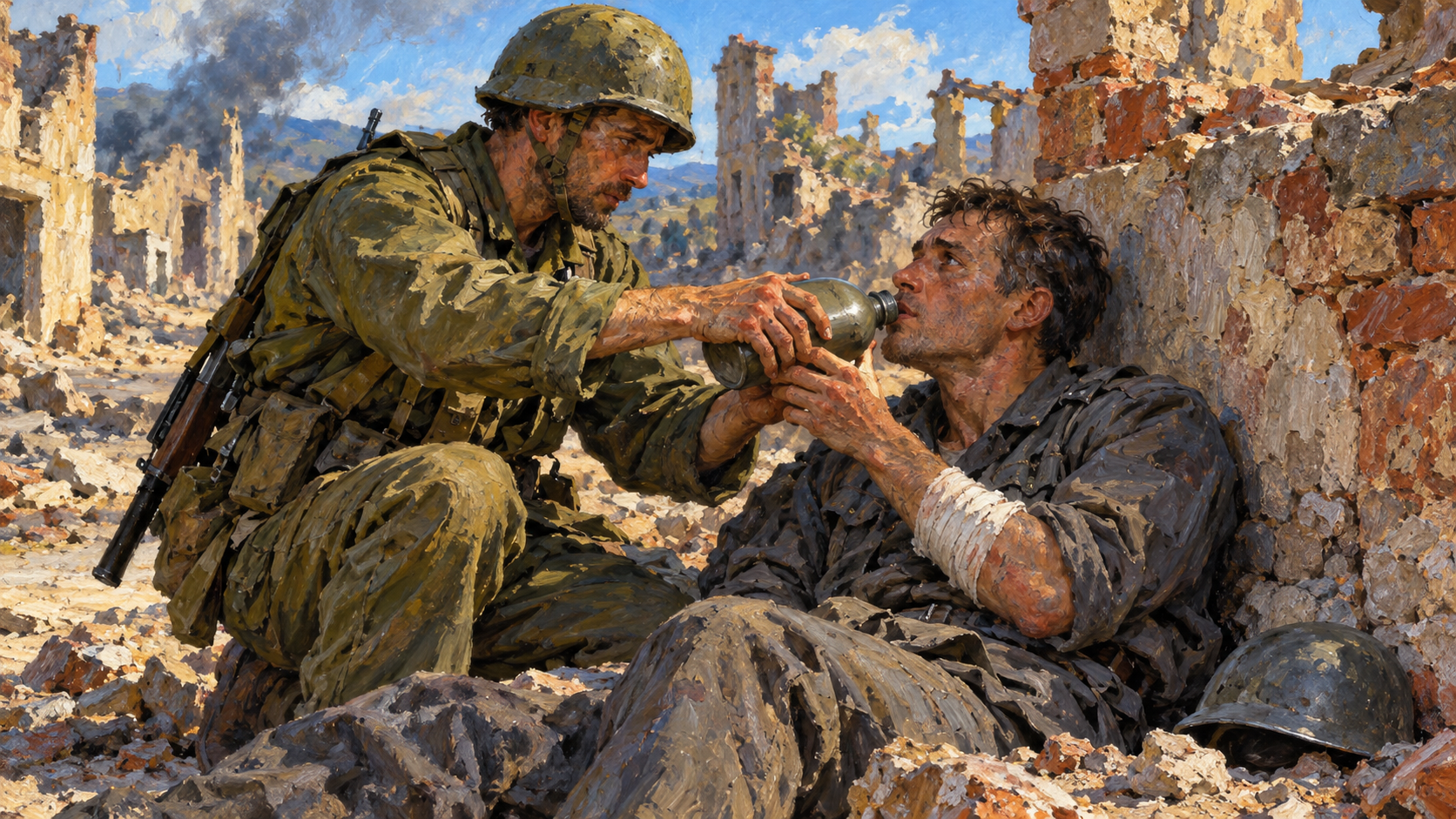
How should a Christian think about war without making violence either unthinkable or easy? Scripture commands us to love enemies and refuse personal vengeance. It also gives civil government authority to restrain public evil and recognizes circumstances in which life may be defended. I want to keep those responsibilities together while asking what separates lawful force from murder, revenge, or blind loyalty to a government.
Human Life and the Limits of Force
War brings these questions into people’s homes and bodies. Families lose loved ones, civilians are displaced, and soldiers may carry injuries, memories, and guilt long after their service ends. A government may protect people in one action and deceive its citizens about another. Courage in battle does not make every order righteous, and an observer far from the danger should not pretend every decision was simple.
I do not believe Scripture requires absolute pacifism, the rejection of all armed force, or grants governments an unrestricted right to fight. The private believer must refuse revenge, love enemies, and pursue peace. Civil government has a limited responsibility to restrain and punish public evil. The church advances the gospel without a physical sword, while final judgment belongs to Christ alone. Confusing those responsibilities can turn enemy love into indifference toward victims or turn public authority into an excuse for aggression.
Some force can be lawful and necessary to protect innocent life, but neither a uniform nor a flag makes it righteous. God judges why it began, who authorized it, whom it targeted, how it was used, and what followed. Before considering a particular conflict, we need the reason Scripture gives for valuing every human life:
Surely for your lifeblood I will demand a reckoning; from the hand of every beast I will require it, and from the hand of man. From the hand of every man's brother I will require the life of man. "Whoever sheds man's blood, By man his blood shall be shed; For in the image of God He made man.
After the Flood, God required an accounting for human blood because He made mankind in His image. A person’s worth does not depend on strength, usefulness, citizenship, or ethnicity. Nor must someone be innocent of every other wrong to possess that dignity. The passage both condemns bloodshed and establishes accountability for it. It cannot be reduced to either indifference toward a victim or a license for private retaliation.
Enemies bear God’s image too. Civilians, prisoners, wounded opponents, and foreigners do not become less than human because our cause is just. Torture, rape, pillage, and false accusation remain evil. At the same time, the life of someone under attack deserves protection. Love for an aggressor does not require allowing him to destroy another person. Defense seeks to stop unjust harm while retaining concern for everyone involved.
The sixth commandment must be read with those distinctions in view. In the NKJV, Exodus 20:13 says, “You shall not murder.” The Hebrew verb ratsach is used in laws concerning homicide, including forms applied in Numbers 35 to murderers and to manslayers who killed unintentionally. Its meaning cannot be settled by saying every occurrence describes deliberate murder or, at the opposite extreme, every death is forbidden.
The surrounding laws examine intent, prior hatred, negligence, the instrument used, and what witnesses can establish. They distinguish treacherous killing from accidental death, regulate public judgment, and address defense during a dangerous intrusion. The command forbids unlawful bloodshed; a word definition alone cannot determine the guilt of everyone who causes a death. The Difference Between Killing and Murder considers those distinctions more fully.
A government therefore cannot make someone innocent merely by calling his action war, but death in combat does not automatically make every soldier a murderer. Authorization, purpose, targets, intention, and conduct all require judgment. Official service places a person under responsibility to God rather than beyond it.
Divine Judgment and Israel’s Covenant Wars
Israel’s song after the crossing of the sea openly praises the LORD for defeating Pharaoh’s army:
Then Moses and the children of Israel sang this song to the LORD, and spoke, saying: "I will sing to the LORD, For He has triumphed gloriously! The horse and its rider He has thrown into the sea! The LORD is my strength and song, And He has become my salvation; He is my God, and I will praise Him; My father's God, and I will exalt Him. The LORD is a man of war; The LORD is His name.
Egypt had enslaved Israel and murdered Hebrew sons. Pharaoh resisted repeated warnings, released the people, and then pursued them with his army. The LORD opened the sea for Israel and judged the pursuers. Their song celebrates a real deliverance and a real judgment. Force and judgment cannot be inherently contrary to God’s character when Scripture identifies Him as the One who acted.
The expression “a man of war” describes the LORD as a warrior, the victorious champion of His people. It does not mean God is a male human creature. He is Spirit, eternal and uncreated, holy and merciful. His judgment belongs with His patience and goodness rather than contradicting them.
A modern ruler cannot acquire that authority by calling an opponent Pharaoh. God knew every fact, gave the warnings, and personally carried out the judgment. A human government’s claim to fight for Him is still subject to examination. Israel’s later wars also belonged to a particular covenant arrangement rather than an unlimited permission to conquer:
"When you go out to battle against your enemies, and see horses and chariots and people more numerous than you, do not be afraid of them; for the LORD your God is with you, who brought you up from the land of Egypt. So it shall be, when you are on the verge of battle, that the priest shall approach and speak to the people. And he shall say to them, 'Hear, O Israel: Today you are on the verge of battle with your enemies. Do not let your heart faint, do not be afraid, and do not tremble or be terrified because of them; for the LORD your God is He who goes with you, to fight for you against your enemies, to save you.' "Then the officers shall speak to the people, saying: 'What man is there who has built a new house and has not dedicated it? Let him go and return to his house, lest he die in the battle and another man dedicate it. Also what man is there who has planted a vineyard and has not eaten of it? Let him go and return to his house, lest he die in the battle and another man eat of it. And what man is there who is betrothed to a woman and has not married her? Let him go and return to his house, lest he die in the battle and another man marry her.' "The officers shall speak further to the people, and say, 'What man is there who is fearful and fainthearted? Let him go and return to his house, lest the heart of his brethren faint like his heart.' And so it shall be, when the officers have finished speaking to the people, that they shall make captains of the armies to lead the people.
The priests reminded Israel that the LORD who brought them out of Egypt would go with them. The officers then released men who had not dedicated a new house, enjoyed a vineyard’s fruit, or married a betrothed wife. Fearful men could also return home so their fear would not spread. Even this army did not have an unlimited claim on every available man.
Later in Deuteronomy 20, Israel was required to offer terms of peace to distant cities before a siege, while fruit trees were protected from destruction for military convenience. The chapter distinguished that warfare from the specified judgment on Canaan. It required attention to peace, participation, and what could be destroyed. We can learn restraint and accountability from it without treating a modern government as Israel or its chaplain as an Israelite priest.
Israel sometimes fought faithfully and sometimes fought in rebellion. Civil war could expose moral collapse, and kings pursued ambitions, ignored prophets, or trusted military power instead of the LORD. Some battles had God’s approval, which prevents calling every war evil. That approval did not extend automatically to every campaign Israel undertook.
The conquest of Canaan requires us to face the hardest part of these accounts: God commanded judgments upon whole communities. Genesis 15:16 describes His patience while Amorite iniquity developed. Leviticus 18 names grave sins and warns Israel that the land would also expel them for practicing those evils. Deuteronomy 9 denies that Israel received the land because it was righteous. The conquest was a particular divine judgment within a defined covenant promise, not a declaration of Israel’s moral superiority.
That judgment concerned evil rather than racial worth. Rahab received mercy through faith. The Gibeonites survived through a flawed treaty that Israel nevertheless had to honor. Israel later suffered severe judgment for adopting the same sins. Direct revelation through Moses and Joshua, a defined territory, and God’s covenant promise set this apart from a nation deciding its enemies deserve extermination.
God created every life and has the right to judge it. His perfect knowledge and justice are not possessions He has handed to modern rulers. No army, nation, church, or individual may use Canaan as standing permission for ethnic cleansing, land seizure, religious conquest, or killing unbelievers. A Complete Bible Study on the Land of Canaan examines the judgment in its own setting.
Amalek likewise faced a particular judgment after attacking Israel and resisting God across generations. Samuel’s command to Saul concerned that people at that time; it did not authorize later governments to designate another Amalek for themselves. The church has received no commission like Joshua’s. Christ sends us to proclaim His gospel, baptize believers, and teach obedience. Weapons can compel outward submission but cannot produce repentance or the new birth.
David’s life illustrates both faithful courage in battle and the danger of assuming that a warrior’s conduct is always righteous:
Then David said to the Philistine, "You come to me with a sword, with a spear, and with a javelin. But I come to you in the name of the LORD of hosts, the God of the armies of Israel, whom you have defied. This day the LORD will deliver you into my hand, and I will strike you and take your head from you. And this day I will give the carcasses of the camp of the Philistines to the birds of the air and the wild beasts of the earth, that all the earth may know that there is a God in Israel. Then all this assembly shall know that the LORD does not save with sword and spear; for the battle is the LORD's, and He will give you into our hands."
Goliath had defied Israel and the living God. David faced him in the LORD’s name, placing his confidence in God’s power rather than conventional military superiority. His victory would make known that there was a God in Israel and that the battle belonged to Him.
As king, David also inquired of the LORD before fighting and received different instructions in different circumstances. A previous victory did not supply an automatic strategy for the next campaign. Yet this same man arranged Uriah’s murder under cover of battle. Military structures that served a public purpose became instruments of his personal evil.
First Chronicles also records that David’s wars and bloodshed were a reason God chose Solomon, a man of rest, to build the temple. That does not pronounce every battle David fought sinful, but it keeps us from romanticizing bloodshed. Calling him a man after God’s heart concerns God’s choice and his kingship; it does not declare all his actions sinless. We can learn from his faith before Goliath without excusing his crimes.
Peacemaking, Enemy Love, and Christ’s Kingdom
Jesus gives peacemaking a place among the conduct that reflects our Father:
Blessed are the peacemakers, For they shall be called sons of God.
Peacemakers do more than avoid starting fights. They tell the truth, work to repair wrong, restrain retaliation, and seek reconciliation. Peace is not weakness, but neither is every announcement of peace truthful. Jeremiah condemned prophets who promised peace where there was none. A settlement built on lies, abandonment of victims, or rewards for aggression may only prepare the way for renewed violence.
Psalm 34 tells us to seek peace and pursue it. Paul qualifies the command in Romans 12 with what is possible and what depends on us. Another person may refuse sincere efforts, but I remain responsible for doing what is truthful and righteous on my side. Ecclesiastes 3:8 recognizes a time of war and a time of peace. We need wisdom under God to discern those times rather than use the verse as permission to act on impulse.
The future Isaiah and Micah describe is not endless warfare. Under the Messiah’s judgment, nations turn swords into plowshares. Even when force becomes necessary in this fallen world, its proper aim is a just peace. Jesus’ teaching about personal injury and enemies must shape how we seek it:
"You have heard that it was said, 'An eye for an eye and a tooth for a tooth.' But I tell you not to resist an evil person. But whoever slaps you on your right cheek, turn the other to him also. If anyone wants to sue you and take away your tunic, let him have your cloak also. And whoever compels you to go one mile, go with him two. Give to him who asks you, and from him who wants to borrow from you do not turn away. "You have heard that it was said, 'You shall love your neighbor and hate your enemy.' But I say to you, love your enemies, bless those who curse you, do good to those who hate you, and pray for those who spitefully use you and persecute you, that you may be sons of your Father in heaven; for He makes His sun rise on the evil and on the good, and sends rain on the just and on the unjust. For if you love those who love you, what reward have you? Do not even the tax collectors do the same? And if you greet your brethren only, what do you do more than others? Do not even the tax collectors do so? Therefore you shall be perfect, just as your Father in heaven is perfect.
The law of an eye for an eye limited public penalties to proportionate justice. Jesus confronted the use of that language to defend personal payback. His disciples were to surrender the impulse to answer injury with injury, give generously, bless those who cursed them, and pray for persecutors. The command challenges our desire to make an enemy suffer because we have suffered.
A slap on the right cheek could carry insult and humiliation, but the verb still describes a real strike. We need not deny bodily injury to understand the demand to refuse retaliation. Jesus also directs love toward people who genuinely hate and persecute us, rather than only toward people whose wrongdoing was minor.
I do not understand this as a command to remain under abuse, conceal a crime, or watch a neighbor be attacked. Jesus withdrew from danger and confronted wrongdoing; Paul exercised legal rights and accepted public protection. Reporting violence, seeking safety, and asking authorities to restrain an aggressor can agree with refusing revenge. A person may accept a personal loss without being required to surrender a child, spouse, neighbor, or stranger to serious violence.
Enemy love remains binding when restraint is necessary. A Christian can seek to stop an attack without cultivating hatred, pray for the offender’s repentance, and insist that a prisoner receive humane treatment. Love seeks a person’s true good under God’s truth. It neither approves the wrongdoing nor permits cruelty in response.
The sword language in Luke 22 needs the same care. Jesus spoke as His arrest approached:
And He said to them, "When I sent you without money bag, knapsack, and sandals, did you lack anything?" So they said, "Nothing." Then He said to them, "But now, he who has a money bag, let him take it, and likewise a knapsack; and he who has no sword, let him sell his garment and buy one. For I say to you that this which is written must still be accomplished in Me: 'And He was numbered with the transgressors.' For the things concerning Me have an end." So they said, "Lord, look, here are two swords." And He said to them, "It is enough."
Earlier the disciples had lacked nothing when sent without ordinary supplies. Jesus now prepared them for rejection and hardship, mentioning money, a knapsack, and a sword. He immediately connected the moment to Isaiah’s prophecy that He would be numbered with transgressors.
When they produced two swords, He said, “It is enough.” Some understand literal preparation, others a symbolic warning or a provision connected with the circumstances of His arrest, and some combine these readings. Two swords did not equip the disciples for a rebellion. Nor does the statement itself give a general rule authorizing lethal self-defense. We need to follow what happened when a disciple used one:
When those around Him saw what was going to happen, they said to Him, "Lord, shall we strike with the sword?" And one of them struck the servant of the high priest and cut off his right ear. But Jesus answered and said, "Permit even this." And He touched his ear and healed him. Then Jesus said to the chief priests, captains of the temple, and the elders who had come to Him, "Have you come out, as against a robber, with swords and clubs? When I was with you daily in the temple, you did not try to seize Me. But this is your hour, and the power of darkness."
The disciples asked whether to strike, but one acted before Jesus answered and cut off the right ear of the high priest’s servant. John 18:10 identifies the disciple as Peter. Jesus said, “Permit even this,” and healed the injured servant. Matthew records Jesus’ warning that those who take the sword perish by it and His ability to summon legions of angels. Jesus submitted to the appointed arrest rather than allow His disciples to fight it off.
Peter’s sword could not accomplish redemption or defend Christ’s kingdom. I cannot use the earlier reference to buying a sword to authorize aggression, revolution, or violence in service of the gospel. At the same time, this was Christ’s unique arrest, so the correction alone does not answer every question about policing, military service, or protecting someone from an attacker. Christians may prepare responsibly for a hostile world while refusing unchecked force or an armed mission for Christ. A Complete Bible Study on Gethsemane considers His willing submission more fully.
After His arrest, Jesus stood before the Roman governor Pilate, who questioned His kingship:
Then Pilate entered the Praetorium again, called Jesus, and said to Him, "Are You the King of the Jews?" Jesus answered him, "Are you speaking for yourself about this, or did others tell you this concerning Me?" Pilate answered, "Am I a Jew? Your own nation and the chief priests have delivered You to me. What have You done?" Jesus answered, "My kingdom is not of this world. If My kingdom were of this world, My servants would fight, so that I should not be delivered to the Jews; but now My kingdom is not from here." Pilate therefore said to Him, "Are You a king then?" Jesus answered, "You say rightly that I am a king. For this cause I was born, and for this cause I have come into the world, that I should bear witness to the truth. Everyone who is of the truth hears My voice."
The charge of kingship carried political danger, but Jesus explained that His kingdom did not originate in this world’s order. If it did, His servants would fight to prevent His being handed over. His kingdom is real, with heavenly authority. The church witnesses to that King through the gospel, prayer, sacrificial love, endurance, baptism, and teaching. Forced conversion contradicts that mission because outward compliance cannot create saving faith.
Christ still has a claim on public life, and Pilate remained accountable for his judgment. Civil government can restrain public evil, but the church cannot borrow its sword to evangelize. Christians may vote, advocate laws, serve in public office, or work in law enforcement without treating those activities as the means of saving people. No nation becomes the church, and no military victory converts a heart.
Private Vengeance, Civil Authority, and Defense
Paul’s teaching moves from the believer’s response to wrongdoing into the distinct responsibility of government. We should read the neighboring passages together:
Bless those who persecute you; bless and do not curse. Rejoice with those who rejoice, and weep with those who weep. Be of the same mind toward one another. Do not set your mind on high things, but associate with the humble. Do not be wise in your own opinion. Repay no one evil for evil. Have regard for good things in the sight of all men. If it is possible, as much as depends on you, live peaceably with all men. Beloved, do not avenge yourselves, but rather give place to wrath; for it is written, "Vengeance is Mine, I will repay," says the Lord. Therefore "If your enemy is hungry, feed him; If he is thirsty, give him a drink; For in so doing you will heap coals of fire on his head." Do not be overcome by evil, but overcome evil with good.
Believers must bless persecutors, refuse to repay evil with evil, and actively care for enemies. Feeding a hungry enemy or giving him a drink leaves personal vengeance with God while answering evil with good. This does not make wrongdoing unreal; earlier in the chapter Paul commands love to abhor evil.
If I pursue private revenge, I assume the roles of accuser, judge, and executioner with my own anger directing the result. A genuine injury does not guarantee that my retaliation will be truthful, proportionate, or harmless to innocent people. Refusing it leaves me free to seek safety and lawful justice without nourishing hatred. Reporting a crime, giving evidence, leaving danger, or requesting lawful protection is compatible with that refusal.
In the next paragraph, Romans 13, Paul turns to an office charged with acting against public evil:
Let every soul be subject to the governing authorities. For there is no authority except from God, and the authorities that exist are appointed by God. Therefore whoever resists the authority resists the ordinance of God, and those who resist will bring judgment on themselves. For rulers are not a terror to good works, but to evil. Do you want to be unafraid of the authority? Do what is good, and you will have praise from the same. For he is God's minister to you for good. But if you do evil, be afraid; for he does not bear the sword in vain; for he is God's minister, an avenger to execute wrath on him who practices evil. Therefore you must be subject, not only because of wrath but also for conscience' sake. For because of this you also pay taxes, for they are God's ministers attending continually to this very thing. Render therefore to all their due: taxes to whom taxes are due, customs to whom customs, fear to whom fear, honor to whom honor.
The ruler bears a sword as God’s servant to restrain and punish wrongdoing. This is more than authority to offer advice. Paul wrote under Roman government, not an ideal Christian state, so I read his description as the purpose of the office rather than an endorsement of everything an official does. Scripture condemns bribery, innocent bloodshed, self-exalting rulers, and calling evil good.
Governments may maintain courts, arrest violent offenders, and defend a population against aggression. They may not dictate worship, redefine good and evil, murder innocent people, or require what God forbids. Taxes, honor, and ordinary submission are duties, but an official chain of command cannot make an evil action righteous.
The church has no corresponding physical sword. It may teach, correct, warn of judgment, and remove an unrepentant member from fellowship. Church discipline does not authorize imprisonment, torture, execution, or religious war. A civil ruler and a church leader answer to God for different responsibilities.
The New Testament’s treatment of soldiers also keeps office and conduct together:
So the people asked him, saying, "What shall we do then?" He answered and said to them, "He who has two tunics, let him give to him who has none; and he who has food, let him do likewise." Then tax collectors also came to be baptized, and said to him, "Teacher, what shall we do?" And he said to them, "Collect no more than what is appointed for you." Likewise the soldiers asked him, saying, "And what shall we do?" So he said to them, "Do not intimidate anyone or accuse falsely, and be content with your wages."
John the Baptist forbade soldiers to intimidate people or accuse falsely and told them to be content with their wages. Repentance had to change their conduct where their authority created opportunities for extortion. He addressed them within their occupation without commanding them to resign.
Cornelius was a centurion who feared God, gave generously, and prayed. He then heard the gospel, believed, and received the Holy Spirit, and Peter commanded baptism. Acts 10 records no demand that he abandon military service. That silence is not a complete argument for every form of service, but it supports the possibility of serving faithfully without approving every assignment.
Paul also accepted military protection when conspirators planned to kill him in Acts 23. His nephew reported the plot to the commander, and Paul traveled under an escort of soldiers, horsemen, and spearmen. Accepting lawful protection did not replace trust in God. These accounts give me no basis to condemn everyone in uniform, yet no office exempts its holder from refusing extortion, false accusation, or a sinful order.
Paul’s escort was public protection, but a private person may face an immediate threat before authorities can arrive. Exodus 22 distinguishes a thief struck during a nighttime intrusion from one struck after sunrise. Darkness made the threat harder to assess; daylight changed the circumstances enough for bloodguilt to attach. The law does not grant an unrestricted right to kill over property.
The aim of defense is to stop unjust harm and preserve life. Once the threat ends, continuing an attack becomes punishment or vengeance rather than protection. The response must be proportionate and use no more force than is reasonably necessary. Safe escape, distance, a warning, a barrier, or public help should be preferred where they can actually protect life without greater force.
An emergency can unfold in seconds, and hindsight should not pretend that every fact was obvious. Even so, fear cannot justify every response. Firearms, physical strength, or military training do not confer moral maturity. Responsible preparation includes de-escalation, secure handling of equipment, appropriate training, emotional restraint, and legal accountability.
The same concern for life must test a government’s decision to fight. Scripture supplies no paragraph called a just-war checklist. Christians draw criteria from its teaching about civil authority, truth, neighbor love, proportionate justice, peace, and the prohibition of murder. I want those principles to examine a proposed war rather than provide religious approval for one already chosen.
Organized warfare belongs to legitimate civil authority, not a private faction, militia, church, or charismatic leader claiming secret revelation. Authorization is necessary but insufficient, because a legitimate government can still fight unjustly. A just cause may include defense against aggression, rescue of people under grave attack, or restraint of severe public evil. Ambition, revenge, wealth, forced religion, national pride, or a distraction from political failure do not supply that cause.
The intention must be protection of life and a realistic, just peace, rather than humiliation, annihilation, or permanent exploitation of another people. Motives can be mixed, and public claims require scrutiny. Patriotic language is not evidence that a government’s account is truthful.
Force must also be necessary rather than convenient. Negotiation, mediation, warnings, sanctions, evacuation, and other less destructive means should be considered where they can realistically protect people. Last resort does not mean waiting until defense becomes impossible. It does mean honestly examining whether another course can work.
Expected good must be weighed against foreseeable destruction and a reasonable prospect of success. A righteous objective does not authorize methods likely to produce greater evil. Combatants must be distinguished from civilians, with precautions to spare them. Deliberately attacking noncombatants, starving civilians as a method of war, or terrorizing a population violates their dignity. Using civilians as shields is also wrong and does not make everyone in their society guilty. The ICRC’s overview of the rules of war explains the legal duties of distinction, proportionality, and precaution.
Conduct remains accountable after a war begins. Torture, rape, pillage, and summary killing of prisoners are evil; capturing someone does not authorize killing him without lawful judgment. Fabricated intelligence, concealed atrocities, and unnecessary destruction cannot be excused as service to a good cause. Wounded enemies and prisoners retain God’s image. Modern weapons can cause immense, widespread harm, so uncertainty about the facts should restrain my confidence rather than strengthen it.
These public criteria never erase a person’s responsibility when an actual order contradicts God’s command:
And when they had brought them, they set them before the council. And the high priest asked them, saying, "Did we not strictly command you not to teach in this name? And look, you have filled Jerusalem with your doctrine, and intend to bring this Man's blood on us!" But Peter and the other apostles answered and said: "We ought to obey God rather than men. The God of our fathers raised up Jesus whom you murdered by hanging on a tree. Him God has exalted to His right hand to be Prince and Savior, to give repentance to Israel and forgiveness of sins. And we are His witnesses to these things, and so also is the Holy Spirit whom God has given to those who obey Him."
The apostles respected authority but refused an order to stop teaching in Jesus’ name. “We ought to obey God rather than men” limits every human office. Soldiers, officers, commanders, contractors, officials, and citizens remain accountable for what they do. Orders to murder civilians, torture prisoners, rape, loot, falsify evidence, or conceal atrocities must be refused. Fear, group loyalty, career loss, and severe pressure can make refusal costly, but they cannot turn evil into obedience to God.
Some Christians cannot in good conscience participate in military force at all, taking enemy love and the church’s suffering witness as decisive. I would respect that conscience where lawful alternatives exist while asking them to recognize the civil responsibility described in Romans 13. They should not condemn every Christian in uniform. Christians who serve should likewise refuse contempt for pacifists and never let state policy determine what God calls righteous.
Claiming to be led by the Spirit does not bypass these duties. He does not contradict Scripture. Prayer, wise counsel, verified facts, lawful processes, and honest examination of motives belong with moral judgment. Conscience needs to be instructed by God’s Word rather than flattered by a cause.
Conscience, Spiritual Warfare, and Christ’s Return
Paul uses military language for the church’s struggle while identifying enemies different from a human population:
Finally, my brethren, be strong in the Lord and in the power of His might. Put on the whole armor of God, that you may be able to stand against the wiles of the devil. For we do not wrestle against flesh and blood, but against principalities, against powers, against the rulers of the darkness of this age, against spiritual hosts of wickedness in the heavenly places. Therefore take up the whole armor of God, that you may be able to withstand in the evil day, and having done all, to stand. Stand therefore, having girded your waist with truth, having put on the breastplate of righteousness, and having shod your feet with the preparation of the gospel of peace; above all, taking the shield of faith with which you will be able to quench all the fiery darts of the wicked one. And take the helmet of salvation, and the sword of the Spirit, which is the word of God; praying always with all prayer and supplication in the Spirit, being watchful to this end with all perseverance and supplication for all the saints–
Our struggle is not against flesh and blood. Truth, righteousness, readiness in the gospel of peace, faith, salvation, God’s Word, and persevering prayer are the means Paul names. They give no authority to demonize an ethnic group, political opponent, neighbor, or another church. Human wrongdoers may need lawful restraint, but we must not identify people themselves as the spiritual powers Paul describes.
The earlier chapters of Ephesians connect this resistance with ordinary discipleship: truthful speech, rejection of corruption, forgiveness, marital faithfulness, care of children, and honest work. Spiritual warfare does not replace those responsibilities with fascination about enemies. The gospel of peace belongs on the believer’s feet even while he stands against wickedness. A Complete Bible Study on the Armor of God follows that teaching more fully.
The church’s refusal to wage physical war for the kingdom does not cancel the righteous judgment that belongs to Christ:
Now I saw heaven opened, and behold, a white horse. And He who sat on him was called Faithful and True, and in righteousness He judges and makes war. His eyes were like a flame of fire, and on His head were many crowns. He had a name written that no one knew except Himself. He was clothed with a robe dipped in blood, and His name is called The Word of God. And the armies in heaven, clothed in fine linen, white and clean, followed Him on white horses. Now out of His mouth goes a sharp sword, that with it He should strike the nations. And He Himself will rule them with a rod of iron. He Himself treads the winepress of the fierceness and wrath of Almighty God. And He has on His robe and on His thigh a name written: KING OF KINGS AND LORD OF LORDS.
Jesus returns bodily as Faithful and True, judging and making war in righteousness. He has not become a different person or lost compassion. I would not describe this as returning no longer as the Lamb but only as the Lion. Revelation continues to identify the conqueror as the Lamb who was slain. The sinless Son who loved enemies, gave Himself, and rose bodily also has authority to judge unrepentant evil.
His judgment is unique because He knows every heart, deed, victim, and hidden fact. Propaganda and prejudice cannot distort His verdict, nor will He misidentify someone or punish excessively. The armies follow, but the sword proceeds from His mouth and He defeats His enemies. Human rulers do not share His infallibility, and the church may neither initiate that judgment nor imitate it through present violence or set its date.
I understand this visible return to follow the literal seven-year Tribulation. Christ delivers Israel, overthrows His enemies, and establishes His literal thousand-year reign. The peace Isaiah describes follows righteous judgment by the King:
Now it shall come to pass in the latter days That the mountain of the LORD's house Shall be established on the top of the mountains, And shall be exalted above the hills; And all nations shall flow to it. Many people shall come and say, "Come, and let us go up to the mountain of the LORD, To the house of the God of Jacob; He will teach us His ways, And we shall walk in His paths." For out of Zion shall go forth the law, And the word of the LORD from Jerusalem. He shall judge between the nations, And rebuke many people; They shall beat their swords into plowshares, And their spears into pruning hooks; Nation shall not lift up sword against nation, Neither shall they learn war anymore.
Nations come to learn the LORD’s ways, and His word goes out from Jerusalem. As He settles disputes and rebukes the peoples, they turn weapons into tools for cultivation and cease training for war. Peace comes through truthful judgment and submission to His word rather than denial that evil exists.
I understand this as a real future earthly condition under Christ’s thousand-year reign, not only an inward sentiment. Our peacemaking anticipates it without pretending political control or conquest can establish it before the King returns. Human war can become a tragic necessity, but it is never our ideal. It should seek conditions in which people live safely, worship, and return to productive work rather than prepare for endless conflict.
Caring for People and Finding Peace with God
Reaching a verdict about policy does not complete our responsibility to people harmed by war. A veteran may carry physical injury, grief for friends, guilt, anger at leaders, or confusion about what happened. Civilians may have lost family, homes, safety, or health. Assault, disability, displacement, and fear can outlast the fighting. Those people deserve patient attention rather than being made into symbols for our argument.
I want to listen before offering a slogan. Lament, pastoral counsel, medical treatment, professional trauma care, and steady community support can belong together. Legal help may also be needed. Seeking truthful care is consistent with dependence on God, who works through such provision as well as through the church’s prayer and friendship.
Moral injury describes lasting distress associated with events that violate deeply held moral convictions. The VA’s National Center for PTSD explains that it can follow participation, failure to prevent an event, or witnessing it, and can involve guilt, shame, anger, or betrayal. It is not itself a diagnosis, though it can occur alongside post-traumatic stress disorder (PTSD). Feeling guilty does not establish what a person was responsible for; understanding the facts and circumstances is essential.
Actual sin calls for honest confession, possible restitution, and lawful accountability where a crime occurred. Anguish over an unavoidable tragedy or events beyond a person’s control needs a different response. We must not reinforce false guilt or assume every trauma response is evidence of wrongdoing. Qualified care can help a person work through those burdens while truthful pastoral counsel addresses his moral and spiritual questions.
I should not presume a veteran is either a hero or a murderer simply because he served. Refugees, civilians, and families need practical care, steady friendship, prayer, and room to grieve. Christ offers forgiveness for sinful violence when a person repents, but forgiveness does not erase earthly consequences, restore a position automatically, or require victims to trust that person again.
The forgiveness Christ offers reaches deeper than a ceasefire between nations. Negotiation may stop bloodshed while pride, hatred, fear, and guilt remain. Political agreement cannot reconcile sinners to God. That peace comes through Jesus Christ.
Jesus is the eternal Son, fully God and fully man, born of a virgin and completely sinless. He loved enemies without approving their evil and willingly fulfilled His saving mission. Wicked men physically tortured, punished, and killed Him, yet He bore that real punishment for our sins in His innocent body and shed His blood. His saving work through His blood and death was complete before His burial and bodily resurrection. The Father did not punish, curse, abandon, strike, bruise, or pour wrath on Jesus.
Christ died for the whole world, and God’s offer of salvation is genuine for every person, though people can resist His grace and reject Him. Neither military service nor pacifism can justify a sinner. Patriotism, sacrifice, suffering, and moral courage cannot save us. God commands repentance and faith in His Son. Everyone who receives Christ is forgiven and justified, meaning declared righteous before God. He is born again as a new creation, indwelt and sealed by the Holy Spirit.
That believer is eternally secure, but security does not excuse lawlessness, and a superficial profession does not prove new birth. Conduct should supply evidence of the life God gives; obedience neither earns nor keeps salvation. Repentance, truthfulness, love for enemies, courage, and a growing desire for peace belong to that changed direction.
The gospel brings former enemies into one church. Allegiance to Christ must come before nationality, party, military identity, or inherited grievances. Christians may disagree about a conflict, but we may not hate brothers and sisters the Lord purchased with His blood.
My Final Thoughts
I do not believe Scripture requires absolute pacifism or authorizes unrestricted war. God values everyone made in His image, forbids murder and private vengeance, and gives civil authority a limited responsibility to restrain public evil. Force may be necessary to protect life, but its authorization, purpose, targets, conduct, and consequences remain accountable to Him. I want to seek peace without abandoning vulnerable people, refuse sinful orders, and care honestly for those wounded by violence. National loyalty must never outrank Jesus or turn the church’s gospel mission into conquest. Our lasting hope is the King whose righteous judgment will turn swords into plowshares.