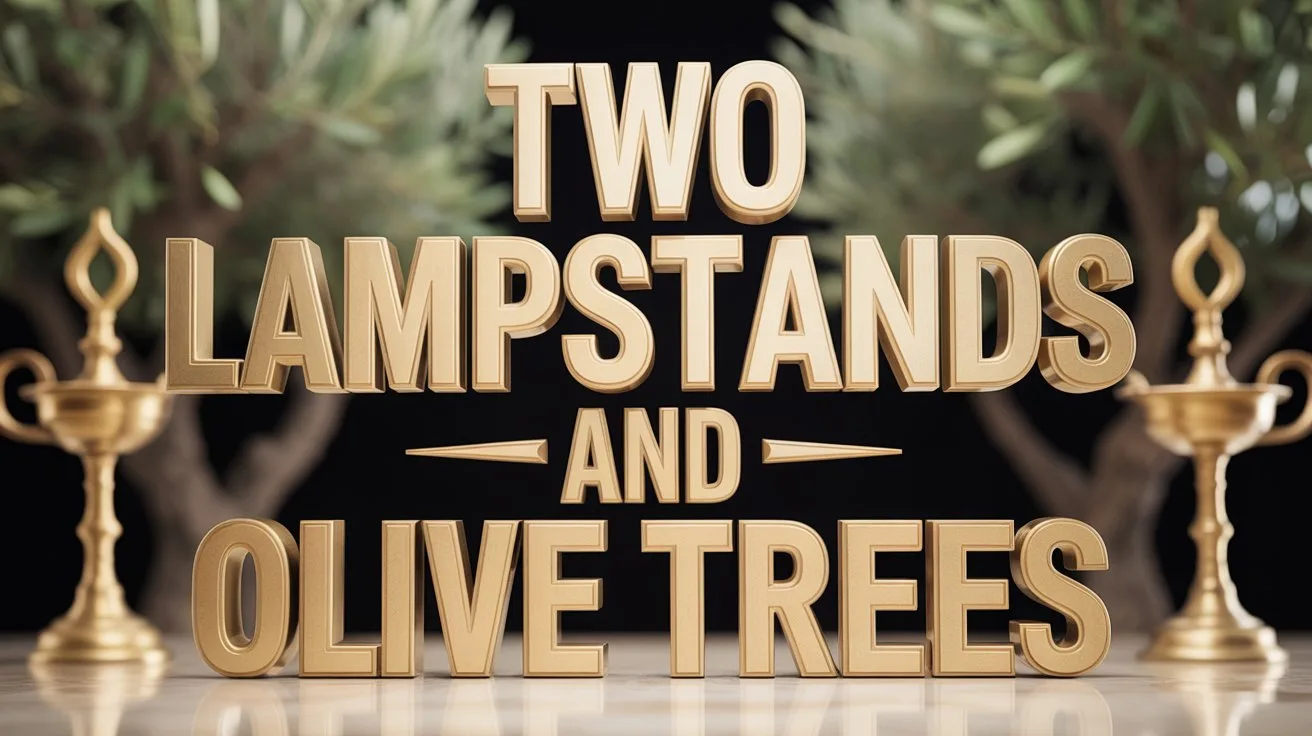
Revelation 11 introduces two men God raises up to speak for Him in a dark time, and John describes them with a phrase that sounds strange until you trace it back through the Bible. In Revelation 11:3-4 they are called two witnesses, and also the two olive trees and the two lampstands standing before the God of the earth. That is not random symbolism. Scripture is pointing us back to Zechariah 4 so we understand how God supplies His servants, keeps His light shining, and finishes His work.
Zechariah in context
Zechariah preached in Jerusalem after the exile, when a small remnant had returned. They were back in the land, but they were weak and pressured. The job in front of them looked bigger than them: rebuilding the temple, restoring worship, and living as God’s people again while surrounded by enemies and discouragement.
God gave Zechariah night visions to steady the people and strengthen their leaders. One of the clearest is the lampstand vision, because it is not just an object lesson. It is a supply lesson. The light is not burning because somebody keeps refilling it by hand. In the vision, the oil keeps coming.
Now the angel who talked with me came back and wakened me, as a man who is wakened out of his sleep. And he said to me, "What do you see?" So I said, "I am looking, and there is a lampstand of solid gold with a bowl on top of it, and on the stand seven lamps with seven pipes to the seven lamps. Two olive trees are by it, one at the right of the bowl and the other at its left." (Zechariah 4:1-3)
The picture has a golden lampstand, a bowl above it, channels feeding the lamps, and two olive trees beside it. In normal life, olive oil is pressed out, stored, and poured. In the vision the supply is built in. God is showing them that the real issue is not whether they can scrape together enough strength. The real issue is whether God will supply what He commands. And He will.
Not by human muscle
Zechariah asks what it means, and the answer goes straight to Zerubbabel, the governor leading the rebuilding effort. God tells him the work will not be finished by human might or human power, but by God’s Spirit.
So he answered and said to me: "This is the word of the LORD to Zerubbabel: "Not by might nor by power, but by My Spirit,' Says the LORD of hosts. (Zechariah 4:6)
The Hebrew word for Spirit is ruach. Depending on context it can mean wind, breath, or spirit. Here it points to God’s living enablement, God actively supplying what His servants need to obey. The verse is not telling them to sit down and wait for a feeling. Zerubbabel still builds. Priests still serve. The point is that success in God’s work is never explained by human resources alone.
Something easy to miss on a first pass: the lampstand itself is not the main surprise in the vision. The steady oil is. A lamp only shines as long as the supply behind it keeps coming. God is teaching discouraged builders that He does not just give a task. He also gives what the task requires, so His people do not burn out and quit.
The two anointed ones
Zechariah presses again about the two olive trees, and the angel identifies them as two anointed ones who stand by the Lord.
Then I answered and said to him, "What are these two olive trees–at the right of the lampstand and at its left?" And I further answered and said to him, "What are these two olive branches that drip into the receptacles of the two gold pipes from which the golden oil drains?" Then he answered me and said, "Do you not know what these are?" And I said, "No, my lord." So he said, "These are the two anointed ones, who stand beside the Lord of the whole earth." (Zechariah 4:11-14)
In Zechariah’s day the two key leaders were Zerubbabel and Joshua the high priest. They represent civil leadership and priestly leadership, the rebuilding of the structure and the restoration of worship. Olive oil fits anointing because oil was used to set people apart for a God-given role. The Hebrew word family behind anointing is tied to mashiach (messiah), meaning an anointed one. Zerubbabel and Joshua were not the Messiah, but the pairing points forward to what is perfectly true in Jesus: He is the rightful King and the perfect High Priest.
Also notice the title in Zechariah: the Lord of the whole earth. God’s right to command and supply His servants is not limited to one city or one nation. He has authority everywhere. Revelation later uses the same language.
Lampstands and witness
By the time you reach the New Testament, lampstand language is no longer just tabernacle furniture. It becomes witness language. A lampstand is not the light itself. It holds up the light so it can be seen. That is simple, but it is the point. God means for truth to be visible.
Jesus used everyday light imagery to teach public witness. His people are not supposed to hide what God has done and what God has said.
"You are the light of the world. A city that is set on a hill cannot be hidden. Nor do they light a lamp and put it under a basket, but on a lampstand, and it gives light to all who are in the house. Let your light so shine before men, that they may see your good works and glorify your Father in heaven. (Matthew 5:14-16)
Revelation itself explains lampstands too. In Revelation 1, John learns that lampstands represent local churches. That keeps us from forcing one rigid meaning onto every lampstand image. In Revelation, lampstands are tied to testimony in a dark world, with Christ present among His people and holding them accountable.
The mystery of the seven stars which you saw in My right hand, and the seven golden lampstands: The seven stars are the angels of the seven churches, and the seven lampstands which you saw are the seven churches. (Revelation 1:20)
So when Revelation 11 calls the two witnesses two lampstands, it highlights their function. They are raised up to hold up God’s truth publicly. They are visible and unavoidable.
Olive trees and supply
The olive tree side of the image is just as important. In Zechariah, the olive trees feed oil into the lampstand. Oil is fuel. It keeps the light going. In the Old Testament, oil also connects to consecration and service because people were anointed for their role. Taken together, the point is plain: God appoints His servants, and God supplies what they need to do what He sent them to do.
This is where the symbolism stays grounded. The vision is not teaching that God’s servants are impressive in themselves. It is teaching that God keeps the supply flowing. When God calls, He provides. When God sends, He enables. That does not mean His servants never suffer. It means nothing can stop their assignment until God says it is finished.
Standing before God
Revelation 11 adds a line that tightens the whole picture: the two witnesses are standing before the God of the earth. That matches Zechariah’s Lord of the whole earth. It tells you where their authority comes from. They are not standing before a crowd asking permission. They are standing before God, under His commission, and they speak because they have been sent.
The two witnesses
Now come back to the main passage with Zechariah in mind. God says He will grant authority to His two witnesses. They will prophesy for 1,260 days, clothed in sackcloth. Then God identifies them by the older symbols: two olive trees and two lampstands.
And I will give power to my two witnesses, and they will prophesy one thousand two hundred and sixty days, clothed in sackcloth." These are the two olive trees and the two lampstands standing before the God of the earth. (Revelation 11:3-4)
The 1,260 days works out to three and a half years, using a thirty-day month. Revelation uses that kind of time marker to show a limited season of intense trouble. In a futurist, premillennial reading, this belongs to the coming Tribulation period. The key point in these verses is not that we can build a neat chart from one number. The point is that God has their ministry measured and timed. It is not vague and open-ended.
Sackcloth and tone
Sackcloth is a sign of mourning and repentance in the Bible. It fits prophets because it fits the message. These men are not presented as entertainers or salesmen. Their appearance matches the seriousness of the hour. They are calling a world that is resisting God to face reality.
That kind of warning is mercy when it comes from God. God warns before He strikes. He does not judge the world in ignorance. He gives testimony.
The shape of power
Revelation describes judgments that fall on those who try to harm them, and it describes their authority in ways that echo Moses and Elijah.
And if anyone wants to harm them, fire proceeds from their mouth and devours their enemies. And if anyone wants to harm them, he must be killed in this manner. These have power to shut heaven, so that no rain falls in the days of their prophecy; and they have power over waters to turn them to blood, and to strike the earth with all plagues, as often as they desire. (Revelation 11:5-6)
Elijah’s ministry included shutting the sky from rain and judgment by fire. Moses’ ministry included turning water to blood and striking Egypt with plagues. Revelation is not presenting these men as clever performers. It presents real prophetic authority backed by the Almighty. The world is not dealing with two stubborn men with strong opinions. It is dealing with God’s public testimony.
Many readers jump straight to the identity question: are they literally Moses and Elijah, or two end-times prophets whose ministries resemble theirs? The echoes are strong. Moses and Elijah also appear with Jesus at the transfiguration, which helps explain why people often pair them.
And behold, Moses and Elijah appeared to them, talking with Him. (Matthew 17:3)
But Revelation 11 does not directly name the two witnesses. We do need to keep this straight: where the text is not explicit, we should not speak like it is settled. What we can say with confidence is what the passage emphasizes: their mission, their authority, their protection until they finish, and their vindication after death.
Witness and martyr
The word translated witnesses is the Greek martys. It means a witness, someone who testifies to what is true. Over time it came to be strongly connected with those who die for their testimony, which is why we get the English word martyr from it. That fits Revelation 11. Their job is testimony, and their end includes death for that testimony.
Why there are two
Revelation does not present one witness but two. Scripture has a principle that a matter is confirmed by two or three witnesses. That comes from the Law and is repeated in the New Testament as a rule of fairness and confirmation. So two witnesses are not a random detail. God is establishing testimony publicly and sufficiently.
"One witness shall not rise against a man concerning any iniquity or any sin that he commits; by the mouth of two or three witnesses the matter shall be established. (Deuteronomy 19:15)
This is one way God shuts the door on excuses. The world cannot honestly say, We were never told. Even in the time of heavy deception, God plants two lampstands right where people can see them. The rebellion is willful, not uninformed.
There is also a practical kindness in the pattern. God often sends servants in pairs. Jesus sent disciples out two by two. Paul had co-laborers. That is not the main reason Revelation gives two witnesses, but it fits the way the Lord often provides support, accountability, and companionship in hard ministry.
Their death and rising
Revelation 11 is blunt about the cost of faithful witness. The witnesses are not killed until their work is complete, and that timing line is easy to skim past. It shows they are not living at the mercy of their enemies. God decides when their testimony is finished, and then the beast is allowed to make war on them and kill them.
When they finish their testimony, the beast that ascends out of the bottomless pit will make war against them, overcome them, and kill them. (Revelation 11:7)
After their death, the world celebrates. It is one of the ugliest details in the chapter, and it shows how far a culture can go when it hates God’s truth. But the celebration does not last. God raises them, and their resurrection is public. Then they are called up to heaven, and their enemies see it.
Now after the three-and-a-half days the breath of life from God entered them, and they stood on their feet, and great fear fell on those who saw them. And they heard a loud voice from heaven saying to them, "Come up here." And they ascended to heaven in a cloud, and their enemies saw them. (Revelation 11:11-12)
The phrase about the breath of life coming from God is not filler. It echoes Old Testament life-giving language, especially the idea that life comes from God’s breath. It tells you this is direct divine action, not a lucky recovery. God is publicly backing up His testimony.
There is a sober balance here. God allows His servants to be killed, but He does not allow their witness to be defeated. Death is real, but it is not the last word. Revelation keeps showing that evil can roar for a moment, but it cannot keep the final word.
Lessons for today
Revelation 11 is future-focused, but it is not useless for believers now. The picture of lampstands and olive trees reminds us how God’s work is always carried out: God appoints, God supplies, God sets the boundaries, and God holds up His truth even when the world hates it.
It also keeps us from the wrong kind of prophecy obsession. The chapter is not inviting us to hunt for two modern names and treat speculation like faith. It is calling us to take witness seriously. A witness tells what is true. A witness does not edit the message to fit the mood of the crowd.
And it gives a needed reminder about strength. The supply is the issue. Zechariah’s builders needed to know that God’s Spirit would supply what the work required. We need to know the same thing. God does not ask you to generate spiritual power out of your own personality. He calls you to stay close to Christ, to stay in the Word, and to obey what you know is true. Faithful witness is not about being flashy. It is about being steady and honest.
"I am the vine, you are the branches. He who abides in Me, and I in him, bears much fruit; for without Me you can do nothing. (John 15:5)
My Final Thoughts
The two olive trees and two lampstands in Revelation 11:3-4 are meant to take you back to Zechariah 4 so you remember how God keeps His light burning: not by human strength, but by His Spirit supplying what His servants need.
If God can keep two witnesses standing in the hardest days ahead, He can keep you faithful in your home, your job, and your church. Stay close to Christ, stay in the Word, and keep your testimony plain and honest. The Lord does not ask you to be impressive. He asks you to be true.

 Get the book that teaches you how to evangelize and disarm doctrines from every single major cult and religion.