
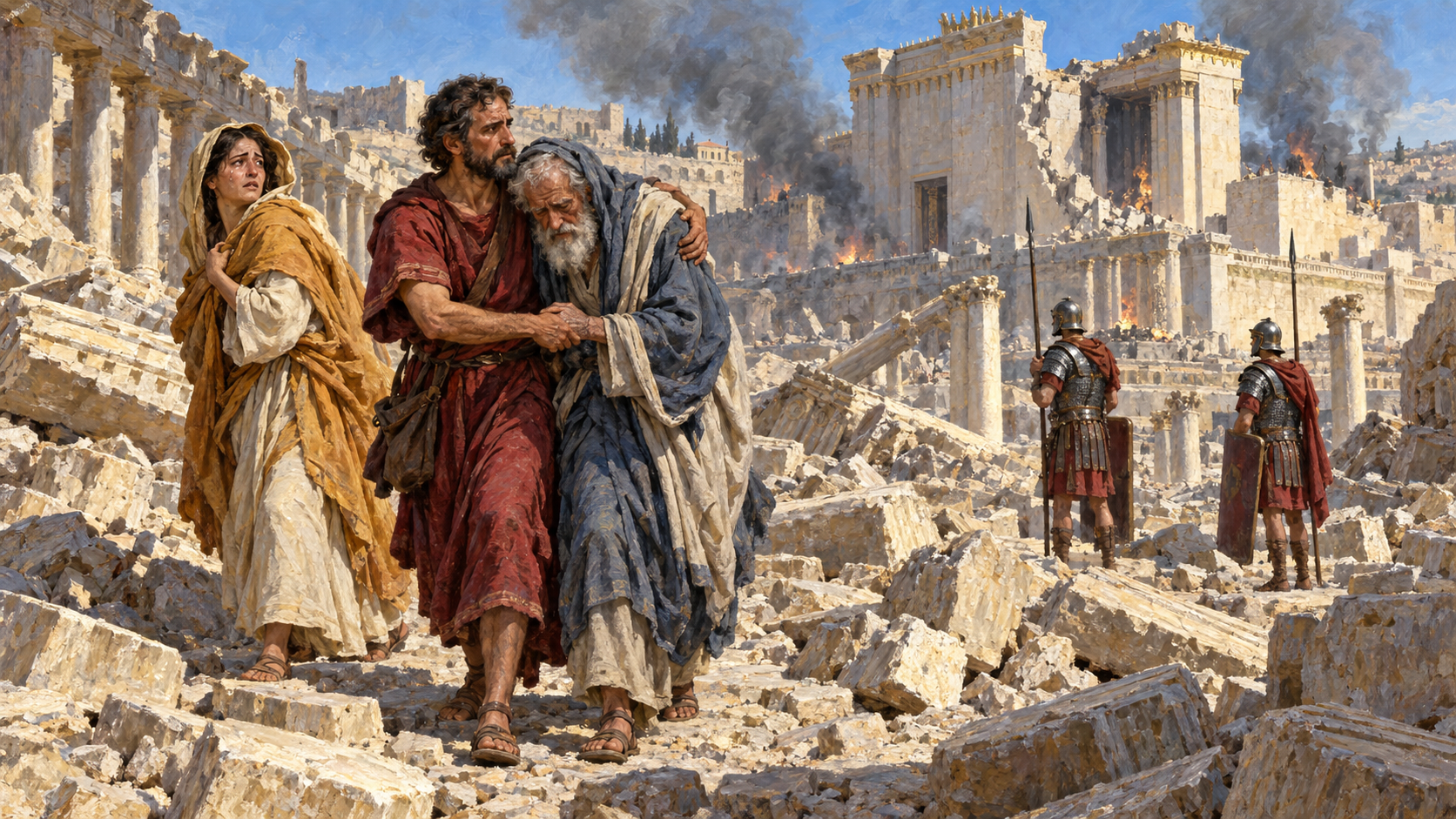
How much of Jesus’ prophecy was fulfilled when Jerusalem fell in AD 70? The temple was destroyed just as He said, but that event was not His bodily return or the end of every prophecy. I want to begin with the Gospels so we understand what that judgment meant. The historical accounts can then help us see how much the city suffered.
Jesus Wept Over Jerusalem
Now as He drew near, He saw the city and wept over it, saying, “If you had known, even you, especially in this your day, the things that make for your peace! But now they are hidden from your eyes.”
Before Jesus described Jerusalem’s destruction, He wept over the city. He knew the suffering that would come and was not indifferent to it. Those tears need to govern how I discuss this judgment. I cannot speak with contempt about people whose suffering moved the Lord to weep.
Luke records Jesus’ warning that enemies would build an embankment around Jerusalem and close it in on every side. They would level the city and not leave one stone upon another. Jesus gave the reason as well: Jerusalem did not know the time of its visitation. The Messiah had come to His own, yet the nation’s leaders rejected Him.
Nothing in this judgment gives anyone permission to hate Jewish people. Jesus is Israel’s Messiah, and His apostles were Jewish. The promises of God are rooted in Israel’s Scriptures. Jerusalem’s fall was a historical judgment, but Romans 11 warns Gentile believers not to boast against the natural branches. Jesus’ tears should also keep us from treating catastrophe as a puzzle to admire from a safe distance.
Jerusalem fell within the generation that heard His warning. The Jewish revolt against Rome began in AD 66, and Vespasian first led the Roman campaign. His son Titus later took command against Jerusalem. The siege trapped the people inside while hunger and internal fighting weakened them. Rome finally broke through and burned Jerusalem, destroying the temple at the center of Jewish worship and leaving the city desolate.
AD 70 fulfilled Christ’s warning about Jerusalem and the temple. He had spoken of the destruction beforehand, so we should recognize it as the judgment He foretold. Yet we cannot make it the fulfillment of every prophecy about the end. Christ did not return bodily, the dead were not raised, and the final judgment did not take place. Jerusalem’s fall was a solemn near fulfillment, while the Tribulation remains future. Christ will visibly return, and God will restore Israel.
I find it sobering that religious privilege did not protect Jerusalem from God’s judgment on rebellion. At the same time, the accuracy of Christ’s warning gives me confidence in Him. Since His words about Jerusalem’s fall proved true, I have reason to trust Him about the events still ahead.
The Temple Stones Were Thrown Down
And Jesus said to them, “Do you not see all these things? Assuredly, I say to you, not one stone shall be left here upon another, that shall not be thrown down.”
The disciples were admiring the grandeur of Herod’s temple complex when Jesus told them it would be destroyed. Its outward splendor could not protect a nation that rejected its King. By naming the buildings before them, He gave a specific warning whose fulfillment could be tested.
The Greek word lithos, translated “stone,” is an ordinary word with a concrete meaning. Understanding that helps us recognize what Jesus was describing: the destruction of the stones the disciples were admiring, not a vague picture of spiritual decline. When Rome destroyed the city, the temple burned and the complex was dismantled. Ancient accounts describe fire and plunder followed by the overturning of stones.
I would not defend this prophecy by claiming that every stone anywhere in Jerusalem disappeared. Jesus was speaking about the temple buildings, and those buildings were brought down. Keeping His words in their setting allows us to recognize the specific fulfillment without exaggerating it or reducing it to a general lesson about how all things change.
Jesus named the temple before its destruction, and history later showed that His warning was true. The event remains a public witness to the trustworthiness of His word. His hearers could hardly imagine such a reversal when they looked at the massive complex, but its strength did not make His prophecy uncertain.
Jerusalem Was Surrounded, and Jesus Told People to Flee
“But when you see Jerusalem surrounded by armies, then know that its desolation is near. Then let those who are in Judea flee to the mountains, let those who are in the midst of her depart, and let not those who are in the country enter her.”
Jesus gave a warning people could recognize: when armies surrounded Jerusalem, its desolation was near. He told those in Judea to flee. Staying out of patriotic bravado or assuming their religious standing would protect them would not have been obedience. He was showing them how to respond to an actual threat.
The Greek word eremosis, translated “desolation,” means devastation or laying waste. Jesus told His hearers they would know that devastation was near when they saw armies around Jerusalem. They did not need an elaborate calculation to recognize the warning; they needed to believe Him and act when the sign appeared.
Jesus called these “days of vengeance, that all things which are written may be fulfilled.” I understand those words in light of the judgment He was describing against that city and generation. It answered God’s written warnings against covenant rebellion and fulfilled Christ’s own words. It does not follow that every prophecy anywhere in Scripture ended in AD 70.
“And they will fall by the edge of the sword, and be led away captive into all nations. And Jerusalem will be trampled by Gentiles until the times of the Gentiles are fulfilled.”
I notice that Jesus says Jerusalem will be trampled “until” the times of the Gentiles are fulfilled. That word takes us beyond the city’s fall. The Greek word kairos, used for the “times” of the Gentiles, can describe an appointed season. God governs those times, so the trampling is neither purposeless nor presented as endless. His purposes for Israel did not stop in AD 70.
Luke also says that people would fall by the sword and be led away captive among the nations. The suffering during the historical siege fits that warning. Yet Jerusalem did not enter a simple period of peace after the conquest. Jesus described continuing trampling with an appointed end, so Rome’s victory cannot be treated as the completion of every purpose God has for the city.
There was mercy in Jesus’ warning because He told His disciples how to respond to the coming danger. Knowing what to watch for was meant to help them obey Him, not merely construct a chart of events. Even if they felt pressure to stay and defend Jerusalem, faithfulness to Christ required them to leave.
What the Historical Record Says About the Siege
The revolt that began in AD 66 grew out of years of tension with Roman rule. Taxation and corruption contributed to the anger, while nationalist hopes made the struggle more intense. Rome first answered under Vespasian. After he became emperor, Titus continued the campaign against Jerusalem, where the crowded city was already bitterly divided within.
Josephus gives us the most detailed surviving ancient account of the siege. He had fought against Rome before surrendering and later wrote under Roman patronage. I need to keep that relationship in mind as I read him. His work is indispensable for understanding what happened, but that does not put every detail beyond question.
Josephus describes famine and internal fighting, followed by horrifying desperation inside the city. He gives enormous figures for the dead and the captives, including a death toll above one million. Historians often discuss whether those numbers are reliable. Even when the figures are treated cautiously, his account still makes the terrible scale of the catastrophe clear.
Josephus’s report of tens of thousands taken captive also matches the aftermath Jesus described in Luke. Our faith does not depend on defending every one of his figures. Even where the precise totals are uncertain, his account describes many deaths and many people carried away. Hunger devastated a city already torn by internal fighting while Roman forces attacked from outside.
He also describes the Roman siege works and battering rams used against the city. Fire followed as the battle reached the temple area. Josephus presents Titus as wanting to preserve the temple, though we cannot easily tell whether that was Titus’s actual motive or how Josephus chose to portray his Roman patron. I can acknowledge that uncertainty without doubting the outcome: the temple burned, its treasures were taken, and Jerusalem was broken.
Tacitus wrote from the Roman side and also confirms the importance of Judea, Jerusalem, and the campaign. A dramatic claim about the “greatest slaughter” is sometimes tied to his account, but I have not found a verified quotation that supports that wording. We do not need to rely on it when witnesses from both the Roman and Jewish worlds already show that Jerusalem’s fall was a major and devastating event.
The Arch of Titus in Rome still displays Rome’s celebration of the conquest. A relief shows soldiers carrying temple spoils, including the menorah. The monument is not Scripture and cannot tell us the inspired meaning of the event. It does provide visible historical testimony that Rome plundered Jerusalem and proudly remembered the victory.
Josephus and Tacitus help us reconstruct the siege, as do Roman monuments. I value what they can tell us about the events, but I look to Scripture to understand why the judgment came and how far its fulfillment reaches. Those sources can inform our understanding of history without determining doctrine.
Remembering that history helps me appreciate why Jesus told those in Judea to flee when they saw the sign. He gave them direction before the ruin came. Religious and national pressure would urge many to remain, but trusting Christ meant accepting His word as more reliable than the city’s walls.
What the Ruins Can and Cannot Prove
Jerusalem’s visible landscape changed dramatically after AD 70. The later Bar Kokhba revolt in AD 132-135 brought further Roman action. Hadrian’s rebuilding and renaming efforts deepened the break between the ancient city Jesus knew and the later city visited by pilgrims.
Some natural landmarks can still be identified, including the Mount of Olives and broad regions such as Galilee. Archaeology has also uncovered first-century roads and stones. Pools, steps, ossuaries, and other remains can help us picture the biblical world. These discoveries are useful, and believers do not need to dismiss them.
Many devotional sites, however, were assigned or developed centuries after Christ. We have different degrees of certainty about later churches and tomb traditions, as well as pilgrimage routes. The Via Dolorosa, for example, reflects later tradition rather than a route we can fully verify from the first century. I would rather acknowledge that limit than claim more than the evidence can establish.
My faith does not depend on identifying the exact paving stone where Jesus placed His foot. It rests on the risen Christ, to whom the apostles bore witness and whom the inspired Scriptures reveal. Uncertainty about a traditional site does not weaken that foundation, since the truth of the Gospels never depended on medieval route markers.
An uncertain tradition about a location does not make the biblical event uncertain. Jerusalem’s destruction changed the city, but it did not erase Scripture’s testimony that Jesus physically died and rose bodily. Those events remain true regardless of what happened to the city afterward.
Jerusalem’s privileges also make me think about our churches today. The city had the temple with its sacrifices and knew Israel’s feasts. It possessed the Scriptures and had received the prophets before the Messiah Himself came. The greater light they had received brought greater responsibility; it did not excuse unbelief.
A church can have impressive buildings and a respected history while its people still need repentance. Familiar songs and active ministries do not remove that need, nor does knowing the right vocabulary. I cannot substitute sacred surroundings for personal faith in Christ. We need to hear the Lord and obey His Word while there is time, rather than become preoccupied with fear of Rome or with relics and ruins.
Some people study future events only to win arguments, while others avoid the subject because they have seen it misused. Jesus’ warning calls for a different response. His disciples needed to believe Him and make a wise choice, so prophecy should move us beyond speculation to obedience. We should receive every warning in Scripture with that same readiness to act.
AD 70 Did Not Fulfill Every Prophecy
Matthew 24 begins with the temple’s destruction. The disciples asked about that event as well as Christ’s coming and the end of the age. Jesus answered with warnings about both near and future events. The temple’s fall was near, while other parts of His prophecy reach beyond it.
“Therefore when you see the ‘abomination of desolation,’ spoken of by Daniel the prophet, standing in the holy place” (whoever reads, let him understand), “then let those who are in Judea flee to the mountains.”
Jesus points us back to Daniel, so I do not think we can make the first-century siege explain everything He describes. AD 70 can foreshadow later judgment and partially fulfill its patterns, but Daniel’s final prophecies reach to the end. The abomination of desolation and the great Tribulation still await their final fulfillment.
The later part of Matthew 24 also speaks of cosmic signs connected with the Son of Man’s appearing. Nothing in the Roman campaign matches the full description of the powers of heaven being shaken and all the tribes of the earth seeing Christ. A near judgment may help us understand the seriousness of the final one, but resemblance does not erase the difference between them.
Luke’s description of Jerusalem surrounded by armies fits AD 70 with striking clarity. Matthew later describes the Son of Man coming on the clouds of heaven with power and great glory. Titus marching into a ruined city did not fulfill that promise. Rome brought judgment upon Jerusalem, but the Roman victory was not the visible reign of Jesus Christ over the earth.
And they will see the Son of Man coming on the clouds of heaven with power and great glory.
Full-preterist readings treat Jerusalem’s fall as the completion of the Second Coming, resurrection, and final judgment. I cannot reconcile that conclusion with Matthew 24’s description of Christ appearing. His bodily and visible return remains future, as do the final resurrection, final judgment, and His kingdom reign. AD 70 fulfilled the warning about the city without fulfilling those promises.
Romans 11 also keeps us from concluding that God cast Israel away forever when Jerusalem fell. Paul says that blindness in part has happened to Israel until the fullness of the Gentiles comes in. He then speaks of Israel’s future deliverance according to God’s covenant promise. The severity of the judgment did not cancel that promise.
For I do not desire, brethren, that you should be ignorant of this mystery… that blindness in part has happened to Israel until the fullness of the Gentiles has come in. And so all Israel will be saved…
The Church is Christ’s Bride and His witness among the nations, but her place does not erase Israel from God’s promises. His covenant mercy remains even after judgment. That is why Paul warns Gentile believers against boasting: the God who judged Jerusalem is faithful to every word He has spoken.
We cannot use Jerusalem’s fall to argue that Gentiles replaced a rejected Israel. Paul describes Israel’s blindness as partial, and “until” tells us it is temporary. I need to take God’s severity in judgment seriously while still trusting His covenant mercy. Romans 11 gives us reason for both.
Christ’s fulfilled warning about the temple gives us reason to trust His promises about His return and kingdom. That confidence should make us watchful and humble. The Church’s hope rests in the Lord who will gather His people to Himself, not in monuments.
In 1 Thessalonians 4:16-17, the Lord Himself will descend and the dead in Christ will rise. Living believers will then be caught up with them to meet Him in the air. Jerusalem’s fallen stones remind me that earthly monuments do not last, but our hope of being forever with Christ rests on His word. His fulfilled warnings give us reason to trust that promise.
For deeper study of those future passages, see A Complete Bible Study on Matthew 24-25, A Complete Bible Study Examining the Pre-Tribulation Rapture, and A Complete Bible Study on The Heavenly Jerusalem.
My Final Thoughts
The fall of Jerusalem leaves me sobered by God’s judgment and confident in Christ’s word. Religious beauty could not shelter a city that rejected its Messiah, and the temple fell exactly as He said it would. Yet His tears leave no room for contempt toward Jewish people, and Romans 11 gives us no right to erase Israel’s future from God’s promises. Our faith rests on Jesus Christ, who physically bore the punishment for our sins in His innocent body. He shed His blood and died, then rose bodily. He will return, and not one word of His will fail.