
When Scripture calls God holy, it tells us who He is before it tells us how to live. He is the uncreated Lord, incomparable in majesty and entirely pure in His character. Yet this same Holy One receives sinners through Jesus Christ. I want to follow how Scripture holds those truths together, because both careless familiarity with God and fear of approaching Him can come from misunderstanding His holiness.
What It Means That God Is Holy
God is distinct from everything He made, and nothing in Him is corrupt. We need both truths. Describing holiness only as distance can make Him sound remote and indifferent; describing it only as good behavior can make Him sound like an unusually respectable creature. He is the Creator on whom every creature depends, and all His thoughts, words, and actions are perfectly right.
The Hebrew adjective qadosh means holy. Its related noun qodesh can refer to holiness or to something holy, such as a place devoted to God. The Greek adjective hagios likewise describes what is holy. Context tells us how these words apply: God Himself is holy, but Scripture also speaks of holy people, heavenly servants, days, places, and objects devoted to worship.
“Set apart” helps explain that language, provided we ask what is set apart and to whom it belongs. A tabernacle bowl was separated from common use by God’s command. God was never common, and no ceremony made Him holy. Holiness belongs to His eternal nature. When He sets people apart for Himself, their conduct should agree with the One to whom they belong. Merely behaving unusually does not establish that someone is holy.
God also does not become good by meeting the demands of a law above Him. His own nature is the perfect standard of righteousness, truth, and beauty. Saying He cannot lie or sin does not place Him under a stronger authority; it recognizes that He never denies Himself or becomes corrupt. He knows all things without learning them and possesses every power consistent with His character.
Scripture shows this holiness in God’s dealings with people, including His deliverance of Israel from Egypt. Pharaoh’s army had pursued the Israelites to the sea, but the LORD brought His people through and destroyed the pursuing force. Moses and Israel then sang of the God who had saved them.
Then Moses and the children of Israel sang this song to the LORD, and spoke, saying: “I will sing to the LORD, For He has triumphed gloriously! The horse and its rider He has thrown into the sea! The LORD is my strength and song, And He has become my salvation; He is my God, and I will praise Him; My father’s God, and I will exalt Him. The LORD is a man of war; The LORD is His name. Pharaoh’s chariots and his army He has cast into the sea; His chosen captains also are drowned in the Red Sea. The depths have covered them; They sank to the bottom like a stone. “Your right hand, O LORD, has become glorious in power; Your right hand, O LORD, has dashed the enemy in pieces. And in the greatness of Your excellence You have overthrown those who rose against You; You sent forth Your wrath; It consumed them like stubble. And with the blast of Your nostrils The waters were gathered together; The floods stood upright like a heap; The depths congealed in the heart of the sea. The enemy said, ‘I will pursue, I will overtake, I will divide the spoil; My desire shall be satisfied on them. I will draw my sword, My hand shall destroy them.’ You blew with Your wind, The sea covered them; They sank like lead in the mighty waters. “Who is like You, O LORD, among the gods? Who is like You, glorious in holiness, Fearful in praises, doing wonders? You stretched out Your right hand; The earth swallowed them. You in Your mercy have led forth The people whom You have redeemed; You have guided them in Your strength To Your holy habitation. “The people will hear and be afraid; Sorrow will take hold of the inhabitants of Philistia. Then the chiefs of Edom will be dismayed; The mighty men of Moab, Trembling will take hold of them; All the inhabitants of Canaan will melt away. Fear and dread will fall on them; By the greatness of Your arm They will be as still as a stone, Till Your people pass over, O LORD, Till the people pass over Whom You have purchased. You will bring them in and plant them In the mountain of Your inheritance, In the place, O LORD, which You have made For Your own dwelling, The sanctuary, O LORD, which Your hands have established. “The LORD shall reign forever and ever.”
The song asks who among the gods can compare with the LORD, “glorious in holiness.” Egypt’s military strength had not enabled it to keep the people God redeemed. His holiness was displayed in judging the oppressor, delivering His people in mercy, and guiding them toward His dwelling. Israel praised the same God for His righteous wrath and His faithful love.
Hannah also joined God’s holiness with His knowledge of human conduct. She had suffered the grief of barrenness and the taunts of her rival, then received Samuel in answer to prayer. After bringing him to serve the LORD, she praised God for overturning the apparent security of the proud and helping the weak.
And Hannah prayed and said: “My heart rejoices in the LORD; My horn is exalted in the LORD. I smile at my enemies, Because I rejoice in Your salvation. “No one is holy like the LORD, For there is none besides You, Nor is there any rock like our God. “Talk no more so very proudly; Let no arrogance come from your mouth, For the LORD is the God of knowledge; And by Him actions are weighed. “The bows of the mighty men are broken, And those who stumbled are girded with strength. Those who were full have hired themselves out for bread, And the hungry have ceased to hunger. Even the barren has borne seven, And she who has many children has become feeble. “The LORD kills and makes alive; He brings down to the grave and brings up. The LORD makes poor and makes rich; He brings low and lifts up. He raises the poor from the dust And lifts the beggar from the ash heap, To set them among princes And make them inherit the throne of glory. “For the pillars of the earth are the LORD’s, And He has set the world upon them. He will guard the feet of His saints, But the wicked shall be silent in darkness. “For by strength no man shall prevail. The adversaries of the LORD shall be broken in pieces; From heaven He will thunder against them. The LORD will judge the ends of the earth. “He will give strength to His king, And exalt the horn of His anointed.”
Hannah’s confession, “No one is holy like the LORD,” accompanies a warning against arrogance. God knows what people do and weighs their actions. The powerful cannot make themselves secure against Him, while poverty or weakness cannot prevent Him from lifting someone up. Her prayer reaches beyond her own household to God’s judgment of the earth and His anointed king.
Psalm 99 similarly brings God’s majesty together with justice and His response to those who call on Him.
The LORD reigns; Let the peoples tremble! He dwells between the cherubim; Let the earth be moved! The LORD is great in Zion, And He is high above all the peoples. Let them praise Your great and awesome name– He is holy. The King’s strength also loves justice; You have established equity; You have executed justice and righteousness in Jacob. Exalt the LORD our God, And worship at His footstool– He is holy. Moses and Aaron were among His priests, And Samuel was among those who called upon His name; They called upon the LORD, and He answered them. He spoke to them in the cloudy pillar; They kept His testimonies and the ordinance He gave them. You answered them, O LORD our God; You were to them God-Who-Forgives, Though You took vengeance on their deeds. Exalt the LORD our God, And worship at His holy hill; For the LORD our God is holy.
The holy King loves justice and establishes equity, treating people rightly. Moses, Aaron, and Samuel called on Him, and He answered. The psalm also remembers forgiveness alongside consequences for wrongdoing. God did not have to cease being holy to forgive, and forgiveness did not make every consequence disappear.
I cannot explain God by imagining His love persuading His holiness to soften, or His justice restraining a careless mercy. That divides Him into competing impulses. His patience, power, love, and justice are always holy, and each agrees perfectly with the others. The study on the characteristics of God examines those perfections more fully.
Isaiah 40 addresses another temptation: judging God’s greatness by the earthly powers confronting His people. Its comfort speaks to Israel’s exile and asks whether anything created can be compared with its Maker.
To whom then will you liken God? Or what likeness will you compare to Him? The workman molds an image, The goldsmith overspreads it with gold, And the silversmith casts silver chains. Whoever is too impoverished for such a contribution Chooses a tree that will not rot; He seeks for himself a skillful workman To prepare a carved image that will not totter. Have you not known? Have you not heard? Has it not been told you from the beginning? Have you not understood from the foundations of the earth? It is He who sits above the circle of the earth, And its inhabitants are like grasshoppers, Who stretches out the heavens like a curtain, And spreads them out like a tent to dwell in. He brings the princes to nothing; He makes the judges of the earth useless. Scarcely shall they be planted, Scarcely shall they be sown, Scarcely shall their stock take root in the earth, When He will also blow on them, And they will wither, And the whirlwind will take them away like stubble. “To whom then will you liken Me, Or to whom shall I be equal?” says the Holy One. Lift up your eyes on high, And see who has created these things, Who brings out their host by number; He calls them all by name, By the greatness of His might And the strength of His power; Not one is missing. Why do you say, O Jacob, And speak, O Israel: “My way is hidden from the LORD, And my just claim is passed over by my God”? Have you not known? Have you not heard? The everlasting God, the LORD, The Creator of the ends of the earth, Neither faints nor is weary. His understanding is unsearchable. He gives power to the weak, And to those who have no might He increases strength. Even the youths shall faint and be weary, And the young men shall utterly fall, But those who wait on the LORD Shall renew their strength; They shall mount up with wings like eagles, They shall run and not be weary, They shall walk and not faint.
An idol needs a craftsman to shape it and keep it from toppling. The LORD calls the stars by name and sustains the heavens. Princes can rise quickly and disappear just as quickly, but the everlasting Creator does not grow weary or lose understanding. An empire’s success cannot establish that its gods are real or that it has overpowered Him.
Transcendence describes God as above and distinct from creation. Isaiah connects that greatness with care for exhausted people: the One who never grows weary gives strength to those who wait on Him. His greatness gives them reason to trust Him when their own strength fails.
Pantheism identifies God with the universe, while deism treats Him as a Creator who does not intervene in its affairs. Neither describes the Lord Isaiah presents. Everything He made depends on Him, yet He remains distinct from it. He governs human affairs, hears prayer, keeps His covenants, and draws near to the contrite. His presence with us is the gracious presence of the Holy One.
His purity also makes Him utterly trustworthy. I can do something outwardly good while seeking praise, and I can misunderstand evidence even when I intend to judge fairly. God has no mixed motive, concealed corruption, or mistaken judgment. He never needs to repent of evil in Himself. Passages about His grief or relenting describe His real dealings with changing people, not the repair of a flaw in His character.
John’s first letter connects God’s complete purity with truthful fellowship.
This is the message which we have heard from Him and declare to you, that God is light and in Him is no darkness at all. If we say that we have fellowship with Him, and walk in darkness, we lie and do not practice the truth. But if we walk in the light as He is in the light, we have fellowship with one another, and the blood of Jesus Christ His Son cleanses us from all sin. If we say that we have no sin, we deceive ourselves, and the truth is not in us. If we confess our sins, He is faithful and just to forgive us our sins and to cleanse us from all unrighteousness. If we say that we have not sinned, we make Him a liar, and His word is not in us.
John announces, “God is light and in Him is no darkness at all.” Someone who chooses a walk in darkness cannot turn it into fellowship with God simply by calling it harmless. The holy God sees the conduct and the motive behind it, however convincing a person’s religious appearance may be.
John also rules out the claim that we have become sinless. Walking in the light includes admitting sin and trusting Christ’s cleansing blood. I do not have to conceal what God already knows or approach Him as though His willingness to forgive were unpredictable. He is faithful and just, and His holiness brings me into honest fellowship rather than a performance designed to hide my need.
Holy, Holy, Holy at the Throne
In Isaiah 6, the prophet’s vision exposed his own uncleanness before God. Uzziah’s long reign had ended, but the Lord remained enthroned.
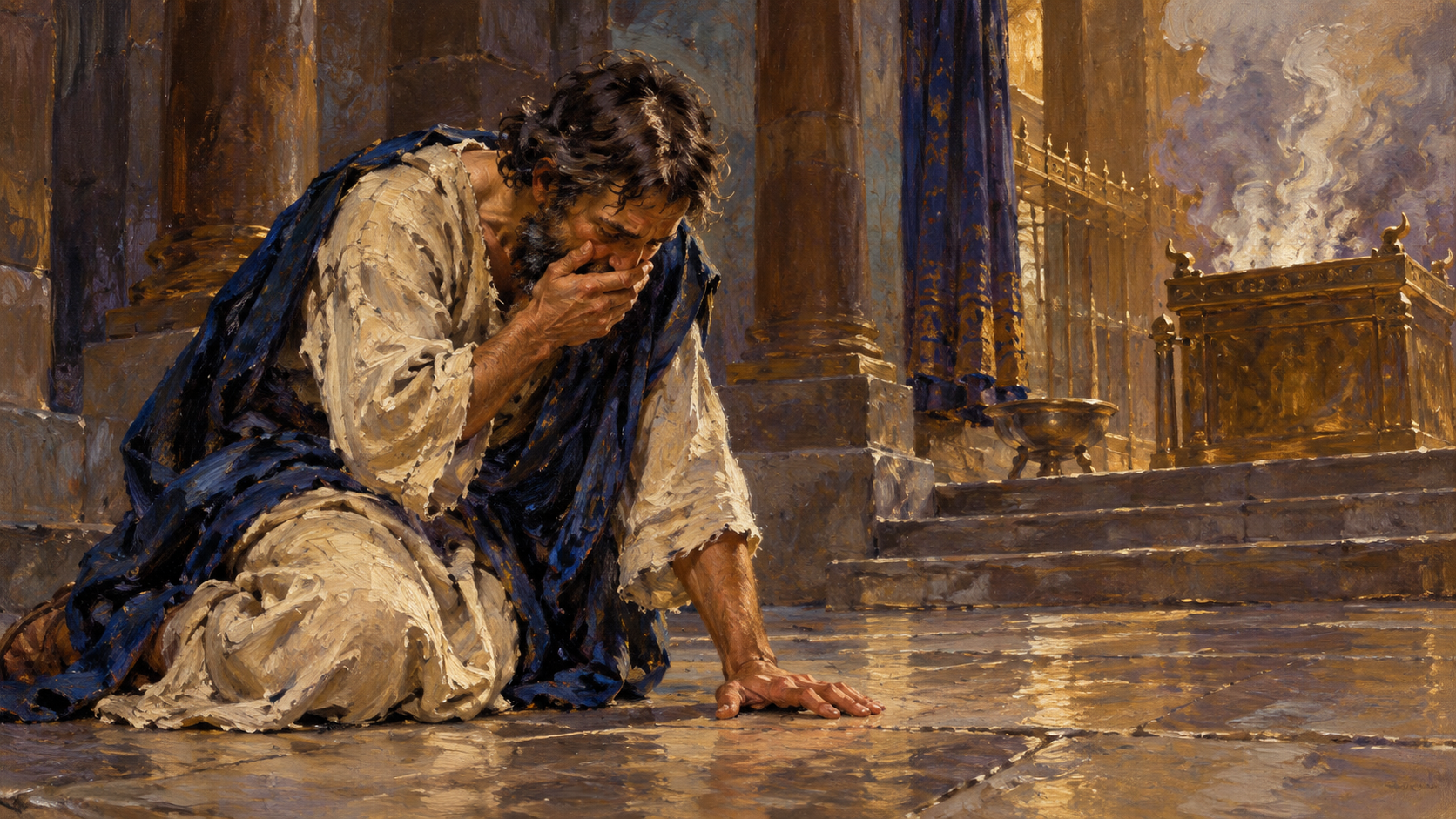
In the year that King Uzziah died, I saw the Lord sitting on a throne, high and lifted up, and the train of His robe filled the temple. Above it stood seraphim; each one had six wings: with two he covered his face, with two he covered his feet, and with two he flew. And one cried to another and said: “Holy, holy, holy is the LORD of hosts; The whole earth is full of His glory!” And the posts of the door were shaken by the voice of him who cried out, and the house was filled with smoke. So I said: “Woe is me, for I am undone! Because I am a man of unclean lips, And I dwell in the midst of a people of unclean lips; For my eyes have seen the King, The LORD of hosts.” Then one of the seraphim flew to me, having in his hand a live coal which he had taken with the tongs from the altar. And he touched my mouth with it, and said: “Behold, this has touched your lips; Your iniquity is taken away, And your sin purged.”
The seraphim covered their faces and feet while crying, “Holy, holy, holy.” These heavenly servants reverenced the King as the thresholds shook and smoke filled the house. Isaiah’s response was, “Woe is me, for I am undone!” He recognized his own unclean lips and the uncleanness of the people among whom he lived. Seeing the King left him unable to hide behind a comparison with someone worse.
A seraph then brought a live coal from the altar, touched Isaiah’s mouth, and announced that his iniquity was taken away. Isaiah did not earn cleansing by enduring pain, and the coal was not a magical object. God provided the cleansing, with the altar pointing to His appointed provision for guilt. Isaiah was cleansed before answering the call to serve that follows in the chapter. His service did not purchase the grace he had received.
John’s vision in Revelation also places the threefold praise at the heavenly throne.
After these things I looked, and behold, a door standing open in heaven. And the first voice which I heard was like a trumpet speaking with me, saying, “Come up here, and I will show you things which must take place after this.” Immediately I was in the Spirit; and behold, a throne set in heaven, and One sat on the throne. And He who sat there was like a jasper and a sardius stone in appearance; and there was a rainbow around the throne, in appearance like an emerald. Around the throne were twenty-four thrones, and on the thrones I saw twenty-four elders sitting, clothed in white robes; and they had crowns of gold on their heads. And from the throne proceeded lightnings, thunderings, and voices. Seven lamps of fire were burning before the throne, which are the seven Spirits of God. Before the throne there was a sea of glass, like crystal. And in the midst of the throne, and around the throne, were four living creatures full of eyes in front and in back. The first living creature was like a lion, the second living creature like a calf, the third living creature had a face like a man, and the fourth living creature was like a flying eagle. The four living creatures, each having six wings, were full of eyes around and within. And they do not rest day or night, saying: “Holy, holy, holy, Lord God Almighty, Who was and is and is to come!” Whenever the living creatures give glory and honor and thanks to Him who sits on the throne, who lives forever and ever, the twenty-four elders fall down before Him who sits on the throne and worship Him who lives forever and ever, and cast their crowns before the throne, saying: “You are worthy, O Lord, To receive glory and honor and power; For You created all things, And by Your will they exist and were created.”
The living creatures praise the Lord God Almighty, who was, who is, and who is to come. The elders fall before Him and cast down their crowns, acknowledging that He is worthy because He created all things. Their praise does not make Him holy; they recognize the majesty and purity that eternally belong to Him.
The repetition gives force to heaven’s worship. It does not establish holiness as God’s only defining perfection or make His love less fully divine. Scripture calls Him both light and love and reveals His grace together with His truth and justice. We should not turn the worship of heaven into a competition among His attributes.
I also would not use the threefold cry as a complete proof of the Trinity. We know there is one God in three Persons from passages that distinguish the Father, Son, and Holy Spirit and identify each as God. The cry of “Holy, holy, holy” fits that revelation, but emphatic repetition does not explain the three Persons by itself.
The Father, Son, and Holy Spirit Are Holy
Father, Son, and Holy Spirit are co-equal and co-eternal: none is a lesser being, and none began to exist. They share the one divine nature rather than forming three gods. Holiness belongs fully to each Person. The Father sent the Son to accomplish redemption, and the Spirit dwells within and seals believers; their distinct works never involve disagreement within God.
On the night before His crucifixion, Jesus addressed the Father in prayer about the disciples He was leaving in the world.
Now I am no longer in the world, but these are in the world, and I come to You. Holy Father, keep through Your name those whom You have given Me, that they may be one as We are. While I was with them in the world, I kept them in Your name. Those whom You gave Me I have kept; and none of them is lost except the son of perdition, that the Scripture might be fulfilled. But now I come to You, and these things I speak in the world, that they may have My joy fulfilled in themselves. I have given them Your word; and the world has hated them because they are not of the world, just as I am not of the world. I do not pray that You should take them out of the world, but that You should keep them from the evil one. They are not of the world, just as I am not of the world. Sanctify them by Your truth. Your word is truth. As You sent Me into the world, I also have sent them into the world. And for their sakes I sanctify Myself, that they also may be sanctified by the truth.
Jesus called Him “Holy Father” and asked Him to keep the disciples through His name. The Father’s holiness appears here in His faithful care and in the truth by which His people are sanctified. To sanctify is to set apart for God. Jesus asked that the disciples be kept from the evil one and sent them into the world with God’s Word.
When Jesus said He sanctified Himself for their sake, He did not mean He needed moral cleansing. He was already without sin. He set Himself apart to complete the saving mission the Father had given Him. His disciples likewise belonged to God for faithful service among the people to whom they were sent. Their separation from evil did not require abandoning their neighbors or refusing to bear witness.
The eternal Son became fully man without ceasing to be fully God. Gabriel announced that the child born of Mary would be called the Holy One. During His ministry even unclean spirits recognized Him as the Holy One of God. Peter later called Him the Holy One and the Just. He faced real temptation, yet never yielded, spoke deceitfully, or failed to love and obey the Father.
John 12 also identifies the glory Isaiah saw with Christ’s glory. After discussing unbelief toward Jesus and quoting Isaiah 6, John says Isaiah spoke when he saw His glory. The Son who came in humility possesses the divine holiness before which Isaiah confessed his uncleanness. Becoming man did not reduce His divine identity.
The Holy Spirit is likewise a divine Person. He speaks, teaches, leads, gives gifts, and can be grieved by disobedience. Acts 5 identifies lying to the Holy Spirit as lying to God. He is no impersonal energy, and His presence in every genuinely born-again believer is God’s own presence.
Because the Spirit inspired Scripture, He never directs us to contradict it. A claimed spiritual experience cannot authorize sexual immorality, deception, pride, or disorder contrary to God’s Word. We must test the claim rather than excuse the conduct because someone describes it as spiritual.
The Spirit seals believers for the day of redemption, and those same believers are commanded not to grieve Him. Eternal security gives me confidence to confess as God’s child and return to obedience. My sin still grieves Him, but I can receive correction without pretending Christ’s saving work must be repeated.
Holiness Exposes Sin and Governs Judgment
Isaiah admitted uncleanness in himself as well as in his people. I need that same honesty when Scripture exposes unbelief, resentment, or pride that I would rather excuse. Sin is more than a public crime or a broken social expectation; it contradicts the will and character of the God who made us.
Envy resents another person’s good, while bitterness can survive beneath respectable manners. A corrupt desire can be cherished before anyone sees its outward expression. Idolatry gives God’s rightful place to something else. Religious habits do not cleanse those choices, and even an outwardly helpful act can be used to gain praise or control.
Conviction calls us to face what is wrong and repent. When I have deceived someone, repentance includes telling the truth and repairing the harm where possible. When I have mistreated someone, I should stop it and seek to make amends. Hiding in shame or maintaining a good reputation will not restore honest fellowship with God.
Habakkuk raised a different question about God’s holiness. He had grieved over Judah’s violence and injustice, and God answered that He was raising up the Chaldeans, or Babylonians, to judge the nation. But Babylon was more ruthless still. How could the Holy One use such an invader?
Are You not from everlasting, O LORD my God, my Holy One? We shall not die. O LORD, You have appointed them for judgment; O Rock, You have marked them for correction. You are of purer eyes than to behold evil, And cannot look on wickedness. Why do You look on those who deal treacherously, And hold Your tongue when the wicked devours A person more righteous than he? Why do You make men like fish of the sea, Like creeping things that have no ruler over them? They take up all of them with a hook, They catch them in their net, And gather them in their dragnet. Therefore they rejoice and are glad. Therefore they sacrifice to their net, And burn incense to their dragnet; Because by them their share is sumptuous And their food plentiful. Shall they therefore empty their net, And continue to slay nations without pity?
Immediately after saying God’s eyes were too pure to behold evil, Habakkuk asked why He looked on treacherous people. The question assumes God could see them. The prophet was asking why God permitted a more wicked nation to devour people more righteous than itself, not suggesting God was unaware of what Babylon did.
God’s pure eyes cannot approve evil or take pleasure in it. His later answer announces judgment on the proud invader too. Using Babylon to discipline Judah did not make Babylon’s cruelty righteous or turn its people into blameless puppets. God could accomplish His purpose while holding the invaders responsible for the evil they chose.
His judgments rest on complete knowledge and perfect righteousness. He cannot be bribed, deceived by appearances, or persuaded to excuse cruelty because it has become popular. He will never mistake innocence for guilt. Present patience therefore gives no assurance that unrepented evil will escape judgment.
Some judgments occur within human history; final judgment follows resurrection. Unbelievers will stand before the Great White Throne, where their deeds are exposed. Those who finally reject the Messiah are blotted out of the Book of Life and face the second death in the Lake of Fire, the irreversible destruction of human body and soul.
I should warn people soberly, without taking pleasure in their destruction or speaking as though I deserved grace. God genuinely offers salvation to the whole world, though people can resist Him. His patience gives room for repentance; it does not make the warning empty.
Mercy meets guilty people with compassion, and grace is undeserved favor. Neither requires God to call their evil good. His love tells us the truth about what destroys us and provides the Savior we cannot provide for ourselves. Approving every desire would leave us in the darkness from which He calls us.
Sinners Approach God Through Christ
Under the Mosaic covenant, God taught Israel that He determined how people could approach Him. He appointed the priesthood, sacrifices, and ceremonial washings. Access became more restricted toward the Most Holy Place, where only the high priest could enter with blood on the appointed Day of Atonement. Sincere intentions could not replace God’s revealed way of worship. Hebrews describes God’s will being accomplished through Christ’s offering.
By that will we have been sanctified through the offering of the body of Jesus Christ once for all. And every priest stands ministering daily and offering repeatedly the same sacrifices, which can never take away sins. But this Man, after He had offered one sacrifice for sins forever, sat down at the right hand of God, from that time waiting till His enemies are made His footstool. For by one offering He has perfected forever those who are being sanctified. But the Holy Spirit also witnesses to us; for after He had said before, “This is the covenant that I will make with them after those days, says the LORD: I will put My laws into their hearts, and in their minds I will write them,” then He adds, “Their sins and their lawless deeds I will remember no more.” Now where there is remission of these, there is no longer an offering for sin. Therefore, brethren, having boldness to enter the Holiest by the blood of Jesus, by a new and living way which He consecrated for us, through the veil, that is, His flesh, and having a High Priest over the house of God, let us draw near with a true heart in full assurance of faith, having our hearts sprinkled from an evil conscience and our bodies washed with pure water.
Paul explains in Hebrews that repeated sacrifices could not finally remove sin. They were shadows pointing forward to Christ, whose offering of His body was once for all. He now serves as High Priest, and believers draw near through His blood with a true heart and full assurance of faith. Access to the Father does not depend on returning to Levitical ritual or obtaining it from an earthly priesthood.
At the cross, wicked men physically tortured and punished Jesus before killing Him. He willingly bore that real punishment for our sins in His innocent body and shed His blood. His saving work through His blood and death was complete when He died. He was buried and then rose bodily from the grave.
The Father did not punish, curse, abandon, strike, bruise, or pour wrath on Jesus. The Father, Son, and Holy Spirit were never divided against one another. The Son offered Himself willingly in obedience to the Father, and the one triune God accomplished salvation in perfect agreement with His holiness, justice, mercy, and love.
Christ died for the whole world, so God’s offer of salvation is genuine for every person, even though people can resist and reject His grace. Everyone who repents and believes is justified, declared righteous before God, and born again. God sets the believer apart in Christ, and the Holy Spirit indwells and seals him so that he is eternally secure.
Neither moral improvement nor church membership can provide that salvation. Baptism and communion do not produce the new birth either. Water baptism follows salvation as identification with Christ, while communion remembers and proclaims His body and blood without repeating His sacrifice. Christ’s blood gives the access no religious ceremony can purchase.
My confidence in approaching God rests on Christ rather than how well I have done recently. Yet the Father who receives me is still the Holy One. Knowing I am welcome should deepen my worship and honesty before Him, without treating His presence as ordinary or His commands as optional.
A Holy People in Worship and Daily Life
Being welcomed through Christ leads directly into the command to live as God’s people. Peter addresses believers whose hope rests on grace and whose redemption came through Christ’s precious blood.
Therefore gird up the loins of your mind, be sober, and rest your hope fully upon the grace that is to be brought to you at the revelation of Jesus Christ; as obedient children, not conforming yourselves to the former lusts, as in your ignorance; but as He who called you is holy, you also be holy in all your conduct, because it is written, “Be holy, for I am holy.” And if you call on the Father, who without partiality judges according to each one’s work, conduct yourselves throughout the time of your stay here in fear; knowing that you were not redeemed with corruptible things, like silver or gold, from your aimless conduct received by tradition from your fathers, but with the precious blood of Christ, as of a lamb without blemish and without spot. He indeed was foreordained before the foundation of the world, but was manifest in these last times for you who through Him believe in God, who raised Him from the dead and gave Him glory, so that your faith and hope are in God.
God’s command, “Be holy, for I am holy,” calls His people to live according to the character of the One who claimed them. Peter quotes Leviticus without placing believers under the Mosaic covenant to earn acceptance. Israel had been redeemed from Egypt before receiving covenant commands. We too are saved by grace and set apart in Christ before growing in practical obedience under the New Covenant.
Sanctification includes that settled belonging to God and the practical growth that follows. Through His truth, the Spirit changes our desires, speech, conduct, and relationships. Being already set apart in Christ does not mean there is nothing left to correct. The study on sanctification develops the believer’s growth, while the study on the word holy in the Bible examines the word group more fully.
Hebrews 12:5–11 describes the Father’s discipline as care for His children, intended for their good so they may share in His holiness. Correction does not mean He has rejected them. Nor does it mean every hardship is punishment for a particular sin. He can use suffering to expose what needs changing and train His people in righteousness.
The same chapter also calls believers to care about the holiness of the community, including what bitterness and careless appetites can do to others.
Pursue peace with all people, and holiness, without which no one will see the Lord: looking carefully lest anyone fall short of the grace of God; lest any root of bitterness springing up cause trouble, and by this many become defiled; lest there be any fornicator or profane person like Esau, who for one morsel of food sold his birthright. For you know that afterward, when he wanted to inherit the blessing, he was rejected, for he found no place for repentance, though he sought it diligently with tears.
I do not read this as a promise that enough moral progress will buy entrance into God’s presence. The warning calls believers to watch over one another so that bitterness does not spread and defile others. Esau treated his birthright as expendable in order to satisfy an immediate appetite, then could not recover the blessing he later desired. His tears did not undo his choice.
We must take seriously what God has set apart. A genuine believer can stumble and need correction, but making permanent peace with sin is not evidence of new life. When I speak of regeneration, I mean actually being born again, not merely calling myself a Christian. Obedience is evidence of that life rather than a payment for salvation or a way to keep myself born again. It does not mean I have reached sinless perfection.
Reverence in worship grows from recognizing our Creator’s worth and authority. His Word should govern our songs and prayers, and preaching should direct attention to Him. Giving should meet real needs and honor Him instead of displaying the giver. Communion and every other act of service belong to the same worship; producing a solemn mood cannot substitute for truth and obedience.
Holiness also reaches ordinary choices. Truth rules out padding an expense claim or misleading an employer about work I have done. Love rules out using anger to intimidate a spouse or humiliating a child to protect my authority. Sexual conduct, entertainment, friendships, and private thoughts also belong under God’s commands. I need to ask whether I am honoring Him, rather than how close I can come to disobedience without being noticed.
Jesus lived among sinners with truth and mercy while remaining separate from sin. Following Him requires refusing evil without withdrawing from every relationship with someone who needs the gospel. Strict personal preferences cannot make me holy or justify pride toward another believer. We need to remain teachable, confess sin honestly, and receive correction as people who belong to the Holy One.
My Final Thoughts
God is the uncreated and incomparable Lord, entirely pure and separate from evil. He receives us through the sinless Son’s willing sacrifice and shed blood, and the Holy Spirit sets us apart and dwells within us. I can therefore approach Him with confidence and worship Him with reverence. The life I live should agree with the truth of the One who saved me, and His grace gives me reason to confess and obey rather than hide my sin or try to earn His welcome.