
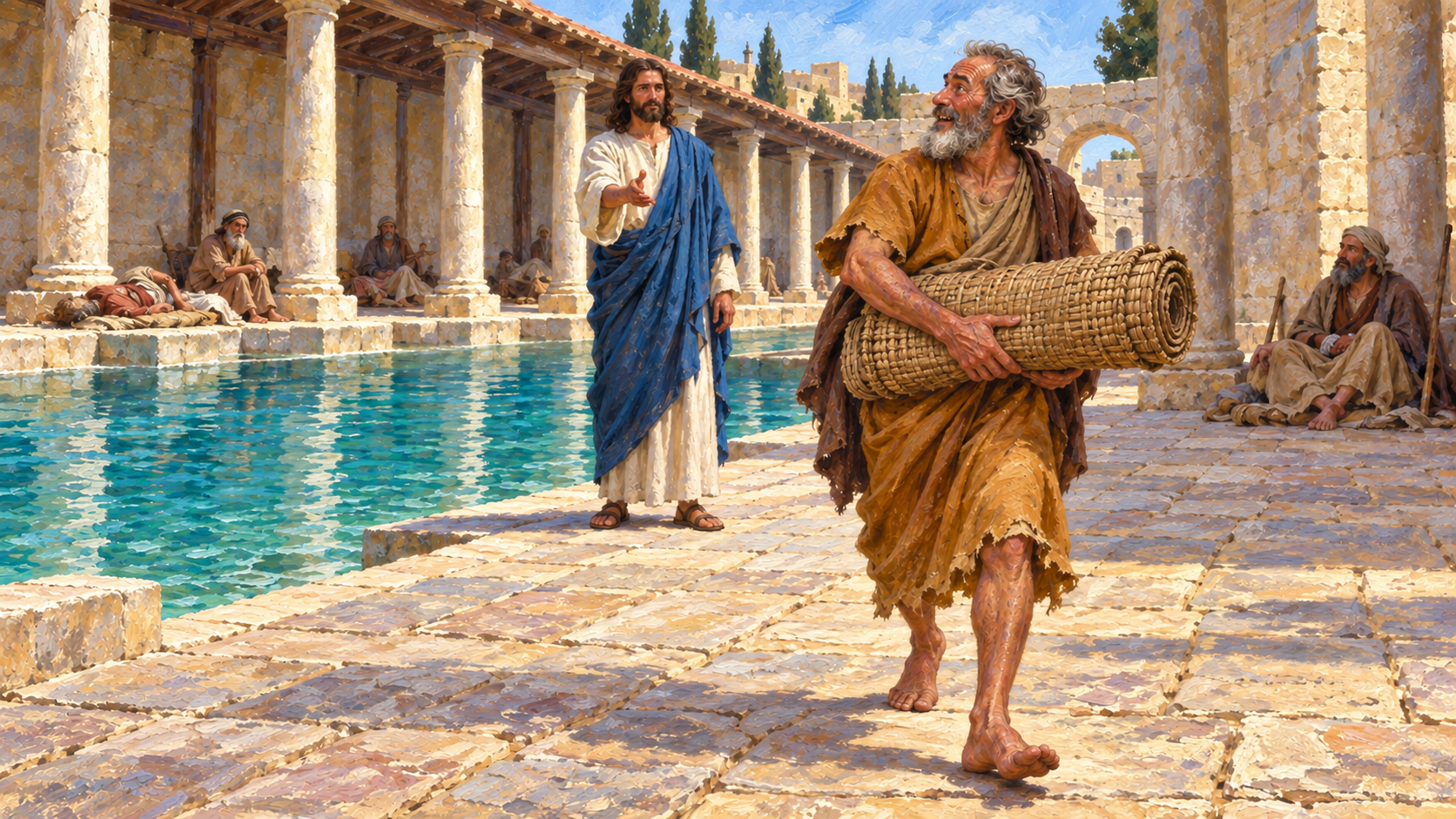
Why did Jesus ask a sick man whether he wanted to be made well, then tell him to carry his mat on the Sabbath? Those details are often turned into lessons about attitude or effort. John, however, follows the healing into a dispute that Jesus answers by declaring His equality and unity with the Father. If I stop when the man walks away, I miss Christ’s explanation of the sign. The One who restored this man’s body also gives everlasting life and will call the dead from their graves.
The Sign Begins at a Real Pool in Jerusalem
After healing an official’s son in Galilee, Jesus returned to Jerusalem for “a feast of the Jews,” which John leaves unnamed. Passover, Pentecost, Purim and the Feast of Tabernacles have all been suggested, but the text does not settle the question. John does identify the place Jesus visited and the suffering people gathered there:
After this there was a feast of the Jews, and Jesus went up to Jerusalem. Now there is in Jerusalem by the Sheep Gate a pool, which is called in Hebrew, Bethesda, having five porches. In these lay a great multitude of sick people, blind, lame, paralyzed, waiting for the moving of the water. For an angel went down at a certain time into the pool and stirred up the water; then whoever stepped in first, after the stirring of the water, was made well of whatever disease he had.
Bethesda stood near the Sheep Gate, north of the temple area in Jerusalem. Its name is often explained as “house of mercy,” although the exact derivation is disputed. The five “porches” were colonnades, covered walkways supported by columns. Excavations north of the Temple Mount revealed two pools divided by a central dam. That arrangement allows for four colonnades around the outside and a fifth across the middle. Urban C. von Wahlde’s discussion of the site explains the remains and the complications caused by later building. The excavated remains support John’s description of the setting without independently proving the healing. Scholars also debate how the complex’s different parts were used as the site changed over time.
The NKJV includes the end of verse 3 and verse 4, following the Textus Receptus. This is the traditional printed Greek New Testament underlying the KJV, broadly belonging to the Byzantine textual tradition. Modern critical editions, which draw heavily on early Alexandrian manuscripts, omit these words or mark them as disputed. The NKJV’s textual note identifies the omission, although verse 7 still refers to the stirring of the water. I retain the received Greek text as the basis of this study. In that text, John explains the angel’s activity as something that happened; he does not merely report a superstition held by the crowd.
Healing at the pool followed a particular order: an angel stirred the water, and the first person to enter was healed. Jesus did not invoke the angel, wait for the stirring, or put the man into the pool. His command would make the man well apart from the means he had been waiting to use.
Jesus Makes a Long-Afflicted Man Well
Now a certain man was there who had an infirmity thirty-eight years. When Jesus saw him lying there, and knew that he already had been in that condition a long time, He said to him, “Do you want to be made well?” The sick man answered Him, “Sir, I have no man to put me into the pool when the water is stirred up; but while I am coming, another steps down before me.” Jesus said to him, “Rise, take up your bed and walk.” And immediately the man was made well, took up his bed, and walked. And that day was the Sabbath.
The man had been ill for thirty-eight years. That tells us the duration of his condition, not his age or whether he had been born with it. John does not give a diagnosis or specifically call him paralyzed. His words “while I am coming” suggest some limited movement, but he could not reach the water first. Jesus knew how long he had suffered before the man explained anything.
John records no request for healing before Jesus approached him and no recognition of who Jesus was. When asked whether he wanted to be made well, the man described the obstacle he faced. He had no one to put him into the water, and another person reached it before him when he tried. Calling Jesus “Sir,” he explained why he could not use the pool’s water. Later, John expressly says he did not know who had healed him.
I would not call his answer an excuse or say that Jesus was exposing a desire to remain sick. He described a real limitation, and John gives us no grounds to dismiss it. Nor does John say that Jesus was testing an existing faith in Him. The question allowed the man to explain his need and the remedy he expected, before Jesus gave him an answer that did not depend on reaching the water.
Jesus told him to rise, take up his bed and walk, and he was made well immediately. There was no extended recovery before he could obey. John places the healing before the man takes up his bed and walks, so we should not make his movement the power that produced the cure. The man who had been lying on the mat could now carry it. Anyone who saw him doing so could see the result of Christ’s command.
The carried mat would also draw the authorities’ attention. John ends the account of the healing by telling us that it happened on the Sabbath.
The Carried Mat Brings a Sabbath Conflict
The Jews therefore said to him who was cured, “It is the Sabbath; it is not lawful for you to carry your bed.” He answered them, “He who made me well said to me, ‘Take up your bed and walk.’” Then they asked him, “Who is the Man who said to you, ‘Take up your bed and walk’?” But the one who was healed did not know who it was, for Jesus had withdrawn, a multitude being in that place.
The authorities challenged the man for carrying his bed. When he explained that his healer had told him to do so, they asked who had given the command. John’s reference to “the Jews” concerns the hostile Jewish authorities in this dispute. Jesus, the healed man, the apostles and the first witnesses were themselves Jewish. The passage gives us no grounds to turn these leaders’ hostility into contempt for an ethnicity.
The authorities’ appeal to the Sabbath requires us to consider the law they were invoking. God had given the Sabbath as a covenant sign for Israel, and the Old Testament did address carrying burdens. Jeremiah spoke to people passing through Jerusalem’s gates:
Thus the LORD said to me: Go and stand in the gate of the children of the people, by which the kings of Judah come in and by which they go out, and in all the gates of Jerusalem; and say to them, Hear the word of the LORD, you kings of Judah, and all Judah, and all the inhabitants of Jerusalem, who enter by these gates. Thus says the LORD: Take heed to yourselves, and bear no burden on the Sabbath day, nor bring it in by the gates of Jerusalem; nor carry a burden out of your houses on the Sabbath day, nor do any work, but hallow the Sabbath day, as I commanded your fathers.
Jeremiah prohibited carrying burdens and doing ordinary work as he called Judah to keep the day holy. Nehemiah later confronted merchants who treated the Sabbath as a day for commerce. Israel’s leaders were responsible to uphold God’s command. We cannot explain this conflict simply by assuming that Scripture permitted people to carry anything light enough to lift.
The man carried the mat on which he had lain, obeying the Son who had made him well. Jesus would defend that command by appealing to the Father’s continuing work and His own work in unity with Him. He did not argue that the mat was light. The leaders would have to reckon with the identity and authority of the One they accused. The Sabbath Day of Rest examines the wider biblical teaching about that day.
At first, the man could repeat his healer’s command but could not give the authorities a name. Jesus had withdrawn into the crowd. Later He found the man in the temple, where He addressed a responsibility that physical recovery had not removed:
Afterward Jesus found him in the temple, and said to him, “See, you have been made well. Sin no more, lest a worse thing come upon you.” The man departed and told the Jews that it was Jesus who had made him well. For this reason the Jews persecuted Jesus, and sought to kill Him, because He had done these things on the Sabbath. But Jesus answered them, “My Father has been working until now, and I have been working.”
John does not explain why the man went to the temple. He tells us that Jesus found him there, reminded him that he had been made well and told him to stop sinning. Jesus’ mercy toward his body had not removed his accountability to God. Care for his suffering belonged with a warning about the consequences of continuing in sin.
Jesus does not say that a particular sin caused the thirty-eight-year illness, nor does He name the “worse thing” that might follow. His warning could concern a harsher consequence in this life, final judgment or both. As the chapter continues, He speaks of a resurrection to condemnation. I need to hear the eternal seriousness of that warning without pretending to know the precise consequence He had in view for this man.
Once the man knew that Jesus had healed him, he reported His identity to the authorities. Some readers understand his action as gratitude or self-defense; others suspect naivety or betrayal. John records what he did without telling us why. He also gives no final account of the man’s faith, so a healed body cannot establish that he was converted.
The authorities persecuted Jesus and sought to kill Him because of His actions on the Sabbath. He answered by placing His work alongside His Father’s continuing work. To understand that answer, they would have to consider much more than whether one man should carry a mat.
The Son Works in Perfect Unity With the Father
God rested from His completed work of creation on the seventh day, but He did not stop sustaining what He had made. He continues giving life and exercising judgment on the Sabbath as on other days. Jesus claimed His place in that divine work when He said, “My Father has been working until now, and I have been working.” He was asserting far more than an exception granted to a healer.
Verse 18 explains why His opponents’ desire to kill Him intensified. They regarded Him as breaking the Sabbath, but He had also called God His own Father, making Himself equal with God. Jesus did not answer by reducing Himself to a created servant. He explained the work and honor He shares with the Father:
Then Jesus answered and said to them, “Most assuredly, I say to you, the Son can do nothing of Himself, but what He sees the Father do; for whatever He does, the Son also does in like manner. For the Father loves the Son, and shows Him all things that He Himself does; and He will show Him greater works than these, that you may marvel. For as the Father raises the dead and gives life to them, even so the Son gives life to whom He will. For the Father judges no one, but has committed all judgment to the Son, that all should honor the Son just as they honor the Father. He who does not honor the Son does not honor the Father who sent Him.”
“The Son can do nothing of Himself” cannot be separated from what Jesus says next: whatever the Father does, the Son does in like manner. He describes their perfect unity, without suggesting that He lacks divine power. The Son does not act independently against the Father or pursue a rival purpose. The Father loves the Son and shows Him His works, and the Son performs them in complete agreement with Him.
That unity does not make the Father and Son the same Person. The Father loves and sends the Son, who sees and performs His Father’s work. One God exists eternally as three distinct, coequal, coeternal Persons: Father, Son and Holy Spirit. Jesus is the eternal, uncreated Son. We would fall far short of His claim if we treated Him as an angel receiving permission to perform an extraordinary act.
Just as the Father raises the dead, the Son gives life to whom He wills. Judgment is also entrusted to Him so that everyone should honor Him just as they honor the Father. No prophet or created messenger possesses that authority by right. The healing at Bethesda gives its witnesses reason to believe the Son’s claim to authority over every grave.
I cannot give Jesus the honor He commands while treating Him as a lesser god or an exalted creature. He says that refusing to honor the Son dishonors the Father who sent Him, so worshiping Jesus obeys the Father’s will. Thomas would later address Him as “My Lord and my God.” These leaders claimed to defend God’s honor, yet their hostility to His Son showed their refusal to receive what God was doing. The Deity of Jesus considers His divine identity across the Scriptures.
The Son Gives Everlasting Life and Raises the Dead
“Most assuredly, I say to you, he who hears My word and believes in Him who sent Me has everlasting life, and shall not come into judgment, but has passed from death into life. Most assuredly, I say to you, the hour is coming, and now is, when the dead will hear the voice of the Son of God; and those who hear will live. For as the Father has life in Himself, so He has granted the Son to have life in Himself, and has given Him authority to execute judgment also, because He is the Son of Man. Do not marvel at this; for the hour is coming in which all who are in the graves will hear His voice and come forth–those who have done good, to the resurrection of life, and those who have done evil, to the resurrection of condemnation.”
The person who hears Jesus’ word and believes the Father who sent Him has everlasting life. Jesus says that person has already passed from death into life and will not enter condemning judgment. He gives us assurance of life we possess now, rather than placing us on a temporary probation dependent on strong feelings. Everyone genuinely born again becomes a new creation, indwelt and sealed by the Holy Spirit, and eternally secure in Christ.
Jesus describes an hour that “now is,” when those who hear the Son’s voice live. He is already giving new life to the spiritually dead. He then speaks of an hour still to come, when everyone in the graves will hear His voice and rise bodily. Present everlasting life and future bodily resurrection belong together, but we must distinguish the life He gives now from the raising of the dead that He will accomplish in the future.
The voice that made this man rise from his mat will one day summon all the dead. Disease, decay and the passage of centuries will not prevent their rising. Jesus distinguishes resurrection to life from resurrection to condemnation, and His reference to good deeds must be read alongside His promise of life through faith. Those deeds do not earn salvation. They reveal the life and allegiance of people who belong to Him, just as evil deeds expose rebellion and unbelief. His command to stop sinning agrees with the new life He gives.
Reading this alongside Revelation 20, I understand unbelievers to be raised for judgment at the Great White Throne. The Lake of Fire is the second death, the final and irreversible destruction of human body and soul. People do not possess inherent immortality, and being raised from the dead does not mean that everyone will be saved. The Son raises all, while distinguishing life from condemnation.
The man at Bethesda received real relief from a long illness, but physical recovery did not place him beyond death or judgment. He still needed the everlasting life that only the Son could give.
In verses 31-47, Jesus identifies the witnesses His opponents refused to receive. John the Baptist testified to the truth, and Jesus’ works showed that the Father had sent Him. The Father’s own testimony agreed with the Scriptures that spoke of His Son. The healing at Bethesda was part of this testimony to Christ’s identity.
These men searched the Scriptures yet refused to come to Christ for life. They wanted one another’s approval more than the honor that comes from God. Their appeal to Moses could not defend them: Moses wrote about Christ and would accuse those who rejected Him. They had evidence before them, but they would not receive it.
That warning reaches me whenever I study the Bible. Familiarity with its words cannot excuse resisting the One they reveal. If I use my learning to secure other people’s approval while rejecting Christ’s correction, I am pursuing the same honor He condemned. His works, the Father’s testimony, and Scripture agree about Him; His later bodily resurrection would confirm that witness decisively.
Healing Must Point Us to Christ, Not a Technique
Bethesda was not the only occasion when a Sabbath healing met with hostility. In Mark 3, Jesus confronted people watching for grounds to accuse Him:
And He entered the synagogue again, and a man was there who had a withered hand. So they watched Him closely, whether He would heal him on the Sabbath, so that they might accuse Him. And He said to the man who had the withered hand, “Step forward.” Then He said to them, “Is it lawful on the Sabbath to do good or to do evil, to save life or to kill?” But they kept silent. And when He had looked around at them with anger, being grieved by the hardness of their hearts, He said to the man, “Stretch out your hand.” And he stretched it out, and his hand was restored as whole as the other. Then the Pharisees went out and immediately plotted with the Herodians against Him, how they might destroy Him.
The Pharisees had just witnessed a man receive mercy, yet they went out to plot with the Herodians to destroy the One who had shown it. Mark tells us that Jesus was angry and grieved at the hardness of their hearts. His Sabbath healings reveal His compassion and His authority as God’s promised Christ, the Messiah. The Miracles of Jesus examines how these works identify Him.
We should not turn a sign that identifies the divine Son into a method every believer can control. Repeating “Rise and walk” does not guarantee a cure. John describes a multitude at Bethesda but records this one healing, without telling us what happened to each sufferer there. The healed man had not expressed informed faith in Jesus before being made well. Accusing a sick person of insufficient faith or an unwillingness to recover goes beyond this passage, and it can be terribly cruel to someone already suffering.
We also need to read Jesus’ warning at Bethesda alongside His explanation of another man’s affliction:
Now as Jesus passed by, He saw a man who was blind from birth. And His disciples asked Him, saying, “Rabbi, who sinned, this man or his parents, that he was born blind?” Jesus answered, “Neither this man nor his parents sinned, but that the works of God should be revealed in him.”
Jesus rejected the disciples’ suggestion that the man’s blindness came from a sin committed by him or his parents. Scripture does connect some sickness with sinful conduct, but that does not authorize us to trace every disability to a particular offense. The warning at Bethesda calls a healed man to leave sin. It does not tell us why every person who remains ill is suffering.
I believe God still heals and gives spiritual gifts today. Every claim must be tested by Scripture, and we can pray earnestly for recovery while continuing to care patiently for a person who remains ill. Full bodily redemption is certain for believers when Christ returns. Present healing, however, is subject to God’s wisdom and timing. A fellow believer who trusts Him through disability or chronic illness should not be treated as spiritually inferior, and even death cannot overturn the resurrection life Christ promises.
John explains why he recorded signs such as the healing at Bethesda:
And truly Jesus did many other signs in the presence of His disciples, which are not written in this book; but these are written that you may believe that Jesus is the Christ, the Son of God, and that believing you may have life in His name.
John’s signs direct us to Jesus as the Christ and the Son of God, so the healing cannot be reduced to an appeal for positive thinking or greater effort. The eternal, uncreated Son became fully man without ceasing to be fully God. Born of a virgin, He lived without sin and willingly gave Himself to be slain as the perfect sacrifice for our sins. Wicked men inflicted His bodily torture and death. His saving sacrifice rests on His perfection and was complete through His shed blood and death before He was buried and rose bodily from the dead.
The Father did not punish, curse, abandon, strike, bruise or pour wrath on Jesus. Father, Son and Holy Spirit acted in perfect unity. Christ died for the whole world, and God’s offer of salvation is genuine for every person. People can resist and reject His grace, as those authorities resisted the witness before them. Everyone who repents and believes is forgiven and justified, meaning declared righteous before God, and receives genuine new birth. The Holy Spirit indwells and seals the believer, whose salvation is eternally secure apart from works.
That security gives no permission for lawlessness, nor does new birth mean that believers never sin. A Christian profession alone cannot establish that a person has been born again; changed conduct gives evidence of new life. Baptism, Sabbath keeping and other religious achievements neither earn salvation nor keep us saved. We receive Christ’s gift through faith, and His mercy gives us reason to obey the Lord who has given it.
My Final Thoughts
Jesus made a man well who did not yet know who He was, then used the carried mat and the ensuing dispute to reveal His work with the Father. The restored body was real mercy, and the sign pointed to His authority to give everlasting life and raise the dead. I want to pray confidently for healing without blaming people who remain sick or treating Christ’s command as a technique. His greater promise calls me to hear His word, leave sin, and trust the Son whose voice will reach every grave.