
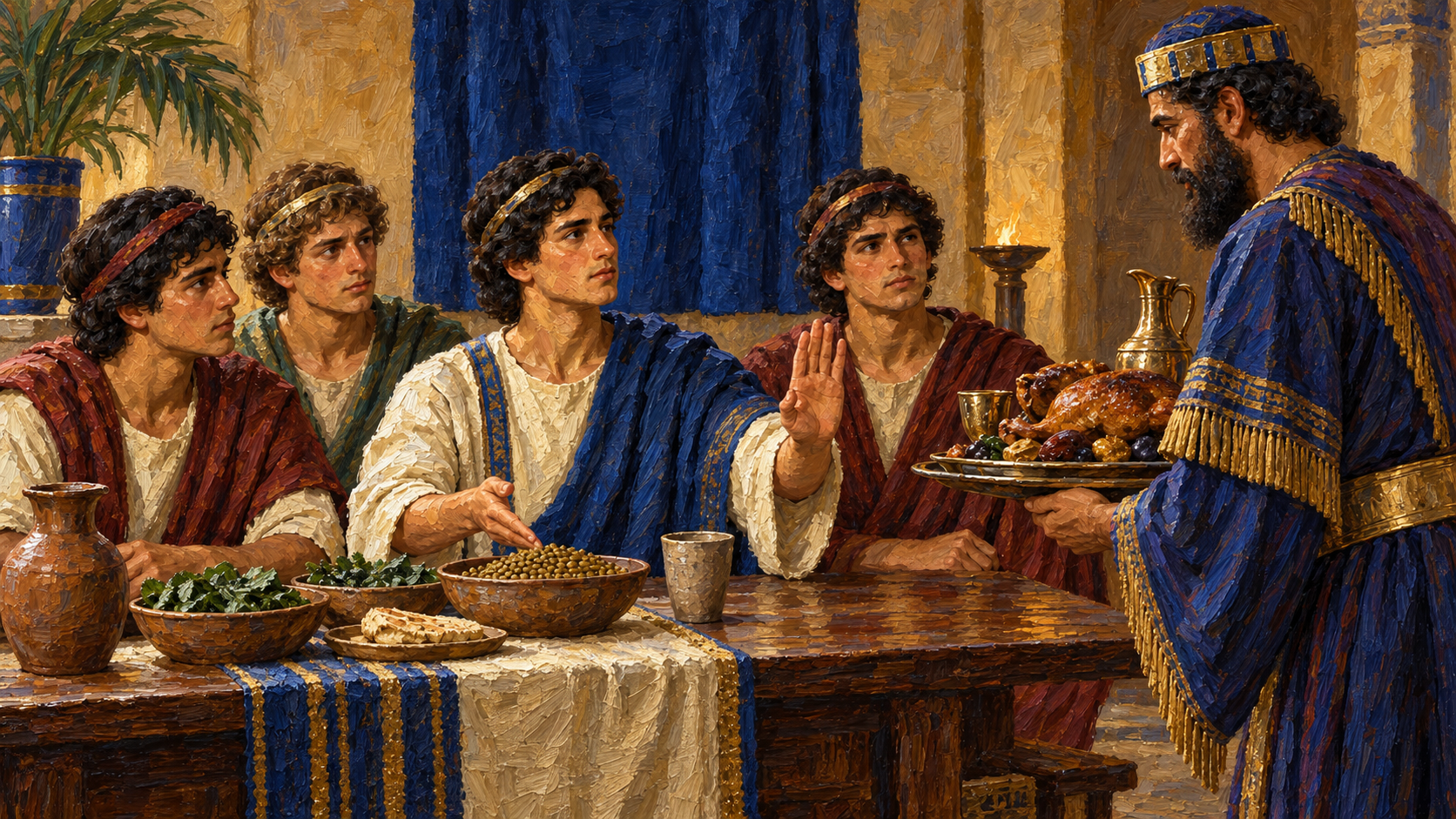
People often call Daniel’s choice in Babylon the “Daniel diet,” but was Daniel trying to give us a health plan? Daniel 1 describes a young captive who refused food because he believed accepting it would defile him before God. Babylon was preparing him for royal service while changing his surroundings, education, and even his name. His decision about the king’s table belongs within that pressure to conform.
Daniel Chose Faithfulness in Exile
Nebuchadnezzar had besieged Jerusalem and carried captives from Judah to Babylon. Among the young men selected for training were Daniel, Hananiah, Mishael, and Azariah. They were to learn Babylon’s language and literature, receive provisions from the king’s own table, and enter his service after three years. The official also gave them Babylonian names: Belteshazzar, Shadrach, Meshach, and Abednego. The study on Nebuchadnezzar follows the ruler whose court became their place of service.
These young men could learn a language and serve in government without giving Babylon the worship they owed to God. Daniel’s refusal of the food shows where he understood obedience to require resistance:
But Daniel purposed in his heart that he would not defile himself with the portion of the king’s delicacies, nor with the wine which he drank; therefore he requested of the chief of the eunuchs that he might not defile himself.
To defile himself meant to make himself unclean before God. Daniel was not choosing a menu because he wanted a leaner body or a more impressive appearance. He had resolved that he would not accept this provision at the expense of faithfulness to God’s covenant.
The chapter does not identify the precise source of defilement. The royal meals may have included animals forbidden under the Mosaic Law, or food and wine associated with offerings to Babylonian gods. Some understand his refusal as a rejection of dependence on the king’s privileges where accepting them would compromise his allegiance to God. These explanations are possible readings of the setting; Daniel does not specify which governed his decision. What he does say is that the king’s food and wine would defile him. That is the reason we must preserve when applying the passage.
I also notice how Daniel approached the official. He had settled his conviction, yet requested permission to avoid the food. He did not need to insult the man in order to remain firm. Scripture also identifies the One who made the official receptive to him:
Now God had brought Daniel into the favor and goodwill of the chief of the eunuchs.
The chief of the eunuchs nevertheless feared the king. If the four young men appeared poorly nourished beside the others, he believed his own life would be endangered for failing to carry out the royal provision. His goodwill toward Daniel had not removed his responsibility to Nebuchadnezzar. Daniel then approached the steward appointed over the four and proposed a limited test that addressed this concern.
The Ten-Day Test Displayed God’s Favor
Daniel asked for vegetables and water, followed by a comparison with the young men eating the royal food:
“Please test your servants for ten days, and let them give us vegetables to eat and water to drink.”
The Hebrew term translated “vegetables” refers to food grown from seed; the older English word “pulse” is also used in translations. It describes plant food without supplying a list of recipes or an exact modern menu.
The steward agreed to the ten days. Daniel had proposed an observable comparison, and the result answered the official’s fear:
And at the end of ten days their features appeared better and fatter in flesh than all the young men who ate the portion of the king’s delicacies.
All four looked better than the young men eating the king’s delicacies. The description “fatter in flesh” certainly does not present their success as weight loss. The steward consequently took away their royal food and wine and continued giving them vegetables, as verse 16 explains. The ten days were the test period; the passage does not say their different meals ended on the tenth day.
God’s provision went beyond preserving their appearance during the food test. The chapter goes on to describe His preparation of these young men for their responsibilities:
As for these four young men, God gave them knowledge and skill in all literature and wisdom; and Daniel had understanding in all visions and dreams.
All four received knowledge and skill, and Daniel received particular understanding in visions and dreams. At the end of their training, Nebuchadnezzar found them exceptional when he examined them. Their ability to serve in his court was God’s gift. We would miss much of the chapter if we made their meals the explanation for their wisdom or treated vegetables as a way to acquire Daniel’s understanding of dreams.
I understand this provision as God’s care for His servants in Babylon. He gave Daniel favor and preserved the four as they refused defilement. The result gives us reason to thank Him, but it does not establish a promise that everyone who copies the meals will receive the same physical result. Nor does it make illness evidence of unfaithfulness. Scripture also describes faithful people who suffered terribly while continuing to trust God.
Daniel’s choice gives us a faithful example without imposing a permanent diet on every believer. He abstained because accepting that food would defile him in his circumstances. The chapter never declares meat inherently sinful or vegetarianism a condition of holiness. To make either claim, we would have to disregard other passages where God permits His people to eat animals.
What the Rest of Scripture Says About Food
The biblical teaching begins with God’s provision in Eden:
And God said, “See, I have given you every herb that yields seed which is on the face of all the earth, and every tree whose fruit yields seed; to you it shall be for food.”
After sin entered, human life was marked by death, toil, and the struggle to survive. Genesis 3:21 records God making garments of skin for Adam and Eve. Later, after the flood, He expressly permitted Noah and his descendants to eat animals:
Every moving thing that lives shall be food for you. I have given you all things, even as the green herbs.
The permission to eat animals did not mean creation had been restored or that death was God’s eternal ideal. It was provision for people living in a fallen world.
Under the Mosaic Law, Israel had to distinguish clean animals from unclean ones, as Leviticus 11 explains. Clean animals could be eaten. During His earthly ministry Jesus served bread and fish in John 6:11, and after His bodily resurrection He ate fish before His disciples:
So they gave Him a piece of a broiled fish and some honeycomb. And He took it and ate in their presence.
Eating meat therefore cannot be inherently sinful. Jesus did not defile Himself by eating the fish, and God did not command Noah to do something morally corrupt. These passages also do not require everyone to eat meat. A person may abstain for conscience, concern for animals, a practical need, or simple preference. He must distinguish his reason for abstaining from a command that God has given to everyone.
Acts 10 takes us to Peter’s vision of animals and the command he initially refused:
And a voice came to him, “Rise, Peter; kill and eat.”
But Peter said, “Not so, Lord! For I have never eaten anything common or unclean.”
And a voice spoke to him again the second time, “What God has cleansed you must not call common.”
God was preparing Peter to enter a Gentile home and receive Gentiles without calling them common or unclean. Peter explains that application in Acts 10:28. We should preserve that immediate purpose while also recognizing that God used animals Peter had regarded as unclean to teach him. Together with Colossians 2:16–17, which rejects judgment over food and drink associated with shadows fulfilled in Christ, the passage helps us understand why the Church is not placed under Israel’s Mosaic food distinctions.
Christian liberty still has boundaries God has given. Acts 15:29 instructs Gentile believers to abstain from things offered to idols, blood, and things strangled, as well as sexual immorality. I cannot use freedom from Mosaic food distinctions to dismiss those instructions. Equally, I cannot take Daniel’s particular abstinence and add a universal ban on meat.
Paul also warns Timothy about teachers who forbid foods God created to be received with thanksgiving. He explains:
For every creature of God is good, and nothing is to be refused if it is received with thanksgiving; for it is sanctified by the word of God and prayer.
Food is sanctified, or set apart for proper use, through God’s Word and prayer. Thanksgiving acknowledges His provision; it is not a way to make a prohibited act acceptable. Paul’s warning concerns people making abstinence a religious obligation where God has permitted food. If I choose to abstain, I have no authority to make everyone else follow my choice.
Idolatry, Conscience, and Christian Liberty
Daniel’s refusal also helps us take seriously what a meal can involve beyond nutrition. Sharing food in an act of pagan worship is different from buying something to eat. Although Daniel 1 leaves the exact defilement unstated, the New Testament directly addresses meals that involve fellowship with idols. Paul says an idol is nothing in itself, yet he commands believers:
Therefore, my beloved, flee from idolatry.
You cannot drink the cup of the Lord and the cup of demons; you cannot partake of the Lord’s table and of the table of demons.
Paul is forbidding participation in idolatrous worship, not claiming that meat has acquired a magical quality. A Christian cannot share the Lord’s table while also participating in a pagan sacrificial table. In the same chapter, Paul permits food bought in the market without an investigation into its origin, while instructing believers to abstain when its identification as sacrificial food makes another person’s conscience an issue. The circumstances can change what eating communicates and whom it harms.
I need to ask more than whether a kind of food is normally permitted. Am I joining in false worship? Am I encouraging someone to act against his conscience? Can I receive this meal with thanksgiving before God? Daniel would not accept a provision that defiled him, and Paul will not let Christians use liberty to excuse idolatry or disregard another person.
That care must also govern disagreements among believers. In Romans 14, Paul addresses Christians who ate all things and others whose convictions led them to eat only vegetables:
For one believes he may eat all things, but he who is weak eats only vegetables.
Let not him who eats despise him who does not eat, and let not him who does not eat judge him who eats; for God has received him.
By “weak,” Paul describes a believer whose faith does not yet allow him to eat freely before God. The person who eats must not despise the one who abstains, and the person who abstains must not condemn the one who eats. God has received them. A believer with liberty to eat has no excuse for sneering at another person’s scruples or pressuring him to violate his conscience. The one who abstains must likewise resist treating his own restriction as proof of greater righteousness. Paul directs their attention to the character of God’s kingdom:
For the kingdom of God is not eating and drinking, but righteousness and peace and joy in the Holy Spirit.
Paul is not giving permission to ignore God’s commands. He is correcting the attempt to make a permitted food choice the measure of another believer’s standing before God. We should care about righteousness, peace, and joy in the Holy Spirit instead of turning a meal into a contest over who is more spiritual. Daniel’s faithful refusal in Babylon and Paul’s protection of Christian liberty agree: we must obey God without binding people to restrictions He has not imposed.
A Daniel Fast and the Real Application of the Chapter
Some Christians call a voluntary season of simple eating, prayer, and consecration a “Daniel fast.” Consecration means setting ourselves apart for God’s service. A believer may choose such a discipline, but Daniel 1 does not command every Christian to adopt that practice or authorize a particular commercial program. The modern name cannot turn a voluntary choice into an obligation from God.
Daniel 1 also gives no individualized medical instructions for someone facing illness, allergies, or other bodily needs. We should not turn this account into a claim that the same eating pattern is appropriate for every person.
A fast also cannot put God in our debt. If I expect a chosen menu to compel Him to answer a prayer, I have confused humble dependence with an attempt to control the outcome. Nor should I promise someone improved health, special insight, or greater spiritual standing because he completes it. The purpose of abstaining should be to seek God and exercise self-control, with confidence in His mercy rather than in the discipline itself. Paul’s instruction applies to both eating and abstaining:
Therefore, whether you eat or drink, or whatever you do, do all to the glory of God.
We can glorify God by gratefully eating what He permits or by voluntarily setting it aside for a time. Both require humility.
Daniel’s conduct also teaches us how to respond to pressure. Daniel resolved not to defile himself before proposing the test. He did not wait to see whether refusing the food would bring a favorable result before deciding that obedience was right. I should likewise settle that God’s commands govern my conduct before an employer, friend, or influential person offers me an advantage that would require disobedience. Waiting until I want the advantage makes rationalizing the compromise much easier.
His request also teaches me to be respectful without surrendering a conviction. I can explain why I cannot participate, ask for a permissible alternative, and take another person’s responsibilities seriously. A gracious response does not require pretending the wrong is acceptable. God gave Daniel favor with the official, and Daniel used that opportunity wisely rather than treating the official as an enemy.
Respectful obedience is our responsibility, but it cannot earn salvation. Choosing simpler food can help me practice self-control; it cannot remove guilt or give me the new life that comes through Christ. The study on being born again explains that genuine new birth. Obedience follows God’s saving work in a believer; we cannot purchase His acceptance through a fast.
The Savior in whom we trust is Jesus Christ, the sinless Son of God. Fully God and fully man, He willingly endured the bodily suffering wicked men inflicted, shed His blood, and died for our sins. His saving work was complete before He rose bodily from the grave. Our confidence rests in Him as we turn to Him in repentance and faith. The study on false gospels addresses the error of making religious performance the basis of acceptance before God.
My Final Thoughts
I do not believe Daniel 1 gives Christians a permanent vegetarian command or a guaranteed plan for physical results. Daniel refused the king’s food because it would defile him, and God provided for him and his friends while equipping them to serve in Babylon. We should learn his firmness, respectful conduct, and willingness to put obedience ahead of privilege. Whether we eat or abstain, we must give thanks, respect the conscience of other believers, and keep our confidence in Christ rather than in our menu.