
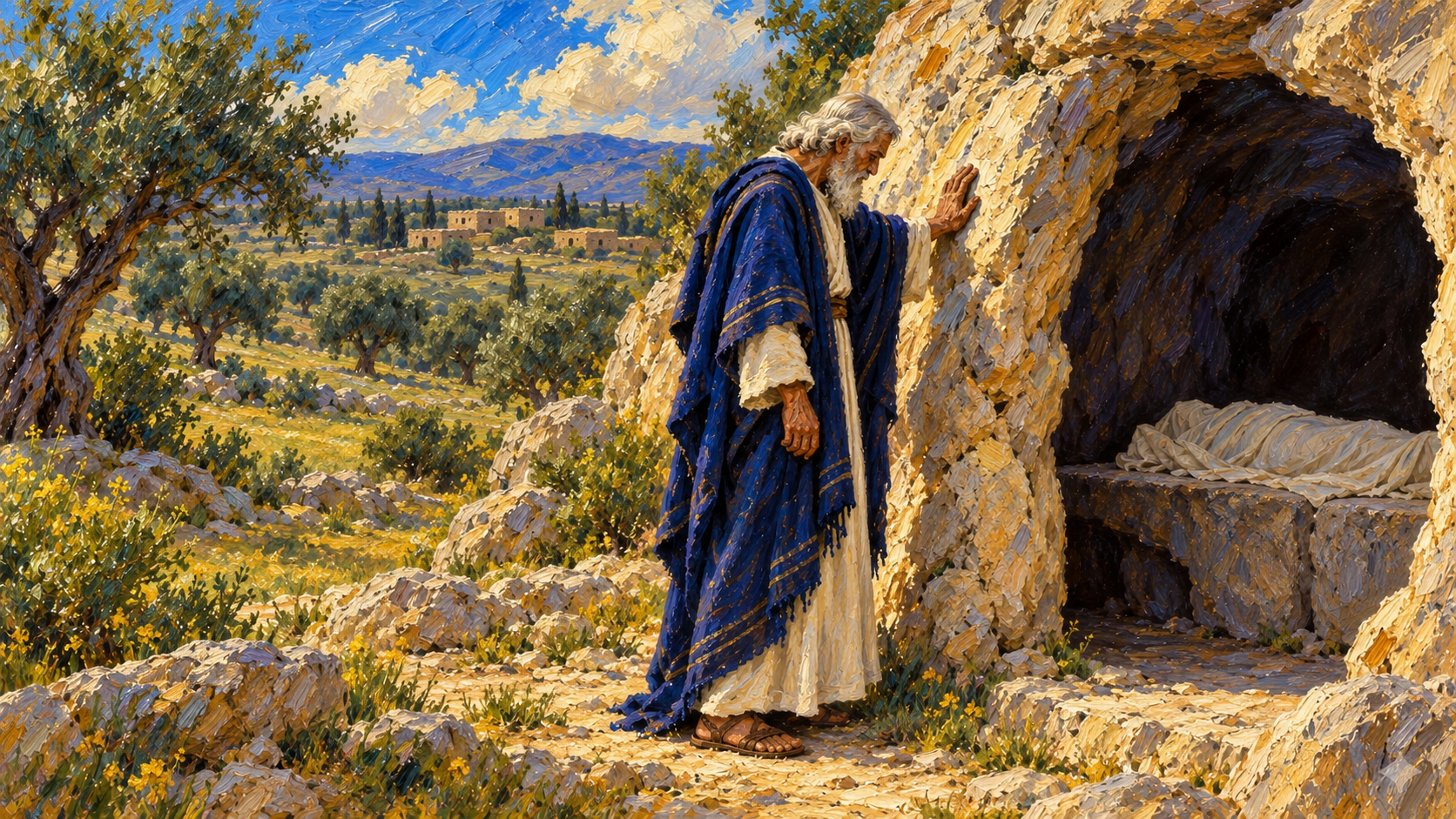
Genesis devotes an entire chapter to Abraham’s purchase of a burial place. Sarah had died, and he needed ground in which to bury her. The negotiation concerned a particular field, cave, and price, but it also took place in the land God had promised him. Machpelah became Abraham’s first recorded purchase of land in Canaan. I want to follow the transaction without losing sight of either the wife he was mourning or the promise he still believed.
Sarah’s Death Led Abraham to His First Possession
God had called Abraham out of his country and promised Canaan to his descendants. He traveled through that land, lived in tents, and built altars to the LORD. The nation and inheritance lay ahead. When Genesis records his first purchase of land there, he was acquiring a family burial place.
Sarah had shared the long wait for the son God promised. She had also lived through the consequences of Abraham’s fearful conduct in Egypt and Gerar before the joy of Isaac’s birth. Now the woman through whom God had given him that son was dead.
Sarah lived one hundred and twenty-seven years; these were the years of the life of Sarah.
So Sarah died in Kirjath Arba, that is, Hebron, in the land of Canaan, and Abraham came to mourn for Sarah and to weep for her.
Genesis names her age, identifies the place of her death, and records Abraham’s mourning. His faith in God’s covenant did not keep him from weeping for his wife. I do not read those tears as a failure to trust the LORD. Death brings real separation and sorrow, even when the person grieving has good reason for hope.
Abraham then rose from beside Sarah’s body and approached the people of the land about a burial place. His grief had not made God’s promise meaningless to him. He sought a place for her in Canaan, where the LORD had said his descendants would live. A Complete Bible Study on the Life of Abraham follows his earlier life and calling.
Abraham Bought the Field Openly and Lawfully
Abraham spoke to the sons of Heth as a resident who still needed property of his own. He did not pretend that God’s promise had already given him possession of every field around him.
“I am a foreigner and a visitor among you. Give me property for a burial place among you, that I may bury my dead out of my sight.”
The sons of Heth honored him as a mighty prince and offered the use of their best burial places. Abraham bowed before them and asked them to speak with Ephron the son of Zohar. He wanted the cave of Machpelah at the end of Ephron’s field and offered to pay the full price for it.
Ephron answered publicly, before those gathered at the city gate. He offered Abraham the field as well as the cave and urged him to bury his dead. Abraham bowed again and insisted on paying for the field. Ephron then named the amount.
And he spoke with Ephron in the hearing of the people of the land, saying, “If you will give it, please hear me. I will give you money for the field; take it from me and I will bury my dead there.”
And Ephron answered Abraham, saying to him,
“My lord, listen to me; the land is worth four hundred shekels of silver. What is that between you and me? So bury your dead.”
And Abraham listened to Ephron; and Abraham weighed out the silver for Ephron which he had named in the hearing of the sons of Heth, four hundred shekels of silver, currency of the merchants.
Abraham paid the four hundred shekels of silver Ephron named, weighing it out where the sons of Heth could witness it. I understand his insistence on payment as a concern to settle ownership clearly. A gift might later be disputed, but the people present could testify that a price had been named and paid.
The transfer included more than the cave. Genesis identifies the field and all the trees within its borders, leaving no doubt about the property involved.
So the field of Ephron which was in Machpelah, which was before Mamre, the field and the cave which was in it, and all the trees that were in the field, which were within all the surrounding borders, were deeded
to Abraham as a possession in the presence of the sons of Heth, before all who went in at the gate of his city.
With the purchase recognized, Abraham buried Sarah in the cave before Mamre, identified with Hebron in Canaan. He now possessed the burial field, although the much greater inheritance God promised still lay ahead. It was actual ground within the promised land, not a substitute for the whole promise. A Complete Bible Study on the Land of Canaan considers the land and its place in Scripture.
The Hebrew name Machpelah is מַכְפֵּלָה (makpelah), commonly associated with doubling or being double. Its exact significance is uncertain, and Genesis does not explain it. I would not derive doctrine from a proposed meaning of the name. The text is much more definite about the location and purchase: a cave before Mamre in Canaan, with a field, trees, boundaries, payment, and witnesses.
Abraham’s confidence in God had not made him careless toward his neighbors. He asked respectfully, paid the agreed price, and accepted a publicly recognized transfer. The promise gave him no license to seize Ephron’s property or ignore its boundaries. I need to remember that when I speak about trusting God. Faith gives me no excuse for manipulative dealings, unreliable accounts, or taking what belongs to another person.
Machpelah Became the Patriarchal Family Tomb
Sarah is the first person Scripture records as buried at Machpelah, often called the Cave of the Patriarchs. Isaac and Ishmael later buried Abraham there. The field then continued to serve the family across generations.
Near the end of Jacob’s life, he was living in Egypt. That land had sheltered his household through the famine, and he had been reunited with Joseph. Nevertheless, Egypt was not the inheritance God had promised Abraham. Jacob told his sons to take him back to the burial place his grandfather had purchased, naming the family members already there.
There they buried Abraham and Sarah his wife, there they buried Isaac and Rebekah his wife, and there I buried Leah.
The field and the cave that is there were purchased from the sons of Heth.
After Jacob died, his sons carried him to Canaan and buried him at Machpelah (Genesis 50:12-13). His instructions expressed continuing confidence in God’s promise while the family was still living away from the land. A Complete Bible Study on the Life of Isaac examines another generation that shared that hope.
We should distinguish these burials from Rachel’s and Joseph’s. Rachel died on the way to Ephrath, identified as Bethlehem, and Jacob set a pillar over her grave there. Joseph died in Egypt after instructing Israel to carry his bones out when God visited them. His remains were eventually buried at Shechem, not Machpelah. The places were different even though Joseph’s instructions expressed the same confidence that God would bring His people into the promised land.
The Cave Witnessed to Faith Beyond Death
Abraham’s expectation did not begin with his ability to buy land. God had spoken before the purchase, naming the land and the descendants who would receive it.
Then the LORD appeared to Abram and said, “To your descendants I will give this land.” And there he built an altar to the LORD, who had appeared to him.
Genesis 15 later gave the covenant boundaries. A burial field near Hebron could not exhaust that promise, but it was a lawful possession within the very land God named. Abraham was not placing his hope in an ambition he had devised. He was responding to the LORD’s word. A Complete Bible Study on the Abrahamic Covenant explains the promises more fully.
Paul describes Abraham’s life in tents in Hebrews. He lived in the land of promise without yet enjoying its full inheritance, and Isaac and Jacob shared that position as heirs with him.
By faith he dwelt in the land of promise as in a foreign country, dwelling in tents with Isaac and Jacob, the heirs with him of the same promise;
for he waited for the city which has foundations, whose builder and maker is God.
Looking for the city God would build did not make Canaan imaginary or turn the field at Machpelah into a mere idea. Abraham trusted God’s purpose beyond what he could possess during his own lifetime. Sarah’s burial and the later deaths of Abraham, Isaac, and Jacob did not cancel God’s purpose.
These all died in faith, not having received the promises, but having seen them afar off were assured of them, embraced them and confessed that they were strangers and pilgrims on the earth.
They died in faith, not in possession of everything God had promised. Paul describes them as assured of what they saw ahead and willing to confess that they were strangers and pilgrims. Their deaths did not make the promises false. I need to distinguish that confidence from demanding that God finish every part of His purpose within the span of my life.
Scripture grounds our hope in God’s power to raise the dead, rather than in the claim that death is harmless because the human soul is naturally immortal. Death is an enemy, and burial acknowledges its reality. God has not finished His purpose for the body when it is laid in a grave. Abraham had already considered God’s ability to raise Isaac from the dead when his faith was tested, as Paul explains in Hebrews 11:17-19.
The cave itself does not set out a complete teaching on resurrection. Its significance belongs within the larger promise of the God who remained faithful to Abraham, Isaac, and Jacob beyond their deaths. Jesus later used God’s identification with those fathers to answer a challenge about resurrection: He is the God of the living, not the dead (Mark 12:26-27). Christian hope similarly looks to God’s power and faithfulness, with the assurance that the Christ who rose bodily will also raise His people.
Christ Secures the Eternal Inheritance
I would not call Machpelah a formal type, an appointed foreshadowing of Christ, when Genesis does not identify it that way. Nor was Abraham’s silver a payment for sin. The connection to Jesus concerns the inheritance God promises and the saving work required for His people to receive it.
And for this reason He is the Mediator of the new covenant, by means of death, for the redemption of the transgressions under the first covenant, that those who are called may receive the promise of the eternal inheritance.
Abraham’s purchase secured a family burial place. Christ’s death secured redemption, delivering sinners from sin and bringing them into the promised eternal inheritance. We should not present those as the same kind of payment with a larger price attached to the cross. Abraham expressed his faith by buying the field; Jesus accomplished the work that saves those who believe.
Jesus is the eternal Son, fully God and fully man. Born of a virgin, He lived without sin and willingly gave Himself for us. Wicked men physically tortured and punished Him before killing Him. He bore that punishment for our sins in His innocent body, shed His blood, and died. His saving sacrifice was complete in His death; He was then buried and rose bodily from the dead.
The Father did not punish, curse, abandon, strike, bruise, or pour wrath on Jesus. Father and Son remained united in redemption. Salvation is received by grace through repentance and faith in Christ, rather than earned by our works. The living Savior secures an inheritance that cannot pass away, including the promise that He will raise His people bodily.
Living as Pilgrims Does Not Mean Living Carelessly
Peter calls believers sojourners and pilgrims while warning them about desires that fight against the life God calls them to live. Looking beyond this age does not make our conduct within it unimportant.
Beloved, I beg you as sojourners and pilgrims, abstain from fleshly lusts which war against the soul.
A sojourner lives away from his permanent home, but he still has responsibilities where he resides. Abraham honored his wife, treated the people around him respectfully, and paid for the property he needed. We should care for our families, perform our work faithfully, and handle possessions honestly while waiting for Christ. Calling this world temporary cannot excuse neglecting the people God has placed in our care.
Our hope also allows us to face grief without pretending that death is welcome. Abraham mourned Sarah and still acted faithfully after her death. We can weep for someone we have lost without treating God’s promise as unreliable. I should not use the hope of resurrection to hurry a bereaved person past their sorrow. Caring for the body and burying the dead with dignity express respect for the person and confidence that the grave is not beyond God’s power.
God’s timing reached beyond the lifetimes of the patriarchs. Sarah died before seeing the nation that would come through Isaac. Abraham, Isaac, and Jacob also died looking forward, and Joseph’s instructions about his bones carried that expectation into another generation. They did not live to see all that God had promised, but He did not lose the ability to fulfill His word when they died.
The Lord will also keep His promises concerning Christ’s return, the resurrection, and His coming kingdom. Waiting for those things should produce faithful living now. I can attend to the ordinary responsibilities before me without treating them as the whole of my hope, just as Abraham could mourn his wife and buy a field while looking for the city whose builder and maker is God.
My Final Thoughts
At Machpelah, Abraham dealt honestly with death, property, and the promise God had given him. His faith did not forbid tears or allow him to disregard his neighbors. He buried Sarah in Canaan and left the greater fulfillment with the LORD. Our hope rests in Jesus Christ, who shed His blood and rose bodily. I want to live honorably in the present while trusting Him for the resurrection and inheritance He has secured.