
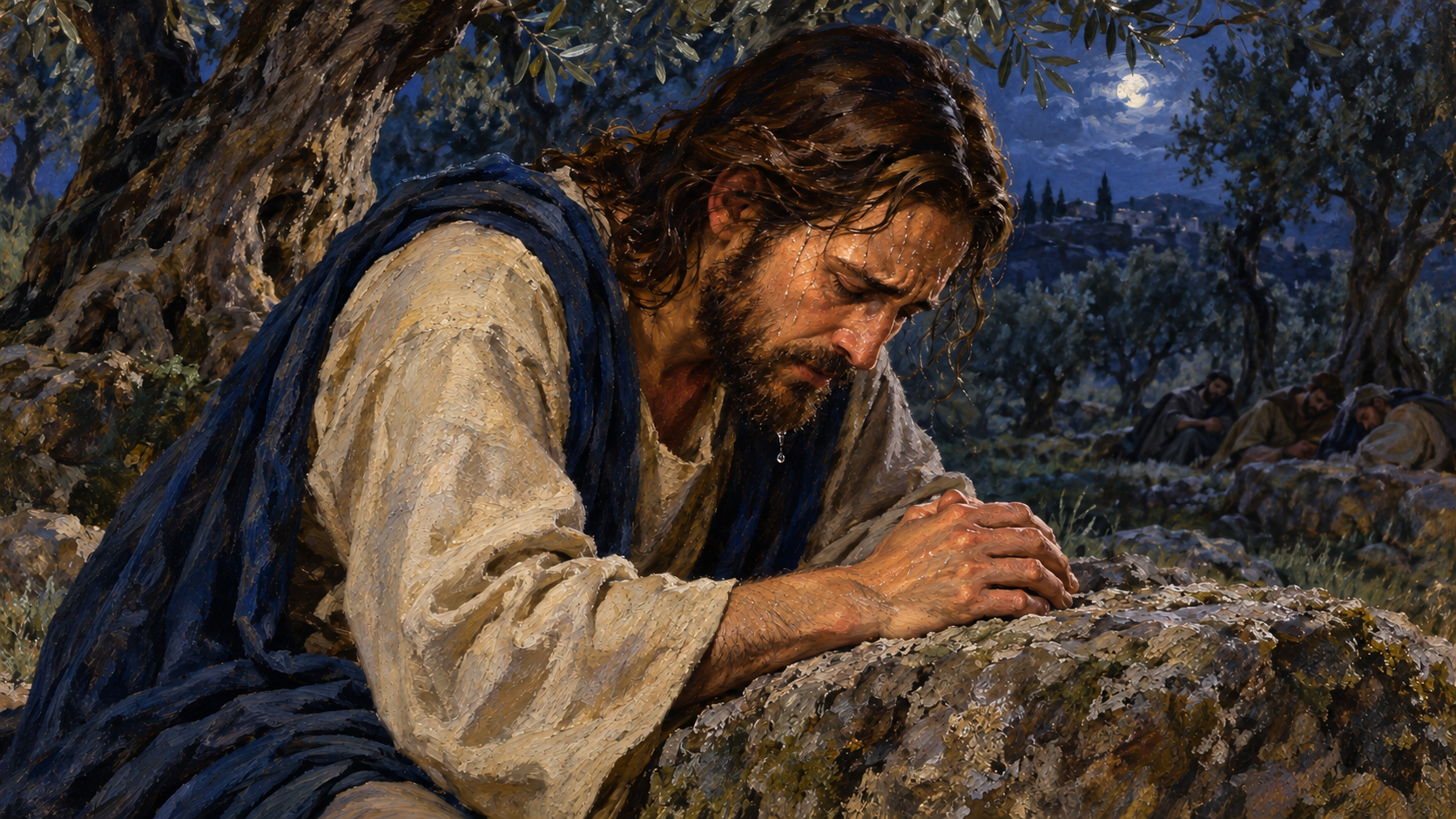
Did Jesus actually sweat blood in Gethsemane? Luke’s description is intense, but before repeating that claim I want to look closely at his words. We also need to hear Christ’s prayer and remember what lay ahead of Him at the cross to understand the moment Luke describes.
Jesus Entered Gethsemane Knowing What Was Ahead
On the night before His crucifixion, Jesus went with His disciples to the Mount of Olives. John calls the place a garden across the Brook Kidron, while Matthew and Mark name it Gethsemane. Luke tells us that Jesus went there as He was accustomed. Judas knew where to find Him because Jesus had often met there with His disciples.
Jesus went to a place Judas knew, so I do not see a man hiding in confusion or caught by surprise when betrayal came. He prayed before the arrest and then rose to meet those who came for Him. His anguish was real, but His mission was not falling apart. The obedient Son was bringing the horror of the coming hour before His Father.
Jesus prayed, “Father, if it is Your will, take this cup away from Me; nevertheless not My will, but Yours, be done.” He spoke honestly and reverently as a real man facing suffering. The incarnate Son expressed His desire to the Father and submitted without rebellion to their shared mission. I would not turn that prayer into sinful reluctance or a struggle within the Trinity.
A cup can describe an assigned portion in Scripture. Some passages use it for blessing, while others speak of suffering or judgment, or another appointed experience. Here we need to hear how Jesus Himself described it. In John 18:11, when Peter tried to defend Him with a sword, Jesus said, “Shall I not drink the cup which My Father has given Me?”
The cup included the path He was about to walk. Judas would betray Him, and false witnesses would accuse Him. Wicked men would mock and scourge Him before nailing Him to the cross. His blood would be shed, and He would die. After His burial, He would rise bodily in victory. The Father gave the saving mission, and the Son willingly accepted it in perfect unity with Him. The Father was not the One who carried out that violence. Wicked men physically punished the innocent Son, and Jesus willingly bore that punishment for our sins in His own body.
Matthew and Mark tell us that Jesus began to be sorrowful, troubled, and deeply distressed. He told Peter, James, and John, “My soul is exceedingly sorrowful, even to death. Stay here and watch.” Luke adds the angel who strengthened Him and describes His agony and sweat like great drops of blood. We can read these accounts together without expecting each writer to repeat every detail.
Jesus’ sorrow did not make Him sinful. Judas’s betrayal lay ahead, along with the failure of His disciples. He also faced public shame and torture before His death. I do not understand sinlessness to mean He felt none of that. His human soul was truly sorrowful without making Him less divine, and He remained perfectly obedient even though the suffering was dreadful.
The full study on the Garden of Gethsemane follows the prayer, betrayal, cup, arrest, and willing surrender in greater detail. Here, Luke’s description of Jesus’ sweat needs our closest attention.
Luke Says His Sweat Became Like Great Drops of Blood
Luke first records Jesus telling the disciples to pray so they would not enter into temptation. He then describes Jesus’ own prayer about the cup. Jesus withdrew about a stone’s throw and knelt to pray. An angel then appeared from heaven and strengthened Him. Even in that agony, Jesus prayed more earnestly, and His sweat fell to the ground.
Coming out, He went to the Mount of Olives, as He was accustomed, and His disciples also followed Him. When He came to the place, He said to them, "Pray that you may not enter into temptation." And He was withdrawn from them about a stone’s throw, and He knelt down and prayed, saying, "Father, if it is Your will, take this cup away from Me; nevertheless not My will, but Yours, be done." Then an angel appeared to Him from heaven, strengthening Him. And being in agony, He prayed more earnestly. Then His sweat became like great drops of blood falling down to the ground. When He rose up from prayer, and had come to His disciples, He found them sleeping from sorrow. Then He said to them, "Why do you sleep? Rise and pray, lest you enter into temptation."
Luke says the sweat became like great drops of blood. He does not say it was blood, and I need to respect that comparison without losing sight of the anguish he describes. Heavy drops fell to the ground while Jesus prayed. Luke was not adding dramatic language to a calm religious scene. The incarnate Son faced betrayal and torture, followed by crucifixion and the shedding of His blood in death. His human anguish was real.
Many sermons mention hematidrosis, a rare condition sometimes described as blood or blood-like fluid appearing with sweat during extreme distress. It may be a possible medical parallel, but I believe we should handle the claim carefully. Luke was a physician, yet he does not give a diagnosis in Luke 22:44. His inspired wording gives a comparison.
Luke already tells us enough to recognize the physical strain: Jesus prayed more earnestly in His agony, and His sweat fell to the ground. I do not need to turn that description into a diagnosis to take His suffering seriously. Staying with the comparison honors what Scripture says without making the medical claim stronger than Luke made it.
We also need to distinguish the sweat in the garden from the blood of atonement. Gethsemane shows Christ’s obedience and sorrow as He approached the cross. Scripture locates redemption in the blood He shed in His sacrificial death at Calvary, where He physically bore the punishment for our sins in His innocent body and died.
The Eternal Son Truly Became Man
An angel strengthened Jesus, and I want to receive that detail reverently as Luke gives it. The eternal Word made flesh had not ceased to be God, but His humanity was real. He knew hunger and thirst, grew tired, and experienced grief. His body could suffer and bleed, and He truly died. Being strengthened by an angel shows us that real humanity without reducing His deity.
Jesus is the eternal Son of God, the Word who was with God and was God. He is also the Word made flesh, with a real body and a real human soul. That is the Person we see praying in Gethsemane. He was not wearing a human disguise. The article on the hypostatic union of Christ explains how full deity and full humanity are united in this one Person.
Hebrews says the children partook of flesh and blood and that Jesus shared in the same. His distress was therefore real, without being a moral failure or a performance for observers. He remained holy in His desires and will, as well as in everything He said and did. His anguish did not make Him sinful.
Christ’s knowledge of human weakness gives me a reason to bring suffering to Him. He knows it from within a true human life, not only from a distance. He experienced sorrow and isolation, and faced temptation as well as bodily pain. He also knew what it was to approach death. Yet none of this led Him into unbelief or rebellion.
Our High Priest Understands and Helps
Hebrews connects Christ’s suffering as a real man with His care for us as High Priest. The One who brings us before God has lived in flesh and blood and passed through testing without sin. Gethsemane lets us see why His sympathy is more than a comforting idea.
Seeing then that we have a great High Priest who has passed through the heavens, Jesus the Son of God, let us hold fast our confession. For we do not have a High Priest who cannot sympathize with our weaknesses, but was in all points tempted as we are, yet without sin. Let us therefore come boldly to the throne of grace, that we may obtain mercy and find grace to help in time of need.
“Tempted in all points as we are” describes real testing that was broad and fully human. It does not mean Jesus experienced every exact circumstance we could name. He knew hunger in the wilderness and rejection by His own people. Later Judas betrayed Him and His disciples failed Him. False witnesses accused Him, and He suffered bodily as He faced death. Through every kind of testing, He remained without sin.
I can come boldly to the throne of grace because this invitation rests on Christ’s priesthood and sinlessness. His suffering was real and His resurrection bodily, and He has access before the Father. That is more than sentimental comfort for a trembling believer. We do not have to hide our anguish behind a performance; through Jesus Christ we may ask for mercy and help when we need it.
For in that He Himself has suffered, being tempted, He is able to aid those who are tempted.
Hebrews 2 explains that the Son shared our flesh and blood so He could die and defeat the devil. Through His death He releases those held in bondage by the fear of death, serving as our merciful and faithful High Priest. When I remember His suffering in Gethsemane, I can better understand the help He gives those who are tempted. The Savior who aids them has Himself suffered without sin.
Hebrews 5 describes the prayers and supplications Jesus offered during His earthly life, with vehement cries and tears. It says He was heard because of His godly fear and explains how He experienced obedience through suffering. It also names Him as the author of eternal salvation. Gethsemane is not named in the passage, but it plainly fits the priestly suffering being described.
who, in the days of His flesh, when He had offered up prayers and supplications, with vehement cries and tears to Him who was able to save Him from death, and was heard because of His godly fear, though He was a Son, yet He learned obedience by the things which He suffered. And having been perfected, He became the author of eternal salvation to all who obey Him,
Being heard did not mean Jesus was spared death on the cross. The Gospels tell us He was arrested and condemned, then crucified and killed. The Father’s full saving answer brought Him through death into resurrection victory. Jesus obeyed to the end and gave His life willingly, and He was raised bodily from the dead.
Nor does “He learned obedience” mean that the Son moved from disobedience to obedience. As the eternal Son, He was always holy. As the incarnate Son, He experienced the cost of obedience in real history. He walked that path all the way to the cross.
The Garden Leads Us to Christ’s Shed Blood
Jesus rose from prayer in Gethsemane and gave Himself into the hands of sinners. They bound and mocked Him, then struck and scourged Him. They pressed thorns onto His head before nailing Him to the cross and killing Him. He shed His blood and died. The garden prepares us for that sacrifice, but its sweat must never take the place of the blood of redemption.
Jesus shared the pain of suffering humanity, but His mission went further. On the cross He physically bore the punishment for our sins in His innocent body. The violence was public and real, as was His death. His bodily resurrection also belongs to what He accomplished.
who Himself bore our sins in His own body on the tree, that we, having died to sins, might live for righteousness–by whose stripes you were healed.
Peter describes the sinless conduct of the One who suffered. Jesus committed no sin and spoke no deceit. When people reviled Him, He did not answer in kind or threaten them in His suffering. He entrusted Himself to the One who judges righteously. This is the same Christ whom Peter says bore our sins in His own body on the tree.
The Father did not punish, curse, abandon, strike, bruise, or pour wrath upon Jesus. Wicked men inflicted the physical punishment. Jesus willingly bore that punishment for our sins as the spotless Lamb. The Father loved the Son who laid down His life, and the Father, Son, and Holy Spirit remained united in the saving purpose.
knowing that you were not redeemed with corruptible things, like silver or gold, from your aimless conduct received by tradition from your fathers, but with the precious blood of Christ, as of a lamb without blemish and without spot.
Peter directs us to Christ’s precious blood as the price of redemption, not to His sweat in Gethsemane. Romans also speaks of propitiation by His blood through faith. In Hebrews, believers enter by the blood of Jesus, while Revelation praises Him for washing us from our sins in His own blood. Those passages keep my attention on how redemption was accomplished at the cross, even as the garden draws me to worship the obedient Savior. The study on the blood of Christ for salvation traces that witness throughout Scripture.
His bodily resurrection belongs to this gospel. Jesus did not remain under the power of death. The One who prayed in agony was buried and then rose in victory. His completed work, described further in the study on tetelestai, “It is finished”, is the ground of our salvation and our confidence before God.
How Gethsemane Shapes Our Response
Jesus brought His anguish to the Father in prayer even though He had no sin to confess or foolish choice to repair. There was no unbelief for Him to overcome. That helps me understand why praying in sorrow is not a lesser form of faith. We do not need to pretend our pain is small before coming to God. We can speak honestly and still be reverent and submitted to Him.
Jesus asked for the cup to pass if it was the Father’s will, then submitted fully: “Nevertheless not My will, but Yours, be done.” He named what He faced and obeyed, showing neither indifference toward suffering nor rebellion against His Father. His prayer helps me distinguish honest desire from rebellion. Submission does not require us to deny pain or stop naming what we fear.
Christ’s saving mission was unique. He willingly surrendered to arrest and death to save us, but His obedience did not give the evil of those who harmed Him divine authority.
Jesus told His disciples to watch and pray so they would not enter into temptation, but they slept from sorrow. Matthew and Mark show how quickly their confident promises collapsed. Sorrow can weigh on the body, and fear can dull the mind. Their weakness helps me see why prayer in such an hour is a necessary expression of dependence on God, rather than a formality.
Hebrews brings us back to the throne of grace, where our confidence rests in the great High Priest rather than in steady feelings. Christ remained sinless through real suffering. He shed His blood and rose bodily, and now He intercedes for His people. We can ask for mercy and help because He understands weakness without sharing our sin.
Finally, we should receive the Savior rather than admire the garden from a distance. Christ died for the whole world, and God’s offer of salvation is genuine. People can resist and reject Him. Whoever repents and believes in Jesus Christ is forgiven and born again. The Holy Spirit indwells and seals that believer, who is eternally secure in Christ. The Savior who prayed in agony now lives to save and help His people.
My Final Thoughts
After reading Luke carefully, I do not believe we should claim more than he says: Jesus’ sweat became like great drops of blood as He prayed in real agony. The garden shows the eternal Son living a truly human life without sin. He brought His sorrow to the Father and obeyed all the way to the cross. We can come to Him without hiding our weakness, because our High Priest understands suffering and gives grace in time of need. Still, Gethsemane must lead us to Calvary, where Jesus willingly bore the punishment for our sins in His body and shed the precious blood that redeems. After He died and was buried, He rose bodily, so our hope rests in the living Savior rather than in the strength of our own resolve.