
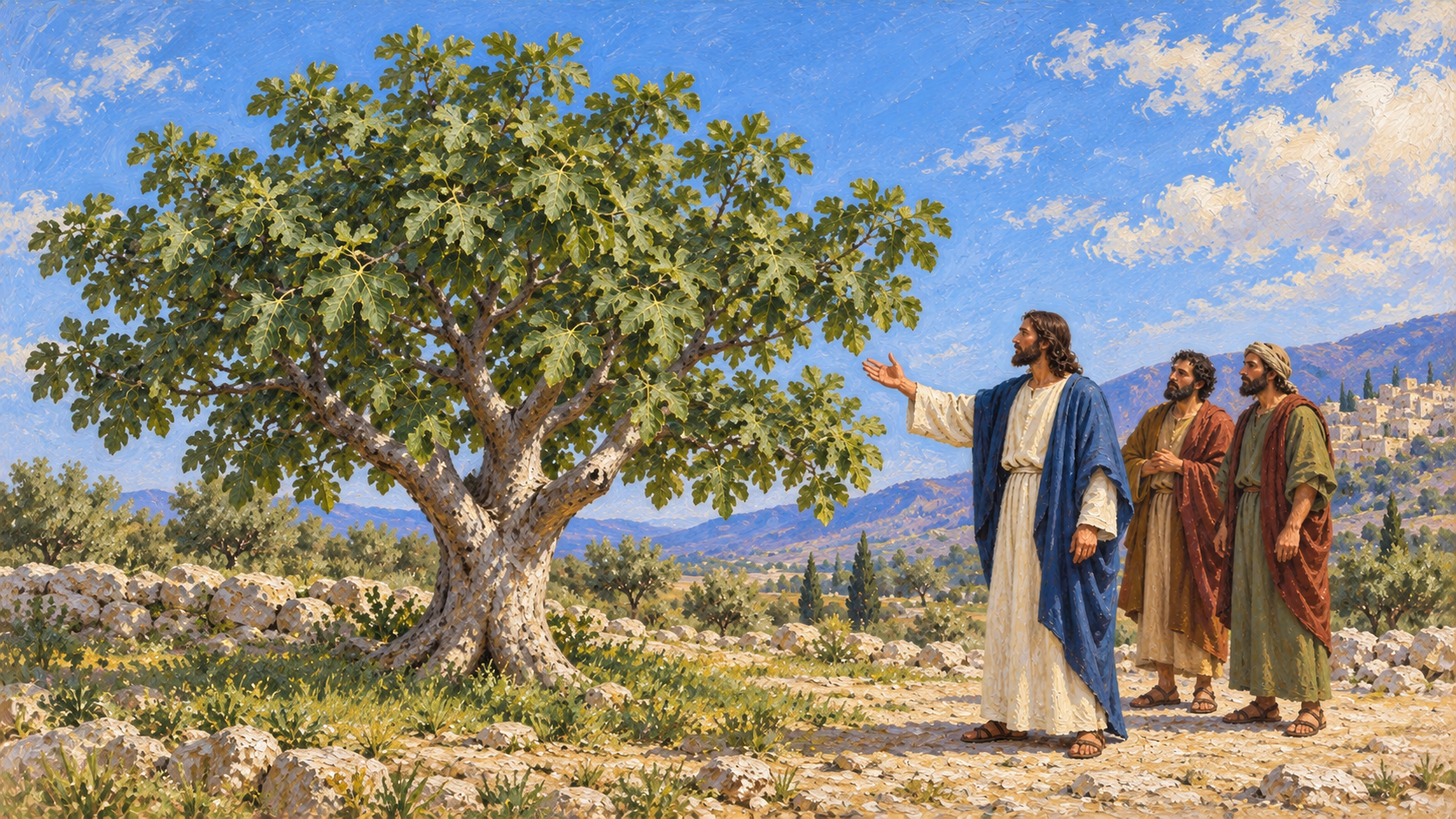
Mark says it was not the season for figs, yet Jesus pronounced judgment on a tree that had no fruit. I understand why that raises a question. If we read the encounter by itself, His action can seem unreasonable. Mark, however, places Jesus’ confrontation in the temple between His words to the tree and the disciples’ discovery that it had withered. We need to follow that sequence, then hear what Jesus taught about faith, prayer, and forgiveness.
Reading the Sign in Mark and Matthew
During the final week before the cross, Jesus was staying in Bethany. One morning, as He went toward Jerusalem, He was hungry and approached a leafy fig tree to see whether there was anything on it. The disciples heard what He said when He found only leaves.
Now the next day, when they had come out from Bethany, He was hungry. And seeing from afar a fig tree having leaves, He went to see if perhaps He would find something on it. When He came to it, He found nothing but leaves, for it was not the season for figs. In response Jesus said to it, "Let no one eat fruit from you ever again." And His disciples heard it. So they came to Jerusalem. Then Jesus went into the temple and began to drive out those who bought and sold in the temple, and overturned the tables of the money changers and the seats of those who sold doves. And He would not allow anyone to carry wares through the temple. Then He taught, saying to them, "Is it not written, 'My house shall be called a house of prayer for all nations'? But you have made it a 'den of thieves.'" And the scribes and chief priests heard it and sought how they might destroy Him; for they feared Him, because all the people were astonished at His teaching. When evening had come, He went out of the city. Now in the morning, as they passed by, they saw the fig tree dried up from the roots. And Peter, remembering, said to Him, "Rabbi, look! The fig tree which You cursed has withered away." So Jesus answered and said to them, "Have faith in God. For assuredly, I say to you, whoever says to this mountain, 'Be removed and be cast into the sea,' and does not doubt in his heart, but believes that those things he says will be done, he will have whatever he says. Therefore I say to you, whatever things you ask when you pray, believe that you receive them, and you will have them. "And whenever you stand praying, if you have anything against anyone, forgive him, that your Father in heaven may also forgive you your trespasses. But if you do not forgive, neither will your Father in heaven forgive your trespasses."
Mark describes two mornings with the temple confrontation between them. Jesus spoke to the tree, entered Jerusalem, and drove buyers and sellers from the temple. He stopped people carrying merchandise through it and explained His action from Scripture: God’s house was to be a house of prayer for all nations, but they had made it a den of thieves. The chief priests and scribes responded by seeking to destroy Him. Jesus left the city that evening, and the next morning the disciples saw the tree dried up from its roots.
I read those events together because Mark has deliberately joined them. Jesus inspected a tree with plentiful leaves and no fruit, then confronted a temple full of religious activity whose leaders were resisting God. Their response to His teaching exposed the failure that the tree pictured. They claimed responsibility for God’s house while plotting against the One who had authority over it.
Matthew places the temple cleansing before the encounter with the tree and brings the pronouncement and visible withering together. I understand him to be grouping the events by subject and emphasizing the immediate authority of Jesus’ word. Mark supplies the sequence across the two mornings. We do not need to make Matthew give every interval Mark records in order to receive both accounts as true.
Then Jesus went into the temple of God and drove out all those who bought and sold in the temple, and overturned the tables of the money changers and the seats of those who sold doves. And He said to them, "It is written, 'My house shall be called a house of prayer,' but you have made it a 'den of thieves.'" Then the blind and the lame came to Him in the temple, and He healed them. But when the chief priests and scribes saw the wonderful things that He did, and the children crying out in the temple and saying, "Hosanna to the Son of David!" they were indignant and said to Him, "Do You hear what these are saying?" And Jesus said to them, "Yes. Have you never read, 'Out of the mouth of babes and nursing infants You have perfected praise'?" Then He left them and went out of the city to Bethany, and He lodged there. Now in the morning, as He returned to the city, He was hungry. And seeing a fig tree by the road, He came to it and found nothing on it but leaves, and said to it, "Let no fruit grow on you ever again." Immediately the fig tree withered away. And when the disciples saw it, they marveled, saying, "How did the fig tree wither away so soon?" So Jesus answered and said to them, "Assuredly, I say to you, if you have faith and do not doubt, you will not only do what was done to the fig tree, but also if you say to this mountain, 'Be removed and be cast into the sea,' it will be done. And whatever things you ask in prayer, believing, you will receive."
Matthew adds that blind and lame people came to Jesus in the temple and were healed. Children praised Him as the Son of David, a title identifying Him with the promised King. The chief priests and scribes saw His works and became indignant. Needy people were receiving the Messiah while the men overseeing the temple opposed Him.
The disputes that followed developed the same charge. Jesus described one son who said he would obey and did not, and another who initially refused but went. He spoke of tenants who rejected the owner’s servants and killed his son, and of invited guests who refused a king’s wedding feast. The leafy, fruitless tree belongs with these warnings about claiming to honor God while rejecting His messengers and His Son.
Not the Season, Yet a Deliberate Prophetic Sign
We should not explain away Mark’s statement that it was not the season for figs. Some explanations appeal to edible growth that may appear before the main crop, but Mark does not identify an early crop or make the explanation depend on one. The most useful connection is the one he actually supplies: the tree, the temple confrontation, and the withering observed afterward.
Jesus’ hunger was real. The eternal Son had truly become man, and His humanity included the need for food. His authority over the tree also belonged to Him as creation’s Lord. I understand His action as a deliberate prophetic sign, an action that made His warning visible. The disciples heard the pronouncement and later saw its result. Neither Gospel describes a loss of self-control over a disappointing meal.
The tree had committed no moral offense and had no covenant duty to produce fruit. We do not need to imagine that it sinned in order to understand Jesus’ use of it. God had used visible actions to explain His messages before: Isaiah’s conduct served as a sign, Jeremiah broke a potter’s vessel, and Ezekiel acted out a siege. Later, Agabus used Paul’s belt to bind his own hands and feet. Jesus stands above the prophets, but His use of an action to teach was familiar within the Scriptures.
The sign does not turn every fig tree into a fixed code for Israel. In Solomon’s reign, the vine and fig tree pictured people living safely and enjoying God’s provision.
Judah and Israel were as numerous as the sand by the sea in multitude, eating and drinking and rejoicing. So Solomon reigned over all kingdoms from the River to the land of the Philistines, as far as the border of Egypt. They brought tribute and served Solomon all the days of his life. Now Solomon's provision for one day was thirty kors of fine flour, sixty kors of meal, ten fatted oxen, twenty oxen from the pastures, and one hundred sheep, besides deer, gazelles, roebucks, and fatted fowl. For he had dominion over all the region on this side of the River from Tiphsah even to Gaza, namely over all the kings on this side of the River; and he had peace on every side all around him. And Judah and Israel dwelt safely, each man under his vine and his fig tree, from Dan as far as Beersheba, all the days of Solomon.
Zechariah used that peaceful picture in a promise concerning the coming Servant, the Branch. The Lord would remove the land’s iniquity, and neighbors would enjoy security together.
'Hear, O Joshua, the high priest, You and your companions who sit before you, For they are a wondrous sign; For behold, I am bringing forth My Servant the BRANCH. For behold, the stone That I have laid before Joshua: Upon the stone are seven eyes. Behold, I will engrave its inscription,' Says the LORD of hosts, 'And I will remove the iniquity of that land in one day. In that day,' says the LORD of hosts, 'Everyone will invite his neighbor Under his vine and under his fig tree.'"
Elsewhere, good and bad figs portray people God would preserve and people appointed for judgment. Jesus also used fig trees in teachings about readiness and patience. Each passage gives us the setting in which to understand its image. Here Mark joins the barren tree to the temple. The building, sacrifices, teachers, and crowds were all visible, but the Lord encountered resistance where there should have been faith and obedience.
The Fruitless Temple and Covenant Judgment
The prophets had already described God looking for fruit among His covenant people. Hosea recalled His delight in Israel’s fathers, then described their turn to idolatry and the judgment that followed.
"I found Israel Like grapes in the wilderness; I saw your fathers As the firstfruits on the fig tree in its first season. But they went to Baal Peor, And separated themselves to that shame; They became an abomination like the thing they loved. As for Ephraim, their glory shall fly away like a bird– No birth, no pregnancy, and no conception! Though they bring up their children, Yet I will bereave them to the last man. Yes, woe to them when I depart from them! Just as I saw Ephraim like Tyre, planted in a pleasant place, So Ephraim will bring out his children to the murderer." Give them, O LORD– What will You give? Give them a miscarrying womb And dry breasts! "All their wickedness is in Gilgal, For there I hated them. Because of the evil of their deeds I will drive them from My house; I will love them no more. All their princes are rebellious. Ephraim is stricken, Their root is dried up; They shall bear no fruit. Yes, were they to bear children, I would kill the darlings of their womb." My God will cast them away, Because they did not obey Him; And they shall be wanderers among the nations.
Israel’s privilege was real, and so was the rebellion. Hosea moved from the first fruit God delighted in to a dried root that would bear no fruit. Jeremiah likewise challenged people who claimed wisdom and possession of God’s law while rejecting His word.
"How can you say, 'We are wise, And the law of the LORD is with us'? Look, the false pen of the scribe certainly works falsehood. The wise men are ashamed, They are dismayed and taken. Behold, they have rejected the word of the LORD; So what wisdom do they have? Therefore I will give their wives to others, And their fields to those who will inherit them; Because from the least even to the greatest Everyone is given to covetousness; From the prophet even to the priest Everyone deals falsely. For they have healed the hurt of the daughter of My people slightly, Saying, 'Peace, peace!' When there is no peace. Were they ashamed when they had committed abomination? No! They were not at all ashamed, Nor did they know how to blush. Therefore they shall fall among those who fall; In the time of their punishment They shall be cast down," says the LORD. "I will surely consume them," says the LORD. "No grapes shall be on the vine, Nor figs on the fig tree, And the leaf shall fade; And the things I have given them shall pass away from them."'"
Priests and prophets dealt falsely, covetousness spread, and reassuring words about peace concealed a condition that required repentance. The absence of grapes and figs, together with fading leaves, pictured the coming judgment. Micah also used the search for fruit to describe a land in which faithfulness had given way to violence and corruption.
Woe is me! For I am like those who gather summer fruits, Like those who glean vintage grapes; There is no cluster to eat Of the first-ripe fruit which my soul desires. The faithful man has perished from the earth, And there is no one upright among men. They all lie in wait for blood; Every man hunts his brother with a net. That they may successfully do evil with both hands– The prince asks for gifts, The judge seeks a bribe, And the great man utters his evil desire; So they scheme together. The best of them is like a brier; The most upright is sharper than a thorn hedge; The day of your watchman and your punishment comes; Now shall be their perplexity. Do not trust in a friend; Do not put your confidence in a companion; Guard the doors of your mouth From her who lies in your bosom. For son dishonors father, Daughter rises against her mother, Daughter-in-law against her mother-in-law; A man's enemies are the men of his own household. Therefore I will look to the LORD; I will wait for the God of my salvation; My God will hear me.
Micah named rulers seeking gifts, judges accepting bribes, and evil reaching into close relationships. His lament ended by looking to the Lord and waiting for the God of his salvation. These passages prepare us to understand Jesus’ sign as a judgment on covenant unfaithfulness. They give Gentiles no reason to claim moral superiority or treat Jewish ethnicity as the offense.
After speaking to the tree, Jesus entered the temple and stopped the commerce described by Mark. Pilgrims could have legitimate needs for animals and currency exchange, so the existence of a transaction was not, by itself, the full accusation. Jesus explained what God’s house was for and what they had made of it. His first citation came from Isaiah’s promise concerning those who joined themselves to the Lord.
Thus says the LORD: "Keep justice, and do righteousness, For My salvation is about to come, And My righteousness to be revealed. Blessed is the man who does this, And the son of man who lays hold on it; Who keeps from defiling the Sabbath, And keeps his hand from doing any evil." Do not let the son of the foreigner Who has joined himself to the LORD Speak, saying, "The LORD has utterly separated me from His people"; Nor let the eunuch say, "Here I am, a dry tree." For thus says the LORD: "To the eunuchs who keep My Sabbaths, And choose what pleases Me, And hold fast My covenant, Even to them I will give in My house And within My walls a place and a name Better than that of sons and daughters; I will give them an everlasting name That shall not be cut off. "Also the sons of the foreigner Who join themselves to the LORD, to serve Him, And to love the name of the LORD, to be His servants– Everyone who keeps from defiling the Sabbath, And holds fast My covenant– Even them I will bring to My holy mountain, And make them joyful in My house of prayer. Their burnt offerings and their sacrifices Will be accepted on My altar; For My house shall be called a house of prayer for all nations." The Lord GOD, who gathers the outcasts of Israel, says, "Yet I will gather to him Others besides those who are gathered to him."
God’s house was to be a place of prayer for all nations. Foreigners who served Him were not to think He had shut them out, and faithful eunuchs were promised a place and name better than sons and daughters. The holiness of the temple could not be used to contradict the welcome God had announced. Worship there was to express His purposes, including His care for people who might otherwise be dismissed.
Jesus’ description of a den of thieves came from Jeremiah’s address at the temple gate. A den is a place where thieves take shelter. Jeremiah condemned people who oppressed the vulnerable, shed innocent blood, and followed other gods, then came to God’s house as though the building would protect them from judgment.
The word that came to Jeremiah from the LORD, saying, "Stand in the gate of the LORD's house, and proclaim there this word, and say, 'Hear the word of the LORD, all you of Judah who enter in at these gates to worship the LORD!'" Thus says the LORD of hosts, the God of Israel: "Amend your ways and your doings, and I will cause you to dwell in this place. Do not trust in these lying words, saying, 'The temple of the LORD, the temple of the LORD, the temple of the LORD are these.' "For if you thoroughly amend your ways and your doings, if you thoroughly execute judgment between a man and his neighbor, if you do not oppress the stranger, the fatherless, and the widow, and do not shed innocent blood in this place, or walk after other gods to your hurt, then I will cause you to dwell in this place, in the land that I gave to your fathers forever and ever. "Behold, you trust in lying words that cannot profit. Will you steal, murder, commit adultery, swear falsely, burn incense to Baal, and walk after other gods whom you do not know, and then come and stand before Me in this house which is called by My name, and say, 'We are delivered to do all these abominations'? Has this house, which is called by My name, become a den of thieves in your eyes? Behold, I, even I, have seen it," says the LORD. "But go now to My place which was in Shiloh, where I set My name at the first, and see what I did to it because of the wickedness of My people Israel. And now, because you have done all these works," says the LORD, "and I spoke to you, rising up early and speaking, but you did not hear, and I called you, but you did not answer, therefore I will do to the house which is called by My name, in which you trust, and to this place which I gave to you and your fathers, as I have done to Shiloh. And I will cast you out of My sight, as I have cast out all your brethren–the whole posterity of Ephraim.
God pointed to Shiloh, where He had previously set His name, to expose the folly of that confidence. A sacred place did not give Judah permission to ignore Him. Jesus brought the warning into His own confrontation: the leaders could not defend the temple’s honor while rejecting God’s Messiah and planning His death. Their commerce and control of the courts belonged within that larger failure of worship.
The tree’s withering from the roots made the completeness of the judgment visible. More leaves could not restore a dead root. I understand Jesus’ pronouncement to announce judgment on the fruitless temple order He had inspected, rather than a call merely to improve its appearance. Jerusalem and the temple would be destroyed within a generation, in AD 70.
That destruction did not end God’s saving purpose or cancel His promises to Israel. Jesus would establish the new covenant in His blood, rise bodily, and build His church. Jesus did not tell the disciples to celebrate the tree’s destruction. When Peter drew attention to it, He directed them to trust God.
Faith in God, Believing Prayer, and Forgiveness
Jesus said, “Have faith in God.” He named the One in whom the disciples were to place their confidence. Faith is not a mental force or a measure of how intensely I can persuade myself that a desired result must happen. We trust God because He is truthful, wise, good, and able to do what He has promised. The study on faith develops that dependence on His word.
A mountain being cast into the sea describes something beyond human strength. The disciples would soon carry the gospel into formidable opposition, and God’s power gave them reason to pray boldly. The resistance they met could not overturn His appointed purpose. Some interpreters connect “this mountain” specifically with the temple mount and its coming judgment. The setting makes that a possible connection, but Jesus does not explicitly identify the mountain in those terms. His instruction directs their confidence to God, who can remove an obstacle they cannot overcome.
I cannot turn that promise into permission to dictate terms to Him. Refusing to acknowledge uncertainty cannot create a promise He has never made. Prosperity teaching and manipulative prayer formulas wrongly make the desired result depend on maintaining a particular mental state. Jesus’ words call us to trust God and ask Him, not to manufacture power within ourselves. Nor do they authorize a reckless spectacle. Jesus refused Satan’s demand that He throw Himself from the temple and force a visible rescue.
James applies believing prayer to the needs of a suffering congregation.
Is anyone among you suffering? Let him pray. Is anyone cheerful? Let him sing psalms. Is anyone among you sick? Let him call for the elders of the church, and let them pray over him, anointing him with oil in the name of the Lord. And the prayer of faith will save the sick, and the Lord will raise him up. And if he has committed sins, he will be forgiven. Confess your trespasses to one another, and pray for one another, that you may be healed. The effective, fervent prayer of a righteous man avails much. Elijah was a man with a nature like ours, and he prayed earnestly that it would not rain; and it did not rain on the land for three years and six months. And he prayed again, and the heaven gave rain, and the earth produced its fruit. Brethren, if anyone among you wanders from the truth, and someone turns him back, let him know that he who turns a sinner from the error of his way will save a soul from death and cover a multitude of sins.
The suffering person is to pray, the cheerful person to sing praise, and the sick person to call the elders for prayer in the Lord’s name. James speaks confidently of the Lord raising up the sick, then adds that sins will be forgiven if the person has committed them. He does not make every illness proof of a particular sin. The church is to attend to physical and spiritual needs without turning sickness into an accusation.
Elijah was a man with a nature like ours, yet his prayer was effective. The power belonged to God, not to a spiritual elite. We need that encouragement alongside the rest of Scripture’s teaching: pray in Jesus’ name, ask according to God’s will, submit our motives to His word, and persist when the answer is delayed. Paul asked repeatedly for his thorn to depart and received sufficient grace instead. Jesus prayed in Gethsemane for the cup to pass if possible, then yielded to the Father’s will. His submission was not deficient faith.
I think it is reckless to blame a suffering believer’s unanswered request on inadequate faith. God’s answer may differ from what we hoped for, and waiting may be painful. We can lament and continue asking without treating our preferred outcome or timetable as the test of His faithfulness. The study on prayer considers that confidence and submission more fully.
Mark 11:25-26 also joins prayer to forgiveness. Verse 26 is included in the traditional Greek text followed by the NKJV here; some translations omit it because of manuscript differences, described in the NET textual note. Verse 25 already commands the person praying to forgive, and the warning in verse 26 makes the consequence of refusal explicit. I cannot claim the promise about moving mountains while protecting my determination to get even.
Jesus was not making forgiveness a way to earn justification. Salvation rests on His shed blood and comes by grace through faith. I understand His warning as concerning fellowship with our Father: a child asking Him for mercy cannot treat cherished hatred as harmless. Forgiving means relinquishing personal revenge and entrusting judgment to God. It does not mean calling evil good, canceling civil consequences, abandoning wise boundaries, or pretending that trust has already been restored.
Fruit Comes From Abiding in Christ
Earlier in His ministry, Jesus had used a fig tree in a parable about patience and repentance. His hearers had reported a tragedy, and He rejected the assumption that its victims must have been worse sinners than everyone else.
There were present at that season some who told Him about the Galileans whose blood Pilate had mingled with their sacrifices. And Jesus answered and said to them, "Do you suppose that these Galileans were worse sinners than all other Galileans, because they suffered such things? I tell you, no; but unless you repent you will all likewise perish. Or those eighteen on whom the tower in Siloam fell and killed them, do you think that they were worse sinners than all other men who dwelt in Jerusalem? I tell you, no; but unless you repent you will all likewise perish." He also spoke this parable: "A certain man had a fig tree planted in his vineyard, and he came seeking fruit on it and found none. Then he said to the keeper of his vineyard, 'Look, for three years I have come seeking fruit on this fig tree and find none. Cut it down; why does it use up the ground?' But he answered and said to him, 'Sir, let it alone this year also, until I dig around it and fertilize it. And if it bears fruit, well. But if not, after that you can cut it down.'"
The owner had repeatedly found no fruit, but the keeper asked for another year to dig around the tree and fertilize it. The delay gave an opportunity for fruit; it did not cancel the possibility of cutting the tree down. God’s patience should move us to repent while there is time. By the final week in Jerusalem, Jesus had preached, healed, called the nation to Himself, and presented Himself as King. The leaders’ determination to kill Him exposed how they had responded to that opportunity.
Fruit describes the visible response to God’s word. John the Baptist called for fruit worthy of repentance because ancestry could not substitute for obedience. Jesus taught that a tree is known by its fruit. A spiritually dead person cannot perform enough good works to bring himself to life, however. God gives new life to the person who repents and believes. The Holy Spirit lives in that believer and changes his direction. Fruit confirms the life God has given; it does not earn the new birth.
During His final teaching before His arrest, after Judas had left, Jesus explained the disciples’ dependence on Him. They would soon live without Him visibly beside them.
"I am the true vine, and My Father is the vinedresser. Every branch in Me that does not bear fruit He takes away; and every branch that bears fruit He prunes, that it may bear more fruit. You are already clean because of the word which I have spoken to you. Abide in Me, and I in you. As the branch cannot bear fruit of itself, unless it abides in the vine, neither can you, unless you abide in Me. "I am the vine, you are the branches. He who abides in Me, and I in him, bears much fruit; for without Me you can do nothing. If anyone does not abide in Me, he is cast out as a branch and is withered; and they gather them and throw them into the fire, and they are burned. If you abide in Me, and My words abide in you, you will ask what you desire, and it shall be done for you. By this My Father is glorified, that you bear much fruit; so you will be My disciples. "As the Father loved Me, I also have loved you; abide in My love. If you keep My commandments, you will abide in My love, just as I have kept My Father's commandments and abide in His love. "These things I have spoken to you, that My joy may remain in you, and that your joy may be full.
Jesus called Himself the true vine and His Father the vinedresser, the One who tends the vine. The disciples had no independent source of fruitfulness. To abide is to remain in living dependence on Him, receiving His word and obeying Him.
The warning about fruitless branches is severe, and we must hear it alongside Jesus’ teaching about genuine disciples and false professions. He told these disciples they were already clean through His word and described the Father pruning fruitful branches so they would bear more fruit. He also taught that He keeps those who truly belong to Him. Everyone genuinely born again is indwelt and sealed by the Spirit. That security neither makes a barren profession saving faith nor excuses lawlessness. It gives us reason to depend on Christ rather than imagine that anxious self-measurement can produce holiness.
Paul describes the Spirit’s fruit as love, joy, peace, longsuffering, kindness, goodness, faithfulness, gentleness, and self-control. Longsuffering means patient endurance, including patience with people. Those qualities become visible in how we treat someone who irritates us, whether we can be trusted, and how we respond to an appetite we need to resist. Scripture also speaks of fruit in praise, generosity, truthful speech, and holy conduct. The study on the fruit of the Spirit examines that character more fully.
Leaves are not themselves the problem. Knowledge of Scripture, public prayer, attendance, giving, music, and visible service can all grow from genuine love for God. The danger is using a good appearance to conceal resistance to Christ. Nor is every inconsistency hypocrisy. A growing Christian can stumble, confess, receive correction, and continue learning obedience. Performing righteousness for an audience while protecting a contrary allegiance is a different response. We need to bring our conduct under God’s word, rather than abandon visible obedience or use it as a disguise.
Israel, the Church, and the Response of Faith
Jesus’ judgment on the temple establishment did not cancel God’s promises to Israel. The apostles soon preached Christ in Jerusalem, where thousands of Jewish hearers believed. The earliest church was Jewish, and the gospel’s spread to Gentiles fulfilled God’s promise to bless the nations through Abraham’s seed. Both Jews and Gentiles are saved through faith in Jesus the Messiah.
Paul warned Gentile branches against boasting and affirmed that God’s gifts and calling concerning Israel are irrevocable. Unbelief brings real judgment, but God will fulfill His covenants and His future purpose for the nation. The church does not become ethnic Israel or erase Israel’s prophetic future. Reading the withered tree as permission to despise Jewish people would itself be a refusal to hear God’s word.
A church can also surround spiritual barrenness with impressive activity. A large congregation, a beautiful building, and well-run programs may serve good purposes, but none can supply the life that comes from Christ. Even a sound doctrinal statement becomes a cover if we display it while refusing its teaching. Changing the language or improving the presentation cannot repair an allegiance that remains opposed to the Lord.
Leaders need to consider that danger when they handle money, oversee worship, and decide how vulnerable people will be treated. An office must never shelter exploitation or make a complaint disappear because it embarrasses the institution. Where Scripture exposes wrongdoing, we need honest repentance, protection for those harmed, and restitution where possible. Prayer should recover its proper place, and believers should use their gifts to serve people in love. Stirring up emotion or adding another program cannot accomplish that change for us.
I should not condemn the temple leaders while refusing the same examination myself. The Lord knows how I treat a vulnerable person, whether I tell the truth about money, and how I respond when Scripture challenges something I want to keep. A good reputation cannot hide those things from Him. We need Christ Himself and the new life He gives.
Jesus is the eternal Son, fully God and fully man, born of a virgin and without sin. Wicked men physically tortured and killed Him, and He willingly bore that punishment for our sins in His innocent body. He voluntarily shed His blood and died, completing His saving work before His burial and bodily resurrection. The Father did not punish, curse, abandon, strike, bruise, or pour wrath on Jesus.
Christ died for the whole world, and God’s offer of salvation is genuine, though people can resist and reject Him. Everyone who repents and believes in Jesus is forgiven and justified, declared righteous before God, and born again as a new creation. The Holy Spirit indwells and seals the believer, whose salvation is eternally secure. We neither earn that salvation nor keep ourselves saved by our performance. Its security does not excuse lawlessness, and a superficial profession cannot establish that someone has truly been born again.
In Christ, we can face the difference between what we profess and how we live. Hidden sin needs plain confession, and repentance should seek to repair harm where possible. Jesus’ command to forgive calls us to relinquish personal vengeance. His command to have faith in God calls us to bring real needs before Him while trusting His wisdom. We bear fruit as we remain in His word and depend on Him, rather than try to maintain an appearance that will impress observers.
My Final Thoughts
Mark’s arrangement leads me to understand Jesus’ action as a deliberate sign of judgment. The tree’s leaves and lack of fruit pictured a temple order busy with religion while opposing its Lord. Jesus then directed His disciples to trust God and pray with hearts willing to forgive. I want us to receive that warning personally. His patience gives us an opportunity to repent, and the fruit He seeks grows as we depend on Christ and let His word govern how we live.