
Does the Bible ever describe something like teleportation? Some passages may bring that idea to mind, but Enoch’s experience was different from Elijah’s, and neither was the same as Philip’s. Ezekiel and Paul also describe extraordinary experiences, while the risen Christ stands apart from all of them. I want to understand what each account actually tells us, affirm its miracle, and leave room for what Scripture does not explain.
The differences become clearer when we notice what happened to each person. Enoch did not see death, and Elijah departed before an eyewitness. Philip was later found at another earthly location. Ezekiel and John explicitly describe visions, while Paul would not say whether his experience was bodily. Jesus appeared physically after rising from the dead and later ascended bodily. He also promises to gather His church through resurrection and transformation, something that sets Him apart from every servant in these accounts.
Scripture never gives us a spiritual technique that explains all these events. It tells us what God did, often without explaining how the physical movement happened. I can affirm the miracles without embarrassment and still admit when I don’t know more. Adding details God did not give would make the account less faithful, not more wonderful.
So I want to ask more than whether teleportation exists. What did God do in each passage, and why? The answer may teach us about death or divine revelation. In another passage, it may concern the spread of the gospel or what believers can expect in the future. Following the purpose of each event keeps us attentive to the Lord rather than merely fascinated by unexplained power in His servants’ lives.
How Scripture Describes Being Taken
The Greek words in these passages have overlapping meanings, but they do not all name the same kind of event. Metatithemi describes a transfer or removal. Harpazo is often more forceful and may describe someone being seized, rescued, or caught away. Understanding the words helps us read accurately, but the surrounding passage must tell us who acted and what happened. It also tells us whether someone appeared in another place or was describing a vision.
The older English word translated can confuse a modern reader. In ordinary conversation, translation means rendering words from one language into another. In older biblical usage, it can mean transferring a person from one place, state, or condition to another. Hebrews 11:5 uses that language for Enoch because God removed him so that he did not experience death.
Hebrews uses the Greek verb metatithemi, whose range includes transferring, removing, or changing position. In Acts 7:16 it describes remains carried elsewhere, while in Galatians 1:6 it describes people turning from one allegiance. Both involve transfer or change, but we need the setting to know what kind. For Enoch, Hebrews makes the result clear: God took him so that he did not see death.
Harpazo is the stronger verb and can describe seizing property or taking something by force. It can also refer to snatching someone from danger or catching someone away. The Spirit caught Philip away in Acts 8, Paul was caught up to the third heaven in 2 Corinthians 12, and living believers will be caught up to meet the Lord in 1 Thessalonians 4. But I wouldn’t assume that the shared word makes their experiences identical. Acts tells us where Philip appeared on earth; Paul would not settle whether his experience was bodily. The promise in 1 Thessalonians concerns resurrected and transformed believers meeting Christ in the air.
I need that context when I study a word’s meaning. A definition can help me read accurately, but it cannot answer a question the inspired writer left open. God acts decisively in these passages. What He intends and what happens to the person have to be learned from each account.
Enoch gives us the first clear example of a person whom God took in an extraordinary way:
Enoch lived sixty-five years, and begot Methuselah. After he begot Methuselah, Enoch walked with God three hundred years, and had sons and daughters. So all the days of Enoch were three hundred and sixty-five years. And Enoch walked with God; and he was not, for God took him.
As we read Genesis 5, the repeated deaths become hard to miss. Each man lived and fathered children, then reached the stated end of his years and died. Even those long lives did not remove the sentence God had warned Adam about. Sin had brought death into human experience, and Enoch’s account interrupts that solemn pattern.
Enoch was sixty-five when Methuselah was born, and he walked with God for another three hundred years while raising sons and daughters. I notice that his fellowship with God continued within ordinary family responsibilities. Walking with God describes sustained fellowship and faithful conduct, not sinless perfection or withdrawal from those responsibilities. Noah receives the same description in Genesis 6:9. Grace brings us into fellowship with God, and faith is expressed in a life lived before Him.
Then Enoch “was not, for God took him.” Genesis interrupts the ending we have come to expect: “and he died.” God took him instead. It does not describe a vehicle or route, tell us what anyone saw, or map the destination. I don’t need those missing details to believe the event, and I shouldn’t invent them. God interrupted the ordinary course of death.
By faith Enoch was taken away so that he did not see death, "and was not found, because God had taken him"; for before he was taken he had this testimony, that he pleased God. But without faith it is impossible to please Him, for he who comes to God must believe that He is, and that He is a rewarder of those who diligently seek Him.
Hebrews makes the meaning plain: Enoch was taken so that he did not see death. He had not earned this by living flawlessly. God did an extraordinary work that Enoch received by faith. Before he was taken, he had the testimony that he pleased God, and the next verse explains why faith is necessary to please Him. We must believe who God is and trust that He rewards those who diligently seek Him.
Later, Hebrews 11:13 says, “These all died in faith.” I would not use that plural statement to cancel what the same chapter explicitly said about Enoch eight verses earlier. The discussion has moved through Abraham, Sarah, and the patriarchs who lived as pilgrims and died without receiving the promises in their fullness. The direct statement about Enoch tells us how to understand his case.
Some see Enoch as a type, or prophetic picture, of the church being removed before the Flood. His departure can illustrate God’s ability to preserve His people before judgment, but Scripture never calls him a predictive type. I would not make the timing of his departure an independent proof of the rapture. The direct passages must establish the church’s gathering, while Enoch gives us an earlier, true witness that death does not limit God.
Nor would I conclude that Enoch became immortal by his own nature. Human life remains dependent on God, and Enoch had no power of his own to escape death. God took him. That keeps the attention on divine grace and on his testimony of faith. His life is examined more fully in A Complete Bible Study on Enoch in the Bible.
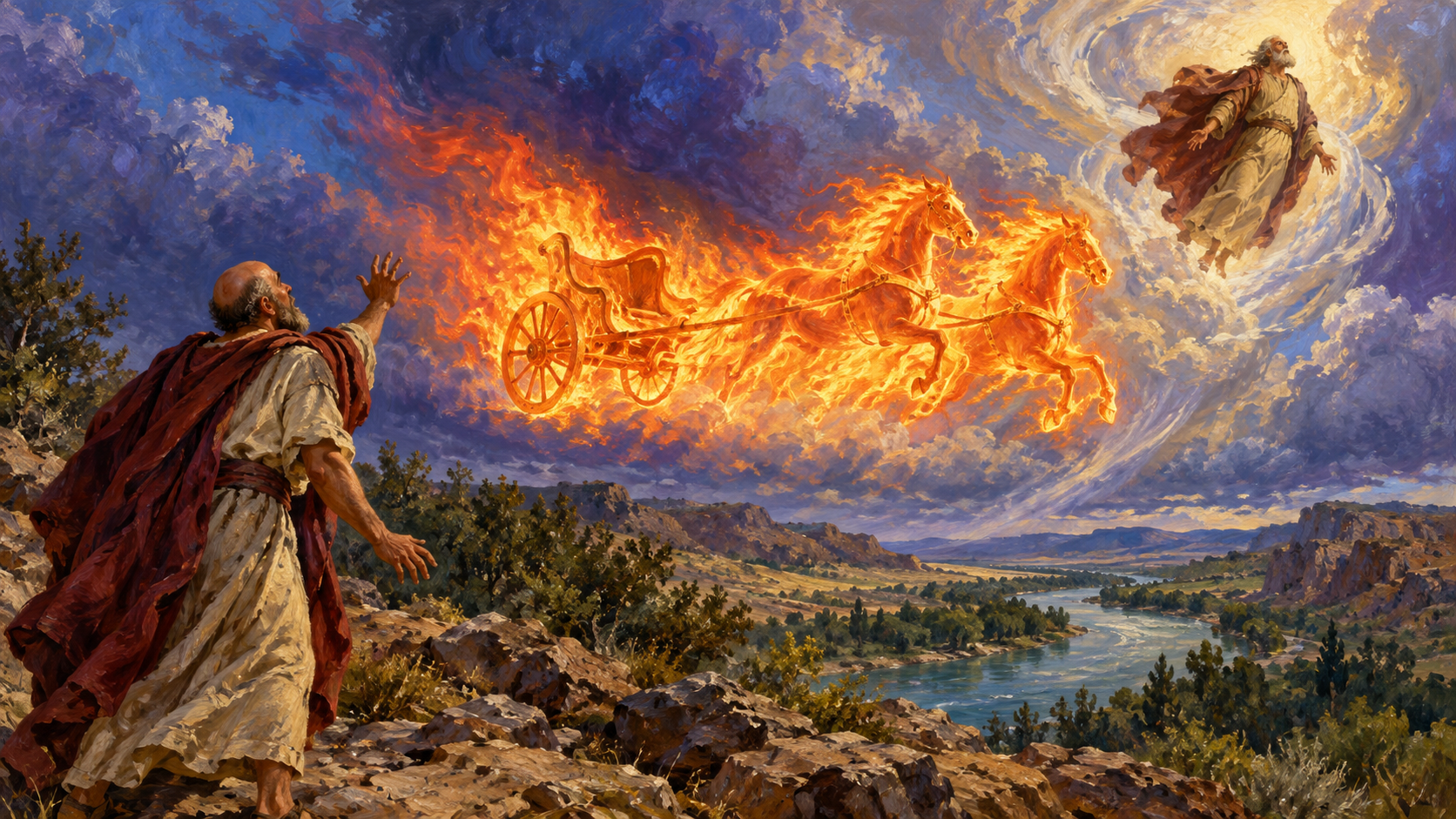
And so it was, when they had crossed over, that Elijah said to Elisha, "Ask! What may I do for you, before I am taken away from you?" Elisha said, "Please let a double portion of your spirit be upon me." So he said, "You have asked a hard thing. Nevertheless, if you see me when I am taken from you, it shall be so for you; but if not, it shall not be so." Then it happened, as they continued on and talked, that suddenly a chariot of fire appeared with horses of fire, and separated the two of them; and Elijah went up by a whirlwind into heaven. And Elisha saw it, and he cried out, "My father, my father, the chariot of Israel and its horsemen!" So he saw him no more. And he took hold of his own clothes and tore them into two pieces.
Elijah and Elisha both knew the LORD was about to take Elijah, as did the prophetic communities at Bethel and Jericho. God was deliberately preparing for the prophetic work to continue through another servant. Elisha refused to leave his teacher and crossed the Jordan with him. In asking for a double portion of Elijah’s spirit, like the portion of a firstborn, he was requesting what he would need to continue that ministry. He was not asking for a magical substance Elijah owned.
I notice a distinction in Elijah’s departure that popular retellings often blur. The chariot and horses of fire appeared and separated the men, but the whirlwind carried Elijah up into heaven. The verse does not place him in the chariot. It tells us about the fiery appearance and the whirlwind as distinct parts of what happened.
Elisha saw what happened and cried out. After tearing his clothes, he picked up Elijah’s fallen mantle and returned to the Jordan, where the LORD confirmed that the prophetic ministry would continue through him. This was a miracle Elisha witnessed, and it marked his succession to Elijah’s work. God took one servant away while showing that His power and word did not depend on keeping that servant permanently present.
Now when the sons of the prophets who were from Jericho saw him, they said, "The spirit of Elijah rests on Elisha." And they came to meet him, and bowed to the ground before him. Then they said to him, "Look now, there are fifty strong men with your servants. Please let them go and search for your master, lest perhaps the Spirit of the LORD has taken him up and cast him upon some mountain or into some valley." And he said, "You shall not send anyone." But when they urged him till he was ashamed, he said, "Send them!" Therefore they sent fifty men, and they searched for three days but did not find him. And when they came back to him, for he had stayed in Jericho, he said to them, "Did I not say to you, 'Do not go'?"
The sons of the prophets recognized that Elijah’s spirit rested on Elisha, yet they still urged him to let them search. They thought the Spirit of the LORD might have lifted Elijah and cast him onto a mountain or into a valley. Supernatural relocation was evidently something they could imagine, perhaps because the Spirit had moved prophets in unusual ways before. Elisha told them not to send anyone, but they persisted until he was ashamed to keep refusing.
Fifty men searched for three days and did not find Elijah in the surrounding country. Their search does not tell us everything about his continuing bodily condition or let us chart the heavens. The Hebrew word translated “heaven” can mean the sky or the heavens according to context. Here we are told that Elijah went upward and was removed from his earthly ministry. His later appearance with Moses at Christ’s transfiguration confirms that he continued to have an exceptional role.
I would keep Elijah’s departure distinct from Christ’s ascension. Elijah was God’s servant whom He took away. Jesus is the eternal Son who rose from death and blessed His disciples before ascending bodily to be exalted at the Father’s right hand. Elijah’s unusual departure also does not prove that he must be one of the witnesses in Revelation 11. The imagery there recalls Elijah and Moses, but John never names the men. For the larger biblical record, see A Complete Bible Study on the Life of Elijah.
Visions, Movement, and the Risen Christ
Enoch and Elijah were removed from ordinary earthly life, but Ezekiel introduces another category. His first account joins the Spirit’s movement with the prophetic commission he received among the exiles:
Then the Spirit lifted me up, and I heard behind me a great thunderous voice: "Blessed is the glory of the LORD from His place!" I also heard the noise of the wings of the living creatures that touched one another, and the noise of the wheels beside them, and a great thunderous noise. So the Spirit lifted me up and took me away, and I went in bitterness, in the heat of my spirit; but the hand of the LORD was strong upon me. Then I came to the captives at Tel Abib, who dwelt by the River Chebar; and I sat where they sat, and remained there astonished among them seven days.
Ezekiel received his commission among the exiles in Babylon. The LORD gave him the scroll and sent him to Israel, then the Spirit lifted him. He heard the living creatures and wheels associated with the vision of God’s glory and went to the captives at Tel Abib. He remained overwhelmed among them for seven days before the word of the LORD appointed him as a watchman.
Ezekiel did reach the community where he would minister, so I would not reduce this to a change in his inward mood. But the account gives no distance or speed and does not explain a physical mechanism. The Spirit’s lifting and taking him belongs to the prophetic vision that began beside the River Chebar. We can affirm that God moved him without forcing the event into a modern category of transportation.
And it came to pass in the sixth year, in the sixth month, on the fifth day of the month, as I sat in my house with the elders of Judah sitting before me, that the hand of the Lord GOD fell upon me there. Then I looked, and there was a likeness, like the appearance of fire–from the appearance of His waist and downward, fire; and from His waist and upward, like the appearance of brightness, like the color of amber. He stretched out the form of a hand, and took me by a lock of my hair; and the Spirit lifted me up between earth and heaven, and brought me in visions of God to Jerusalem, to the door of the north gate of the inner court, where the seat of the image of jealousy was, which provokes to jealousy. And behold, the glory of the God of Israel was there, like the vision that I saw in the plain.
Ezekiel 8 is more explicit about how the prophet experienced the movement. He was sitting in his house in Babylon with the elders of Judah before him when the hand of the Lord GOD fell upon him. The Spirit brought him to Jerusalem “in visions of God.” There he saw the image of jealousy and corrupt temple worship, including women weeping for Tammuz and men worshiping the sun.
That vision was real without requiring Ezekiel to leave his house physically. God showed him actual abominations and coming judgment through a prophetic experience. He could see Jerusalem by revelation while remaining among the exiles. I cannot call this physical teleportation when Ezekiel himself tells us he saw Jerusalem by revelation in a vision.
So the cherubim lifted up their wings, with the wheels beside them, and the glory of the God of Israel was high above them. And the glory of the LORD went up from the midst of the city and stood on the mountain, which is on the east side of the city. Then the Spirit took me up and brought me in a vision by the Spirit of God into Chaldea, to those in captivity. And the vision that I had seen went up from me. So I spoke to those in captivity of all the things the LORD had shown me.
The end of the account confirms that we are reading about a vision. The glory of the LORD departed from Jerusalem and stood over the mountain to its east. The Spirit then brought Ezekiel back to Chaldea in a vision. When the vision ended, he told the captives everything the LORD had shown him. God had revealed these things for him to proclaim.
Ezekiel’s accounts make me careful about assuming that similar phrases always describe the same event. The Spirit may empower bodily work or direct where a prophet goes. Elsewhere He may reveal distant events through a vision. We learn which is happening from the surrounding sentences. Taking the supernatural seriously includes respecting the distinctions Scripture makes.
Then, the same day at evening, being the first day of the week, when the doors were shut where the disciples were assembled, for fear of the Jews, Jesus came and stood in the midst, and said to them, "Peace be with you." When He had said this, He showed them His hands and His side. Then the disciples were glad when they saw the Lord. And after eight days His disciples were again inside, and Thomas with them. Jesus came, the doors being shut, and stood in the midst, and said, "Peace to you!" Then He said to Thomas, "Reach your finger here, and look at My hands; and reach your hand here, and put it into My side. Do not be unbelieving, but believing." And Thomas answered and said to Him, "My Lord and my God!" Jesus said to him, "Thomas, because you have seen Me, you have believed. Blessed are those who have not seen and yet have believed."
On the evening of His resurrection, Jesus stood among disciples who had gathered behind shut doors for fear of the Jewish leaders. Eight days later He came again while the doors were shut. John tells us about their fear and Christ’s sudden presence, then directs our attention to His greeting of peace and the wounds He showed them. We also see how the disciples responded to Him.
The passage never says Jesus walked through a wall. He could have done more than the text explains, but ability is not evidence that a particular mechanism occurred. I do not want to turn the shut doors into a detail John never supplies. He tells us that the doors were shut and that Jesus stood among them, so both facts should remain in our conclusion.
Thomas confessed Jesus as “My Lord and my God!” The wounds showed him that the crucified One was alive: the body laid in the tomb belonged to the Lord now standing before him. Jesus accepted Thomas’s confession instead of rebuking it. He also pronounced a blessing on later believers who would trust the apostles’ testimony without seeing Him physically.
Now as they said these things, Jesus Himself stood in the midst of them, and said to them, "Peace to you." But they were terrified and frightened, and supposed they had seen a spirit. And He said to them, "Why are you troubled? And why do doubts arise in your hearts? Behold My hands and My feet, that it is I Myself. Handle Me and see, for a spirit does not have flesh and bones as you see I have." When He had said this, He showed them His hands and His feet. But while they still did not believe for joy, and marveled, He said to them, "Have you any food here?" So they gave Him a piece of a broiled fish and some honeycomb. And He took it and ate in their presence.
Luke helps us understand what kind of body the disciples encountered. They were frightened and thought they had seen a spirit, but Jesus invited them to examine His hands and feet and touch Him. He pointed out that a spirit does not have flesh and bones as they could see He had. Then He ate broiled fish in front of them.
Jesus had a physical, glorified resurrection body that they could recognize and touch. He was not a ghost or a vision produced by grief, and His body had not been discarded as an empty shell. Yet He had not simply returned to ordinary mortal life either. He will never die again. I don’t have to choose between a real body and divine power, because the Gospels affirm both.
That gives our hope a bodily future too. We are not waiting to live forever as disembodied consciousness. The dead in Christ will rise, and living believers will be changed. Christ’s own bodily resurrection is the firstfruits, the beginning and guarantee of what awaits His people.
So all those in the synagogue, when they heard these things, were filled with wrath, and rose up and thrust Him out of the city; and they led Him to the brow of the hill on which their city was built, that they might throw Him down over the cliff. Then passing through the midst of them, He went His way.
Jesus’ neighbors became enraged when His synagogue teaching exposed their unbelief and recalled God’s mercy to Gentiles in Elijah’s and Elisha’s days. They forced Him out of the city and led Him toward the brow of the hill to throw Him down. But He passed through their midst and went His way.
I can see that Jesus escaped, but Luke never says He vanished or stopped occupying space. We could imagine divine protection or a commanding presence. Perhaps the crowd was confused, or perhaps a miracle occurred that we could not classify. Luke gives us the result without settling those possibilities. What we can affirm is that the murderous crowd could not end Christ’s life before His appointed hour.
When His hour did come, Jesus willingly went to Jerusalem and yielded Himself. His earlier escapes show that the cross did not take Him by surprise. He had authority over the timing of His mission.
So when they had rowed about three or four miles, they saw Jesus walking on the sea and drawing near the boat; and they were afraid. But He said to them, "It is I; do not be afraid." Then they willingly received Him into the boat, and immediately the boat was at the land where they were going.
On the Sea of Galilee, Jesus walked on the water toward the disciples’ boat. Their fear gave way when He identified Himself, and they willingly received Him. The boat was then immediately at the land where they were going.
John uses the Greek adverb eutheos, meaning immediately, at once, or straightaway. He closely connects that remarkable arrival with Jesus entering the boat. Some readers understand the boat to have been transported instantly; others understand the remaining journey to have ended rapidly. I would not claim a process or a remaining distance that the verse does not give. John also does not use harpazo here.
As we follow the chapter, it keeps directing us to Jesus. He multiplied bread but refused the crowd’s attempt to make Him a political king. He walked on the sea and calmed His disciples’ fear by His presence, then revealed Himself as the Bread of Life. I want the sign to lead me to the Son, rather than isolate it to build a theory about moving through space.
Philip, Paul, and John
The New Testament gives three uses of catching-away language that must also remain distinct. Acts first lets us follow Philip from his meeting with the Ethiopian official to the place where the Spirit sends him next:
Then Philip opened his mouth, and beginning at this Scripture, preached Jesus to him. Now as they went down the road, they came to some water. And the eunuch said, "See, here is water. What hinders me from being baptized?" Then Philip said, "If you believe with all your heart, you may." And he answered and said, "I believe that Jesus Christ is the Son of God." So he commanded the chariot to stand still. And both Philip and the eunuch went down into the water, and he baptized him. Now when they came up out of the water, the Spirit of the Lord caught Philip away, so that the eunuch saw him no more; and he went on his way rejoicing. But Philip was found at Azotus. And passing through, he preached in all the cities till he came to Caesarea.
Philip’s account gives us the clearest New Testament example of supernatural removal followed by a named location on earth. An angel first directed him toward the road from Jerusalem to Gaza, and the Spirit then told him to overtake the Ethiopian official’s chariot. Finding the man reading Isaiah 53, Philip began with that Scripture and preached Jesus to him.
The official believed the gospel and asked to be baptized when they reached water. Both men went down into it, and Philip baptized him. His baptism followed his reception of Christ and publicly identified him with the Savior; it did not save him. When they came up from the water, the Spirit caught Philip away. The official no longer saw him and continued on his way rejoicing.
Philip was found at Azotus, the Old Testament city of Ashdod, and went northward preaching through the cities until he reached Caesarea. I notice that being moved miraculously did not end his ordinary work of going from place to place to proclaim Christ. The miracle served the gospel. It did not replace Scripture and preaching, or remove the need for faith, baptism, and continued ministry.
The phrase “caught Philip away” uses harpazo to describe an action that was sudden and forceful from the official’s perspective. Acts tells us that Philip was removed from one setting and found in another. It does not give the baptism site’s exact coordinates or say he traveled exactly twenty miles. Nor does it measure how long it was before he was found at Azotus. Teleportation may help a modern reader picture the relocation, but I would not attach those measurements to Luke’s account as though they were inspired facts.
The Spirit had arranged for a traveler to hear Christ preached from Isaiah. The man believed and obeyed in baptism, then went toward Africa rejoicing. Philip appeared where he was needed and continued preaching. That is what I want to follow in Luke’s account: God was exercising His sovereignty to advance His Word.
It is doubtless not profitable for me to boast. I will come to visions and revelations of the Lord: I know a man in Christ who fourteen years ago–whether in the body I do not know, or whether out of the body I do not know, God knows–such a one was caught up to the third heaven. And I know such a man–whether in the body or out of the body I do not know, God knows– how he was caught up into Paradise and heard inexpressible words, which it is not lawful for a man to utter. Of such a one I will boast; yet of myself I will not boast, except in my infirmities. For though I might desire to boast, I will not be a fool; for I will speak the truth. But I refrain, lest anyone should think of me above what he sees me to be or hears from me. And lest I should be exalted above measure by the abundance of the revelations, a thorn in the flesh was given to me, a messenger of Satan to buffet me, lest I be exalted above measure.
Paul writes about “a man in Christ,” but the surrounding argument shows that he is describing his own experience in the third person out of deliberate modesty. He had been forced to answer boastful opponents, yet refused to base his apostolic authority on impressive accounts of unusual experiences. This revelation had happened fourteen years earlier without becoming a centerpiece of self-promotion.
Twice Paul says he does not know whether he was in the body or out of the body; God knows. I do not think we should rush past his restraint, because that repeated uncertainty is part of the inspired account. He was caught up to the third heaven, which he also calls Paradise, and heard words he was not permitted to utter. The revelation was real, but its bodily mode remained unknown to him.
We can understand “third heaven” alongside the Bible’s ordinary uses of heaven for the sky around us, the realm of heavenly lights, and God’s dwelling. Paul describes Paradise and divine revelation, not levels that believers can learn to visit. I also wouldn’t use “out of the body” to settle every question about the intermediate state or to claim that human souls are inherently immortal. Paul leaves his condition unresolved and says that God alone knows it fully.
Paul again uses harpazo, but that does not make his experience the same as Philip’s. Philip appeared at Azotus and resumed public evangelism. Paul heard words he was forbidden to repeat, so we are not free to satisfy our curiosity about their content. The spiritual effect of that revelation was humility.
Paul next tells us about the thorn in his flesh, given so that he would not become exalted above measure. God’s answer was sufficient grace and strength perfected in weakness. A genuine revelation of heaven had not made Paul untouchable or freed him from suffering. Rather than making him self-important, it brought a danger of pride serious enough that God humbled him.
After these things I looked, and behold, a door standing open in heaven. And the first voice which I heard was like a trumpet speaking with me, saying, "Come up here, and I will show you things which must take place after this." Immediately I was in the Spirit; and behold, a throne set in heaven, and One sat on the throne. And He who sat there was like a jasper and a sardius stone in appearance; and there was a rainbow around the throne, in appearance like an emerald.
John was on Patmos because of the Word of God and the testimony of Jesus Christ. Revelation 1:10 says he was in the Spirit on the Lord’s Day when he heard the voice behind him. In chapter 4, after the messages to the seven churches, he saw an open door in heaven and heard the trumpet-like voice say, “Come up here.” Immediately he was in the Spirit and saw God’s throne.
John describes a prophetic vision. He does not tell us that people searched Patmos for his missing body or that he left the island permanently. God showed him realities in heaven so he could write what the churches needed to hear. The vision began at God’s throne, then showed heaven’s worship and the Lamb receiving the scroll before the judgments unfolded.
Some pre-Tribulation teachers understand John’s invitation as a symbolic picture of the whole church being raptured before the following judgments. Its placement may fit that understanding of prophecy, but the verse addresses John in a vision. It never identifies him as the church or says his invitation fulfills 1 Thessalonians 4. I would establish the church’s gathering from passages that directly tell us about dead believers rising and living believers being caught up.
I don’t weaken the pre-Tribulation position by rejecting that proposed symbolism. I place the weight on Christ’s direct promises to deliver His people from the wrath to come and keep them from the worldwide hour of trial. He will raise those who died in Him and change living believers, gathering both to Himself.
Christ’s Ascension and the Two Witnesses
All of these accounts prepare us to see how completely Christ’s ascension stands apart. Luke records a public, bodily departure that also carries a direct promise of His return:
Now when He had spoken these things, while they watched, He was taken up, and a cloud received Him out of their sight. And while they looked steadfastly toward heaven as He went up, behold, two men stood by them in white apparel, who also said, "Men of Galilee, why do you stand gazing up into heaven? This same Jesus, who was taken up from you into heaven, will so come in like manner as you saw Him go into heaven."
After forty days of bodily appearances and teaching about God’s kingdom, Jesus commissioned His apostles as witnesses. They watched as He was taken up until a cloud hid Him from their sight. The two men in white then directed them from staring into heaven to the promise that Jesus would return.
The promise is that this same Jesus will return in like manner. I would not understand His ascension as dissolving into divine energy or leaving His humanity behind. Neither did He become merely an idea carried on by His followers. He remains fully God and fully man, exalted at the Father’s right hand, the only High Priest and Mediator for His people. The One who returns is the very Lord who ascended bodily.
We can now see why His ascension differs from the earlier accounts. God took Enoch so he would not see death and removed Elijah from prophetic ministry. Philip was moved so he could continue preaching, while Paul and John received revelation. Jesus first conquered death bodily. After completing His earthly testimony, He ascended before His appointed witnesses to the place of supreme authority that belongs to Him. The appearances leading to that moment are considered in Post-Resurrection Jesus and His Ascension.
The ascension also points us toward His return. Christ will first receive His church to Himself at the pre-Tribulation gathering. After the literal seven-year Tribulation, He will appear visibly in glory to overthrow His enemies and deliver Israel. He will establish His literal thousand-year reign. These events belong to the prophetic plan of the same Lord, but we should not merge them into one movement.
When they finish their testimony, the beast that ascends out of the bottomless pit will make war against them, overcome them, and kill them. And their dead bodies will lie in the street of the great city which spiritually is called Sodom and Egypt, where also our Lord was crucified. Then those from the peoples, tribes, tongues, and nations will see their dead bodies three-and-a-half days, and not allow their dead bodies to be put into graves. And those who dwell on the earth will rejoice over them, make merry, and send gifts to one another, because these two prophets tormented those who dwell on the earth. Now after the three-and-a-half days the breath of life from God entered them, and they stood on their feet, and great fear fell on those who saw them. And they heard a loud voice from heaven saying to them, "Come up here." And they ascended to heaven in a cloud, and their enemies saw them.
During the Tribulation, two witnesses will prophesy with authority for 1,260 days. The beast will kill them when they have finished their testimony, and their bodies will lie exposed in Jerusalem while the world celebrates. After three and a half days, the breath of life from God will enter them. They will stand, and those watching will become greatly afraid.
A loud voice from heaven calls, “Come up here.” The witnesses ascend in a cloud before the eyes of their enemies. I notice that this differs from John’s visionary invitation in Revelation 4: these once-dead bodies are explicitly said to stand on their feet before the ascent is witnessed. God summons them after raising them, publicly vindicating His servants.
The witnesses’ powers recall Moses and Elijah. They shut heaven, turn waters to blood, and strike the earth with plagues. Many have therefore identified them with particular Old Testament figures, but Revelation does not name them. Nor must Enoch and Elijah return to die simply because of their unusual departures. Hebrews 9:27 states the general course of human death and judgment without making every exception impossible.
What the passage does make clear is that God vindicates His servants. The beast can kill them only after they finish their assigned testimony, and the world’s contempt cannot stop God from raising them. Their ascent displays His authority over life and death, on earth and in heaven, before the nations that rejected Him.
The Church Will Be Caught Up and Changed
That brings us to the event most directly connected with the believer’s hope. Paul writes about it to comfort Christians who are grieving those who died in Christ:
But I do not want you to be ignorant, brethren, concerning those who have fallen asleep, lest you sorrow as others who have no hope. For if we believe that Jesus died and rose again, even so God will bring with Him those who sleep in Jesus. For this we say to you by the word of the Lord, that we who are alive and remain until the coming of the Lord will by no means precede those who are asleep. For the Lord Himself will descend from heaven with a shout, with the voice of an archangel, and with the trumpet of God. And the dead in Christ will rise first. Then we who are alive and remain shall be caught up together with them in the clouds to meet the Lord in the air. And thus we shall always be with the Lord. Therefore comfort one another with these words.
Paul did not dismiss their grief or tell them only that their loved ones would live on in memory. He gave them hope grounded in Jesus’ death and bodily resurrection: because Christ rose, those who died in Him will rise too.
The Lord Himself will descend from heaven with a shout, the voice of an archangel, and the trumpet of God. The dead in Christ will rise first, then living believers will be caught up with them in the clouds to meet Him in the air. I find the lasting comfort in Paul’s next words: “And thus we shall always be with the Lord.” This is the promise he tells us to use in comforting one another.
“Caught up” translates harpazo, the word used for the Spirit catching Philip away and for Paul being caught up to Paradise. Here we are told what will happen, rather than being left with the uncertainty Paul expressed about his private revelation. This is not a move to another earthly location either. The Lord will descend, and raised and living believers will be gathered together in the clouds to meet Him in the air and remain with Him forever.
Our English word rapture comes through the Latin rendering of this language about being caught away. I don’t need the English label to appear in a translation for the event to be taught there. Paul’s inspired sentence says that living believers will truly be caught up.
I believe this gathering occurs before the literal seven-year Tribulation. 1 Thessalonians 1:10 says believers wait for God’s Son, Jesus, who delivers us from the wrath to come. In 1 Thessalonians 5:9, Paul says God did not appoint believers to wrath. Revelation 3:10 also promises preservation from the worldwide hour of trial. Christians experience persecution and tribulation in the present world, but the church is not appointed to the coming period of divine wrath.
Enoch’s departure before the Flood fits a pattern of rescue before judgment, as do Noah’s protection in the ark and Lot’s removal before the fire. But I would not use those patterns alone to establish the timing of the rapture. The argument depends on the direct promises of deliverance from wrath and the order of prophetic events.
This hope should make me faithful in my work now, not give me a puzzle for setting dates or an excuse to neglect earthly responsibilities. It does not promise escape from every hardship. Paul gives it to comfort believers and call them to readiness. Expecting to meet Christ should lead us to live holy lives and serve steadily, sharing the gospel with urgency while enduring present suffering. The full prophetic case appears in Examining the Pre-Tribulation Rapture.
Now this I say, brethren, that flesh and blood cannot inherit the kingdom of God; nor does corruption inherit incorruption. Behold, I tell you a mystery: We shall not all sleep, but we shall all be changed– in a moment, in the twinkling of an eye, at the last trumpet. For the trumpet will sound, and the dead will be raised incorruptible, and we shall be changed. For this corruptible must put on incorruption, and this mortal must put on immortality. So when this corruptible has put on incorruption, and this mortal has put on immortality, then shall be brought to pass the saying that is written: "Death is swallowed up in victory." "O Death, where is your sting? O Hades, where is your victory?" The sting of death is sin, and the strength of sin is the law. But thanks be to God, who gives us the victory through our Lord Jesus Christ. Therefore, my beloved brethren, be steadfast, immovable, always abounding in the work of the Lord, knowing that your labor is not in vain in the Lord.
In 1 Corinthians 15, Paul explains how believers will be transformed at this gathering. Flesh and blood in our present mortal condition, subject to decay, cannot inherit God’s kingdom. Not every believer will sleep in death, but every believer will be changed. Paul reveals that truth as a mystery made known to us.
At the trumpet, the change will happen in a moment, in the twinkling of an eye. The dead will be raised incorruptible, no longer subject to decay, and the living will be changed. What was corruptible will put on incorruption, and what was mortal will put on immortality. I understand immortality here as God’s gift in resurrection and transformation, not something every human soul already possesses by nature.
Christ redeems whole people, so this promised future is bodily. Salvation does not end with an invisible soul escaping creation forever. Death is an enemy, and God gives victory by raising the dead and clothing His people with life that cannot decay.
Enoch and Elijah show that God can preserve particular servants from ordinary death. The rapture gives a distinct promise to believers alive when Christ gathers His church: they will be changed without sleeping in death. Those who have died in Christ will not miss out. They rise first and join the living to meet the Lord.
Paul ends by telling believers how to work, rather than inviting speculation. Because resurrection victory is certain, we should remain steadfast and immovable, always abounding in the Lord’s work. I can give myself to faithful obedience now knowing that labor done in Him is not empty. The promised transformation gives that work lasting significance.
Miracles Serve God’s Revealed Purpose
In these accounts, we see the Creator exercising authority over the world He made. Distance cannot frustrate His purpose, and a closed room cannot keep out the risen Christ. Earthly rulers cannot hold a servant beyond the work God assigns. Most of all, death cannot keep those He raises. He has power to reveal heaven to His servants or summon His people there.
That authority does not make creation unreal. Nor are its physical laws enemies God has to fight. He established the ordinary patterns of creation and continues to sustain them. A miracle is His purposeful act within that world. We recognize it because it exceeds ordinary creaturely ability and serves His revelation or plan.
Each passage shows a particular purpose. Enoch’s taking interrupted the repeated record of death and testified to faith. Elijah’s departure confirmed that God’s prophetic work would continue through Elisha. Ezekiel saw Jerusalem’s abominations in visions, while Christ’s appearances established His bodily resurrection. Philip was moved as the gospel advanced. Paul received revelation that humbled him, and John was shown God’s throne and future plan. God will publicly vindicate the two witnesses through their ascent. When He gathers the church, believers will receive resurrection life and lasting comfort in Christ’s presence.
None of these servants learned a method he could use at will. Enoch walked with God without scheduling his own translation, and Elisha could not make Elijah’s departure happen. Philip obeyed the next instruction he received. Paul could not even say what his bodily condition had been, while John received only what he was told to write. God’s actions are personal and purposeful, not a force we can learn to manipulate.
Ordinary providence depends on God too. Most believers travel by ordinary means and serve within physical limits. They may endure illness and eventually die. Once Philip was at Azotus, he went on walking and preaching from city to city. Paul continued to face difficult journeys and imprisonment along with bodily weakness. I don’t need a spectacular escape to serve God faithfully.
I would therefore test claims of supernatural transport today instead of accepting them simply because they sound spiritual. Scripture remains the final authority. The intensity of a testimony cannot make it authoritative, and a private experience cannot establish doctrine. God can act beyond ordinary means, but that gives us no reason to accept manipulation or invented certainty. Claims that compete with the sufficiency of His written Word must be rejected.
Several popular claims go farther than these passages allow. John tells us that the doors were shut and Jesus stood among the disciples, while Luke tells us His risen body had flesh and bones and could be touched. Both facts are true, but neither Gospel says He walked through a wall. In the same way, Acts says the Spirit caught Philip away and that he was found at Azotus. It does not give the baptism site’s coordinates, the exact distance, or the time that passed.
Ezekiel twice identifies his experience in Jerusalem as a vision, so I should not recast it as bodily travel. Paul twice says that only God knows whether his experience was in or out of the body. Claiming more certainty than either writer gives us would add to Scripture rather than demonstrate stronger faith.
John’s experience in Revelation 4 should likewise remain a vision of God’s throne given to him. The pre-Tribulation gathering rests on passages directly describing Christ receiving His church before the coming wrath. These extraordinary accounts also give me no promise of freedom from ordinary limits. God may preserve or redirect His servants, yet He also works through ordinary roads and long labor. His people still face weakness and suffering as well as aging and death. I cannot demand that Philip’s experience become my own transportation promise.
Enoch and Elijah did not become Christ’s equals because God took them in unusual ways. They remained servants dependent on Him. Jesus is the eternal Son who laid down His life and took it again. He rose bodily and ascended in glory to reign at the Father’s right hand, where He intercedes for His people. He will return, and every exceptional servant remains completely dependent on Him.
Interest in translation and the rapture can distract us from the question that determines our future: do we belong to Jesus Christ? Living in the generation when the church is gathered will not save an unbeliever. In 1 Thessalonians, the promise belongs to those who are “in Christ.” Our resurrection hope rests on the gospel.
Jesus is the eternal Son, fully God and fully man. Born of a virgin and completely sinless, He entered our history rather than keeping His distance. He revealed the Father and fulfilled the Scriptures, showing love to sinners while obeying without sin.
Wicked men physically tortured and punished Jesus before killing Him, yet He willingly bore that real punishment for our sins in His innocent body. He shed His blood and died, was buried, and rose bodily. The Father did not punish, curse, abandon, strike, bruise, or pour wrath on Jesus.
Christ died for the whole world, and the offer of salvation is genuine even though people can resist and reject Him. A ritual cannot remove guilt, nor can a good moral record or connection with a church. Unusual experiences and visions cannot do it either, and knowing prophecy does not save us. God commands sinners to repent and believe in His Son.
Everyone who turns to Christ in faith receives forgiveness and eternal life. That believer is born again and made a new creation, with the Holy Spirit dwelling within and sealing him. He is eternally secure in Christ. This security does not excuse lawlessness, and merely professing faith does not prove that someone has been born again. Saving faith receives the living Lord and begins a changed life under His Word.
The One who saves us will also gather us. If a believer dies before the rapture, death cannot cancel Christ’s promise. If he remains alive until Christ comes, his mortal body will have to be changed for the kingdom. The dead will rise and the living will be transformed, and both will be with the Lord forever.
My Final Thoughts
I cannot fit every extraordinary act in these passages into one modern word. God truly took Enoch and Elijah, and Philip was caught away. The prophets received real visions, while Christ rose and ascended bodily. I want to affirm what Scripture records without inventing a route or mechanism it does not explain. My hope is in the risen Jesus, who has authority over death and will gather everyone who belongs to Him, not in learning to control a hidden power. Until He comes, I want to trust His written Word and serve faithfully where He places me. We can comfort one another with His promise that the church will be caught up and changed to be with Him forever.