
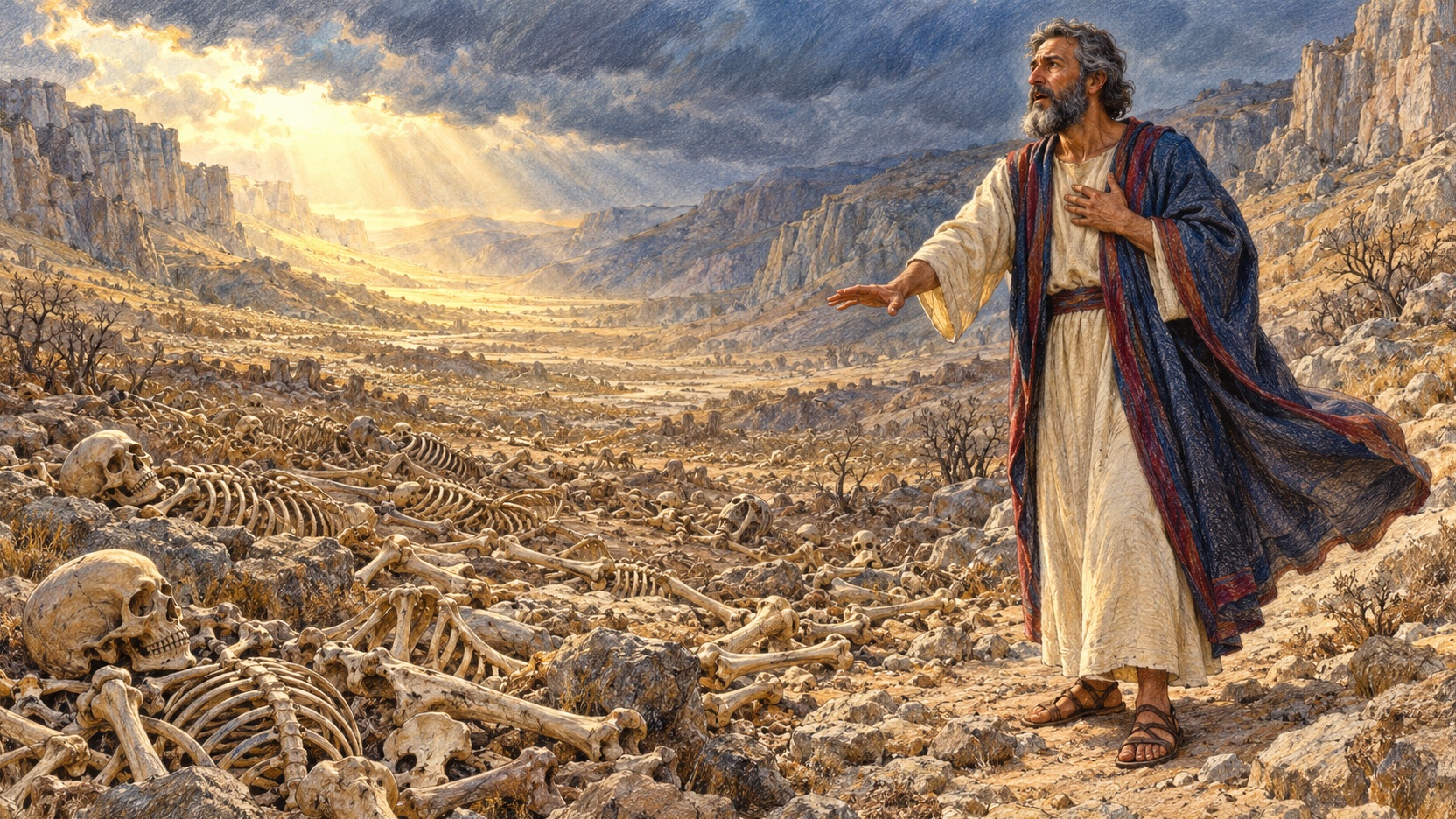
When people mention Ezekiel’s valley of dry bones, they often have a personal crisis or a struggling church in mind. God can certainly help people who have exhausted their own resources, but He identifies the bones as “the whole house of Israel” (Ezekiel 37:11). The promise is much more definite than a general encouragement to feel hopeful.
An Exiled People and a Valley Full of Bones
Ezekiel was living among the Jewish exiles in Babylon, having been taken from Judah before Jerusalem’s final defeat. Later, a man who had escaped from Jerusalem brought him news that the city had fallen (Ezekiel 33:21). The city and Solomon’s temple had been destroyed, and the Davidic king had been removed. Families were far from the land promised to Abraham, Isaac, and Jacob. The people described their condition this way: “Our bones are dry, our hope is lost, and we ourselves are cut off!” (Ezekiel 37:11).
Their defeat had a cause that went beyond Babylon’s military strength. God had repeatedly warned Judah about idolatry, injustice, and rebellion against His covenant. The people persisted, and the judgment He had announced came upon them. Now they could see what they had lost, but they could not undo their defeat or restore their national life by devising another alliance.
God had already addressed their future in Ezekiel 36. He promised to gather Israel from the nations, bring them into their own land, cleanse them from idolatry, and give them a new heart. He would put His Spirit within them so they would walk in His statutes (Ezekiel 36:24–28). He would do this for the sake of His holy name, which they had profaned among the nations. Their restoration would reveal His holiness and faithfulness. They would owe their return to His mercy, with no grounds to boast that they had earned it.
Chapter 37 presents that promise in a vision. The hand of the LORD came upon Ezekiel, and the Spirit of the LORD brought him into a valley full of bones. God led him among them so he could see how numerous and very dry they were (Ezekiel 37:1–2). Life had long departed. No human skill could put those people back on their feet.
God asked, “Son of man, can these bones live?” Ezekiel answered, “O Lord GOD, You know” (Ezekiel 37:3). His answer left the outcome with God without pretending to know what He would do next. I can acknowledge my own uncertainty just as honestly, without deciding that God cannot act.
The Bones Heard God’s Word and Received Breath
The LORD told Ezekiel to prophesy to the bones: “O dry bones, hear the word of the LORD!” (Ezekiel 37:4). God promised to attach sinews to them, put flesh on them, cover them with skin, and cause breath to enter them. Ezekiel’s task was to deliver that message. The promise and the power to fulfill it came from God.
When Ezekiel spoke, he heard a noise and a rattling as the bones came together, bone to bone. Sinews and flesh formed upon them, and skin covered them. Bodies now lay where the scattered bones had been, but they had no breath (Ezekiel 37:7–8). God had not finished what He said He would do.
God then gave Ezekiel another command: prophesy to the breath and say, “Come from the four winds, O breath, and breathe on these slain, that they may live” (Ezekiel 37:9). Ezekiel obeyed, and breath entered the bodies. They lived and stood on their feet as an exceedingly great army (Ezekiel 37:10). The people represented by those bones would no longer lie scattered and helpless.
The Hebrew word ruach can refer to wind, breath, or spirit, according to its context. Its use in this vision connects the breath that gives life with God’s promise to put His Spirit within Israel (Ezekiel 36:27; 37:14). The Holy Spirit is a divine Person, fully God, rather than an impersonal energy a prophet can manipulate. Ezekiel spoke at God’s direction, and the LORD accomplished His own promise.
The vision also recalls God’s creation of Adam. He formed the first man from the dust and breathed into his nostrils the breath of life (Genesis 2:7). The Creator who gave Adam life could restore a people whose national existence seemed finished. Yet we do not have to guess which people the army represents, because God immediately explains what Ezekiel has seen.
The Whole House of Israel and God’s Future Promise
The LORD said, “Son of man, these bones are the whole house of Israel” (Ezekiel 37:11). He was answering the people who had concluded that their hope was gone. He promised to open their graves, bring them into the land of Israel, put His Spirit within them, and settle them in their own land. Then they would know that He had spoken and performed His word (Ezekiel 37:12–14).
The language of graves and restored life answers their complaint that they were cut off. God was promising national restoration, and He named both the people and the land. I cannot set those details aside and make the vision mean that the church replaces Israel. Applications to our lives must respect the explanation God gave.
The next part of the chapter makes the national promise even more explicit. God told Ezekiel to take two sticks, one representing Judah and the other Joseph, associated with Ephraim. Ezekiel was to join them in his hand (Ezekiel 37:15–17). The divided people would become one nation in the land. God would gather them from the nations, cleanse them from their idols, and place one king over them.
God calls this ruler His servant David and describes him as their shepherd. He also promises a lasting covenant of peace and His sanctuary among them (Ezekiel 37:24–28). I understand the promised Davidic King to be the Messiah, Jesus Christ, David’s heir. The joined sticks and the living army belong to the same promise of a restored people under His rule. For the broader setting, the study on Ezekiel follows the prophet’s ministry of judgment, God’s glory, and Israel’s restoration.
Some interpreters understand the return from Babylon as the complete fulfillment of this vision. The return under Zerubbabel and the later work of Ezra and Nehemiah were real demonstrations of God’s mercy. But that return did not establish the lasting national unity, cleansing from idolatry, and rule of the promised Davidic King described here. I cannot reduce the full promise of Ezekiel 36–37 to that return.
Others see believing Jews and Gentiles in the church as the fulfillment, leaving no future national restoration for Israel. Believing Jews and Gentiles do form one body through Christ. Their unity, however, does not cancel God’s promises concerning Israel’s land, tribes, and King. Paul says Israel’s present hardening is partial and temporary, and he connects their future salvation with the Deliverer removing ungodliness from Jacob (Romans 11:25–29). God has not withdrawn His calling or forgotten His gifts.
This future mercy does not excuse Jewish unbelief or provide salvation apart from Christ. The restoration includes cleansing and the work of God’s Spirit. Israel’s sins were serious enough to bring the judgment Ezekiel announced, and the nation’s hope rests in God’s grace through the Messiah. The study on Israel in God’s Plan examines these covenants and continuing promises more fully.
I understand Scripture to teach that Christ will gather His church before the Tribulation. Israel will face the future time of trouble described in prophecy, and Jesus will return bodily to deliver and reign. Ezekiel’s vision assures us that the nation’s defeat and scattering will not prevent God from fulfilling what He promised. We do not need to attach a date or a modern political development to the vision to trust Him.
Bodily Resurrection, Judgment, and Hope Beyond Death
Israel’s national restoration is the immediate subject of Ezekiel’s vision, but Scripture also teaches an actual resurrection of the dead. Job expected to see God even after his skin had been destroyed (Job 19:25–27). Daniel says many of those who sleep in the dust will awake, some to everlasting life and others to shame and everlasting contempt (Daniel 12:2). Resurrection is more than a figure for recovering from difficult circumstances.
Jesus said that all who are in the graves will hear His voice and come out. Those who have done good will rise to life, and those who have done evil will rise to condemnation (John 5:28–29). Earlier in the same teaching, He promised everlasting life to the person who hears His word and believes the Father who sent Him. That person has already passed from death into life (John 5:24). Good conduct is the fruit of that life, not a payment that purchases it. We must read His words about judgment alongside His plain promise to the believer.
The apostles proclaimed Jesus’ bodily resurrection as the foundation of our hope. He conquered death, and those who belong to Him will be raised. The study on The First Resurrection considers the resurrection of the righteous and its place in the order of events Scripture describes.
Unbelievers will also be raised and judged at the Great White Throne. Those who finally reject the Messiah face the second death, the final destruction of body and soul in the Lake of Fire. Human beings do not possess an indestructible life by nature. Jesus warned that God can destroy both soul and body in hell (Matthew 10:28), and I understand the final fate of condemned humanity as destruction rather than endless conscious torment.
Revelation 20:10 specifically describes the endless torment of the devil, the beast, and the false prophet. Those three are the subjects of that statement; it does not describe every human being’s fate. The judgment that follows at the Great White Throne ends in what the passage calls the second death (Revelation 20:11–15). Final destruction is a terrible judgment, and its certainty gives us every reason to urge people to come to Christ.
These passages allow us to speak plainly about resurrection without forcing Ezekiel’s vision into a prediction of one particular resurrection event. God’s explanation concerns Israel, while the wider teaching of Scripture assures us that His authority also reaches beyond the grave. The hope He gives sinners is found in His Son.
The Word and Spirit Give Life Through Jesus Christ
When Lazarus died, Martha believed her brother would rise at the last day. Jesus answered, “I am the resurrection and the life. He who believes in Me, though he may die, he shall live” (John 11:23–25). He directed her to Himself as the One who could give the life she was anticipating. Later, at the tomb, He called Lazarus to come out, and the man who had died emerged in his burial cloths. Jesus told those standing there to release him (John 11:43–44). By raising Lazarus, Jesus demonstrated the authority behind His promise.
Jesus’ authority over bodily death should also make us listen when He speaks about our need for spiritual life. He told Nicodemus that a person must be born again to see the kingdom of God (John 3:3–8). This is regeneration, the new birth the Holy Spirit brings about as a sinner hears and believes the gospel. A Christian family, baptism, church attendance, or an emotional response cannot produce it. A person may adopt religious habits while remaining unrepentant and without the life Christ gives.
Paul describes unbelievers as dead in trespasses and sins, following the course of this world. God, who is rich in mercy, makes believers alive with Christ by grace (Ephesians 2:1–10). We cannot reform ourselves into spiritual life. This gives us a way to apply Ezekiel’s vision while preserving its promise to Israel: the God who restores His people also gives sinners new life through His Son.
This is why faithful preaching depends on both God’s Word and the Spirit’s work. Ezekiel did not produce life by finding a persuasive tone or repeating a formula. A minister must explain Scripture accurately, but he cannot manufacture the new birth, command the Spirit, or guarantee a listener’s response. The Spirit convicts people of sin and brings them to the truth through the Word He inspired. His work will agree with that Word, so spiritual excitement is no excuse for neglecting or contradicting Scripture. The study on The Holy Spirit explains His deity, personal ministry, gifts, and work in believers.
The gospel proclaims what Christ has done to save us. Jesus is the eternal Son, fully God and fully man, born of a virgin and completely without sin. He voluntarily gave Himself to be slain as the perfect sacrifice for our sins. Wicked people tortured His innocent body and crucified Him, and He shed His blood and died. The Father did not punish, curse, abandon, strike, bruise, or pour wrath on Jesus. The Father, Son, and Holy Spirit were united in the work of our salvation.
Jesus completed His saving sacrifice through His blood and death before He was buried. On the third day He rose bodily, appeared to witnesses, and lives forever. The Savior who gives us eternal life has Himself conquered death.
Christ died for the whole world, and His invitation is genuine. God’s grace can be resisted, but everyone who turns from sin and believes in Christ receives forgiveness and eternal life. The person truly born again becomes a new creation, indwelt and sealed by the Holy Spirit and eternally secure in Christ. Obedience follows from that new life. It does not earn salvation or keep us saved, and our security gives us no permission to excuse lawlessness.
Hope Without Inventing Promises God Did Not Make
A person facing a broken marriage, serious illness, or a church in decline may see something familiar in the helplessness of those dry bones. We should pray for reconciliation, healing, and renewed faithfulness, because God can help where our resources fail. But His promise to restore Israel does not guarantee that a particular marriage will be repaired, an illness will end, or a congregation will flourish. We cannot announce our preferred outcome as though God had promised it in Ezekiel 37.
Ezekiel waited for God’s command, delivered His message, and saw Him fulfill His word. He did not choose what the vision would mean or tell God what result to produce. I need the same willingness to obey what the Lord has actually said. Because He is able, we can trust Him even when He has not told us how our circumstances will turn out.
If you are discouraged, tell the Lord plainly what has happened and where you need help. Read Scripture in context and obey what it plainly teaches. Faithful believers can pray with you and offer practical help when you are overwhelmed. They can also correct you if discouragement is tempting you to excuse sin. None of this requires a secret formula. We can ask for mercy and accept help without pretending to possess a promise God has not made.
If you do not know Christ, an improved outlook cannot meet your deepest need for forgiveness and new life. Turn to the crucified and risen Savior, who receives those who come to Him. If you belong to Him, weakness and grief do not cancel His love or place you beyond His care. Even death cannot rob you of the life He has given. Believers who die are consciously with Christ while awaiting the bodily resurrection He will give them when He comes.
My Final Thoughts
I come away from this vision confident that God will fulfill His promises to Israel. The nation that appeared finished to the exiles was still the people He intended to gather, cleanse, and restore under the Messiah. Our own hope rests in the same faithful Lord, whose Son shed His blood for sinners and rose bodily from the grave. We can trust Him for eternal life, obey His Word now, and ask for His help without converting Ezekiel’s promise into a guarantee of whatever outcome we desire.