
Ezekiel begins with God’s glory appearing to an exiled priest in Babylon. Later, that glory leaves a defiled temple in Jerusalem, and near the book’s end it returns to a future house. I find that movement helpful when following the wheels, strange signs, dry bones, invading army, and detailed measurements. These passages belong to a prophecy about why Jerusalem fell and how God will restore His people without disregarding the sins that brought judgment.
Ezekiel lived among people who had lost their homes while Jerusalem and its temple still stood. Babylon appeared to control their future. God answered that apparent helplessness by showing His throne before explaining what would happen to the city. He had not been defeated by Babylon or confined within Jerusalem. He would judge His people’s rebellion, gather His scattered sheep, cleanse them, and dwell among them again.
The promises lead us to Jesus Christ, the sinless Son of God and Shepherd from David’s line. The church receives forgiveness, new birth, and the Spirit through Him, but those blessings do not erase the people and land Ezekiel names. I understand the book to promise a future national restoration of Israel, under Messiah’s rule, with God’s glory present among His people.
The Priest-Prophet Saw God’s Glory Above Every Empire
Judah’s deportations happened in stages. An earlier group had been taken during Jehoiakim’s reign, while Ezekiel went into captivity with King Jehoiachin in 597 BC. Other Judeans remained under a ruler appointed by Babylon, so exile and life in Jerusalem continued at the same time. Five years after Jehoiachin’s captivity, the LORD’s word came to Ezekiel beside the Chebar, apparently part of Babylonia’s canal system.
The opening’s “thirtieth year” may refer to Ezekiel’s age or another chronological reckoning; it does not name the starting point. His dated messages extend from the fifth into the twenty-seventh year of Jehoiachin’s captivity, placing his ministry within the events he describes.
False prophets encouraged hopes of a quick return. Ezekiel had to confront the belief that the temple’s presence made Jerusalem invulnerable. Covenant promises gave Israel no permission to disregard covenant commands.
Chapters 1–3 record his call, and chapters 4–24 chiefly announce judgment on Jerusalem. Chapters 25–32 address surrounding nations. Chapter 33 records news of the city’s fall and renews the watchman’s commission, followed by restoration and protection in chapters 34–39. Chapters 40–48 describe the future sanctuary, worship, tribal land, river, and city. This is a broad progression: hope appears before the fall, and warnings continue after it.
Ezekiel 1:3 calls him “Ezekiel the priest, the son of Buzi.” Exile prevented ordinary service at Solomon’s temple, but the concerns of priestly service run through his prophecy. He addresses holiness, defilement, sacrifice, clean and unclean things, and the treatment of sacred space. God commissioned him to speak to a rebellious house whether its members welcomed the message or refused it. Their approval would not decide whether he had been faithful.
God repeatedly calls him son of man. The Hebrew ben-adam describes a human being, reminding us that this servant is mortal and dependent on God even to stand before Him. Jesus’ title Son of Man also affirms true humanity, but carries the heavenly, royal authority revealed in Daniel 7. We should not transfer that messianic identity to Ezekiel merely because similar words occur in both settings.
The first vision approaches with storm, cloud, flashing fire, and brilliant light. Four living creatures stand beneath an expanse, with wheels beside them and a throne above. Ezekiel 10 identifies the creatures as cherubim. The creatures and wheels move together under the Spirit’s direction, changing direction without first turning. The wheels are full of eyes, and the throne remains above the whole ordered movement.
I cannot draw every detail of a wheel within a wheel with confidence, but the vision gives no reason to identify a spacecraft or modern machine. God’s throne was not stranded at the temple. I understand the moving wheels to display the unrestricted reach of His rule and the eyes to convey His complete awareness. Judeans carried away from Jerusalem had not been carried beyond His authority.
And above the firmament over their heads was the likeness of a throne, in appearance like a sapphire stone; on the likeness of the throne was a likeness with the appearance of a man high above it. Also from the appearance of His waist and upward I saw, as it were, the color of amber with the appearance of fire all around within it; and from the appearance of His waist and downward I saw, as it were, the appearance of fire with brightness all around. Like the appearance of a rainbow in a cloud on a rainy day, so was the appearance of the brightness all around it. This was the appearance of the likeness of the glory of the LORD. So when I saw it, I fell on my face, and I heard a voice of One speaking.
Ezekiel describes appearance and likeness because he is reporting a real divine manifestation through language fitted to what he saw. He does not claim that God’s infinite being has been contained in his description. The brightness resembling a rainbow recalls God’s covenant sign after the Flood. His judgment will be consistent with His holy character and promises, rather than an unpredictable outburst.
The Hebrew kabod conveys glory, honor, or weighty splendor. That glory appears in exile, later departs the defiled sanctuary, and finally returns. The Son makes the unseen Father known, and divine revelation finds its clearest expression in Jesus. Yet Ezekiel does not expressly identify the manlike figure on the throne as the preincarnate Christ, meaning Christ before He took on human flesh. I would keep that distinction while recognizing the divine glory he witnessed. Ezekiel fell on his face and listened; fascination with the vision should lead us to receive God’s word too.
The Scroll, Watchman, and Fall of Jerusalem
God gave Ezekiel a scroll written on both sides with lamentation, mourning, and woe. He ate it, and it tasted sweet. The message was God’s good and truthful word even though the coming judgment would be painful. Ezekiel had to receive it before delivering it. God also commissioned him to warn Israel as a watchman:
“Son of man, I have made you a watchman for the house of Israel; therefore hear a word from My mouth, and give them warning from Me:
A watchman is responsible to warn when danger approaches. Ezekiel had to announce the warning God gave him, though he could not force people to heed it. Refusal by the hearers did not excuse silence by the messenger. God strengthened him for stubborn opposition, but courage did not authorize needless harshness. I need to approach Scripture with the same willingness to be governed by what I teach, rather than regard it only as information for someone else.
His commission was a particular prophetic office toward Israel. It does not make each Christian eternally guilty for every person he never contacted. We are responsible to testify faithfully about Christ, while salvation remains God’s work and each hearer is responsible to repent and believe. I should neither hide the warning nor pretend I can produce another person’s conversion.
God also made Ezekiel’s actions visible signs. He portrayed Jerusalem’s siege on a tile, lay on his sides for assigned periods, ate measured food, and shaved his hair. He also packed baggage, ate with trembling, and dug through a wall to portray exile. These were explanations God commanded him to act out, not performances Ezekiel devised to attract attention.
Jerusalem’s fall would be more than a consequence of Babylon’s military strength. The city was guilty of idolatry, bloodshed, oppression, sexual sin, dishonest gain, contempt for God’s word, and profaning the Sabbath. False prophets reassured people who needed to repent. They wanted the protection of belonging to God’s chosen nation while rejecting the responsibilities of that relationship.
Chapters 8–11 take Ezekiel through the sanctuary’s corruption in a vision of Jerusalem. An image provoking jealousy stood near an entrance. Elders burned incense before carved creatures and idols in secret rooms, claiming the LORD did not see. Women mourned Tammuz, a foreign deity, while men near the altar faced the rising sun with their backs toward the temple. The worship continued outwardly, but devotion owed to the LORD was being given to idols.
God’s glory withdrew in stages, moving to the threshold, above the cherubim, to the east gate, and then to the mountain east of the city. He was leaving in judgment after repeated warnings and open desecration. Babylon had not driven Him from His own house. A religious building could not guarantee His approval while the worshipers persisted in rebellion.
The severe marriage imagery in chapters 16 and 23 exposes the same betrayal. Jerusalem had received God’s love and gifts, then used those gifts in covenant unfaithfulness and violence. The disturbing language was meant to awaken hardened consciences. Careless jokes or unnecessary graphic retelling would evade the accusation instead of helping us understand it.
Ezekiel 18 confronts another evasion. The exiles repeated a proverb about fathers eating sour grapes and their children’s teeth being set on edge. Earlier generations had contributed to the disaster, but that did not make the hearers innocent or remove their present responsibility. God illustrated His answer through a righteous father, a violent son, and a righteous grandson. Neither inherited righteousness nor inherited guilt determined their judgment; each answered for his own conduct.
The soul who sins shall die. The son shall not bear the guilt of the father, nor the father bear the guilt of the son. The righteousness of the righteous shall be upon himself, and the wickedness of the wicked shall be upon himself.
The Hebrew word translated “soul” can mean a person or living being. Here the soul who sins can die. I cannot use this verse to establish that every human soul is naturally immortal and must remain conscious forever. Immortality and eternal life are gifts God gives through His Son.
God sincerely calls the wicked to turn and live, declaring that He has no pleasure in the death of the one who dies. They can resist that invitation and remain responsible for doing so. Their judgment does not imply that He secretly desired their rebellion. Nor should the chapter’s covenant warnings be turned into a system in which a genuinely born-again person repeatedly loses and regains eternal salvation through performance. The New Testament teaches new birth and the Spirit’s indwelling and sealing. Security in Christ never excuses sin, but our salvation rests on God’s preserving work.
I may suffer consequences from decisions other people made, and their examples can exert real pressure. I still need to confess the sin that belongs to me. The past cannot serve as an excuse for refusing the mercy God offers now.
In chapter 24, the death of Ezekiel’s wife, “the desire of his eyes,” brought the warning into his own home. God’s restriction on his public mourning portrayed the stunned response to Jerusalem’s coming disaster. This particular sign does not condemn ordinary grief or authorize us to turn another person’s bereavement into a spectacle.
Chapters 25–32 show that surrounding nations also answer to the LORD. Ammon and Moab treated Judah’s ruin with contempt. Edom and Philistia pursued old hostility and revenge. Tyre trusted its commercial greatness, Sidon faced judgment, and Egypt encouraged Judah to rely on a refuge that could not save it. These are distinct accusations against actual nations. Their borders did not put cruelty, pride, or false promises outside God’s authority.
Tyre’s ruler claimed, “I am a god,” though he remained a man. Ezekiel 28 then moves from the human prince to a lament describing one who had been in Eden, an anointed cherub placed on God’s holy mountain, created blameless until corruption was found in him. I understand this passage to address both the proud ruler and Satan, the fallen spiritual power behind that rebellion. This is a dual horizon, an address reaching beyond the immediate ruler to the enemy whose pride he reflects. It is not a complete biography of Satan or permission to assign every rebuke of an earthly king to a demon. Satan is created, not eternal, and his corruption brings judgment.
Egypt’s failure also exposed Judah’s misplaced confidence. Armies and horses seemed more dependable than repentance, but God broke the support His people trusted. Even a useful created thing becomes an idol when we give it the trust owed to Him.
In chapter 33, a fugitive arrived with the report, “The city has been captured!” Jerusalem’s fall ended the claim that it could never happen. The emphasis could now turn more fully toward restoration without feeding that denial. Hope would acknowledge the judgment and receive God’s promise beyond it.
Some still listened to Ezekiel as though he were an entertainer. They admired his words while covetousness governed their hearts and they had no intention of obeying. I need to hear that rebuke when enjoying a sermon becomes a substitute for repentance. Ezekiel had no grounds to gloat over being proved right, either. The LORD still called the wicked to turn and live.
The One Shepherd, New Heart, and Restored Israel
Ezekiel 34 exposes leaders who fed and clothed themselves from the flock while leaving its needs unattended. They did not strengthen the weak, treat the sick, bind the injured, or seek the wandering and lost. Their harsh rule scattered the people. A title could not excuse their greed or make neglected sheep expendable.
‘For thus says the Lord GOD: “Indeed I Myself will search for My sheep and seek them out.
The LORD would do what those shepherds refused to do: seek, gather, feed, heal, and protect His flock. He would also judge between sheep, including the strong animals pushing and harming the weak. His care for the wounded would not require tolerating those who continued trampling them.
He promised one Shepherd, “My servant David.” David had been dead for centuries, so I understand this promise to point to the Messiah from his line. Jesus’ identification as the Good Shepherd in John 10 fulfills both aspects of Ezekiel’s promise: God Himself seeks the sheep, and a Shepherd from David’s line rules them. Jesus is fully God and truly man, the eternal Son and bodily Son of David. He willingly gave His life for the sheep and rose bodily to keep them under a living Shepherd’s care. The study on Jesus as the Good Shepherd examines that connection more closely.
Chapter 36 addresses Israel’s mountains and land. Enemies had claimed them, and Israel had profaned God’s name among the nations. The LORD would gather His people from those countries, return them to their own land, cleanse them, and display His holiness. He would act for His name’s sake, so the people who needed cleansing had no grounds to boast that they had earned restoration.
I will give you a new heart and put a new spirit within you; I will take the heart of stone out of your flesh and give you a heart of flesh. I will put My Spirit within you and cause you to walk in My statutes, and you will keep My judgments and do them.
The heart of stone pictures resistance to God; the heart of flesh pictures an inwardly renewed person who responds to Him. External pressure can restrain conduct without giving spiritual life. God promises the renewal His people need, along with His Spirit dwelling within them.
The clean-water imagery in Ezekiel 36:25 does not teach baptismal regeneration, the belief that water baptism produces the new birth. Baptism follows salvation as a picture of identification with Christ. God saves by grace through faith, cleansing through Christ’s blood and renewing by the Holy Spirit. Water cannot create the spiritual life it represents.
The Spirit is a divine Person who teaches and leads, convicts the world of sin, gives gifts for service, and produces fruit in changed character. He lives within and seals everyone who is born again. God’s promise to cause His people to walk in His statutes includes effective renewal, instruction, and discipline. It does not turn them into robots or establish Calvinistic irresistible grace, the teaching that God’s saving grace cannot be resisted. Human response remains genuine and accountable.
The new-heart promise belongs with the surrounding promises of rebuilt cities, fruitful land, and restored Israel. Jeremiah identifies the new covenant with the houses of Israel and Judah, and Jesus established it through His blood. Believing Jews and Gentiles now receive forgiveness, new birth, and the Spirit through Israel’s Messiah. The church shares these spiritual blessings without replacing Israel or exhausting the future national and territorial fulfillment.
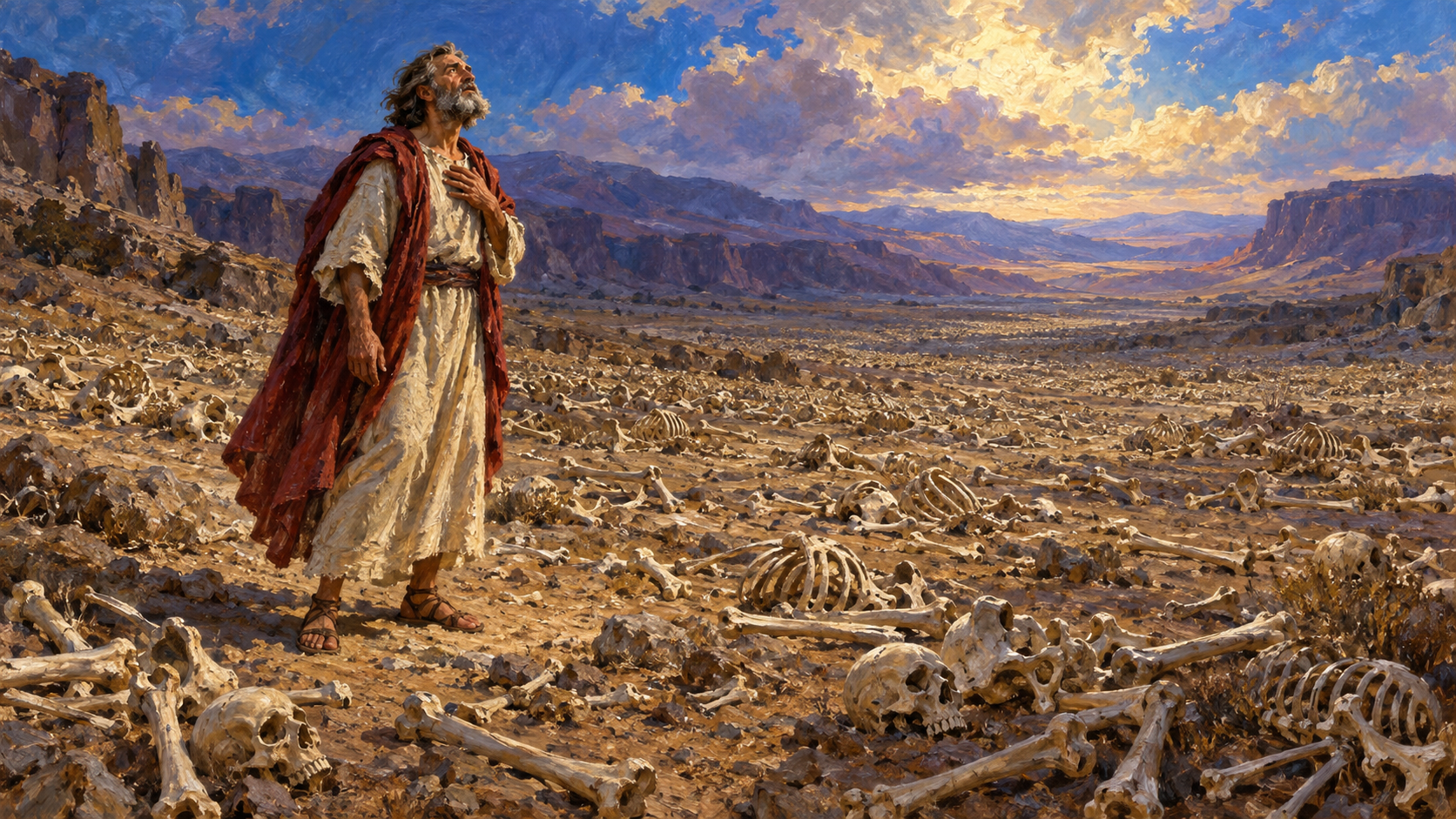
In chapter 37, the Spirit led Ezekiel around a valley full of very dry bones. Asked whether they could live, he answered, “O Lord GOD, You know.” At God’s command he prophesied, and the bones joined together, receiving sinews, flesh, and skin. They still lacked breath until God commanded him to speak to the breath. Then the slain stood alive as a great army. The Hebrew ruach can mean wind, breath, or Spirit according to context. The vision draws on that range of meaning while identifying God as the giver of life.
Then He said to me, “Son of man, these bones are the whole house of Israel. They indeed say, ‘Our bones are dry, our hope is lost, and we ourselves are cut off!’
God identifies the bones as the whole house of Israel. We should let that explanation govern the vision. The language of opened graves displays resurrection power and agrees with the hope of bodily resurrection, but the immediate promise concerns national restoration. God will bring Israel into its land and put His Spirit within the people. A physical gathering without spiritual renewal would not fulfill the whole promise.
The two sticks reinforce the same identity. One represents Judah; the other, Joseph and Ephraim with their associated tribes. God joins them into one nation under one King, cleanses their idolatry, and promises “David My servant” as their prince forever. I can take encouragement from God’s ability to give life without treating the valley as a guarantee that He will restore every marriage, business, ministry, or physical condition I want changed. Faith receives the promise He actually made.
Gog, the Future Temple, and the Returning Glory
Chapters 38–39 describe an invasion in the latter years, after Israel has been gathered from many peoples into its land. Gog, a ruler from Magog, leads a coalition including Persia, Cush and Put, Gomer, and the house of Togarmah. Cush and Put are rendered Ethiopia and Libya in some Bibles. Persia has a clear historical identity, but I would not confidently assign every ancient name to a current nation. Maps and fashionable identifications have changed with political events.
Gog comes to plunder Israel. God uses the attack to make His holiness known through an earthquake, confusion among the invaders, pestilence, flooding rain, hailstones, fire, and brimstone. The rescue is His work, rather than the result of Israel possessing superior weapons. The nations will recognize the LORD who has delivered His people.
I distinguish this attack from the Gog and Magog rebellion in Revelation 20. Ezekiel describes a named ruler and coalition attacking restored Israel, with burial of the dead and extended cleansing afterward. Revelation describes a worldwide rebellion from the earth’s four corners after Christ’s literal thousand-year reign, immediately ended by fire from heaven. Shared names connect the attacks without requiring us to identify them as one event.
I place Ezekiel’s invasion before the Millennial Kingdom, Christ’s literal thousand-year reign, without claiming that this overview settles every proposed point within the Tribulation sequence. Revelation’s later rebellion occurs at that reign’s end. The study on The End Times Timeline considers the wider sequence. We should retain what Ezekiel clearly describes without attaching a speculative date or modern leader’s name.
In the twenty-fifth year of captivity, Ezekiel was taken in visions to Israel’s land. A man with a flax line and measuring rod measured gates, courts, walls, chambers, the sanctuary, and altar. Chapters 40–48 also assign priestly responsibilities and tribal boundaries. Some interpreters understand this as an ideal sanctuary, heavenly worship, or a symbol of the church. The animal offerings raise a serious question about how the vision fits Christ’s final sacrifice, which I will address below. Yet the coordinated measurements, priestly responsibilities, and land divisions lead me to understand a real future sanctuary in Israel during Christ’s kingdom. Its detailed architecture can carry symbolic meaning without ceasing to describe an actual place.
The glory’s return connects the vision to the judgment earlier in the book. It had left the corrupted temple toward the east in chapters 10–11. Now it comes from the east and enters the measured house:
And the glory of the LORD came into the temple by way of the gate which faces toward the east. The Spirit lifted me up and brought me into the inner court; and behold, the glory of the LORD filled the temple.
The empty sanctuary was not God’s final word to Israel. He will restore His dwelling presence among a cleansed people. The gates, priestly assignments, land divisions, and returning glory describe an ordered future that retains the identity of the nation He addresses.
The animal offerings require explanation in light of Christ’s finished sacrifice. They cannot repeat, supplement, or improve His atonement. Hebrews teaches that animal blood never removed moral guilt, even under the Mosaic covenant. Jesus offered His sinless body once, shed His blood, and obtained eternal redemption. Any interpretation that makes future animal blood complete His work conflicts with that truth.
I therefore understand the kingdom offerings as looking back to the completed cross and serving the ceremonial order God describes. Ezekiel does not call each offering a memorial, so this explanation is an inference from reading him alongside Hebrews. We should acknowledge that. Communion now remembers and proclaims Christ’s body and blood without repeating His death; future ceremonies likewise cannot provide an atonement independent of Him. Animal blood has never accomplished what His blood accomplishes.
The prince in chapters 44–46 should also be distinguished from Jesus. He has provision for sons’ inheritances and presents an offering for himself as well as the people. I understand him as a human ruler serving under Jesus, the kingdom’s sinless King.
Chapter 47 follows water flowing east from beneath the temple threshold. The guide led Ezekiel through water at his ankles, then his knees and waist, until it became too deep to cross. Its depth grows supernaturally, with no tributaries mentioned. It heals the waters of the eastern region, brings abundant fish, and sustains trees that bear fresh fruit monthly with leaves for medicine.
I read this as a real kingdom river. It also displays blessing flowing from God’s dwelling into places previously marked by death. Zechariah 14 describes living waters from Jerusalem during the LORD’s future reign, while Revelation 22 describes the river of life in the final new creation. The passages are related, but they do not describe one identical moment. Living Water examines the wider biblical imagery.
The tribal allotments, boundaries, and provision for the stranger keep the restoration concrete. The people named are Israel’s tribes. At the end stands a measured city called THE LORD IS THERE. The name answers exile’s grief: after defilement, departing glory, destruction, and scattering, God promises His holy presence among His restored people.
How Ezekiel Leads Us to Jesus Christ
These promises lead us to Christ while retaining their original settings. The Son is the image of the invisible God and the brightness of His glory. He did not begin at Bethlehem; the eternal Word took humanity and made the Father known. Ezekiel had to say, “The word of the LORD came to me.” Jesus is Himself the eternal Word, greater than every prophet, speaking with the Son’s own authority.
He is also the promised Shepherd and Son of David. He knows His sheep, gave His life for them, and rose bodily to keep them in His hand. His kingdom will never end. Believers already form a spiritual house in Him, and He gives the Spirit as living water. Those present blessings do not cancel the future sanctuary, river, or national promises. The King who returns bodily can fulfill what He promised Israel.
Our salvation rests in His completed offering. Wicked people tortured the sinless Son and inflicted the bodily punishment He willingly bore for our sins. He shed His innocent blood and died, completing His saving work before He was buried and rose bodily. The Father did not punish, curse, abandon, strike, bruise, or pour wrath on Jesus. Christ died for the whole world, genuinely offering salvation to every person. Whoever repents and believes receives forgiveness and new birth. Grace can be resisted; ritual and good works cannot produce the life the Spirit gives.
Keeping Christ central does not require us to rename Israel as the church, turn the wheels into technology, or make the temple offerings repeat the cross. It means trusting the Savior to accomplish the restoration He defines. Neither prophetic insight nor an imaginative interpretation can improve His sufficient sacrifice.
Living Under Ezekiel’s Warning and Hope
Ezekiel saw God’s throne while Babylon seemed to control his future. Governments, war, changing markets, illness, and personal loss can likewise narrow my view until the immediate trouble seems to explain everything. None displaces the LORD from His throne. I can acknowledge the danger without treating earthly power as final.
The hidden rooms of idolatry challenge me more directly than speculation about the wheels. I can use Christian language and keep a busy religious schedule while protecting a rival loyalty in private. My use of money, what governs my fears, and the commands I keep excusing can expose where my trust has gone. God sees those choices as clearly as public worship.
Ezekiel received the scroll before speaking its message. I need to receive Scripture with a willingness to obey, especially when it confronts something I want to defend. The listeners who enjoyed Ezekiel without changing warn me against mistaking interest in biblical teaching for repentance.
The sour-grapes proverb also prevents me from using another person’s conduct to excuse my own. The harm may be real, and its consequences may continue, but God still holds me responsible for my response. His call to turn is sincere. I can confess honestly and seek the mercy He offers in Christ.
The Shepherd’s character supplies a standard for leadership. Pastors serve under Him and do not own the flock. They need sound doctrine and a willingness to care for weak people, confront predators, and accept personal cost for others’ good. Power used chiefly to protect a leader’s comfort resembles the shepherds Ezekiel rebuked.
I also need to respect the distinction between Israel and the church. Removing the nation, tribes, and land from promises that name them does not honor the church. God’s faithfulness to Israel gives us reason to trust the promises He has made to believers in Christ.
Everyone genuinely born again is a new creation in whom the Holy Spirit lives. He seals that believer, making salvation eternally secure. Our obedience does not complete the atonement, but changed conduct should provide evidence of the life He gives. That assurance calls for worship and holiness, never permission to cherish sin.
Ezekiel’s hope reaches toward the returning King and His actual reign. The scattered flock will be gathered, the nation reunited, its enemies defeated, and God’s glory present. The kingdom temple and river belong to that promised future. We have grounds for hope because God has spoken, even while we wait for what has not yet been fulfilled.
My Final Thoughts
I keep returning to the glory that appears in Babylon, leaves a defiled temple, and finally fills God’s future house. Ezekiel will not let me dismiss sin as harmless or conclude that exile has defeated God’s purpose. The LORD sees hidden idolatry, calls people to turn, seeks His sheep, and keeps His promises to Israel. My hope rests in Jesus Christ, the Good Shepherd who shed His blood for the whole world and rose bodily. He gives life through His Spirit and will return to reign as King.