
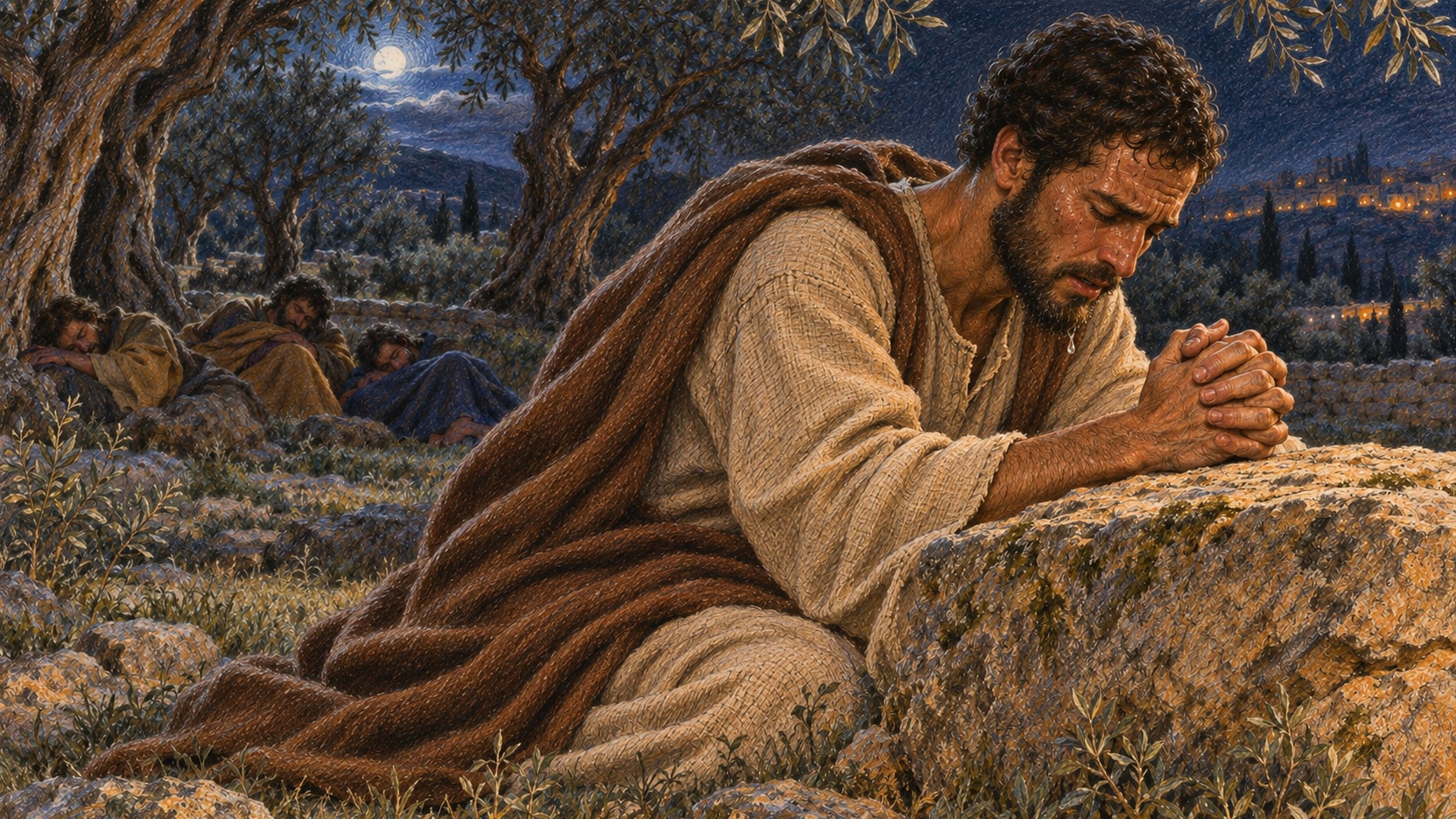
On the night before His crucifixion, Jesus prayed in such agony that Luke describes His sweat becoming like great drops of blood falling to the ground. Did He actually sweat blood? I would keep Luke’s comparison as he gives it rather than turn it into a definite medical diagnosis, but I also do not want that question to distract us from what he plainly describes: the Son of God was deeply distressed, and He brought that distress to His Father while remaining willing to obey Him.
Jesus Entered Gethsemane Knowing What Was Ahead
Jesus had eaten the Passover supper with His disciples, the men who had followed Him during His ministry. During that meal, He spoke about His approaching suffering and identified the bread and cup with His body given for them and His blood shed for them. He also warned that one of those at the table would betray Him. Judas Iscariot, one of the twelve disciples, had already agreed to help the religious authorities seize Him away from the crowds.
After the meal, Jesus went with His disciples to the Mount of Olives. Matthew and Mark name the place where He prayed as Gethsemane, and John describes a garden across the Brook Kidron. Luke tells us that going there was His custom. That helps us understand why Judas knew where to bring the men who would arrest Him. Jesus had often met there with His disciples.
He went to that familiar place knowing what lay ahead. John 18 tells us that when the armed group arrived, Jesus knew everything that would come upon Him and went forward to meet them. His prayer before the arrest belongs within that knowledge. He was facing what He had come to do, including the actual suffering His sacrifice would involve.
Matthew and Mark describe Him taking Peter, James, and John farther into the place where He would pray. These three were among His closest disciples. He told them that His soul was exceedingly sorrowful, even to death, and asked them to remain and keep watch. Then He moved a little farther away to pray. The Gospel accounts allow us to hear His sorrow in His own words before we hear how He submitted it to the Father.
Jesus asked for the cup to be taken away if that was the Father’s will. The cup was an image for what He was about to undergo. Scripture uses a cup to describe a person’s portion or experience in different settings. Psalm 23:5 speaks of a cup overflowing in God’s care, while Psalm 75:8 uses the image for judgment upon the wicked. We have to consider the passage in front of us to understand what the cup means there.
In the garden, I understand it to refer to the suffering and death Jesus was about to accept in fulfilling His saving mission. We can see His willingness again at His arrest. Peter drew a sword and cut off the right ear of a servant of Israel’s high priest. Jesus told him to put the sword away and asked whether He should not drink the cup His Father had given Him (John 18:10-11). He would not allow Peter’s attempt to defend Him to turn Him from that mission.
The Father’s purpose and the attackers’ wrongdoing have to be kept clear. The Father sent the Son to save, and the Son willingly offered Himself. Judas was still guilty of betrayal, and the men who would falsely accuse, torture, and kill Jesus were responsible for their evil. Jesus’ submission to the Father did not make their actions righteous.
Knowing that He would obey did not remove the sorrow of what He faced. His own disciples would fail Him, and He would endure public shame and crucifixion. I do not read His distress as a failure of holiness. He faced the real cost of obedience without turning against His Father. The study on the Garden of Gethsemane follows the prayer and arrest in greater detail, but this is the setting in which Luke describes His sweat.
Luke Says His Sweat Became Like Great Drops of Blood
Luke begins this part of the account with Jesus telling His disciples to pray that they would not enter into temptation. Then Jesus withdraws about a stone’s throw from them, kneels down, and prays. These are the words Luke records:
"Father, if it is Your will, take this cup away from Me; nevertheless not My will, but Yours, be done." Then an angel appeared to Him from heaven, strengthening Him. And being in agony, He prayed more earnestly. Then His sweat became like great drops of blood falling down to the ground.
Jesus asks for relief and submits His desire to the Father’s will in the same prayer. Luke then tells us that an angel appears from heaven and strengthens Him. After mentioning that help, Luke still describes Jesus as being in agony and praying more earnestly. Being strengthened did not mean that the suffering immediately disappeared.
I find that detail helpful because it keeps me from treating the sweat as an isolated medical curiosity. Luke is describing Jesus praying through anguish. His sweat falls to the ground while He continues to seek the Father, and the comparison with great drops of blood communicates the severity of that moment.
We should retain the word like. Luke does not simply write that blood came out through Jesus’ skin, and he does not give us a medical explanation of the process. That does not require us to say bloody sweating was impossible. It means that a definite diagnosis goes beyond what the verse establishes. We can take every word of the account seriously without making it answer a question in more detail than Luke supplies.
A rare condition called hematidrosis, also called hematohidrosis, is described in medical reports as bloody sweating or blood-stained fluid emerging through intact skin. The clinical case report in the Canadian Medical Association Journal describes a woman whose doctors observed blood-stained fluid on her face and identified red blood cells in it. She reported that the bleeding became more intense during periods of perceived emotional stress.
That is a possible medical parallel, but the report concerns a modern patient. It cannot establish what happened to Jesus in the garden. The authors also explain that the mechanism of the bleeding is not settled, so I would not add a confident explanation about ruptured vessels and sweat glands as though Luke had described one.
The apostle Paul identifies Luke as a physician in Colossians 4:14. That does not change the wording Luke chose here. He gives us a comparison within an account of earnest prayer, and I think our explanation should remain as careful as his wording. Jesus’ agony does not become less real because we refrain from assigning it a modern diagnosis.
The Eternal Son Truly Became Man
The angel’s strengthening raises a related question. If Jesus is God, why would He receive help from an angel? To understand that, we have to remember what Scripture says about His becoming man. John 1 begins by identifying the Word as both with God and God, and it says that everything was made through Him. Then John tells us that the Word became flesh and dwelt among us.
The eternal Son did not cease to be God when He became human. He took a real human body and a real human soul. John describes Him becoming weary during a journey and sitting beside a well in Samaria (John 4:6). At the death of His friend Lazarus, He wept with those who were grieving (John 11:32-35). On the cross, He spoke of His thirst. These are events in a genuine human life.
The term hypostatic union of Christ describes full deity and full humanity united in one Person. We are speaking about the same Jesus when we say that He made all things and that He became tired during a journey. His humanity was not an appearance He put on, and His deity was not diminished when He experienced human weakness.
That is how I understand His receiving strength in the garden. The angel was helping Him in the human life He had truly entered. Luke is not telling us that God had become deficient or that Jesus was less than the eternal Son. He is showing us the Son enduring distress as a man. The One kneeling in prayer could truly suffer, bleed, and die.
His request about the cup belongs to that real humanity as well. Betrayal and torture were dreadful things to face, and His desire for relief was not sinful. He brought that desire before His Father and yielded to His will. I would not turn the prayer into a rebellion within Jesus or a disagreement within the Trinity. The Son remained holy as He willingly accepted the path before Him.
We can sometimes speak about His sinlessness as though it made suffering easy for Him. But the garden does not show us an indifferent Savior going through a performance. His anguish was real, and so was His obedience. He continued to pray and submit while experiencing the cost of what He was doing.
Our High Priest Understands and Helps
Paul explains in Hebrews why Christ’s real humanity gives believers confidence when they need help. He calls Jesus our High Priest. In Israel, the high priest represented the people before God and brought sacrifices for sin. Jesus fulfills that priestly work through His own perfect offering, and He now represents His people before God. His knowledge of our weakness includes the human life He actually lived:
Seeing then that we have a great High Priest who has passed through the heavens, Jesus the Son of God, let us hold fast our confession. For we do not have a High Priest who cannot sympathize with our weaknesses, but was in all points tempted as we are, yet without sin. Let us therefore come boldly to the throne of grace, that we may obtain mercy and find grace to help in time of need.
The passage holds His sympathy and His sinlessness together. He understands human weakness, and He remained without sin through every test. We do not have to choose between a Savior who is holy and a Savior who understands suffering. Hebrews gives us reason to trust Him precisely as the sinless Son who has lived among us.
Being tempted in all points as we are does not require Him to have encountered every exact circumstance any person could name. It tells us that His testing was genuine. He knew hunger, rejection, and the pain of betrayal. As His death approached, He faced false accusations and bodily suffering, and His disciples failed to stand with Him. None of that led Him into sin.
Because this is our High Priest, Paul invites us to come boldly to the throne of grace. He is telling us to approach God with confidence that we may receive mercy and help. That confidence rests in Christ. It does not mean that I can make demands of God or insist that He give me every answer I prefer.
I also do not need to disguise distress behind religious language that makes me sound stronger than I am. Jesus’ agony in the garden shows that suffering can be brought honestly before the Father. Through the Savior who understands it, we can ask for help while we are still in need.
Hebrews 2 explains further why He is able to help:
For in that He Himself has suffered, being tempted, He is able to aid those who are tempted.
In the verses leading to that statement, Paul says that the Son shared our flesh and blood so that He could die. Through His death He would defeat the devil, who held the power of death, and release people who had lived in bondage to the fear of death. His priestly mercy is therefore joined to His actual suffering, rather than remaining something distant from human experience.
Hebrews 5 then describes His prayers during His earthly life. Paul does not name Gethsemane in that passage, so I would not say that every word refers only to the garden. But the earnest prayer and anguish Luke describes give us a clear example of what Paul is explaining:
who, in the days of His flesh, when He had offered up prayers and supplications, with vehement cries and tears to Him who was able to save Him from death, and was heard because of His godly fear, though He was a Son, yet He learned obedience by the things which He suffered. And having been perfected, He became the author of eternal salvation to all who obey Him,
Supplications are earnest requests, and godly fear here describes reverence toward God. Jesus approached the Father with cries and tears, and the passage says that He was heard. Yet He did not escape arrest or crucifixion. He truly died. I understand the Father’s saving answer to include bringing Him through death into bodily resurrection.
Being heard, then, should not be reduced to having the painful experience removed. Jesus submitted His request to the Father’s will and continued in obedience through death. When we compare Hebrews with the prayer in the garden, we see why the anguish of that prayer and the faithfulness of the Father’s answer belong together.
The words about learning obedience do not mean Jesus began as a disobedient Son who needed to be corrected. He was always holy. As the Son who had become man, He lived out obedience through actual suffering. He did what the Father appointed in human history, with the cost that obedience required.
Likewise, being perfected does not mean a moral flaw had to be removed from Him. I understand it in relation to His completing the suffering and work through which He became the author of eternal salvation. He accomplished the saving mission, and those who come to Him are receiving a Savior whose work is sufficient. The passage does not leave us with an unfinished offering or a priest unable to help.
The Garden Leads Us to Christ’s Shed Blood
Jesus’ suffering in Gethsemane was part of His obedient approach to the cross, but we should not identify His sweat as the blood that redeems us. The passages that explain our redemption direct us to His sacrificial death. Our confidence in salvation does not depend on settling the medical question about His sweat.
After He prayed, Judas arrived with the men who would arrest Him. They bound Jesus and took Him away. Before His crucifixion, wicked people mocked and struck Him, scourged Him, and pressed a crown of thorns onto His head. Then they nailed Him to the cross and killed Him. He willingly gave His innocent body as the perfect sacrifice for our sins and shed His blood. His saving sacrifice was complete through His death before His burial and bodily resurrection on the third day.
The apostle Peter connects our release from sin with that bodily sacrifice:
who Himself bore our sins in His own body on the tree, that we, having died to sins, might live for righteousness–by whose stripes you were healed.
The tree in that verse is the cross on which Jesus was crucified. Peter is speaking about the innocent Savior bearing our sins in His own body so that we might live for righteousness. In the preceding verses, he describes how Jesus conducted Himself while people mistreated Him. Jesus committed no sin and spoke no deceit. When He was reviled, He did not answer with reviling, and when He suffered, He did not threaten. He entrusted Himself to the One who judges righteously.
I understand the atonement in terms of that sinless, willing sacrifice. The Father did not punish, curse, abandon, strike, or bruise Jesus, and He did not pour wrath on Him. Sinful people inflicted the violence, while the Son willingly gave Himself to fulfill the saving purpose He shared with the Father.
Jesus had said that His Father loved Him because He laid down His life, and that He had authority to lay it down and take it again (John 10:17-18). Hebrews 9:14 also says that He offered Himself without spot to God through the eternal Spirit. Father, Son, and Holy Spirit remained united in saving sinners. The mission was given by the Father; the cruelty of the men who attacked Jesus remained their own wrongdoing.
Peter also explains the cost of redemption, which means our release at a price:
knowing that you were not redeemed with corruptible things, like silver or gold, from your aimless conduct received by tradition from your fathers, but with the precious blood of Christ, as of a lamb without blemish and without spot.
Silver and gold could not secure that rescue. Christ’s own precious blood did, and Peter describes Him as an unblemished lamb because the sacrifice was innocent. That is why I do not want our discussion of the sweat to obscure the sacrifice to which the apostles direct us.
Paul says in Romans 3:25 that God provided Christ as the atoning sacrifice by His blood, received through faith. Hebrews 10:19 then tells believers that they have access to God by the blood of Jesus. Revelation 1:5 praises Him for loving us and washing us from our sins in His own blood. Each passage connects the sinner’s cleansing and acceptance with what Christ gave for us. The study on the blood of Christ for salvation follows that testimony in greater detail.
Nor did the Savior remain in the grave after completing His sacrifice. He was buried and rose bodily on the third day, as Paul explains in 1 Corinthians 15:3-4. The One who prayed in agony is now alive to save and help His people. The study on tetelestai, “It is finished” explains the declaration He made from the cross and the completeness of His offering. We come to God through the crucified and risen Lord.
How Gethsemane Shapes Our Response
Jesus had no sin to confess when He knelt in the garden. He had not brought this sorrow on Himself by making a foolish decision, and He was not trying to escape the consequences of wrongdoing. His distress therefore cannot be treated as evidence that He lacked faith. I think we need to remember that before making judgments about another person’s anguish.
A believer who is deeply distressed does not necessarily need to be told that his feelings prove he is failing God. We can help him bring those fears to the Father and seek the grace Christ promises. The garden gives me reason to be careful with someone else’s pain, because the sinless Savior Himself spoke openly about how sorrowful He was.
Jesus also asked for relief. His willingness to obey did not prevent Him from bringing that desire before His Father. I find that to be helpful when I am thinking about prayer, because I can honestly ask God to remove a painful circumstance without making my trust depend on His removing it. Jesus submitted the request to the Father’s will and continued to obey.
We should also keep His unique saving mission in view when applying the account. He accepted arrest and death to offer Himself for sinners. That did not give the men who attacked Him a right to do evil, and it does not give wicked people a right to demand submission to whatever they choose to inflict. Jesus’ obedience was to His Father. We should not use His suffering to excuse someone else’s cruelty.
Luke also describes what happened to the disciples while Jesus was praying. When He returned to them, He found them sleeping from sorrow. He told them to rise and pray so that they would not enter into temptation. Their grief was real, but it did not remove their need to heed His warning.
Matthew and Mark fill out that part of the account. Earlier, Peter had insisted that he would not deny Jesus even if he had to die with Him, and the other disciples had made the same promise. In the garden, they repeatedly fell asleep when Jesus had asked them to watch. When He was arrested, they fled, and Peter later denied that he knew Him. Their confidence in their own loyalty had not prepared them for the test.
I can recognize the danger in assuming that determination will be enough. Jesus told His disciples to pray because they needed help, and I have no reason to think I can remain faithful without depending on God. Prayer belongs before the failure as well as after it. The warning in the garden gives me a reason to seek help while I still think I am strong.
Hebrews points us to where that help is found. Our sinless High Priest has suffered, offered Himself, and risen from the dead. He now intercedes for His people, which means that He represents them before God. I can approach through Him when my feelings are unsteady because His faithfulness is not changing with my emotions.
Receiving His help begins with receiving Him as Savior. Admiring His courage is not the same as repenting and believing in Him. Christ died for the whole world, and God’s offer of salvation is genuine for every person. A person can resist His grace and reject Him, but whoever turns to God and trusts Jesus Christ receives forgiveness and new life. Salvation is God’s gift by grace through faith, rather than a reward for copying Jesus’ courage well enough.
The Holy Spirit indwells and seals the believer, marking that person as belonging to God. Ephesians 1:13-14 describes the Spirit as the guarantee of the believer’s inheritance. Jesus also says that those who are His receive eternal life and will never perish (John 10:27-29). I understand those promises to give genuine believers eternal security in Christ.
That assurance does not make lawlessness acceptable. The grace that saves also teaches us to turn from ungodliness, and the Spirit works in those He indwells to produce obedience. When we remember what our Savior willingly endured, we have reason to trust His keeping power and to seek His help in following Him.
My Final Thoughts
Luke tells us that Jesus’ sweat became like great drops of blood falling to the ground. I would leave that comparison intact instead of claiming a medical certainty the passage does not give. What Luke does establish is that Jesus experienced real agony, received strength, and continued to pray in submission to His Father.
He then went willingly to the cross, where He offered His innocent body and shed the blood that redeems us. His saving sacrifice was completed through His death, and He was buried and rose bodily. The Savior who endured that suffering now represents His people before God. I can bring my weakness to Him honestly and ask for the help to obey, because the High Priest who understands our need is also able to meet it.