
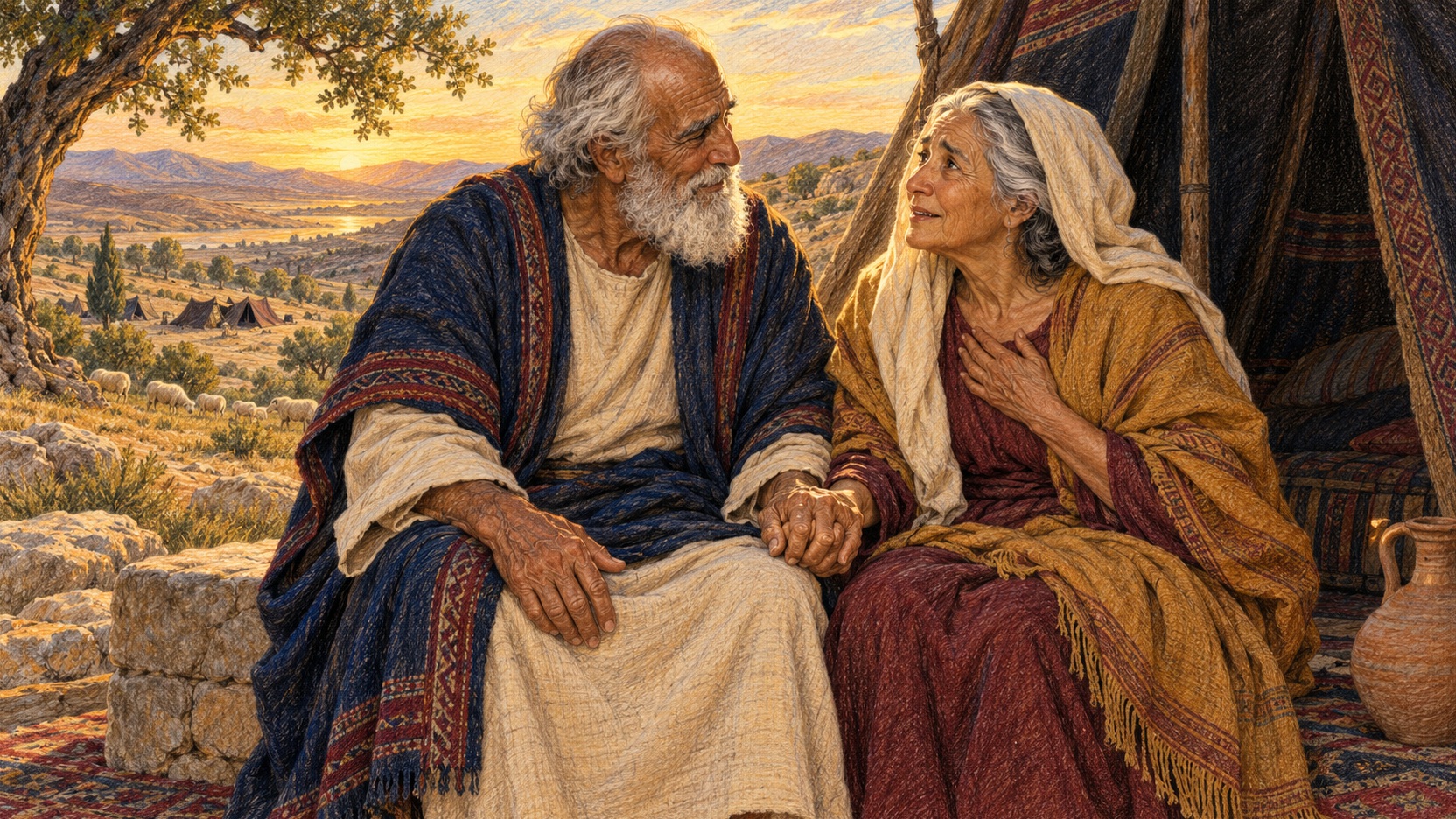
God changed Abram’s name to Abraham and Sarai’s name to Sarah while they were still waiting for the son He had promised. The new names identified them with a future God would bring about: Abraham would be the father of many nations, and Sarah would bear the covenant son and become the mother of nations and kings.
Abram Believed God Before His Name Changed
Abram had known the Lord long before Genesis 17. God had called him to leave his country and his father’s household for a land He would show him. The promises given with that call concerned Abram’s descendants and the blessing that would reach other families through him:
Now the LORD had said to Abram: “Get out of your country, From your family And from your father’s house, To a land that I will show you. I will make you a great nation; I will bless you And make your name great; And you shall be a blessing.”
“I will bless those who bless you, And I will curse him who curses you; And in you all the families of the earth shall be blessed.”
God promised Abram land and descendants who would become a great nation. He would bless Abram and make his name great, and through him bless all the families of the earth. Abram left in obedience before he could see how God would fulfill those promises. The study on the life of Abraham follows that journey and the difficulties he faced along the way.
By Genesis 15, Abram still had no son to inherit what God had promised. He brought that problem before the Lord, who assured him that his heir would come from his own body. God then took him outside:
Then He brought him outside and said, “Look now toward heaven, and count the stars if you are able to number them.” And He said to him, “So shall your descendants be.”
And he believed in the LORD, and He accounted it to him for righteousness.
Abram had not yet produced the heir or established the nation. He believed the Lord who promised them, and God accounted it to him for righteousness. Paul later uses this passage to explain justification, God’s declaration that a person is righteous before Him through faith. Abram received that standing before the circumcision commanded in Genesis 17 and before God changed his name.
We therefore should not treat the renaming as the moment an unbeliever became a believer or as a reward for an unblemished record. Abram’s faith was genuine, but Genesis also records his failures. In Genesis 16, Sarai asked him to have a child with her servant Hagar, hoping to obtain children through that arrangement. Abram agreed, and Ishmael was born. That son was not the one God would later identify as the covenant heir.
Abram was eighty-six when Ishmael was born and ninety-nine when the Lord appeared in Genesis 17. Ishmael was now thirteen. God was about to name Sarah as the mother of the promised heir, while Abraham would plead for the son he already had.
The Covenant Setting of Abraham’s New Name
The Lord appeared as Almighty God and called Abram to live faithfully before Him:
When Abram was ninety-nine years old, the LORD appeared to Abram and said to him, “I am Almighty God; walk before Me and be blameless. And I will make My covenant between Me and you, and will multiply you exceedingly.”
Then Abram fell on his face, and God talked with him, saying: “As for Me, behold, My covenant is with you, and you shall be a father of many nations.”
A covenant is a solemn commitment, and God repeatedly calls this one “My covenant.” He promises to multiply Abram, make him the father of many nations, and establish His covenant with his descendants. The command to walk before Him and be blameless calls for integrity in Abram’s conduct. It does not mean Abram had earned the promises by never having sinned.
Within this announcement, God changed Abram’s name:
“No longer shall your name be called Abram, but your name shall be Abraham; for I have made you a father of many nations.”
Abram is commonly understood to mean “exalted father.” God explains Abraham by connecting the name with fatherhood of a multitude of nations. The NET translation notes describe the connection as wordplay with the Hebrew expression for father of a multitude. The passage itself supplies the meaning God intends us to hear: this man’s descendants and influence would extend beyond one household, and nations and kings would come from him.
God said, “I have made you.” Abraham was still waiting for Isaac, and the promised multitude was not yet visible. The Lord spoke with certainty because He had committed Himself to bring it about. Abraham was ninety-nine, and Sarah was beyond the ordinary years of childbearing. Their bodies could not produce the promised son by ordinary means; they would have to depend on God.
The power to fulfill that promise belonged to God. Abraham’s new name announced what God would do, but the name itself could not make it happen. I cannot use this passage to claim that repeating a name or a desired outcome compels God to act. Biblical faith trusts what He has spoken rather than treating words as a technique for creating our preferred reality.
God also commanded circumcision as the covenant sign for the males in Abraham’s household. That obedience was required, but it did not make Abraham righteous for the first time. Genesis 15 has already told us how God accounted him righteous. Abraham received the sign in response to God’s promise; neither the sign nor his obedience created that promise. The study on the Abrahamic covenant examines its promises and obligations more fully.
Sarah and the Promised Son
The Lord then named Sarah as the mother through whom the promised son would come:
Then God said to Abraham, “As for Sarai your wife, you shall not call her name Sarai, but Sarah shall be her name. And I will bless her and also give you a son by her; then I will bless her, and she shall be a mother of nations; kings of peoples shall be from her.”
Both Sarai and Sarah express royalty or princely standing. A familiar explanation translates Sarai as “my princess” and Sarah as “princess,” suggesting an expanded role beyond one family. That distinction requires care; the NET note on Sarah’s name explains them as variant forms meaning princess or queen. We do not need to resolve every linguistic detail to understand God’s announcement. Sarah herself would receive His blessing, bear the son, and become the mother of nations and kings.
God had identified the mother as well as the father. Abraham already had a son through Hagar, but God promised another son specifically through Sarah. Abraham fell on his face and laughed. He asked whether a man of a hundred could have a child and whether Sarah could bear one at ninety. He also pleaded that Ishmael might live before God. The Lord answered by specifying Sarah and naming their son:
Then God said: “No, Sarah your wife shall bear you a son, and you shall call his name Isaac; I will establish My covenant with him for an everlasting covenant, and with his descendants after him.”
God also heard Abraham’s plea for Ishmael and promised to bless him, multiply him greatly, and make him a great nation. Genesis 17:20 even specifies twelve princes among his descendants. Ishmael’s life and future were not dismissed as worthless. The blessing was real, while the covenant would continue through Isaac. God then restated His commitment concerning Isaac:
“But My covenant I will establish with Isaac, whom Sarah shall bear to you at this set time next year.”
Isaac means “he laughs,” connecting the name with the laughter surrounding the announcement. God also gave a definite time for the birth: Sarah would bear him the following year. Before Isaac was born, God had identified him as the covenant heir. Neither the parents’ age nor Abraham’s plea for Ishmael changed that promise.
Genesis 21 records that the Lord visited Sarah and did for her what He had promised. Isaac was born at the appointed time. Abraham and Sarah received the son through whom the covenant would continue. Their new names had identified them with that future while they were still waiting; Isaac’s birth showed that God had kept His word. Nothing hidden within the names had produced the child.
What the Hebrew Spelling Can and Cannot Prove
The changes are visible in Hebrew. Abram is אַבְרָם (Avram), while Abraham is אַבְרָהָם (Avraham). The letter ה, called he or hei, appears in the new name. Sarai is שָׂרַי (Sarai), while Sarah is שָׂרָה (Sarah). In her name the final י, called yod, is replaced by ה. These are related changes, but Sarah’s spelling does not simply gain an extra letter.
The letter he also appears in the divine name represented in English as YHWH. Some readers see a devotional connection there, describing the renaming as God placing something of His own name, breath, or Spirit into Abraham and Sarah’s names. The shared letter is an observation about spelling. Genesis does not say that God transferred part of His name or that the letter carries the meaning of His Spirit.
A letter does not acquire the meaning of every word in which it appears. We cannot make he automatically mean breath, revelation, or divine presence wherever we find it. Someone may offer a cautious devotional reflection, but it must remain a reflection rather than a claim about what the Hebrew letter proves.
Genesis gives us a much firmer explanation. God explicitly connects Abraham’s new name with many nations, and He places Sarah’s new name beside the promise that she will bear Isaac and become the mother of nations and kings. Their names identify them with His announced purpose. We lose precision if we replace that explanation with a code the passage never supplies.
The Promise Reaches the Nations Through Christ
Paul draws on God’s announcement to Abraham when he explains faith in Romans 4:
(as it is written, “I have made you a father of many nations”) in the presence of Him whom he believed, God, who gives life to the dead and calls those things which do not exist as though they did;
He did not waver at the promise of God through unbelief, but was strengthened in faith, giving glory to God, and being fully convinced that what He had promised He was also able to perform.
Abraham trusted God’s ability to fulfill His promise even though he and Sarah could not produce this son by ordinary means. Paul is not teaching that we can call an imagined future into existence by declaring it. God gives life and calls into existence what is not there. Abraham depended on what God could do, rather than on a power in his own words.
Paul’s description of that faith does not require us to ignore the questions and failures Genesis records. Abraham had agreed to the arrangement involving Hagar and later questioned how Sarah could bear a child. Yet the promise depended on God’s power, and Abraham came to rest his confidence there. Circumcision followed the righteous standing he had received through faith; it was no substitute for trusting the Lord.
Galatians 3 then identifies the promised Seed through whom blessing reaches the nations:
Now to Abraham and his Seed were the promises made. He does not say, “And to seeds,” as of many, but as of one, “And to your Seed,” who is Christ.
Jesus Christ came through Abraham’s line according to the flesh, through Isaac, Israel, and David’s royal family. He is the promised Seed in whom Jews and Gentiles receive salvation through faith. Physical descent from Abraham cannot save a person, and a Gentile does not need to become Abraham’s biological descendant to receive the blessing in Christ. God’s promise reaches people of every nation without making human ancestry the means of justification.
This blessing does not erase the promises God made concerning Abraham’s descendants and the land. Genesis speaks of a real family and a real covenant, while Paul explains how the blessing of salvation reaches the nations through Christ. We should receive that wider reach without treating the earlier promises as disposable.
The Savior is the eternal Son, fully God and fully man, who lived without sin and voluntarily gave Himself to be slain as the perfect sacrifice for our sins. Wicked men inflicted His bodily suffering and crucified Him. His sacrifice was complete through His shed blood and death before His burial and bodily resurrection. The Father did not punish or abandon Him. We receive salvation by grace through repentance and faith in Christ, rather than by ancestry, a religious sign, or personal achievement. The study on the gospel follows this saving work and our response to it.
We can learn from Abraham and Sarah’s waiting without claiming their particular promise as our own. God was not establishing a rule that every believer must receive a private new name, become the parent of nations, or obtain a child after years of barrenness. He made specific promises to this couple at a particular point in His redemptive work. Their fulfillment gives us reason to trust His faithfulness to what He has actually promised us.
Waiting also did not remove Abraham’s responsibility to obey. Genesis 17 ends with him carrying out the circumcision God had commanded for his household. He could not produce the promised future by his own strength, but he could respond to the word he had received. I need the same willingness to obey what God has made clear instead of treating uncertainty about the future as an excuse to do nothing.
Their names kept God’s promise before them while the visible circumstances still seemed to contradict it. Abraham was called the father of many nations before Isaac was born, and Sarah received a name associated with royalty before the promised son arrived. God kept His word at the time He had appointed. The years of waiting had not weakened His ability to fulfill it.
My Final Thoughts
God renamed Abram and Sarai to identify them with the covenant future He had promised. Abraham would be the father of many nations, and Sarah would bear Isaac and become the mother of nations and kings. Those names did not make them righteous or carry a power that compelled God to act. They bore witness to His commitment, which He fulfilled through Isaac and carried forward to Christ. I can trust the God who kept that promise without claiming every detail of it for myself. He calls us to believe His word and obey while waiting for what He has promised us in Christ.