
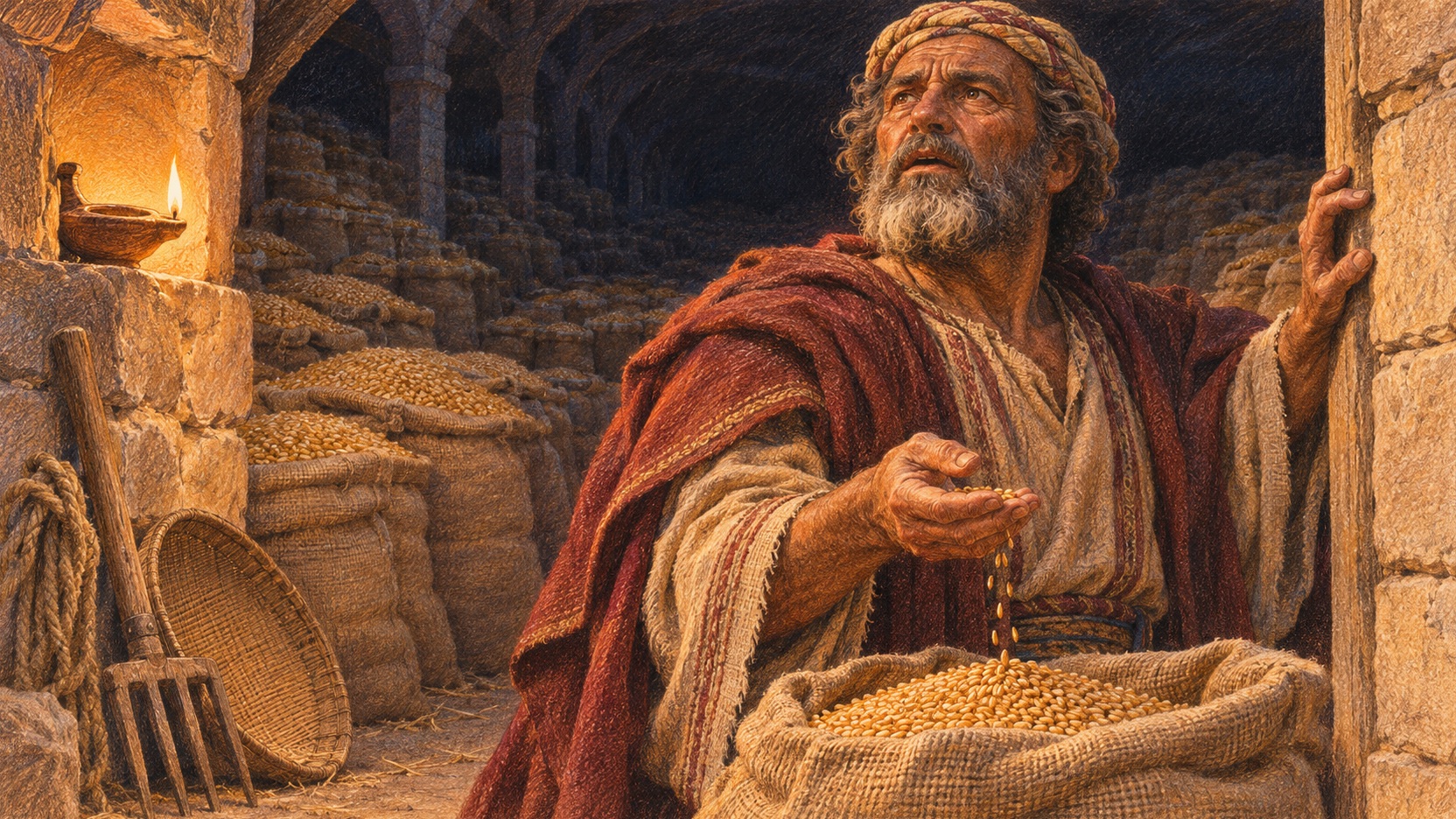
A man in the crowd wanted Jesus to tell his brother to divide their inheritance. Jesus answered with a warning about greed, and then He described a farmer whose harvest was so large that he wanted bigger barns. I find the connection between those two men helpful, because one wanted to receive more and the other already had more than he could store, but neither situation could give a man control over his life.
Jesus Warned About Covetousness in a Serious Setting
Before we look at the farmer, let’s consider what Jesus was saying when the man interrupted Him. Luke 12 opens with a crowd so large that people were trampling one another. Jesus was speaking first to His disciples, warning them about hypocrisy and about allowing fear of other people to determine whether they would acknowledge Him. Persecutors could kill their bodies, but their authority ended there. God had authority beyond death, and they needed to fear Him.
Jesus also assured His followers that God had not forgotten them. Even the hairs of their heads were numbered, and the Holy Spirit would teach them what to say when they were brought before authorities. In the middle of that teaching about trusting God and remaining faithful under pressure, someone raised a question about family property.
Then one from the crowd said to Him, “Teacher, tell my brother to divide the inheritance with me.”
An inheritance is property passed on to surviving family members, so this man’s request concerned something that could make a real difference in his circumstances. He called Jesus Teacher, but he was asking Him to give his brother a particular instruction. Luke does not tell us enough about their dispute to decide which brother had the rightful claim. There may have been a genuine injustice, and nothing in Jesus’ answer cancels the responsibilities God gave families concerning inheritance.
But He said to him, “Man, who made Me a judge or an arbitrator over you?”
Jesus declined to act as the arbitrator, the person who would hear the dispute and settle it. Instead of deciding how much each brother should receive, He turned to a danger everyone listening needed to consider. I can have a valid claim to something and still become so consumed with getting it that I stop considering what God requires of me. A fair division of the property would settle the ownership question, but it would not necessarily change that desire.
And He said to them, “Take heed and beware of covetousness, for one’s life does not consist in the abundance of the things he possesses.”
Notice that Jesus tells them both to take heed and to beware. The Greek word horate carries the instruction to pay attention, and phylassesthe tells them to guard themselves. He is calling the people who hear Him to examine their own hearts. I haven’t answered His warning if all I have done is identify somebody who seems greedier than I am.
Covetousness translates pleonexia, a greedy desire to have more. The apostle Paul calls it idolatry in his letter to the believers at Colossae, in Colossians 3:5. That helps us understand why Jesus treats it so seriously. Idolatry gives something the place that belongs to God, and possessions can take that place when I trust them to secure my life or allow the pursuit of them to decide whether I will obey Him. If obeying God means I will receive less, which am I willing to give up?
That desire can hide behind a good responsibility. I should provide for my family, but providing for them does not give me permission to be dishonest or to refuse every opportunity to help somebody else. I may also have a fair complaint about something that belongs to me. Even then, I need to consider whether winning the dispute has become more important to me than behaving faithfully before God.
The study of covetousness looks further at how this desire grows. An amount I once thought would be enough can begin to seem too small as soon as I have it. Someone with very little can be consumed with acquiring more, and someone who is already wealthy can keep expecting the next increase to make him secure. Jesus’ warning applies to both because neither person’s life is measured by how much he owns.
The word translated life in verse 15 is zoe. Food, shelter, and money can improve our circumstances, and Jesus is not pretending those needs are imaginary. But having an abundance cannot guarantee another day of life, and it cannot make us right with God. To show what happens when a man expects his possessions to provide that security, Jesus tells the following parable.
The Harvest Was a Gift, Not the Sin
Then He spoke a parable to them, saying: “The ground of a certain rich man yielded plentifully.
The farmer was already rich before this harvest came in. Now his land had produced even more, and Jesus does not say that he had stolen the land or cheated the people who worked for him. We should not add those accusations. Growing a good crop was not his sin. A productive farm can feed a household, provide work, and supply food for people who did not grow it themselves.
What the farmer did with that increase would show how he understood what he had received. He could cultivate the ground, but he had not created the soil, the rain, or the seasons that made the harvest possible. Even the strength he needed to work depended on God. His dependence did not disappear just because the crop was large enough to fill his barns.
Proverbs 3:9–10 tells God’s people to honor the LORD with their possessions and with the firstfruits of their increase. The firstfruits were the first portion of what they received from the harvest. Giving that portion to the Lord acknowledged that the harvest came from Him. The passage speaks of barns filled with plenty, so the Bible is not treating a full barn as something shameful. It is teaching the person who owns it to honor the One who provided what is inside.
I find that to be a useful place to examine my own response when I receive more than I expected. The increase gives me something to be thankful for, and it also gives me a responsibility to consider how the Lord would have me use it. In the thoughts Jesus reports, the farmer does neither. He never turns to God for direction or considers whether someone else could benefit. His attention goes straight to finding somewhere to keep everything for himself.
Bigger Barns Revealed a Life Closed to God
And he thought within himself, saying, ‘What shall I do, since I have no room to store my crops?’ So he said, ‘I will do this: I will pull down my barns and build greater, and there I will store all my crops and my goods.
His crop would not fit in the buildings he had, so he decided to tear them down and build larger ones. As we listen to him explain the plan, his own possessions and his own decisions fill the conversation. He speaks about what he will do with his crops and his goods, but there is no acknowledgment that God has any claim on how he uses them.
We should be careful here, because the problem cannot simply be that he wanted to store grain. Genesis 41 describes Joseph doing that very thing in Egypt. Pharaoh, Egypt’s king, had received dreams that God enabled Joseph to explain. Seven years of plentiful harvests would be followed by seven years of severe famine. After explaining that warning, Joseph advised Pharaoh to appoint someone to collect grain during the plentiful years so there would be food when the crops failed.
Pharaoh placed Joseph in charge, and Joseph gathered grain into storehouses throughout Egypt. When the famine came, those stores supplied food to people who needed it. Joseph was preparing in response to what God had revealed, and the preparation preserved lives. The farmer in Jesus’ parable was planning for his own ease without considering God. Both men stored grain, but the reasons for their plans and the uses they intended were different.
Proverbs 6:6–11 also tells the lazy person to consider the ant, which gathers food during the harvest. There is wisdom in working while we have the opportunity and preparing for needs that will come later. A household can make a budget, save money, and prepare for a difficult season while depending on the Lord. I don’t want to take Jesus’ warning about greed and turn it into a reason to neglect those responsibilities.
The farmer’s next words show us what had gone wrong with his preparation. He expected the larger barns to do more than protect the harvest. Once he had enough goods stored away, he believed he could settle into years of enjoyment.
And I will say to my soul, “Soul, you have many goods laid up for many years; take your ease; eat, drink, and be merry.”‘
Pay attention to how he connects the goods with the years. He has enough stored up to last a long time, so he speaks to himself as though the time is also his to enjoy. But food for many years does not give a person many years. His grain could provide the next meal if he lived to eat it. It could not promise that he would be alive tomorrow, and it could not prepare him to meet God if he died.
God Required the Life He Could Not Secure
Up to this point we have heard the farmer talking to himself about his future. Then God speaks, and the future the farmer has imagined ends that very night.
But God said to him, ‘Fool! This night your soul will be required of you; then whose will those things be which you have provided?’
The word translated Fool is aphron, which describes someone foolish or without sound understanding. That does not mean the farmer lacked the ability to run a farm. He understood that his harvest required more storage, and he could make plans to provide it. What he failed to understand was that his life remained in God’s hands while he was arranging it as though it belonged entirely to him.
Psalm 14:1 describes the fool who says in his heart, “There is no God.” Jesus does not tell us that the farmer said those words, so I would not put them in his mouth. But I see a similar disregard for God in the future he describes. A person can profess belief in God and then make his decisions as though God has nothing to do with his life. That is what people mean by practical atheism. The denial shows up in how someone lives, even if he would never say that God does not exist.
God’s words about the farmer’s soul being required refer here to his life being demanded back. The Greek word psyche, translated soul, can refer to a person’s life. I do not read this verse as establishing that human souls possess immortality independently of God. The point in this account is that the farmer could keep his grain, but he could not keep his life when God required it. The One he had left out of his plans had authority over every day he thought lay ahead of him.
God then asks who will have the things the man has prepared. His death would not make the harvest disappear. It would end his ability to keep it and enjoy it for himself. Ecclesiastes 2:18–21 describes the frustration of working with skill and wisdom only to leave the result to someone who did not do that work. The person who labored cannot even ensure that the one who comes after him will use it wisely. The farmer had made his plans around enjoying what he owned, but another person would have it.
James 4:13–15 brings the same problem into a business plan. People announce that they will go to a certain city, spend a year trading there, and make a profit. They have decided where they will go, how long they will stay, and what they expect to gain, yet they do not know what will happen tomorrow. James tells them to say, “If the Lord wills, we shall live and do this or that.” Notice that living comes before carrying out the plan. Before I can complete tomorrow’s work, I need the life the Lord gives me to do it.
I can still make the plan. What I cannot honestly do is treat the coming year as something I already possess. Recognizing that dependence should affect more than the words I add to a conversation. If I am planning under God’s authority, then His will also governs whether the work I intend to do is right.
That is why I don’t think a charitable donation by itself would have solved the farmer’s problem. He needed to repent, to turn from living without regard for God and come to Him. Giving some grain away while continuing to reject God’s authority would leave that relationship unchanged. Generosity belongs in the response to Jesus’ warning, but neither a larger barn nor a better distribution of its contents can reconcile a sinner to God.
Being Rich Toward God Changes How We Hold Possessions
“So is he who lays up treasure for himself, and is not rich toward God.”
Jesus applies the farmer’s warning to anyone who lays up treasure for himself while remaining poor toward God. That includes a person who has not yet managed to accumulate much. Poverty does not remove the desire for wealth, and having wealth does not automatically make someone unfaithful. The question is whether I am living before God with what I have or treating my possessions as the thing that will secure my life.
Being rich toward God begins with turning to Him in repentance and faith. Once I recognize that I belong to Him, I cannot treat the things He gives me as though they have no purpose beyond satisfying me. I receive them with gratitude, and I am accountable for how I use them. That is what stewardship means: managing something that has been entrusted to my care. Faithful stewardship follows from belonging to the Lord; it does not purchase His acceptance.
Jesus also describes the worth of His kingdom in the parable of the hidden treasure in Matthew 13:44. A man finds treasure hidden in a field, and in his joy he sells what he has so he can buy the field. What he has found changes how he values what he already owns. I see that comparison helping us with the rich fool’s mistake. The farmer’s goods had become the thing he prized above everything else, and he had given no thought to the God before whom he would have to stand.
Paul gives specific instructions about wealth in 1 Timothy 6:17–19. He tells Timothy, who was serving in the work of the church, to command wealthy believers not to become proud and not to trust riches, which are uncertain. They are to trust the living God who provides for them, and they are to use what they have to do good. Paul calls them to be ready to give and willing to share. Their wealth gives them opportunities to serve others, but it must not become the object of their trust.
Those instructions help me examine a savings account or retirement plan without assuming that simply having one is evidence of greed. Money can be set aside faithfully for a household’s needs. A home, a business, and the tools required for work can also serve good purposes. But if I refuse to meet an obligation because I cannot bear to reduce my savings, or dismiss God’s commands whenever they interfere with my plans, then I am giving those possessions authority they should not have.
For a business owner, obedience may mean paying what is owed and providing useful work instead of increasing profit through somebody else’s loss. A household may be able to help a person in need with money it would otherwise spend on another comfort. Someone may need to sell a possession because maintaining it has begun to dominate his time and money. I cannot measure faithfulness merely by whether something is kept or sold. I need to consider whether I am obeying the Lord in what I do with it.
Jesus continues the discussion in Luke 12 by telling His disciples not to worry about food and clothing. That follows naturally from what He has said about the farmer. One person may believe that having enough stored away has made him secure, while another may spend his days afraid that he will never have enough. In either case, earthly provision can take over his thinking. Jesus directs His disciples to their Father, who knows what they need, and tells them to seek His kingdom.
He points to ravens that God feeds even though they have no storehouses, and to flowers that God clothes without their having to make garments. The comparison gives the disciples a reason to trust their Father’s care. Their needs matter to Him. Seeking His kingdom means that His rule and His purposes should govern their lives instead of fear about what they will eat or wear.
Jesus then tells them to sell and give alms, meaning material help to people in need. Trusting the Father should make a difference in what we are willing to share. In Matthew 6:19–21, He explains that earthly treasure can decay or be stolen, while treasure in heaven is secure. He also says that the heart follows the treasure. I cannot use the fact that covetousness is a heart problem as an excuse to avoid looking at my spending and giving. Those choices can show what my heart has come to value.
Later in Luke 12, Jesus describes servants waiting for their master to return from a wedding. They are to be ready to open the door when he arrives. Jesus applies that readiness to His own coming as the Son of Man, which will be at an hour they do not expect. The farmer had prepared for the future he wanted, but he had not prepared to answer to God. The teaching about possessions belongs with this warning because a life absorbed in what we intend to enjoy can leave no room for considering the Lord’s coming.
The parable of the ten virgins in Matthew 25:1–13 gives a similar warning. Ten young women go out to meet a bridegroom, but only five bring a supply of oil with their lamps. When he comes, the ones who are ready go into the wedding with him, and the door is shut. The others arrive afterward and are not admitted. Their intention to take part did not replace being ready when he arrived.
Being ready to meet the Lord requires the salvation He provides through Jesus Christ. The eternal Son became fully man without ceasing to be God, and He lived without sin. He voluntarily gave Himself to be slain as the perfect sacrifice for our sins. Wicked people inflicted His bodily suffering; the Father did not punish Him. His saving work through His innocent blood and death was complete when He died, before His burial and bodily resurrection. We receive salvation through repentance and faith in Him. Neither the money we save nor the money we give can purchase what He has accomplished.
Jesus shows the mercy of God toward a returning sinner in the parable of the prodigal son in Luke 15. The younger son takes his inheritance, leaves home, and wastes what he has received. After his money is gone and famine leaves him hungry, he decides to return and confess his sin to his father. His father welcomes him with compassion. The son comes home without the inheritance he carried away, and he receives mercy he cannot buy. That is the hope I want you to hear alongside the warning about greed. Turning to the Lord is not a matter of first accumulating enough or giving away enough to deserve Him.
My Final Thoughts
The farmer could calculate how much grain his barns would hold, but he could not calculate how much life remained to him. Jesus has shown why receiving more cannot give us the security we may expect from it. Even a carefully managed harvest leaves us dependent on God, and no amount of wealth can make us right with Him.
I want that to shape how I plan, while there is still time to use what the Lord has given me. I can thank Him for His provision, care for my household, and prepare for future needs while allowing His commands to govern what I keep and what I share. Christ has provided the salvation my possessions could never give me. Because my trust belongs in Him, I don’t have to ask my savings to promise me a life they have no power to secure.