
When we hear the name Baal, it is easy to think of little more than a dead religion from the ancient world. Yet Scripture treats his worship as a direct challenge to the living God. I want to follow that history because it shows why Israel kept returning to Baal and why the LORD called that worship betrayal.
Baal Worship Was a Fight Over Who Gives Life
The Hebrew word baal can mean lord, master, owner, or husband, depending on its setting. That keeps us from assuming that the word itself is always a technical name for idolatry. A common word for lordship became attached to a false god and to local forms of his worship. When the Old Testament speaks of “the Baals,” it can refer to multiple local forms, shrines, or titles connected with this same false worship.
Baal was especially associated with storms, rain, fertility, and agricultural prosperity in the world Scripture describes. That claim helps us understand why the Bible’s confrontations with Baal take the shape they do. If Baal supposedly gave rain, the LORD’s drought exposed him. If he supposedly gave life and fruitful harvests, the LORD’s power over life, fire, and the land showed who truly ruled.
The deepest contrast, then, is not between two ancient names. It is between a false master and the living LORD. Israel could not choose whichever power seemed useful at the moment. The LORD had delivered them from Egypt and entered into covenant with them. He gave them His law, which plainly warned them not to serve other gods. Baal worship was therefore not an innocent mistake. It was adultery against the covenant God.
We also should not sensationalize Baal beyond what Scripture says. The Bible gives us enough to see the truth across Israel’s history. The nation served the Baals after Joshua’s generation, and Ahab later built a temple and altar for Baal. Elijah confronted Baal’s prophets, while Jeremiah rebuked both Baal worship and the child sacrifice connected with it. Hosea exposed Israel for using God’s gifts in service to the idol. Paul then looked back to the seven thousand who had not bowed to Baal to explain the remnant God preserves by grace.
When I put those passages together, Baal worship becomes a fight over the source of life. The people who belonged to the LORD tried to receive rain and prosperity from another master. They also sought protection and acceptance from the culture around them. A false god promised blessing while drawing their hearts away from obedience. Baal offered the appearance of control without repentance and abundance without holiness. Scripture presents that promise for what it was: a lie that led God’s people into betrayal.
Why Israel Kept Turning to Baal
Baal worship appealed to ordinary fears and desires. Ancient families depended on rain and harvest for their food. In a drought or famine, a religion that claimed to secure agricultural prosperity could feel very practical. The temptation was not only a theory discussed by religious leaders. It touched survival, household security, and the future of the next crop.
It also came with cultural pressure. Israel lived among nations that served false gods, and close ties with those nations made compromise easier. Intermarriage and political alliances joined households and rulers together, while trade created its own pressure to fit in. Baal worship could seem like the normal religion of the land, while loyalty to the LORD required Israel to remain separate and trust Him.
The difference was moral as well as religious. The LORD demanded faith and holiness. His people had to turn from sin and obey His word, and that obedience included doing what was right toward others. They also had to worship Him as He commanded. Idolatry offered a god who seemed easier to manage through ritual. A worshiper could imagine that the right ceremony controlled blessing while his heart remained unchanged.
Then the children of Israel did evil in the sight of the LORD, and served the Baals; and they forsook the LORD God of their fathers, who had brought them out of the land of Egypt; and they followed other gods from among the gods of the people who were all around them, and they bowed down to them; and they provoked the LORD to anger. They forsook the LORD and served Baal and the Ashtoreths.
Judges describes the repeated collapse that followed Joshua’s generation. Israel did evil and served the Baals. The people forsook the LORD, followed the gods of those around them, and bowed down to those gods. The passage piles up these actions so that we will not reduce idolatry to one private error. A whole way of life had turned away from God.
Notice the covenant language. They forsook the LORD God of their fathers, the One who had brought them out of Egypt. These were not people who had never heard about Him. They turned from the God who had revealed Himself and rescued them. The cycle in Judges shows what followed. Israel’s sin brought oppression. When the people cried out, God raised a deliverer, yet after the rescue the nation fell again. Baal did not make Israel strong. Serving him left the people exposed because they had turned from the God who was their life.
The same pattern is still recognizable, though we should apply it carefully. A person does not need an altar bearing Baal’s name to seek blessing apart from God. Prosperity or sexuality can become a master, and the desire for influence can rule us too. We may place family approval above obedience or trust political power to give what only God can provide. Occult practice makes the spiritual rebellion more direct. Not every temptation is literally Baal worship, and calling everything “Baal” would weaken the Bible’s serious warning. Yet Baal worship does show the shape of idolatry: another master promises life if we will turn from the LORD.
The Drought and Mount Carmel Exposed Baal
Under Ahab, Israel’s rebellion gained the open support of the throne. Scripture says it seemed a trivial thing for him to follow the sins of Jeroboam, so he went further. He married Jezebel, the daughter of Ethbaal, king of the Sidonians, and brought a strong Sidonian Baal influence into the royal house.
And it came to pass, as though it had been a trivial thing for him to walk in the sins of Jeroboam the son of Nebat, that he took as wife Jezebel the daughter of Ethbaal, king of the Sidonians; and he went and served Baal and worshiped him. Then he set up an altar for Baal in the temple of Baal, which he had built in Samaria. And Ahab made a wooden image. Ahab did more to provoke the LORD God of Israel to anger than all the kings of Israel who were before him.
Ahab served Baal and built an altar and temple for him in Samaria. Idolatry now had the support of the throne and was woven into national life. Jezebel was a fierce promoter of Baal and an enemy of the LORD’s prophets. We do not need to invent details beyond the text to make the record severe. Together, Ahab and Jezebel helped lead Israel into open rebellion against God, and their influence increased the pressure on ordinary Israelites to follow.
Elijah’s first recorded word to Ahab announced that there would be no dew or rain except at his word. The judgment struck directly at Baal’s supposed domain. If Baal was the storm god who gave rain and agricultural blessing, then the drought exposed his claim as a lie.
The drought also fulfilled the covenant warnings God had already given through Moses. Deuteronomy warned Israel that if the people turned aside to serve other gods, the LORD would shut the heavens so that there would be no rain. Elijah was not inventing a contest of his own. He was announcing that the covenant God was carrying out His word.
I think the drought helps us see how judgment can also bring merciful exposure. God could have allowed Israel to keep thanking Baal for blessings that came from the LORD. Instead, He made the idol’s failure public. The brooks dried up and the land felt the drought, while Baal could do nothing. Creation itself testified that the LORD ruled it.
And Elijah came to all the people, and said, “How long will you falter between two opinions? If the LORD is God, follow Him; but if Baal, follow him.” But the people answered him not a word.
Mount Carmel was not a contest between equal powers. It was the public exposure of a false god and a divided people. Elijah did not ask Israel to add the LORD to Baal. He forced the question of exclusive allegiance: if the LORD is God, follow Him; if Baal is god, follow him.
The people’s silence is painful. They did not defend Baal, but neither did they confess the LORD. A divided heart often prefers silence because a clear answer would require repentance. Elijah’s question took away the shelter of delay.
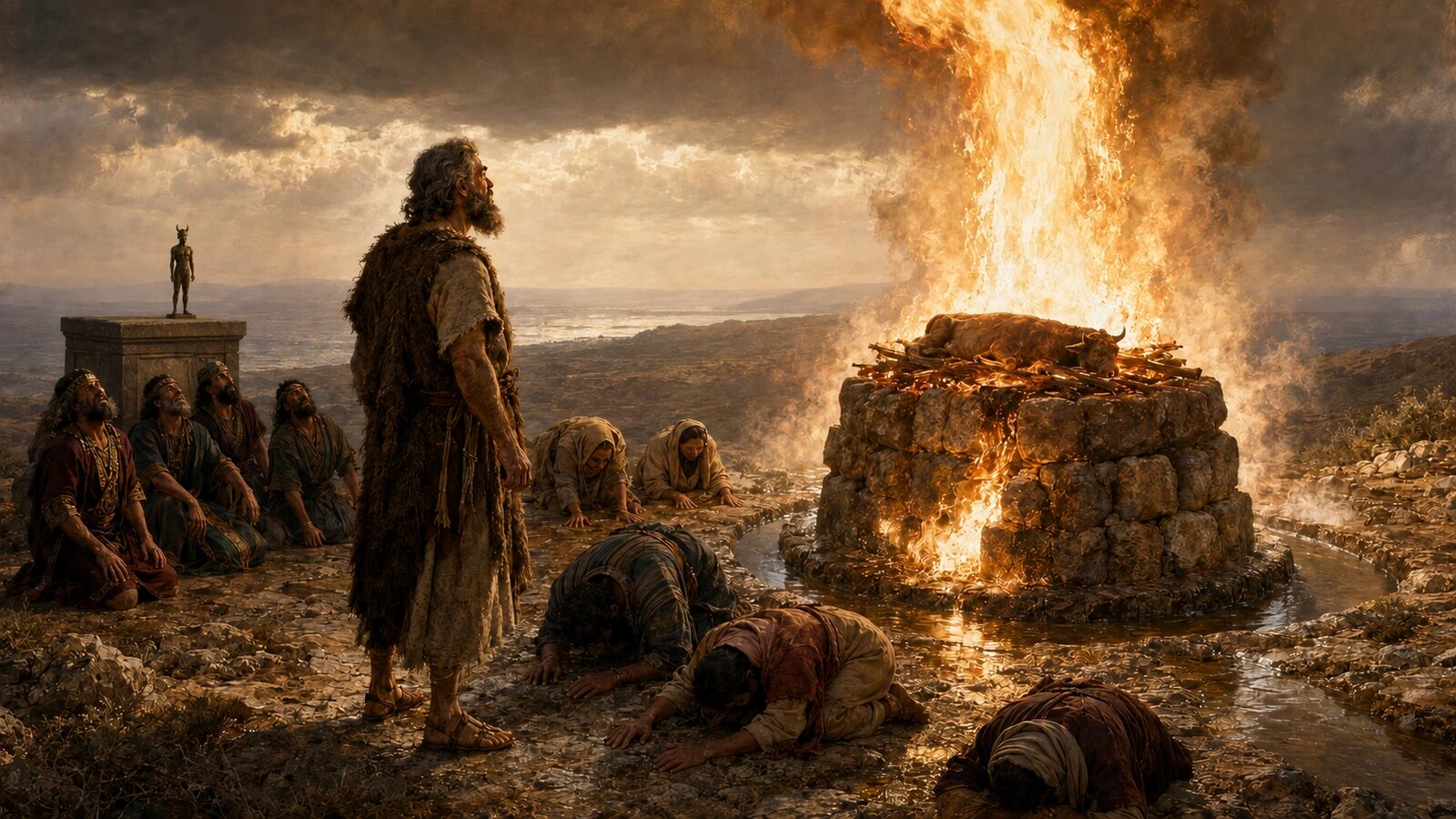
Baal’s prophets called on him from morning until noon and leaped around their altar. Still, there was no voice and no answer. Elijah mocked them because the supposed god could not respond.
And so it was, at noon, that Elijah mocked them and said, “Cry aloud, for he is a god; either he is meditating, or he is busy, or he is on a journey, or perhaps he is sleeping and must be awakened.”
Elijah’s mockery was prophetic exposure, not childish cruelty. A god who must be awakened or excused is no god at all. When Elijah’s turn came, he prayed briefly and centered his request on God’s honor. He asked the LORD God of Abraham, Isaac, and Israel to show that He was God in Israel, that Elijah was His servant, and that He was turning the people’s hearts back again.
The LORD answered by fire. It consumed the sacrifice and the wood, then the stones, dust, and water. The people fell on their faces and confessed, “The LORD, He is God! The LORD, He is God!” Baal’s silence and the LORD’s answer made the conclusion unmistakable. James 5:17-18 later reminds us that Elijah had a nature like ours and prayed earnestly. The power at Carmel belonged to God, not to the force of Elijah’s personality.
Destroying One Idol Is Not the Same as Wholehearted Faith
2 Kings 10 records another dramatic confrontation. Jehu gathered Baal’s worshipers and prophets and killed them. He then broke down the sacred pillar and tore down the temple. The place became a refuse dump, and the text says that Jehu destroyed Baal from Israel.
Yet the chapter does not let us turn Jehu into an example of complete faithfulness. He did not turn away from the sins of Jeroboam, nor did he take care to walk in the law of the LORD God of Israel with all his heart. Jehu opposed one form of idolatry while preserving another. His zeal against Baal did not make his own heart whole.
That warns us about selective repentance. We can denounce an obvious darkness while protecting a compromise that feels familiar or useful. The LORD is not asking us to trade one idol for another that looks more respectable. He calls for undivided loyalty.
We see a different kind of faithfulness in the remnant God preserved. When Elijah later felt completely alone, God told him that seven thousand in Israel had not bowed the knee to Baal. Paul quotes that account in Romans 11 to explain the remnant according to the election of grace.
Paul’s point is not that these people saved themselves through superior strength. God’s answer was, “I have reserved for Myself seven thousand men.” Their refusal to bow was real obedience, but God’s grace stood behind their endurance. I find that deeply encouraging when false worship is louder than faithfulness and even receives official approval. The LORD knows those who are His, and He is able to preserve a people who will not bow.
The Prophets Exposed the Horror of Covenant Betrayal
Will you steal, murder, commit adultery, swear falsely, burn incense to Baal, and walk after other gods whom you do not know, and then come and stand before Me in this house which is called by My name, and say, “We are delivered to do all these abominations”?
Jeremiah rebuked people who combined moral rebellion and Baal worship with confidence in the temple. They sinned and burned incense to Baal, then stood in the LORD’s house as though the building guaranteed their safety. That mixture was not faith. It was hypocrisy that used religious confidence to cover disobedience.
Jeremiah also named the horror of child sacrifice connected with the high places of Baal:
They have also built the high places of Baal, to burn their sons with fire for burnt offerings to Baal, which I did not command or speak, nor did it come into My mind.
The LORD completely separated Himself from this evil. He had not commanded it or spoken it. False worship can train people to call cruelty sacred, but Scripture will not let us soften what happened.
Hosea adds another painful layer. Israel received grain, new wine, oil, silver, and gold from the LORD, then prepared those gifts for Baal. Israel was not merely asking an idol to provide. The people were taking what God had already given and using it in service to a false master.
I find Hosea’s warning especially searching. Our breath and abilities come from the Giver, and our work depends on what He has provided. The relationships and opportunities entrusted to us are His gifts too. When we use any of them to support rebellion against Him, we repeat the logic of idolatry. The gift has not become evil, but we have directed it away from the One to whom it belongs.
An Idol Is Nothing, but False Worship Is Not Harmless
Paul helps us hold two truths together. In 1 Corinthians 8, he says that an idol is nothing in the world and that there is no other God but one. Baal was not a real god competing with the LORD. An image has no divine life or authority, and it has no power to save.
Yet Paul refuses to treat pagan worship as a harmless ceremony:
Rather, that the things which the Gentiles sacrifice they sacrifice to demons and not to God, and I do not want you to have fellowship with demons.
False worship is spiritually serious even though the idol itself is nothing. Demons receive and exploit worship directed toward false gods. This keeps us from two opposite errors. We should not fear Baal as though he were a rival deity, but neither should we treat idolatry, occult practice, or spiritual blending as neutral. Believers cannot drink the cup of the Lord and the cup of demons.
It is also wrong to say that Baal was merely another name for the LORD. The fact that baal could be a common title does not make the objects of worship interchangeable. Judges says that serving the Baals meant forsaking the LORD. Kings, Jeremiah, and Hosea draw the same clear line. The drought and Carmel also showed that Baal did not control rain or fertility. He could not send rain, answer prayer, or protect those who served him.
Scripture’s conclusion is firm: Baal was no god. He could not give life, answer by fire, cleanse sin, or save his worshipers. Israel took gifts from the LORD and gave its trust and worship to a false master. The prophets rebuked both the pagan rituals and the hypocrisy of trying to remain in the LORD’s house while serving other gods.
This contrast finally brings us to Jesus Christ. He is the eternal Son, fully God and fully man, the only Savior and Mediator. Wicked men physically tortured, punished, and killed Him, and He willingly bore that real punishment for our sins in His innocent body. He shed His blood, died, was buried, and rose bodily. Baal cannot save, but Christ saves all who repent and believe.
Readers who want to trace these themes further can continue with A Complete Bible Study on Idolatry, The Life of Elijah, and A Complete Bible Study on Demons.
My Final Thoughts
After following Baal worship through Scripture, I do not see a forgotten god that Christians need to fear; I see a lie that keeps taking new forms. Another master promises life on easier terms, while the LORD calls us to trust Him and obey Him with a whole heart. Elijah’s question still presses for an answer: if the LORD is God, follow Him. We should not offer Him the leftovers of a divided life, because the God who gives every good gift has also given His Son to save us.