
God gave His promise not to forsake His people when they faced danger, loss, and responsibilities beyond their own strength. They needed His help, and His assurance did not spare them every hardship. That promise does not ask a suffering person to pretend the pain is small or assure him of an outcome God has never guaranteed.
God’s Promise Speaks in Hard Places
Jacob heard God’s assurance while leaving home after his deception had provoked Esau’s anger. Israel and Joshua heard it before entering a land occupied by formidable enemies. Hebrews later addressed believers who knew public reproach, imprisonment, and the loss of possessions. A peaceful landscape printed beside a verse about God’s presence can easily leave us unprepared for the circumstances in which His people first heard it.
We also need to distinguish God’s faithfulness from approval of everything His people do. He can expose dishonesty, oppose a sinful plan, and allow painful consequences while remaining faithful. Likewise, His preservation of Israel did not mean every Israelite was saved, and His promise concerning their land does not transfer that land to the church. Christians receive direct New Testament assurance through Christ and the permanent indwelling of His Spirit.
At Bethel, God assured Jacob that He would remain with him as He fulfilled His promises about descendants, land, and blessing for the families of the earth. Jacob had dreamed of a ladder reaching heaven.
And behold, the LORD stood above it and said: "I am the LORD God of Abraham your father and the God of Isaac; the land on which you lie I will give to you and your descendants. Also your descendants shall be as the dust of the earth; you shall spread abroad to the west and the east, to the north and the south; and in you and in your seed all the families of the earth shall be blessed. Behold, I am with you and will keep you wherever you go, and will bring you back to this land; for I will not leave you until I have done what I have spoken to you."
Jacob had obtained Isaac’s blessing through deception and left because Esau intended to kill him. At Bethel, the LORD reaffirmed His promises to Abraham and Isaac. Jacob would have descendants and a land, and blessing would reach the families of the earth through him and his seed. God also promised to keep him on his journey and bring him back.
God made that promise to fulfill His covenant purpose. He was not approving Jacob’s deception or declaring him spiritually mature. Years of difficult dealings in Laban’s household still lay ahead. Through them, Jacob would learn how dependent he was on the God who had spoken to him. God’s grace preserved him while his wrongdoing still needed correction.
God eventually brought Jacob home, keeping His promise through Jacob’s failures and the hardships of those years. That does not guarantee a comfortable outcome for every move I make. It does show that God kept the man He had promised to preserve while correcting the way he lived.
God Preserved Israel Without Erasing Judgment
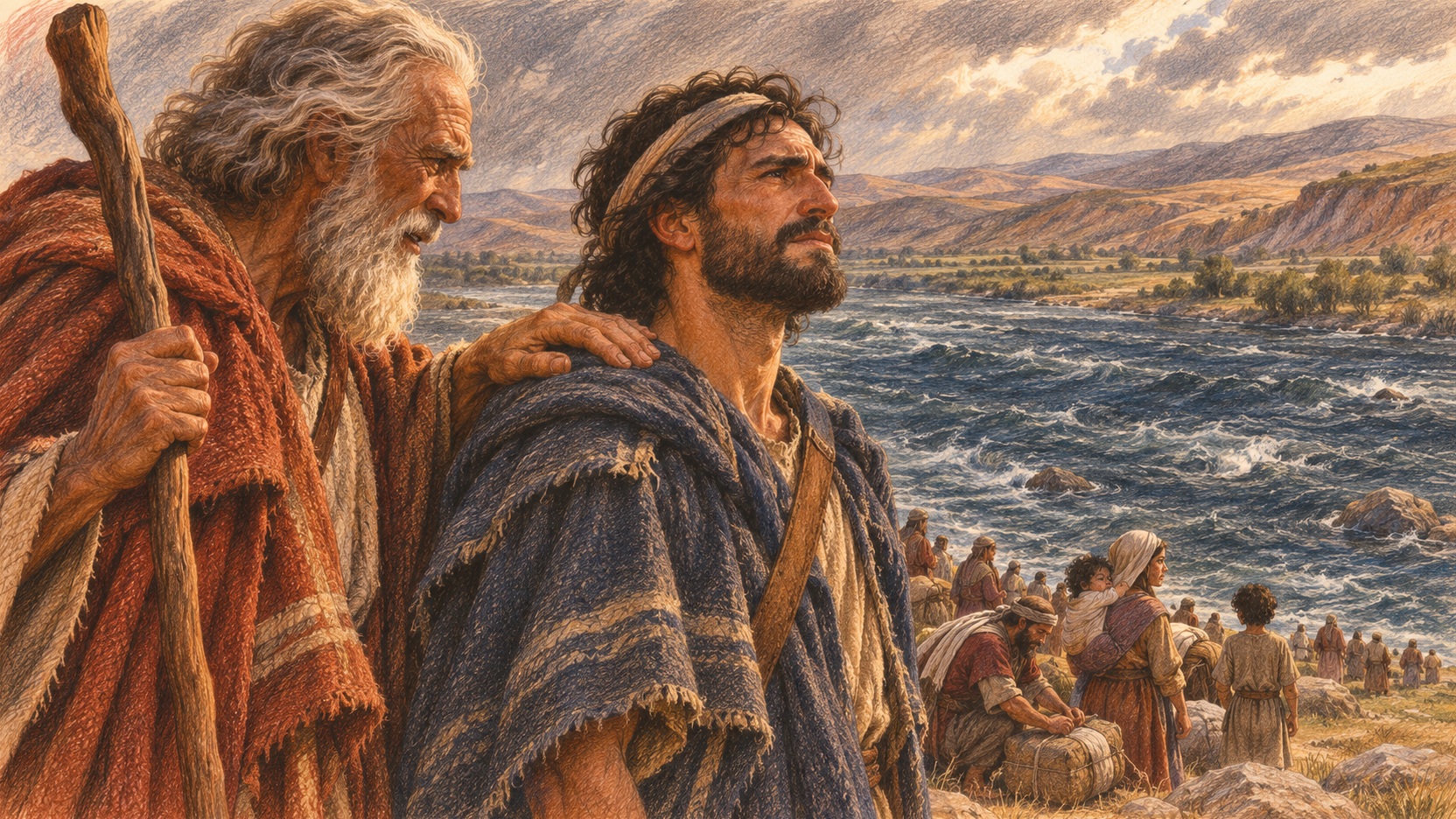
When Jacob’s descendants approached Canaan, they too needed assurance of God’s presence for the work He had given them. Moses would not lead them across the Jordan (Deuteronomy 31:1-5). They had to follow Joshua into a land occupied by stronger nations and obey the LORD there.
"Be strong and of good courage, do not fear nor be afraid of them; for the LORD your God, He is the One who goes with you. He will not leave you nor forsake you." Then Moses called Joshua and said to him in the sight of all Israel, "Be strong and of good courage, for you must go with this people to the land which the LORD has sworn to their fathers to give them, and you shall cause them to inherit it. And the LORD, He is the One who goes before you. He will be with you, He will not leave you nor forsake you; do not fear nor be dismayed."
Moses assured the people, “He will not leave you nor forsake you.” Verse 6 addresses Israel; verse 8 gives Joshua the same assurance personally. They still had to cross the river, face their enemies, and obey God’s commands. Trusting Him did not mean remaining inactive or assuming He would support anything they chose.
The Hebrew verb azab, translated “forsake,” can mean leaving or abandoning. In other settings it can describe letting something go or releasing it, so context determines the meaning. Here, the paired promises about not leaving and not forsaking assure Israel of God’s continuing help and faithful leadership. He would not desert the people He was sending forward.
After Moses died, God repeated that assurance to Joshua and placed obedience to the written Law at the center of his commission.
No man shall be able to stand before you all the days of your life; as I was with Moses, so I will be with you. I will not leave you nor forsake you. Be strong and of good courage, for to this people you shall divide as an inheritance the land which I swore to their fathers to give them. Only be strong and very courageous, that you may observe to do according to all the law which Moses My servant commanded you; do not turn from it to the right hand or to the left, that you may prosper wherever you go. This Book of the Law shall not depart from your mouth, but you shall meditate in it day and night, that you may observe to do according to all that is written in it. For then you will make your way prosperous, and then you will have good success.
Joshua was to speak God’s Word, meditate on it day and night, and act according to it. God called him to be courageous in leading Israel into the land He had sworn to their fathers. That assignment defined the promised success. Joshua could not claim God’s backing for a campaign God had never commanded.
For the same reason, I cannot claim Canaan’s conquest as a guarantee of career promotion, political domination, or ownership of whatever I dare to demand. We can learn courage from God’s faithfulness to Israel while receiving our own duties from what He has commanded us.
Israel’s covenant contained real warnings. Deuteronomy 31:17 also warns that God would forsake the people and hide His face in judgment when they turned to other gods. We must not make the earlier assurance erase that warning. Leviticus explains how severe judgment could fall without God’s utterly destroying the nation or breaking His covenant.
Yet for all that, when they are in the land of their enemies, I will not cast them away, nor shall I abhor them, to utterly destroy them and break My covenant with them; for I am the LORD their God. But for their sake I will remember the covenant of their ancestors, whom I brought out of the land of Egypt in the sight of the nations, that I might be their God: I am the LORD.
Rebellion would leave Israel’s land desolate and its people in exile among their enemies. God would oppose their disobedience, and they would have to acknowledge their guilt. Yet He would remember His covenant with Jacob, Isaac, and Abraham, including the land (Leviticus 26:40-43). He would not utterly destroy Israel or cancel what He had promised.
I do not see room here for replacement theology, the claim that the church has taken Israel’s place in a way that cancels her national promises. God named the people and the land, and their preservation and future in His prophetic purpose rest on His faithfulness. We do not have to deny Israel’s sins to affirm that promise. Every individual still needs repentance and faith; preserving a nation does not mean saving every member of it.
Samuel later gave Israel assurance and warning together after the people demanded a king.
"For the LORD will not forsake His people, for His great name's sake, because it has pleased the LORD to make you His people. Moreover, as for me, far be it from me that I should sin against the LORD in ceasing to pray for you; but I will teach you the good and the right way. Only fear the LORD, and serve Him in truth with all your heart; for consider what great things He has done for you. But if you still do wickedly, you shall be swept away, both you and your king."
Samuel acknowledged the wickedness in the way they had demanded a king. He told them to keep following the LORD wholeheartedly instead of turning to empty things that could neither profit nor deliver them (1 Samuel 12:20-21). God would not forsake His people for His great name’s sake. He had chosen to make them His people, and His faithfulness gave them reason to return to Him.
Samuel warned in the same address that persistent wickedness would sweep away both people and king. He also committed himself to praying for them and teaching them the right way. His commitment to serve them belonged alongside the warning, and the people remained responsible to obey.
After the exile, the prayer recorded in Nehemiah looked back on God’s patience with their ancestors in the wilderness.
Yet in Your manifold mercies You did not forsake them in the wilderness. The pillar of the cloud did not depart from them by day, To lead them on the road; Nor the pillar of fire by night, To show them light, And the way they should go. You also gave Your good Spirit to instruct them, And did not withhold Your manna from their mouth, And gave them water for their thirst. Forty years You sustained them in the wilderness; They lacked nothing; Their clothes did not wear out And their feet did not swell.
Their ancestors had refused to obey, hardened their hearts, and appointed a leader to return to bondage. Even after they made the calf (Nehemiah 9:16-18), God continued to guide them by cloud and fire. His good Spirit instructed them, and He supplied manna and water. Through those forty years, their clothing did not wear out and their feet did not swell.
Many rebels nevertheless died in the wilderness, and the unbelieving generation did not enter the land. “You did not forsake them” must be read with that judgment in view. God sustained His covenant people without excusing unbelief or sparing every individual its consequences. Psalm 37 brings His sustaining care into view in the life of a righteous person.
I have been young, and now am old; Yet I have not seen the righteous forsaken, Nor his descendants begging bread. He is ever merciful, and lends; And his descendants are blessed. Depart from evil, and do good; And dwell forevermore. For the LORD loves justice, And does not forsake His saints; They are preserved forever, But the descendants of the wicked shall be cut off.
David describes the LORD upholding a good person who falls (Psalm 37:23-24) and preserving His saints. He speaks from years of observing God’s care, contrasting the lasting future of the righteous with the destruction of the wicked (Psalm 37:28-29). The person who falls has not slipped beyond God’s sustaining hand.
I would misuse the psalm if I promised that a believer could never become poor, lose his position, stumble, or die. Its confidence reaches to God’s preservation and the inheritance He gives His people. The wicked cannot secure a permanent future by violence, even when their present prosperity looks impressive.
In Isaiah 49, Zion, representing Jerusalem and her people, complains of being forgotten by God.
But Zion said, "The LORD has forsaken me, And my Lord has forgotten me." "Can a woman forget her nursing child, And not have compassion on the son of her womb? Surely they may forget, Yet I will not forget you. See, I have inscribed you on the palms of My hands; Your walls are continually before Me."
Zion said, “The LORD has forsaken me, and my Lord has forgotten me.” Devastation and displacement made that complaint understandable. God answered by asking whether a mother could forget her nursing child. Even if she did, He would not forget Zion. The picture of her inscribed on His palms expresses His continuing remembrance, and His promise to gather her children gives hope for the city left in ruins (Isaiah 49:17-18).
This is first a promise to Zion. I should not make it merely a statement that an individual Christian is literally marked on God’s hands while Israel disappears from the explanation. God assured His people that He remembered their city and would gather her children. Christians learn His faithfulness here and also receive direct promises in the New Testament.
Zion truly felt forgotten, but God answered her fear by assuring her that He remembered her. That gives me a way to pray when pain leads me to doubt His care. I can bring my anguish to Him and let His Word correct the conclusion I have drawn from it.
The New Testament Applies the Promise to Believers
In Hebrews 13, Paul applies God’s continuing presence to Christian contentment and faithful living.
Let your conduct be without covetousness; be content with such things as you have. For He Himself has said, "I will never leave you nor forsake you." So we may boldly say: "The LORD is my helper; I will not fear. What can man do to me?"
Paul places the promise among instructions for ordinary Christian life: loving one another, welcoming strangers, remembering prisoners, caring for the mistreated, and honoring marriage (Hebrews 13:1-4). When he addresses money, God’s presence gives believers reason to reject covetousness and be content with what they have.
The Greek negatives in Hebrews 13:5 make God’s assurance emphatic. He promises His people that He will remain with them, giving them reason to confess that the Lord is their helper even when other people threaten them.
We still need money for rent, food, and necessary care. Contentment means I do not have to make possessions my final source of security. The readers of Hebrews had suffered reproach and affliction, including imprisonment and the loss of goods. God’s promise did not reverse every loss, but it assured them that no loss could take their Helper away.
Hebrews applies the language of the Old Testament promises directly to Christians. We have an inspired basis for receiving that assurance without claiming Israel’s territory or replacing her in God’s purposes. The same faithful God keeps His people through the Son and Spirit while remaining true to His promises concerning Israel.
The risen Jesus also promised His presence to the disciples He sent to the nations.
And Jesus came and spoke to them, saying, "All authority has been given to Me in heaven and on earth. Go therefore and make disciples of all the nations, baptizing them in the name of the Father and of the Son and of the Holy Spirit, teaching them to observe all things that I have commanded you; and lo, I am with you always, even to the end of the age." Amen.
The risen Jesus commanded the apostles to make disciples of all nations on the basis of His authority in heaven and on earth. They were to baptize in the name of the Father, Son, and Holy Spirit and teach people to observe everything He commanded. “I am with you always” belongs with that mission.
Christ’s promised presence sustains the church as it carries His gospel. We cannot invent another message to suit changing tastes and assume His commission covers it. Nor can I turn a private ambition into His assignment by claiming His presence. He tells us what to proclaim, whom to baptize, and what obedience to teach. That work continues under His care to the end of the age.
Christ’s promised presence is not confined to a sacred building. Before the cross, He had already assured His apostles that they would not be left as orphans.
"If you love Me, keep My commandments. And I will pray the Father, and He will give you another Helper, that He may abide with you forever– the Spirit of truth, whom the world cannot receive, because it neither sees Him nor knows Him; but you know Him, for He dwells with you and will be in you. I will not leave you orphans; I will come to you.
On the night before the cross, Jesus prepared the apostles for His departure by promising another Helper who would abide forever. The Spirit of truth is a divine Person, rather than an atmosphere or an emotional sensation. Jesus also promised, “I will not leave you orphans; I will come to you.”
Jesus spoke to apostles who were about to lose His visible presence. Later New Testament teaching makes clear that every person who belongs to Christ has the Spirit. No true believer is left spiritually orphaned or required to earn His indwelling. The study on The Person of the Holy Spirit examines His work more fully.
In Him you also trusted, after you heard the word of truth, the gospel of your salvation; in whom also, having believed, you were sealed with the Holy Spirit of promise, who is the guarantee of our inheritance until the redemption of the purchased possession, to the praise of His glory.
Having heard the gospel and believed in Christ, believers are sealed by the Holy Spirit, who guarantees their inheritance until the redemption of God’s purchased possession. His seal does not depend on maintaining a feeling of closeness to God.
Ephesians 4:30 later warns believers not to grieve the very Spirit who has sealed them for the day of redemption. Sin damages fellowship and requires repentance, but it does not undo the new birth or cancel God’s pledge. His permanent presence makes our conduct a personal concern: we can grieve the One who dwells within us. Truthfulness, honest work, sexual purity, kindness, and forgiveness belong in the life He has given us; lawlessness does not.
God Is Present Through Suffering and Discipline
Paul’s own suffering shows what it means to be kept by God while enduring weakness and danger. He knew God’s faithfulness through blows that his faith did not spare him.
But we have this treasure in earthen vessels, that the excellence of the power may be of God and not of us. We are hard-pressed on every side, yet not crushed; we are perplexed, but not in despair; persecuted, but not forsaken; struck down, but not destroyed– always carrying about in the body the dying of the Lord Jesus, that the life of Jesus also may be manifested in our body.
Paul was hard-pressed, perplexed, persecuted, and struck down, yet he could acknowledge all of that and say he was not forsaken. He carried the gospel’s treasure in an earthen vessel, his fragile human life. His weakness made it clear that the power sustaining his ministry came from God.
His confidence rested in resurrection (2 Corinthians 4:14-18). The God who raised Jesus would raise His people too. Paul’s body was wearing out while the inward person was renewed, and present affliction could not outweigh the glory ahead. We do not have to pretend grief is imaginary or the body unimportant to share his hope. Death cannot cancel the future God has promised.
Who shall separate us from the love of Christ? Shall tribulation, or distress, or persecution, or famine, or nakedness, or peril, or sword? As it is written: "For Your sake we are killed all day long; We are accounted as sheep for the slaughter." Yet in all these things we are more than conquerors through Him who loved us. For I am persuaded that neither death nor life, nor angels nor principalities nor powers, nor things present nor things to come, nor height nor depth, nor any other created thing, shall be able to separate us from the love of God which is in Christ Jesus our Lord.
Romans 8 names tribulation, distress, persecution, famine, nakedness, peril, and the sword. Paul includes a passage about people killed for God’s sake, then says that none of these things separates believers from Christ’s love. Being more than conquerors cannot mean that faithful people always escape suffering. It means their suffering cannot sever the saving relationship Christ established.
Paul extends that assurance beyond immediate suffering to death and life, angels, principalities, powers, present and future things, height, depth, and every other created thing. None can separate believers from God’s love in Christ. God justifies His people, and Christ, who died and rose, intercedes for them (Romans 8:33-34). No accusation can overturn His saving work.
This assurance belongs to those in Christ. It does not declare everyone secure regardless of faith. Christ died for the whole world and genuinely calls every person, yet people can resist Him. Those who receive Him are justified, indwelt by the Spirit, and kept. It is reckless to treat a faithful believer’s hardship as proof of deficient faith when Scripture describes God’s people suffering and even being killed.
Suffering does not prove abandonment, and neither does God’s correction of His children. Hebrews 12 explains why even painful discipline can express His fatherly care (Hebrews 12:3-6).
If you endure chastening, God deals with you as with sons; for what son is there whom a father does not chasten? But if you are without chastening, of which all have become partakers, then you are illegitimate and not sons. Furthermore, we have had human fathers who corrected us, and we paid them respect. Shall we not much more readily be in subjection to the Father of spirits and live? For they indeed for a few days chastened us as seemed best to them, but He for our profit, that we may be partakers of His holiness. Now no chastening seems to be joyful for the present, but painful; nevertheless, afterward it yields the peaceable fruit of righteousness to those who have been trained by it.
Paul addresses weary believers in Hebrews as children whose Father is training them to share His holiness. Correction hurts in the present, but those trained by it bear the peaceful fruit of righteousness. Its purpose gives them reason to receive it even while they feel its pain.
Fatherly discipline is different from final condemnation. When God corrects His child, He addresses someone who belongs to Him. Final condemnation is the judgment of those who remain outside Christ. A believer needs to receive correction and repent, rather than conclude that the Father has discarded him.
We must not diagnose every illness, accident, bereavement, or other hardship as punishment for a particular sin. Job’s friends reasoned that way and spoke falsely. Jesus also rejected explanations that made unusual personal guilt the cause of another person’s affliction. When Scripture exposes actual sin, however, we should confess it and obey.
Repentance may require restitution and accepting consequences. Church discipline may remove someone from a role, and damaged trust may take time to rebuild. Forgiveness does not guarantee immediate restoration of position, money, health, or opportunity. God may provide another path while an earlier loss remains real. Christ says in Revelation 3:19 that He rebukes and chastens those He loves and calls them to zeal and repentance. His holy love confronts what harms His people.
When God Feels Distant, Bring the Pain to Him
The Psalms bring sleeplessness, enemies, grief, and remembered joy into prayer. They ask how long suffering will continue and plead for help. This is lament, prayer spoken from pain. The person lamenting is still addressing the LORD, rather than having to hide anguish to appear faithful.
Jesus Himself prayed in anguish from the cross.
Now from the sixth hour until the ninth hour there was darkness over all the land. And about the ninth hour Jesus cried out with a loud voice, saying, "Eli, Eli, lama sabachthani?" that is, "My God, My God, why have You forsaken Me?"
Roman soldiers had scourged and mocked Jesus, exposed His body, and nailed Him to the cross. Religious rulers and passersby added ridicule. His pain was genuine, and His cry quoted the opening of Psalm 22.
Psalm 22 follows a righteous sufferer through anguish and public mockery. It describes pierced hands and feet and divided garments. Then the prayer receives an answer (Psalm 22:19-21), and the sufferer’s praise among the brethren leads toward worship reaching the nations and future generations. I hear Jesus’ quotation within that prophetic account of the crucifixion, rather than isolating the opening lament from what follows.
I will declare Your name to My brethren; In the midst of the assembly I will praise You. You who fear the LORD, praise Him! All you descendants of Jacob, glorify Him, And fear Him, all you offspring of Israel! For He has not despised nor abhorred the affliction of the afflicted; Nor has He hidden His face from Him; But when He cried to Him, He heard.
Psalm 22 says God did not despise the afflicted One or hide His face from Him. God heard the afflicted One’s cry. I cannot use the opening question to contradict that explicit answer. Jesus had also told His disciples that they would scatter and leave Him, adding, “And yet I am not alone, because the Father is with Me.” His final prayer entrusted His spirit into the Father’s hands.
The Father, Son, and Holy Spirit remained one God in three coequal, coeternal Persons. Their unity did not break at Calvary. Wicked men inflicted bodily torture and crucified Jesus, but He freely gave Himself to be slain for our sins. His sinless perfection made Him the perfect sacrifice, and He completed that offering through His shed blood and death. The Father did not punish, curse, abandon, strike, bruise, or pour wrath on Jesus.
Jesus remained the sinless, beloved Son. He did not suffer the second death, enter the Lake of Fire, or undergo an eternity of torment compressed into hours. He completed His saving offering on the cross, went to Paradise, and rose bodily on the third day. The study on Psalm 22: A Prophetic Cry of the Messiah examines the passage more fully.
His cry was genuine lament and messianic fulfillment. We can acknowledge the full severity of His suffering while receiving the psalm’s assurance that God heard Him. We too can bring our pain to God and trust what He has said about His faithfulness.
A sense of distance can accompany grief, unanswered prayer, depression, exhaustion, trauma, or physical illness. Sometimes known sin is involved and needs confession. The feeling deserves attention, but it cannot give an infallible verdict on God’s faithfulness. We need His Word and patient help to understand what we are experiencing.
Other believers can help with a meal, transportation, caring for children, finances, or a difficult decision. They can listen patiently as someone grieves and pray when he can hardly find words. Qualified medical or mental-health care may also be needed. Telling someone “God will not forsake you” should go with a willingness to offer the care we can actually provide.
Keep bringing your needs to God even when prayer feels dry. Read a manageable passage and participate in a faithful local church as you are able. Attend to rest and food, and accept appropriate help without shame. None of these activities purchases God’s presence. They are ways of living honestly before Him while receiving care.
The Gospel Gives a Secure Relationship With God
For I delivered to you first of all that which I also received: that Christ died for our sins according to the Scriptures, and that He was buried, and that He rose again the third day according to the Scriptures,
Our saving relationship with God comes through Jesus Christ, the eternal Son, fully God and fully man, born of a virgin and completely without sin. He willingly shed His blood and died for our sins, completing His saving sacrifice before His burial and bodily resurrection. Our confidence rests on what He accomplished even when we struggle to feel safe.
Christ died for the whole world. God’s offer of salvation is genuine for every person, though people can resist His grace and reject Him. Whoever repents and believes in Jesus is forgiven and justified, meaning declared righteous before God. He is born again as a new creation, indwelt and sealed by the Holy Spirit. Everyone who truly receives this life is eternally secure.
A person can attend church, use Christian language, or remember a religious experience without having trusted Christ. A profession of faith alone does not prove new birth. The Savior who keeps His people also corrects them and makes them holy, so genuine new life should be evident in conduct. Good works neither earn nor keep salvation, and security in Christ never excuses lawlessness. The study on The Blood of Christ for Salvation explains why our acceptance rests in His work.
My sheep hear My voice, and I know them, and they follow Me. And I give them eternal life, and they shall never perish; neither shall anyone snatch them out of My hand. My Father, who has given them to Me, is greater than all; and no one is able to snatch them out of My Father's hand. I and My Father are one."
Jesus knows His sheep and gives them eternal life. He keeps them in His hand, and the Father keeps them too. No created enemy can overpower the Father and Son or snatch a true believer from their possession. His sheep may stumble, but He promises them life that will not end and keeps them through the threats they face.
Begin by reading promises in context. Ask whom God addressed, what He promised, and how later Scripture applies His words. Then obey what He has made clear. Joshua’s courage was governed by God’s commands, and I cannot claim His presence as permission to contradict them.
Pray with complete honesty before God. Tell Him when He feels far away and continue listening to His written Word. Anguish and faith can belong in the same prayer. Changing feelings do not undo the Spirit’s seal or loosen the Father’s hand.
Receive practical help without carrying shame. Let the church serve through prayer, counsel, companionship, and ordinary assistance. Appropriate medical or mental-health care can accompany that help. Trusting God does not require facing every need alone.
When God disciplines you, respond with repentance. Confess what is wrong, make restitution where possible, and accept the consequences of what you have actually done. Conviction calls you back to the Father who corrects His children. You do not have to receive His correction as proof that He has rejected you.
My Final Thoughts
When pain makes God’s presence difficult to perceive, His promises give me a firmer basis for trust than my changing feelings. He preserves Israel according to His covenant, and the risen Christ remains with His church. Every true believer is indwelt and sealed by the Spirit. Those assurances leave room for honest grief, painful discipline, and correction of plans God has never approved. Jesus’ own anguished cry leads us to Psalm 22’s assurance that God heard Him and did not hide His face. Everyone who comes to Christ in faith can trust His keeping: suffering, death, and every created power will fail to separate His people from His love.