
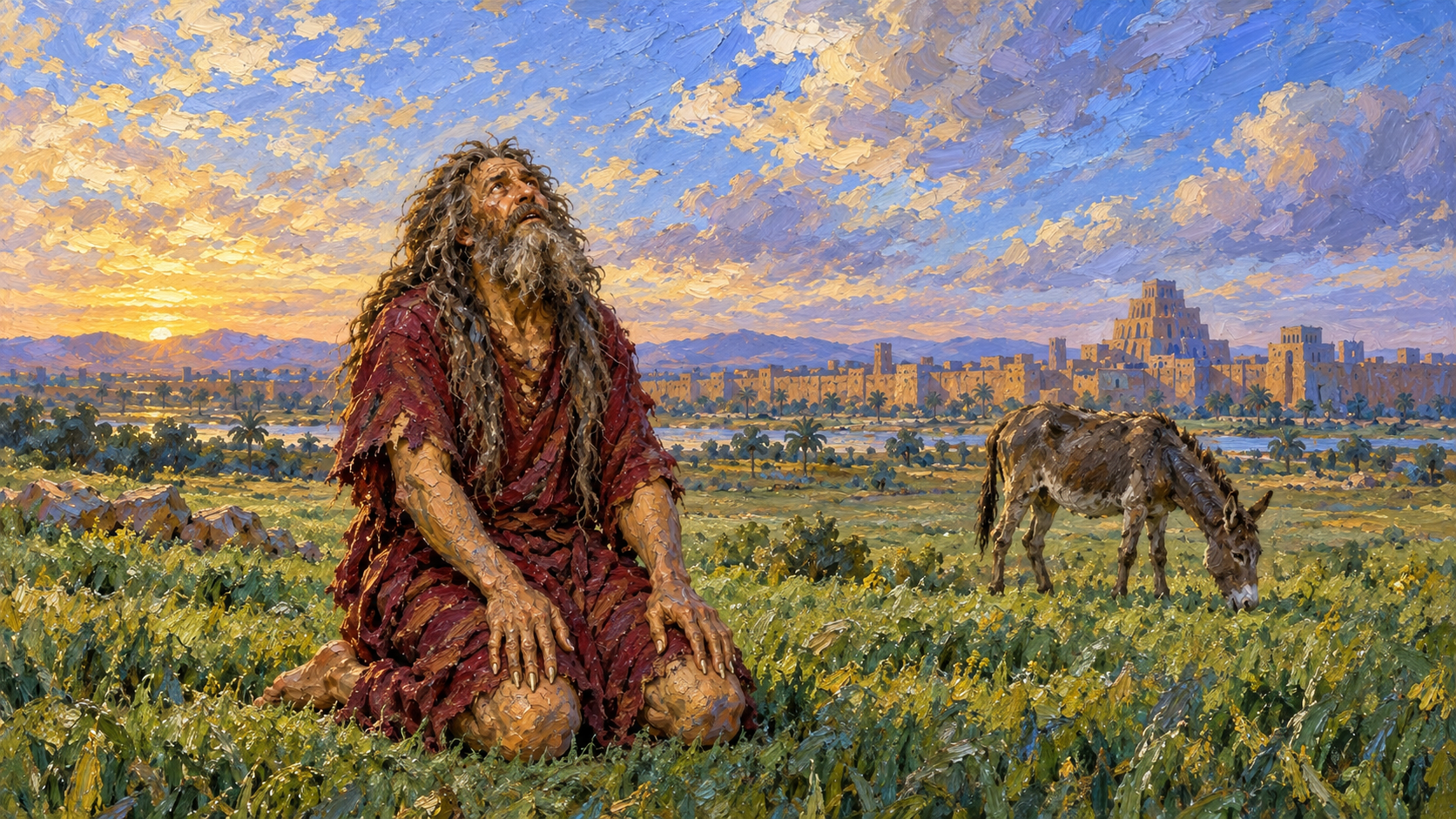
Nebuchadnezzar conquered Jerusalem, carried its people into exile, and made Babylon an imposing imperial capital. Yet the man who could remove kings could not preserve his own reason when God humbled him. As I follow his dealings with Judah and the exiles in Daniel, I want to keep both his responsibility and his dependence on God in view. His victories did not make his cruelty righteous, and his authority never entitled him to the worship he demanded.
A Great King Still Lived Under Heaven
Nebuchadnezzar II succeeded his father Nabopolassar, founder of the Neo-Babylonian dynasty. Neo-Babylonian distinguishes this later empire centered in Babylon from earlier Babylonian kingdoms. He took the throne in 605 BC, while his first full official regnal year began in 604 BC; this explains why accounts of his reign sometimes begin with either date. Ancient rulers did not all count the first partial year alike. His reign ended in 562 BC.
His Akkadian name is commonly rendered Nabu-kudurri-usur and invokes the Babylonian god Nabu. Jeremiah often uses the Hebrew form Nebuchadrezzar, while other passages use Nebuchadnezzar. Those spellings identify the same king. When Daniel called him a king of kings, he recognized an emperor ruling over other kings, not a divine being.
The Babylonian Chronicle records his accession and his capture of Jerusalem in 597 BC, when he removed its king and appointed a replacement. His own building inscriptions also survive. A cylinder in the Metropolitan Museum of Art, for example, commemorates Babylon’s outer wall. These records establish important parts of the setting; they do not document every event in Daniel. The Hanging Gardens are less certain. Their builder and location remain disputed, and Scripture does not mention them, so I would not credit them to Nebuchadnezzar as settled history. In Judah, King Jehoiakim became one of the rulers obliged to serve Babylon:
In his days Nebuchadnezzar king of Babylon came up, and Jehoiakim became his vassal for three years. Then he turned and rebelled against him. And the LORD sent against him raiding bands of Chaldeans, bands of Syrians, bands of Moabites, and bands of the people of Ammon; He sent them against Judah to destroy it, according to the word of the LORD which He had spoken by His servants the prophets. Surely at the commandment of the LORD this came upon Judah, to remove them from His sight because of the sins of Manasseh, according to all that he had done, and also because of the innocent blood that he had shed; for he had filled Jerusalem with innocent blood, which the LORD would not pardon. Now the rest of the acts of Jehoiakim, and all that he did, are they not written in the book of the chronicles of the kings of Judah? So Jehoiakim rested with his fathers. Then Jehoiachin his son reigned in his place. And the king of Egypt did not come out of his land anymore, for the king of Babylon had taken all that belonged to the king of Egypt from the Brook of Egypt to the River Euphrates. Jehoiachin was eighteen years old when he became king, and he reigned in Jerusalem three months. His mother's name was Nehushta the daughter of Elnathan of Jerusalem. And he did evil in the sight of the LORD, according to all that his father had done. At that time the servants of Nebuchadnezzar king of Babylon came up against Jerusalem, and the city was besieged. And Nebuchadnezzar king of Babylon came against the city, as his servants were besieging it. Then Jehoiachin king of Judah, his mother, his servants, his princes, and his officers went out to the king of Babylon; and the king of Babylon, in the eighth year of his reign, took him prisoner. And he carried out from there all the treasures of the house of the LORD and the treasures of the king's house, and he cut in pieces all the articles of gold which Solomon king of Israel had made in the temple of the LORD, as the LORD had said. Also he carried into captivity all Jerusalem: all the captains and all the mighty men of valor, ten thousand captives, and all the craftsmen and smiths. None remained except the poorest people of the land. And he carried Jehoiachin captive to Babylon. The king's mother, the king's wives, his officers, and the mighty of the land he carried into captivity from Jerusalem to Babylon. All the valiant men, seven thousand, and craftsmen and smiths, one thousand, all who were strong and fit for war, these the king of Babylon brought captive to Babylon. Then the king of Babylon made Mattaniah, Jehoiachin's uncle, king in his place, and changed his name to Zedekiah. Zedekiah was twenty-one years old when he became king, and he reigned eleven years in Jerusalem. His mother's name was Hamutal the daughter of Jeremiah of Libnah. He also did evil in the sight of the LORD, according to all that Jehoiakim had done. For because of the anger of the LORD this happened in Jerusalem and Judah, that He finally cast them out from His presence. Then Zedekiah rebelled against the king of Babylon.
Judah lost its independence through a succession of invasions and rebellions. Jehoiakim served Babylon for three years before rebelling. During the 597 BC campaign, his son Jehoiachin surrendered, and Babylon carried away the royal household, military men, craftsmen, and temple treasures. Nebuchadnezzar appointed Jehoiachin’s uncle Mattaniah in his place and renamed him Zedekiah. Removing leaders and skilled workers weakened Judah while supplying Babylon with people it could put to use.
Deportation meant forcing people from their homeland and resettling them within the empire. Families could not simply choose to remain at home. But 2 Kings explains their defeat through more than Babylon’s military strength. Manasseh had filled Jerusalem with innocent blood, and Judah had persisted in the sins against which God’s prophets warned. The Lord gave His people over to judgment. Their defeat did not establish that Babylon’s gods had overcome Him. Zedekiah, the replacement king, also rebelled, and the next chapter describes the siege during his reign:
Now it came to pass in the ninth year of his reign, in the tenth month, on the tenth day of the month, that Nebuchadnezzar king of Babylon and all his army came against Jerusalem and encamped against it; and they built a siege wall against it all around. So the city was besieged until the eleventh year of King Zedekiah. By the ninth day of the fourth month the famine had become so severe in the city that there was no food for the people of the land. Then the city wall was broken through, and all the men of war fled at night by way of the gate between two walls, which was by the king's garden, even though the Chaldeans were still encamped all around against the city. And the king went by way of the plain. But the army of the Chaldeans pursued the king, and they overtook him in the plains of Jericho. All his army was scattered from him. So they took the king and brought him up to the king of Babylon at Riblah, and they pronounced judgment on him. Then they killed the sons of Zedekiah before his eyes, put out the eyes of Zedekiah, bound him with bronze fetters, and took him to Babylon. And in the fifth month, on the seventh day of the month (which was the nineteenth year of King Nebuchadnezzar king of Babylon), Nebuzaradan the captain of the guard, a servant of the king of Babylon, came to Jerusalem. He burned the house of the LORD and the king's house; all the houses of Jerusalem, that is, all the houses of the great, he burned with fire. And all the army of the Chaldeans who were with the captain of the guard broke down the walls of Jerusalem all around. Then Nebuzaradan the captain of the guard carried away captive the rest of the people who remained in the city and the defectors who had deserted to the king of Babylon, with the rest of the multitude. But the captain of the guard left some of the poor of the land as vinedressers and farmers. The bronze pillars that were in the house of the LORD, and the carts and the bronze Sea that were in the house of the LORD, the Chaldeans broke in pieces, and carried their bronze to Babylon. They also took away the pots, the shovels, the trimmers, the spoons, and all the bronze utensils with which the priests ministered. The firepans and the basins, the things of solid gold and solid silver, the captain of the guard took away. The two pillars, one Sea, and the carts, which Solomon had made for the house of the LORD, the bronze of all these articles was beyond measure. The height of one pillar was eighteen cubits, and the capital on it was of bronze. The height of the capital was three cubits, and the network and pomegranates all around the capital were all of bronze. The second pillar was the same, with a network. And the captain of the guard took Seraiah the chief priest, Zephaniah the second priest, and the three doorkeepers. He also took out of the city an officer who had charge of the men of war, five men of the king's close associates who were found in the city, the chief recruiting officer of the army, who mustered the people of the land, and sixty men of the people of the land who were found in the city. So Nebuzaradan, captain of the guard, took these and brought them to the king of Babylon at Riblah. Then the king of Babylon struck them and put them to death at Riblah in the land of Hamath. Thus Judah was carried away captive from its own land.
The Babylonian siege reduced Jerusalem to famine before its defenses broke. Zedekiah fled, was overtaken near Jericho, and was taken to Nebuchadnezzar at Riblah. The conquerors killed his sons before his eyes, then blinded him and carried him to Babylon. Nebuzaradan, the captain of the guard, burned the temple, palace, and major houses, demolished the walls, and removed more captives and sacred vessels. Some of the poor remained to cultivate the land. Jerusalem’s destruction is usually dated to 587 or 586 BC, depending on the chronology used.
I do not want those dates to conceal what the judgment involved. People starved during the siege, families lost their homes, and worship at the temple ceased when the sanctuary burned. Judah had violated its covenant with God, and His judgment was righteous. The devastation was nevertheless terrible. Jeremiah had spent years urging the people to turn back before it came:
The word that came to Jeremiah concerning all the people of Judah, in the fourth year of Jehoiakim the son of Josiah, king of Judah (which was the first year of Nebuchadnezzar king of Babylon), which Jeremiah the prophet spoke to all the people of Judah and to all the inhabitants of Jerusalem, saying: "From the thirteenth year of Josiah the son of Amon, king of Judah, even to this day, this is the twenty-third year in which the word of the LORD has come to me; and I have spoken to you, rising early and speaking, but you have not listened. And the LORD has sent to you all His servants the prophets, rising early and sending them, but you have not listened nor inclined your ear to hear. They said, 'Repent now everyone of his evil way and his evil doings, and dwell in the land that the LORD has given to you and your fathers forever and ever. Do not go after other gods to serve them and worship them, and do not provoke Me to anger with the works of your hands; and I will not harm you.' Yet you have not listened to Me," says the LORD, "that you might provoke Me to anger with the works of your hands to your own hurt. "Therefore thus says the LORD of hosts: 'Because you have not heard My words, behold, I will send and take all the families of the north,' says the LORD, 'and Nebuchadnezzar the king of Babylon, My servant, and will bring them against this land, against its inhabitants, and against these nations all around, and will utterly destroy them, and make them an astonishment, a hissing, and perpetual desolations. Moreover I will take from them the voice of mirth and the voice of gladness, the voice of the bridegroom and the voice of the bride, the sound of the millstones and the light of the lamp. And this whole land shall be a desolation and an astonishment, and these nations shall serve the king of Babylon seventy years. 'Then it will come to pass, when seventy years are completed, that I will punish the king of Babylon and that nation, the land of the Chaldeans, for their iniquity,' says the LORD; 'and I will make it a perpetual desolation. So I will bring on that land all My words which I have pronounced against it, all that is written in this book, which Jeremiah has prophesied concerning all the nations. (For many nations and great kings shall be served by them also; and I will repay them according to their deeds and according to the works of their own hands.)'"
God called Nebuchadnezzar His servant because He was using the king to carry out an announced judgment. The title did not declare this pagan ruler righteous or approve his motives. In the same passage God set a term of seventy years for Babylon’s domination and promised to punish that nation for its own iniquity. The empire could serve His purpose and still answer for the blood it shed.
Habakkuk struggled with precisely that problem. How could God use the Chaldeans, whose violence and arrogance were so conspicuous, to discipline Judah?
"Look among the nations and watch– Be utterly astounded! For I will work a work in your days Which you would not believe, though it were told you. For indeed I am raising up the Chaldeans, A bitter and hasty nation Which marches through the breadth of the earth, To possess dwelling places that are not theirs. They are terrible and dreadful; Their judgment and their dignity proceed from themselves. Their horses also are swifter than leopards, And more fierce than evening wolves. Their chargers charge ahead; Their cavalry comes from afar; They fly as the eagle that hastens to eat. "They all come for violence; Their faces are set like the east wind. They gather captives like sand. They scoff at kings, And princes are scorned by them. They deride every stronghold, For they heap up earthen mounds and seize it. Then his mind changes, and he transgresses; He commits offense, Ascribing this power to his god." Are You not from everlasting, O LORD my God, my Holy One? We shall not die. O LORD, You have appointed them for judgment; O Rock, You have marked them for correction. You are of purer eyes than to behold evil, And cannot look on wickedness. Why do You look on those who deal treacherously, And hold Your tongue when the wicked devours A person more righteous than he? Why do You make men like fish of the sea, Like creeping things that have no ruler over them? They take up all of them with a hook, They catch them in their net, And gather them in their dragnet. Therefore they rejoice and are glad. Therefore they sacrifice to their net, And burn incense to their dragnet; Because by them their share is sumptuous And their food plentiful. Shall they therefore empty their net, And continue to slay nations without pity?
The prophet described conquerors gathering people as fishermen gather a catch, then honoring the means by which they had become wealthy. Their success encouraged them to credit their own power or their god. Habakkuk asked how long they would be permitted to keep slaughtering nations without pity. He saw people being devoured by a more wicked power and asked why God was allowing it. God had appointed Babylon for judgment without turning its slaughter and plunder into righteous acts. The conquerors would also have to answer to Him.
For Judah and the neighboring kingdoms, however, resisting Babylon could not undo the judgment God had announced. Jeremiah used a yoke, the wooden harness placed on working animals, to explain the submission God now required:
In the beginning of the reign of Jehoiakim the son of Josiah, king of Judah, this word came to Jeremiah from the LORD, saying, "Thus says the LORD to me: 'Make for yourselves bonds and yokes, and put them on your neck, and send them to the king of Edom, the king of Moab, the king of the Ammonites, the king of Tyre, and the king of Sidon, by the hand of the messengers who come to Jerusalem to Zedekiah king of Judah. And command them to say to their masters, "Thus says the LORD of hosts, the God of Israel–thus you shall say to your masters: 'I have made the earth, the man and the beast that are on the ground, by My great power and by My outstretched arm, and have given it to whom it seemed proper to Me. And now I have given all these lands into the hand of Nebuchadnezzar the king of Babylon, My servant; and the beasts of the field I have also given him to serve him. So all nations shall serve him and his son and his son's son, until the time of his land comes; and then many nations and great kings shall make him serve them. And it shall be, that the nation and kingdom which will not serve Nebuchadnezzar the king of Babylon, and which will not put its neck under the yoke of the king of Babylon, that nation I will punish,' says the LORD, 'with the sword, the famine, and the pestilence, until I have consumed them by his hand. Therefore do not listen to your prophets, your diviners, your dreamers, your soothsayers, or your sorcerers, who speak to you, saying, "You shall not serve the king of Babylon." For they prophesy a lie to you, to remove you far from your land; and I will drive you out, and you will perish. But the nations that bring their necks under the yoke of the king of Babylon and serve him, I will let them remain in their own land,' says the LORD, 'and they shall till it and dwell in it.'"'"
Jeremiah was to send yokes to the kings of Edom, Moab, Ammon, Tyre, and Sidon through their envoys. The Creator had assigned their lands to Nebuchadnezzar for a time. Prophets who promised that these nations would escape his rule were offering false reassurance. At that particular point, submitting to Babylon meant accepting God’s declared discipline rather than trusting a flattering prediction. Yet the command to submit also set a limit: Babylon’s own time would come, and other nations would make it serve them.
There is a difficulty in the chapter’s heading: the quoted text names Jehoiakim in verse 1, while verse 3 and the later addresses name Zedekiah. Some Hebrew manuscripts and ancient versions read Zedekiah in the heading, as the NET textual note explains. The manuscript difference concerns the heading; the body of the chapter plainly addresses envoys coming to Zedekiah and makes the required submission clear.
Ezekiel described a later campaign during Nebuchadnezzar’s reign, when his army labored against Tyre without receiving the spoil it expected:
And it came to pass in the twenty-seventh year, in the first month, on the first day of the month, that the word of the LORD came to me, saying, "Son of man, Nebuchadnezzar king of Babylon caused his army to labor strenuously against Tyre; every head was made bald, and every shoulder rubbed raw; yet neither he nor his army received wages from Tyre, for the labor which they expended on it. Therefore thus says the Lord GOD: 'Surely I will give the land of Egypt to Nebuchadnezzar king of Babylon; he shall take away her wealth, carry off her spoil, and remove her pillage; and that will be the wages for his army. I have given him the land of Egypt for his labor, because they worked for Me,' says the Lord GOD. 'In that day I will cause the horn of the house of Israel to spring forth, and I will open your mouth to speak in their midst. Then they shall know that I am the LORD.'"
The army had exhausted itself against Tyre without receiving the spoil expected from its labor. God assigned Egypt as its wages. Nebuchadnezzar could plan campaigns and command soldiers, yet Ezekiel described their service within purposes larger than the king’s ambitions. As Jeremiah had already warned, being given a task did not mean Babylon could determine the length of its own rule or escape judgment for wrongdoing.
Faithful Exiles and the God Who Gives Wisdom
Within that imperial setting, Daniel takes us back to the earlier capture of selected Judean youths, before Jerusalem’s final destruction. His opening dates the siege to Jehoiakim’s third year; Jeremiah 25 refers to the fourth year in connection with Nebuchadnezzar’s rise. Counting a king’s first partial year differently provides a reasonable explanation for the one-year difference. We need to consider those conventions before assuming that the writers contradicted one another.
The captives were to learn Babylon’s language and literature and prepare for service at court. That could equip them for useful work, but the palace also supplied their provisions and replaced their Hebrew names with Babylonian ones. Daniel became Belteshazzar; Hananiah, Mishael, and Azariah became Shadrach, Meshach, and Abed-Nego. They were expected to function within a court whose religion and loyalties differed from their own.
In the third year of the reign of Jehoiakim king of Judah, Nebuchadnezzar king of Babylon came to Jerusalem and besieged it. And the Lord gave Jehoiakim king of Judah into his hand, with some of the articles of the house of God, which he carried into the land of Shinar to the house of his god; and he brought the articles into the treasure house of his god. Then the king instructed Ashpenaz, the master of his eunuchs, to bring some of the children of Israel and some of the king's descendants and some of the nobles, young men in whom there was no blemish, but good-looking, gifted in all wisdom, possessing knowledge and quick to understand, who had ability to serve in the king's palace, and whom they might teach the language and literature of the Chaldeans. And the king appointed for them a daily provision of the king's delicacies and of the wine which he drank, and three years of training for them, so that at the end of that time they might serve before the king. Now from among those of the sons of Judah were Daniel, Hananiah, Mishael, and Azariah. To them the chief of the eunuchs gave names: he gave Daniel the name Belteshazzar; to Hananiah, Shadrach; to Mishael, Meshach; and to Azariah, Abed-Nego. But Daniel purposed in his heart that he would not defile himself with the portion of the king's delicacies, nor with the wine which he drank; therefore he requested of the chief of the eunuchs that he might not defile himself. Now God had brought Daniel into the favor and goodwill of the chief of the eunuchs. And the chief of the eunuchs said to Daniel, "I fear my lord the king, who has appointed your food and drink. For why should he see your faces looking worse than the young men who are your age? Then you would endanger my head before the king." So Daniel said to the steward whom the chief of the eunuchs had set over Daniel, Hananiah, Mishael, and Azariah, "Please test your servants for ten days, and let them give us vegetables to eat and water to drink. Then let our appearance be examined before you, and the appearance of the young men who eat the portion of the king's delicacies; and as you see fit, so deal with your servants." So he consented with them in this matter, and tested them ten days. And at the end of ten days their features appeared better and fatter in flesh than all the young men who ate the portion of the king's delicacies. Thus the steward took away their portion of delicacies and the wine that they were to drink, and gave them vegetables. As for these four young men, God gave them knowledge and skill in all literature and wisdom; and Daniel had understanding in all visions and dreams. Now at the end of the days, when the king had said that they should be brought in, the chief of the eunuchs brought them in before Nebuchadnezzar. Then the king interviewed them, and among them all none was found like Daniel, Hananiah, Mishael, and Azariah; therefore they served before the king. And in all matters of wisdom and understanding about which the king examined them, he found them ten times better than all the magicians and astrologers who were in all his realm. Thus Daniel continued until the first year of King Cyrus.
Daniel settled that he would not defile himself with the king’s provisions, then respectfully asked for a test. The official feared that changing the diet could endanger his own life if the young men appeared unhealthy. Daniel proposed ten days of vegetables and water, with their condition examined afterward. The steward agreed, and their favorable appearance allowed the arrangement to continue. Daniel held to his conviction while dealing considerately with the people responsible for him.
The four men did not reject all learning or refuse government service. They learned well and served capably without allowing the palace to decide their obedience to God. That required discernment about what they could accept and where they must refuse. Withdrawal from every responsibility would not have been the same thing as faithfulness, and neither would adopting everything Babylon required.
When Nebuchadnezzar examined them, he found their wisdom and understanding ten times better than that of his court specialists. The passage names magicians and astrologers as recognized classes of advisers; it does not endorse their occult practices. Nor does it make vegetables a method for obtaining extraordinary intelligence. God gave the four their knowledge and skill, and He gave Daniel understanding of visions and dreams.
Daniel 1 ends by looking ahead to Cyrus’s first year. Babylon would not outlive the captive it had taken into its service. Chapter 2 then returns to an early crisis in Nebuchadnezzar’s reign, when the king’s advisers could not give him the knowledge he demanded:
Now in the second year of Nebuchadnezzar's reign, Nebuchadnezzar had dreams; and his spirit was so troubled that his sleep left him. Then the king gave the command to call the magicians, the astrologers, the sorcerers, and the Chaldeans to tell the king his dreams. So they came and stood before the king. And the king said to them, "I have had a dream, and my spirit is anxious to know the dream." Then the Chaldeans spoke to the king in Aramaic, "O king, live forever! Tell your servants the dream, and we will give the interpretation." The king answered and said to the Chaldeans, "My decision is firm: if you do not make known the dream to me, and its interpretation, you shall be cut in pieces, and your houses shall be made an ash heap. However, if you tell the dream and its interpretation, you shall receive from me gifts, rewards, and great honor. Therefore tell me the dream and its interpretation." They answered again and said, "Let the king tell his servants the dream, and we will give its interpretation." The king answered and said, "I know for certain that you would gain time, because you see that my decision is firm: if you do not make known the dream to me, there is only one decree for you! For you have agreed to speak lying and corrupt words before me till the time has changed. Therefore tell me the dream, and I shall know that you can give me its interpretation." The Chaldeans answered the king, and said, "There is not a man on earth who can tell the king's matter; therefore no king, lord, or ruler has ever asked such things of any magician, astrologer, or Chaldean. It is a difficult thing that the king requests, and there is no other who can tell it to the king except the gods, whose dwelling is not with flesh." For this reason the king was angry and very furious, and gave the command to destroy all the wise men of Babylon. So the decree went out, and they began killing the wise men; and they sought Daniel and his companions, to kill them. Then with counsel and wisdom Daniel answered Arioch, the captain of the king's guard, who had gone out to kill the wise men of Babylon; he answered and said to Arioch the king's captain, "Why is the decree from the king so urgent?" Then Arioch made the decision known to Daniel. So Daniel went in and asked the king to give him time, that he might tell the king the interpretation. Then Daniel went to his house, and made the decision known to Hananiah, Mishael, and Azariah, his companions, that they might seek mercies from the God of heaven concerning this secret, so that Daniel and his companions might not perish with the rest of the wise men of Babylon. Then the secret was revealed to Daniel in a night vision. So Daniel blessed the God of heaven. Daniel answered and said: "Blessed be the name of God forever and ever, For wisdom and might are His. And He changes the times and the seasons; He removes kings and raises up kings; He gives wisdom to the wise And knowledge to those who have understanding. He reveals deep and secret things; He knows what is in the darkness, And light dwells with Him. "I thank You and praise You, O God of my fathers; You have given me wisdom and might, And have now made known to me what we asked of You, For You have made known to us the king's demand." Therefore Daniel went to Arioch, whom the king had appointed to destroy the wise men of Babylon. He went and said thus to him: "Do not destroy the wise men of Babylon; take me before the king, and I will tell the king the interpretation." Then Arioch quickly brought Daniel before the king, and said thus to him, "I have found a man of the captives of Judah, who will make known to the king the interpretation." The king answered and said to Daniel, whose name was Belteshazzar, "Are you able to make known to me the dream which I have seen, and its interpretation?" Daniel answered in the presence of the king, and said, "The secret which the king has demanded, the wise men, the astrologers, the magicians, and the soothsayers cannot declare to the king. But there is a God in heaven who reveals secrets, and He has made known to King Nebuchadnezzar what will be in the latter days. Your dream, and the visions of your head upon your bed, were these: As for you, O king, thoughts came to your mind while on your bed, about what would come to pass after this; and He who reveals secrets has made known to you what will be. But as for me, this secret has not been revealed to me because I have more wisdom than anyone living, but for our sakes who make known the interpretation to the king, and that you may know the thoughts of your heart. "You, O king, were watching; and behold, a great image! This great image, whose splendor was excellent, stood before you; and its form was awesome. This image's head was of fine gold, its chest and arms of silver, its belly and thighs of bronze, its legs of iron, its feet partly of iron and partly of clay. You watched while a stone was cut out without hands, which struck the image on its feet of iron and clay, and broke them in pieces. Then the iron, the clay, the bronze, the silver, and the gold were crushed together, and became like chaff from the summer threshing floors; the wind carried them away so that no trace of them was found. And the stone that struck the image became a great mountain and filled the whole earth. "This is the dream. Now we will tell the interpretation of it before the king. You, O king, are a king of kings. For the God of heaven has given you a kingdom, power, strength, and glory; and wherever the children of men dwell, or the beasts of the field and the birds of the heaven, He has given them into your hand, and has made you ruler over them all–you are this head of gold. But after you shall arise another kingdom inferior to yours; then another, a third kingdom of bronze, which shall rule over all the earth. And the fourth kingdom shall be as strong as iron, inasmuch as iron breaks in pieces and shatters everything; and like iron that crushes, that kingdom will break in pieces and crush all the others. Whereas you saw the feet and toes, partly of potter's clay and partly of iron, the kingdom shall be divided; yet the strength of the iron shall be in it, just as you saw the iron mixed with ceramic clay. And as the toes of the feet were partly of iron and partly of clay, so the kingdom shall be partly strong and partly fragile. As you saw iron mixed with ceramic clay, they will mingle with the seed of men; but they will not adhere to one another, just as iron does not mix with clay. And in the days of these kings the God of heaven will set up a kingdom which shall never be destroyed; and the kingdom shall not be left to other people; it shall break in pieces and consume all these kingdoms, and it shall stand forever. Inasmuch as you saw that the stone was cut out of the mountain without hands, and that it broke in pieces the iron, the bronze, the clay, the silver, and the gold–the great God has made known to the king what will come to pass after this. The dream is certain, and its interpretation is sure." Then King Nebuchadnezzar fell on his face, prostrate before Daniel, and commanded that they should present an offering and incense to him. The king answered Daniel, and said, "Truly your God is the God of gods, the Lord of kings, and a revealer of secrets, since you could reveal this secret." Then the king promoted Daniel and gave him many great gifts; and he made him ruler over the whole province of Babylon, and chief administrator over all the wise men of Babylon. Also Daniel petitioned the king, and he set Shadrach, Meshach, and Abed-Nego over the affairs of the province of Babylon; but Daniel sat in the gate of the king.
Nebuchadnezzar required both the dream and its interpretation. Some readers think he had forgotten what he dreamed; others think he withheld it to test his advisers. Daniel does not tell us which, but the demand was clear. The men insisted that no one on earth could do what he asked and claimed that only gods who did not dwell with flesh could reveal it. The king became furious and ordered all Babylon’s wise men destroyed, including Daniel and his companions.
Daniel spoke prudently to Arioch, learned why the decree had been issued, and asked the king for time. He then told his companions what had happened so they could seek God’s mercy together. They needed an answer none could produce by ingenuity or training. God revealed the secret to Daniel in a night vision, and Daniel thanked Him before going back to court. His praise named the God who reveals hidden things and who raises up kings or removes them.
Before telling the dream, Daniel asked that the wise men be spared. He did not use their failure as an opportunity to have rivals killed. He also refused to take personal credit before Nebuchadnezzar. Babylon’s specialists could not reveal the secret, but the God in heaven had made it known. Daniel could respect the king’s office while telling him plainly that the revelation had come from beyond the resources of his court.
The Kingdoms in the Image and the Stone That Remains
The king had seen an imposing image with a golden head, silver chest and arms, bronze belly and thighs, iron legs, and feet of iron mixed with clay. Daniel identified Nebuchadnezzar and his kingdom as the head of gold. Before naming that distinction, however, he explained its source: the God of heaven had given the king authority, power, strength, and glory. Nebuchadnezzar possessed real greatness, but he had received it.
The kingdoms that followed would differ in character and strength. Daniel called the next one inferior, which need not mean smaller in territory or weaker in every military respect. The book later identifies Media and Persia and then Greece, providing grounds for reading the silver and bronze stages. I understand the iron kingdom as Rome, extending into the divided final form pictured by the feet. Interpreters dispute the fourth kingdom and its final stage, but the image plainly shows successive human empires whose strength cannot make them permanent.
Iron and clay retained different qualities without forming a lasting union. Attempts to mingle could not make the divided kingdom hold together. The final answer was a stone cut without hands. It struck the feet, crushed all the image’s materials together, and left them like chaff blown away. The stone then became a mountain filling the earth. God would establish a kingdom that no other people could inherit or destroy; the human empires would not gradually improve themselves into it.
I understand that promised kingdom to be fulfilled in the Messiah. Jesus applied the rejected stone of Psalm 118 to Himself, and He will return bodily to establish His reign. The stone passages need to be read in their own settings, but they direct us toward God’s appointed King. Daniel 2 supplies a broad outline rather than every detail of the prophetic sequence. The study on the seventy weeks of Daniel examines another part of that revelation.
After hearing the dream and its meaning, Nebuchadnezzar fell before Daniel and acknowledged his God as God of gods, Lord of kings, and revealer of secrets. He promoted Daniel, who also asked for appointments for his companions. Those men had prayed with him in the danger, and he remembered them when advancement came. The king had heard the truth about the source and limits of his authority. His next recorded demand for worship shows that acknowledging the truth had not settled his obedience to it.
The Golden Image, the Furnace, and the Divine Deliverer
Nebuchadnezzar the king made an image of gold, whose height was sixty cubits and its width six cubits. He set it up in the plain of Dura, in the province of Babylon. And King Nebuchadnezzar sent word to gather together the satraps, the administrators, the governors, the counselors, the treasurers, the judges, the magistrates, and all the officials of the provinces, to come to the dedication of the image which King Nebuchadnezzar had set up. So the satraps, the administrators, the governors, the counselors, the treasurers, the judges, the magistrates, and all the officials of the provinces gathered together for the dedication of the image that King Nebuchadnezzar had set up; and they stood before the image that Nebuchadnezzar had set up. Then a herald cried aloud: "To you it is commanded, O peoples, nations, and languages, that at the time you hear the sound of the horn, flute, harp, lyre, and psaltery, in symphony with all kinds of music, you shall fall down and worship the gold image that King Nebuchadnezzar has set up; and whoever does not fall down and worship shall be cast immediately into the midst of a burning fiery furnace." So at that time, when all the people heard the sound of the horn, flute, harp, and lyre, in symphony with all kinds of music, all the people, nations, and languages fell down and worshiped the gold image which King Nebuchadnezzar had set up. Therefore at that time certain Chaldeans came forward and accused the Jews. They spoke and said to King Nebuchadnezzar, "O king, live forever! You, O king, have made a decree that everyone who hears the sound of the horn, flute, harp, lyre, and psaltery, in symphony with all kinds of music, shall fall down and worship the gold image; and whoever does not fall down and worship shall be cast into the midst of a burning fiery furnace. There are certain Jews whom you have set over the affairs of the province of Babylon: Shadrach, Meshach, and Abed-Nego; these men, O king, have not paid due regard to you. They do not serve your gods or worship the gold image which you have set up." Then Nebuchadnezzar, in rage and fury, gave the command to bring Shadrach, Meshach, and Abed-Nego. So they brought these men before the king. Nebuchadnezzar spoke, saying to them, "Is it true, Shadrach, Meshach, and Abed-Nego, that you do not serve my gods or worship the gold image which I have set up? Now if you are ready at the time you hear the sound of the horn, flute, harp, lyre, and psaltery, in symphony with all kinds of music, and you fall down and worship the image which I have made, good! But if you do not worship, you shall be cast immediately into the midst of a burning fiery furnace. And who is the god who will deliver you from my hands?" Shadrach, Meshach, and Abed-Nego answered and said to the king, "O Nebuchadnezzar, we have no need to answer you in this matter. If that is the case, our God whom we serve is able to deliver us from the burning fiery furnace, and He will deliver us from your hand, O king. But if not, let it be known to you, O king, that we do not serve your gods, nor will we worship the gold image which you have set up." Then Nebuchadnezzar was full of fury, and the expression on his face changed toward Shadrach, Meshach, and Abed-Nego. He spoke and commanded that they heat the furnace seven times more than it was usually heated. And he commanded certain mighty men of valor who were in his army to bind Shadrach, Meshach, and Abed-Nego, and cast them into the burning fiery furnace. Then these men were bound in their coats, their trousers, their turbans, and their other garments, and were cast into the midst of the burning fiery furnace. Therefore, because the king's command was urgent, and the furnace exceedingly hot, the flame of the fire killed those men who took up Shadrach, Meshach, and Abed-Nego. And these three men, Shadrach, Meshach, and Abed-Nego, fell down bound into the midst of the burning fiery furnace. Then King Nebuchadnezzar was astonished; and he rose in haste and spoke, saying to his counselors, "Did we not cast three men bound into the midst of the fire?" They answered and said to the king, "True, O king." "Look!" he answered, "I see four men loose, walking in the midst of the fire; and they are not hurt, and the form of the fourth is like the Son of God." Then Nebuchadnezzar went near the mouth of the burning fiery furnace and spoke, saying, "Shadrach, Meshach, and Abed-Nego, servants of the Most High God, come out, and come here." Then Shadrach, Meshach, and Abed-Nego came from the midst of the fire. And the satraps, administrators, governors, and the king's counselors gathered together, and they saw these men on whose bodies the fire had no power; the hair of their head was not singed nor were their garments affected, and the smell of fire was not on them. Nebuchadnezzar spoke, saying, "Blessed be the God of Shadrach, Meshach, and Abed-Nego, who sent His Angel and delivered His servants who trusted in Him, and they have frustrated the king's word, and yielded their bodies, that they should not serve nor worship any god except their own God! Therefore I make a decree that any people, nation, or language which speaks anything amiss against the God of Shadrach, Meshach, and Abed-Nego shall be cut in pieces, and their houses shall be made an ash heap; because there is no other God who can deliver like this." Then the king promoted Shadrach, Meshach, and Abed-Nego in the province of Babylon.
Nebuchadnezzar set up a colossal golden image on the plain of Dura and summoned his officials. The herald ordered the gathered peoples to bow when the music sounded. Anyone who refused would immediately be thrown into a furnace. The king was using the machinery of government to demand religious submission.
Daniel does not identify the image as a portrait of Nebuchadnezzar or say that it was built to overturn the dream of the different metals. Those are possible reconstructions. What the chapter explicitly records is a command to worship an image, backed by a threat of death. Shadrach, Meshach, and Abed-Nego could perform their public duties, but they could not give the king authority over worship owed to God.
The accusers presented their refusal as disregard for Nebuchadnezzar, even reminding him that he had appointed these men over Babylon’s affairs. He gave them another opportunity to bow and challenged any god to rescue them from his hand. Their answer acknowledged that God could deliver them, but it did not make their obedience conditional on rescue. Even if deliverance did not come, they would not serve the king’s gods or worship his image. They had settled whom they would serve before knowing whether they would survive.
Incensed by their refusal, Nebuchadnezzar ordered the furnace heated seven times more than usual. Soldiers bound the men and carried them to the fire, where the flames killed the soldiers themselves. His rage was costing the lives of those carrying out his orders. Then he saw four figures walking unharmed where three bound men had been thrown. He called the men out, and the gathered officials examined them. Their bodies, hair, and clothes were unscathed, without even the smell of fire.
The king’s Aramaic description can be rendered as a son of the gods or the Son of God. He spoke as a pagan ruler describing an extraordinary sight; his words alone do not establish a complete confession of Christ’s identity. In verse 28 he said their God had sent His angel, or messenger. I believe this was likely a Christophany, an appearance of the eternal Son before His incarnation. Incarnation means His taking on human flesh. The figure in the fire fits the Old Testament pattern of the distinctive Angel of the Lord, although the identification is less explicit here.
Nebuchadnezzar blessed their God and recognized that the men had yielded their bodies rather than worship another. His new decree, however, still threatened dismemberment and ruined houses for those who spoke against their God. He was defending the God he had challenged while continuing to compel compliance through terror. His acknowledgment of God’s power was true; it did not authorize those brutal penalties or make coerced devotion acceptable worship.
The king promoted the men after God publicly delivered them. I need to read their rescue alongside Paul’s account in Hebrews of faithful people who also endured torture and death. It is reckless to blame a suffering believer for lacking faith merely because rescue has not come. The three men trusted God’s ability to save them without claiming a right to dictate the outcome. We owe Him obedience when it brings relief and when it exposes us to suffering.
The Tree, the Warning, and the Humbling of Pride
Daniel 4 records a further encounter with God’s authority, this time in Nebuchadnezzar’s own testimony. He tells the peoples of his empire how the Most High dealt with him, beginning with praise before recounting the judgment that brought him to it:
Nebuchadnezzar the king, To all peoples, nations, and languages that dwell in all the earth: Peace be multiplied to you. I thought it good to declare the signs and wonders that the Most High God has worked for me. How great are His signs, And how mighty His wonders! His kingdom is an everlasting kingdom, And His dominion is from generation to generation. I, Nebuchadnezzar, was at rest in my house, and flourishing in my palace. I saw a dream which made me afraid, and the thoughts on my bed and the visions of my head troubled me. Therefore I issued a decree to bring in all the wise men of Babylon before me, that they might make known to me the interpretation of the dream. Then the magicians, the astrologers, the Chaldeans, and the soothsayers came in, and I told them the dream; but they did not make known to me its interpretation. But at last Daniel came before me (his name is Belteshazzar, according to the name of my god; in him is the Spirit of the Holy God), and I told the dream before him, saying: "Belteshazzar, chief of the magicians, because I know that the Spirit of the Holy God is in you, and no secret troubles you, explain to me the visions of my dream that I have seen, and its interpretation. "These were the visions of my head while on my bed: I was looking, and behold, A tree in the midst of the earth, And its height was great. The tree grew and became strong; Its height reached to the heavens, And it could be seen to the ends of all the earth. Its leaves were lovely, Its fruit abundant, And in it was food for all. The beasts of the field found shade under it, The birds of the heavens dwelt in its branches, And all flesh was fed from it. "I saw in the visions of my head while on my bed, and there was a watcher, a holy one, coming down from heaven. He cried aloud and said thus: 'Chop down the tree and cut off its branches, Strip off its leaves and scatter its fruit. Let the beasts get out from under it, And the birds from its branches. Nevertheless leave the stump and roots in the earth, Bound with a band of iron and bronze, In the tender grass of the field. Let it be wet with the dew of heaven, And let him graze with the beasts On the grass of the earth. Let his heart be changed from that of a man, Let him be given the heart of a beast, And let seven times pass over him. 'This decision is by the decree of the watchers, And the sentence by the word of the holy ones, In order that the living may know That the Most High rules in the kingdom of men, Gives it to whomever He will, And sets over it the lowest of men.' "This dream I, King Nebuchadnezzar, have seen. Now you, Belteshazzar, declare its interpretation, since all the wise men of my kingdom are not able to make known to me the interpretation; but you are able, for the Spirit of the Holy God is in you." Then Daniel, whose name was Belteshazzar, was astonished for a time, and his thoughts troubled him. So the king spoke, and said, "Belteshazzar, do not let the dream or its interpretation trouble you." Belteshazzar answered and said, "My lord, may the dream concern those who hate you, and its interpretation concern your enemies! "The tree that you saw, which grew and became strong, whose height reached to the heavens and which could be seen by all the earth, whose leaves were lovely and its fruit abundant, in which was food for all, under which the beasts of the field dwelt, and in whose branches the birds of the heaven had their home– it is you, O king, who have grown and become strong; for your greatness has grown and reaches to the heavens, and your dominion to the end of the earth. "And inasmuch as the king saw a watcher, a holy one, coming down from heaven and saying, 'Chop down the tree and destroy it, but leave its stump and roots in the earth, bound with a band of iron and bronze in the tender grass of the field; let it be wet with the dew of heaven, and let him graze with the beasts of the field, till seven times pass over him'; this is the interpretation, O king, and this is the decree of the Most High, which has come upon my lord the king: They shall drive you from men, your dwelling shall be with the beasts of the field, and they shall make you eat grass like oxen. They shall wet you with the dew of heaven, and seven times shall pass over you, till you know that the Most High rules in the kingdom of men, and gives it to whomever He chooses. "And inasmuch as they gave the command to leave the stump and roots of the tree, your kingdom shall be assured to you, after you come to know that Heaven rules. Therefore, O king, let my advice be acceptable to you; break off your sins by being righteous, and your iniquities by showing mercy to the poor. Perhaps there may be a lengthening of your prosperity." All this came upon King Nebuchadnezzar. At the end of the twelve months he was walking about the royal palace of Babylon. The king spoke, saying, "Is not this great Babylon, that I have built for a royal dwelling by my mighty power and for the honor of my majesty?" While the word was still in the king's mouth, a voice fell from heaven: "King Nebuchadnezzar, to you it is spoken: the kingdom has departed from you! And they shall drive you from men, and your dwelling shall be with the beasts of the field. They shall make you eat grass like oxen; and seven times shall pass over you, until you know that the Most High rules in the kingdom of men, and gives it to whomever He chooses." That very hour the word was fulfilled concerning Nebuchadnezzar; he was driven from men and ate grass like oxen; his body was wet with the dew of heaven till his hair had grown like eagles' feathers and his nails like birds' claws. And at the end of the time I, Nebuchadnezzar, lifted my eyes to heaven, and my understanding returned to me; and I blessed the Most High and praised and honored Him who lives forever: For His dominion is an everlasting dominion, And His kingdom is from generation to generation. All the inhabitants of the earth are reputed as nothing; He does according to His will in the army of heaven And among the inhabitants of the earth. No one can restrain His hand Or say to Him, "What have You done?" At the same time my reason returned to me, and for the glory of my kingdom, my honor and splendor returned to me. My counselors and nobles resorted to me, I was restored to my kingdom, and excellent majesty was added to me. Now I, Nebuchadnezzar, praise and extol and honor the King of heaven, all of whose works are truth, and His ways justice. And those who walk in pride He is able to put down.
The king had been flourishing in his palace when a dream made him afraid. This time he told the dream to his advisers, but they could not interpret it. When Daniel came, Nebuchadnezzar described a magnificent tree that provided fruit and shelter for living creatures. A watcher, a holy heavenly messenger, ordered it cut down. The stump and roots were to remain, bound with iron and bronze, while the person represented by the tree received a beast’s heart for seven times. The announcement explained its purpose: the living must know that the Most High rules human kingdoms and gives authority to whomever He chooses.
Daniel understood that the tree represented Nebuchadnezzar. He was troubled and wished the dream concerned the king’s enemies instead. Yet his concern did not lead him to conceal the warning. The king would be driven from human society and live among the beasts until he learned that heaven rules. The preserved stump meant his kingdom would be restored after that humbling.
Daniel urged him to turn from sin by doing right and showing mercy to the poor. A change in royal language would not be enough if people continued to suffer under his wrongdoing. The king needed to change how he treated them. Daniel could care about a ruler who had inflicted terrible harm and still tell him what God required. His warning was neither flattery nor delight in the humiliation to come.
Twelve months passed before Nebuchadnezzar stood at his palace crediting Babylon’s greatness to his own power and majesty. He had indeed accomplished much, but workers had built with materials he did not create, and he depended on strength and time he could not give himself. Daniel had already told him that God granted his kingdom. His boast claimed glory without acknowledging that dependence. The year’s delay had given him time to respond; it had not canceled the warning.
The sentence came while he was still speaking. His kingdom departed from him, he was driven from human society, and he lived exposed to the weather, eating grass while his hair and nails grew long. Daniel describes a judgment appointed by God, with a stated cause and purpose. The account does not give us enough clinical information to assign a modern psychiatric diagnosis.
The seven times are commonly understood as years, which fits the prolonged change in his condition and the traditional reading. The Aramaic expression names periods of time rather than supplying the word years itself, so I would explain seven years as the likely duration while keeping that qualification. God had appointed the term, and He had also promised restoration. Nebuchadnezzar could not shorten it by royal decree.
At the end of the appointed period, the king lifted his eyes to heaven and his understanding returned. He blessed the Most High, acknowledged His everlasting dominion, and confessed that no one could restrain His hand. His counselors returned, and his kingdom and honor were restored with added majesty. The king now praised the truth and justice of God’s works and warned from experience that God can bring down those who walk in pride.
Was Nebuchadnezzar genuinely saved? His public confession gives strong evidence of humbling and reasonable grounds to see personal faith. Scripture does not expressly say he was born again, however, and his earlier true acknowledgments had been followed by further rebellion. I would neither dismiss this confession nor treat it as a complete account of his spiritual condition. God humbled him, restored his understanding and kingdom, and received public praise in place of the boast for which he had been judged.
Babylon Passed, but God’s Purpose Continued
Nebuchadnezzar died in 562 BC after a reign of about forty-three years. His son and successor, Evil-Merodach, is known as Amel-Marduk in Babylonian records. Jeremiah closes with an account of the exiles and the kindness this later king showed Jehoiachin:
These are the people whom Nebuchadnezzar carried away captive: in the seventh year, three thousand and twenty-three Jews; in the eighteenth year of Nebuchadnezzar he carried away captive from Jerusalem eight hundred and thirty-two persons; in the twenty-third year of Nebuchadnezzar, Nebuzaradan the captain of the guard carried away captive of the Jews seven hundred and forty-five persons. All the persons were four thousand six hundred. Now it came to pass in the thirty-seventh year of the captivity of Jehoiachin king of Judah, in the twelfth month, on the twenty-fifth day of the month, that Evil-Merodach king of Babylon, in the first year of his reign, lifted up the head of Jehoiachin king of Judah and brought him out of prison. And he spoke kindly to him and gave him a more prominent seat than those of the kings who were with him in Babylon. So Jehoiachin changed from his prison garments, and he ate bread regularly before the king all the days of his life. And as for his provisions, there was a regular ration given him by the king of Babylon, a portion for each day until the day of his death, all the days of his life.
Jehoiachin had lost his throne and spent years in captivity. Evil-Merodach released him from prison, spoke kindly to him, and gave him a place of honor among the captive kings, with a regular provision for his needs. His elevation offered a sign of hope for David’s line while Judah remained in exile. Nebuchadnezzar had died, but God’s purpose for His people had not ended with the man who conquered them.
Other kings followed before Babylon fell. Nabonidus was king at the empire’s end, while Belshazzar exercised royal authority in Babylon. Daniel 5 calls Nebuchadnezzar Belshazzar’s father, using a word that can extend to an ancestor or predecessor rather than requiring a biological father. At Belshazzar’s feast, the earlier king’s humiliation became evidence against a ruler who knew what had happened and still refused to humble himself:
Then Daniel answered, and said before the king, "Let your gifts be for yourself, and give your rewards to another; yet I will read the writing to the king, and make known to him the interpretation. O king, the Most High God gave Nebuchadnezzar your father a kingdom and majesty, glory and honor. And because of the majesty that He gave him, all peoples, nations, and languages trembled and feared before him. Whomever he wished, he executed; whomever he wished, he kept alive; whomever he wished, he set up; and whomever he wished, he put down. But when his heart was lifted up, and his spirit was hardened in pride, he was deposed from his kingly throne, and they took his glory from him. Then he was driven from the sons of men, his heart was made like the beasts, and his dwelling was with the wild donkeys. They fed him with grass like oxen, and his body was wet with the dew of heaven, till he knew that the Most High God rules in the kingdom of men, and appoints over it whomever He chooses. "But you his son, Belshazzar, have not humbled your heart, although you knew all this. And you have lifted yourself up against the Lord of heaven. They have brought the vessels of His house before you, and you and your lords, your wives and your concubines, have drunk wine from them. And you have praised the gods of silver and gold, bronze and iron, wood and stone, which do not see or hear or know; and the God who holds your breath in His hand and owns all your ways, you have not glorified. Then the fingers of the hand were sent from Him, and this writing was written. "And this is the inscription that was written: MENE, MENE, TEKEL, UPHARSIN. This is the interpretation of each word. MENE: God has numbered your kingdom, and finished it; TEKEL: You have been weighed in the balances, and found wanting; PERES: Your kingdom has been divided, and given to the Medes and Persians." Then Belshazzar gave the command, and they clothed Daniel with purple and put a chain of gold around his neck, and made a proclamation concerning him that he should be the third ruler in the kingdom. That very night Belshazzar, king of the Chaldeans, was slain. And Darius the Mede received the kingdom, being about sixty-two years old.
Daniel reminded Belshazzar of the power God had given Nebuchadnezzar and the judgment that removed it. Belshazzar had not been left ignorant. He nevertheless profaned the temple vessels, praised lifeless gods, and failed to honor the God who held his breath. That night he was killed and his kingdom passed to the Medes and Persians. Later, Cyrus permitted the exiles to return. The empire that had carried them away could not make their captivity permanent or thwart God’s purpose.
Nebuchadnezzar’s life also gives me reason to consider how I account for my own success. Ability, property, and a responsible position can be received with gratitude. I misuse them when I act as though I owe nothing to God or to the people whose work helped me. If an employee’s labor has contributed to my success while I have withheld fair treatment or proper credit, modest language will not repair the wrong. Repentance needs to change my conduct toward that person. The studies on the pride of men and true humility examine that response more fully.
The everlasting King to whom Daniel’s prophecy directs us is Jesus Christ. He is the eternal Son, fully God and fully man, born of a virgin and without sin. Wicked men tortured Him and inflicted the bodily punishment that killed Him, while He willingly bore that punishment for our sins in His innocent body. He shed His blood and died, completing His saving work before His burial and bodily resurrection. The Father did not punish, curse, abandon, strike, bruise, or pour wrath on Jesus.
Christ died for the whole world, and God’s offer of salvation is genuine even though people can resist it. Whoever repents and believes in Jesus is forgiven, declared righteous before God, and born again as a new creation. The Holy Spirit indwells and seals the believer, whose salvation is eternally secure. Obedience neither earns that salvation nor keeps us saved. Nor does security excuse lawlessness or make a Christian label proof of genuine new birth. The King who will bring rebellious kingdoms to an end now offers mercy to proud sinners.
My Final Thoughts
Nebuchadnezzar received power to rule other kings, yet he could not make himself independent of God. He was accountable for the people harmed by his decisions, and his humiliation called for more than a change in how he described himself. I want to recognize what God has entrusted to me and use it faithfully, giving credit and showing mercy where pride would claim an entitlement. The faithful exiles also remind me that no human authority can claim the worship that belongs to God. Babylon’s demands passed with its empire. Christ’s kingdom will never be destroyed.