
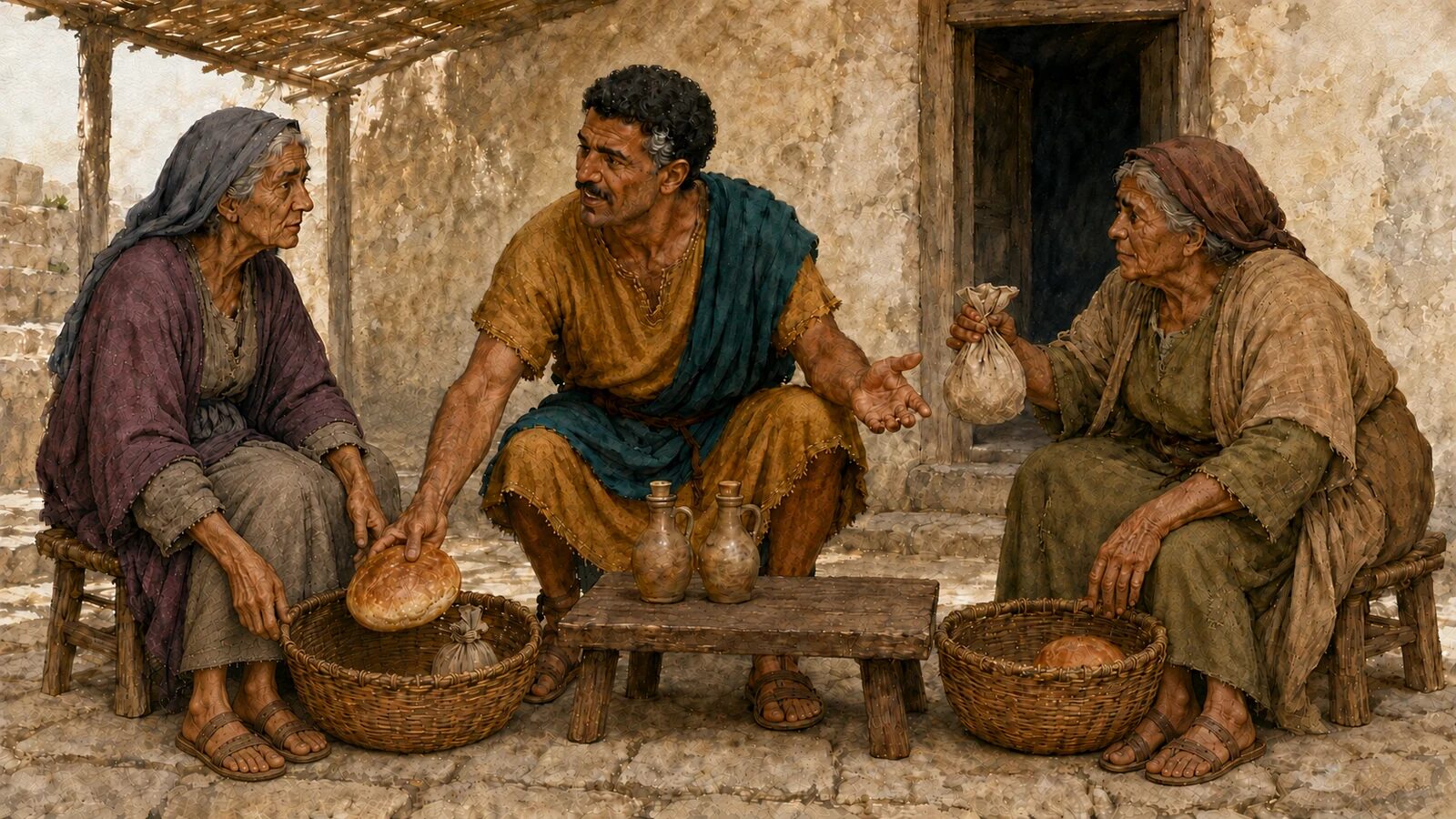
Stephen is often remembered for the way he died, but Acts first introduces him when widows are being overlooked. I want to follow his whole story because the same man who helped protect a fair distribution later answered his opponents from Scripture. As they killed him, he prayed for them, and that whole path helps us see why Acts calls him full of faith and the Holy Spirit.
Stephen’s Witness Begins With Service
Stephen enters Acts because vulnerable widows are being overlooked in the church’s daily distribution. He is chosen to help administer that practical need. Within the same chapter, he performs great wonders and speaks with wisdom that his opponents cannot answer. He then faces manufactured accusations and stands before the council with a face like an angel.
Acts 7 then records the longest speech in Acts, and Stephen’s courage is grounded in a careful knowledge of Israel’s Scriptures. He understands the accusation and answers it by tracing God’s presence and promise through the history of rejected deliverers and repeated rebellion. He also explains the place of the tabernacle and temple before identifying the council with the very pattern it claims to condemn.
Tradition calls Stephen the first Christian martyr after Pentecost. The Greek word martys ordinarily means witness and later becomes closely associated with a witness killed for his testimony. Stephen deserves both senses because he testifies to the Just One and is killed when his hearers refuse that testimony. His death is neither defeat nor performance. Full of the Holy Spirit, he sees Jesus and prays directly to Him. He asks mercy for his killers before entrusting his spirit to the Lord.
Now in those days, when the number of the disciples was multiplying, there arose a complaint against the Hebrews by the Hellenists, because their widows were neglected in the daily distribution. Then the twelve summoned the multitude of the disciples and said, "It is not desirable that we should leave the word of God and serve tables. Therefore, brethren, seek out from among you seven men of good reputation, full of the Holy Spirit and wisdom, whom we may appoint over this business; but we will give ourselves continually to prayer and to the ministry of the word." And the saying pleased the whole multitude. And they chose Stephen, a man full of faith and the Holy Spirit, and Philip, Prochorus, Nicanor, Timon, Parmenas, and Nicolas, a proselyte from Antioch, whom they set before the apostles; and when they had prayed, they laid hands on them. Then the word of God spread, and the number of the disciples multiplied greatly in Jerusalem, and a great many of the priests were obedient to the faith.
Earlier in Acts, believers had voluntarily shared resources so that needy people could receive care. Acts 6 shows that good intentions did not make the growing church immune to an unequal distribution. The daily provision was meant to meet ordinary needs such as food, and widows without dependable household support were especially vulnerable.
As the disciples multiply, Hellenists complain against Hebrews because their widows are neglected in the daily distribution. Both groups are Jewish. Hellenists commonly used Greek language and culture, while Hebrews were more closely associated with the local Aramaic-speaking environment. The distinction could produce social and linguistic fault lines inside one redeemed community.
Acts does not dismiss the complaint as divisive merely because it names an unequal outcome. Widows were economically vulnerable, and the distribution was part of the church’s shared care. Rapid growth had exposed an administrative failure.
The apostles gather the multitude and propose a transparent remedy. The congregation identifies qualified men, whom the apostles appoint over the need, so practical justice works together with congregational participation. Spiritual qualification governs the whole process, and the result protects neglected people while allowing the word of God to continue spreading.
The apostles do not ask only for people who can calculate portions or organize a schedule. The seven must be men from among the congregation with a good reputation, full of the Holy Spirit and wisdom. Administration affecting vulnerable people is spiritual work and demands tested character.
Stephen is named first and described as full of faith and the Holy Spirit. What catches my attention is that this fullness is not self-advertised; the congregation recognizes it, and his later conduct confirms it. His wisdom appears first in fair service and then in biblical reasoning, while his response to slander reveals both composure and mercy toward his enemies.
Churches sometimes excuse poor character because a person seems gifted. They can make the opposite mistake by treating practical competence as though doctrine and spiritual maturity do not matter. A person who handles benevolence, private records, food, or money can harm people deeply without integrity. Scripture therefore joins visible faithfulness to Spirit-shaped wisdom.
The congregation chooses Stephen and Philip, along with Prochorus, Nicanor, Timon, Parmenas, and Nicolas, a proselyte from Antioch. Their Greek names may suggest that the church wisely selected men able to understand the Hellenistic community, though names alone cannot prove every background detail.
The apostles pray and lay hands on them, publicly entrusting the responsibility. Acts uses the ordinary language of serving tables and ministry of the word. It does not explicitly call the seven by the later office title diakonos, or deacon. Many Christians reasonably view this event as a prototype of diaconal ministry, but the narrative should not be made to say more than it says.
The passage also supports the wider apostolic pattern that authoritative church office belongs to qualified men. That conviction never turns care ministry into lesser work. The need requires some of the strongest character language in the chapter.
The apostles say it would not be desirable to leave the word of God to serve tables. They do not insult tables. They recognize distinct callings and the danger of abandoning their assigned work. Prayer and ministry of the word require sustained attention, while the distribution needs trustworthy leadership of its own.
The solution is not a hierarchy where public teaching is spiritual and mercy is secular. Both assignments belong to obedience. The apostles remain devoted to their commission, and Spirit-filled men ensure widows are not neglected.
After the appointment, God’s word spreads and the disciples multiply greatly in Jerusalem. Many priests also obey the faith. Healthy organization removes an obstacle to mission. Stephen’s later preaching does not mean that table service was beneath him or merely a stepping stone. Faithfulness in one assignment and usefulness in another can grow from the same Spirit-filled life.
Wisdom, Signs, and False Accusations
And Stephen, full of faith and power, did great wonders and signs among the people. Then there arose some from what is called the Synagogue of the Freedmen (Cyrenians, Alexandrians, and those from Cilicia and Asia), disputing with Stephen. And they were not able to resist the wisdom and the Spirit by which he spoke. Then they secretly induced men to say, "We have heard him speak blasphemous words against Moses and God." And they stirred up the people, the elders, and the scribes; and they came upon him, seized him, and brought him to the council. They also set up false witnesses who said, "This man does not cease to speak blasphemous words against this holy place and the law; for we have heard him say that this Jesus of Nazareth will destroy this place and change the customs which Moses delivered to us." And all who sat in the council, looking steadfastly at him, saw his face as the face of an angel.
Stephen is full of faith and power as he performs great wonders and signs among the people. Acts does not describe the signs in detail. Their purpose is bound to his witness rather than to his personal status. Claims of miraculous power today must likewise be tested by Scripture rather than accepted through spectacle.
Members associated with the Synagogue of the Freedmen dispute with him. “Freedmen” commonly referred to formerly enslaved people who had been released, or to their descendants. Luke mentions Cyrenians and Alexandrians, along with people from Cilicia and Asia. These names point to Jewish communities with roots in North Africa and regions of the Roman world outside Judea. The grammar may describe one synagogue containing regional groups or several connected synagogues. Certainty about the arrangement exceeds the text.
They cannot resist the wisdom and the Spirit by which Stephen speaks. Their defeat in argument does not guarantee repentance. They secretly induce men to accuse him and stir up the people and their leaders. Then they seize Stephen and bring him before the council. Intellectual inability becomes conspiratorial hostility.
The council is the Jerusalem Sanhedrin, the ruling Jewish body that had already questioned Peter and John. Rome still controlled capital authority in Judea, which helps explain why Acts does not present Stephen’s death as a calmly completed legal sentence. The hearing rapidly becomes collective violence.
Stephen is likely a Hellenistic Jewish believer himself, given his Greek name and the setting of his selection. His opponents also come from diaspora backgrounds. This is not a conflict between Christianity and an unrelated ethnic religion. It is an argument within Israel about the promised Messiah and the meaning of the law and temple. Israel’s history stands at the center of the dispute.
Cilicia is especially noteworthy because Saul came from Tarsus in Cilicia. Acts does not explicitly say Saul debated Stephen in this synagogue, so that possibility must remain an inference rather than a fact.
Stephen’s wisdom is biblical and contextual. He does not answer accusations about the temple and Moses with a generic testimony. He traces the history from Abraham through Joseph and Moses. His account continues through the wilderness and tabernacle before reaching David and Solomon. Bold witness requires enough knowledge to answer the question actually being contested.
The induced men claim Stephen speaks blasphemous words against Moses and God. False witnesses then say he continually speaks against the holy place and the law and that Jesus of Nazareth will destroy the place and change Mosaic customs.
The witnesses are false, yet effective lies often distort real statements. Jesus foretold the temple’s destruction and identified His body as the true temple in John 2. He fulfilled the law rather than abolishing God’s word. The apostles proclaimed covenant transition through the Messiah. Stephen likely taught implications that his accusers maliciously reframed.
His defense does not treat the temple and law as insignificant. Stephen honors God’s covenant with Abraham, Moses’ divine commission, the living oracles, and the God-given tabernacle. He also gives David’s desire and Solomon’s building their proper place. His point is that these gifts never authorized resistance to the One they anticipated or confined the Most High to a building made by human hands.
Everyone sitting in the council looks steadfastly at Stephen and sees his face as the face of an angel. Luke does not say he became an angel or describe a sentimental smile. The comparison signals a God-given appearance fitting a messenger who is about to speak with unusual authority and calm.
Moses’ face shone after speaking with God, and angels in Scripture can inspire fear through reflected glory. Stephen has been accused of opposing Moses, yet his appearance resembles a divinely authenticated messenger before his defense even begins.
The sign does not force belief, because the council can see and still resist. Evidence can expose the heart without mechanically producing repentance. God’s genuine witness may be rejected, a truth Stephen later names directly when he says they resist the Holy Spirit.
Stephen Answers From Israel’s History
Then the high priest said, "Are these things so?" And he said, "Brethren and fathers, listen: The God of glory appeared to our father Abraham when he was in Mesopotamia, before he dwelt in Haran, and said to him, "Get out of your country and from your relatives, and come to a land that I will show you.' Then he came out of the land of the Chaldeans and dwelt in Haran. And from there, when his father was dead, He moved him to this land in which you now dwell. And God gave him no inheritance in it, not even enough to set his foot on. But even when Abraham had no child, He promised to give it to him for a possession, and to his descendants after him. But God spoke in this way: that his descendants would dwell in a foreign land, and that they would bring them into bondage and oppress them four hundred years. "And the nation to whom they will be in bondage I will judge,' said God, "and after that they shall come out and serve Me in this place.' Then He gave him the covenant of circumcision; and so Abraham begot Isaac and circumcised him on the eighth day; and Isaac begot Jacob, and Jacob begot the twelve patriarchs.
Stephen begins with “the God of glory” appearing to Abraham in Mesopotamia before he lived in Haran. God’s presence and initiative therefore precede both the land of Israel and the Jerusalem temple. Abraham obeys, but at first he receives no inherited possession. He does not receive even enough land to set his foot upon.
The promise rests on God’s word. He promises descendants and future possession after four hundred years of affliction. God will judge the enslaving nation, and afterward Abraham’s descendants will worship Him. Circumcision comes as the covenant sign before the patriarchal line proceeds through Isaac and Jacob.
This history answers the holy-place accusation without despising the land. The land is genuinely promised, yet God is never geographically trapped. Promise exists before possession, and worship depends on the God who reveals Himself rather than on human control of sacred space.
"And the patriarchs, becoming envious, sold Joseph into Egypt. But God was with him and delivered him out of all his troubles, and gave him favor and wisdom in the presence of Pharaoh, king of Egypt; and he made him governor over Egypt and all his house. Now a famine and great trouble came over all the land of Egypt and Canaan, and our fathers found no sustenance. But when Jacob heard that there was grain in Egypt, he sent out our fathers first. And the second time Joseph was made known to his brothers, and Joseph's family became known to the Pharaoh. Then Joseph sent and called his father Jacob and all his relatives to him, seventy-five people. So Jacob went down to Egypt; and he died, he and our fathers. And they were carried back to Shechem and laid in the tomb that Abraham bought for a sum of money from the sons of Hamor, the father of Shechem.
The patriarchs become envious and sell Joseph into Egypt, but God is with him. He delivers Joseph from afflictions and grants favor and wisdom before Pharaoh. Joseph becomes governor over Egypt and the royal household.
Famine later drives his brothers to seek food from the very man they rejected. On the second visit Joseph becomes known to them, and his family is brought into Egypt. The rejected brother becomes the God-appointed means of preservation.
Stephen counts seventy-five members of Jacob’s family, while the Masoretic wording of Genesis 46 gives a total of seventy through a different family reckoning. Ancient witnesses preserve more than one way of totaling the expanded household. The numerical question does not alter Stephen’s argument: the covenant family entered Egypt through the rejected Joseph whom God had exalted. I retain the Masoretic Text as the Old Testament base while also receiving Luke’s inspired record of Stephen’s speech.
Stephen does not explicitly stop to say Joseph is a type of Jesus, but the narrative pattern prepares his charge. Israel’s honored ancestors once rejected the deliverer God exalted. Recognition came later. The council must consider whether it has repeated that pattern by betraying and murdering the Just One whom God exalted.
"But when the time of the promise drew near which God had sworn to Abraham, the people grew and multiplied in Egypt till another king arose who did not know Joseph. This man dealt treacherously with our people, and oppressed our forefathers, making them expose their babies, so that they might not live. At this time Moses was born, and was well pleasing to God; and he was brought up in his father's house for three months. But when he was set out, Pharaoh's daughter took him away and brought him up as her own son. And Moses was learned in all the wisdom of the Egyptians, and was mighty in words and deeds. "Now when he was forty years old, it came into his heart to visit his brethren, the children of Israel. And seeing one of them suffer wrong, he defended and avenged him who was oppressed, and struck down the Egyptian. For he supposed that his brethren would have understood that God would deliver them by his hand, but they did not understand. And the next day he appeared to two of them as they were fighting, and tried to reconcile them, saying, "Men, you are brethren; why do you wrong one another?' But he who did his neighbor wrong pushed him away, saying, "Who made you a ruler and a judge over us? Do you want to kill me as you did the Egyptian yesterday?' Then, at this saying, Moses fled and became a dweller in the land of Midian, where he had two sons.
As the promise approaches, Israel multiplies and a new Pharaoh oppresses the nation. Moses is born and is well pleasing to God. Although Pharaoh ordered Hebrew baby boys to be left to die, Moses is rescued. Pharaoh’s daughter then raises him and gives him an Egyptian education.
At forty he visits his brethren and defends an oppressed Israelite, but he kills the Egyptian and hides the body. Stephen emphasizes Moses’ expectation that Israel would recognize a coming deliverance; he does not turn the killing into a righteous method. Moses acts prematurely and sinfully before fleeing when the deed becomes known. The next day an aggressor rejects him with the question, “Who made you a ruler and a judge over us?” Moses then escapes to Midian.
Stephen repeats that rejection question later with force: the Moses whom they rejected is the one God sends as ruler and deliverer. The council claims loyalty to Moses while resisting the Messiah Moses foretold. Mere possession of Moses’ customs cannot substitute for receiving the Deliverer to whom his ministry points.
"And when forty years had passed, an Angel of the Lord appeared to him in a flame of fire in a bush, in the wilderness of Mount Sinai. When Moses saw it, he marveled at the sight; and as he drew near to observe, the voice of the Lord came to him, saying, "I am the God of your fathers–the God of Abraham, the God of Isaac, and the God of Jacob.' And Moses trembled and dared not look. "Then the LORD said to him, "Take your sandals off your feet, for the place where you stand is holy ground. I have surely seen the oppression of My people who are in Egypt; I have heard their groaning and have come down to deliver them. And now come, I will send you to Egypt."' "This Moses whom they rejected, saying, "Who made you a ruler and a judge?' is the one God sent to be a ruler and a deliverer by the hand of the Angel who appeared to him in the bush. He brought them out, after he had shown wonders and signs in the land of Egypt, and in the Red Sea, and in the wilderness forty years. "This is that Moses who said to the children of Israel, "The LORD your God will raise up for you a Prophet like me from your brethren. Him you shall hear.' "This is he who was in the congregation in the wilderness with the Angel who spoke to him on Mount Sinai, and with our fathers, the one who received the living oracles to give to us, whom our fathers would not obey, but rejected. And in their hearts they turned back to Egypt, saying to Aaron, "Make us gods to go before us; as for this Moses who brought us out of the land of Egypt, we do not know what has become of him.' And they made a calf in those days, offered sacrifices to the idol, and rejoiced in the works of their own hands. Then God turned and gave them up to worship the host of heaven, as it is written in the book of the Prophets: "Did you offer Me slaughtered animals and sacrifices during forty years in the wilderness, O house of Israel? You also took up the tabernacle of Moloch, And the star of your god Remphan, Images which you made to worship; And I will carry you away beyond Babylon.'
After forty years, the Angel of the Lord appears in the flame of a burning bush at Sinai. The voice identifies Himself as the God of Abraham and the God of Isaac and Jacob. He calls the ground holy and says that He has seen Israel’s oppression before sending Moses. This distinctive Angel speaks as God. He is a Christophany, which is a preincarnate appearance of the eternal Son.
That conclusion does not make every angel later mentioned in Stephen’s speech Christ. Angels are said to participate in giving the law, and ordinary heavenly messengers remain creatures. Context identifies the burning-bush Messenger by His divine self-identification.
The rejected Moses performs wonders and leads Israel out before foretelling a Prophet like himself. He receives living oracles to give the people. Stephen honors both Moses and the law. His accusation is that their fathers would not obey. They rejected Moses in their hearts and turned back toward Egypt.
While Moses is on the mountain, Israel asks Aaron to make gods and fashions a calf. The people sacrifice to the idol and rejoice in the work of human hands. Stephen then draws from Amos to describe the later worship of Moloch and the star of Remphan, followed by exile beyond Babylon.
The speech compresses centuries to reveal a sobering covenant pattern. Israel can receive revelation while resisting it and possess holy institutions while worshiping idols. In the same way, people may praise their ancestors and still repeat their rebellion.
This is not an ethnic accusation against every Jewish person. Stephen is Jewish, as are the apostles and prophets. Jesus is Jewish as well. Thousands of Jewish believers have received the Messiah in Acts. The indictment addresses covenant rebellion wherever it appears, especially in leaders who honor the symbols while rejecting God’s present word. Gentile churches must never use Stephen’s speech to justify antisemitism.
God Is Not Confined to the Temple
"Our fathers had the tabernacle of witness in the wilderness, as He appointed, instructing Moses to make it according to the pattern that he had seen, which our fathers, having received it in turn, also brought with Joshua into the land possessed by the Gentiles, whom God drove out before the face of our fathers until the days of David, who found favor before God and asked to find a dwelling for the God of Jacob. But Solomon built Him a house. "However, the Most High does not dwell in temples made with hands, as the prophet says: "Heaven is My throne, And earth is My footstool. What house will you build for Me? says the LORD, Or what is the place of My rest? Has My hand not made all these things?'
Israel had the tabernacle of witness in the wilderness, which was made according to God’s revealed pattern. Joshua’s generation brought it into the land. The tabernacle was holy and commanded, yet it remained mobile. This again shows that God’s witness was not limited to Solomon’s later building.
David found favor and desired to find a dwelling for the God of Jacob. Solomon built Him a house. Stephen neither mocks David’s desire nor calls the temple an unauthorized mistake.
He then quotes Isaiah: the Most High does not dwell in temples made with hands as though creation could contain Him. Heaven is His throne and earth His footstool. The temple is a place God chose for His name and worship, but it cannot be used to domesticate Him or shield rebellion from His judgment.
The accusation treated Stephen as an enemy of “this holy place.” His answer locates holiness in the God of glory who appeared in Mesopotamia and spoke in both Egypt and Midian. God made wilderness ground holy and traveled with the tabernacle. He cannot be contained by the temple.
Jesus had already announced judgment on the Jerusalem temple, and that judgment came in AD 70. Its destruction did not prove God failed. It confirmed that covenant privileges cannot be used against the Messiah.
Church buildings face a related temptation. A congregation can preserve architecture and denominational memory while resisting Scripture. The same danger exists when it treasures its liturgy or a celebrated pulpit. No building or movement guarantees faithfulness, and neither does an institution. God’s people should steward places gratefully without confusing possession of a place with submission to the Lord.
"Woe to you, scribes and Pharisees, hypocrites! Because you build the tombs of the prophets and adorn the monuments of the righteous, and say, "If we had lived in the days of our fathers, we would not have been partakers with them in the blood of the prophets.' "Therefore you are witnesses against yourselves that you are sons of those who murdered the prophets. Fill up, then, the measure of your fathers' guilt. Serpents, brood of vipers! How can you escape the condemnation of hell? Therefore, indeed, I send you prophets, wise men, and scribes: some of them you will kill and crucify, and some of them you will scourge in your synagogues and persecute from city to city, that on you may come all the righteous blood shed on the earth, from the blood of righteous Abel to the blood of Zechariah, son of Berechiah, whom you murdered between the temple and the altar. Assuredly, I say to you, all these things will come upon this generation. "O Jerusalem, Jerusalem, the one who kills the prophets and stones those who are sent to her! How often I wanted to gather your children together, as a hen gathers her chicks under her wings, but you were not willing! See! Your house is left to you desolate; for I say to you, you shall see Me no more till you say, "Blessed is He who comes in the name of the LORD!"'
Jesus had rebuked leaders who decorated prophets’ tombs and claimed they would never have joined their fathers, while preparing to persecute His messengers. Stephen stands inside that prophetic pattern. He is not suddenly abandoning biblical exposition for personal rage.
He calls his hearers stiff-necked and uncircumcised in heart and ears. Circumcision of heart is already a Mosaic and prophetic demand. External covenant signs without inward submission become evidence against hypocrisy rather than protection from judgment.
The fathers persecuted prophets who announced the Just One, and the present leaders have become His betrayers and murderers. They received the law through angelic direction but did not keep it. Stephen answers the charge against him by showing that his accusers stand against the obedience the law requires. They also oppose its Messiah. Stephen does not.
Stephen says the fathers resisted the Holy Spirit and the council now does the same. The Spirit truly spoke through prophets and Stephen; the hearers truly reject that witness. Their resistance is morally responsible, not evidence that God never addressed them sincerely.
This language contradicts Calvinistic claims about irresistible grace. God genuinely calls and convicts people. He warns them and offers mercy, while they can harden their hearts and refuse. Divine sovereignty is never threatened by the reality Scripture states.
Being cut to the heart does not guarantee repentance. In Acts 2, hearers cut to the heart ask what they should do and receive Peter’s call. In Acts 7, hearers gnash their teeth and attack Stephen. Conviction can be answered with repentance or intensified resistance. The reader must not admire Stephen while resisting the same Spirit through Scripture.
The Heavens Open and Stephen Dies
"You stiff-necked and uncircumcised in heart and ears! You always resist the Holy Spirit; as your fathers did, so do you. Which of the prophets did your fathers not persecute? And they killed those who foretold the coming of the Just One, of whom you now have become the betrayers and murderers, who have received the law by the direction of angels and have not kept it." When they heard these things they were cut to the heart, and they gnashed at him with their teeth. But he, being full of the Holy Spirit, gazed into heaven and saw the glory of God, and Jesus standing at the right hand of God, and said, "Look! I see the heavens opened and the Son of Man standing at the right hand of God!" Then they cried out with a loud voice, stopped their ears, and ran at him with one accord; and they cast him out of the city and stoned him. And the witnesses laid down their clothes at the feet of a young man named Saul. And they stoned Stephen as he was calling on God and saying, "Lord Jesus, receive my spirit." Then he knelt down and cried out with a loud voice, "Lord, do not charge them with this sin." And when he had said this, he fell asleep.
Full of the Holy Spirit, Stephen gazes into heaven and sees God’s glory and Jesus standing at the right hand of God. He identifies Jesus as the Son of Man, using the title associated with Daniel 7 and Jesus’ own testimony before the council.
Most right-hand passages describe Christ seated because His sacrificial work is finished and His authority established. Acts does not explain why He stands here. Perhaps He is receiving or honoring Stephen; others see Him bearing witness or rising in judgment. I think these possibilities may help us consider the scene, but none should be preached as though Acts itself gives that explanation.
The vision confirms what the council denies. The crucified Jesus is alive and glorified in a position of divine authority. Stephen’s testimony about the opened heavens triggers loud cries. His hearers stop their ears and rush upon him together before removing him from the city.
And when they had come to the place called Calvary, there they crucified Him, and the criminals, one on the right hand and the other on the left. Then Jesus said, "Father, forgive them, for they do not know what they do." And they divided His garments and cast lots. And the people stood looking on. But even the rulers with them sneered, saying, "He saved others; let Him save Himself if He is the Christ, the chosen of God." The soldiers also mocked Him, coming and offering Him sour wine, and saying, "If You are the King of the Jews, save Yourself." And an inscription also was written over Him in letters of Greek, Latin, and Hebrew: THIS IS THE KING OF THE JEWS. Then one of the criminals who were hanged blasphemed Him, saying, "If You are the Christ, save Yourself and us." But the other, answering, rebuked him, saying, "Do you not even fear God, seeing you are under the same condemnation? And we indeed justly, for we receive the due reward of our deeds; but this Man has done nothing wrong." Then he said to Jesus, "Lord, remember me when You come into Your kingdom." And Jesus said to him, "Assuredly, I say to you, today you will be with Me in Paradise." Now it was about the sixth hour, and there was darkness over all the earth until the ninth hour. Then the sun was darkened, and the veil of the temple was torn in two. And when Jesus had cried out with a loud voice, He said, "Father, "into Your hands I commit My spirit."' Having said this, He breathed His last.
Stephen’s death unmistakably echoes Jesus. Jesus asks the Father to forgive His executioners and entrusts His spirit to the Father. Stephen calls directly to the Lord Jesus and asks Him to receive his spirit. He then kneels before crying out to the Lord not to charge them with this sin. Christ’s mercy shapes the servant.
Prayer to Jesus and entrusting the departing spirit to Him confess Christ’s deity and authority over death. When Acts says Stephen fell asleep, it uses a common biblical metaphor for bodily death. It does not teach soul sleep. His spirit is consciously entrusted to Jesus.
Forgiveness does not rename murder or prevent civil accountability. Stephen has just charged the leaders plainly. His prayer refuses personal vengeance and seeks mercy from the Judge who alone can forgive guilt.
The mob casts Stephen outside the city and stones him without the careful legal verdict or Roman authorization we might expect. The scene reads as enraged collective violence. He dies as a faithful witness, not because every bold sermon must end in death, but because obedience to Christ may carry that cost.
Persecution Scatters the Witness
Now Saul was consenting to his death. At that time a great persecution arose against the church which was at Jerusalem; and they were all scattered throughout the regions of Judea and Samaria, except the apostles. And devout men carried Stephen to his burial, and made great lamentation over him. As for Saul, he made havoc of the church, entering every house, and dragging off men and women, committing them to prison. Therefore those who were scattered went everywhere preaching the word. Then Philip went down to the city of Samaria and preached Christ to them. And the multitudes with one accord heeded the things spoken by Philip, hearing and seeing the miracles which he did. For unclean spirits, crying with a loud voice, came out of many who were possessed; and many who were paralyzed and lame were healed. And there was great joy in that city.
Witnesses lay garments at the feet of Saul, and he consents to Stephen’s death. Devout men bury Stephen and lament deeply. Great persecution arises against the Jerusalem church, scattering believers through Judea and Samaria while the apostles remain.
Acts does not say Stephen’s death secretly planted a gospel seed in Saul or specify its immediate emotional effect. It says Saul ravaged the church. Later, Christ confronts him directly on the Damascus road.
"Now it happened, when I returned to Jerusalem and was praying in the temple, that I was in a trance and saw Him saying to me, "Make haste and get out of Jerusalem quickly, for they will not receive your testimony concerning Me.' So I said, "Lord, they know that in every synagogue I imprisoned and beat those who believe on You. And when the blood of Your martyr Stephen was shed, I also was standing by consenting to his death, and guarding the clothes of those who were killing him.' Then He said to me, "Depart, for I will send you far from here to the Gentiles."'
Years later, Paul remembers standing by and consenting to Stephen’s death while guarding the killers’ clothes. The memory belongs to his testimony. Yet his conversion rests on the risen Christ’s intervention and grace rather than on a psychological reconstruction.
Those scattered preach the word. Philip goes to Samaria, and the city experiences joy. Persecution is evil, yet God sovereignly advances the Acts 1:8 mission through believers who carry the gospel beyond Jerusalem. Stephen’s witness is silenced locally, but the Word is not bound.
Stephen’s story teaches us to notice the overlooked person before asking for a public platform. His service begins with widows, a tested reputation, and wisdom that can be trusted with a real need. Churches should hear substantiated complaints and protect people when cultural lines make neglect easier to miss.
His public witness also shows why believers need to learn Scripture deeply enough to answer the question actually being asked. Boldness is not volume, insult, or needless provocation. Stephen honors the biblical record and speaks most forcefully when the evidence requires it.
The same Holy Spirit who strengthened Stephen also convicted his hearers, so admiration for Stephen must lead us to examine our own response. When the Word exposes the heart, we should repent instead of resisting. Opposition does not require falsehood or private vengeance, and forgiveness does not call evil good. Lawful protection may be used where it is available, but our life and reputation finally belong in the hands of the glorified Lord Jesus.
Why could Stephen place even his departing spirit in Jesus’ hands? His prayer rests on who Jesus is. Jesus Christ is the eternal Son, fully God and fully man. He was born of a virgin and lived without sin. Wicked men physically punished Him, and He willingly bore that punishment for our sins in His innocent body. He shed His blood and died. After He was buried, He rose bodily from the dead. The Father did not turn against His Son or pour wrath on Him. He did not abandon Jesus, nor was He the one who struck and bruised Him.
Christ died for the whole world. Everyone who repents and believes is forgiven and justified before God. The believer is born again as a new creation, while the Holy Spirit indwells and seals him. That salvation is eternally secure, though security never makes lawlessness harmless. A superficial profession does not prove that a person has been born again. Stephen’s warning still calls us to receive the Spirit’s conviction instead of resisting Him.
Related studies: The Book of Acts, Saul’s Conversion, The Holy Spirit.
My Final Thoughts
After following Stephen from the widows’ distribution to the stones outside Jerusalem, I cannot separate his practical service from his public witness. The Holy Spirit shaped how he handled a real failure in the church. That same Spirit gave him wisdom to open Israel’s Scriptures and mercy to pray for his killers. Stephen told the truth without hatred and left judgment with the glorified Jesus. I want that kind of faithfulness to begin wherever God has placed me, even when the work seems ordinary, and to remain when obedience carries a cost.