
God told Israel to remove leaven from their homes and eat unleavened bread for seven days. I want to understand why He gave them that command and how the New Testament uses the feast to teach Christ’s church. We need to begin with the night God actually delivered Israel, then follow the Christian application without turning the feast into a ritual Christians must keep.
The Memorial God Gave Israel
The Feast of Unleavened Bread began when the LORD brought Israel out of Egypt. For seven days, the people were to remove leaven from their homes and eat bread made without it, gathering for sacred assemblies on the first and seventh days. God put the exodus into the nation’s yearly calendar so that children who had never seen Egypt would still hear how He rescued their ancestors. They needed to know that Israel had not delivered itself.
I don’t want to lose that history when we come to Paul’s teaching in 1 Corinthians 5. He uses the feast to call a church away from corrupting wickedness, but his application does not erase what the bread first meant to Israel. It does not make every biblical use of leaven a picture of sin either, or make ritual food a way for Christians to become holy. The exodus tells us where the observance began. Paul’s church setting explains his use of it, and Christ’s completed work governs how we apply it.
Passover and Unleavened Bread were closely connected, but they were not quite the same observance. The Passover sacrifice belonged to the fourteenth day of the first month, and the seven-day feast began on the fifteenth. They met at the evening boundary and remembered the same deliverance, which helps explain why Scripture can use “Passover” for the wider season. The original commands still distinguish them. Passover focused on the lamb and the houses marked with blood when judgment fell on Egypt, while Unleavened Bread continued that remembrance through the following week.
'So this day shall be to you a memorial; and you shall keep it as a feast to the LORD throughout your generations. You shall keep it as a feast by an everlasting ordinance. Seven days you shall eat unleavened bread. On the first day you shall remove leaven from your houses. For whoever eats leavened bread from the first day until the seventh day, that person shall be cut off from Israel. On the first day there shall be a holy convocation, and on the seventh day there shall be a holy convocation for you. No manner of work shall be done on them; but that which everyone must eat–that only may be prepared by you. So you shall observe the Feast of Unleavened Bread, for on this same day I will have brought your armies out of the land of Egypt. Therefore you shall observe this day throughout your generations as an everlasting ordinance. In the first month, on the fourteenth day of the month at evening, you shall eat unleavened bread, until the twenty-first day of the month at evening. For seven days no leaven shall be found in your houses, since whoever eats what is leavened, that same person shall be cut off from the congregation of Israel, whether he is a stranger or a native of the land. You shall eat nothing leavened; in all your dwellings you shall eat unleavened bread.'"
God called the day a memorial and required Israel to act on what they remembered. They removed leaven from their houses, and anyone who ate leavened bread during the appointed days faced being “cut off” from Israel. That meant exclusion from the covenant community and its privileges, although the passage does not tell us every human procedure or the precise earthly penalty in each case. On the first and seventh days, the people set ordinary work aside and gathered before the LORD. Those were the holy convocations.
Their homes and meals bore witness to what the LORD had done. Work stopped for sacred assemblies, and each year the calendar brought them back to that deliverance. This was an observance God established and explained, not a custom to which Israel later added religious meaning. I also notice that “everlasting ordinance” appears with “throughout your generations” and addresses God’s covenant people. It establishes an enduring ordinance for Israel without, by itself, placing the church under the Mosaic calendar.
Then he called for Moses and Aaron by night, and said, "Rise, go out from among my people, both you and the children of Israel. And go, serve the LORD as you have said. Also take your flocks and your herds, as you have said, and be gone; and bless me also." And the Egyptians urged the people, that they might send them out of the land in haste. For they said, "We shall all be dead." So the people took their dough before it was leavened, having their kneading bowls bound up in their clothes on their shoulders. Now the children of Israel had done according to the word of Moses, and they had asked from the Egyptians articles of silver, articles of gold, and clothing. And the LORD had given the people favor in the sight of the Egyptians, so that they granted them what they requested. Thus they plundered the Egyptians. Then the children of Israel journeyed from Rameses to Succoth, about six hundred thousand men on foot, besides children. A mixed multitude went up with them also, and flocks and herds–a great deal of livestock. And they baked unleavened cakes of the dough which they had brought out of Egypt; for it was not leavened, because they were driven out of Egypt and could not wait, nor had they prepared provisions for themselves.
Exodus shows us why the bread had no time to rise. After Egypt’s firstborn died, Pharaoh ordered Israel to leave, and the Egyptians urged them out because they feared more deaths. The people carried their dough in kneading bowls wrapped in clothing on their shoulders. They took their children and livestock, along with the goods the Egyptians had given them. They had been slaves only the day before, but the LORD was bringing them out so quickly that ordinary bread preparation had to wait.
But the hurry of leaving did not create the feast. Earlier in Exodus 12, before the departure, God had already commanded unleavened bread for the Passover meal and prescribed the seven-day observance. I need to keep that order clear. God gave the sign first, and the rescue then gave Israel a memory they could never honestly claim as their own achievement.
"Observe the month of Abib, and keep the Passover to the LORD your God, for in the month of Abib the LORD your God brought you out of Egypt by night. Therefore you shall sacrifice the Passover to the LORD your God, from the flock and the herd, in the place where the LORD chooses to put His name. You shall eat no leavened bread with it; seven days you shall eat unleavened bread with it, that is, the bread of affliction (for you came out of the land of Egypt in haste), that you may remember the day in which you came out of the land of Egypt all the days of your life. And no leaven shall be seen among you in all your territory for seven days, nor shall any of the meat which you sacrifice the first day at twilight remain overnight until morning. "You may not sacrifice the Passover within any of your gates which the LORD your God gives you; but at the place where the LORD your God chooses to make His name abide, there you shall sacrifice the Passover at twilight, at the going down of the sun, at the time you came out of Egypt. And you shall roast and eat it in the place which the LORD your God chooses, and in the morning you shall turn and go to your tents. Six days you shall eat unleavened bread, and on the seventh day there shall be a sacred assembly to the LORD your God. You shall do no work on it.
Deuteronomy calls it the “bread of affliction” and again connects it with the haste of departure. The bread was not itself sinful or an object of misery. It reminded Israel of the bitter bondage God had rescued them from. As they ate, they were to remember that suffering honestly and give the Deliverer the credit. The LORD’s mighty hand had brought them out, and His promised land lay ahead.
Deuteronomy also looks ahead to worship at the place the LORD would choose. The first observance took place in Israelite homes in Egypt, while the later national celebration was tied to the central sanctuary. Those instructions belong to different stages of the same covenant history, so I need to follow that development as Scripture presents it. Combining every detail into one ceremony would not give us a modern meal that reproduces the whole law.
Understanding the original words helps us follow what God commanded. The Hebrew plural matsot, used in the feast’s name, commonly means unleavened breads or cakes. Chamets can describe something leavened or fermented, whereas seor refers to leaven or a fermented starter kept for a fresh batch. In Greek, azyma can refer to unleavened bread or to the festival season, depending on the context. Even our English word “leaven” can name the starter or its action. These meanings help us read accurately, but they do not conceal a secret doctrine in the syllables. We still need the context to tell us which meaning is intended.
And Moses said to the people: "Remember this day in which you went out of Egypt, out of the house of bondage; for by strength of hand the LORD brought you out of this place. No leavened bread shall be eaten. On this day you are going out, in the month Abib. And it shall be, when the LORD brings you into the land of the Canaanites and the Hittites and the Amorites and the Hivites and the Jebusites, which He swore to your fathers to give you, a land flowing with milk and honey, that you shall keep this service in this month. Seven days you shall eat unleavened bread, and on the seventh day there shall be a feast to the LORD. Unleavened bread shall be eaten seven days. And no leavened bread shall be seen among you, nor shall leaven be seen among you in all your quarters. And you shall tell your son in that day, saying, 'This is done because of what the LORD did for me when I came up from Egypt.' It shall be as a sign to you on your hand and as a memorial between your eyes, that the LORD's law may be in your mouth; for with a strong hand the LORD has brought you out of Egypt. You shall therefore keep this ordinance in its season from year to year.
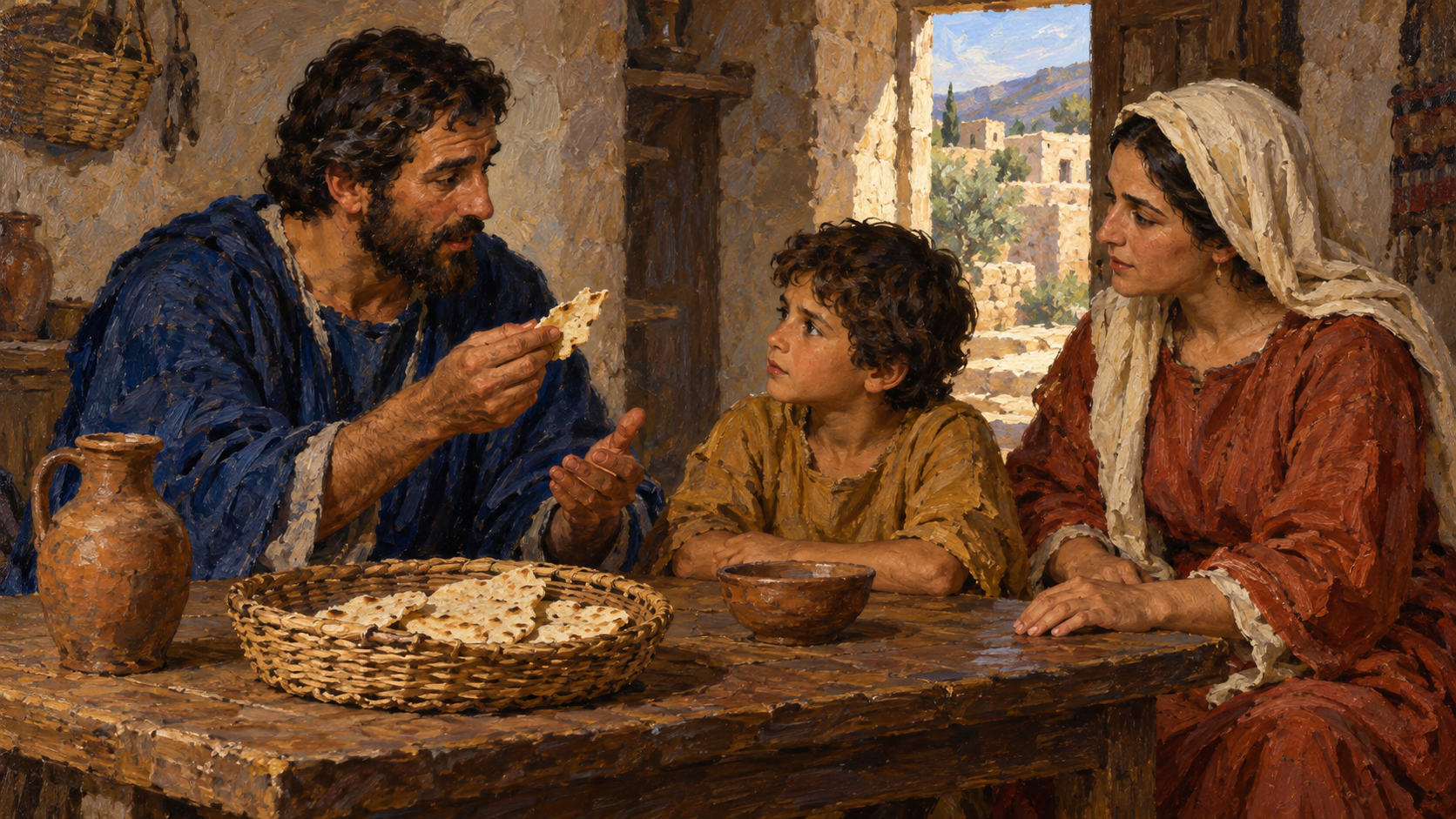
Moses began by telling the people to remember. The LORD’s strong hand had brought them out of slavery, and parents were to explain why their families ate this bread. They were to say, “This is done because of what the LORD did for me when I came up from Egypt.” I notice how personal that explanation was. They were passing on more than instructions for a meal. They were to tell the truth about their bondage and how Israel’s faithful God had rescued them, because the nation’s life rested on His work.
The observance served as a sign and memorial so that the LORD’s law would remain in the people’s mouths. Eating the bread expressed their covenant identity and obedience, but chemically pure dough had not rescued Israel. God had redeemed them by His power, and they remembered His work each year. The text connects this bread with haste and affliction. I would not turn that connection into a rule that unleavened bread always means moral perfection.
'These are the feasts of the LORD, holy convocations which you shall proclaim at their appointed times. On the fourteenth day of the first month at twilight is the LORD's Passover. And on the fifteenth day of the same month is the Feast of Unleavened Bread to the LORD; seven days you must eat unleavened bread. On the first day you shall have a holy convocation; you shall do no customary work on it. But you shall offer an offering made by fire to the LORD for seven days. The seventh day shall be a holy convocation; you shall do no customary work on it.'"
Leviticus puts Passover on the fourteenth day at twilight and the beginning of Unleavened Bread on the fifteenth. The people ate this bread for seven days and gathered on the first and seventh, with appointed offerings throughout the week. Numbers 28 gives further details about those daily offerings. Those sanctuary requirements help me see why avoiding yeast at home cannot amount to keeping the whole Mosaic feast. Its observance included Israel’s priesthood and sacrifices. Removing leaven can teach something today, but an attempt to “keep the biblical feast” that stops there does not fulfill the complete law given at Sinai.
The calendar gave the whole nation a responsibility to remember. Remembrance did not depend on someone happening to feel reflective. Families prepared their homes before the national assembly, and the priests carried out the required sacrifices at the sanctuary. Ordinary work was interrupted so that remembering deliverance would not be pushed aside. This was also more than a private spiritual picture: the God they worshiped had acted in Egypt and brought this particular people out of bondage.
Deliverance Remembered in the Land
Exodus 13 expects a child to ask why the family is eating this bread. Without an explanation, the act could become empty repetition. If the explanation left out the actual exodus, it could become no more than a moral lesson. Parents needed to connect what the family did with what God had done. I think Christian parents can learn from that without claiming Israel’s covenant identity. We should teach children the actual events of Scripture and explain the practices Christ gave His church, so His saving work remains clearer than any family custom.
A child learning about baptism or Communion needs to hear who commanded it and what it points to, along with why Christians obey. The ceremony itself cannot save. Remembering rightly means telling the truth about bondage and rescue, then directing faith toward the One who rescued us. If a family uses unleavened bread to teach the exodus, the lesson should help them understand Israel’s history. It should not suggest that their family has come under Israel’s Mosaic obligation.
Now the children of Israel camped in Gilgal, and kept the Passover on the fourteenth day of the month at twilight on the plains of Jericho. And they ate of the produce of the land on the day after the Passover, unleavened bread and parched grain, on the very same day. Then the manna ceased on the day after they had eaten the produce of the land; and the children of Israel no longer had manna, but they ate the food of the land of Canaan that year.
Israel kept Passover at Gilgal after crossing the Jordan, before the campaign against Jericho. They ate unleavened bread made from Canaan’s produce, and the manna stopped the following day. What catches my attention is that they were remembering the night they left Egypt while eating food from the land God had promised. The LORD who fed them from heaven was now feeding them through the land promised to Abraham’s descendants.
The feast carried the memory of a hurried departure into settled life. Unleavened bread was not only for the panic of leaving Egypt. Prosperity in Canaan was never meant to make Israel forget the slave houses or imagine they had established themselves. They still depended on the LORD who had brought them out by His mighty hand.
Now many people, a very great assembly, gathered at Jerusalem to keep the Feast of Unleavened Bread in the second month. They arose and took away the altars that were in Jerusalem, and they took away all the incense altars and cast them into the Brook Kidron. Then they slaughtered the Passover lambs on the fourteenth day of the second month. The priests and the Levites were ashamed, and sanctified themselves, and brought the burnt offerings to the house of the LORD. They stood in their place according to their custom, according to the Law of Moses the man of God; the priests sprinkled the blood received from the hand of the Levites. For there were many in the assembly who had not sanctified themselves; therefore the Levites had charge of the slaughter of the Passover lambs for everyone who was not clean, to sanctify them to the LORD. For a multitude of the people, many from Ephraim, Manasseh, Issachar, and Zebulun, had not cleansed themselves, yet they ate the Passover contrary to what was written. But Hezekiah prayed for them, saying, "May the good LORD provide atonement for everyone who prepares his heart to seek God, the LORD God of his fathers, though he is not cleansed according to the purification of the sanctuary." And the LORD listened to Hezekiah and healed the people. So the children of Israel who were present at Jerusalem kept the Feast of Unleavened Bread seven days with great gladness; and the Levites and the priests praised the LORD day by day, singing to the LORD, accompanied by loud instruments. And Hezekiah gave encouragement to all the Levites who taught the good knowledge of the LORD; and they ate throughout the feast seven days, offering peace offerings and making confession to the LORD God of their fathers.
Hezekiah restored the feast as part of a much wider reform. The people removed unlawful altars from Jerusalem, while priests and Levites who had neglected their service were ashamed and sanctified themselves. Some worshipers had not completed the required cleansing. Hezekiah prayed for those who had prepared their hearts to seek God, and the LORD heard him and healed them. I see both earnest zeal and God’s revealed order in this account. The people needed mercy, but receiving mercy did not make disobedience harmless. Keeping the restored feast belonged to their return to the LORD.
Josiah later kept Passover and Unleavened Bread during the covenant renewal that followed the recovery of the Book of the Law. Scripture praises the scale and order of that observance, but the ceremony could not take the place of obeying the Word that had exposed Judah’s condition. Both reforms show people taking God’s revelation seriously. Their renewed worship was more than enjoyment of a religious festival.
And the descendants of the captivity kept the Passover on the fourteenth day of the first month. For the priests and the Levites had purified themselves; all of them were ritually clean. And they slaughtered the Passover lambs for all the descendants of the captivity, for their brethren the priests, and for themselves. Then the children of Israel who had returned from the captivity ate together with all who had separated themselves from the filth of the nations of the land in order to seek the LORD God of Israel. And they kept the Feast of Unleavened Bread seven days with joy; for the LORD made them joyful, and turned the heart of the king of Assyria toward them, to strengthen their hands in the work of the house of God, the God of Israel.
After the exile and the rebuilding of the temple, the returned community kept Passover and the seven-day feast again. Priests and Levites purified themselves, and those who separated from the surrounding nations’ defilement joined in seeking the LORD. Scripture credits God with their joy: He had turned the king’s heart and strengthened their work. As I follow Israel beyond Egypt, I see them still depending on the same faithful God. The feast bore witness that restoration came through His providence.
How the Feast Leads into the Gospel Accounts
The distinction between Passover and Unleavened Bread also helps us read the New Testament. A writer may call the wider season Passover or use Unleavened Bread while describing preparation for the Passover meal. The Greek pascha can refer to the sacrifice or the meal, and sometimes to a particular day or the wider season. I don’t see a contradiction in that flexibility. I need to see how each writer uses the word instead of insisting that it must always have one narrow meaning.
Now the Feast of Unleavened Bread drew near, which is called Passover. And the chief priests and the scribes sought how they might kill Him, for they feared the people. Then Satan entered Judas, surnamed Iscariot, who was numbered among the twelve. So he went his way and conferred with the chief priests and captains, how he might betray Him to them. And they were glad, and agreed to give him money. So he promised and sought opportunity to betray Him to them in the absence of the multitude. Then came the Day of Unleavened Bread, when the Passover must be killed. And He sent Peter and John, saying, "Go and prepare the Passover for us, that we may eat." So they said to Him, "Where do You want us to prepare?" And He said to them, "Behold, when you have entered the city, a man will meet you carrying a pitcher of water; follow him into the house which he enters. Then you shall say to the master of the house, 'The Teacher says to you, "Where is the guest room where I may eat the Passover with My disciples?"' Then he will show you a large, furnished upper room; there make ready." So they went and found it just as He had said to them, and they prepared the Passover. When the hour had come, He sat down, and the twelve apostles with Him. Then He said to them, "With fervent desire I have desired to eat this Passover with you before I suffer; for I say to you, I will no longer eat of it until it is fulfilled in the kingdom of God." Then He took the cup, and gave thanks, and said, "Take this and divide it among yourselves; for I say to you, I will not drink of the fruit of the vine until the kingdom of God comes." And He took bread, gave thanks and broke it, and gave it to them, saying, "This is My body which is given for you; do this in remembrance of Me." Likewise He also took the cup after supper, saying, "This cup is the new covenant in My blood, which is shed for you.
Luke calls the approaching Feast of Unleavened Bread Passover, then describes the disciples preparing the meal. Jesus wanted to eat this Passover with them before His suffering. At the table, He spoke of His body being given for them and of the new covenant in His blood. Luke could use the wider name for the season and still describe the particular meal within the same account.
Jesus was born under the Law and obeyed God’s commands to Israel, including going to Jerusalem at the appointed time. But when He said, “Do this in remembrance of Me,” He did not require Gentile believers to become Israel or reproduce every later Seder custom. He gave the church bread and cup to remember His own sacrifice. These signs point to the real body He gave and the real blood He shed; He did not say the bread became His physical body or the cup became literal blood.
I want to take the Gospel chronology seriously without claiming more certainty than the texts give. Matthew, Mark, and Luke directly describe preparing and eating the Passover. John uses preparation language during the crucifixion and mentions leaders who still intended to eat the Passover. Some interpreters propose different calendars, while others point to the Jewish day beginning at sunset or the broader meaning of festival terms. “Preparation” could also serve as the ordinary name for Friday. These are legitimate possibilities, but no single explicit timeline in Scripture settles every modern reconstruction.
What all four Gospels agree on is that Jesus truly died during the Passover season, was buried, and rose bodily. Some teachers go further, placing His burial on the exact first day of Unleavened Bread and treating the condition of His body in the tomb as that feast’s specific fulfillment. I would not call that settled doctrine. The New Testament does not assign that exact typological meaning to His burial.
"Men of Israel, hear these words: Jesus of Nazareth, a Man attested by God to you by miracles, wonders, and signs which God did through Him in your midst, as you yourselves also know– Him, being delivered by the determined purpose and foreknowledge of God, you have taken by lawless hands, have crucified, and put to death; whom God raised up, having loosed the pains of death, because it was not possible that He should be held by it. For David says concerning Him: 'I foresaw the LORD always before my face, For He is at my right hand, that I may not be shaken. Therefore my heart rejoiced, and my tongue was glad; Moreover my flesh also will rest in hope. For You will not leave my soul in Hades, Nor will You allow Your Holy One to see corruption. You have made known to me the ways of life; You will make me full of joy in Your presence.' "Men and brethren, let me speak freely to you of the patriarch David, that he is both dead and buried, and his tomb is with us to this day. Therefore, being a prophet, and knowing that God had sworn with an oath to him that of the fruit of his body, according to the flesh, He would raise up the Christ to sit on his throne, he, foreseeing this, spoke concerning the resurrection of the Christ, that His soul was not left in Hades, nor did His flesh see corruption. This Jesus God has raised up, of which we are all witnesses.
Peter makes a direct apostolic claim about Jesus’ resurrection. Lawless men crucified Him according to God’s determined purpose and foreknowledge, but death could not hold Him. David’s body remained in its tomb, while the promised Christ rose without seeing corruption. I don’t want to reduce that to a corpse escaping normal decay. God raised Jesus bodily, and the apostles saw Him alive.
Jesus rose during the feast season, and we have no reason to question His complete sinlessness. But Scripture does not say an unleavened loaf predicted the condition of His body in the tomb. I can affirm His sinlessness without relying on that inference. His burial and bodily resurrection are directly established in the New Testament.
How Paul Applies the Feast to the Church
We also have to consider how differently Scripture uses leaven. Jesus warned about the leaven of the Pharisees and Sadducees, with the context identifying hypocrisy or harmful teaching as the danger. Paul used its spreading action to describe tolerated sexual immorality in Corinth and false persuasion in Galatia. Yet Leviticus 7 included leavened bread in a thanksgiving peace offering, and Leviticus 23 required it in the wave loaves at the Feast of Weeks. Jesus even compared the kingdom to leaven hidden in meal until it affected the whole batch. We cannot conclude that God commanded sinful offerings or likened His kingdom to sin.
Removing leaven first belonged to Israel’s remembrance of an actual deliverance. In 1 Corinthians 5, Paul uses that familiar act to explain why a church must remove tolerated wickedness. A small starter spreading through dough makes the analogy understandable. I don’t need to make every piece of leaven in Scripture secretly stand for evil to follow Paul’s point. The passage itself tells us how to understand the image.
It is actually reported that there is sexual immorality among you, and such sexual immorality as is not even named among the Gentiles–that a man has his father's wife! And you are puffed up, and have not rather mourned, that he who has done this deed might be taken away from among you. For I indeed, as absent in body but present in spirit, have already judged (as though I were present) him who has so done this deed. In the name of our Lord Jesus Christ, when you are gathered together, along with my spirit, with the power of our Lord Jesus Christ, deliver such a one to Satan for the destruction of the flesh, that his spirit may be saved in the day of the Lord Jesus. Your glorying is not good. Do you not know that a little leaven leavens the whole lump? Therefore purge out the old leaven, that you may be a new lump, since you truly are unleavened. For indeed Christ, our Passover, was sacrificed for us. Therefore let us keep the feast, not with old leaven, nor with the leaven of malice and wickedness, but with the unleavened bread of sincerity and truth. I wrote to you in my epistle not to keep company with sexually immoral people. Yet I certainly did not mean with the sexually immoral people of this world, or with the covetous, or extortioners, or idolaters, since then you would need to go out of the world. But now I have written to you not to keep company with anyone named a brother, who is sexually immoral, or covetous, or an idolater, or a reviler, or a drunkard, or an extortioner–not even to eat with such a person. For what have I to do with judging those also who are outside? Do you not judge those who are inside? But those who are outside God judges. Therefore "put away from yourselves the evil person."
The Corinthians were tolerating open sexual immorality that even the Gentiles around them recognized as shameful. The congregation was proud when it should have been mourning. Purging the old leaven meant, first of all, removing the unrepentant offender from fellowship. Paul was calling them back to holiness through the imagery of Israel’s feast preparation. He was not asking them to search their pantry shelves or telling them believers become sinlessly perfect.
At the end of the chapter, Paul distinguishes the church’s judgment from God’s judgment of outsiders. Christians are responsible for what they knowingly protect among people who claim Christ’s name, rather than for purging every unbeliever from society. That responsibility calls for evidence and proper order in church discipline. Qualified leaders need to act without favoritism, and the congregation must keep a painful process from becoming gossip or a public spectacle.
Delivering the man to Satan meant removing him from the church’s protected fellowship into the world outside. The aim was his salvation, not revenge. Discipline names the evil honestly to protect others from its influence while warning the offender and calling him to repent. Later, 2 Corinthians tells the church to forgive and comfort a disciplined person whose sorrow had become sufficient. He may have been the same man, but Scripture never expressly identifies him that way, so I would not insist on the connection. The later command still teaches us that real repentance should be met with a welcome to restoration.
Paul gives the reason for removing wickedness in the words “since you truly are unleavened.” They were to live according to what Christ had already made them, not earn redemption by cleaning themselves up. Christ our Passover was sacrificed for us, and His saving work gives His people a new identity. I understand “Let us keep the feast” as a call to a continuing life of sincerity and truth, rather than an annual obligation. We cannot defend malice and hypocrisy as normal parts of our fellowship.
Christians still sin, and when we do, we need to confess it and receive God’s cleansing. Where restitution is necessary, making it belongs to our return to obedient fellowship. Eternal security does not give us permission for lawlessness. Everyone truly born again is a new creation whom the Holy Spirit indwells and seals. But I would not treat a shallow profession that stubbornly protects evil as proof that the person has been born again.
What Christ’s Church Is Commanded to Remember
That brings us to a practical question: must Christians keep this feast every year? Colossians 2 helps answer it by placing Israel’s festival calendar in relation to Christ.
And you, being dead in your trespasses and the uncircumcision of your flesh, He has made alive together with Him, having forgiven you all trespasses, having wiped out the handwriting of requirements that was against us, which was contrary to us. And He has taken it out of the way, having nailed it to the cross. Having disarmed principalities and powers, He made a public spectacle of them, triumphing over them in it. So let no one judge you in food or in drink, or regarding a festival or a new moon or sabbaths, which are a shadow of things to come, but the substance is of Christ. Let no one cheat you of your reward, taking delight in false humility and worship of angels, intruding into those things which he has not seen, vainly puffed up by his fleshly mind, and not holding fast to the Head, from whom all the body, nourished and knit together by joints and ligaments, grows with the increase that is from God. Therefore, if you died with Christ from the basic principles of the world, why, as though living in the world, do you subject yourselves to regulations– "Do not touch, do not taste, do not handle," which all concern things which perish with the using–according to the commandments and doctrines of men? These things indeed have an appearance of wisdom in self-imposed religion, false humility, and neglect of the body, but are of no value against the indulgence of the flesh.
Paul tells believers not to accept condemnation over what they eat or drink, or over festivals, new moons, and Sabbaths. Those observances were shadows pointing to the substance found in Christ. That does not make Unleavened Bread a foolish human rule; it was God’s own command to Israel. But the New Testament does not make it an annual obligation for the church. The apostles never required Gentiles to adopt Israel’s calendar or remove leaven from their homes. Nor did they require them to travel to Jerusalem and present temple offerings.
I can learn from the shadow without treating Christ’s finished work as incomplete. A shadow reveals the shape of what is coming, so calling the feast a shadow does not make the Old Testament false or useless. It shows us God’s faithfulness in history and helps us understand Paul’s call to church holiness. Returning to selected food rules cannot make someone righteous before God.
A Jewish believer may keep cultural feast practices while confessing Christ. A Gentile Christian might join an educational meal or remove leaven as a teaching exercise, while another chooses not to take part. Romans 14 tells us to honor the Lord in disputed observances of days without despising one another. Alongside that, Colossians forbids condemnation over festivals and food, and Galatians rejects using the law to obtain justification. Choosing an optional feast practice would not give me salvation or a higher place in the church.
When churches teach about the feast, I want us to make clear which commands come from Scripture and which Jewish customs developed later. A reconstructed meal can help people learn, but we should not claim it perfectly duplicates the Last Supper. Telling the truth about that difference is part of respecting Jewish people.
Communion is the remembrance Christ commanded His church. Through the bread and cup, believers remember His body and blood and proclaim His death until He comes. The elements remain bread and the fruit of the vine. They do not become His physical flesh and blood, bring salvation, or repeat His sacrifice. Christ offered Himself once for sins and lives forever as our High Priest. Each believer is called to self-examination and proper discernment of the body, while sharing the meal expresses our fellowship and looks ahead to His bodily return.
The Passover setting helps explain Communion, but we are not commanded to reproduce the whole seven-day feast each time we gather. Christ chose the bread and cup for His disciples to remember Him. Paul passed that command on to the church, explaining that we proclaim the Lord’s death until He comes. We look back to His finished sacrifice and ahead to His bodily return. That also affects how we come to the table now. People redeemed by one Lord should not approach it proudly defending the kind of sin that tears their fellowship apart.
Israel’s rescue from Pharaoh’s slavery was an actual deliverance, and the feast directs us to the greater redemption Christ accomplished. Jesus is the eternal Son, fully God and fully man. He was born of a virgin and lived completely without sin. Wicked men physically tortured and killed Him, yet He willingly bore that real punishment for our sins in His innocent body. He shed His blood and died. After being buried, He rose bodily. The Father did not punish or abandon Jesus. Neither did He curse Him, strike Him, bruise Him, or pour wrath upon Him. Father and Son remained united in the work of redemption.
Christ died for the whole world, and God offers salvation genuinely to every person, even though people may resist and finally reject Him. Everyone who repents and believes in Jesus is forgiven and declared righteous before God. They are born again and made new, and the Holy Spirit indwells and seals them. They are eternally secure, but none of this can be accomplished through a ritual. Eating unleavened bread cannot replace faith, nor can ancestry or church membership save us. Baptism and Communion cannot take Christ’s place.
The proper response is to receive Christ and remember what He has done. Those who belong to Him should let redemption shape the way they live together. For a fuller look at the adjoining observance, see The Passover. The way Jesus used leaven elsewhere is examined in The Parable of the Leaven. The Gospel chronology receives a separate treatment in The Moment Jesus Died.
My Final Thoughts
God gave Israel this feast so they would remember the deliverance He had actually accomplished for them. Paul then uses that familiar image to call the church away from defended sin, because Christ our Passover has already been sacrificed for us. I cannot honor that redemption by trusting a ritual to make me clean or placing myself under Israel’s calendar. My response should be to rest in Christ’s finished work and let the redemption He gave us shape how we live together in sincerity and truth.