
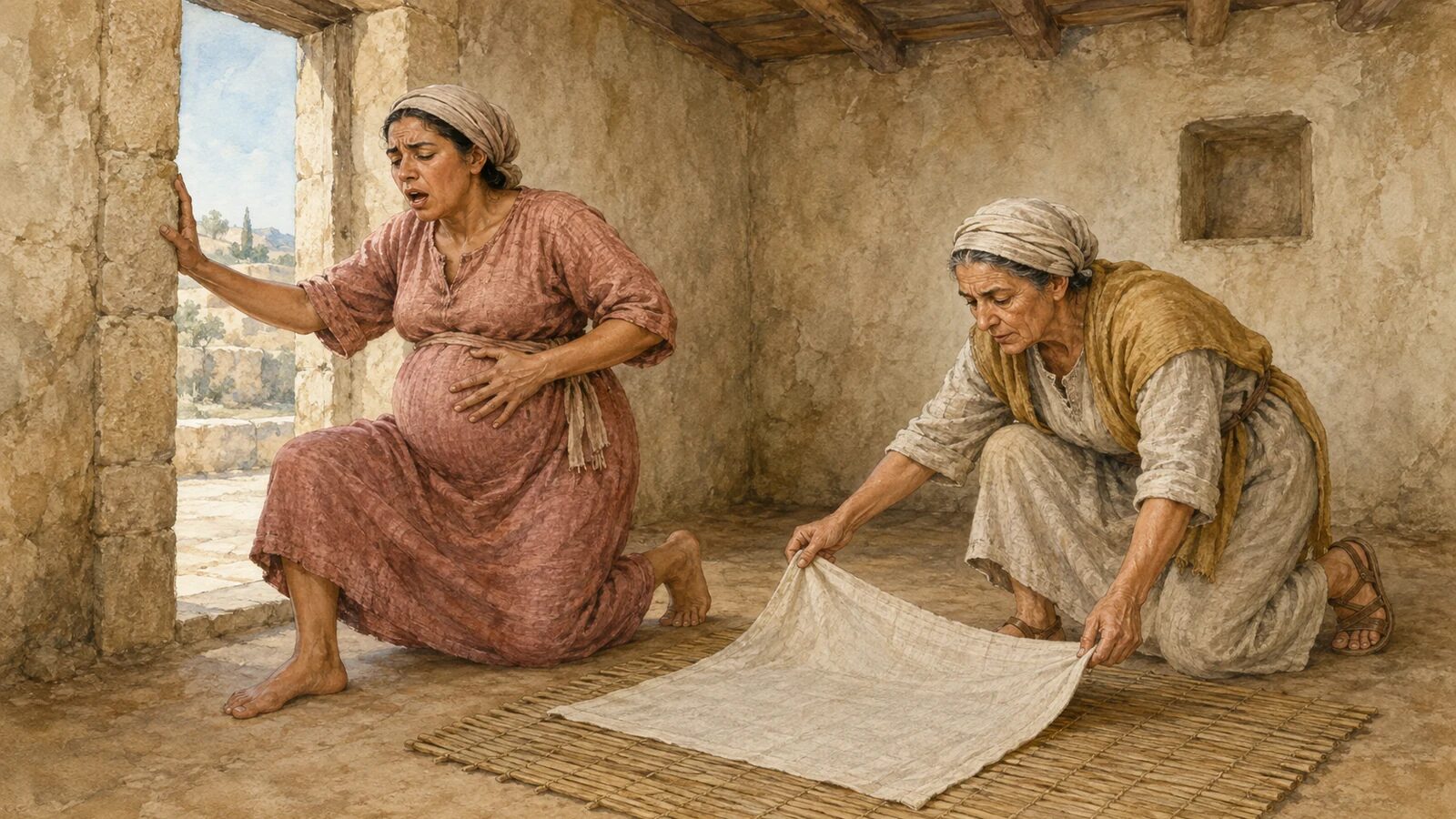
What did Jesus mean by the “beginning of sorrows”? He had just spoken about deception, war, hunger, disease, and earthquakes, but He also told His disciples not to panic or draw the wrong conclusion. I want to keep His words in their setting, because the full sequence is much clearer than the claims often built from the latest headline.
The Beginning of Sorrows in Jesus’ Discourse
Then Jesus went out and departed from the temple, and His disciples came up to show Him the buildings of the temple. And Jesus said to them, "Do you not see all these things? Assuredly, I say to you, not one stone shall be left here upon another, that shall not be thrown down." Now as He sat on the Mount of Olives, the disciples came to Him privately, saying, "Tell us, when will these things be? And what will be the sign of Your coming, and of the end of the age?" And Jesus answered and said to them: "Take heed that no one deceives you. For many will come in My name, saying, "I am the Christ,' and will deceive many. And you will hear of wars and rumors of wars. See that you are not troubled; for all these things must come to pass, but the end is not yet. For nation will rise against nation, and kingdom against kingdom. And there will be famines, pestilences, and earthquakes in various places. All these are the beginning of sorrows. "Then they will deliver you up to tribulation and kill you, and you will be hated by all nations for My name's sake. And then many will be offended, will betray one another, and will hate one another. Then many false prophets will rise up and deceive many. And because lawlessness will abound, the love of many will grow cold. But he who endures to the end shall be saved. And this gospel of the kingdom will be preached in all the world as a witness to all the nations, and then the end will come.
Jesus had just confronted Jerusalem’s unbelieving leaders and lamented over the city. As He left the temple, the disciples pointed out its buildings. He answered that not one stone would remain upon another. Rome’s destruction of Jerusalem in AD 70 fulfilled that prediction and gives the discourse a real first-century setting.
Yet Jesus’ answer reaches beyond AD 70. The disciples asked when the temple would fall, but they also asked about the sign of His coming and the end of the age. Later in the discourse, Jesus points to Daniel’s abomination of desolation and describes a time of unmatched tribulation. Cosmic signs then come before His visible return in power and glory. The fall of Jerusalem was a true historical judgment and a pattern, but it did not exhaust everything Jesus said.
Then as He went out of the temple, one of His disciples said to Him, "Teacher, see what manner of stones and what buildings are here!" And Jesus answered and said to him, "Do you see these great buildings? Not one stone shall be left upon another, that shall not be thrown down." Now as He sat on the Mount of Olives opposite the temple, Peter, James, John, and Andrew asked Him privately, "Tell us, when will these things be? And what will be the sign when all these things will be fulfilled?" And Jesus, answering them, began to say: "Take heed that no one deceives you. For many will come in My name, saying, "I am He,' and will deceive many. But when you hear of wars and rumors of wars, do not be troubled; for such things must happen, but the end is not yet. For nation will rise against nation, and kingdom against kingdom. And there will be earthquakes in various places, and there will be famines and troubles. These are the beginnings of sorrows. "But watch out for yourselves, for they will deliver you up to councils, and you will be beaten in the synagogues. You will be brought before rulers and kings for My sake, for a testimony to them. And the gospel must first be preached to all the nations. But when they arrest you and deliver you up, do not worry beforehand, or premeditate what you will speak. But whatever is given you in that hour, speak that; for it is not you who speak, but the Holy Spirit. Now brother will betray brother to death, and a father his child; and children will rise up against parents and cause them to be put to death. And you will be hated by all for My name's sake. But he who endures to the end shall be saved.
I find the slightly different wording in Mark and Luke helpful because it shows why every sentence should not be forced onto one date. The disciples naturally connected the ruin of the temple with the end, but Jesus answered without treating every subject as one event. Some warnings were needed by the first disciples and remain needed by believers in every age. Other details belong to a future crisis centered in Judea and reach their climax during the Tribulation.
This layered answer explains why part of the discourse fits first-century Jerusalem while other parts go far beyond it. Confining everything to AD 70 leaves the great Tribulation and visible return without their full fulfillment. On the other hand, transferring every sentence directly to the church ignores the Jewish setting and the concrete instructions Jesus gives. We must begin with the people and place Jesus names. The covenant background and His order of events then help us follow the meaning.
Then, as some spoke of the temple, how it was adorned with beautiful stones and donations, He said, "These things which you see–the days will come in which not one stone shall be left upon another that shall not be thrown down." So they asked Him, saying, "Teacher, but when will these things be? And what sign will there be when these things are about to take place?" And He said: "Take heed that you not be deceived. For many will come in My name, saying, "I am He,' and, "The time has drawn near.' Therefore do not go after them. But when you hear of wars and commotions, do not be terrified; for these things must come to pass first, but the end will not come immediately." Then He said to them, "Nation will rise against nation, and kingdom against kingdom. And there will be great earthquakes in various places, and famines and pestilences; and there will be fearful sights and great signs from heaven. But before all these things, they will lay their hands on you and persecute you, delivering you up to the synagogues and prisons. You will be brought before kings and rulers for My name's sake. But it will turn out for you as an occasion for testimony. Therefore settle it in your hearts not to meditate beforehand on what you will answer; for I will give you a mouth and wisdom which all your adversaries will not be able to contradict or resist. You will be betrayed even by parents and brothers, relatives and friends; and they will put some of you to death. And you will be hated by all for My name's sake. But not a hair of your head shall be lost. By your patience possess your souls.
The first thing Jesus emphasizes is deception. False claimants will come in His name, and some will announce that the time has drawn near. Jesus says plainly, “Do not go after them.” That warning should govern the way we study every prophetic sign. A teacher may build certainty from a headline or a political movement. Someone else may appeal to a dream or a private calculation. Prophetic excitement must not move any of those claims into the place that belongs to Christ’s own words.
He also says that wars and commotions must happen, but the end will not come immediately. War reveals the violence of a fallen world, yet no single conflict sets the date. “Nation against nation” and “kingdom against kingdom” describe broad conflict among peoples and political powers. The Greek word ethnos can refer to a nation, a people, or a Gentile population, but that range does not turn the verse into a narrow prediction about one modern social struggle.
Famines, pestilences, and earthquakes are equally real. Famine may follow war and displacement, and Scripture can also present it as judgment. Hunger should move us to care about people who suffer, not use their suffering to sell prophetic certainty. In the received Gospel text, Jesus also names pestilences among the sorrows. The Greek word loimos means plague or pestilence. No pandemic by itself proves that Daniel’s final seven years have begun, and no disease should become an excuse for rumor or careless medical claims.
Revelation 6 later describes grain becoming painfully expensive under the third seal. A denarius was a day’s wage, so the prices communicate severe scarcity in which basic food consumes what a worker earns. I would not force the modern label “hyperinflation” onto the verse. The passage speaks clearly enough without pretending that one present market report has already fulfilled it.
Pestilence also belongs to a creation that has been damaged by sin, and Scripture records times when God used disease in judgment. That does not make ordinary care for the sick unspiritual. Christians should neither mock serious illness nor treat each pathogen as a coded prophecy. Jesus prepares sober hearers who recognize the limits of this fallen world while refusing speculation that outruns the text.
Earthquakes remind us how little control human beings have over the ground beneath them. Still, Matthew 24 does not rest upon a graph claiming that global earthquakes must steadily increase through the church age. Such comparisons require careful definitions and must account for better detection. Christ’s prophecy does not become stronger when data are exaggerated, and it does not become weaker if a popular chart is disputed.
Jesus calls this entire cluster “the beginning of sorrows.” The Greek word is odin, meaning the pain of labor or childbirth. Matthew and Mark use the form odinon in the phrase translated “beginning of sorrows.” The image describes painful travail moving toward an appointed outcome. These events are not the birth itself, and they are not a random pile of troubles. They begin a sequence whose outcome is certain because Christ will complete it.
I think we need to be careful not to demand more from the picture than Jesus gives. Labor pains are urgent because the suffering is real. They also move toward an outcome that will arrive. The verse does not state a mathematical rule requiring every kind of trouble to rise at a measurable rate through every century. Jesus Himself supplies the sequence, and He explicitly tells His hearers that the end is not yet.
I do not think we should overlook that last statement. The wars and disasters are not harmless, but Jesus does not want His disciples to interpret their seriousness as proof that the final moment has arrived. The beginning has a real place in the prophetic order. It prepares the way for what follows without allowing us to collapse the whole prophecy into its opening events.
What the Prophets Show Us About Labor Pains
Wail, for the day of the LORD is at hand! It will come as destruction from the Almighty. Therefore all hands will be limp, Every man's heart will melt, And they will be afraid. Pangs and sorrows will take hold of them; They will be in pain as a woman in childbirth; They will be amazed at one another; Their faces will be like flames. Behold, the day of the LORD comes, Cruel, with both wrath and fierce anger, To lay the land desolate; And He will destroy its sinners from it. For the stars of heaven and their constellations Will not give their light; The sun will be darkened in its going forth, And the moon will not cause its light to shine. "I will punish the world for its evil, And the wicked for their iniquity; I will halt the arrogance of the proud, And will lay low the haughtiness of the terrible. I will make a mortal more rare than fine gold, A man more than the golden wedge of Ophir. Therefore I will shake the heavens, And the earth will move out of her place, In the wrath of the LORD of hosts And in the day of His fierce anger.
Isaiah’s oracle names Babylon and warns of destruction from the Almighty. People lose their strength, and pangs seize them like a woman in childbirth. The historical judgment upon a proud empire is real, but the language widens toward the punishment of the world. The lights of heaven grow dark, and the heavens and earth are shaken.
This background gives Jesus’ words greater weight. In prophecy, labor pains can describe helpless terror as divine judgment arrives. They do not mean that suffering saves everyone who experiences it. Isaiah also shows how prophecy can hold a near judgment and a final horizon together. Babylon’s fall displays God’s rule within history, while the cosmic scope points toward the climactic Day of the LORD.
Now these are the words that the LORD spoke concerning Israel and Judah. "For thus says the LORD: "We have heard a voice of trembling, Of fear, and not of peace. Ask now, and see, Whether a man is ever in labor with child? So why do I see every man with his hands on his loins Like a woman in labor, And all faces turned pale? Alas! For that day is great, So that none is like it; And it is the time of Jacob's trouble, But he shall be saved out of it. "For it shall come to pass in that day,' Says the LORD of hosts, "That I will break his yoke from your neck, And will burst your bonds; Foreigners shall no more enslave them. But they shall serve the LORD their God, And David their king, Whom I will raise up for them. "Therefore do not fear, O My servant Jacob,' says the LORD, "Nor be dismayed, O Israel; For behold, I will save you from afar, And your seed from the land of their captivity. Jacob shall return, have rest and be quiet, And no one shall make him afraid. For I am with you,' says the LORD, "to save you; Though I make a full end of all nations where I have scattered you, Yet I will not make a complete end of you. But I will correct you in justice, And will not let you go altogether unpunished.'
Jeremiah connects the same image with the “time of Jacob’s trouble.” Men hold their sides like women in labor, and their faces turn pale. Yet the passage does not end with terror. God promises that Jacob will be saved out of that trouble, that the foreign yoke will be broken, and that Israel will serve the LORD and David their king.
I understand this as a future deliverance that fits the Tribulation and Messiah’s kingdom. God has not discarded Israel, nor has He transferred every national promise into an undefined symbol for the church. The distress is severe, but God’s covenant faithfulness controls the outcome. He sets the boundary of the trouble and preserves His people through it. The promised Davidic King will then rule over them.
Now why do you cry aloud? Is there no king in your midst? Has your counselor perished? For pangs have seized you like a woman in labor. Be in pain, and labor to bring forth, O daughter of Zion, Like a woman in birth pangs. For now you shall go forth from the city, You shall dwell in the field, And to Babylon you shall go. There you shall be delivered; There the LORD will redeem you From the hand of your enemies. Now also many nations have gathered against you, Who say, "Let her be defiled, And let our eye look upon Zion." But they do not know the thoughts of the LORD, Nor do they understand His counsel; For He will gather them like sheaves to the threshing floor. "Arise and thresh, O daughter of Zion; For I will make your horn iron, And I will make your hooves bronze; You shall beat in pieces many peoples; I will consecrate their gain to the LORD, And their substance to the Lord of the whole earth."
Micah begins with Zion’s pain and exile. Jerusalem will go to Babylon, where the LORD will redeem her. The prophet then looks beyond that crisis to nations gathered against Zion and to God’s purpose in judging those hostile powers. Pain comes before redemption and kingdom victory, but Zion does not produce the kingdom by the power of her own suffering. The LORD acts to redeem and rule.
This keeps us from turning labor language into a cheerful promise that every cultural crisis will automatically produce a better society. Biblical hope rests in God’s covenant action and Messiah’s reign. The prophets use the picture because judgment is painful and unavoidable, while deliverance remains in the Lord’s hands.
For I consider that the sufferings of this present time are not worthy to be compared with the glory which shall be revealed in us. For the earnest expectation of the creation eagerly waits for the revealing of the sons of God. For the creation was subjected to futility, not willingly, but because of Him who subjected it in hope; because the creation itself also will be delivered from the bondage of corruption into the glorious liberty of the children of God. For we know that the whole creation groans and labors with birth pangs together until now. Not only that, but we also who have the firstfruits of the Spirit, even we ourselves groan within ourselves, eagerly waiting for the adoption, the redemption of our body. For we were saved in this hope, but hope that is seen is not hope; for why does one still hope for what he sees? But if we hope for what we do not see, we eagerly wait for it with perseverance.
Romans 8 uses related language for the whole creation. Creation was subjected to futility because of human sin, and it has groaned under corruption since the curse. Believers also groan while waiting for the redemption of the body. The hope in this passage is resurrection and a liberated creation, not escape into a permanently disembodied existence.
Romans 8 and Matthew 24 belong to the same large biblical story, but they do not describe the same chronological beginning. Creation’s groaning did not start at Christ’s ascension. Paul looks across the long suffering of the fallen creation toward bodily redemption, while Jesus uses birth pains for the opening of an end-time sequence. We should let the shared picture connect the passages without making their timing identical.
Isaiah, Jeremiah, Micah, and Romans help us hear the image as Jesus’ disciples would have heard it. Labor points to real suffering rather than a painless transition, but it also looks beyond that suffering because God has already appointed what will follow. Proud powers will face judgment, while Israel will be delivered according to covenant promise. Creation itself will also be freed from corruption. These truths belong together, though each passage makes its own distinct contribution.
From the Early Sorrows to Great Tribulation
The discourse does not stop with disasters. Jesus next warns that His followers will be persecuted and that some will betray one another. False prophets will rise as lawlessness grows. Christians already face hatred in this world, and faithful discipleship has always carried a cost. The passage also looks ahead to intensified persecution during the Tribulation, so we should distinguish those two settings without denying either one.
When Jesus says that the person who endures to the end will be saved, He is not teaching that eternal life is earned by personal stamina. Salvation is God’s gift through faith in Christ. Endurance shows genuine allegiance when faith is pressed, and in this prophetic setting the words also speak of deliverance through the appointed period.
The gospel of the kingdom will be preached throughout the world as a witness to the nations before the end comes. This is not a second way of salvation. It is the good news centered upon the same King, Jesus Christ, with special attention to His promised rule. Sinners are saved by God’s grace through repentance and faith in Christ, never by works or by surviving a prophetic crisis.
The phrase also keeps the coming kingdom in view. Jesus is not only warning that trouble will deepen. He is announcing that the rightful King will return and rule. The witness reaches the nations even when many oppose it, so human resistance cannot prevent God from completing His purpose.
The church should proclaim Christ now, and Revelation shows that God will preserve witnesses during the Tribulation. The gathering of the church will not leave God without servants, and even the darkest period cannot silence His Word. Modern travel and communication can spread teaching widely, but no internet counter can tell us when this witness has fulfilled God’s purpose.
"Seventy weeks are determined For your people and for your holy city, To finish the transgression, To make an end of sins, To make reconciliation for iniquity, To bring in everlasting righteousness, To seal up vision and prophecy, And to anoint the Most Holy. "Know therefore and understand, That from the going forth of the command To restore and build Jerusalem Until Messiah the Prince, There shall be seven weeks and sixty-two weeks; The street shall be built again, and the wall, Even in troublesome times. "And after the sixty-two weeks Messiah shall be cut off, but not for Himself; And the people of the prince who is to come Shall destroy the city and the sanctuary. The end of it shall be with a flood, And till the end of the war desolations are determined. Then he shall confirm a covenant with many for one week; But in the middle of the week He shall bring an end to sacrifice and offering. And on the wing of abominations shall be one who makes desolate, Even until the consummation, which is determined, Is poured out on the desolate."
Daniel’s seventy weeks concern his people and his holy city. The final week includes a covenant confirmed for one week, and in its middle sacrifice is stopped as an abomination brings desolation. Jesus sends the reader back to Daniel and treats this as a decisive sign. This is the clear turning point in the discourse, not a modern war, earthquake, or disease.
When the abomination stands in the holy place, people in Judea must flee at once. A person on a rooftop must not go back for belongings, and someone in a field must not return for clothing. Jesus shows special concern for pregnant and nursing women, then tells His hearers to pray that the flight will not happen in winter or on a Sabbath. These concrete details describe a real geographic crisis. They cannot be reduced to a general picture of religious decline.
The command to flee is urgent because this event opens the period Jesus calls great Tribulation. He does not tell those in Judea to go back for clothing or possessions. The warning is practical and immediate. It also confirms that the “beginning of sorrows” is not the end of the sequence, because Jesus identifies a later sign that changes the situation in a decisive way.
2 Thessalonians 2 connects the final rebellion with the man of sin exalting himself in the temple of God. Taken together, the passages identify a future Antichrist who will profane the temple. His action creates the midpoint crisis in a literal seven-year Tribulation.
"Therefore when you see the "abomination of desolation,' spoken of by Daniel the prophet, standing in the holy place" (whoever reads, let him understand), "then let those who are in Judea flee to the mountains. Let him who is on the housetop not go down to take anything out of his house. And let him who is in the field not go back to get his clothes. But woe to those who are pregnant and to those who are nursing babies in those days! And pray that your flight may not be in winter or on the Sabbath. For then there will be great tribulation, such as has not been since the beginning of the world until this time, no, nor ever shall be. And unless those days were shortened, no flesh would be saved; but for the elect's sake those days will be shortened. "Then if anyone says to you, "Look, here is the Christ!' or "There!' do not believe it. For false christs and false prophets will rise and show great signs and wonders to deceive, if possible, even the elect. See, I have told you beforehand. "Therefore if they say to you, "Look, He is in the desert!' do not go out; or "Look, He is in the inner rooms!' do not believe it. For as the lightning comes from the east and flashes to the west, so also will the coming of the Son of Man be. For wherever the carcass is, there the eagles will be gathered together. "Immediately after the tribulation of those days the sun will be darkened, and the moon will not give its light; the stars will fall from heaven, and the powers of the heavens will be shaken. Then the sign of the Son of Man will appear in heaven, and then all the tribes of the earth will mourn, and they will see the Son of Man coming on the clouds of heaven with power and great glory. And He will send His angels with a great sound of a trumpet, and they will gather together His elect from the four winds, from one end of heaven to the other.
Jesus calls what follows “great tribulation.” The Greek phrase thlipsis megale speaks of unmatched distress, yet even this evil is not sovereign. God shortens the days for the sake of the elect and fixes the boundary of the suffering.
False christs and false prophets will display great signs and wonders. Spectacle is therefore never enough to prove that a spiritual claim is true. Jesus warns His hearers not to follow reports of a hidden Christ in the desert or an inner room. His real return will not need secret promotion. After the Tribulation, the heavens are shaken and the Son of Man comes visibly and bodily with power and great glory. He returns as the rightful King and will establish His literal thousand-year reign.
The Seals, the Gathering, and the Day of the Lord
Now I saw when the Lamb opened one of the seals; and I heard one of the four living creatures saying with a voice like thunder, "Come and see." And I looked, and behold, a white horse. He who sat on it had a bow; and a crown was given to him, and he went out conquering and to conquer. When He opened the second seal, I heard the second living creature saying, "Come and see." Another horse, fiery red, went out. And it was granted to the one who sat on it to take peace from the earth, and that people should kill one another; and there was given to him a great sword. When He opened the third seal, I heard the third living creature say, "Come and see." So I looked, and behold, a black horse, and he who sat on it had a pair of scales in his hand. And I heard a voice in the midst of the four living creatures saying, "A quart of wheat for a denarius, and three quarts of barley for a denarius; and do not harm the oil and the wine." When He opened the fourth seal, I heard the voice of the fourth living creature saying, "Come and see." So I looked, and behold, a pale horse. And the name of him who sat on it was Death, and Hades followed with him. And power was given to them over a fourth of the earth, to kill with sword, with hunger, with death, and by the beasts of the earth.
Revelation gives us an ordered series of Tribulation judgments, and the Lamb Himself opens every seal. The first rider goes out to conquer. The second removes peace, and severe scarcity comes with the third. Death then follows under the fourth seal. I understand these as future judgments, not merely a symbolic cycle that was exhausted by ordinary history.
I understand the rider on the white horse as a deceptive conqueror connected with the rise of Antichrist, not as Jesus. The Lamb is already the One opening the seal, while the rider belongs to the same series that leads into war, scarcity, and death. The rider carries a bow and receives a crown. His conquest first appears different from the open bloodshed brought by the rider on the red horse, but it is still domination.
The sequence also explains why the beginning of sorrows is more than vague bad news. Matthew 24 and Revelation both open with deception and conflict. Scarcity follows, while pestilence and other means contribute to widespread death. Persecution unfolds within a period ordered by divine judgment. The riders never operate outside God’s authority, because the Lamb opens each seal and limits what follows.
But I do not want you to be ignorant, brethren, concerning those who have fallen asleep, lest you sorrow as others who have no hope. For if we believe that Jesus died and rose again, even so God will bring with Him those who sleep in Jesus. For this we say to you by the word of the Lord, that we who are alive and remain until the coming of the Lord will by no means precede those who are asleep. For the Lord Himself will descend from heaven with a shout, with the voice of an archangel, and with the trumpet of God. And the dead in Christ will rise first. Then we who are alive and remain shall be caught up together with them in the clouds to meet the Lord in the air. And thus we shall always be with the Lord. Therefore comfort one another with these words.
Paul comforts grieving Christians with the promise of resurrection and gathering. When the Lord descends, the dead in Christ rise first. Believers who are still alive are then caught up with them to meet Him in the air. From that moment on, everyone who belongs to Christ will always be with Him.
I believe this gathering happens before Daniel’s final seven-year period. Christians can suffer persecution and severe pressure in the present world, but the church is not appointed to the coming wrath. Present suffering must not be confused with that appointed period of judgment.
Matthew 24’s public appearing after the Tribulation has a different setting and emphasis. The same Jesus fulfills both promises in their proper order. He first gathers His church. Later He appears publicly, judges rebellion, delivers Israel, and establishes His kingdom.
But concerning the times and the seasons, brethren, you have no need that I should write to you. For you yourselves know perfectly that the day of the Lord so comes as a thief in the night. For when they say, "Peace and safety!" then sudden destruction comes upon them, as labor pains upon a pregnant woman. And they shall not escape. But you, brethren, are not in darkness, so that this Day should overtake you as a thief. You are all sons of light and sons of the day. We are not of the night nor of darkness. Therefore let us not sleep, as others do, but let us watch and be sober. For those who sleep, sleep at night, and those who get drunk are drunk at night. But let us who are of the day be sober, putting on the breastplate of faith and love, and as a helmet the hope of salvation. For God did not appoint us to wrath, but to obtain salvation through our Lord Jesus Christ, who died for us, that whether we wake or sleep, we should live together with Him. Therefore comfort each other and edify one another, just as you also are doing.
Paul moves from the gathering in chapter 4 to the Day of the Lord in chapter 5. He discusses times and seasons without giving a date. Those saying “Peace and safety” will meet sudden destruction like labor pains upon a pregnant woman, and they will not escape.
Then Paul draws a contrast between “they” and “you.” Believers are children of light. They are not in darkness for that Day to seize them as a thief, and God did not appoint them to wrath. Our salvation rests in Jesus Christ, who died for us so that we will live together with Him.
This hope calls for sobriety, not laziness. An awake church continues in faith and love while holding firmly to the hope of salvation. Believers comfort one another, pursue holiness, and keep bearing witness. Pre-Tribulation hope should make us faithful in the work Christ has already given us.
Notice that Paul gives these promises for comfort and mutual encouragement. He does not use the rapture to make believers careless about grief, suffering, or daily obedience. Resurrection means that death will not separate Christians from Christ or from one another forever. Freedom from the coming wrath gives us reason to live as children of the day right now.
Watching Without Panic or Speculation
Jesus does not command His people to stare anxiously at every headline. I understand watchfulness as loyal attention to the returning Lord, beginning with testing doctrine against Scripture. It also means depending upon God in prayer and continuing to serve alongside other believers. We do not have to deny the seriousness of world events, but neither should we surrender our discernment to fear.
Date-setting contradicts that posture. Recognizing the prophetic sequence is not the same as claiming to know the day or hour. Jesus does not say the birth pains began at His ascension, that every war makes the end immediate, or that earthquake counts must follow a measurable upward curve throughout the church age. He does not define ethnos as one modern conflict. Revelation’s costly grain should not be reduced to a single economic diagnosis, and worldwide witness cannot be timed with a website statistic.
We should also refuse the opposite mistake. Because careless claims have been made, some people dismiss prophecy or treat Christ’s warnings as empty symbols. Jesus did not speak this way. These events have meaning, and their sequence has an appointed end. Christ’s future return will be bodily and public. Discernment means staying within what Scripture says, not explaining away what makes us uncomfortable.
I find that careful limits protect our confidence instead of weakening prophecy. Christ’s actual words still warn that deception will come and the sorrows will begin. Daniel’s abomination then marks the decisive crisis, followed by great Tribulation and, at the end, the glorious return of the Son of Man. We do not need unstable claims to make those promises certain.
The returning King first came to save. Jesus is the eternal Son, fully God and fully man. He was born of a virgin and lived without sin. Wicked men physically tortured and killed Him, yet He willingly bore that real punishment for our sins in His innocent body. He shed His blood and died before being buried and rising bodily. The Father did not punish or curse Jesus, nor did He abandon His Son. He did not strike, bruise, or pour wrath upon Him.
Christ died for the whole world, and people can resist and finally reject God’s genuine offer. Everyone who repents and believes is forgiven and justified, which means declared righteous before God. That person is born again, indwelt and sealed by the Holy Spirit, and eternally secure in Christ. Eternal security never makes lawlessness harmless, and a superficial profession is not proof of new birth.
Prophecy knowledge cannot save anyone. Our refuge from coming judgment is Jesus Christ. His bodily resurrection assures us that He will gather His church as promised, and He will return publicly to judge evil and reign. The right response is not panic or secret preparation. We should come to Christ and keep His gospel clear. As we wait, we can care for people who suffer while continuing the responsibilities God has given us.
A stockpile cannot regenerate the heart, and no political plan can stop the Day of the Lord. Looking for a hidden code cannot replace Scripture either, because readiness begins with trusting Christ. From there, the faithful servant keeps doing the Master’s work instead of letting fear or prediction take over his life.
For a closer look at connected passages, see the studies on Matthew 24-25, The Pre-Tribulation Rapture, and The Day of the Lord.
My Final Thoughts
After following Jesus’ words through the prophets and the apostles, I do not believe the beginning of sorrows gives us permission to turn each disaster into a countdown. The labor pains begin an ordered sequence that moves through Daniel’s abomination and great Tribulation to Christ’s visible return. The church’s hope is to be gathered to Him before that period of wrath. This should make us watchful without making us fearful, because the future rests in the hands of the same Savior who shed His blood and rose for us. As we wait, I want us to trust His Word, proclaim His gospel, and help those who suffer. We can remain faithful because He will come exactly as He promised.